
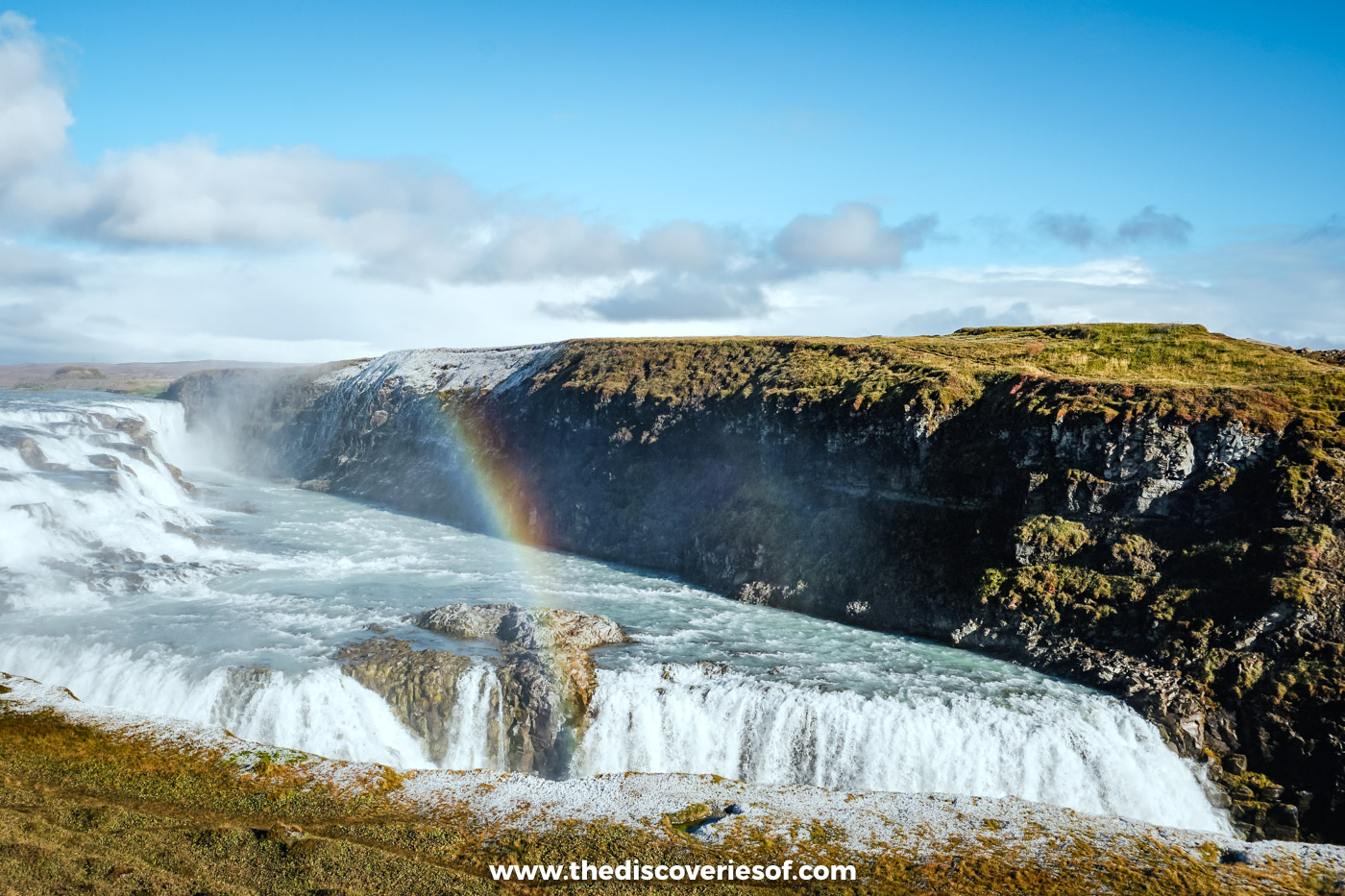

Gullfoss waterfall is one of Iceland’s most famous falls, which is a tough call in a country that’s pretty much packed with them. It’s the grand finale of the Golden Circle and a must-see on any Icelandic itinerary. Here’s why, plus everything you need to plan your visit, from the two viewing paths and the free parking to the paths that close in winter.
OK dudes. My first trip to Iceland pretty much blew my mind. Where else can you go where you can see golden waterfalls, black sand beaches, mossy landscapes, glaciers and geysers all in the course of one day?
One of the real highlights was taking a peek at Gullfoss. It’s a place that had been on my travel bucket list for a long, long time, and Iceland’s waterfalls have to be seen to be believed. Millions of litres of water thundering into the abyss in a striking setting: it was always going to be a winner, right?
I’ve now been twice. The first time was at the end of a guided day around the Golden Circle in early May, when the falls were grey, wintry and moody. The second was a sunny afternoon in late September, when the spray was full of rainbows. Same waterfall, two completely different experiences.
If you’re visiting Iceland, there’s no doubt that Gullfoss is going to be on your itinerary. Here’s what you need to know.
Why Gullfoss waterfall is worth the drive
Gullfoss sits on the Golden Circle, a loop that is brimming with spectacular natural sights that even give the falls a run for their money. Sure, the Golden Circle is crowded and the chances of you getting any of its sights to yourself are slim to none, but it’s so very worth it.
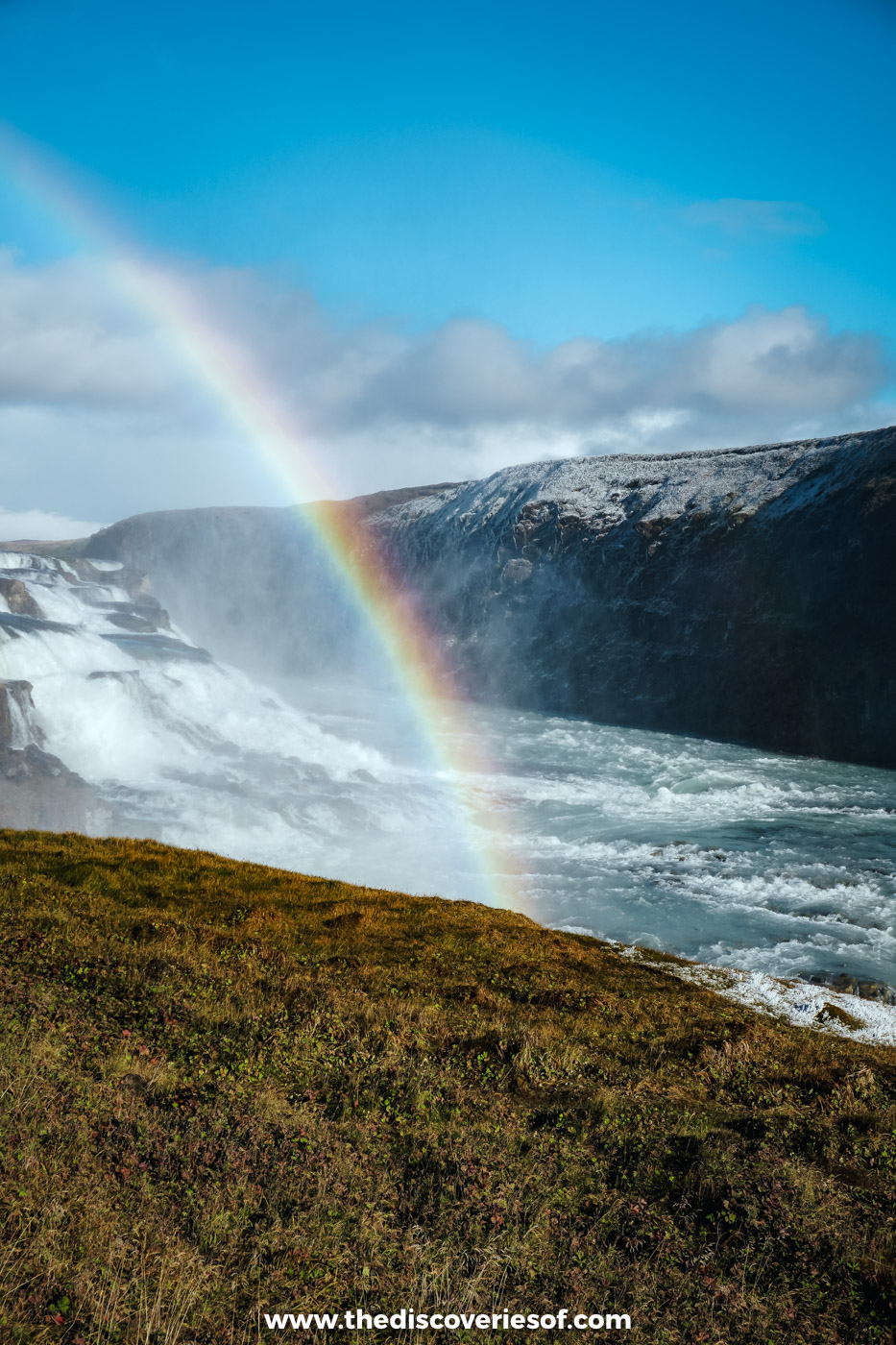
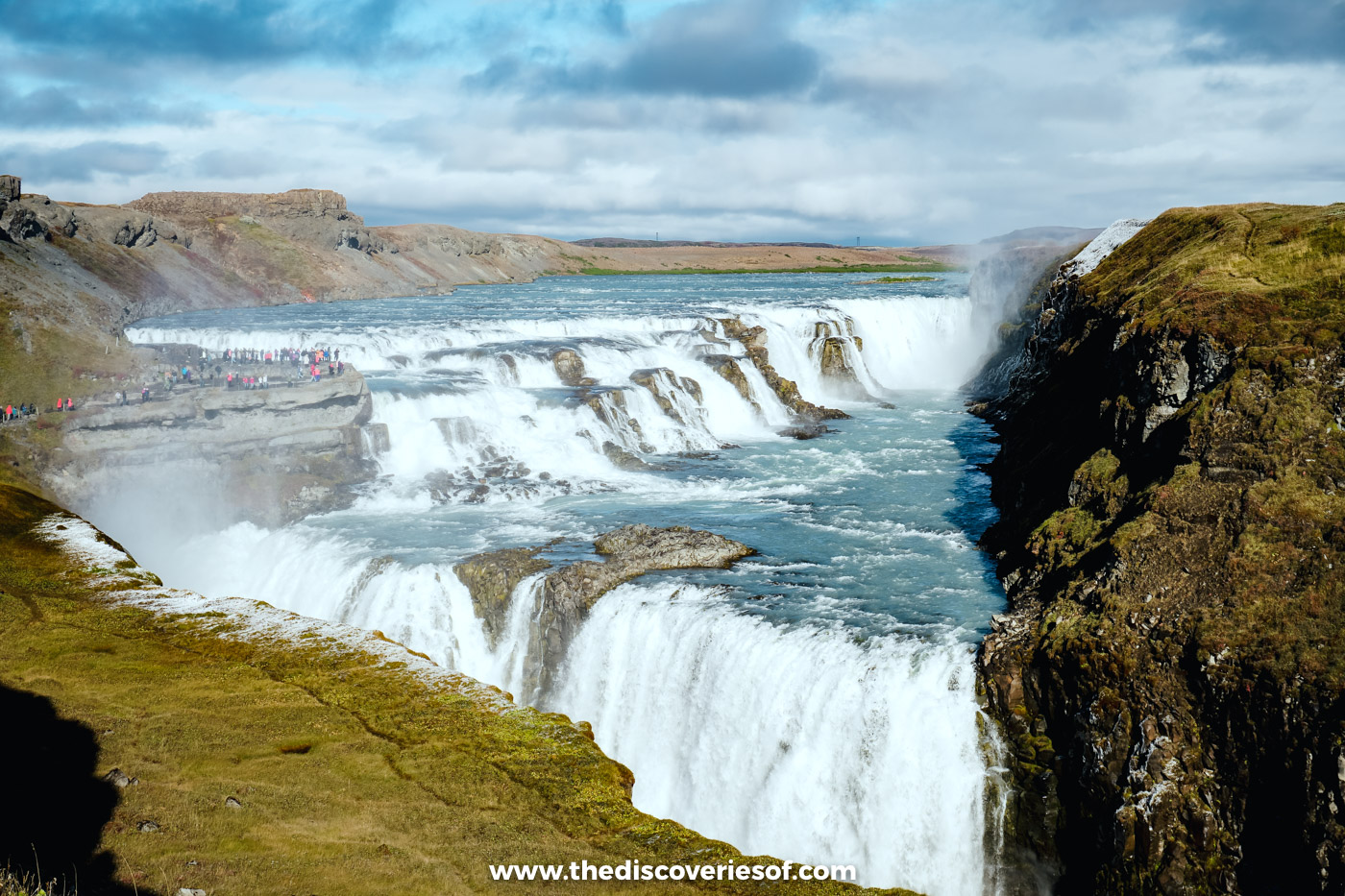
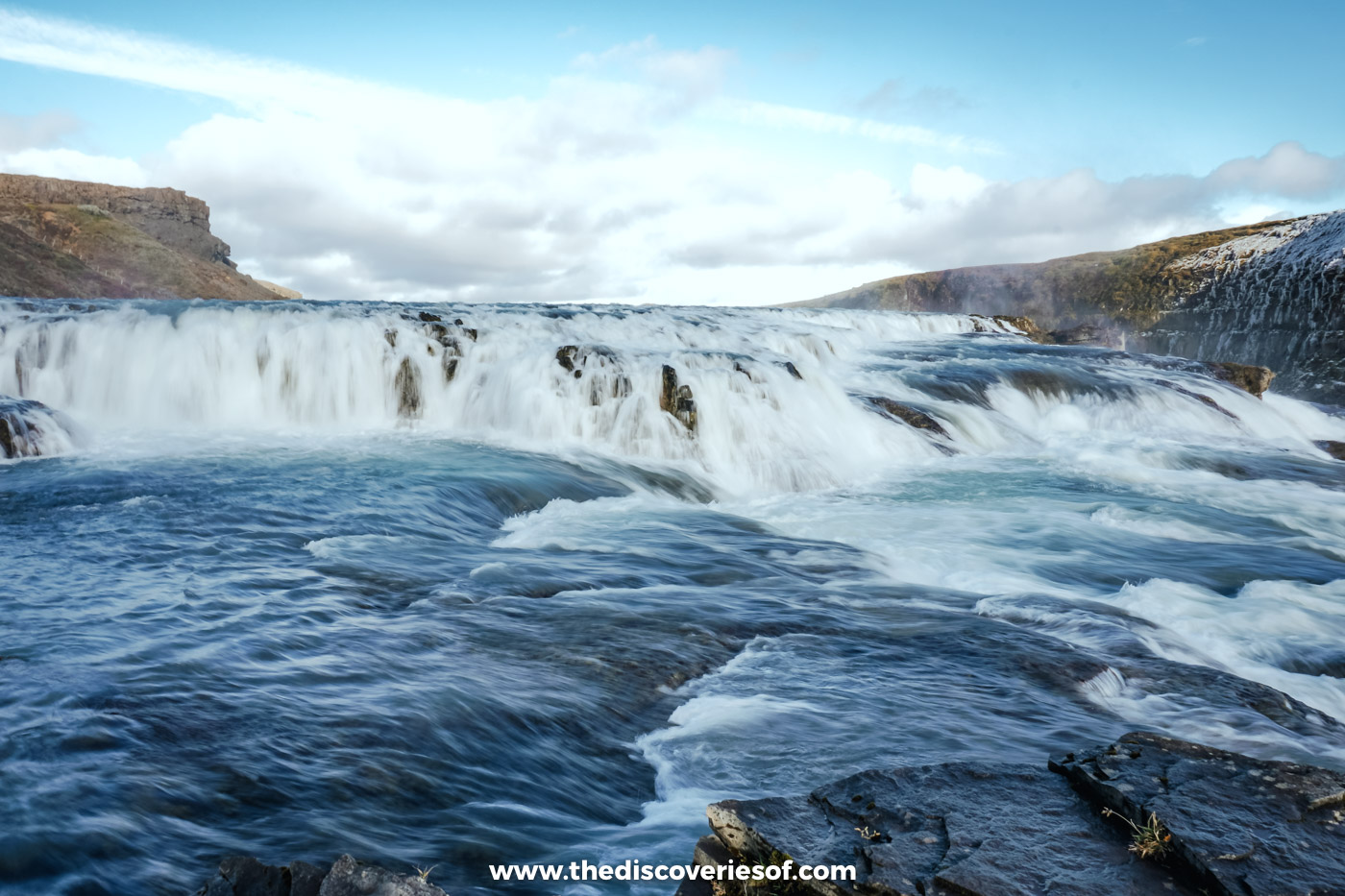
Here’s what makes this one special. The glacial river Hvítá, which flows down from the lake Hvítárvatn at the foot of the Langjökull ice cap, swings round a sharp bend, tumbles down a wide, curving staircase and then drops in two steps: first about 11 metres, then about 21 metres, for 32 metres in all. At the bottom it plunges sideways into a narrow crevice and roars away down a canyon about 2.5 kilometres long, with walls up to 70 metres high.
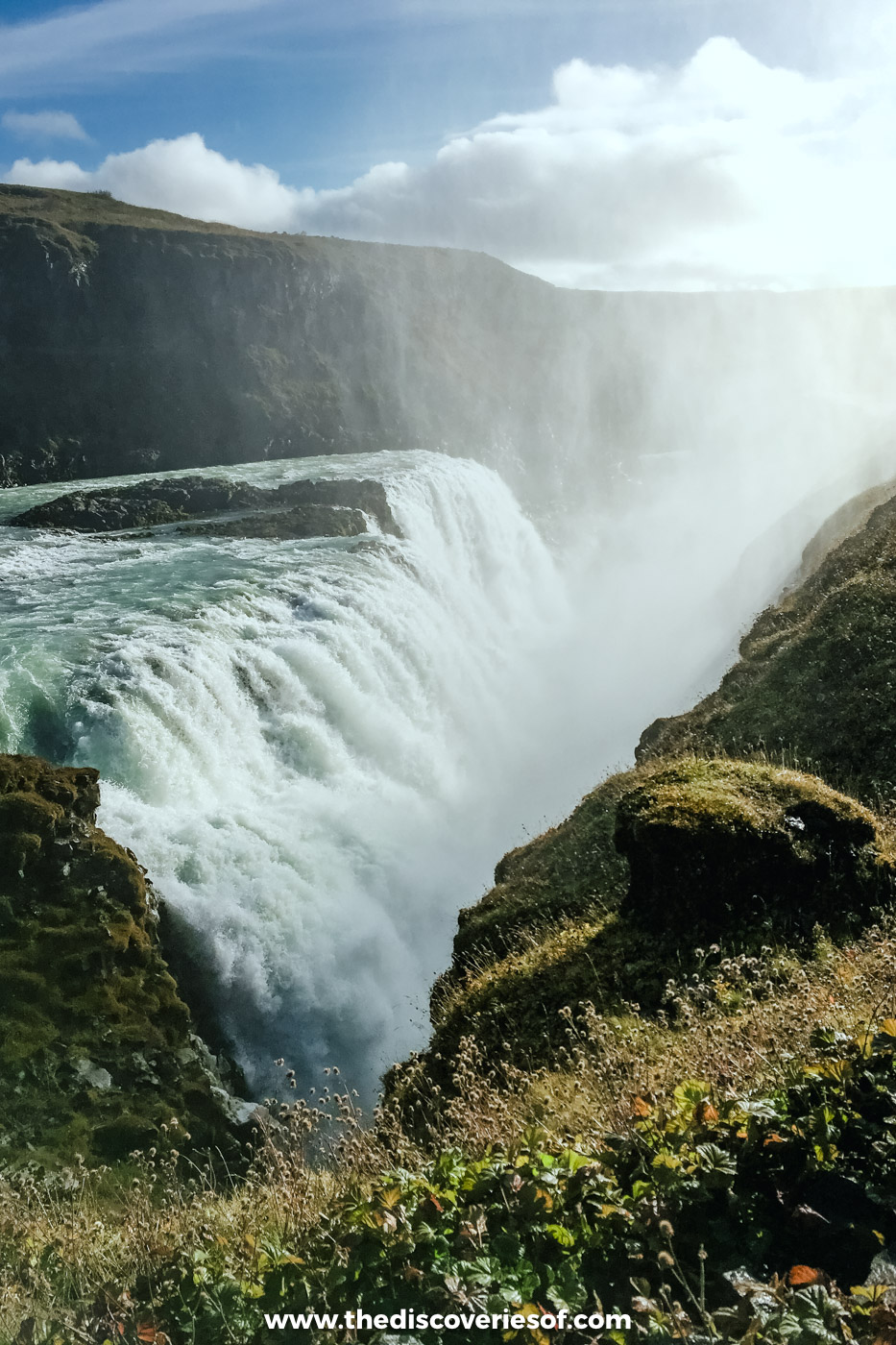
It’s not the tallest waterfall in Iceland by a long way. What it has is power. On average around 109 cubic metres of water pour over the edge every second, rising to about 130 in summer as the glacier melts, and the biggest floods on record have topped 2,000. That’s millions of litres every minute. You’d have to have a heart of stone not to be moved by it.
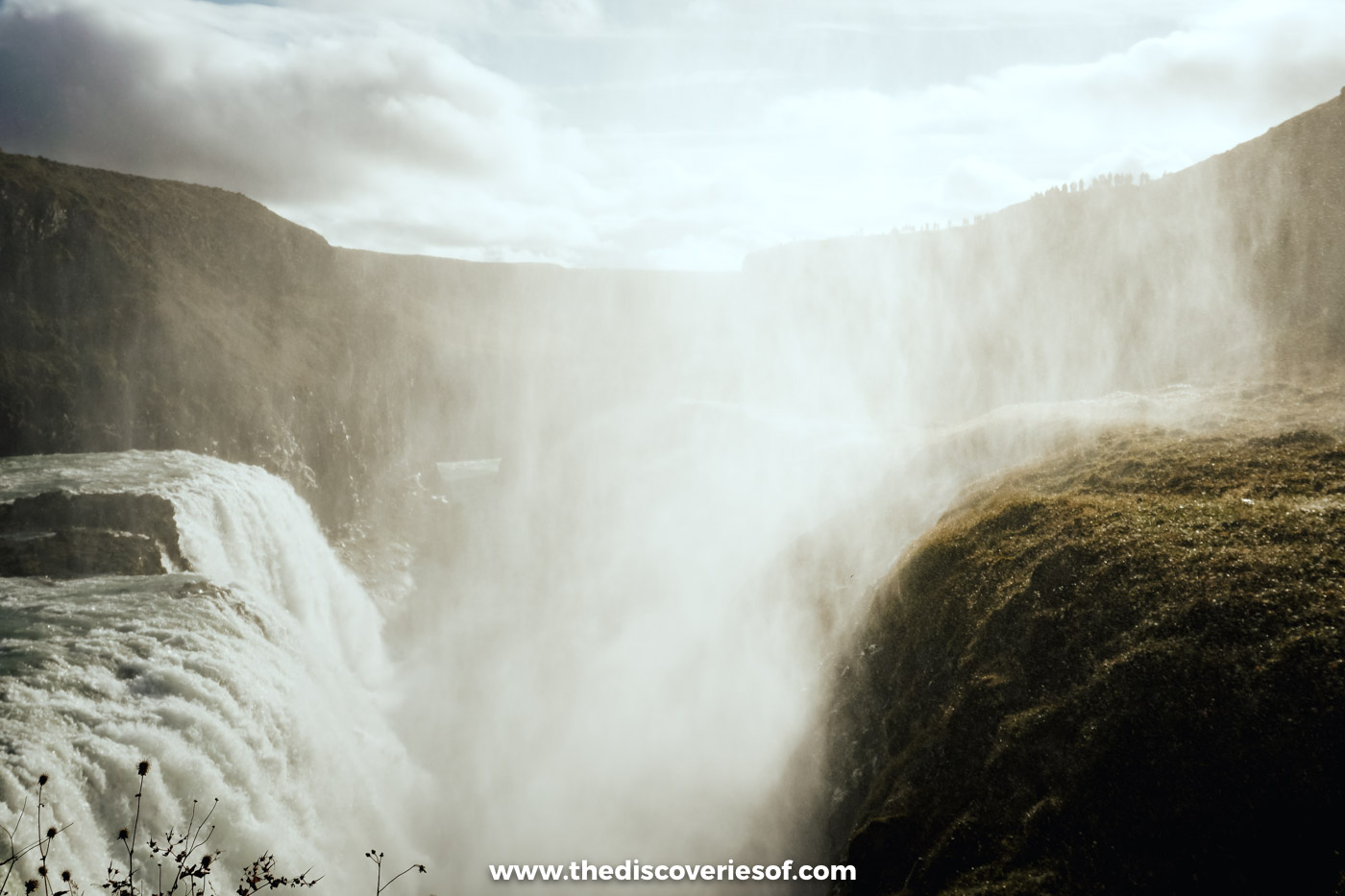
Photos and videos really don’t do it justice. What they can’t capture is the noise, a deep and constant roar, and the way the spray hangs in the canyon so that you can never quite see where the water lands.
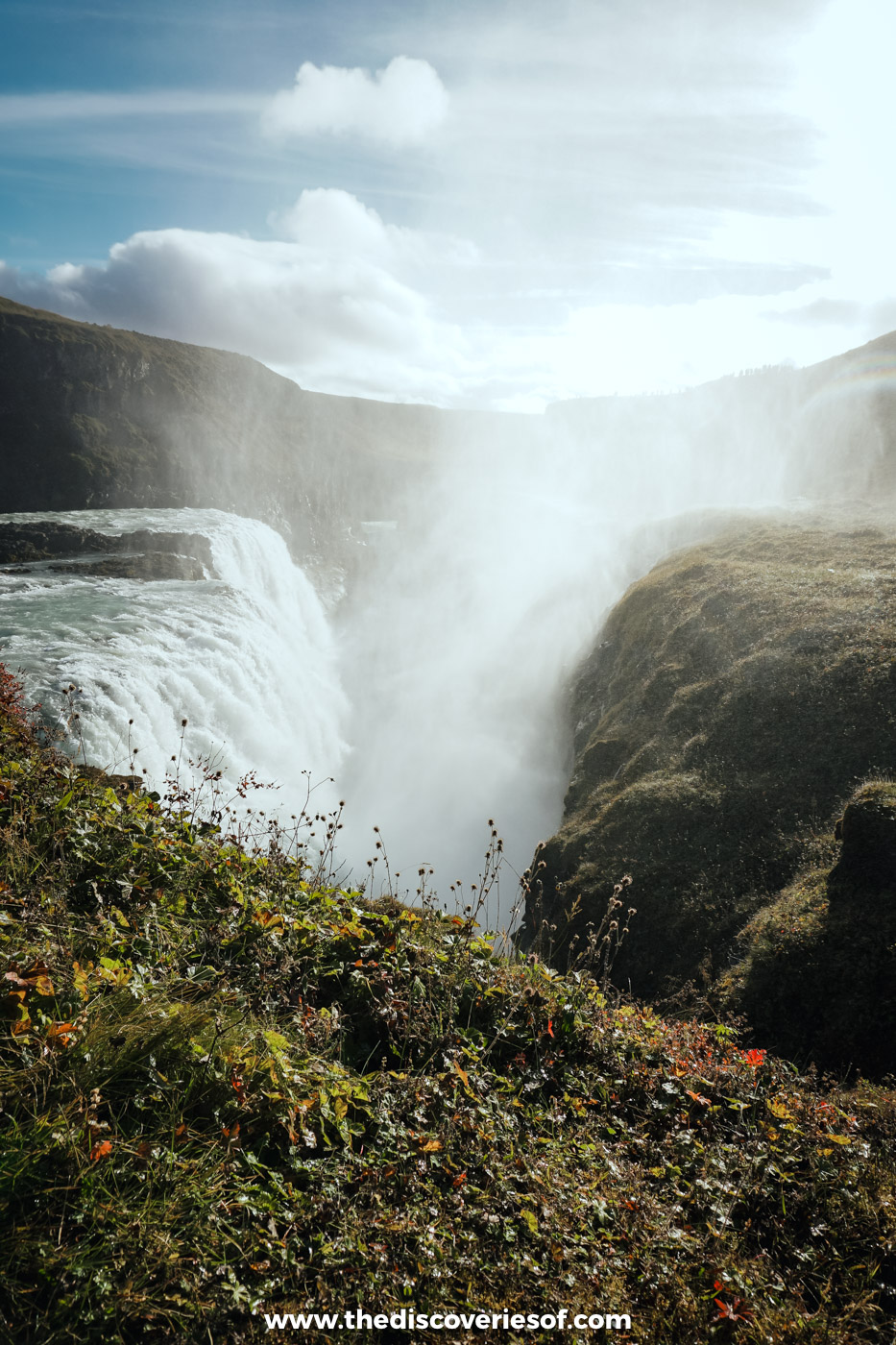
The atmosphere is only enhanced by the layer of mist that cloaks the scenery on a cold day. Watch out, though: that mist will suck the soul out of your camera in seconds. Keep a cloth in your pocket and wipe your lens between every shot.
It’s not only one of Iceland’s most famous falls, but also one of its most legendary. If you only do one thing in Iceland outside of visiting Reykjavik, this should be it.
Why is it called the golden falls?
Gullfoss translates as “golden waterfall”, and there’s a good reason for that.
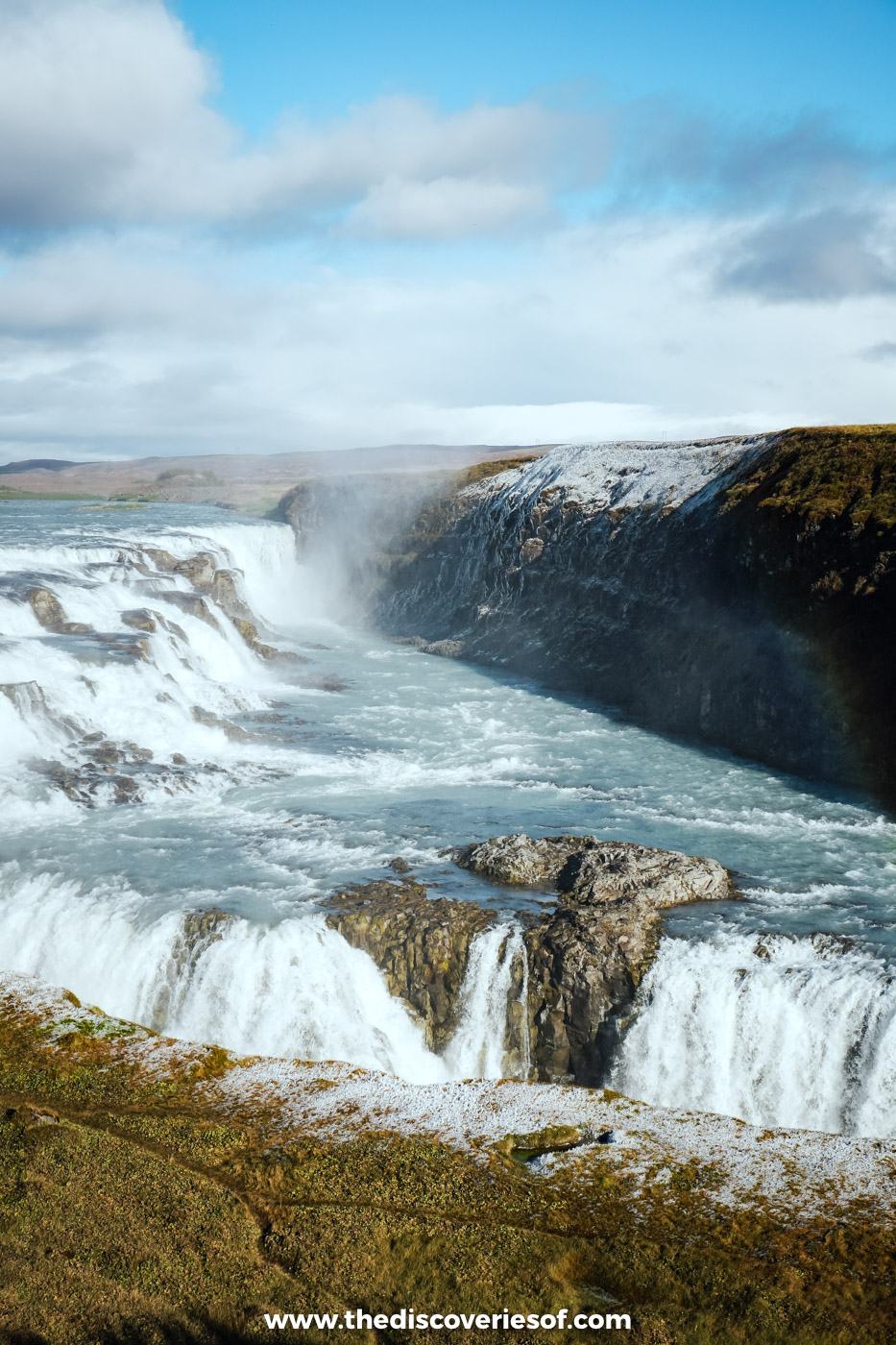
When the light hits the water on a sunny day, it reveals a beautiful golden tint. But why?
The Hvítá carries plenty of sediment, ground out of the rock by the glacier upstream. It’s this fine, pale silt that catches the sunlight and gives the falls their golden glow. On a grey day it simply looks white and wild, which is exactly how I first saw it.
Two visits, two very different waterfalls
One of the best things about these falls is how much it changes with the weather and the seasons. Here’s how my two visits compared.
Early May: grey skies and late-winter colours
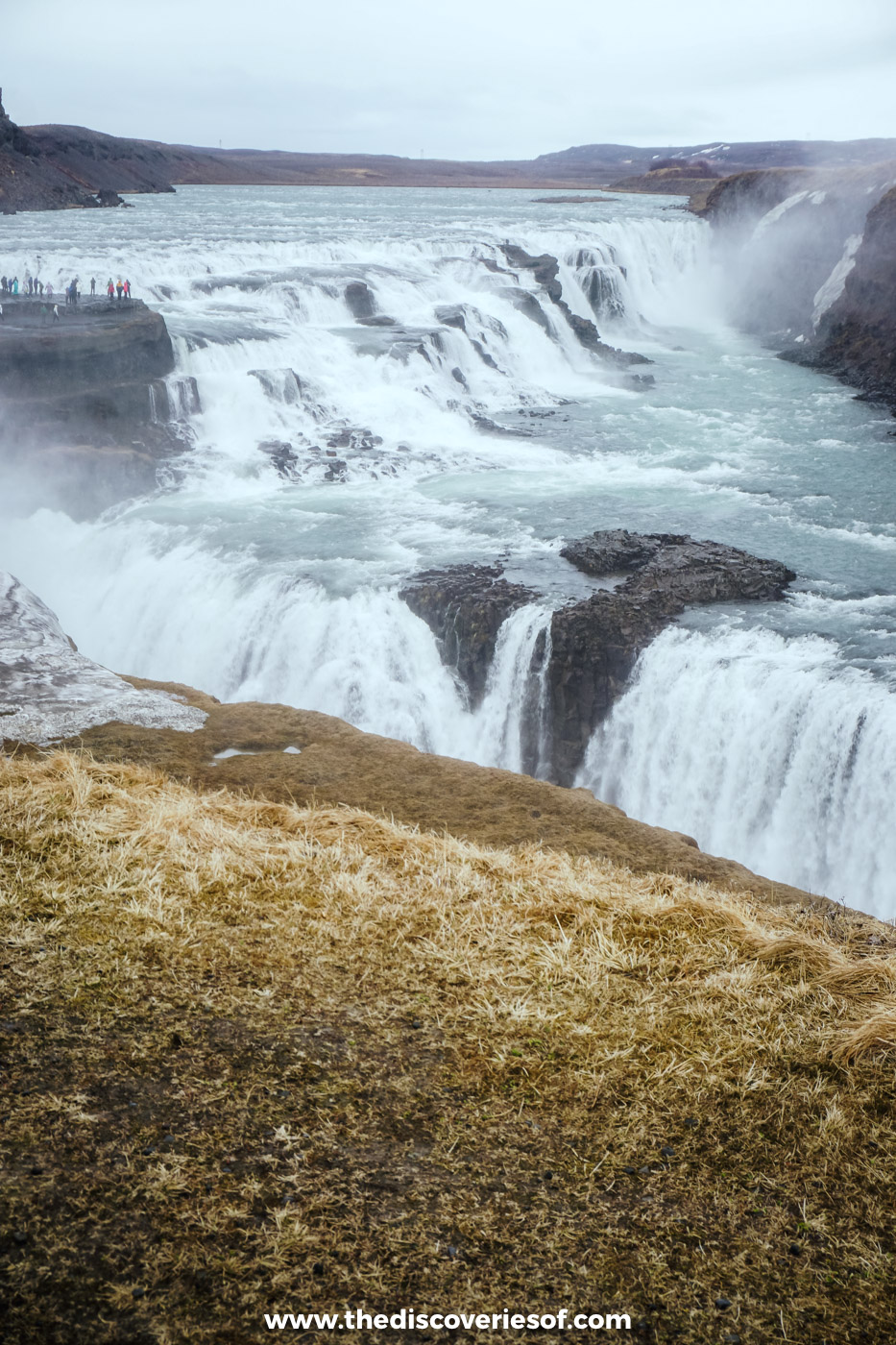
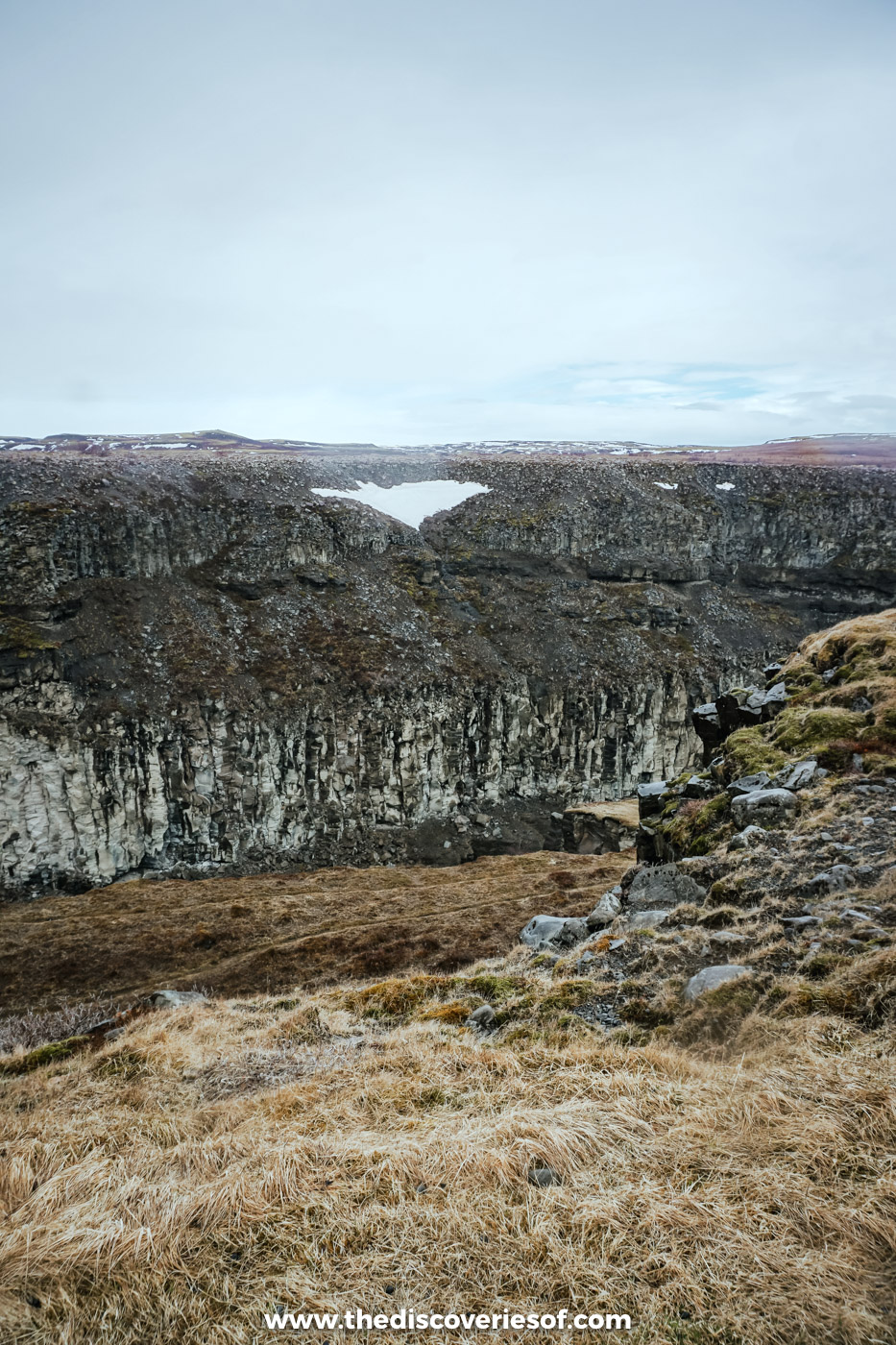
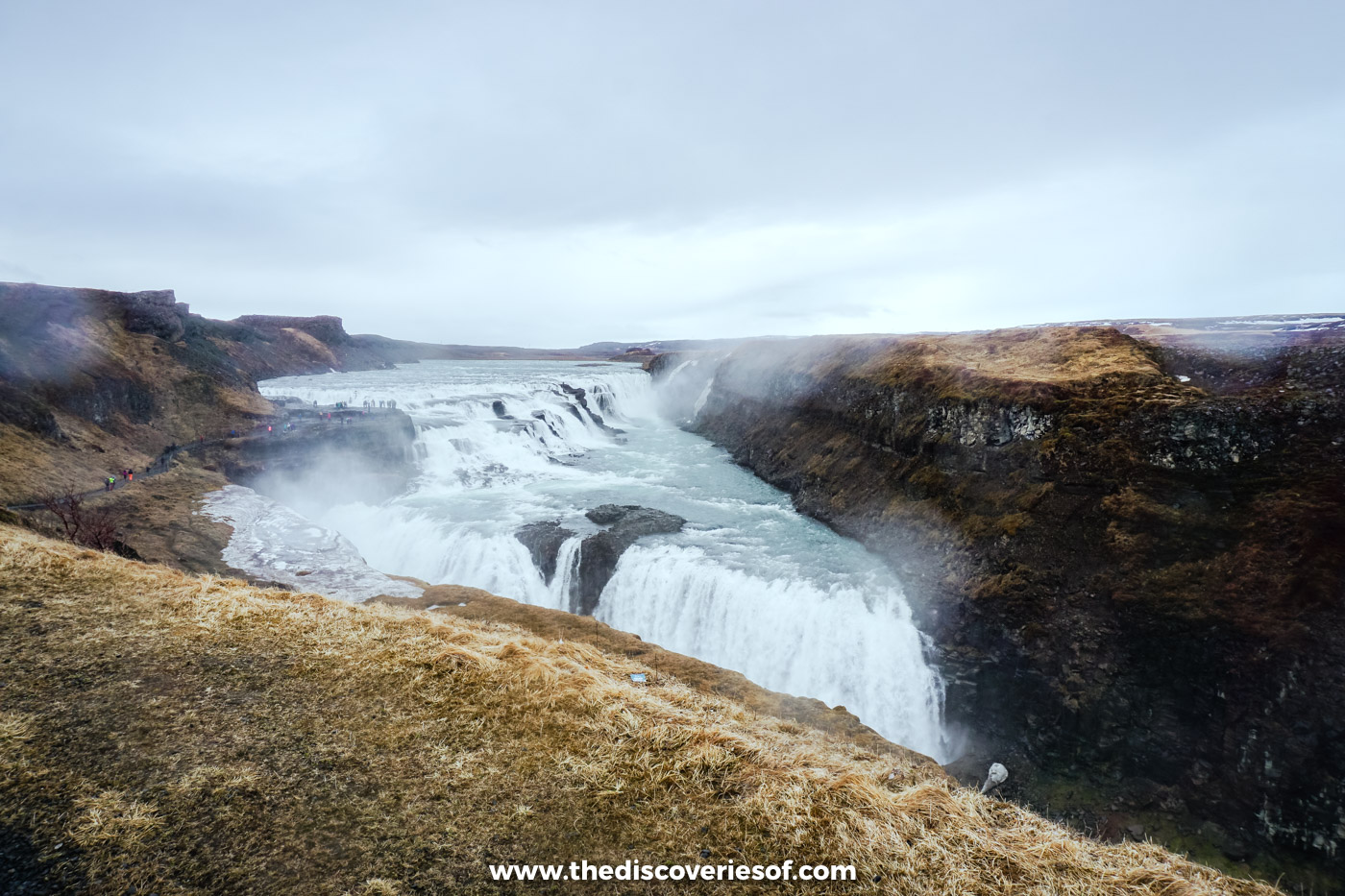
My first visit came in the early evening, at the end of a long guided day around the Golden Circle. The sky was a flat, steely grey, the grass on the canyon rim was still straw-coloured after the winter, and a few stubborn patches of snow clung to the cliffs below.
It wasn’t pretty in a postcard way, but it was dramatic. With no sun to soften it, the water looked pale and furious, and the spray drifted up out of the canyon like smoke.
Late September: sunshine and rainbows
I came back a few months later, this time with a hire car, and it was like visiting a different place.
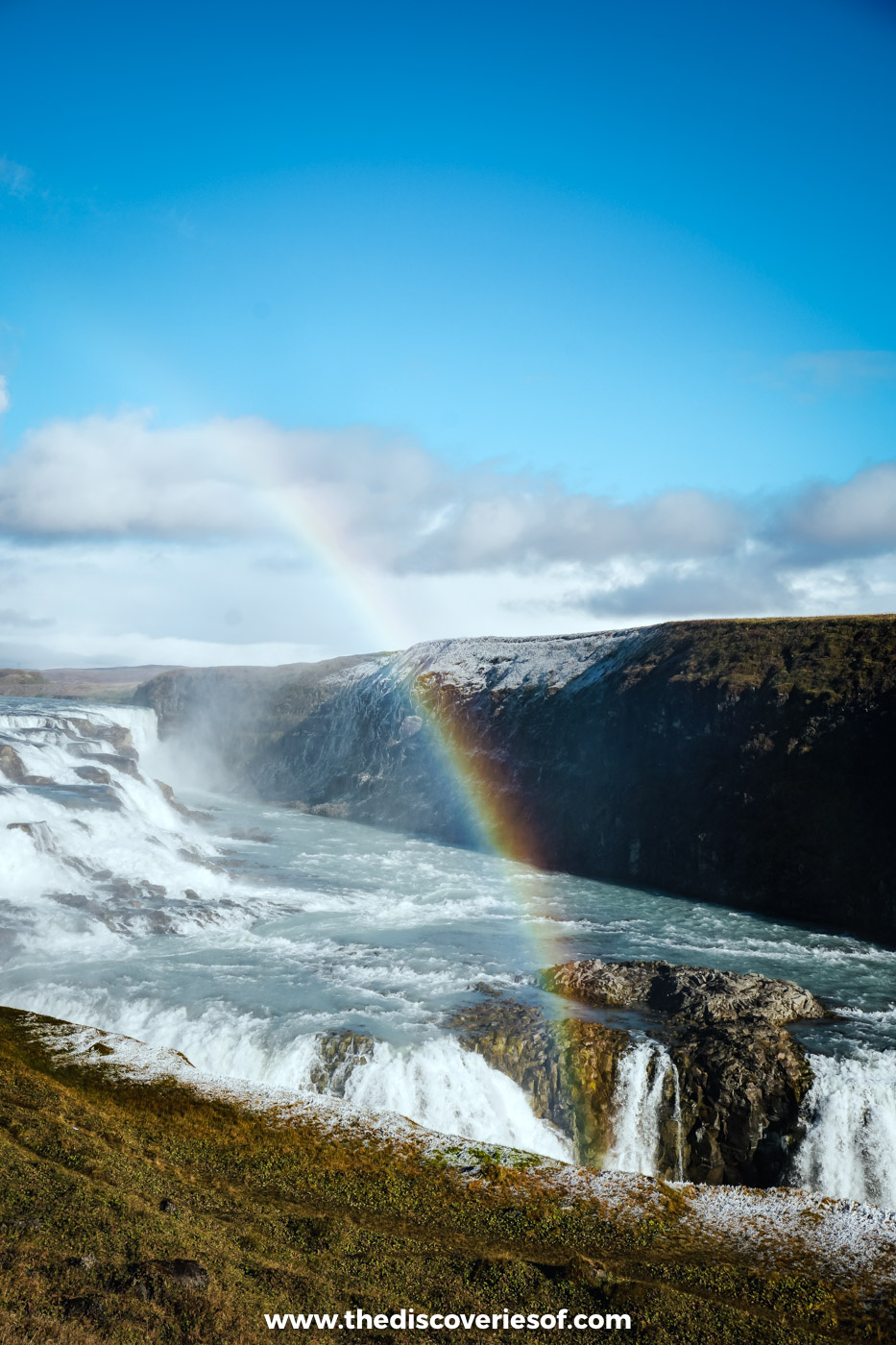
The sun was out, the sky was a deep blue, and the moss along the canyon rim was a vivid green. Best of all, the afternoon sun lit up the spray, and wherever I stood there seemed to be a rainbow arcing over the falls.
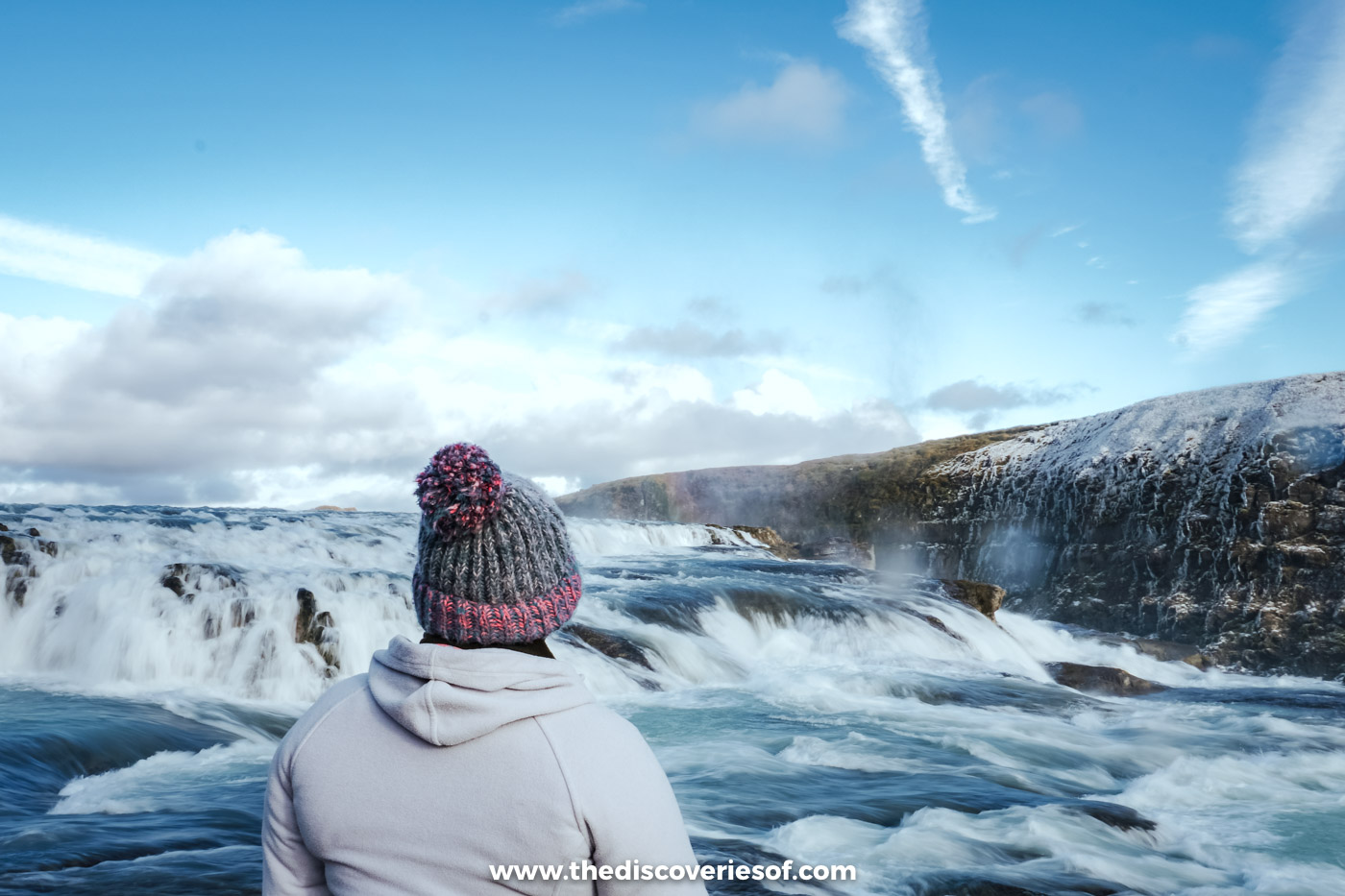
In September I also walked out along the lower path, and it’s a completely different perspective. Out on the rocks you’re almost level with the first step of the falls, with the river rushing past just beyond the rope.
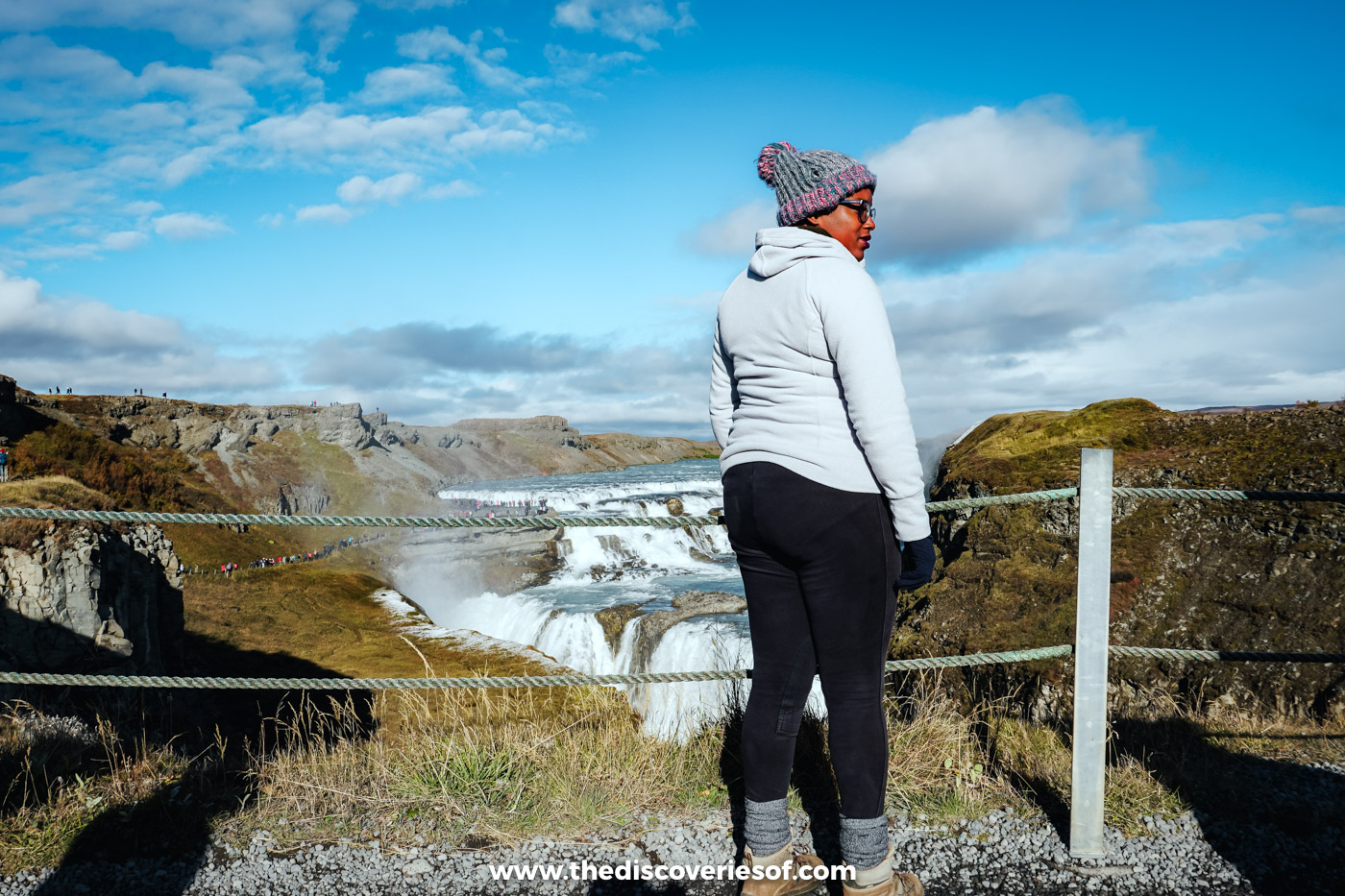
So which season is better? Honestly, I’d happily go back in either. Guess the only way to know for sure is to visit in more than one season, right? If you can choose, a sunny day in late summer or autumn gives you the best chance of rainbows, while early morning and evening are the quietest times whatever the month.
Sigríður Tómasdóttir: the woman who saved Gullfoss
Despite being a thing of beauty, the waterfall has something of a dramatic past. In fact, it very nearly wasn’t here at all.
In the early 20th century, the falls belonged to two farmers, Tómas Tómasson of the nearby Brattholt farm and Halldór Halldórsson. Around 1907 the landowners leased the rights to the falls, and the lease ended up in the hands of foreign investors who wanted to harness the river’s power for a hydroelectric plant. A dam on the Hvítá would have changed the falls forever.
Tómas’s daughter, Sigríður Tómasdóttir, was having none of it. She had grown up beside the falls and had helped to make the first path to them, and she fought the scheme with everything she had. She used her own savings to hire a lawyer, Sveinn Björnsson, who later went on to become Iceland’s first president, and she made trip after trip to Reykjavik, some 120 kilometres away, to make her case. By some accounts she walked, until her feet were bloodied. She’s even said to have threatened to throw herself into the falls if construction began.
Her court case actually failed. But the investors’ plans ran out of money, the agreement became void in 1928, and the dam was never built. The Icelandic state bought the falls in 1940, and Gullfoss became a protected nature reserve in 1979. Today Sigríður is often called Iceland’s first environmentalist.
How much of the story is fact and how much has grown in the telling is up for debate, especially the barefoot walks. But you shouldn’t miss the chance to see her memorial. A stone relief of her profile by the sculptor Ríkarður Jónsson sits above the falls, seen by thousands of visitors every year.
The upper and lower paths: how to see the falls
There are two main ways to see the falls, and if the weather allows, do both. Allow 45 minutes to an hour to walk them at a gentle pace.
The upper path
The upper car park sits next to the visitor centre. From there, a paved path and boardwalk lead to a viewing platform on the clifftop, a few minutes’ walk away, with a sweeping view over the staircase of falls and down the canyon. This is the step-free option, and it’s the one that stays open all year round.
The lower path
A staircase leads down from the upper area (or you can park at the lower car park) to a gravel path that runs along the canyon rim and out onto a rocky shelf right beside the first drop. This is where you get the full force of the falls, and the spray. It’s not suitable for wheelchairs, and it can be muddy and slippery at any time of year.
Top Tip
Stay on the marked paths and behind the ropes. The canyon edges are unstable, and the vegetation up here is fragile: at this altitude, with such a short growing season, a trampled shortcut takes years to heal. If a path is closed, it’s closed for a reason.
Can you visit Gullfoss in winter?
Iceland thrives in winter, and Gullfoss is no exception.
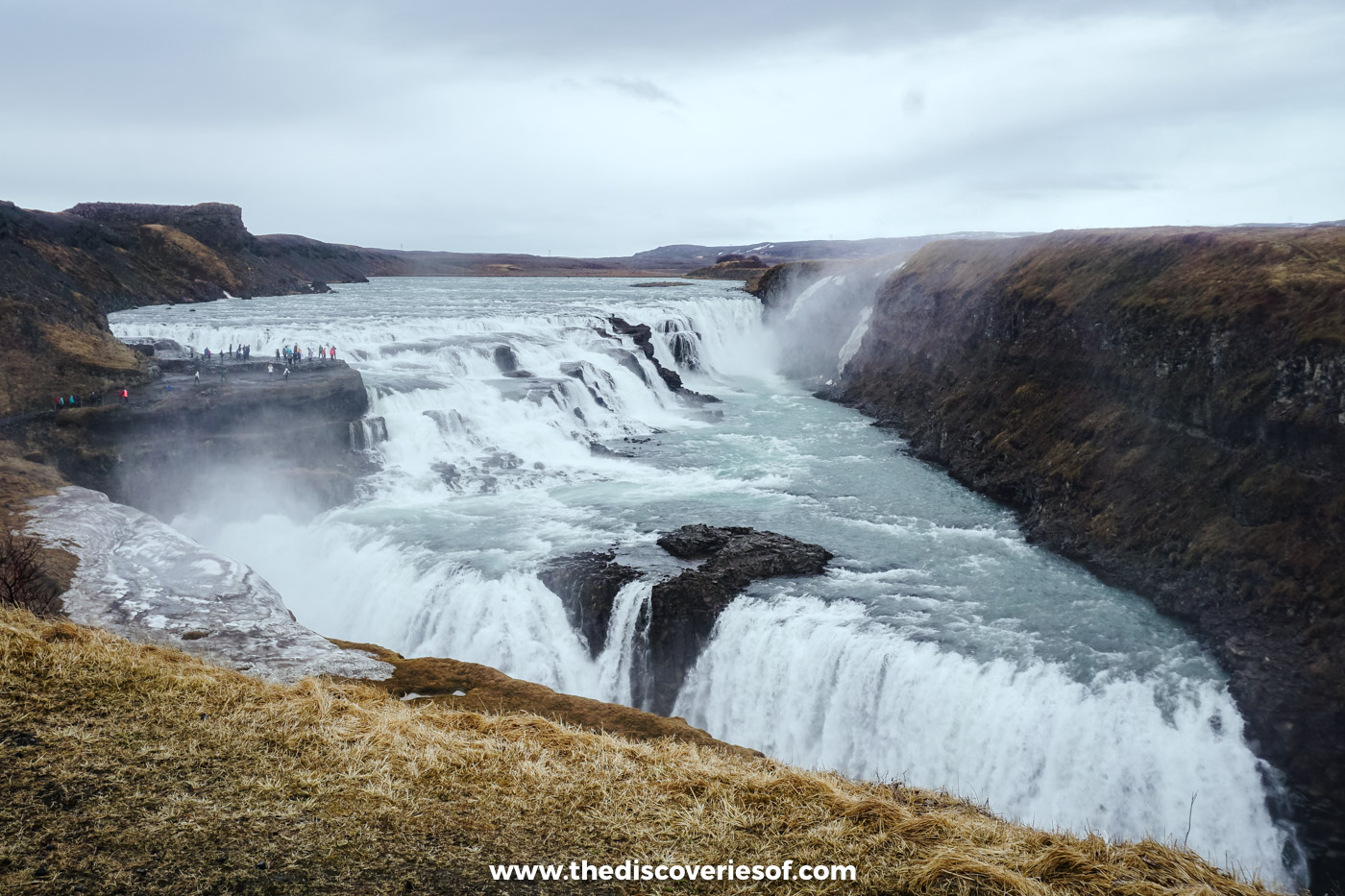
The falls can most definitely be visited during the winter months. The site itself is open 24 hours a day, all year round, and many people argue that it’s even more picturesque when it’s cloaked in snow. With a bit of luck you’ll see the striking sight of the falls partly frozen, with great curtains of ice hanging from the rock while the river keeps thundering through the middle. Get your camera ready: this is something you won’t want to miss.
Be aware, though, that the lower path is often closed in winter because of heavy ice, and it can also close in bad weather at other times of year. The upper viewing platform by the visitor centre stays open throughout the season and gives a safe view of the falls.
Before venturing onto any of the paths, wear sensible boots with a good grip, and pack a pair of microspikes if you have them. Daylight is short in December and January, so plan your Golden Circle day around the light, and check the road conditions at umferdin.is and the alerts on safetravel.is before you set off.
Getting to Gullfoss
The falls are about 120 kilometres from Reykjavik, which is roughly 1 hour 45 minutes to 2 hours by car. You can get to Gullfoss in a couple of ways.
Driving from Reykjavik
If you want more independence, I’d recommend hiring a car and driving the Golden Circle yourself, so you have the freedom to roam as you please. That’s what I did in September, and it meant I could take my time at the falls.
The quickest route is to head east from Reykjavik on the Ring Road (Route 1) over the Hellisheiði mountain pass for around 54 kilometres, then turn left onto Route 35 and stay on it for about 68 kilometres until you reach the falls. If you’re doing the full loop, you’ll more likely arrive from Þingvellir via Laugarvatn and Geysir, which is just 10 minutes’ drive down the road.
Getting There
There are two car parks: the upper one by the visitor centre and a lower one closer to the lower path. Parking at both is free, and so is entry to the falls. The road is paved all the way from Reykjavik. Beyond Gullfoss, Route 35 becomes the Kjölur highland road (F35), which is open in summer only and to 4×4 vehicles only.
On a tour
My first visit was on a guided day, and it’s an easy way to see the area if you don’t want to drive. Tours typically allow around 45 minutes at the falls.
Do
This Golden Circle full-day tour with Kerið crater picks up in Reykjavik and runs for 7 to 8.5 hours. Along with the falls, it covers the famous geothermal Geysir area and the explosive hot spring of Strokkur, and meanders through Þingvellir National Park, where the Eurasian and North American tectonic plates meet. Add a stop at the volcanic crater of Kerið and it’s one of the best ways to see the area if you’re short on time.
By bus
There’s no public bus to the falls. Iceland’s long-distance Strætó buses link towns such as Selfoss, but they don’t stop at the falls or the other Golden Circle sights. If you don’t have a car, a day tour is the way to go.
Know before you go
- Facilities: the visitor centre at the upper car park has toilets, a gift shop and the Gullfoss café and restaurant, which serves hot meals (including a hearty Icelandic lamb stew), snacks and takeaway. It’s open daily from 9am to 7pm, and the kitchen closes an hour before. Hours can be shorter in winter, so check gullfoss.is before you rely on it for lunch. I ate here on my May visit.
- Leave the drone in the bag: the falls sit in a protected nature reserve, and flying a drone here is banned without a permit from the Nature Conservation Agency (Náttúruverndarstofnun). Since May 2026 the agency only issues permits for professional work such as film, news and research, so recreational flying isn’t an option at any time of year.
- Beat the crowds: day tours from Reykjavik tend to arrive from late morning to mid-afternoon. Come early in the morning or in the evening (easy in summer, when it’s light until late) and you’ll share the paths with far fewer people.
- Expect to get wet: the spray reaches the lower path and, when the wind blows the wrong way, the upper platform too. A waterproof jacket earns its keep here.
- Fees could change: a draft law published in September 2026 proposes a national access pass for Gullfoss, Geysir and Þingvellir from May 2027 for visitors who aren’t resident in Iceland. It’s only a proposal for now, so check before you travel.
Nearby on the Golden Circle
The falls are the furthest point of the classic Golden Circle loop, so it pairs easily with the other big sights. My Golden Circle guide has the full route and timings.
- Geysir and Strokkur: 10 minutes away. Strokkur erupts every few minutes.
- Faxi: a broad, low waterfall on the Tungufljót river near Reykholt, about 20 minutes south on Route 35. Parking is ISK 700, paid on site.
- Friðheimar: the tomato greenhouse restaurant at Reykholt, about half an hour away. Book ahead. See my things to do in Iceland.
- Þingvellir National Park: the rift valley and parliament site, around an hour to the west.
- Kerið: a red volcanic crater with a lake in its belly, on Route 35 near Selfoss on the way back to Reykjavik.
Map
Read next
- Iceland’s Golden Circle: the complete guide
- Iceland’s most stunning waterfalls
- Iceland landmarks you need to see
- When’s the best time to visit Iceland?
- When’s the best time to see the Northern Lights?
- Visiting Reynisfjara, Iceland’s most famous black sand beach
- How to visit the Reynisdrangar sea stacks
- Is Iceland expensive?
- Iceland travel guide
Love this? Save and share on Pinterest

Discover the top things to do, insider tips and hidden gems in our Iceland Travel Guide.
Read the guides →


Nice photos! I dont get tired looking at them. The places are so beautiful but you made them a lot more beautiful with your great skill.
I don’t know what am I waiting to see Iceland with my own eyes ? Beautiful pictures ?
it seems really cool! Iceland is great, no matter what time of year. Hope i get to tick that item off my bucket list soon. ?
is there an entrance/admission fee to see the Gullfoss Waterfall/ Pingvier National Park? Thank you so much.
Hey Oliver – so glad you enjoyed. I really hope you get there soon – nope, no admission fees to enter. ?