Geysir gave its name to every geyser on the planet, and its neighbour Strokkur still fires a column of scalding water skywards several times an hour. Here’s how to see Geysir and Strokkur for yourself: what you’ll find in the geothermal field, how to catch an eruption on camera, parking, the best time to go and how to stay safe around water this hot.
My trip to the Atacama Desert had finished at El Tatio, the biggest geyser field in the southern hemisphere, so I came to Haukadalur thinking there wasn’t much a geyser could show me. Then I saw Strokkur go off, and I had to think again. This, after all, is home to Geysir, the spring that gave every other geyser its name.
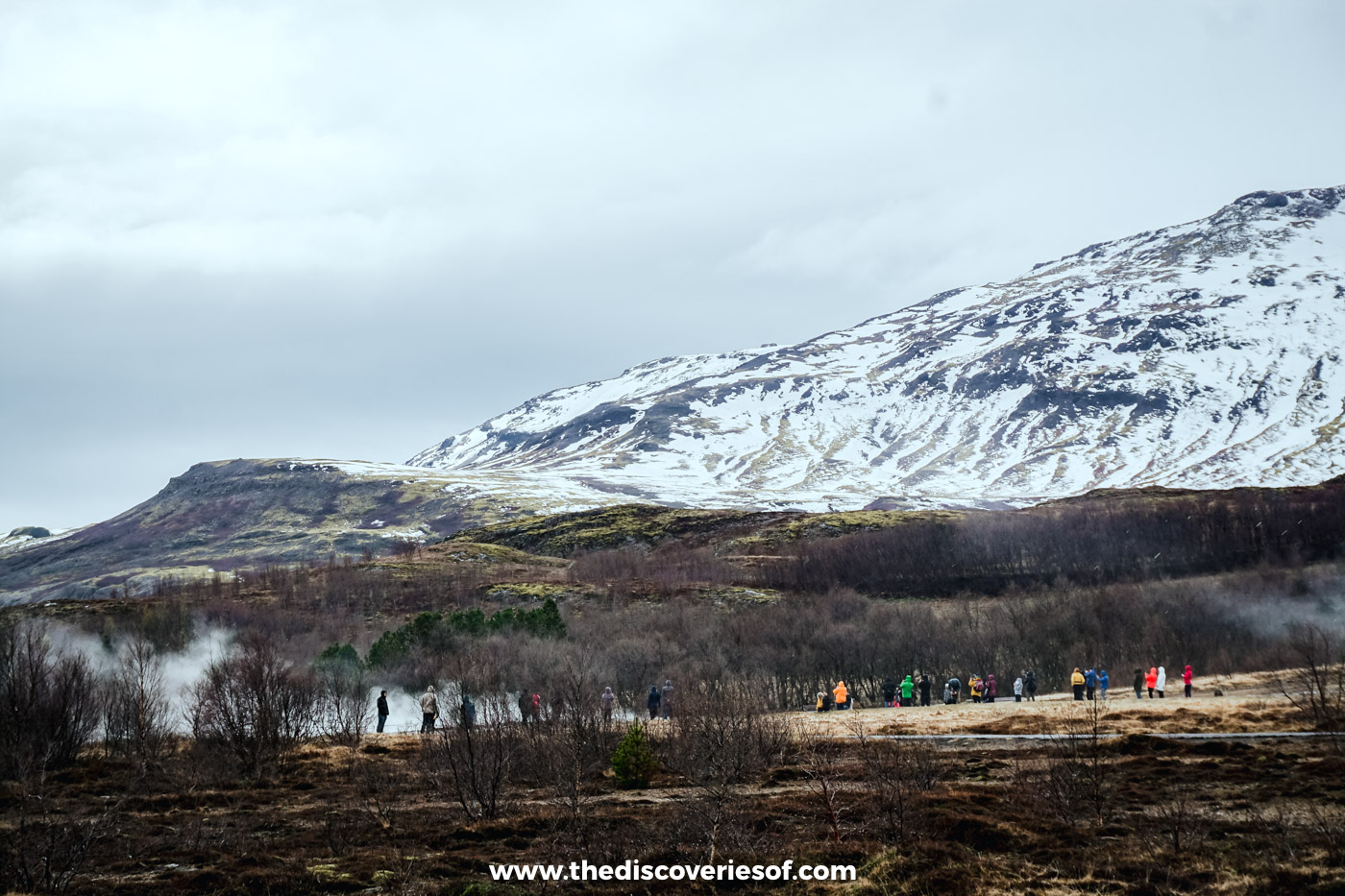
I visited in early May, on a guided day around the Golden Circle that also took in Þingvellir and Gullfoss. Winter hadn’t quite let go: the heath was still brown, snow streaked the hills behind the field and the steam hung low over the ground. It’s the stop on the loop where the earth feels most alive.
The geothermal area is free to visit and open all day, every day. This guide covers the original Geysir, Strokkur and the hot pools around them, then the practical side: getting there, parking, timing your visit and the rules that keep you in one piece.
Geysir and Strokkur at a glance
- Where: the Haukadalur valley in South Iceland, beside Route 35, about 10 minutes from Gullfoss.
- Cost: free to walk around. Parking costs ISK 1,080 for a car with up to seven seats, valid for up to eight hours, paid through Parka.
- Eruptions: Strokkur goes off roughly every five to 10 minutes, usually reaching 15 to 20 metres. The Great Geysir is mostly dormant.
- Time needed: 30 to 45 minutes for Strokkur and the main pools; about an hour and a half with the climb up Laugarfjall.
- Open: all year, around the clock, with no tickets.
- Facilities: toilets, cafés, restaurants and shops at the Geysir Center across the road.
- Drones: only with a permit from the Nature Conservation Agency, which manages the area.
The Great Geysir, the hot spring that named them all
Every geyser in the world takes its name from this one. The word is Icelandic, from geysa, meaning to gush or rush forward, and when English needed a word for a spring that shoots water into the air, it simply borrowed it.
The springs in Haukadalur were written about as far back as 1294, and the name Geysir first turns up in 1647. In its prime it was a showstopper. Visitors in the early 1800s timed eruptions roughly every 30 hours, up to about 30 metres high, and when the German chemist Robert Bunsen measured it in 1846 he recorded jets of 45 to 54 metres. An earthquake in 1896 woke it up again, sending water as high as 70 or 80 metres, but by 1916 the eruptions had all but stopped.
What happened next is a slightly embarrassing chapter. In 1935 a channel was dug through the silica rim, which lowered the water level and briefly revived the eruptions until it clogged up again. Once the ditch was cleared in 1981, soap was added on special occasions to force a show. By the 1990s environmental concerns had all but ended the practice, and today it’s unthinkable.
Nature had the last word anyway. Earthquakes in South Iceland in 2000 jolted Geysir back into life, and for two days it shot water around 122 metres into the air. It has erupted only rarely since, most recently in 2016, so these days it’s a wide, steaming bowl of blue water rather than a fountain. Don’t come expecting it to perform. Its neighbour does that.
The land itself has had a colourful history too. A British buyer acquired part of the springs in 1894 and charged people to see them; in 1935 Sigurður Jónasson bought the land back and gave it to the Icelandic people. The state bought out the remaining landowners in 2016, and the area was formally protected on 17 June 2020. Look out for the “king stones” inside the protected area, which mark visits by three Danish kings: Christian IX in 1874, Frederick VIII in 1907 and Christian X in 1921.
Strokkur, the one you’ll actually see erupt
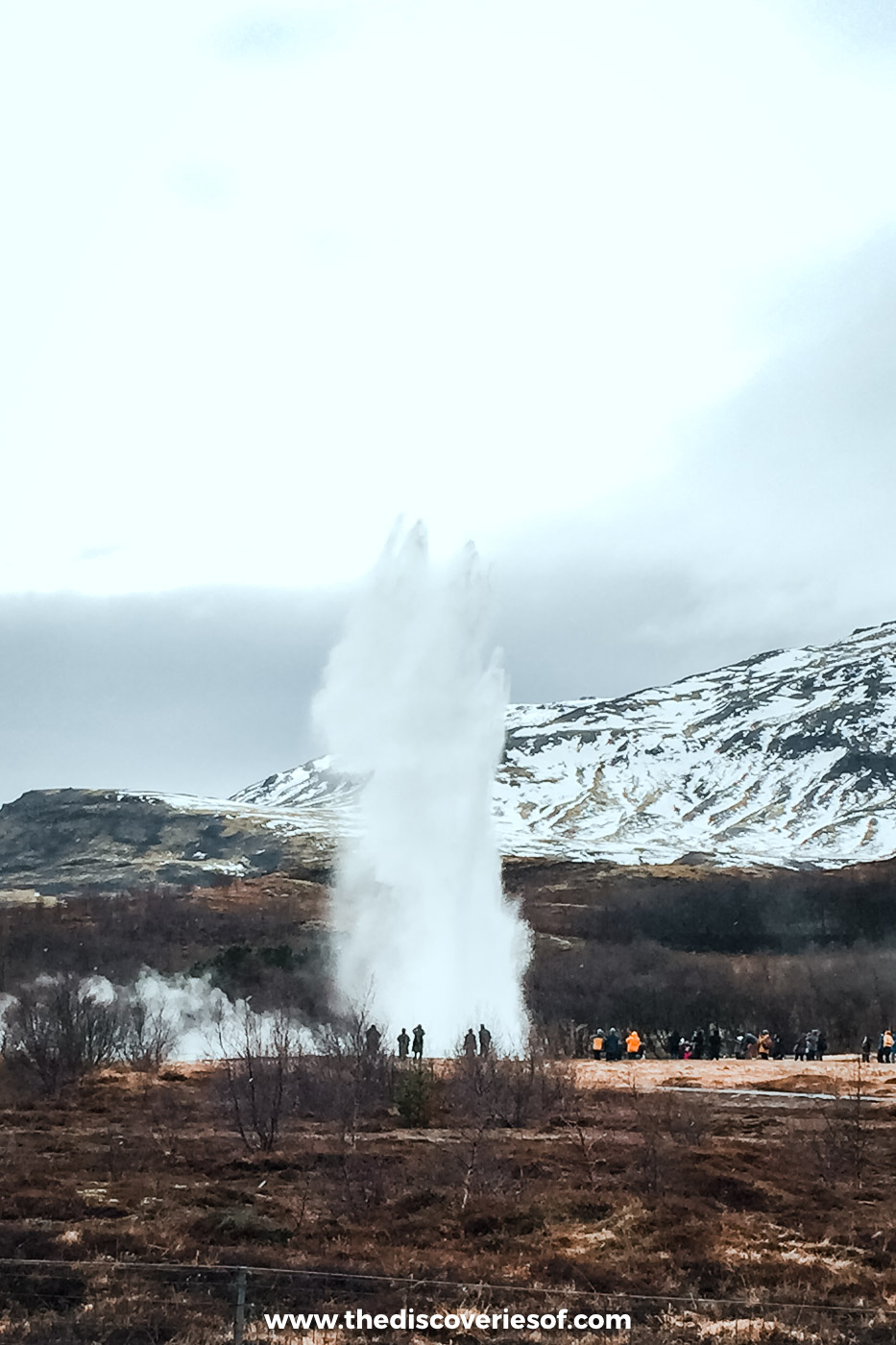
About 50 metres south of the Great Geysir, Strokkur (the name means “churn”) is the reason the car park is full. It first appears in the records in 1789, after an earthquake opened up its conduit. Another quake blocked it around the turn of the 20th century, and it stayed quiet until 1963, when locals cleared the plug at the bottom of the pool. It has been going off ever since.
It erupts every five to 10 minutes or so, usually to 15 or 20 metres and now and then to about twice that. The reason it’s so reliable is that it never fully empties. The pool refills quickly after each burst, the water deep in the shaft heats past boiling point, and the pressure builds until it has to give.
You can see it coming, if you know what to look for. The surface starts to pulse and slop over the edge of the basin. Then the water rises into a smooth, bright turquoise dome, a giant bubble of steam pushing up from below, and a split second later it bursts into a white column. Sometimes it goes twice or three times in quick succession, and the crowd’s cheer gets louder each time. Then the pool drains back, gurgles and starts all over again.
In October 2024, rangers reported unusual activity across the field, with normally quiet springs such as Blesi, Konungshver and Smiður boiling vigorously and spurting, and the water level in Blesi dropping by up to half a metre. It’s a reminder that this is a live geothermal area, not a stage set, and that the paths and ropes are there for good reason.
How to photograph Strokkur
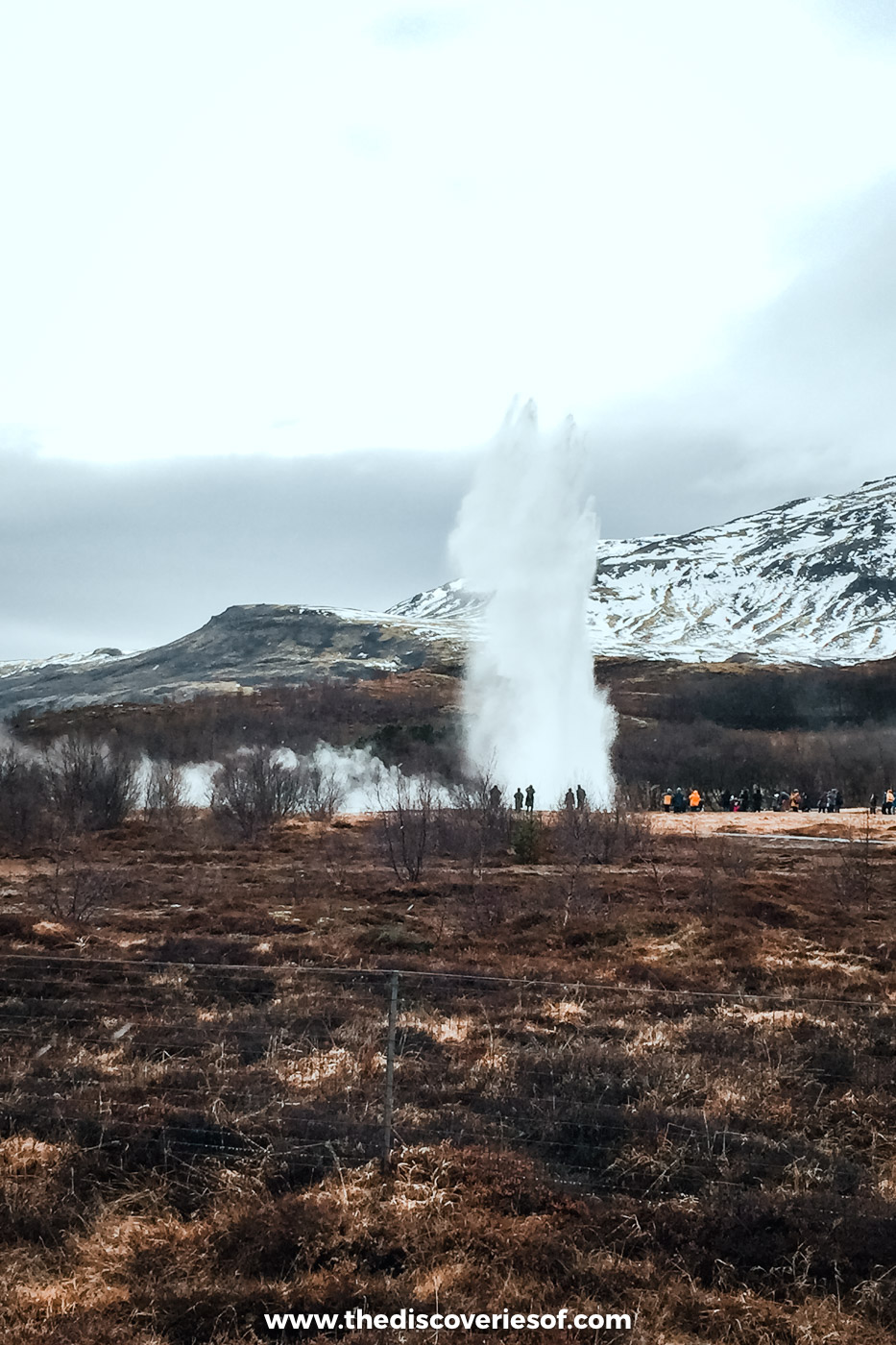
Getting Strokkur on camera felt like the fastest finger first round on Who Wants to Be a Millionaire: only those with lightning reflexes need apply. But even if the shot gets away from you, the sight itself is worth the trip.
A few things make it easier:
- Watch for the dome. Don’t wait for the spray. Start shooting the moment the blue bubble rises.
- Use burst mode or video. A short burst catches the whole eruption, and a video lets you pull a still from the best frame later.
- Stand upwind. Check which way the steam is drifting before you pick your spot, or your lens (and you) will get a dousing of warm, sulphurous spray.
- Go wide, then tight. A wide lens shows the scale of the column against the hills; once you’ve got that, zoom in for the moment the dome breaks.
- Use the low sun. In the darker months, when the sun sits low all day, it lights up the spray beautifully, and the cold air makes the steam plume billow even bigger.
The hot pools around the field
Strokkur and Geysir are the headliners, but the high-temperature area here covers about three square kilometres, and the paths take you past a string of other springs, fumaroles and bubbling mud. The colourful mineral crust around them is geyserite, which is also named after Geysir.
- Blesi: two pools side by side above the Great Geysir. One is so clear you can see deep down into its blue throat; the other is a milky, opaque blue.
- Konungshver: the “king’s spring”, a deep blue pool on the quieter eastern side of the field.
- Litli Geysir: “little Geysir”, one of the smaller named springs in the field.
- Óþerrishola, Smiður and Fata: smaller springs that are usually quiet. In October 2024, they were among those rangers saw boiling and spurting.
For the best overview, climb Laugarfjall (also called Laugarfell), the 187-metre hill behind the springs. A marked path leads up to two viewing platforms: one looks down over the geothermal field and the Haukadalur forest, and the other across the valley of Helludalur to Bjarnarfell. It’s steep in places and muddy after rain, but it needs no special kit, and few of the coach crowds make the effort.
If you have more time, the Haukadalsskógur forestry is just up the valley, with marked trails such as the Svartagil walk and the Gunnarslundur loop.
Getting there and parking
The springs sit beside Route 35 in Haukadalur, on the Golden Circle. All the roads are paved, so any hire car can manage it outside winter storms. Rough driving times, without stops:
- Gullfoss: about 10 minutes
- Reykholt and Friðheimar: about 20 minutes
- Laugarvatn: about 25 minutes
- Selfoss: about 55 minutes
- Þingvellir: about an hour
- Hotel Rangá, near Hella: about an hour and 10 minutes
- Reykjavik: about an hour and 40 minutes via Route 1 and Route 35
Parking is in the large car parks at the Geysir Center, across the road from the springs. Cameras read your number plate, and the fee is paid through Parka (online or in the app): ISK 1,080 for a car with up to seven seats, ISK 400 for a motorbike, plus an ISK 89 payment fee. It covers up to eight hours, and you can pay up to 24 hours after you leave. Forget, and a surcharge of ISK 1,490 lands on top, which hire companies usually pass straight on with a fee of their own. Overnight stays in the car park aren’t allowed.
Without a car, the easiest way here is a tour. Almost every Golden Circle day trip stops at the geothermal field, usually for 45 minutes to an hour. This Golden Circle tour with an optional Kerið stop covers Þingvellir, Geysir and Gullfoss in six and a half to seven hours, from about $87.
Top Tip
The rules may change. A draft bill published in September 2026 proposes a “nature and infrastructure fee” for non-residents aged 18 and over to visit Geysir, Gullfoss and Þingvellir from 1 May 2027: ISK 4,500 from June to October and ISK 3,000 the rest of the year, in place of parking charges at those sites. Nothing is law yet, so look at the latest news when you plan.
When to visit
Time of day matters more than the season. The field is open around the clock, but between about 10:00 and 16:00 the tour coaches arrive in waves and the rope around Strokkur is several people deep. Arrive before the first coaches or after the last ones have gone, or in summer in the long light evenings, and you’ll have far more room.
May and September are a good compromise between daylight and crowds, and in May, when I visited, the snow still lingering on the hills made a dramatic backdrop to every eruption. For the full picture by month, see my guide to the best time to visit Iceland.
June to August brings long days and the most visitors.
November to February gives you only a short window of daylight, barely four hours in Reykjavik at the solstice, and the boardwalks and paths can be icy where spray has frozen. The trade-off is worth it: steam looks spectacular in the cold, Strokkur keeps erupting after dark, and on a clear night you might see the aurora over the field. My guide to the best time to see the northern lights in Iceland has the details. Check road.is and vedur.is before you set off.
Staying safe around the springs
The water here is at or near boiling point, and the ground around it isn’t always as solid as it looks. A few rules keep you safe:
- Stay on the paths and behind the ropes. The crust beside the pools can be paper-thin over boiling mud and water. The ropes are low, but treat them as a wall.
- Never touch the water. Not even a finger in a pool that looks calm. Keep children close and by the hand.
- Don’t throw anything in. Coins, stones and litter can damage the springs.
- Mind the wind. Spray and steam can drift across the paths with little warning.
- Wear grippy shoes. In winter, slip-on spikes are a good idea on icy boardwalks. My Iceland packing list covers the rest.
- Leave the drone in the car. Flying one in the protected area needs a permit from the Nature Conservation Agency.
In an emergency, call 112.
The Geysir Center, across the road
Across Route 35 from the springs, the Geysir Center is where you’ll park and where all the facilities are: toilets, cafés, restaurants and shops selling snacks and souvenirs. It’s a useful place to warm up between eruptions.
For a proper meal, the restaurant at Hotel Geysir serves a lunch buffet daily from 11:30 to 14:00, with soups, salads, seafood and homemade bread. It also runs a “hot spring bread” experience, where the chef leads you across the geothermal ground to taste rye bread that has been baked underground for 24 hours, with butter, eggs boiled in the hot earth and herring.
Nearby stops worth adding
- Gullfoss. The two-tiered waterfall is just 10 minutes up the road, and it’s the natural next stop. I’ve been in May and September, and my Gullfoss guide covers both seasons.
- Efstidalur II. A dairy farm about 10 minutes away whose restaurant serves its own beef, with an ice cream counter looking into the cowshed.
- Brúarfoss. About 20 minutes away, a small waterfall with water so blue it barely looks real. Access is in my guide to Iceland waterfalls.
- Friðheimar. The greenhouse restaurant at Reykholt, about 20 minutes away, where tomatoes grow all year under geothermal heat. The bloody mary is reason enough to book.
- Laugarvatn Fontana. Steam baths and lakeside pools in Laugarvatn, about 25 minutes west.
- The Secret Lagoon. A relaxed geothermal pool at Flúðir, about 30 minutes south, with its own baby geyser.
- Kerið. About 50 minutes south, on the way back towards Reykjavik: a 6,500-year-old crater whose lake glows blue-green against red rock.
All of these are in my Golden Circle guide, with a self-drive itinerary that strings them together in a day. For a longer trip, my 7 day Iceland itinerary adds the south coast.
Quick answers before you go
Is it free to visit?
Yes. There’s no entrance fee for the geothermal area; you only pay for parking (ISK 1,080 for a car). That may change if the proposed visitor fee for Geysir, Gullfoss and Þingvellir goes ahead in 2027.
How often does Strokkur erupt?
Roughly every five to 10 minutes, usually to 15 or 20 metres. Stay for half an hour and you’ll see several, often including a double.
Does the Great Geysir still erupt?
Rarely. It woke up after earthquakes in 2000 and has erupted only occasionally since, most recently in 2016. Strokkur is the one to watch.
How long should I spend there?
Allow 30 to 45 minutes for Strokkur and the main pools, or about an hour and a half if you want to walk the whole field and climb Laugarfjall for the view.
Can I visit in winter or at night?
Yes. The field is open all year, around the clock, and Strokkur erupts whatever the hour. In winter, expect icy paths and short days, and check road conditions before you drive.
Map
Read next
- Iceland’s Golden Circle: the stops, the costs and a self-drive day
- Gullfoss waterfall in two seasons
- El Tatio geysers in Chile’s Atacama Desert
- Things to do in Iceland
- Iceland landmarks
- Iceland waterfalls
Love this? Save and share on Pinterest

Discover the top things to do, insider tips and hidden gems in our Iceland Travel Guide.
Read the guides →