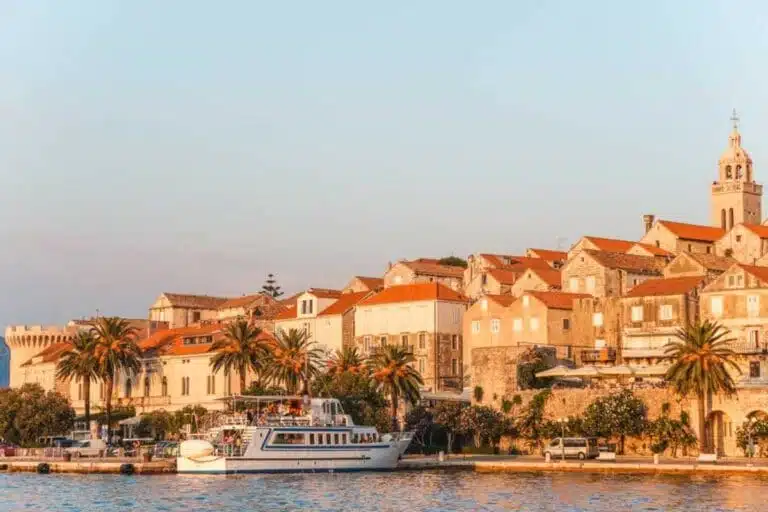
Looking for the best things to do in Split? This is my pick of what to see, eat and do in the city, from Diocletian’s Palace and Marjan Hill to island hops and national parks, with tips from my own time there.
Ah, Split. Where do I start? Split is one of the Adriatic’s most vibrant cities: bustling with a wonderful mix of modern life, ancient history and true Croatian culture.
Stunningly positioned between mountains and sea, Split simply oozes charm.
Sure, it’s Croatia’s second-largest city, but that’s not what draws you in.
Perhaps it’s the maze of architecture, spanning every period since Roman times. Where else can you find a UNESCO World Heritage city centre built inside a Roman emperor’s palace, with Venetian, Austrian and Croatian architecture layered on top?

Perhaps it’s the location. After all, Split commands a jaunty perch on the Adriatic coast. Framed by crystal-clear waters and pine forests, there’s no doubt about its beauty, and it’s the main ferry port for the islands of central Dalmatia, so Hvar, Brač and Vis are all on the doorstep.
If I’m truthful, after becoming totally enraptured with Dubrovnik, I thought that Split might be a bit of a let-down.
Not so. I spent the end of August here, on my third trip to Croatia, and the city stole its way into my heart. Split is one of Croatia’s not-so-hidden gems: spend more than a day here and chances are that you won’t want to leave.
You can see the main sights in a day, but I’d give it two or three days at least, so you can explore at leisure and fit in a day trip or two. If you want to see Split at its liveliest, visit between May and October. July and August are very busy and very hot; May, June, September and early October are quieter, and the sea is still warm in September. Winters are mild and wet, but rarely bad enough to ruin a trip.
Split Airport sits about 25 km west of the city, near Trogir, and a shuttle bus links it with the main bus station. The bus station, ferry port and train station are all at the eastern end of the Riva, a short walk from the Old Town. If you’re coming up from Dubrovnik, the catamaran takes around four and a half hours and runs from April to October. By road, the Pelješac Bridge means you no longer have to cross the short stretch of Bosnia and Herzegovina at Neum, but check your coach’s route: if it still goes via Neum, you’ll need your passport at the border.
Planning your trip? Check out my pick of the best things to do in Split.
Some links in this article may be affiliate links, which means we may receive a small commission, at no additional cost to you, if you decide to purchase through one of my recommended partners.
PS: Planning to spend more time in Croatia? Read this guide to seeing the best of the country in 10 days
and also The best places to stay in Split
Top 5 things to do in Split
See Diocletian’s Palace

Short on time? If I had to pick one must-see landmark in Split, it would be Diocletian’s Palace.
It would be kind of hard not to, to be honest. You can’t avoid it if you visit the Old Town, because the palace is the backbone of the whole area.
This UNESCO World Heritage site (listed in 1979) was built for the Roman Emperor Diocletian between about 295 and 305 AD, as the place he would retire to after he gave up the throne. Part luxury villa, part fortified military camp, it measures roughly 215 by 180 metres, with a gate in each of its four walls.
When nearby Salona fell in the 7th century, its people took refuge inside the palace walls, and over the centuries Split has grown up in and around it. Thankfully, many of the palace’s buildings have remained intact, and people still live, work and drink their coffee among them, which is what makes it feel so different from a ruin behind a fence.
Unmissable sights within Diocletian’s Palace include the Peristyle (the central square, ringed with red granite columns, where the emperor appeared before his subjects), the Vestibule, the Cardo (one of the main streets through the palace) and the cellars. The cellars, or substructures, are cavernous (and blessedly cool) vaulted halls that once held up the emperor’s apartments. The central passage from the Bronze Gate on the Riva is free and lined with stalls, while a ticket gets you into the halls on either side, which doubled up as a filming site for Game of Thrones.
The best way I found to get my bearings was this walking tour of Diocletian’s Palace and the Old Town, which may well be one of the best that I’ve ever been on. My guide was a walking, talking, wise-cracking fact machine who breezed through the fascinating history of the city: maximum information, maximum entertainment.
Top Tip
Book the earliest tour of the day. I went on the 9am tour and ended up having a private tour, as everyone else was still snoozing it up in bed. The early bird catches the worm and feels supremely smug about it too. The tour meets at the Golden Gate and lasts about two and a half hours.
Go kayaking in the sea

It would be a shame to go to Split and not spend any time on the cerulean waters that glitter from most vantage points in the city.
The calm waters of the Adriatic and easy-to-reach coastal hideaways set you up nicely for a kayaking trip from the city. Guided trips usually last two to three hours, and many set off from Stobreč, a beach suburb on Split’s eastern edge, so they include a transfer from the centre.
There are many sea kayaking tours in Split, but opt for a sunset one if you really want an unforgettable experience. This one paddles about 4 km, from the river at Stobreč out into the open sea, timed so that you’re on the water as the sun goes down behind the islands. If you’re lucky, you’ll be chilling on the sea as you’re treated to a radiant sunset.
Bring a dry bag for your phone, and wear something you don’t mind getting wet. In high summer, the sunset trips are also the coolest time of day to be paddling.
Walk around the Old Town

Split’s Old Town is a charmer.
You can be certain of two things during your visit to the Old Town: you’ll fill up your phone from taking so many pictures, and you will get lost in the area’s notoriously confusing labyrinth of tiny lanes and alleys.
There are a few landmarks you shouldn’t skip: the statue of Gregory of Nin (see entry below) outside the Golden Gate, the City Museum of Split in the Gothic Papalić Palace, and Pjaca (People’s Square), just through the Iron Gate, with its Renaissance clock and the old Town Hall. A little further out, the Archaeological Museum and the Meštrović Gallery are both worth the walk.
Be sure to pop into the numerous artisan stalls and boutiques selling local crafts and unique souvenirs. The central passage through the palace cellars is a particularly good shopping spot, and I’d also head out through the Silver Gate on the east side to browse the market stalls there.
Spend time on Marjan Hill

Imagine leaving the Old Town, walking a few minutes and being immersed in a natural setting that also doubles up as one of the best places in Split.
Marjan Hill is just that.
A broad, pine-covered peninsula, criss-crossed with hiking paths and more than the occasional viewpoint, it’s a protected forest park, and spending time on Marjan is a must. Its highest point, Telegrin, is 178 metres above the sea.
Marjan offers a welcome respite from a city that can feel busy to the point of bursting during peak season.
The easiest way up is by the stone steps from Veli Varoš, at the western end of the Riva. It’s about a 15-minute walk to Vidilica, a café terrace with a widespread panorama over the Old Town, the harbour and the islands, and the old Jewish cemetery is right next to it. Keep going and you’ll find the Sedlo watchtower, a wooden lookout with a lift that’s free to climb, and the little church of St Jerome, built against the cliff below Telegrin.
Pull on your walking shoes and set off for at least a few hours traversing the paths. If you have more time, carry on round to the pebbly beaches on the peninsula’s southern side, such as Kašjuni, which is one of the prettiest beaches near the city.
Split’s sunsets are legendary, and the best place to watch the sunset in Split is from one of the viewpoints on Marjan Hill. Take my advice and do it at least once during your trip.
Hunt out Game of Thrones filming locations

Recognise this?
It’s no secret how much I adore Game of Thrones (as in hunting out GOT filming locations in Dubrovnik kind of obsession). Even with the slightly clunky last episode, it’s a love that burns hot and fierce.
So there was zero chance of me not finding / stalking the Game of Thrones filming locations in Split. Unlike Dubrovnik, Split’s filming spots (which were used for scenes in Meereen) are harder to find.
In the city itself, they’re mainly focused on one spot: the cellars of Diocletian’s Palace. The cellars were used both as the place where Daenerys chains up her dragons in Meereen and as her throne room.
If you’re lucky, you will also spot a few familiar passageways overground too, including the Vestibule and the lanes around it, where the Sons of the Harpy ambush Grey Worm and the Unsullied.
Outside the city, Klis Fortress stood in for Meereen itself, the quarry and old mills at Žrnovnica appear in Meereen scenes too, and Kaštel Gomilica, between Split and Trogir, became the port of Braavos.
As Split’s Game of Thrones filming locations are so well-hidden, the best way to discover them is on a Game of Thrones-themed walking tour, which takes about two hours and includes entry to the cellars.
Simply rock up and prepare to be immersed in the programme’s fantastical world (and, if you’re lucky, pick up a few pieces of insider gossip).
More of the best sights in the city
Stroll along the Riva

I said that there’s more to Split than its beauty, and that is true, but there’s no denying the city’s visual appeal.
A stroll along the Riva, the city’s palm-lined waterfront promenade, is undoubtedly one of the top things to do in Split, and it’s pretty gorgeous to boot. The palace’s southern wall runs right along it, so you’re walking past 1,700-year-old masonry as you go.
Day and night, the Riva is buzzing. It’s perpetually filled with a mix of locals hanging out (a cup of strong coffee in hand) and wide-eyed tourists soaking up the obvious charm.
There’s no better place to people-watch in the city. Order a glass of wine or a coffee, sit back and watch the world pass by.
Visit Saint Domnius Cathedral
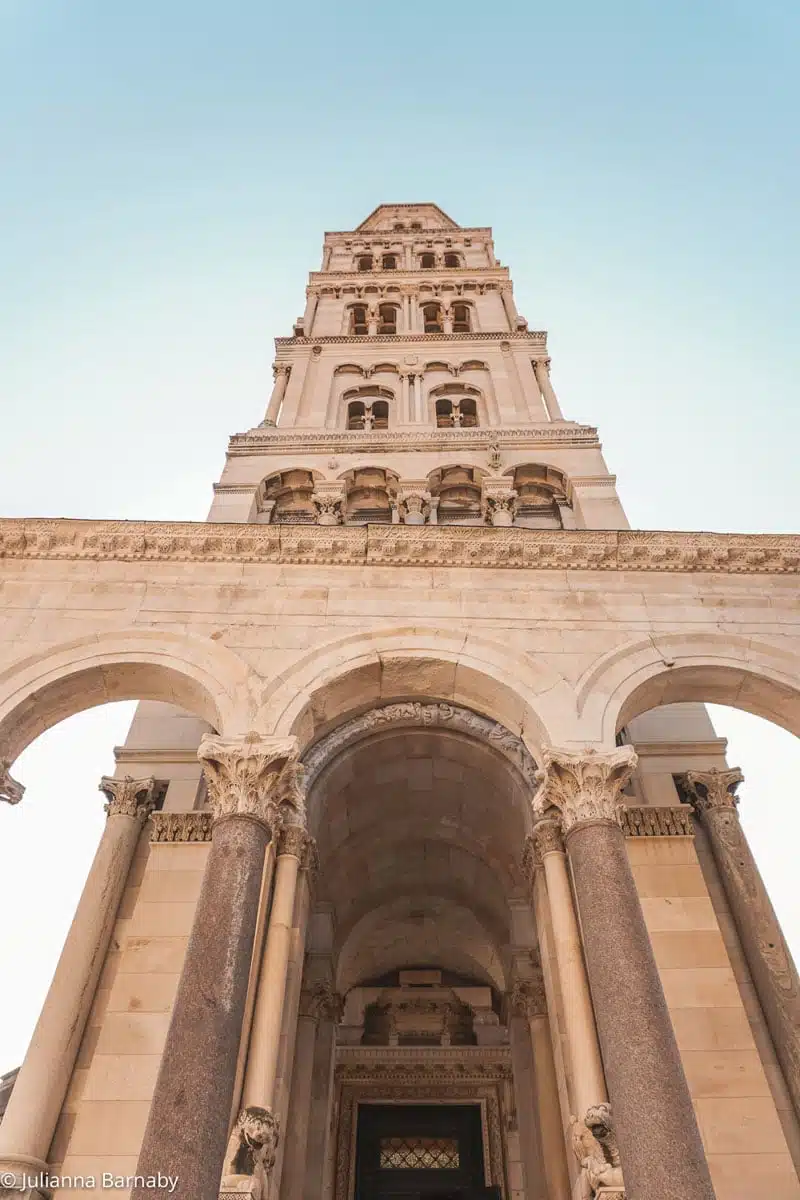
Wondering what to do in Split? There’s no missing St Domnius Cathedral: you’ll spot the bell tower peeping out above the rooftops in many parts of town.
Located in the heart of Diocletian’s Palace, on the Peristyle, the cathedral was built as Diocletian’s mausoleum and was turned into a church in the 7th century. That makes it the oldest building in use as a Catholic cathedral anywhere in the world, which is quite something when you consider that the emperor it was built for was one of the great persecutors of Christians.
Fancy a challenge? You should totally climb the 57-metre bell tower for the best views of the city. Work on it began in the 13th century. The climb is steep, and the upper stairs are open metal steps, so it’s not one for anyone who’s nervous of heights. A combined ticket covers the cathedral, the bell tower, the treasury and the Temple of Jupiter.
Check out the Meštrović sculpture of Gregory of Nin

It seems weird to say that one of the top things to do in Split is rubbing the toe of the sculpture, but bear with me a second.
Gregory of Nin was a 10th-century bishop who heavily influenced Croatia’s history by championing the Croatian language in church services, rather than Latin, as Rome decreed.
Given the measure of his influence, it’s fitting that his large statue dominates the section of the Old Town in which it stands. It was put up on the Peristyle in 1929, removed during the Second World War and moved to its current spot, just outside the Golden Gate, in 1954.
Created by Croatia’s most famous sculptor, Ivan Meštrović, the statue is testament to Meštrović’s skill, even if, as the story goes, he rather cheekily put his own face on it.
Legend has it that you should rub the statue’s toe for good luck. You won’t have a problem spotting the right toe: it’s bright gold from all the rubbing it’s received over the years.
Meštrović Gallery

Meštrović was one of the best-known sculptors of the 20th century, and he trained as a stonemason’s apprentice in Split as a teenager.
Take the opportunity to get up close and personal at the striking Meštrović Gallery, a must on any list of the best things to see in Split. It’s housed in the grand seafront villa he designed and built for his family in the 1930s, on the southern slopes of Marjan, about a 25-minute walk west of the Old Town.
The gallery houses many of the sculptor’s definitive works. Bronze, marble, wood: there were few mediums he couldn’t master in order to create striking sculptures in his signature style.
The ticket (€12) also gets you into Crikvine-Kaštilac, a short walk along the road, where a chapel holds his cycle of wooden reliefs of the life of Christ. Opening hours change with the seasons, so check before you go.
Chill out on Bačvice Beach

Only five minutes’ walk from Split Old Town, Bačvice Beach is the city’s most popular coastal hangout.
You can see why: the sandy shores and shallow, warm waters are too tempting to resist. It’s the best of Split’s laid-back lifestyle in one spot.
Bačvice is also the home of picigin, a game in which players stand in the shallows and keep a small ball from touching the water with flying, splashing dives. It was first played here in 1908, it’s on Croatia’s list of protected intangible cultural heritage, and watching a game is half the fun of a morning on the beach.
Don’t expect to have it all to yourself: between the picigin players, tourists and locals vying for their share of the sunshine, it does get busy, and that’s just part of the appeal.
There are plenty of bars and cafés to hang out in. The beach is a lively spot to spend some time at night during the summer months, when it becomes one of Split’s coolest nightlife spots.
Visit the Ethnographic Museum
Croatia has a fascinating cultural history, but despite all of the historic architecture, it can be difficult to get a sense of who its past inhabitants were.
The Ethnographic Museum, tucked into the southern part of the palace just behind the Vestibule, showcases the traditions and people of Split and wider Dalmatia through many of the crafts, clothing and practices that formed a part of their everyday lives.
With traditional costumes, Hvar lace made by Benedictine nuns and a furnished 19th-century room, it’s unlike any other spot in the city. The building itself incorporates rooms from Diocletian’s private quarters.
Your ticket includes access to the terrace on top of the Vestibule, one of the best views over the Peristyle and the cathedral, so time your visit to coincide with a klapa performance down below (see below). It’s usually closed on Sundays.
Hear the klapa singing

Klapa is a traditional form of a cappella singing, usually performed by male singing groups, and it’s on UNESCO’s list of the Intangible Cultural Heritage of Humanity.
There are a few spots where you can see klapa in Split, but the most iconic is undoubtedly in the Vestibule, the magnificent domed entrance hall next to the Peristyle. The open dome gives it incredible acoustics.
Groups perform there at intervals through the day, most days in the summer season, transporting you into the Croatia of days of yore. Listening is free, and buying a CD is the best way to say thank you.
See Roman architecture in the Temple of Jupiter

The Temple of Jupiter is one of Split’s most iconic landmarks.
It stands in the heart of Diocletian’s Palace, just west of the Peristyle, and was built as part of the palace at the turn of the 4th century and dedicated to Jupiter.
Jupiter was the most important god in Roman mythology: the god of the sky and thunder, and the patron of the state and its rulers. Diocletian styled himself as Jupiter’s representative on Earth, so it’s little surprise that this temple is something of an architectural showpiece, with a beautifully carved coffered ceiling.
In late antiquity, it became the baptistery of St John the Baptist, and a bronze statue of the saint by Meštrović now stands inside. Look out for the headless black granite sphinx by the entrance, one of several that Diocletian brought from Egypt.
It’s a beautiful example of Roman architecture, and is well worth a visit if you’re exploring Split’s city centre. Entry is included in the cathedral’s combined ticket.
Visit the Archaeological Museum
If you want to understand Split, you first need to understand its history. And there’s no better place to start than the Archaeological Museum.
The Archaeological Museum, founded in 1820, is the oldest museum in Croatia. Its collection outgrew its first home next to the palace, and since 1922 it has been in a purpose-built neo-Romanesque building a 15-minute walk north of the Old Town.
It contains a wealth of artefacts from across Dalmatia, including stone inscriptions and sculpture from Salona, Greek and Hellenistic pottery, Roman glass and a huge coin collection. Don’t skip the garden arcades, which are lined with Roman sarcophagi and mosaics.
The museum covers everything from prehistory and the ancient Greek colonies on the islands, through the Romans and the early medieval period.
If you’re planning to visit Salona, come here first.
Find the Jewish Passage

There has been a Jewish community in Split since Roman times: look and you will see the city’s Jewish heritage interwoven within the culture and architecture of the city.
Židovski prolaz, or the Jewish Passage, is where you can spot one of the oldest Sephardic synagogues still in use in the world, dating from around 1500.
The synagogue takes some finding: it was created from two converted medieval houses on the upper floor, so it doesn’t look like a synagogue from the outside.
Inside, the Aron Hakodesh, where the Torah scrolls are kept, is set into the western wall of Diocletian’s Palace.
Soak up the sun on Firule Beach
If you want to soak up the sun, Firule Beach is another great option.
It’s a great spot for sunbathing, swimming and relaxing, with a long stretch of sand and pebbles and shallow water.
With its views across the bay towards Marjan Hill, it’s a good spot to escape the hustle and bustle of Split’s city centre.
The beach is about a 15 to 20-minute walk from the Riva, just east of Bačvice and the Hotel Park. It’s a great place to spend a lazy day in the sun.
Word of warning: don’t go expecting an isolated spot. Firule is one of Split’s most popular beaches, especially with local families.
Catch an opera at the Split Summer Festival
If you’re visiting from mid-July to mid-August, check what’s on at the Split Summer Festival (Splitsko ljeto), which has been running since the 1950s.
The highlight is opera staged under the open sky on the Peristyle, with the cathedral and the palace columns as the set. The rest of the programme fills the city’s squares, churches and historic courtyards with theatre, ballet and concerts.
Tickets for the opera nights sell out, so book ahead if you’re set on a particular performance.
Get lost in Veli Varoš
Most visitors never make it past the Old Town, but just west of it, on the lower slopes of Marjan, is Veli Varoš, the old quarter of fishermen and farmers.
It’s a tangle of stone houses, steep steps, tiny chapels and courtyards full of potted plants and washing lines, and it feels a world away from the crowds on the Riva. It’s also the way up to Marjan, and home to one of my favourite konobas (more on that below).
Wander through on your way up to the Vidilica viewpoint, or come back in the early evening for a drink and dinner on one of its lanes.
Watch the sunset from Sustipan
Sustipan is a small pine-covered headland on the western side of the harbour, just past the marina.
It was the site of a Benedictine monastery and later the city cemetery, and today it’s a quiet park with a little gazebo, benches facing out to sea and views back across the bay to the Old Town.
If you don’t have time to climb Marjan, it’s the next-best spot for sunset, and it’s far less busy.
Sleep inside Diocletian’s Palace

The city is mainly divided into eight districts, all of which have different things to offer for visitors planning their stay. I’d recommend the Old Town if you can afford it: there’s nothing quite like waking up inside a Roman palace and stepping out into a UNESCO World Heritage site before the day-trippers arrive.
Old Town: best for first-time visitors
Split’s Old Town is packed with heritage. Each corner reveals a new historic landmark or cultural attraction, all interwoven with the big ticket: Diocletian’s Palace.
Recommended stay: Plaza Marchi Old Town
Unashamedly opulent and quirky, this boutique hotel is one of the most in-demand hotels in Split. Snag a reservation for stellar service and panoramic views of the city.
Radunica: best area for old-world charm
East of the Old Town, Radunica is another historic neighbourhood with a lot of charm, but with lower prices. It’s still an easy walk to the Old Town’s main sights, with the added benefit that things are a bit quieter.
Recommended stay: Balatura The Fine Bed & Breakfast
This cosy but chic bed and breakfast, in a house that’s more than 200 years old and about 400 metres from the palace, is a good option if you want to snap up a well-priced stay without sacrificing the luxury touches.
For more areas and hotels, read my guide to the best places to stay in Split.
Where to eat and drink in Split
Enjoy brunch at Uje Oil Bar

There are many traditional restaurants in Split, but its contemporary food scene is thriving too. Step into Uje Oil Bar, one of the city’s most popular restaurants and a must for any foodie visiting the city.
The chic bistro-style restaurant is nice, but it’s the Dalmatian olive oil, food and wine that are the real stars of the show. Start with a tasting of oils with bread, then move on to cured ham, cheeses and seasonal Dalmatian dishes.
I went for brunch to try their rustic dishes, washed down with a glass of wine. My pick was a Postup, a red made from plavac mali grapes on the Pelješac peninsula: rich, light and yet fruity, with nice tannins.
Dine at one of the spots on Trg Republike
For a beautiful dinner, head to Trg Republike (Republic Square), better known as the Prokurative, a grand, three-sided square of arcaded Venetian-style buildings that opens onto the sea at the western end of the Riva.
There are a couple of noteworthy spots on this small but mighty square, but my favourite is Bajamonti, known for its toothsome menu of seafood and pizza, with tables under the arcades.
Fish Mama, on the same square, has an epic menu and equally impressive reviews. The menu, like you might expect, is filled with some of the freshest seafood in town, along with steaks.
Eat some peka

Split boasts many local traditions, but few are as iconic as peka: meat or seafood and vegetables slow-cooked under a domed iron lid buried in the embers of a fire.
The meat varies depending on who’s cooking or what’s on the menu. Veal, lamb, chicken and even seafood such as octopus aren’t unusual choices.
Many Dalmatian homes, especially in the villages, have a hearth outside for cooking peka, and it’s the dish families make for a big gathering.
The best way to experience peka is at a local’s house, but failing that, there are plenty of konobas in and around Split that serve it. You generally have to order it at least a few hours in advance, often the day before, as it takes hours to cook. Or book onto a Split food tour that starts with a brunch at the Green Market and tastes your way through the Old Town.
Enjoy a coffee at D16
The artisan coffee revolution has spread its grip to pretty much every major city in Europe: unsurprisingly, Split is no exception.
In need of a caffeine pick-me-up? Head to D16, my favourite coffee shop in Split, a small specialty coffee bar in the Old Town.
The coffee is unfailingly perfect, just what you need to set you up for a long morning exploring the Old Town.
Dine at Konoba Varoš

Finding traditional food in Split isn’t tough. The city’s culinary scene is poppin’ and there are plenty of restaurants serving up Split’s distinctive regional cuisine.
Even so, eating at Konoba Varoš, a traditional taverna that has been serving up hearty Croatian specialities for decades, is undoubtedly one of the best things to do in Split.
Tucked down a small road in Veli Varoš, on the edge of the Old Town, it’s traditional in every sense of the word, from the reasonable prices to the decor.
Want to try something different? Opt for the cuttlefish risotto, black with cuttlefish ink and flecked with the tenderest pieces of cuttlefish. Mine was absolutely divine.
Feast on fish at Konoba Fetivi
If you love seafood, Konoba Fetivi is among my favourite places in Split to gorge on it.
It’s a small konoba on a narrow street in the city centre, with a covered terrace and no fuss. The catch of the day is brought to the table on a tray, you choose your fish, and it comes back perfectly grilled, with the staff happy to fillet it for you. It’s now listed in the Michelin Guide, so book ahead.
Drink Croatian wine at Zinfandel
For a glass of something good in the evening, head to Zinfandel Food & Wine Bar in the Old Town.
As the name suggests, wine is the focus, with a strong list of Croatian wines and good food to go with them. It’s listed by both the Michelin Guide and Gault&Millau, so it’s popular: book a table in summer.
Find fresh food at the green and fish markets

It’s easy to see why Split’s outdoor markets are a central part of local life.
Stall after stall heaves with colourful fish, vegetables, fruit and preserves, and what’s more, they’re manned by equally charismatic sellers.
If you only have time to peek at a couple, make a beeline for the Fish Market and the Green Market.
The Fish Market (Ribarnica), just off Marmontova Street and a few minutes’ walk from the little fishing harbour at Matejuška, can be a little overwhelming at first sight. Perhaps not one for the faint of stomach either. Locals will tell you there are never any flies, thanks to the sulphur springs underneath. Go in the morning, as it winds down around lunchtime.
Get past that and you can browse fresh-off-the-boat catch and immerse yourself in the bustle of locals picking up their evening’s meal.
The Green Market (Pazar), just outside the Silver Gate on the palace’s east side, is a marginally more sedate affair: there’s food, of course, but also flowers, souvenirs and some (not so great quality) clothes. It’s an obvious stop if you’re self-catering, but it’s worth a nose even if you’re not.
Day trips from Split
Krka National Park

If you’re looking for a day trip from Split, Krka National Park should be at the top of your list. In my opinion, a visit to Croatia isn’t complete without it, and it’s only about an hour’s drive north.
The park is named after the river that flows through it, and is famous for its stunning waterfalls and lakes.
The most impressive (and popular) waterfall in the park is Skradinski buk: a cascade of 17 travertine steps, around 800 metres long, that drops a total of 45.7 metres. It’s one of the most popular natural attractions in Croatia, and it’s easy to see why.
Krka National Park is simply stunning. The park also has an incredible array of flora and fauna, with hundreds of plant species, more than 200 bird species and a host of fish, amphibians and reptiles.
Swimming at Skradinski buk has been banned since 2021, to protect the falls, so you’ll be admiring them from the wooden walkways that loop around the cascades. If you want a swim, many tours stop in the town of Skradin or at a beach on the way home.
Adult tickets are €40 from June to September (€30 after 3pm), €20 in April, May and October, and €7 in winter. From April to October, the ticket includes the boat from Skradin up the river to the falls, which is the prettiest way to arrive. In summer, go early or late to avoid the coach crowds, and add the boat trip to the island monastery of Visovac if you have time.
How to visit: Go on a day trip to Krka National Park
Plitvice Lakes National Park

One of the most magical day trips from Split is this tour to Plitvice Lakes National Park. While you technically don’t need a guided tour, I do think it’s the best way to avoid having to sort out the logistics of hiring a car and driving through the Croatian countryside for two and a half to three hours each way.
Plus, your tour guide will be a gem, helping you learn a little bit more about the landscape and UNESCO World Heritage site. The park is a chain of 16 named lakes, linked by waterfalls and set in verdant forest, and a day is enough to see the highlights of both the upper and lower lakes.
While you’ll have plenty of opportunities to hike (make sure you do the trail that runs between the lower and upper lakes), the real highlights of this trip are the electric boat across Lake Kozjak and the little panoramic train, which save your legs between the two halves of the park.
I first heard about Plitvice on a short trip to Zagreb, couldn’t fit it in, and made it a priority the next time I visited Croatia. Believe me when I say it’s really special. If you can stay overnight, do. The longest walking route, Trail H, is 8.9 km and takes four to six hours, depending on your speed and how long you spend chasing that perfect shot (so a lot of time, in my case).
Plitvice is busier than Krka and has stricter rules. Swimming is banned throughout the park, tickets are sold for a set date and entrance (book online in advance in summer), and adults pay €40 from June to September, €23 in April, May and October and €10 in winter.
How to visit: Take a day trip from Split (boat ride included!)
Read next: My guide to visiting Plitvice Lakes National Park
Klis Fortress

Klis Fortress is one of the most iconic sights near Split.
It guards the mountain pass between Kozjak and Mosor, about 30 minutes inland, and whoever held it controlled the route from the coast into the interior. That’s why it was the seat of early Croatian rulers, why the Ottomans spent years besieging it before it fell in 1537, and why the Venetians fought so hard to win it back in 1648.
Perched high on a rocky ridge, it offers stunning views over Split’s cityscape, the islands and the Adriatic Sea.
It’s a great place to explore, with plenty of ramparts, towers and fortifications to discover, and the walk up through the three rings of walls to the top is worth it for the panoramic views.
What’s more, Klis was used as one of the filming locations for Game of Thrones. The fortress was used as the setting for the city of Meereen, and it’s easy to see why: its imposing walls and dramatic views make it the perfect location for a city under siege.
Entry is €10 for adults. You can get there on local bus 22 from Split, but the easiest way is a sunset tour of Klis Fortress, which runs a sightseeing bus up from Split in the evening, when the light over the coast is at its best.
How to visit: Take a day trip to Salona, Klis and Trogir
See how the Romans lived in Salona

Salona was the capital of the Roman province of Dalmatia well before Split was a twinkle in Croatia’s eye: a remarkable Roman city with at least 60,000 inhabitants, and the place where Diocletian himself was born.
Those days are long gone: it was sacked by the Avars and Slavs in the early 7th century. If you’re visiting Split, a trip to see Salona’s ruins is highly recommended: they’re only about 6 km northeast of Split, in the town of Solin, and spread out throughout an extensive archaeological park.
Walking around serves as a reminder of Salona’s importance during Roman times. Look out for the amphitheatre, the city walls and gates, the baths and the early Christian cemetery at Manastirine, where the first Christian martyrs of Salona were buried.
Though some of the city’s treasures have been transferred to the Archaeological Museum in Split, a sizeable number have been left on site. It’s also far less visited than the palace, so you may well have whole sections to yourself.
Leave at least an hour to explore, but I’d recommend taking the morning or afternoon to walk around at leisure, and bring water and a hat in summer, as there’s very little shade.
How to visit: Take a day trip to Salona, Klis and Trogir
Wander the island town of Trogir

About 27 km west of Split, the little island town of Trogir is a UNESCO World Heritage site in its own right, and it’s an easy half-day trip.
Its medieval centre sits on a tiny island between the mainland and the island of Čiovo, and it’s packed with Romanesque and Renaissance churches, palaces and squares. The star is the Cathedral of St Lawrence, whose main doorway was carved by the master Radovan in 1240 and is one of the finest Romanesque portals in Croatia. Climb its bell tower for the view, then walk the waterfront to the 15th-century Kamerlengo Fortress.
Game of Thrones fans: Trogir stood in for Qarth in season two.
Buses run frequently from Split and take around 40 minutes, and in summer you can also take the Bura Line boat from Split’s harbour, which takes just over an hour. Trogir is also close to the airport, so it’s a good stop on your first or last day.
How to visit: Take a guided tour of Trogir, Salona and Klis
Raft the Cetina River at Omiš
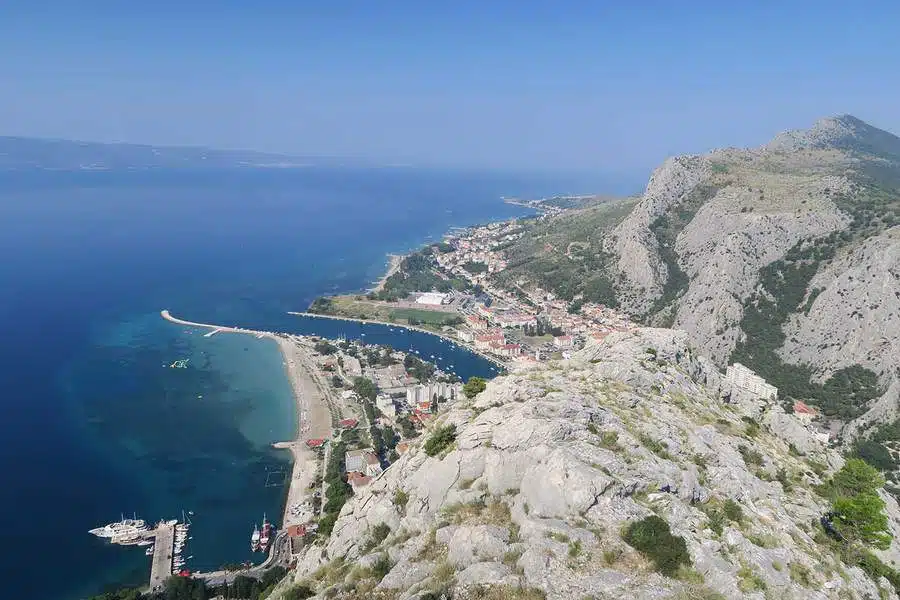
About 25 km south of Split, the town of Omiš sits where the Cetina River bursts out of a dramatic canyon into the sea. In the Middle Ages, it was a base for the notorious Omiš pirates, and you can still climb up to the Mirabela and Fortica fortresses for the views over the town and the river mouth.
If you fancy your day trips with a heavy dose of adrenaline, though, the main event is rafting on the Cetina. The river has gentle stretches and grade three rapids, which, from my experience, are fairly rough. Most trips include stops for swimming and cliff jumping.
There’s also a zipline across the canyon and gentle boat trips up the river, if rafting isn’t your thing.
How to visit: Book a Cetina River rafting and cliff jumping tour
Hop over to Hvar
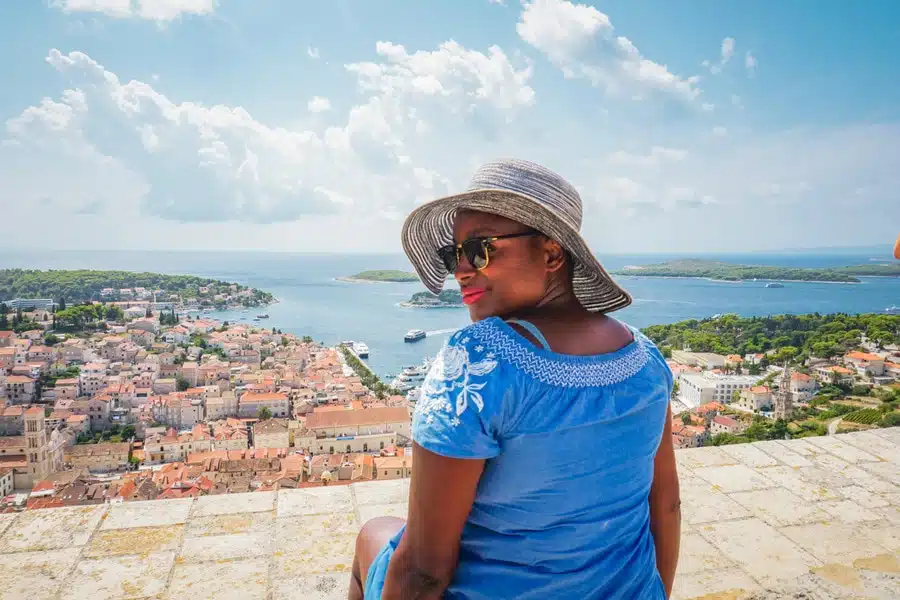
Hvar is my favourite place in Croatia, and it’s only about an hour from Split by catamaran. I swung by on one of my trips to Croatia and, although I initially only planned to stay a few days, a few days turned into just over a week.
Hvar has a reputation as Croatia’s party island, and I’ll be honest: I didn’t love the bars and clubs. But there’s so much more to it than rich people and parties. I huffed and puffed my way up to the Fortica fortress early in the morning, which I’d recommend unless you like being sweaty mcsweaty, and the views over the town and the Pakleni Islands are spectacular. My favourite place to eat was Lungo Mare, which serves stellar seafood in a non-touristy part of town.
Catamarans run to Hvar Town many times a day in summer, but book ahead in high season. The car ferry goes to Stari Grad, on the other side of the island, and takes about two hours. If you only have a day, a boat trip that combines Hvar Town with the Pakleni Islands and a swim stop off Brač is the easiest way to see the highlights.
How to visit: Take a Hvar, Brač and Pakleni Islands cruise from Split
Read next: The best things to do in Hvar
Spend a day on Brač

Brač is the closest of the big islands to Split, and it’s the easiest island to do as a day trip.
The car ferry to Supetar takes about 50 minutes and runs all year round, and from mid-May to September a catamaran goes straight to Bol on the south coast in about an hour. Bol is home to Zlatni Rat, the long spit of fine pebbles that changes shape with the wind and currents and is one of the most photographed beaches in Croatia.
With a car, you can also drive up Vidova Gora, the highest peak on any Adriatic island, for views over Zlatni Rat and Hvar, and visit the Blaca hermitage, a monastery built into a cliff. Brač’s white limestone has been quarried for centuries and was used to build Diocletian’s Palace itself.
Read next: The best Croatian islands to visit
See the Blue Cave and Vis

The Blue Cave, on the tiny island of Biševo, is one of the most famous sights in Croatia. Around the middle of the day, sunlight comes through an underwater opening and lights the whole cave an unreal, glowing blue.
It’s a long day out from Split, so most people visit on a speedboat tour that also takes in Vis, Stiniva cove, the Blue Lagoon at Budikovac and Hvar Town. You transfer to a small boat to go into the cave, and you only get a few minutes inside, so manage your expectations. The cave can close when the sea is rough, and the light is best between about 10am and 2pm.
Vis itself was a closed military island until 1989, so it’s less developed than its neighbours. It’s where Mamma Mia! Here We Go Again was filmed, and its two towns, Vis and Komiža, are worth a night if you have one to spare. The ferry from Split takes about two and a half hours.
How to visit: Book a Blue Cave and 5 islands tour from Split
Split attractions: map
Love this? Save and share on Pinterest
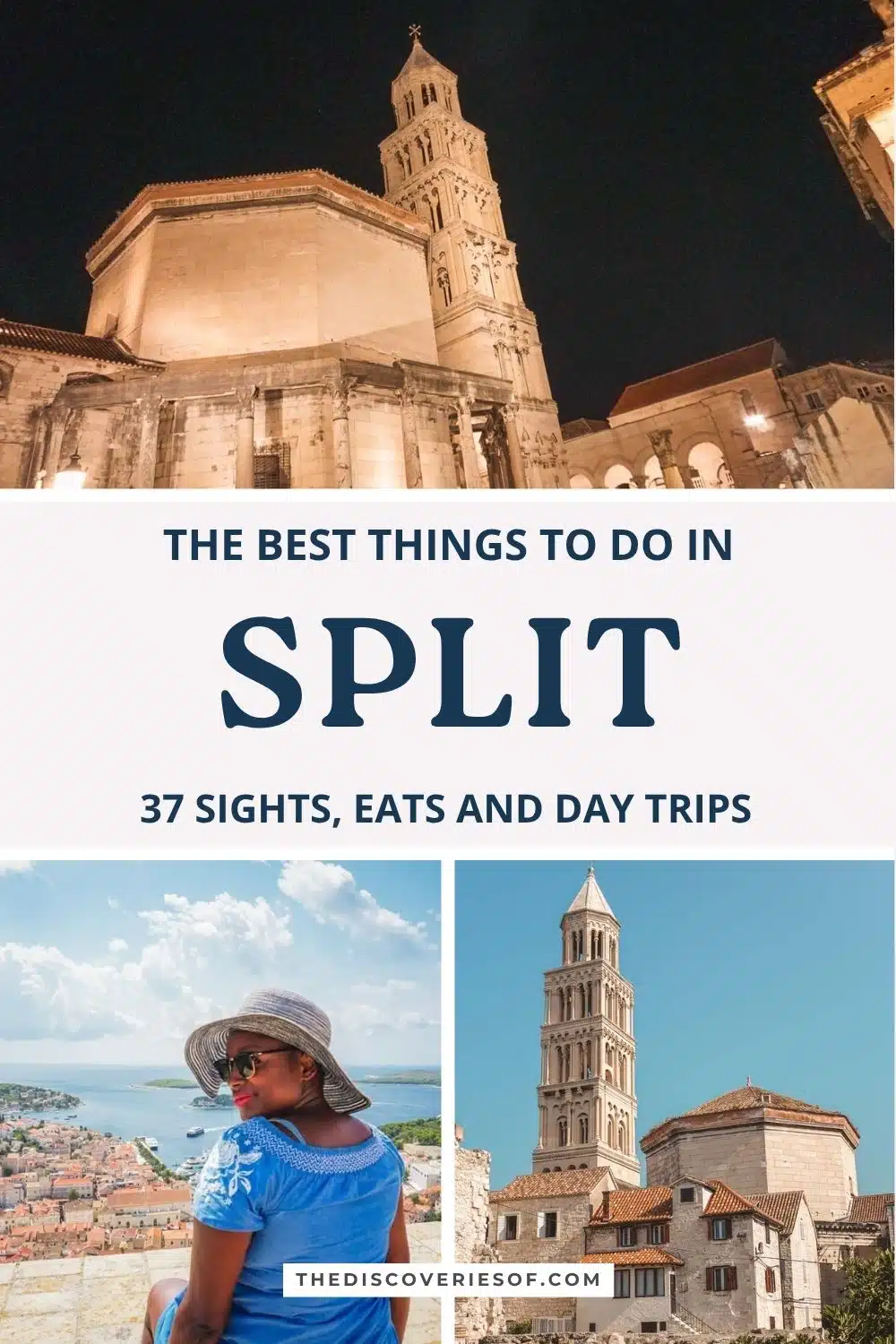
Looking for more Split and Croatia travel tips? Read these
- The best places to stay in Split
- How to see Croatia’s highlights on a 10-day trip
- The Dubrovnik city guide: cool things to do and see
- 24 hours in Zagreb: what to see in the Croatian capital in one day
- Things to do in Croatia
- How to visit Plitvice Lakes National Park
- The best things to do in Hvar

Discover the top things to do, insider tips and hidden gems in our Croatia Travel Guide.
Read the guides →