Heading to the Amalfi Coast and looking for the best things to do in Sorrento? This clifftop town on the Bay of Naples may be small, but it packs in lemon groves, sea-bathing platforms, Baroque churches and some of the best day trips in Italy.
Sorrento sits on a ledge of rock high above the water, with pastel-coloured facades, a jumble of lanes and Vesuvius across the bay. I’ve had the pleasure of visiting Sorrento a few times, each trip more magical than the last, and yet I’m still dreaming about my next visit.
Take it from me: after a few days in this charming town, you’ll be dying to return. Two or three days will cover the town itself, but give yourself closer to a week if you want to add Capri, Pompeii and the Amalfi Coast. May, June, September and early October are the sweet spot, with warm sea and fewer crowds than July and August. In winter, many hotels and ferries close or cut back, but prices drop and the town feels far more local.
There’s something for everyone in this guide, whether you’re a fan of art, a foodie, or keen on a bit of adventure.
Some links in this article may be affiliate links, which means we may receive a small commission, at no additional cost to you, if you decide to purchase through one of my recommended partners.
Not sure where to stay on your getaway? Consider staying at the charming Il Roseto, an adults-only bed and breakfast with a pool, about 15 minutes’ walk from Piazza Tasso along Corso Italia.
Top 5 things to do in Sorrento
Visit Marina Grande and Marina Piccola

Despite its name, Marina Piccola (Small Marina) is actually larger and busier than Marina Grande. If you’re looking to take a ferry to Capri, Positano, Amalfi or Naples, this marina will be your point of departure. You can walk down the steps from Piazza Tasso, or take the public lift from the Villa Comunale gardens.
Marina Grande is the old fishing village, a smaller marina with colourful buildings that house many family-run seafood trattorie. Stop by Trattoria da Emilia, which has been feeding the harbour since 1947, for hearty seafood gnocchi, or Bagni Delfino, a restaurant right on the water, for a meal with a delicious view.
Sorrento doesn’t really do big sandy beaches. Instead, you swim from small pebbly coves and from the wooden bathing platforms that stick out from the foot of the cliffs below town. Most are private lidos where you pay for a sunbed and umbrella, but there are a few free stretches, including the little beach at Marina Grande, if you just want to lounge about or take a dip.
Take a cooking class

There’s no doubt in my mind that Sorrento is as much a visual experience as it is a gastronomic one.
In fact, I would take a punt that there’s no better way to get an authentic taste of the traditional Sorrento cuisine and culture than by preparing it yourself, under the watchful eye of Nonna, of course.
Take a cooking class to learn how to prepare authentic Sorrentine dishes from scratch and with the freshest ingredients. This three-hour class runs at lunchtime or in the evening, starts with a welcome cocktail and ends with the three-course meal you’ve cooked, with wine on the table. There are meat, fish and vegetarian menus.
Or get hands-on experience learning to make the perfect Italian pizza from a proper pizzaiolo. The pizza course takes about two hours and ends by sitting down to enjoy the meal you’ve just made with your group and new friends.
Book your Sorrento cooking class here
Explore the Sorrento coast by kayak

One of the more unusual ways to see the town is from a kayak. Depart from Marina Grande on a two-hour small-group paddle to Bagni della Regina Giovanna and the nearby Roman ruins, with a stop to swim in the natural pool before you paddle back.
Or, join a longer guided trip towards Punta Campanella and the Bay of Ieranto, said to be the home of the tempting Sirens which Ulysses encountered. You’ll view the cliffs from a completely new perspective and get to peek at the ocean life while you’re at it, as the coast around Punta Campanella is a protected marine area.
Stay at an agriturismo
If Sorrento had veins, it would have lemon juice pumping through it. You’ll find lemon-flavoured pasta, lemon gelato (my favourite), and limoncello served up all over the town. But the peninsula is also covered in olive groves and walnut trees, and has all sorts of other tasty local produce, from fior di latte to the provolone del Monaco cheese made in the hills.
Of course, you’ll find all of Sorrento’s fresh yields served up in its restaurants and at food markets, but I urge you to experience a different side of Sorrento. Why not book your next stay at an agriturismo (farmhouse) and enjoy homey meals prepared with produce grown only a few steps away? Fattoria Terranova is a working farm in the hills of Massa Lubrense, with its own restaurant.
If you’d rather stay in the thick of things, two very different hotels in town are worth a look.
Casa Sorrentina is the place if you want to be central. This bright and elegant guesthouse sits just off Piazza Tasso, a few minutes’ walk from the steps down to the sea.
Check rates and availability for Casa Sorrentina
Or wake up to sea views at the Grand Hotel Capodimonte. This four-star superior hotel is about ten minutes’ walk from Piazza Tasso, with terraced gardens, several swimming pools and views across the Bay of Naples to Vesuvius, which is all you’ll need to unwind below the Sorrentine sun.
Check rates and availability for Grand Hotel Capodimonte
Take a day trip along the coast

Sorrento also happens to be as conveniently located as it gets. It’s a short boat ride from the island of Capri, a bus ride from pretty Positano, and half an hour by train from the famous Italian landmark, Pompeii. You would be a fool not to spend a day or two exploring the nearby towns and attractions, and I’ve given each of the best ones its own entry further down.
If you’d rather someone else did the planning, take an Amalfi Coast day trip by boat and enjoy the scenic route. It picks you up from your hotel, sails from Massa Lubrense past the Li Galli islands, and gives you free time in Amalfi and then Positano. On the way back you’ll have the chance to swim and snorkel off Nerano.
Or, go on a trip to Pompeii and Mount Vesuvius with a guide on this full-day tour, which you can join from Sorrento. Exploring this archaeological site with a guide means you won’t miss any important sights, and the views over the Bay of Naples from the top of Vesuvius are breathtaking.
Book your Amalfi Coast boat trip
Brilliant things to see and do by day
Bathe in the Bagni della Regina Giovanna

If you’re wondering what to do in Sorrento in the summer, the Baths of Queen Giovanna are the perfect place to lounge about on the rocks, read a book and cool down. The clear turquoise water, which flows into a natural rock pool through a narrow arch from the sea, is the perfect tonic to a hot summer’s day.
The pool sits on the headland of Capo di Sorrento, among the ruins of the Villa Pollio Felice, a Roman villa built in the 1st century AD. Legend has it that Queen Giovanna II of Anjou used to entertain her lovers here in the 15th century. And, with rock and trees sheltering the pool, it’s not hard to see why. Why not bring your own love interest here for a romantic picnic and bask in those Sorrento sunrays?
It’s about a 30-minute walk from the centre, or a short bus ride to Capo di Sorrento and then a walk down a lane. There are no facilities, so bring water and shoes you can swim in, and come early or late in the day in summer, when it gets very busy around midday.
Admire the Correale di Terranova Museum
Once the 18th-century summer home of the Correale family, the Counts of Terranova, this villa is now a museum spread over three floors. The last two brothers of the family, Alfredo and Pompeo, left the house and its collection to become a museum.
The 24 rooms contain displays of precious porcelain from Capodimonte, Meissen and Sèvres, 18th-century clocks, Neapolitan paintings, inlaid furniture and archaeological finds. Don’t skip the dreamy garden, where an avenue runs through citrus groves to a terrace high above the sea, and visitors are invited to sit down and breathe in the beauty.
The museum reopened in spring 2026 after a closure. Entry is €15 and it’s closed on Mondays.
Marvel at the Cathedral of Saints Filippo and Giacomo of Sorrento

While this cathedral, otherwise known as Sorrento Cathedral, appears humble on the outside, you’ll be the humbled one upon entry.
Founded around the 11th century and rebuilt in the 15th, it has been redecorated so many times over the centuries that it’s now a treasure trove of Baroque beauty behind a facade that only dates from 1924. The main doors are older still, said to have come from Constantinople in the 11th century, and the poet Torquato Tasso was baptised here.
Look out for the inlaid-wood panels inside, including the Stations of the Cross, made using marquetry, a long-standing traditional Sorrentine craft. If, like me, you’re a fan of stunning architecture, this cathedral is well worth visiting.
Learn about marquetry at the Bottega della Tarsia Lignea Museum
Staying on the topic of marquetry, Sorrento takes immense pride in this craft, and rightfully so. The Museobottega della Tarsialignea houses some of the most exquisite examples of intarsio (inlay) furniture you’ll ever come across.
The museum fills the 18th-century Palazzo Pomarici Santomasi on Via San Nicola. Its collection runs from inlay masters of the 15th to 18th centuries to the Sorrentine workshops of the 19th century, and it also includes paintings, photos and prints of everyday life in Sorrento from that period. The ground floor sells modern inlaid pieces if you want to take one home. It’s open daily and costs around €8.
Go shopping on Corso Italia

Whether you’re looking to buy a bottle of limoncello (bring one back for me please) or even an ornate wood-inlay box as a memento, Corso Italia should be your first port of call. Running straight through Piazza Tasso, this road is ever-buzzing with local and visiting shoppers.
Treat yourself to a high-end shopping spree, or relax at one of the many bars and take in the beautiful sights and zesty scents surrounding you. Be sure to explore the laneways flowing out from this street to discover more treasures.
Explore Villa Fiorentino
The Fondazione Sorrento runs Villa Fiorentino, a handsome villa on Corso Italia that is now the town’s main cultural space, and a regular host to weddings.
Pop by to see the latest temporary art or photography exhibition, or have a look at their website to find out about upcoming events. The gardens, with roses, camellias and a citrus grove, are a peaceful place to sit.
Also, be sure to visit their permanent collection of enchanting music boxes on the second floor, donated to the town by the Sorrentine cabinetmaker Enrico Salierno, and a second permanent display that shows how Sorrento inlay is made, step by step.
Admire nature-covered ruins at Il Vallone dei Mulini

Just behind Piazza Tasso, you’ll find the mystical “Valley of the Mills”, named after the wheat mill that worked here until the early 1900s. The streams also powered a sawmill that cut wood for local carpenters and inlay makers, and local women came here to do their washing. This was once a thriving area, but when Piazza Tasso was built in 1866, it cut the gorge off from the sea at Marina Piccola.
Without the sea breeze, the gorge became a humid, uninhabitable valley, for humans anyway. In these ideal growing conditions, nature has taken it upon itself to adorn the old mill, which is now draped in ferns. You can’t walk down into it, but you can view and capture this greenwashed gorge from the railings on Via Fuorimura, a couple of minutes’ walk from Piazza Tasso.
Discover the peninsula’s history at the Georges Vallet Archaeological Museum
Travel back in time to learn more about Sorrento’s history by heading over to the Territorial Archaeological Museum of the Sorrento Peninsula “Georges Vallet”. It’s in Villa Fondi, a villa above the sea in neighbouring Piano di Sorrento, a couple of stops from Sorrento on the Circumvesuviana train or a short bus ride.
The museum is home to archaeological finds that go back thousands of years, from prehistoric objects and Greek grave goods to Roman marble and a mosaic from Massa Lubrense. It also traces the story of the Roman town of “Surrentum” and finds from the Temple of Athena at Punta Campanella. It’s an insightful collection that will leave you feeling even more connected to the area. Entry is €7, it’s closed on Mondays and opening hours change through the week, so check before you go.
Visit the Basilica of Sant’Antonino
Sorrento’s patron saint, Antonino Abate, died here in the 7th century, and his basilica on Piazza Sant’Antonino has been standing since at least the 11th century. Locals credit him with saving the town from plague, invasion and shipwreck.
The best story is the one about the whale. Antonino is said to have rescued a child who had been swallowed by one, which is why you’ll find whale bones hanging in the entrance. Head down to the 18th-century crypt to see the paintings and gifts left by sailors who believed he had saved them at sea.
Tour a lemon grove
Sorrento’s lemons, the big, knobbly sfusato lemons with thick, fragrant skins, grow on terraces all over the peninsula, under dark pergolas of straw and netting that protect them from the wind. Some of the most beautiful groves are right in town, hidden behind high walls.
To get behind those walls, book a visit to a working garden. On this limoncello making and tasting experience, you’re taken by minivan from Via Fuorimura to a lemon garden a few minutes away to pick the fruit and make your own limoncello. It takes about an hour, and it’s the perfect excuse to come home with a bottle you made yourself.
Walk to the Bay of Ieranto and lunch at Marina del Cantone
West of Sorrento, the peninsula gets wilder. The village of Nerano, in Massa Lubrense, is the starting point for a path down through olive groves to the Bay of Ieranto, a protected cove looked after by the FAI (Italy’s National Trust) with views across the water to Capri. In 2026 the old quarry platform and the sea off it were closed while repairs are planned, but the path and the beach in the middle of the bay remain open.
Afterwards, walk down to Marina del Cantone, a pebbly fishing village with restaurants right on the beach. This is where spaghetti alla Nerano, made with fried courgettes and provolone del Monaco, was invented, and it’s the dish to order. Buses run from Sorrento to Nerano and Marina del Cantone, though it’s easier still to hop on a boat.
Sorrento at night
Wander through the Villa Comunale gardens

If you’re looking for things to do in Sorrento at night, the Villa Comunale is the park to be. This small clifftop garden next to the church of San Francesco is a popular spot for tourists and locals to take a walk or kick back on a bench and enjoy the views and fresh coastal air at sunset.
The terrace is the perfect place to view the Gulf of Naples, Mount Vesuvius, and the islands dotting the horizon, and you’ll often find music here on summer evenings. A public lift runs from the gardens down to Marina Piccola, which saves you the steps.
Piazza Tasso
Don’t get me wrong: Piazza Tasso is well worth visiting during the day. But the atmosphere is entirely different and even more exciting at night.
As boring as it may sound, one of the main highlights is people watching. You’ll spot families taking an evening passeggiata, couples enamoured with each other, and young adults hanging out.
Of course, it’s rude to stare. So join the crowd with a stroll, or enjoy a drink at one of the surrounding bars. If you want the stories behind what you’re looking at, this guided walking tour with a local guide takes about two and a half hours.
Go lemon crazy on Via San Cesareo
While it’s smaller, narrower, and much less fancy than Corso Italia, Via San Cesareo does not lack zest or excitement.
This narrow shopping street through the old town is the spot if you’re looking for anything lemon-related (soap, fridge magnets, liqueur). You’ll also find spectacularly crafted products, inlaid wood, leather goods and ceramics, and may just hear some music while you shop.
Along the way, look out for the Sedile Dominova, a 16th-century open loggia where the town’s nobles once met. It has faded 18th-century frescoes and a green and yellow majolica dome, and in the late afternoon members of the local workers’ mutual aid society still gather inside to play cards. While wandering the street, keep an eye out for the little Chiesa dell’Addolorata too.
Take a passeggiata

Although mentioned before, I’ve yet to stress the importance Italians place on the passeggiata. These evening strolls are enjoyed by one and all in Italy, and can be taken pretty much wherever you are.
This evening stroll is not only a great activity with the family but also an excellent opportunity for social interaction. And it’s yet another fantastic free thing to do in Sorrento.
Enjoy the evening air, moonlight, and relaxed atmosphere with a stroll along Corso Italia, the marina, or wherever your heart takes you.
The Cloister of San Francesco

The church of San Francesco began life in the 8th century as an oratory founded by Saint Antonino, and Franciscan friars took it over in the 14th century. Its cloister is brimming with compelling surprises: two sides have rounded arches and the other two have interlaced Arab-style arches, with columns and capitals said to have been salvaged from older buildings.
The Cloister of San Francesco is undoubtedly a joy to visit during the day, when it’s shady and full of bougainvillea, but evening classical concerts provide an entirely different experience. Attend a nighttime show in summer and travel back to a different era amongst the mix-and-match architecture. It’s also one of the most popular wedding venues in town.
Sunset cruise from the marina

Another fun thing to do in Sorrento is to glide along the coast. Take a sunset cruise to Capri island for a truly luxurious and memorable Sorrento adventure. This small-group trip leaves in the late afternoon, stops for swims, and sails home after dark.
Enjoy wine, good company, and perhaps even a meal on the island of Capri before heading back to Sorrento’s twinkling lights.
Book your Sorrento sunset cruise
See a tarantella show
The Spanish have flamenco, and the Italians have the tarantella. This traditional southern Italian folk dance is usually danced in pairs, as it’s considered bad luck to dance alone.
The long-running dinner show at Teatro Tasso, just off Piazza Tasso, works the tarantella and the folk legends of the area into an evening of music, singing and dancing, with colourful outfits and a glass of wine. If you’d like to take it a step further, why not book a tarantella dancing class so you can leave the town with a new skill?
Day trips from Sorrento
Capri

Capri is the classic day trip, and it’s close. Fast ferries from Marina Piccola take 20 to 30 minutes, run by Caremar, NLG, Alilauro and SNAV, with one-way fares from about €16 to €23. A small landing tax is built into the ticket price.
Once you’re there, take the funicular up to the Piazzetta, walk out to the Gardens of Augustus for the view over the Faraglioni rocks, and catch a bus up to Anacapri, where a chairlift climbs Monte Solaro. The Blue Grotto is reached by rowing boat from the cave mouth: entry costs €19 (the boat plus the site ticket), there’s no booking, so you queue on the water, and it closes whenever the sea is rough.
Capri gets very busy in summer, and since May 2026 the island has new rules to keep things liveable. Tour groups can land no more than 40 people at a time, guides of groups over 20 have to use headsets, and loudspeakers, flags and umbrellas held aloft are banned. The easiest way to dodge the crowds is to see the coast by boat: this Capri boat tour from Sorrento circles the island, with the Blue Grotto as an optional stop.
Positano

Positano is the Amalfi Coast’s postcard: a stack of pink, peach and white houses tumbling down to a dark sand beach, with the majolica dome of Santa Maria Assunta at the bottom. It’s steep, glamorous and expensive, and it’s at its best early in the morning before the boats arrive.
Wander the lanes of boutiques selling linen and sandals, then walk the cliff path to Fornillo Spiaggia, the quieter beach just west of the main one. If your budget stretches, have a drink on the terrace of Le Sirenuse, one of the most stunning hotels on the coast.
From Sorrento, the SITA bus takes around 40 minutes along the clifftop road (buy a ticket before you board; a 24-hour COSTIERASITA pass is €10). In season, the prettier option is the ferry, which takes about 35 minutes, or this boat tour to Positano and Amalfi, which is one of the cheapest ways to see both by sea.
Amalfi and Ravello

The town of Amalfi was once the capital of a powerful maritime republic, and you can feel it in the Cathedral of Sant’Andrea at the top of its grand staircase. Pay to see the Cloister of Paradise next door, with its interlaced white arches and palm trees, then head up into the paper-making valley above town.
From Amalfi, it’s a short bus ride up to Ravello, which sits high above the sea and feels a world away from the crowds below. Villa Rufolo has the gardens that inspired Wagner and hosts the Ravello Festival concerts each summer (tickets €8, sold on site only). Villa Cimbrone (€10) has the Terrace of Infinity, a balcony of marble busts looking straight down the coast.
The SITA bus from Sorrento takes about an hour and a half to Amalfi. If you’re thinking of driving the Amalfi Coast road instead, know that on peak dates (in recent years Easter week, the late April to early May holidays, summer weekends, and every day in August and September), an alternating number plate rule applies on the SS163 between Positano and Vietri sul Mare from 10am to 6pm. On odd dates, cars with a plate ending in an odd number can’t use it, and on even dates the same goes for even numbers. Guests with a hotel booking can arrive and leave on their booked dates, but check with your hotel first.
Hike the Path of the Gods

The Sentiero degli Dei, or Path of the Gods, is one of the most beautiful hikes in Europe, a narrow path high above the Amalfi Coast with views all the way to Capri. Walk it from Bomerano, in Agerola, to Nocelle, above Positano, and it’s mostly downhill: about 7.8km and three to four hours with stops.
From Nocelle, either take the local bus down to Positano or walk the 1,500 or so steps. The trail is free, with no permit or booking, but there are cliff-edge sections with no railings, so it isn’t one for vertigo sufferers or very young children. April, May, September and October are the best months; skip it in the heat of July and August, and after heavy rain.
Getting to the start by public transport from Sorrento is a slog: a SITA bus to Amalfi, then another up to Agerola, about two hours in all. This guided Path of the Gods hike picks you up in Piazza Tasso and drives you there and back.
Pompeii

When Vesuvius erupted in AD 79, it buried Pompeii under metres of ash, and the city that has been dug out since is like nowhere else on earth: whole streets of houses, bakeries, bars, frescoed villas and an amphitheatre. It’s huge, so give it at least half a day and wear proper shoes.
It’s easy from Sorrento: the Circumvesuviana train takes about half an hour to Pompei Scavi-Villa dei Misteri, right by the entrance. In season, the Campania Express tourist train runs a few times a day with reserved seats for a higher fare.
Book ahead. Tickets are named, so bring ID that matches, and the site caps visitors at 20,000 a day. From mid-March to mid-October you also book a time slot, morning (9am to 1pm) or afternoon (1pm to 5.30pm). The Pompei Express ticket (the ancient city) costs €20, and Pompei Plus (adding the Villa of the Mysteries and the suburban villas) costs €25; the official seller is Vivaticket. Under-18s go free, and so does everyone on the first Sunday of the month, when it’s at its busiest. If you’d rather have it all arranged, this Pompeii tour from Sorrento includes transport and a guide, with the option to add Vesuvius.
Herculaneum
If Pompeii is the big picture, Herculaneum is the close-up. This smaller, wealthier town was buried under a far deeper layer of volcanic material than Pompeii, which sealed it so well that upper floors, wooden beams and even furniture survived. Hundreds of skeletons were found in the boat sheds on the old shoreline, where people had sheltered from the eruption.
It’s further along the same Circumvesuviana line (get off at Ercolano Scavi), it takes two or three hours to see, and it’s far less crowded than Pompeii. Entry is €13, and you can book an entry ticket with an optional audio guide in advance.
Mount Vesuvius

Standing on the rim of the volcano that destroyed Pompeii is quite something. Buses and shuttles run from Ercolano and Pompeii to the car park at about 1,000 metres, and from there a wide gravel path climbs to the crater edge. Allow about two hours up and back.
Tickets for the Gran Cono (around €12) are sold only online through the park’s official Vivaticket site, in 10-minute time slots released 30 days ahead. There’s no ticket office at the top, so book before you go. The path closes in high winds, heavy rain and on days with a weather warning. The simplest way to do it from Sorrento is this park entry ticket with a return bus from Ercolano, or combine it with Pompeii on the full-day tour above.
Naples

Naples is loud, chaotic and completely addictive, and it’s well under an hour away by hydrofoil from Marina Piccola, or just over an hour by Circumvesuviana train to Napoli Garibaldi. Head straight for the old centre along Spaccanapoli, duck into churches stuffed with Baroque treasures and, of course, eat pizza in the city that invented it.
Don’t miss the National Archaeological Museum, where many of the frescoes, mosaics and statues from Pompeii and Herculaneum ended up. It makes the perfect follow-up to a day among the ruins.
Things to do in Sorrento: map
Discover more Italy travel guides
- Italy travel guide and tips
- Famous landmarks in Italy you have to see
- Burano, Italy: a gorgeous day trip from Venice
- Visiting Italy’s Cinque Terre: what you need to know
- Best beaches in Italy
- The best Italy road trips
- The best day trips from Rome
Love this? Save and share on Pinterest
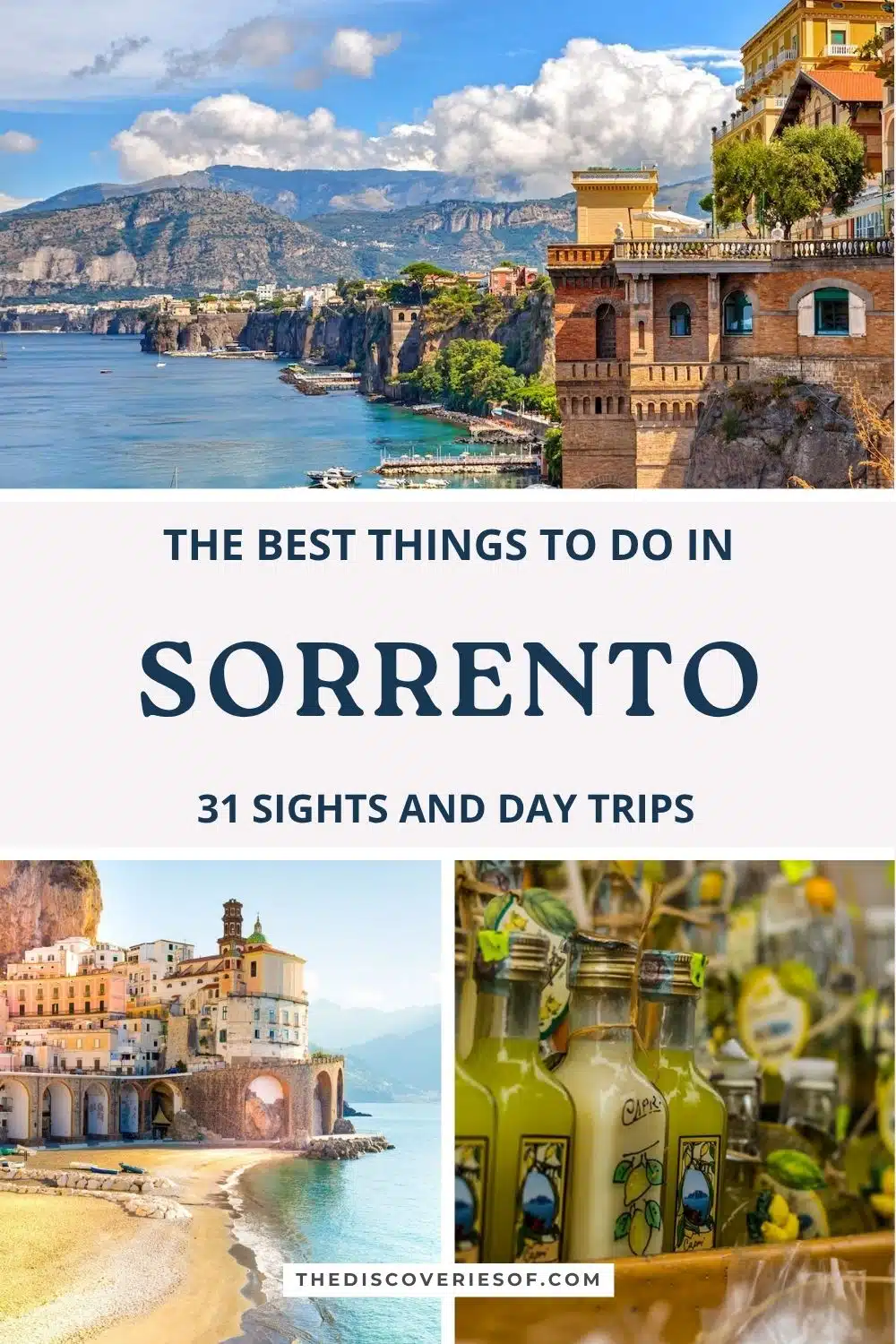

Discover the top things to do, insider tips and hidden gems in our Italy Travel Guide.
Read the guides →