The Great Temple of Ramses II is one of the wonders of ancient Egypt, a temple carved deep into a sandstone cliff at Abu Simbel. Here’s how to read it, from the four colossi on the facade to the Battle of Kadesh and the sanctuary the sun lights up twice a year.
Even among Egypt’s proliferation of striking landmarks and historic sites, this one stands out. It forms part of the wider complex at Abu Simbel, on what used to be the border with ancient Nubia, and it tells the story of one of Egypt’s greatest rulers, exactly the way he wanted it told.
Ramses built this temple to glorify himself, and it shows. It’s also breathtaking. You walk up to four colossal versions of the same face, then into halls carved from floor to ceiling with his victories, and the scale of his ambition is impossible to miss.
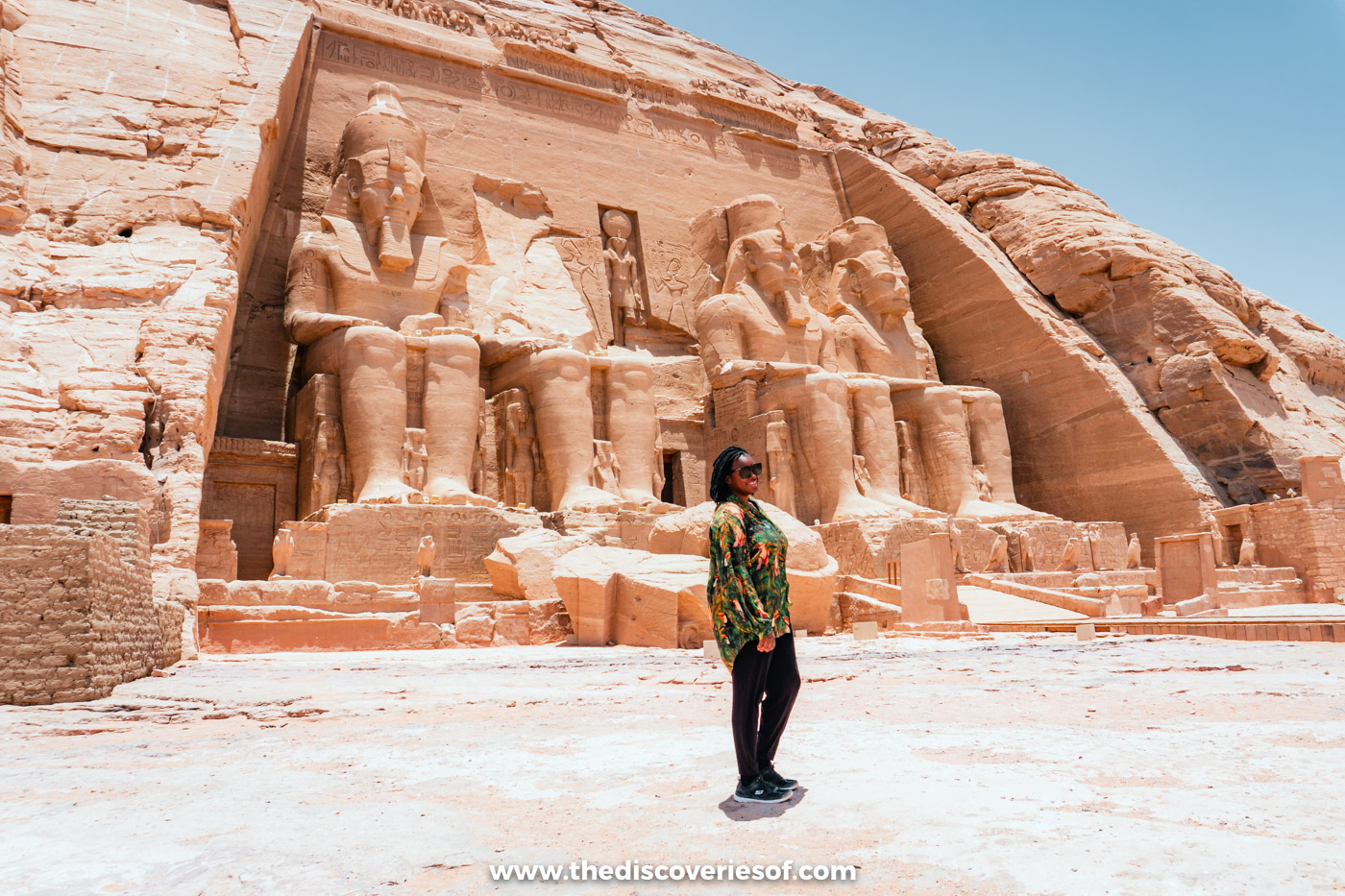
I went in early June, the day after Philae, and among the many incredible temples in Egypt, this one lives up to its name. This guide is about the temple itself: who built it and why, what you’re looking at on the facade, and what to find in each room as you walk deeper into the rock. For getting there, tickets and the Small Temple next door, see my guide to visiting Abu Simbel.
At a glance
- Where: Abu Simbel, on the west bank of Lake Nasser, about 280 km south of Aswan
- Built: around 1264 to 1244 BC, for Ramses II
- Dedicated to: Amun-Ra, Ra-Horakhty and Ptah, and to Ramses himself as a god
- Size: a facade 33 metres high and 38 metres wide, with rooms cut about 60 metres into the rock
- Ticket: about 820 EGP for adults, covering both temples
- Time needed: 45 minutes to an hour inside the Great Temple, more with a guide
- Sun festival: 22 February and 22 October
Why the Great Temple of Ramses II matters
To put it simply, to understand ancient Egyptian history, you need to understand Ramses II, and nowhere is his influence better seen than here.
Sure, nearly 3,000 years of ancient Egyptian civilisation left many well-preserved temples, built in a diverse range of architectural styles. But this one stands apart. Most temples were built up from the ground, block by block. This one was hollowed out of a mountain, with its halls, statues and reliefs all cut from the living rock.
Its location was no accident either. The site was sacred to the goddess Hathor, but by building on the frontier with Nubia, Ramses also made sure that anyone travelling north up the Nile, whether trader, envoy or enemy, would sail past a cliff carved with four giant versions of the pharaoh. It was a reminder of who was in charge, and of the gold, ivory and other riches that Egypt drew from Nubia.
Ramses had the temple carved for several reasons, among them to commemorate his “victory” at the Battle of Kadesh, which is duly represented on its walls. But above all, it’s a temple to Ramses as a god. In the sanctuary, he sits among the great gods of Egypt as one of them.
Who was Ramses II?
Ramses II was one of Egypt’s great rulers: a pharaoh under whose rule the country flourished, fought its neighbours and built on its reputation as a formidable force in the region. He came to the throne around 1279 BC, in the 19th Dynasty, and ruled for about 66 years, until around 1213 BC. He lived to be about 90, outliving many of his own children, and most of his subjects had never known another king.
Though he was many things (warrior, ruler, devoted husband), Ramses was never coy about letting everyone know of his accomplishments. During his reign, he embarked on a building campaign the length of Egypt, from the Hypostyle Hall at Karnak to his own mortuary temple, the Ramesseum, in Luxor. He also had his name carved over older kings’ monuments so often that Egyptologists have nicknamed him “the great chiseller”.
A few more things worth knowing before you go in:
- His wives: his great royal wife, Nefertari, has her own temple next door and one of the most beautiful tombs in Egypt, in the Valley of the Queens. He had several other wives, including Isetnofret and, later, a Hittite princess.
- His children: historians reckon he fathered more than 100 children, and some of them stand at the feet of the colossi outside.
- His peace treaty: after years of war, he signed a treaty with the Hittites around 1259 BC. It’s one of the earliest peace treaties to survive anywhere.
- His mummy: his tomb (KV7) is in the Valley of the Kings, but his mummy now lies in the Royal Mummies Hall at the National Museum of Egyptian Civilisation in Cairo, one of the best museums in Cairo.
The facade: four colossi and a falcon
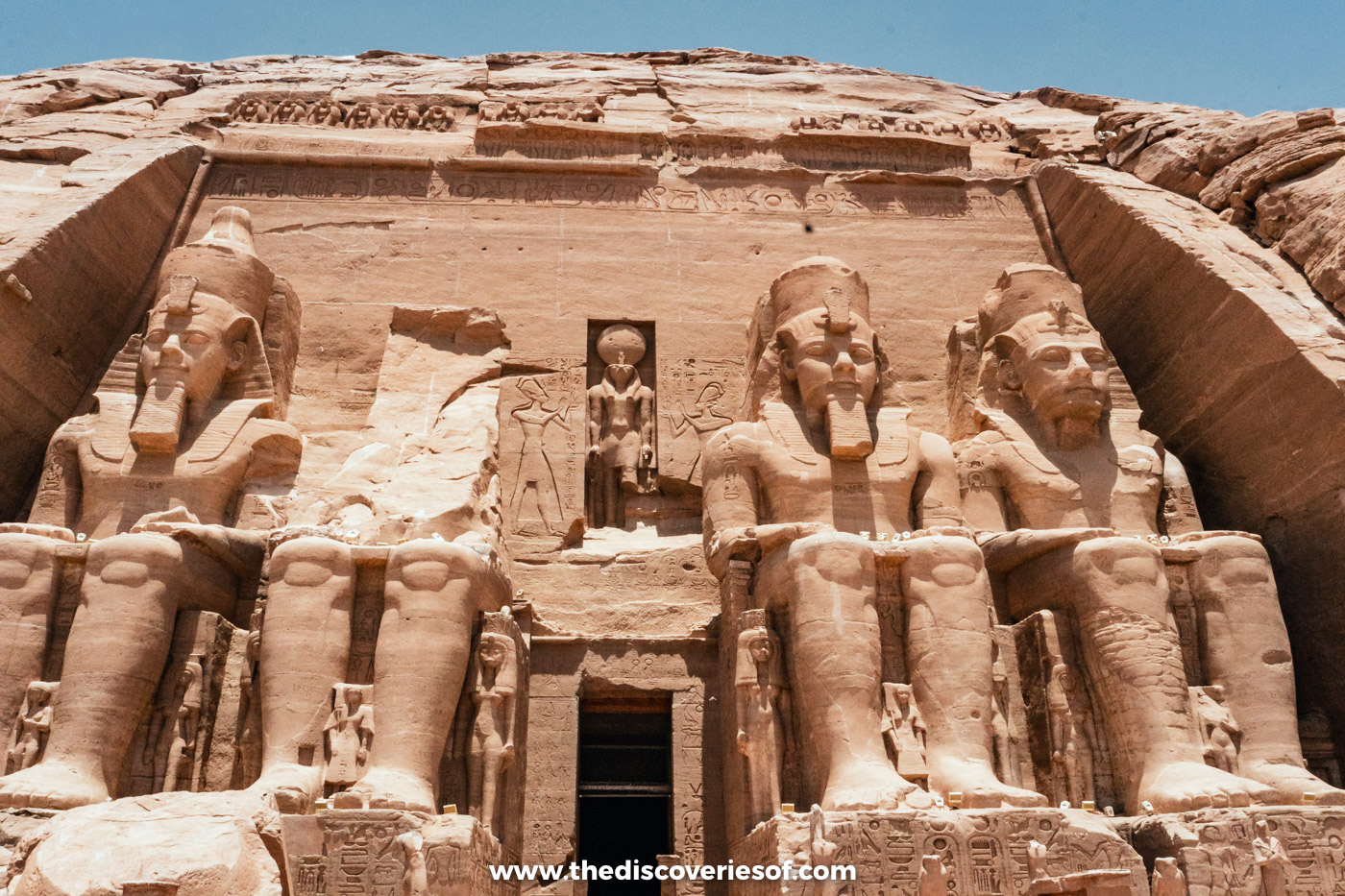
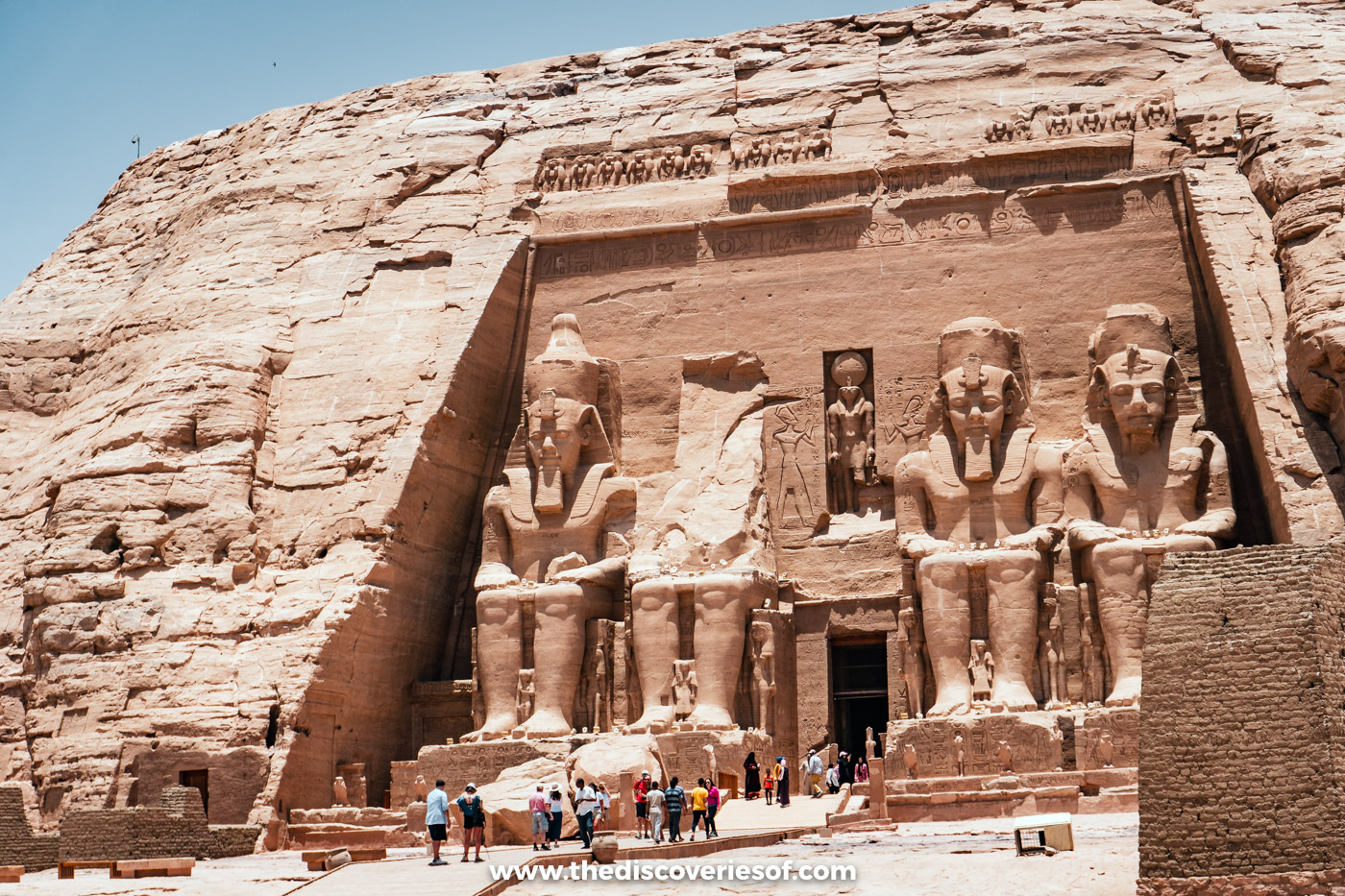
Coming down the path from the visitor entrance, you turn the corner and the facade reveals itself in its full glory. It’s 33 metres high and 38 metres wide, carved to look like the pylon, or monumental gateway, of a temple built of stone blocks.
The four colossi
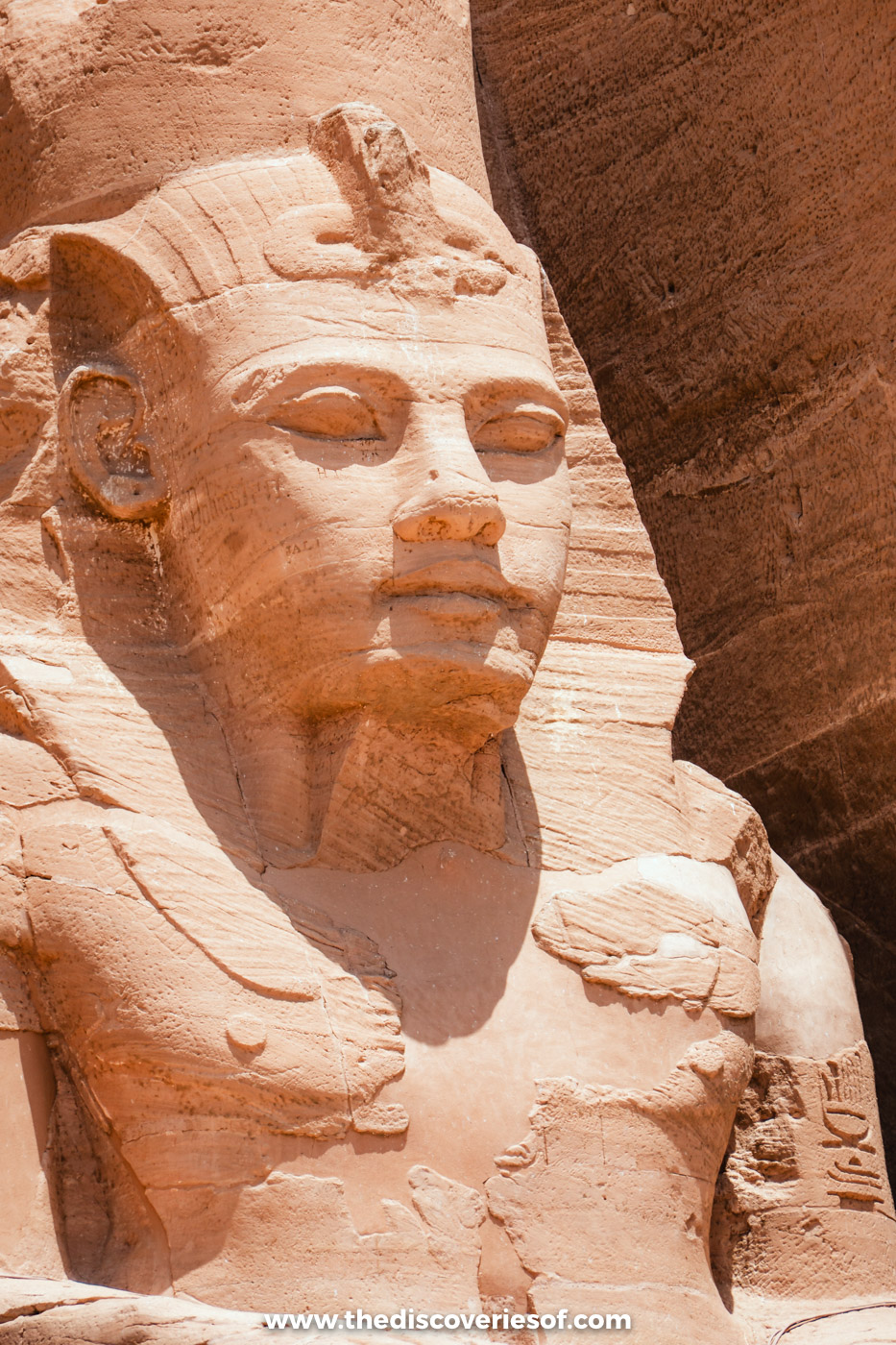
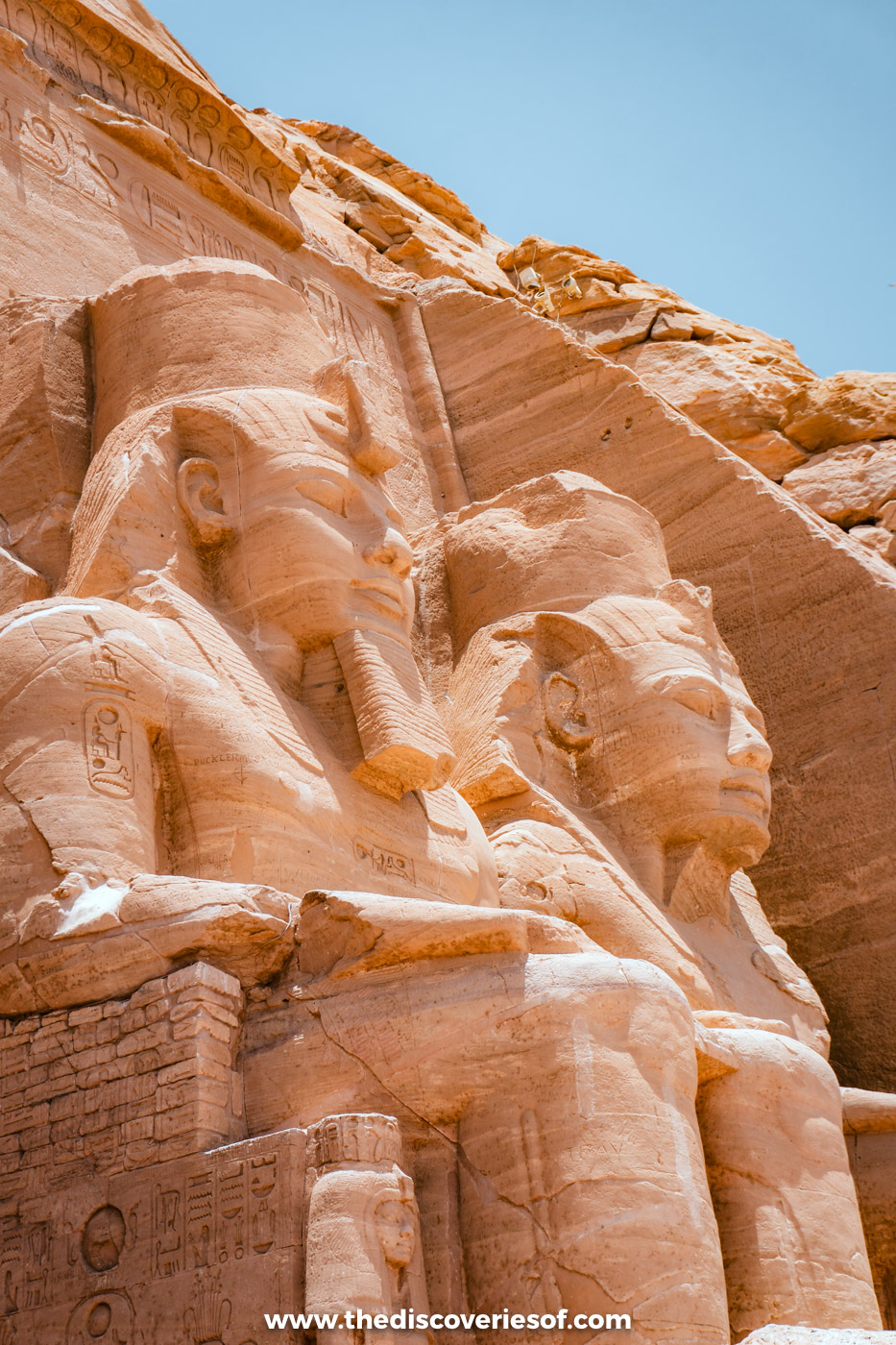
Four seated statues of Ramses, each about 20 metres high, guard the entrance. He wears the double crown of Upper and Lower Egypt and the striped nemes headcloth, and his names are carved on his shoulders and chest.
Look at the second colossus from the left. An earthquake brought its head and upper body crashing down not long after the temple was finished, and the pieces still lie where they fell. When the temple was moved in the 1960s, the engineers decided to put them back exactly as they were found rather than restore the statue.
The family at his feet
Around the legs of the colossi stand much smaller statues of the royal family, none of them taller than the king’s knees: his wife Nefertari, his mother Mut-Tuya, two of his sons and six of his daughters. Ramses is the giant here, and everyone else is to scale.
On the sides of the thrones, two Nile gods tie together the papyrus and the lotus, the plants of Lower and Upper Egypt, a symbol of the two lands united under the king. Along the bases, rows of bound captives make the same point less subtly: Nubians on the south side, and Asiatic enemies from the Near East on the north.
Ra-Horakhty above the door
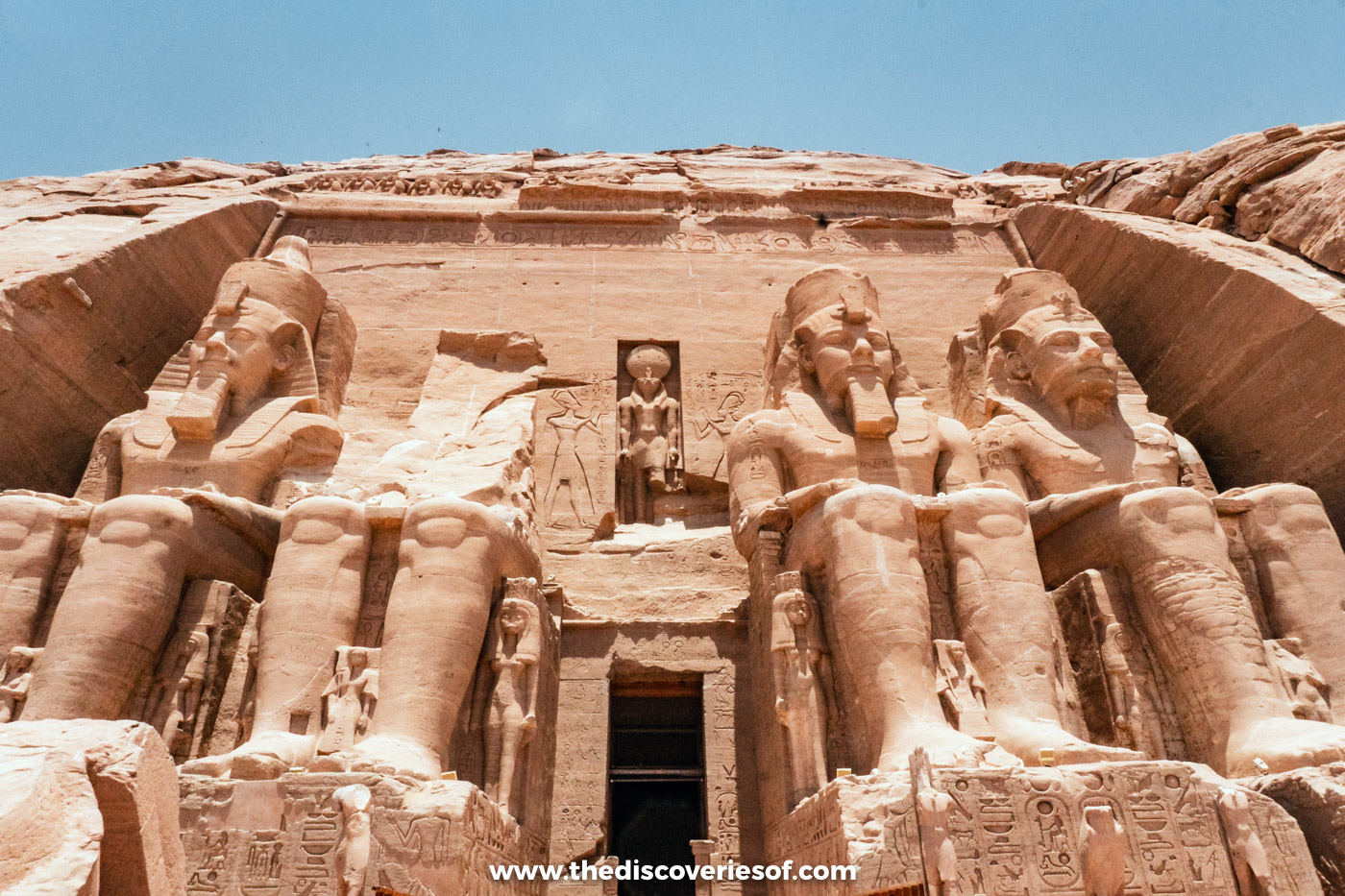
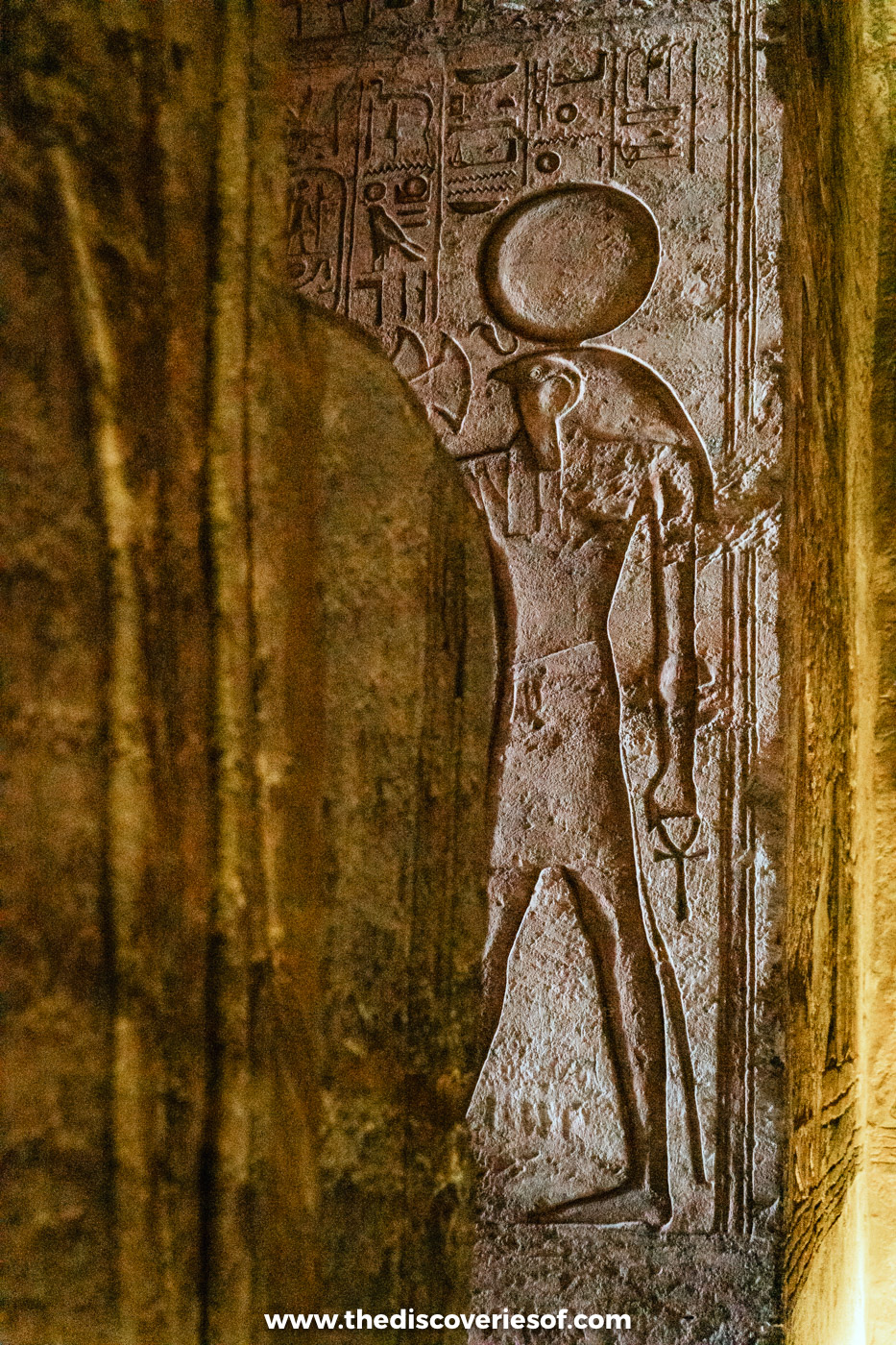
Above the entrance, the falcon-headed sun god Ra-Horakhty stands in a deep niche, with the king carved on either side worshipping him. It’s also a pun. Beside the god are a sceptre and a figure of Maat, goddess of truth and order, which together with the sun god’s name spell out Ramses’ throne name, User-Maat-Ra.
High above, along the very top of the facade, a row of 22 baboons raise their arms to greet the rising sun.
Graffiti 2,600 years old
Look closely at the legs of the colossi just south of the entrance. In 591 BC, Greek mercenaries serving in the army of the pharaoh Psamtik II, on their way back from a campaign in Nubia, scratched their names and a short account of their expedition into the stone. By then, the sand had already reached the colossi’s knees, which is why they could reach. It’s one of the oldest known Greek inscriptions anywhere, and travellers have been leaving their mark here ever since.
Inside: the hall of Osiride statues
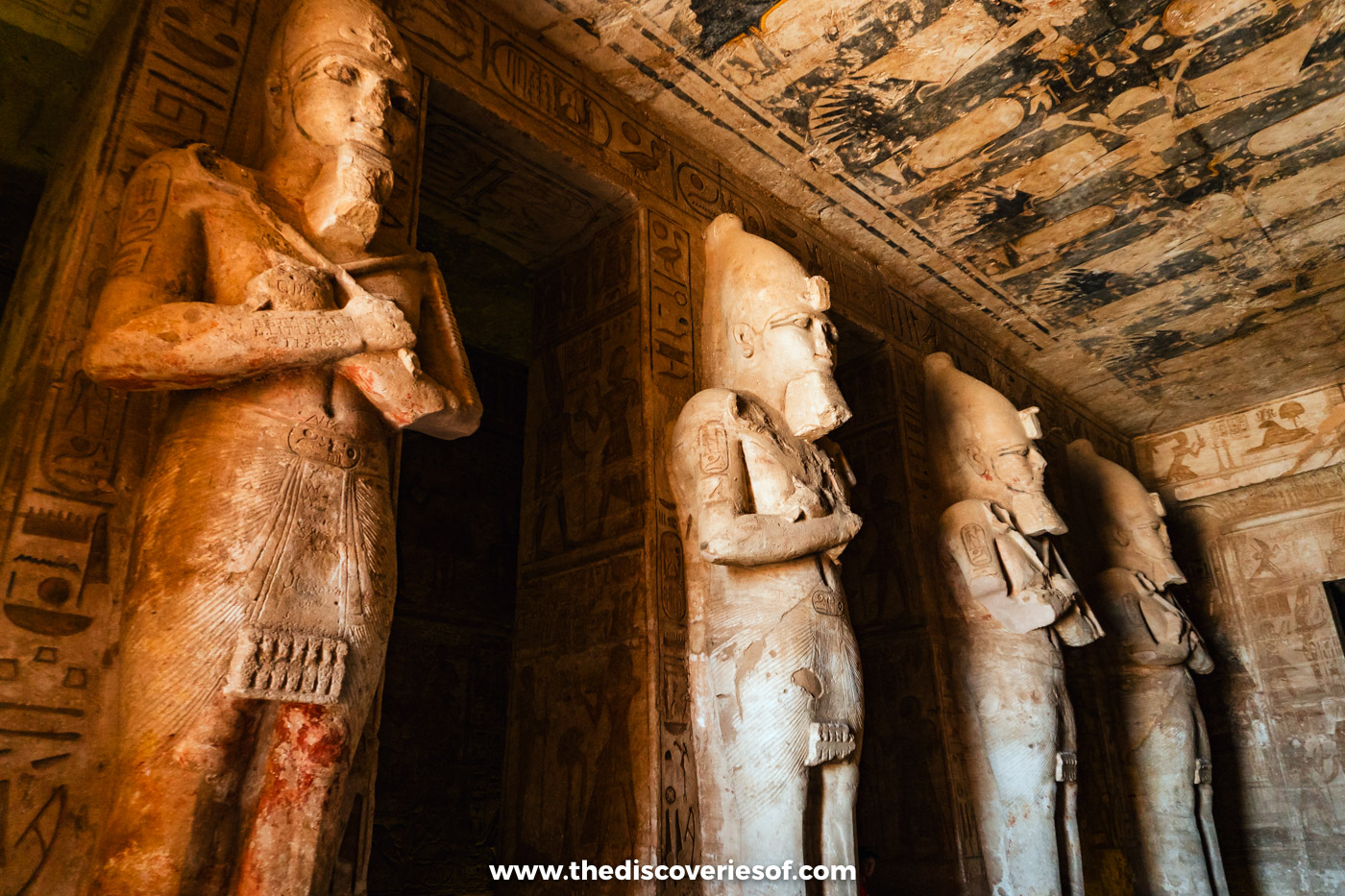
Step through the door and your eyes take a moment to adjust. The first room is the great hall, about 18 metres long and 16.7 metres wide, and it’s lined with eight huge statues of Ramses as Osiris, god of the afterlife, each about 10 metres tall. His arms are crossed over his chest, holding the crook and flail. Look at the crowns: the four on the left wear the white crown of Upper Egypt, and the four on the right wear the double crown of Upper and Lower Egypt. On the ceiling of the central aisle, the vulture goddess spreads her wings above you.
The walls are where Ramses really gets going. Instead of quiet scenes of offerings, they’re covered in war: the king in his chariot firing arrows, smiting his enemies and leading lines of prisoners, in campaigns against the Libyans, the Nubians and the Syrians. There are so many carvings of Ramses’ exploits that it’s impossible to keep track of them.
The Battle of Kadesh, Ramses’ version
The north wall, on your right as you walk in, tells the story of the Battle of Kadesh, fought in about 1274 BC against the Hittite king Muwatalli II, near the city of Kadesh on the Orontes River in what’s now Syria.
It reads almost like a comic strip. Look out for the Egyptian army’s camp, two Hittite spies being beaten until they reveal that the enemy army is hiding nearby, the Hittite chariots crashing into the camp, and Ramses charging into battle in his chariot as the moated city of Kadesh stands by the river.
In Ramses’ telling, he was ambushed and left almost alone, then routed the enemy more or less single-handed. In reality, the battle was closer to a draw, and Kadesh stayed in Hittite hands. A little over a decade and a half later, the two empires made peace, and Ramses married a Hittite princess, an event recorded on a stela outside the temple. You won’t find that part of the story on the north wall, though.
The second hall, the side rooms and the vestibule
Beyond the great hall, the temple gets smaller, lower and darker as you go deeper into the mountain, a deliberate effect that draws you towards the sanctuary.
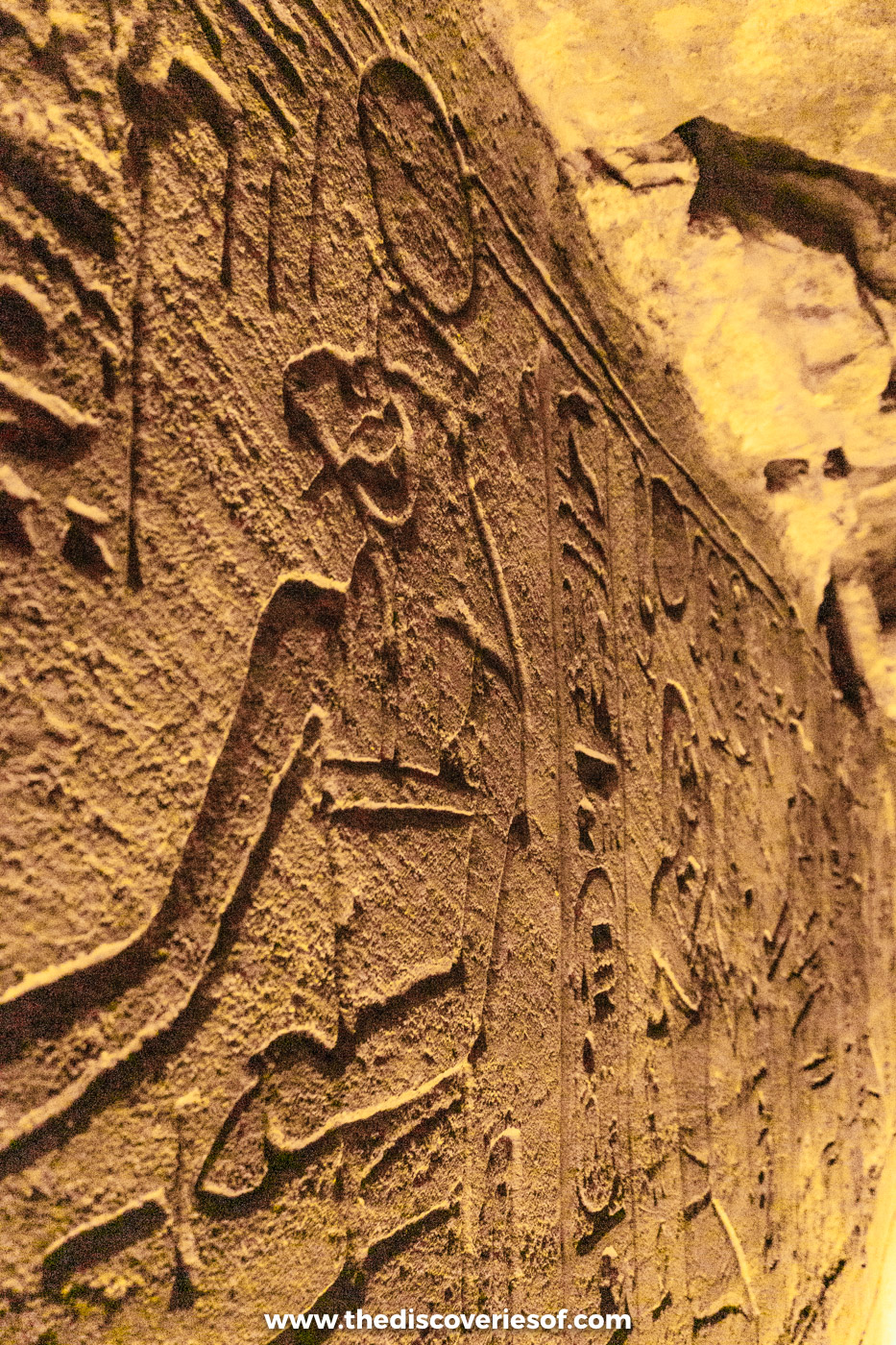
The second hall has four square pillars, and its walls swap war for worship. Here, Ramses and Nefertari stand before the sacred boats of Amun and Ra-Horakhty, the boats in which the gods’ statues were carried in procession. In a few scenes, Ramses even makes offerings to a deified version of himself.
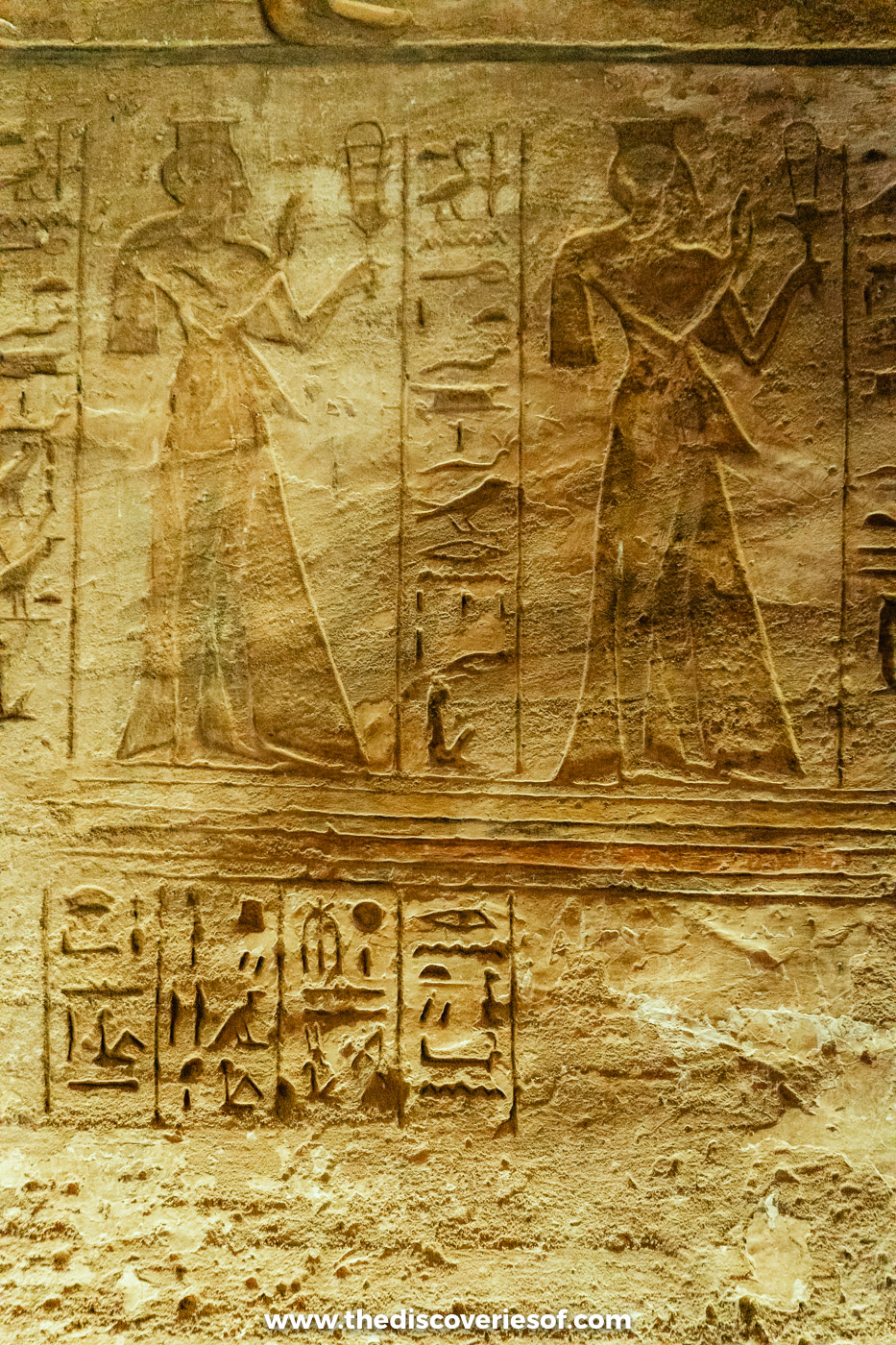
Off the halls, a series of long, narrow side rooms were probably used to store the temple’s equipment and offerings. They’re decorated with scenes of the king presenting food, flowers and incense to the gods, and they’re often quieter than the main axis, so they’re worth a look if the hall is busy.
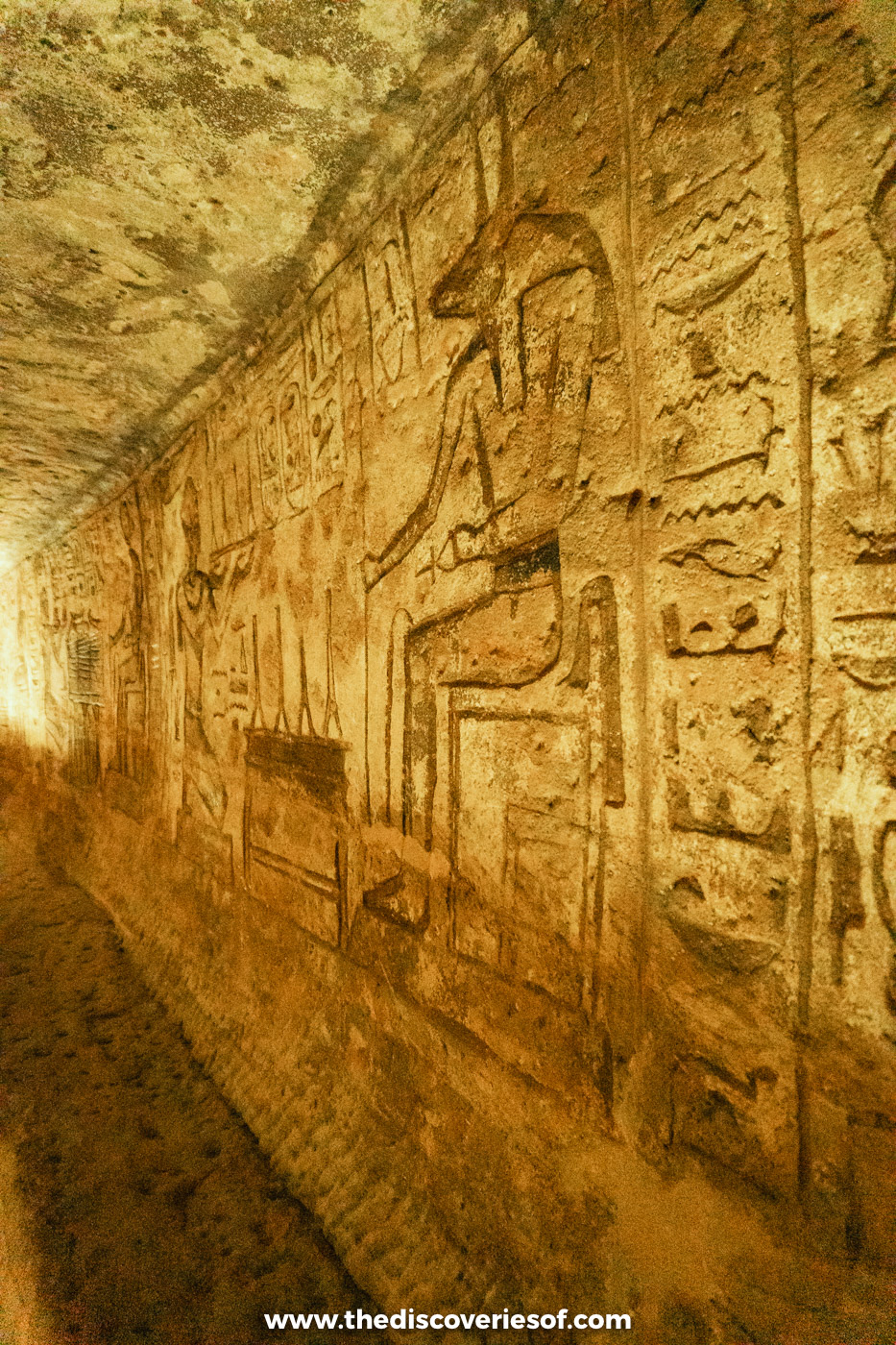
Next comes the vestibule, a narrow room running across the temple, where Ramses offers wine, milk, bread and flowers to the gods. Its central doorway opens onto the sanctuary.
The sanctuary and the sun
At the very back of the temple, around 60 metres into the rock, four statues sit side by side against the end wall: Ptah, Amun-Ra, Ramses himself and Ra-Horakhty. They’re the four gods of the temple, and the king has given himself a seat among them.
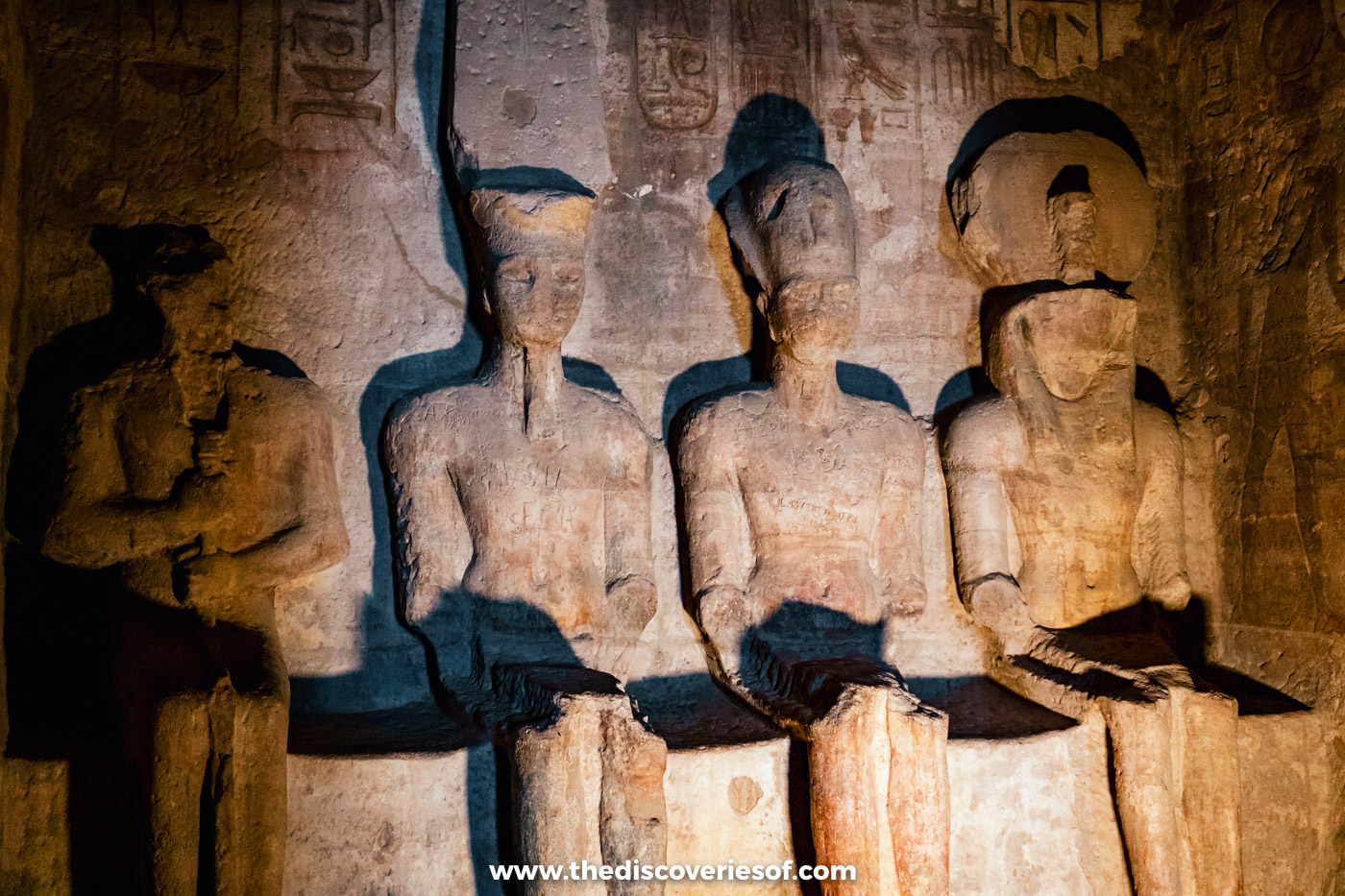
The temple was aligned so that, on two mornings a year, the rising sun shines straight through the entrance, along the halls and into the sanctuary, lighting up three of the four statues. Only Ptah, the creator god of Memphis and a god linked with the underworld, stays in the shadows. The light lasts for about 20 minutes.
Today, this happens on 22 February and 22 October. It’s often said that the dates mark Ramses’ birthday and his coronation, but there’s no ancient evidence for that, and the alignment may simply have marked the seasons. The dates have also shifted slightly since the temple was built and moved. If you want to see it, you’ll need to arrive before sunrise and stand in a crowd of several thousand people; my guide to visiting Abu Simbel has the details.
Buried, found and moved
Subsumed by sand
As time passed and the temple fell out of use, the shifting sands of the desert began to cover the statues outside. By the 6th century BC, the sand was already knee height, and it kept rising until the Great Temple and its smaller sibling, the Temple of Hathor and Nefertari, were swallowed up and forgotten.
Rediscovery
The temple was largely unknown in Europe until March 1813, when the Swiss explorer Johann Ludwig Burckhardt spotted the top of the facade above the sand. Over the next four years, several attempts were made to dig down to the entrance, and the Italian explorer Giovanni Battista Belzoni finally succeeded on 1 August 1817, becoming the first European to enter the temple.
Relocation
You’d think being lost for millennia would be the last of the temple’s woes, but a far greater threat loomed in the 1960s, when the building of the Aswan High Dam meant the waters of the new Lake Nasser would rise over the site. Left where it was, the temple would have been drowned, lost again to time, but this time for good.
To save it, UNESCO and the Egyptian government launched one of the greatest rescue operations in archaeology. Between 1964 and 1968, both temples were cut into 1,036 huge blocks, lifted to their new site about 65 metres higher and 200 metres back from the water, and painstakingly reassembled inside an artificial hill, held up by a vast concrete dome. Engineers even had to make sure the sun would still reach the sanctuary. The result is the Great Temple of Ramses II you see today, and once you know, you can’t quite stop looking for the joins.
Tips for visiting the Great Temple
- Get your briefing outside: guides usually aren’t allowed to explain things inside the temples, so they’ll talk you through the history in front of the facade first. This guide should help you work out what you’re looking at once you’re in.
- Find the Battle of Kadesh: it’s on the right-hand wall as you enter. If a coach group has just gone in ahead of you, spend a few minutes on the facade first and let them move through to the sanctuary.
- Look up and look down: the baboons along the top of the facade and the Greek graffiti on the colossi’s legs are easy to miss.
- Photos: taking photos on your phone is fine, but flash isn’t, and professional cameras and tripods need a permit.
- Prepare for the heat: there’s almost no shade between the entrance and the temples, so bring water, a hat and sunscreen.
For how to get here from Aswan by road or air, tickets, opening hours and staying nearby, read my guide to visiting Abu Simbel.
Watch my Aswan video
Subscribe on YouTube and discover new destinations.
Map
Read next
- Abu Simbel temples: is the early start worth it?
- Philae Temple, Aswan: the Isis temple saved from the Nile
- Nubian Museum, Aswan: the story you didn’t learn at school
- Things to do in Aswan
- 11 ancient Egyptian temples you can still see today
- Best museums in Cairo: from royal mummies to Tutankhamun
- The step-by-step Egypt itinerary
- The best things to do in Egypt
Love this? Save and share on Pinterest

Discover the top things to do, insider tips and hidden gems in our Egypt Travel Guide.
Read the guides →