Preparing for a trip to the El Tatio geysers? Here’s everything you need to know about the largest geyser field in the Southern Hemisphere, from my tips after two sunrise visits to the geology behind this magnificent spectacle.
Welcome to El Tatio, a geothermal wonder high in the Andes of northern Chile, where dozens of geysers and fumaroles hiss, boil and steam into the freezing dawn air.
I’ll be blunt: whether you’re spending a short or longer time in the country, El Tatio needs to find its way into your Chilean itinerary.
I mean, come on: it’s not every day that you get to visit the largest geyser field in the Southern Hemisphere, right up in the towering Andes Mountains.
I’ve watched the sun come up over El Tatio on both of my trips to the Atacama Desert: first at the end of a week-long campervan road trip, and again on a July trip in the depths of the southern winter. It was just as spectacular the second time. Here’s everything you need to know for a successful visit, so stick around.
Some links in this article may be affiliate links, which means we may receive a small commission, at no additional cost to you, if you decide to purchase through one of my recommended partners.
Why visit El Tatio, Chile?

Let me rephrase that question. Why not visit El Tatio?
This one-of-a-kind attraction is largely unknown outside of those who venture to the Atacama. Besides the fact that it sits in the impressive Andes Mountains, the geothermal field is a treasure trove of natural wonders: geysers spurting boiling water into the air, fumaroles sending up great clouds of steam, bubbling hot springs and pools, and strange, crusty sinter deposits in shades of white, orange and green.
Then there’s the setting. The field sits in a high basin ringed by volcanoes that top 5,000 metres, and at sunrise the whole place turns into a stage show of steam and light. It’s one of the most incredible places I’ve ever seen, and I’d say the same about the Atacama in general. There’s a lot to see and do here, which I’ll talk about now.
My two sunrises at El Tatio
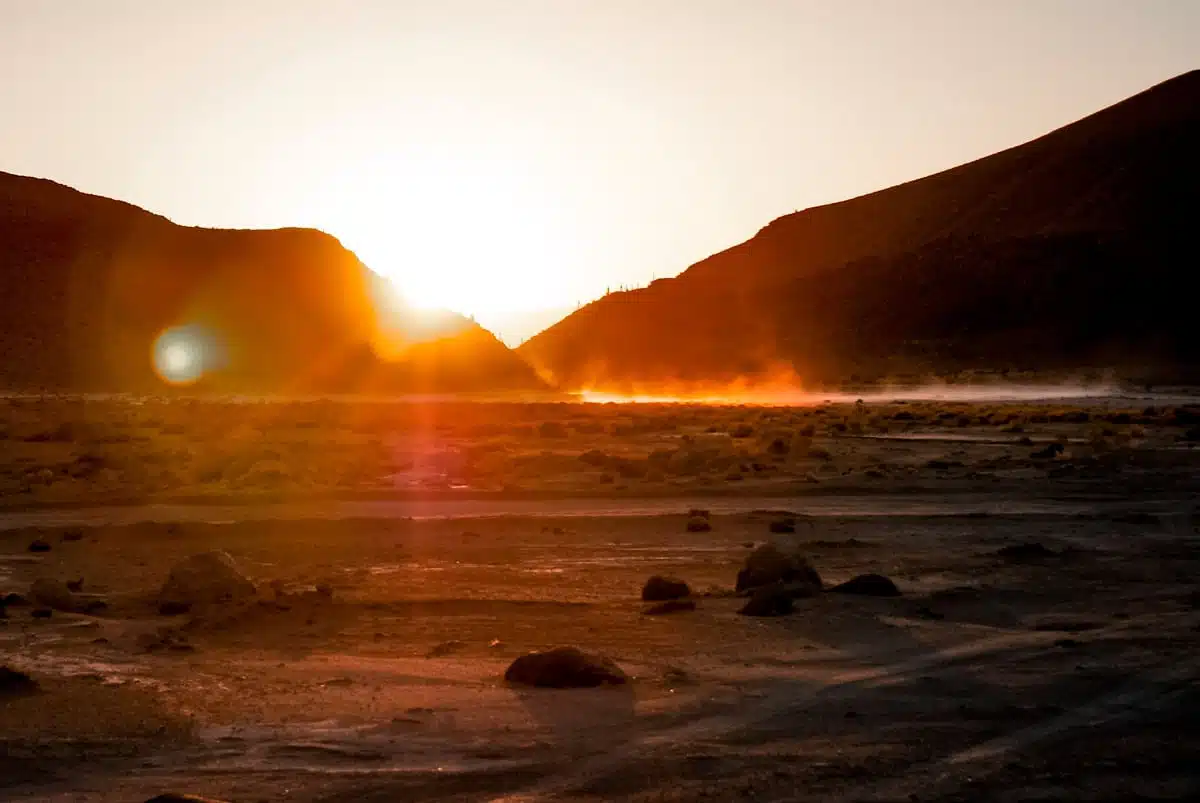
My first visit came at the very end of my Atacama road trip, a week of driving around 1,000 miles in a brightly coloured campervan I’d nicknamed Bruno. The geysers are at their most active at sunrise, so I spent the night before in the tiny hamlet of Guatín, on the road up from San Pedro de Atacama, to shorten the morning’s drive, and was back on the road by 3:30am.
After a week off-grid, it was strange to be surrounded by people, each on their own Atacama adventure, all trying to get as close to the geysers as possible while they started to bubble and boil. Even the crowds couldn’t detract from the slightly ethereal sight of the whole field erupting, hissing and steaming across my line of vision. I stayed on after the tour buses had left, but the magic went with them: once the sun is fully up, the geysers quieten to a gurgle.
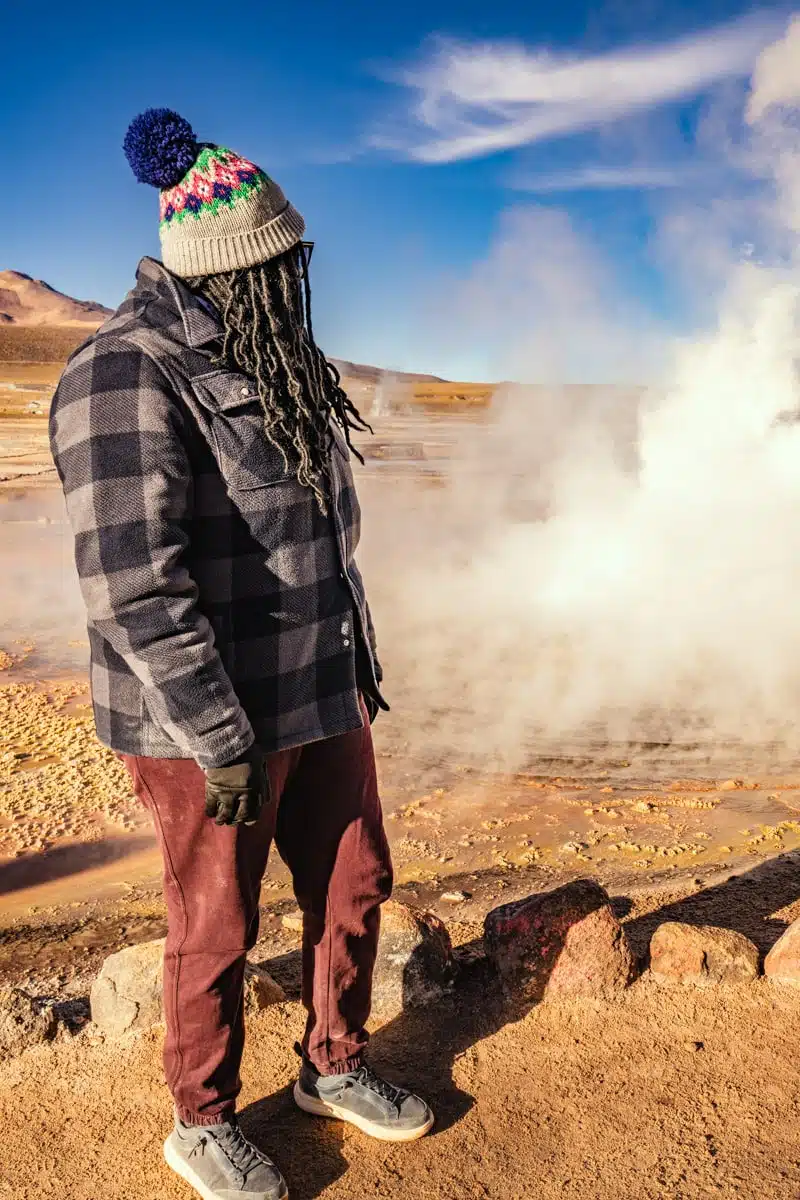
The Atacama had such a stranglehold on me that I knew I had to go back, and on my July trip I returned with Rodolfo, my private guide from Nayara Alto Atacama, who grew up in nearby Calama. The second visit started, as all good trips do, at 3am. Getting up at that hour is a lot easier when you have the whole of the Milky Way spread out in front of you on the drive up, and I was at the field well before sunrise.
It was -15°C. My British self is not made for those temperatures, but I’ll do it for views like that. I set up my tripod for a time-lapse and watched as, one by one, the geysers and fumaroles came to life: the geysers spurting water into the air, the fumaroles sending clouds of steam into the dusky sky, while the sky went from light purple to touches of gold and then erupted into full sunlight. I’d seen it all before. Was it any less spectacular the second time? No.
What you need to know before you go to El Tatio: top tips

I’ve got a whole section on practical tips towards the end of this guide, but I’m going to run through some of the most important tips, as well as what you should expect from your visit, in this section.
Top Tip
As the geysers are located at over 4,300 metres, you need to spend time acclimatising at gradually increasing elevations before you visit. San Pedro de Atacama sits at about 2,400 metres, so save El Tatio for the end of your trip, after a few days in town and a trip or two up to the high lagoons.
Go early
Most people (including me, both times) visit just before sunrise to see the geyser field at its best. The difference between the freezing night air and the hot water first thing in the morning means the steam columns are at their biggest and the field is at its most active. As the sun climbs and the air warms up, it becomes less and less active, so you want to be there for sunrise or, better still, just before.
The run-up to sunrise is just as magical. The sky turns a deep purple before gradually transforming to the warmth of the dawn colours, and you see the last of the stars fade into the light. Most tours pick up in San Pedro between about 4:30am and 5am; if you’re driving yourself, aim to leave by 4am at the latest. The gates open at 6am. On my July visit I was there before they opened and waited at the gate, which meant I was in among the first and saw the field before the crowds arrived.
Be sure to see “nature’s fireworks”

Head to the southern geyser field just as the sun rises and go to the fumarole in the far left corner.
As the sun comes over the Andes and catches the steam at just the right angle, you can see the colours of the different minerals light it up like a kaleidoscope, a rainbow-coloured plume. My guide Rodolfo called it “nature’s fireworks”, and I can’t think of a better way of describing it. He insisted that I had to be there at exactly that moment, and that man knew what he was talking about: it was one of the highlights of the morning.
Wrap up warm
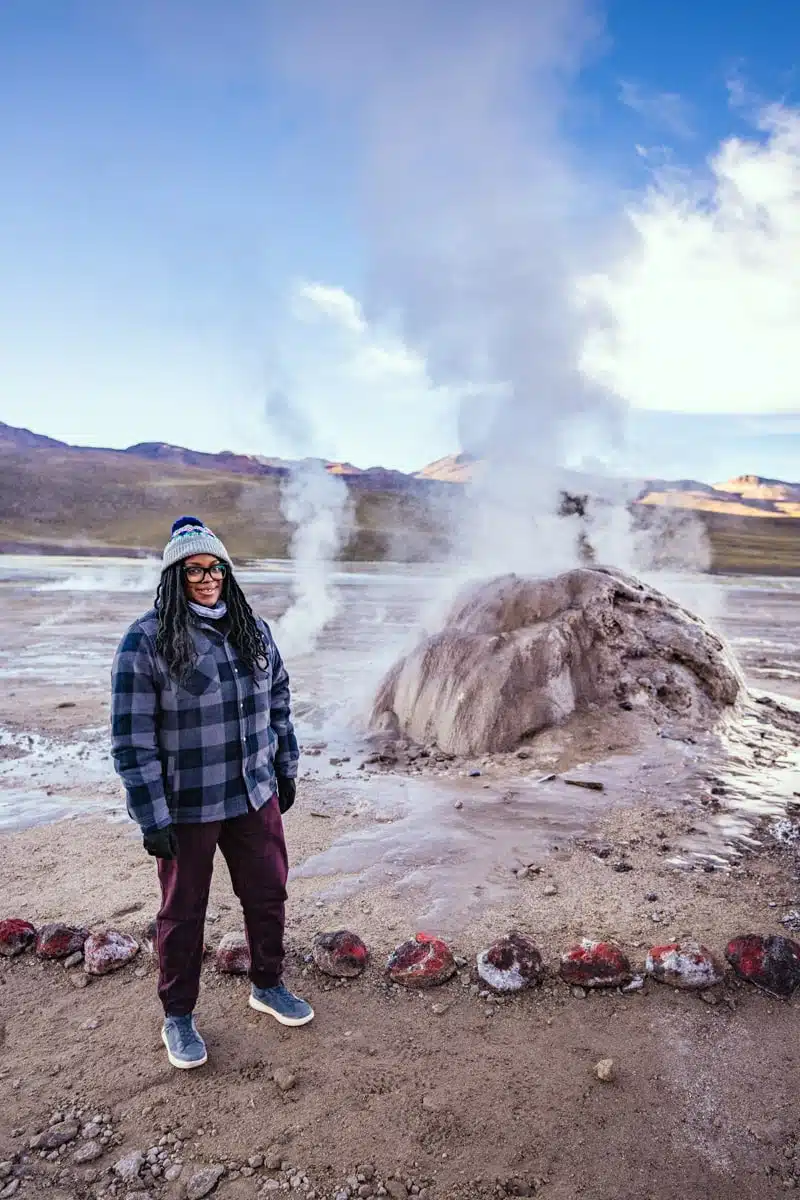
LAYERS!
Wrap up warm. I cannot stress this enough. On the morning of my second visit to El Tatio, it was -15°C. Yes, really! And by the time I left, it hadn’t warmed up much at all.
Wear layers, including a hat, a thick jacket, a buff or scarf and gloves, plus thick-soled shoes. The ground is so cold that if your soles are too thin, you can feel the chill creeping up through your feet.
Geysers and fumaroles are different

Although the geothermal field is commonly referred to as the El Tatio geysers, it would be more accurate to call it El Tatio geysers and fumaroles. I guess that doesn’t have quite the same ring to it.
What’s the difference between a geyser and a fumarole? Geysers are where water erupts out of the earth, whereas fumaroles give off steam and gas rather than water. Both are spectacular. And on that note…
Visit both the northern and southern geyser fields
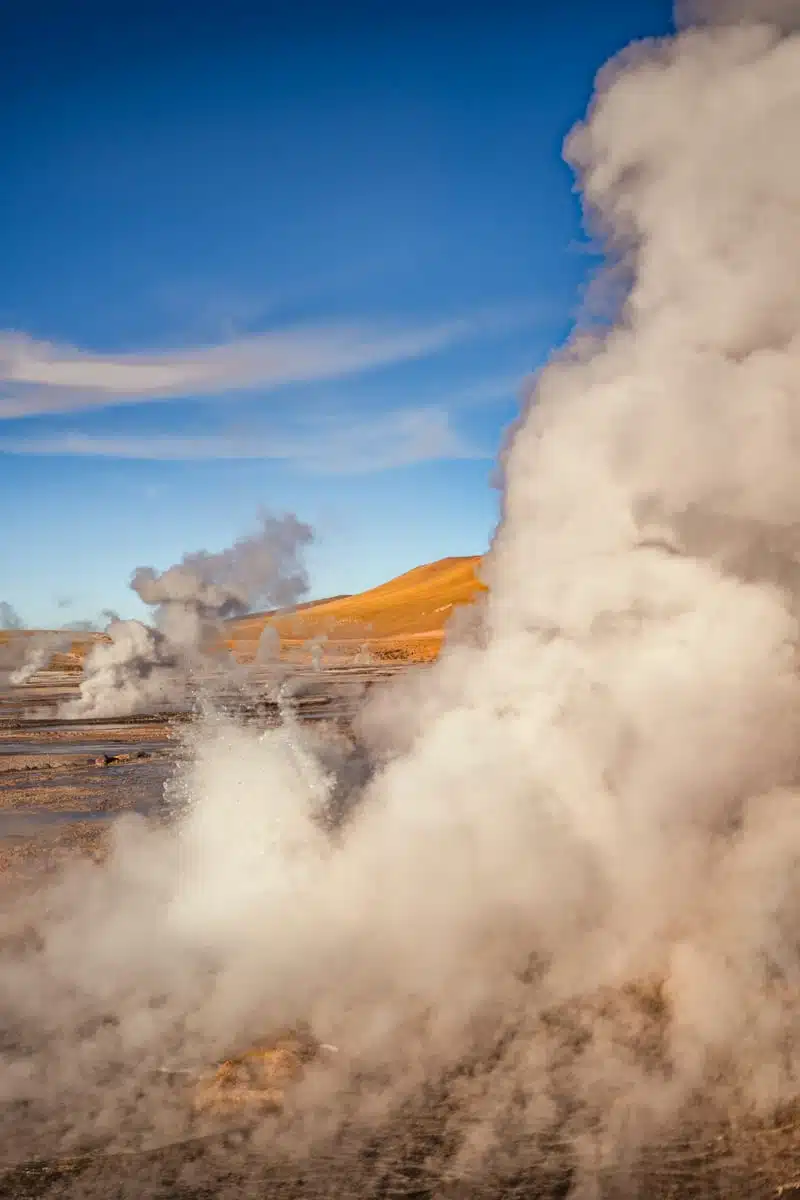
The geothermal field is split into two geyser fields, the northern and southern. Though many visitors only explore one of the two, I’d advise you to take the time to see them both.
The northern field has the biggest and most active fumaroles, but the southern field has the most geysers. I recommend splitting your time between both.
Do
This San Pedro de Atacama El Tatio geysers tour includes hotel pick-up and drop-off, breakfast and the entry fee.
Watch a geyser go through its cycle
Pick one geyser and stay with it for a while. On my visit, one was erupting roughly every six minutes: the pressure builds until the water bursts out with real force, then it fades over a few minutes into a plume of steam, until the whole cycle starts again. It’s mesmerising.
Stick to the marked paths
Be careful as you walk around. The ground around the vents is a thin crust over boiling water, and there are clearly marked areas where you cannot walk. There have been fatal accidents here, including a visitor who died after falling into a geyser in 2015, and the local communities who run the site are careful to close off dangerous areas. Respect the boundaries, keep children close and don’t be tempted to step over the stones for a better photo. Water boils at only about 86°C at this altitude, but that’s more than enough to scald.
Keep an eye out for wildlife
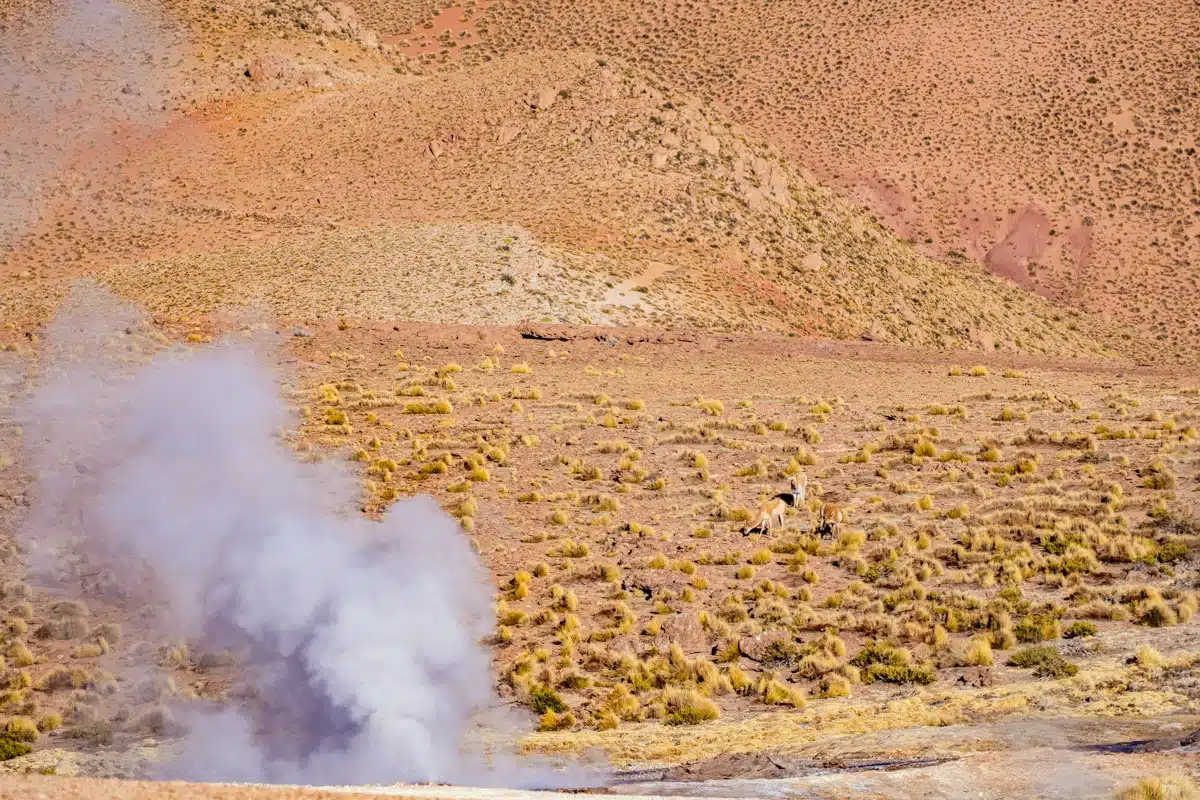
The geysers aren’t the only thing worth looking at. Vicuñas, the small, wild relatives of the llama, graze the yellow grass right around the edge of the field, and their pelts blend in so well with the landscape that you have to look carefully to spot them. On my July visit, a few were grazing just beyond the steaming vents.
Don’t head straight back to San Pedro

Most people finish up at El Tatio and truck straight back down to San Pedro. Don’t make that mistake. On my July visit, I assumed I was heading back to town for breakfast. Absolutely not: Rodolfo had a trick up his sleeve. He drove me away from the crowds to a verdant river valley a short drive from the geysers, cut through by a crystal-clear stream, where I had a picnic breakfast surrounded by nothing but vicuñas and rheas (the long-legged, flightless birds of the altiplano). There was nobody else there, and it was completely quiet. I sent my drone up over it: it’s a stunning spot.
The landscapes up here change completely with the altitude, so take your time on the way down. If you’re on a tour, look for one that includes breakfast out in the landscape rather than back in town. Many tours also stop at the tiny village of Machuca and the Río Putana wetlands, where you’ll often see flamingos and other water birds. If you have the energy, the Guatín canyon hike, lined with candelabra cacti up to 7 metres tall, is the perfect foil to the busy geysers, and the Termas de Puritama hot springs, about 30km from San Pedro on the same road, are the obvious place to thaw out (book online in advance; entry is around CLP 38,000).
What makes the geysers del Tatio so special? The geology behind the spectacle
Before I get into the nitty gritty details of what you need to know to plan your trip to El Tatio, let’s take a step back and find out a little more about the geysers themselves because, when you think about it, they’re rather fascinating things.
Why exactly is there a geothermal field belching out steam and hot water at dizzyingly high elevations in the Andes? Let’s take a deep dive.
Location

El Tatio sits at a staggering 4,320 metres (14,170 feet) above sea level in northern Chile. The geothermal field covers about 30 square km (12 square miles) of the Andes Mountains, with the most intense activity concentrated in three areas.
All of that makes it the third-largest geyser field in the world, after Yellowstone in the USA and the Valley of Geysers in Russia, and the largest in the Southern Hemisphere. It’s also one of the highest geyser fields on Earth.
It sits at the base of a series of stratovolcanoes in the Central Volcanic Zone, close to the border between Chile and Bolivia. It lies about 89km (55 miles) north of San Pedro de Atacama, the small oasis town that’s the hub for the Atacama Desert, and about 100km east of Calama.
What exactly are the El Tatio geysers? How were they formed?

El Tatio is a large and intricate system of calderas, ignimbrites, geysers, hot springs and fumarole vents formed over millions of years. Around 80 geysers are spread across this vast area, along with hundreds of hot springs, bubbling pools and fumaroles, divided into the northern and southern fields.
The hot pools around the field reach between about 60°C and 80°C (140°F to 176°F), close to boiling point at this altitude. Most of the geyser fountains are less than a metre high, though a few have shot up more than 10 metres in the past, and the mineral cones that have built up around some of the vents stand up to three metres (nine feet) tall.
What about how they were formed? El Tatio sits in the Andean Mountains, an area well known for its volcanic and tectonic activity thanks to the movements of the Nazca Plate and the South American Plate. Great to know, but it also has significant implications for the formation of the geothermal field.

Water from rainfall and melting snow penetrates the ground and moves towards a heat source, whether that’s magma or extremely hot rocks. The water heats up, which in turn builds pressure as it’s enclosed by layers of impermeable rock.
Once the pressure exceeds a certain threshold, the hot water and steam are forced up through fractures in the Earth’s crust, resulting in the spectacular geysers, hot springs and fumaroles you see at El Tatio today.
Think of them as mini volcanoes, but instead of spouting rock and ash, they erupt with steam and water. They do so far more frequently than volcanoes, too.
All that heat has attracted energy companies over the years. Geothermal prospecting began here in the 1920s, and in 2009 an exploratory well blew out, sending a column of steam high into the air. The outcry that followed brought development to a halt.
Life in the geysers

El Tatio’s vents teem with life and contain forms of micro-organisms that include extremophiles (tiny organisms that live in extreme environments) and hyperthermophiles (microorganisms that thrive in temperatures of 80°C or above).
In fact, this area is so unique that scientists have studied it as an analogue for possible past life on Mars, and to understand Earth’s beginnings.
What’s in a name? The meaning of “El Tatio”

The word “Tatio” comes from Kunza, the language of the Atacameño people, which is now all but extinct. Tatio has numerous meanings, including “oven”, “the crying grandfather”, “burnt” and “to appear”.
“Oven” and “to appear” are probably the most accurate descriptions of El Tatio because the geysers are boiling and appear suddenly.
The first written mentions of the geysers appear in records from the late 19th century, but the Atacameño people knew about them long before then. Today, the site is run by the Atacameño communities of Toconce and Caspana under a long-term concession from the state.
Planning your visit to El Tatio
Where is El Tatio?
- Route B-245, municipality of Calama, Antofagasta Region, Chile. The field is about 89km north of San Pedro de Atacama, roughly an hour and a half’s drive.
Opening times and entry fee
Daily: 6am to 4pm
Entry costs CLP 15,000 for adults, paid in cash at the booth (tours usually collect it from you in advance). The site is run by the Atacameño communities of Toconce and Caspana, and the fee goes back to them. Bring a swimsuit and towel if you fancy a dip: there’s a thermal pool at the field, though getting changed in sub-zero air takes some commitment.
Visiting El Tatio independently

Basing yourself in San Pedro de Atacama, the small town at the heart of the desert, is the best way to explore the El Tatio geysers. You can visit on your own if you rent a car. I did it in a campervan on my first visit, and it gave me the freedom to stay on after the tour buses had left.
The road up is about 89km on Route B-245, partly unpaved and winding, and you’ll be driving it in the dark at altitude, so take it slowly. A high-clearance car or 4×4 is the comfortable choice, fill up in San Pedro before you go, and pull over if you start to feel light-headed. I recommend arriving early, as the place fills up quickly with tour buses. If you want to shorten the morning drive, do what I did and spend the night before in Guatín.
Taking a tour to El Tatio

Visiting El Tatio on a tour has its benefits, too, mainly that it takes the hassle out of planning everything yourself and that someone else does the driving in the dark.
This San Pedro de Atacama El Tatio geysers tour takes about six hours, with hotel pick-up between about 4:30am and 5am. It includes a bilingual guide, the entry fee and a breakfast to power you through the day, and on the way back it stops at a lagoon with flamingos and runs through the Putana Valley. There are plenty more options in my round-up of the best Atacama Desert tours.
When to visit El Tatio
The geysers are a year-round sight, but the experience changes with the seasons. In the southern winter (roughly June to August), it’s bitterly cold at dawn, as my -15°C July morning proved, but the skies are clear and the steam columns are at their most dramatic in the cold air. Summer mornings are milder, though still close to freezing. From around January to February, summer storms in the high Andes can occasionally damage or close the roads up to the altiplano, so check conditions in San Pedro before you set off. Whatever the month, go for sunrise.
Where to stay near El Tatio
Hotel Desertica

San Pedro de Atacama is the best place to base yourself if you plan on doing things in the Atacama and surrounding areas, like visiting the El Tatio geysers.
One of my top hotel picks here is Hotel Desertica, a small boutique hotel in an old family orchard. This chic retreat offers peace from the busy centre of San Pedro de Atacama.
The hotel’s rooms are large and spacious and have a stunning blend of contemporary touches mixed with local woven textiles and spots of colour. Each one is a standalone, circular “turi”, and after my days on the road in Bolivia, it was exactly what I needed. The restaurant is great, too. Perfect for relaxing after a long day of exploring. Read my full Hotel Desertica review.
Book now on Booking.com
Nayara Alto Atacama
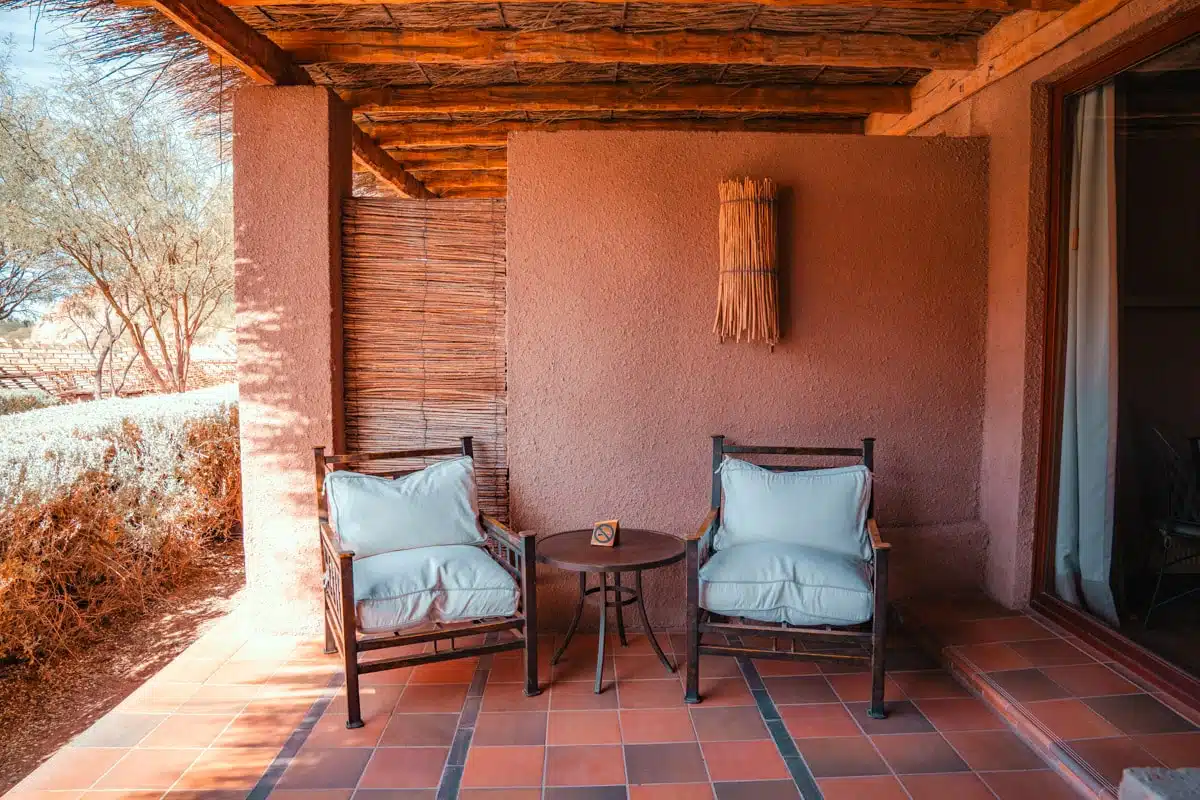
For my second visit, I stayed at Nayara Alto Atacama, a few kilometres outside San Pedro in the Catarpe valley. I chose the all-inclusive package with private tours, which is how I ended up at El Tatio with Rodolfo, and it’s a brilliant way to see the Atacama at your own pace and get to places the big groups don’t. My Catarpe room had one of the most comfortable beds I’ve ever slept in, there are six pools (two of them heated, which you’ll want in winter), and the hotel has its own observatory, where I took some of my best photos of the night sky. Read my full Nayara Alto Atacama review, or check rates on Booking.com.
For more options at every budget, see my guide to the best Atacama Desert hotels.
What to pack for a visit to El Tatio
While it gets rather hot later in the day, the mornings are incredibly freezing. On my last trip to El Tatio, it was -15°C (5°F), so here’s what I recommend packing:
- Thermal outdoor leggings to keep warm.
- Waterproof hiking shoes with thick soles (certain areas are pretty wet and muddy, and the ground is very cold).
- A thick waterproof jacket, gloves and a beanie hat.
- A head torch for the walk from the car park in the dark, and a tripod if you want to shoot a time-lapse of the sunrise.
- Sunscreen and sunglasses, as the sun is fierce at this altitude once it’s up.
- A bathing suit and a towel for the thermal pool or for later at the Puritama hot springs.
Read all Atacama guides
More guides
San Pedro de Atacama is the best place to base yourself if you plan on doing things in the Atacama and surrounding areas, like visiting the El Tatio Geysers.
One of my top hotel picks here is Hotel Desertica, a small boutique hotel in an old family orchard. This chic retreat offers peace from the busy centre of San Pedro de Atacama.
The hotel’s rooms are large and spacious and have a stunning blend of contemporary touches mixed with local woven textiles and spots of colour. Perfect for relaxing after a long day of exploring.
What to Pack for a Visit to El Tatio Geysers
While it gets rather hot later in the day, the mornings are incredibly freezing. On my last trip to El Tatio, it was -15°C (5°F), so here’s what I recommend packing:
- Thermal outdoor leggings to keep warm.
- Waterproof hiking trainers (Certain areas are pretty wet and muddy).
- A thick waterproof jacket, Gloves, and beanie hat.
- Sunscreen and a bathing suit and a towel for later at the Puritama Hot Springs

El Tatio Geysers Map
Love This? Save and Share on Pinterest

El Tatio geysers map
Visiting El Tatio? You should also read these
- Everything you need to know to plan your Atacama trip
- 9 must-book tours to help you explore the Atacama
- 3 days in the Atacama? Explore with this itinerary
- Why stargazing in the Atacama should be at the top of your bucket list
- The best things to do in the Atacama Desert
- Atacama Desert map: the places you shouldn’t miss
- Fascinating facts about the Atacama Desert
- The best things to do in Chile
Love this? Save and share on Pinterest
Discover the top things to do, insider tips and hidden gems in our Chile Travel Guides.
Read the guides →