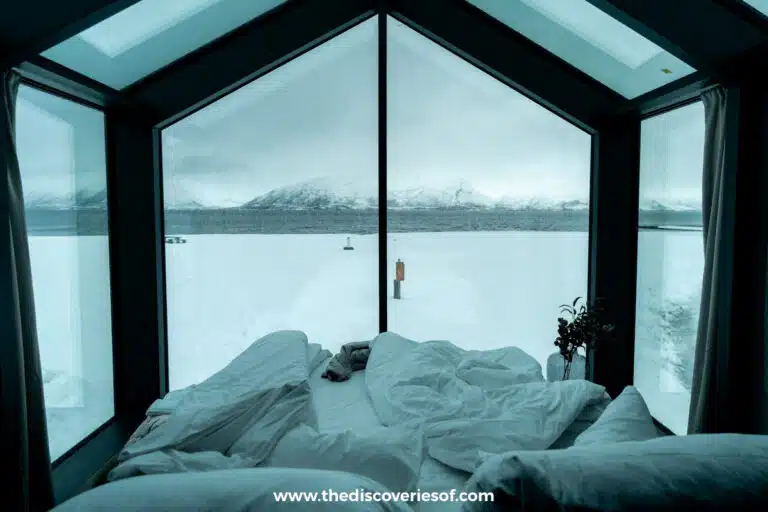
Discover the Lofoten Islands in Norway with this guide: where to go, the best things to do, how to get there and around, when to visit and where to stay.
The Lofoten Islands, an archipelago in Norway’s Arctic Circle, verge on the unbelievable. Snow-capped mountains rise straight out of the sea, red fishing cabins sit on stilts over inky water, and sea eagles swoop down so close you could almost touch them.
I’ve been twice, in October and again the following February, and both times the islands blew me away with their raw, unadulterated beauty. If you’re thinking of booking a trip, do it. If you’re not thinking of booking a trip, well, you certainly should be.

Colourful fishing villages pop against the background of granite and snow, wildlife comes closer than you’d think possible and, through it all, the E10 winds its way from island to island, the promise of discovery around every corner. If I had to sum up Lofoten in one word, it would be drama. You turn round every corner, and there it is.
It’s no wonder that it’s a photographer’s playground.
This guide covers everything I’d want to know before going back: where to go, what to do, how to get there and around, when to visit and where to stay, with links to my more detailed guides to the villages along the way.
Want to take a peek at what to expect from your trip? Check out my Lofoten Travel Guide video
Lofoten Islands: at a glance
- Do: The Sea Eagle Safari with a trip to Trollfjord.
- Stay: In a traditional rorbu (converted fishing hut), or in Svolvær if it’s your first visit.
- Eat: A dish made with stockfish, the lifeblood of the Lofoten Islands since the Viking times.
- See: Rambergstranda, a stunning Arctic beach, with pale turquoise water.
- Treat: Yourself to a meal at Lofoten Food Studio, where chef Roy Berglund serves stellar dishes from local produce at an intimate chef’s table at his home in Ballstad.
- Getting there: Fly to Harstad/Narvik Airport, Evenes, and drive, or fly straight to Leknes or Svolvær.
How to plan a trip to Norway’s Lofoten Islands: before you go
OK, so you’re onto the “I definitely want to go to Lofoten” train. The next logical question is how you actually do that. Getting there takes a little planning and forethought, so here’s what you need to consider.
Where are the Lofoten Islands?
The Lofoten Islands are a chain of mountainous islands off the coast of Nordland in northern Norway, well above the Arctic Circle. From east to west, the main islands are Austvågøya (home to Svolvær, Kabelvåg and Henningsvær), Gimsøya, Vestvågøya (Leknes, Stamsund and Borg), Flakstadøya (Ramberg and Nusfjord) and Moskenesøya (Reine and Å, with Hamnøy just off its northern tip).
The E10 strings them all together with bridges and tunnels. Since the Lofast road opened in 2007, you can drive all the way from the mainland without a single ferry. From Svolvær, the biggest town, it’s about a two-hour drive to Å at the very end of the road, longer in winter, when you’ll want to take it slowly.
Take a tour or travel independently?
First up, if you’re planning to go to Lofoten, you will want to think about whether you want to travel independently or use a tour operator. There are pros and cons to both.
Using a tour operator like Original Travel, whose Lofoten itineraries showcase the very best of the islands, is the easiest option. They create tailor-made itineraries depending on your preferences, but you don’t have to do any of the work.
Alternatively, if you have the time and patience, you can book your travels independently, which will be more cost-effective, but takes more time.
Best time to visit Lofoten

It’s a bit tough to say when the best time to visit Lofoten is, simply because each season has its own unique appeal.
Want a shot at seeing the Northern Lights? Visit between late August and mid-April. The darkest months, from October to February, give you the most hours to look for them.
If you want to see the midnight sun, you’ll need to go between the end of May and mid-July.
Looking for a true wintery wonderland? Go and visit between January and March. That’s also skrei season, when the migrating Arctic cod arrive off Lofoten to spawn, the fishing harbours are at their busiest and the drying racks fill up with fish. I wasn’t sure what to expect from coming in February, but those snowy peaks rising straight out of the sea were exactly what I’d come for.
Autumn is beautiful too. On my October trip, the sunrises over Svolvær harbour were glorious, and darkness had already fallen by the time we landed.
Bear in mind that in the darkest weeks, from early December to early January, the sun doesn’t rise above the horizon at all, so you’ll have a few hours of blue twilight rather than daylight.
Alternatively, if you’re really keen to explore the great outdoors, particularly to tackle the many hiking trails that crisscross the islands, then the summer is the time to go.
Bear in mind that the summer is, without a doubt, the most popular time to visit the Lofoten Islands. If you do want to go then, you will need to make sure that you book your flights, accommodation, ferries and activities well in advance, as the islands do, quite literally, book out.
Whenever you go, build in some slack. The weather here changes fast, and on the last day of my February trip, it looked as if our flight home might be cancelled because of the weather. There are worse places to be stuck.
How to get to the Lofoten Islands
There are several ways to get to the Lofoten Islands, each with its own pros and cons. I’ve run through some of the most popular ones below.
I personally think that flying to Harstad/Narvik Airport, Evenes, and hiring a car to drive to Lofoten from there is the best option when you consider cost, time and convenience.
Fly to the Lofoten Islands
There are two small airports in Lofoten, at Svolvær and Leknes. Widerøe flies small propeller planes to Leknes from Oslo and Bodø, and to Svolvær from Bodø and Tromsø.
While this is undoubtedly the most convenient option, it’s not necessarily the best because the flights tend to be pretty expensive. On top of that, the choice of cars for hire at these airports tends to be relatively limited.
Fly to Harstad / Evenes and drive
This is the way that I’ve travelled to the Lofoten Islands on both of my trips.
Norwegian and SAS both fly from Oslo to Harstad/Narvik Airport, Evenes, which is about 170km, or roughly a 2.5-hour drive, from Svolvær (the first and biggest town in Lofoten).
On my first trip, it took two flights, a changeover in Oslo and a two-hour bus ride to reach Svolvær, the last leg in the dark with glimpses of the mountains lit by the moon. On my second, I picked up a hire car at the airport and drove.
It’s easy to rent a car at Harstad through Avis, Sixt or Hertz and then drive up to the islands. If you’d rather not drive, the Arctic Route airport bus runs from Evenes to Svolvær in about three hours (NOK 690 one way).
Fly to Bodø and get the ferry
You also have the option of flying to Bodø and then getting a boat across the Vestfjorden. The Torghatten Nord car ferry runs from Bodø to Moskenes, at the southern end of the islands, in around three to four hours, and some sailings go the long way round via Værøy and Røst. There’s also a passenger-only express boat from Bodø to Svolvær once a day.
While this option is not too difficult, you’re restricted to the ferry times and the car ferry books out in high season. Only part of each sailing can be reserved for cars, so book as early as you can, and expect long queues for the rest in summer.
Arrive by sea on the Coastal Express
The coastal ships of Hurtigruten and Havila Voyages sail the Bergen to Kirkenes route every day and call at Stamsund and Svolvær, so you can arrive in Lofoten by sea as part of a longer voyage along the coast.
Getting around Lofoten

Hire a car
Unless you’re planning to base yourself in one of the larger destinations like Svolvær and book tours and excursions from there, the easiest way to get around the Lofoten Islands is by car.
Local and international car hire companies rent cars from various hubs in Lofoten, including Avis, Sixt, and Hertz from Harstad / Evenes Airport, Sixt and Europcar from Svolvær and Hertz, Sixt and Europcar from Leknes.
Whoever you rent from, ensure that you take out fully-comprehensive insurance, particularly if you’re travelling in Lofoten’s winter months. It’s not unheard of for car doors to blow off on gusty days or other accidents to occur in the slippery conditions.
Your hire car should come with winter tyres in the season and an AutoPASS tag for road tolls. Check the Statens vegvesen website for road conditions and closures before you set off, and leave plenty of time: the E10 is a two-lane road, and you’ll want to stop every five minutes for photos anyway.
Use public transport
Public transport in the Lofoten Islands is restricted to buses and boats, but there are actually enough options to make it feasible (if not necessarily that easy) to get around the islands using public transport alone. The main bus line follows the E10 from Narvik through Svolvær and Leknes to Å, with local buses to places like Henningsvær. Plan your journeys in the Reis app, as some timetables change between summer and winter.
You can get a seven-day public transport pass from Travelpass Nordland, sold in the Reis app. It covers buses and express boats across Nordland, but not the ferries.
Book excursions
If you’re not hiring a car and don’t want to use public transport, your best option is to base yourself in Svolvær and book excursions from there.
Don’t worry, you still have plenty of options for activities, including going on a sea eagle safari (highly recommended), going deep fjord fishing, Northern Lights hunting or snowshoeing off the beaten path. There are also day tours from Svolvær that cover Reine, Hamnøy and Å in a single (long) day.
Seeing the Northern Lights in Lofoten

I think it’s only fair that I preface this section by saying that even though Lofoten is very firmly within the Northern Lights zone, it’s not necessarily the absolute best place to go and see the Northern Lights.
Why?
Pesky, freaking clouds.
Let me explain.
The Northern Lights take place in the earth’s atmosphere, 60-150 miles above the surface of the earth. On the other hand, clouds tend to form 1-5 miles from the ground, making them the perfect blocker for any stunning Northern Lights display.
They’re like that horrid person in the club you can’t shake when you’re trying to impress someone you’ve got a raging crush on. You know, the ones who insist on trying to strike hollow conversation after hollow conversation when you’re just desperate to get away.
Unfortunately, Lofoten is quite cloudy, particularly in comparison to other Northern Lights destinations like Tromsø and Abisko in Sweden. It was quite cloudy for much of my February trip.
I’m not saying you can’t see the Northern Lights in Lofoten, you absolutely can, it’s just not necessarily the place with the highest chance of seeing them. When the cloud lifts and the lights come out over those mountains and beaches, though, it’s a spectacular place to see them.
Still, it’s 100% worth booking onto a Lofoten Northern Lights tour, as these guys are the best at hunting out the lights. If you’re driving yourself, watch the cloud forecast as closely as the aurora forecast. On my Tromsø trip, I used the cloud layers on Windy Premium to find a clear patch of sky, and the same trick works here. My guide to how to see the Northern Lights has more tips, and my guide to the best time and places to see the Northern Lights in Norway compares Lofoten with the rest of the north.
Seeing the midnight sun in the Lofoten Islands
Where your chances of seeing the Northern Lights in Lofoten might be in doubt, you are absolutely guaranteed to see the midnight sun if you travel to Lofoten between the end of May and mid-July.
I’ve never travelled to Lofoten in the summer, but the locals describe it as a magical and somewhat surreal time, with plenty of time for long hikes and magical light that shows the islands at their very best.
Where to stay in Lofoten

Lofoten is famed for its traditional rorbuer (converted fishermen’s cottages), and many travellers opt to stay in one or two of these for the duration of their trip.
Alternatively, there are a number of hotels, particularly in Svolvær, that make a nice base for your stay.
I stayed in the Thon Hotel on my first trip and the Scandic Hotel on my second, both in Svolvær, and would recommend both. The Scandic is cheaper, but the rooms are very basic, while the Thon is a much nicer (and pricier) option.
The Thon Hotel Lofoten sits right on the harbour, the rooms are cosy and well designed, and its breakfast is (rightly) famous: it took first place in Norway’s Best Breakfast Awards in 2023 and 2024. The Scandic Svolvær was a perfectly good base for exploring by car.
Svolvær is the best base for a first trip: it has the most restaurants, bars and tours, and the best-value accommodation. The trade-off is the drive to the far end of the islands. If you want to wake up somewhere more remote, here are the areas I’d look at:
- Svolvær: For a rorbu without leaving town, Svinøya Rorbuer sits on its own little island, linked by a bridge to the centre. Read my Svolvær travel guide for more.
- Henningsvær: Arty, pretty and about half an hour from Svolvær. Henningsvær Rorbuer and the apartments at Tobiasbrygga are both in the heart of the village.
- Hamnøy and Reine: The postcard views of the south. Eliassen Rorbuer is the classic red rorbu stay in Hamnøy, and Reinefjorden Sjøhus is a good pick in Reine.
- Nusfjord and Unstad: For something quieter, the restored fishing village of Nusfjord and the surf retreat at Unstad both have cabins to stay in.
Rorbuer aren’t cheap. In summer, expect to pay roughly NOK 2,000 to 3,500 a night, and the best ones sell out months ahead, so book as soon as your dates are fixed. From 2027, Lofoten’s municipalities can also apply to add a visitor levy of up to 3% to paid overnight stays, so check whether it’s included in your rate.
Alternatively, check rates and availability on Booking.com
Things to do in the Lofoten Islands
Take a sea eagle safari


Lofoten isn’t short of wildlife-spotting opportunities, but, if you only have time to do one of them, I would plump for the sea eagle safari for a chance to get up close and personal with white-tailed sea eagles, the biggest birds of prey in northern Europe.
You hop onto a RIB boat in Svolvær, cling on as you bomb it through the fjords and then watch as the sea eagles swoop down mere metres away to catch the fish the captain throws out to lure them in.
Although I was looking forward to the safari, I wasn’t out of my mind with anticipation before I went, but this turned out to be one of my favourite experiences from my trips to Lofoten. When I came off the boat, all I could say was that it was the most ridiculous experience I’d ever been on. Seeing the eagles in their natural habitat, surrounded by the dramatic landscapes of the fjords, is something you really shouldn’t miss.
The safari heads into Trollfjord, a narrow fjord with sheer walls on both sides. Our guide told us the local legend of how it was made: two trolls fought over the grazing land here, and one of them hurled a giant axe to scare away the other’s animals. He missed, struck the mountainside and cut it clean through, and the sea flooded in. Once you see how sharply the cliffs drop into the water, you can see why the story stuck.
The trip I’d recommend lasts about two hours and runs from Svolvær. Wrap up in every layer you’ve got: the wind on a RIB at full speed is bitter.
Book Your Sea Eagle Safari Here
Go deep fjord fishing

Life on the Lofoten Islands has always revolved around fishing, so what better way to experience Lofoten than on a boat trawling for your own catch of the day?
Again, this was another of my favourite things to do in Lofoten.
Waking up bleary-eyed and definitely not bushy-tailed, I stumbled onto the fishing boat with XX Lofoten, decked out in a fetching padded and inflatable onesie to shield me against the Arctic winds.
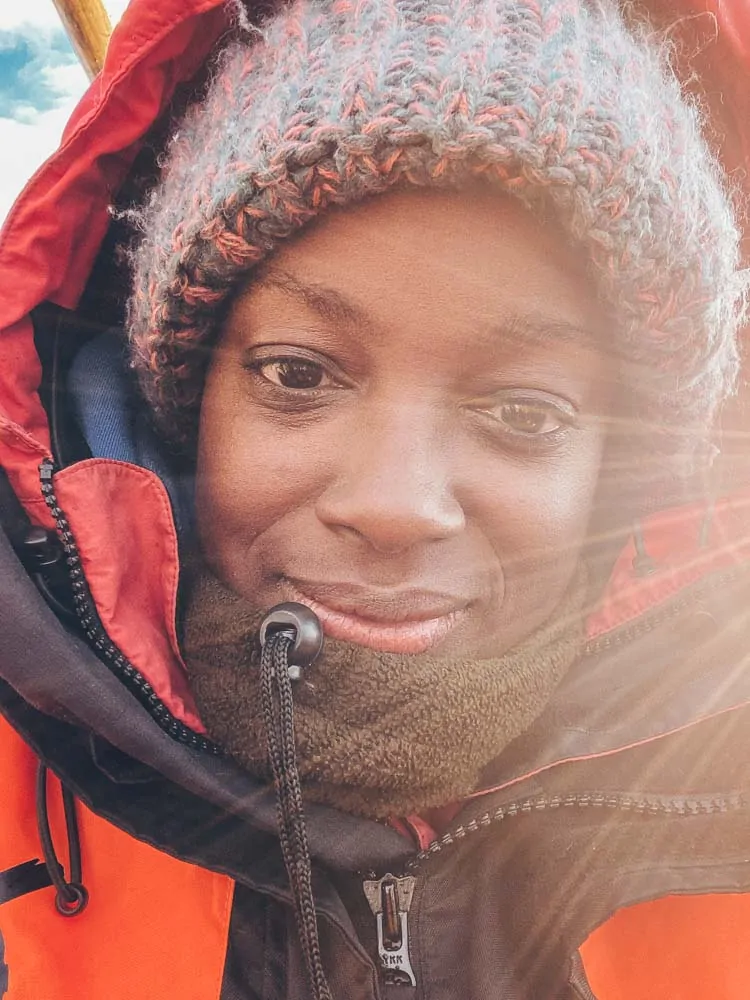
I spent the next two hours alternating between trying to focus on catching the fish and being distracted by some, quite frankly, monstrously pretty views of the islands. Tough life.
The captain used a fish finder to put us right over the shoal, and I’d barely dropped my line before I felt the first tug. I pulled the line in five times: two misses and three fish, one so small we threw it back. The gulls swarmed the boat the whole time, angling for their share of the catch. I wrote about the whole morning in my Lofoten food guide.
Stroll around the gorgeous towns and villages in Lofoten
Svolvær
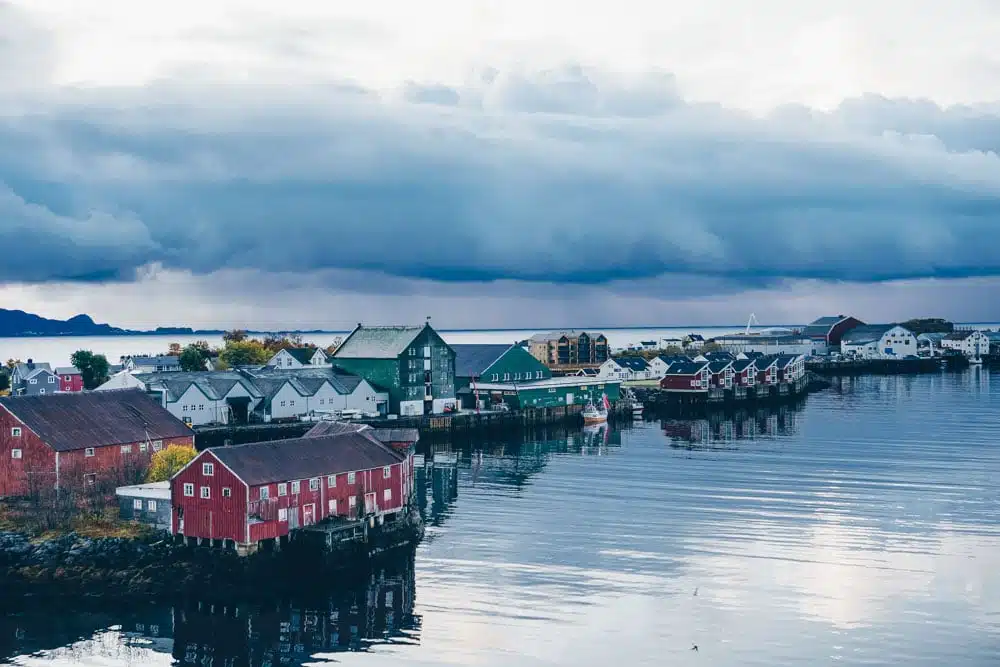
Svolvær is Lofoten’s biggest town and its main hub, and it’s where I based myself on both of my trips. It isn’t a bustling metropolis, but it has the most restaurants, bars and hotels on the islands, and it’s the starting point for most boat trips, including the sea eagle safaris and fishing trips.
Watch the sun come up over the harbour, wander out to the rorbuer on Svinøya, and look up at the jagged peaks behind town. Everything you need to know is in my Svolvær travel guide.
Henningsvær + the Henningsvær football pitch

IMHO Henningsvær is one of the prettiest villages in the Lofoten Islands due to the fact it’s spread out over a number of islands.
It’s sometimes called the Venice of the North, and it’s easy to see why.
Lights twinkle over the quay, snug restaurants serve up warming meals and there’s even a cool art gallery, Galleri Lofoten (formerly Galleri Lofotens Hus), that showcases paintings of Lofoten and Northern Norway.
In fact, Henningsvær is something of a surprising little arts hub: an old caviar factory doubles up as another contemporary art gallery that’s aptly named the KaviarFactory. Check opening times before you go.
Cute and twee as that is, Henningsvær is hiding a secret from you, a secret that only reveals itself if you just so happen to have a drone with you (judging from my trips to Lofoten, that would cover about 90% of visitors anyway).

The Henningsvær football pitch.
Yes, it’s real. No, it’s not a Photoshop myth: the football pitch really is located on its own little island. If you don’t have a drone, you can walk on a path that ends with a view of the pitch and the village behind it.
When I visited in February, the weather was looking distinctly unpromising, but I got the drone up anyway and the view from above was insane.
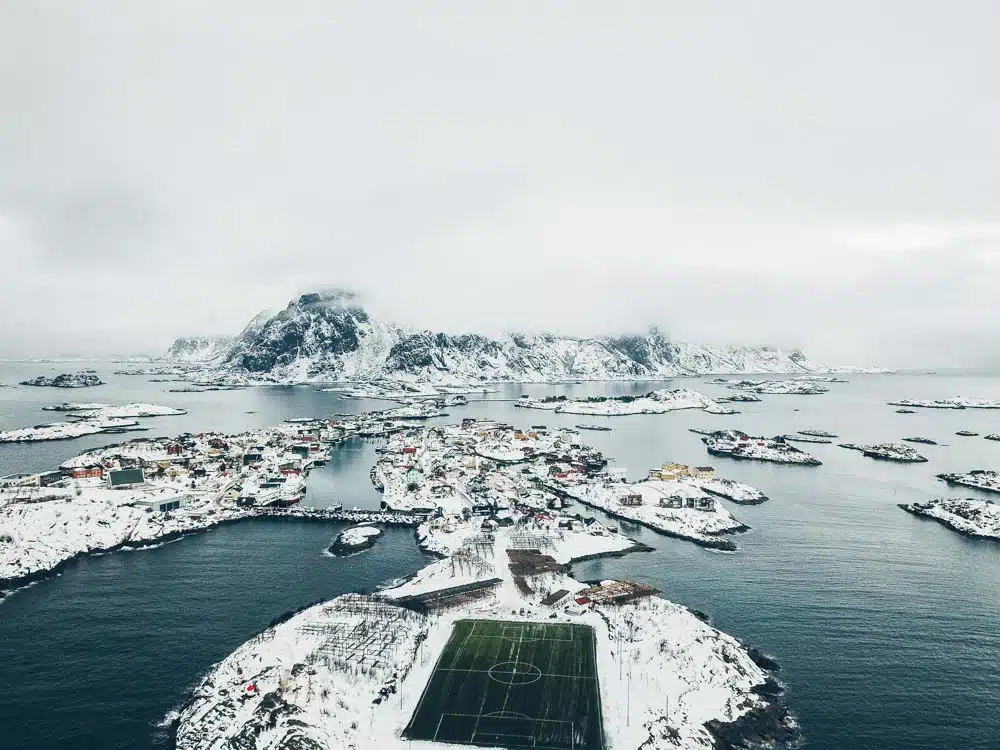
Read more in my Henningsvær travel guide and my guide to the Henningsvær football stadium.
Hamnøy

If you’ve ever spent any time in the history of ever on Instagram looking at travel photos, I guarantee you’ll have seen a shot of Hamnøy: cute red rorbuer on stilts over inky black water, the mountain peak of Festhæltinden looming in the background.
Of course, you should take a chance to see this idyllic village for yourself. It’s small and there’s not much to do other than appreciate how damned beautiful it is, but that will keep you busy enough.
The morning I visited, I woke up to dreadful weather and thought the day was a write-off. Then I got to Hamnøy, and it was just so much drama.
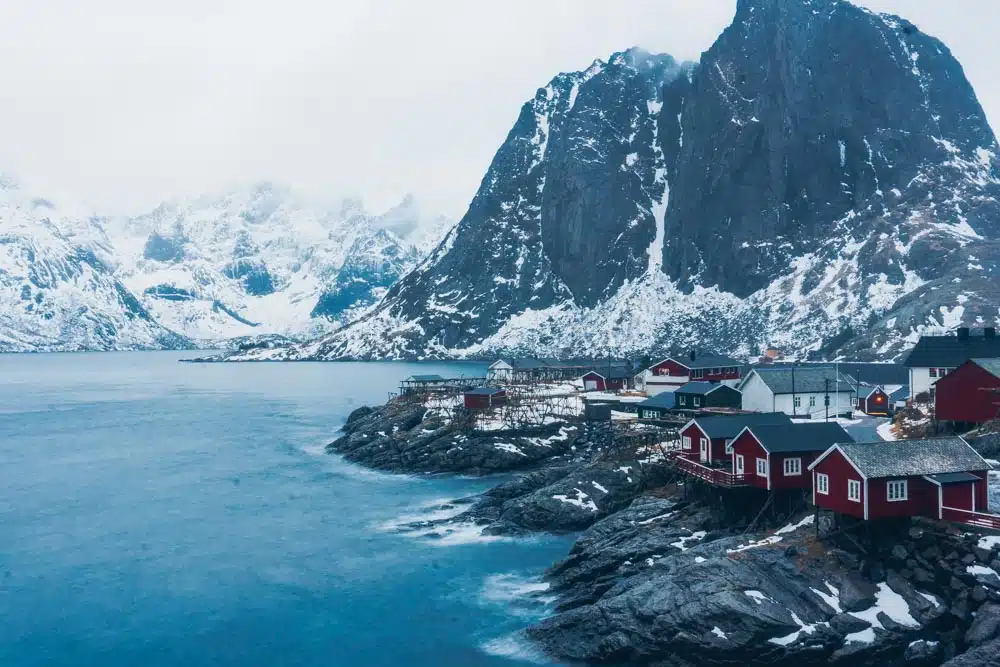
Psst, if you are looking for that iconic shot to blow up the ‘gram, it’s taken from the bridge on the E10. My Hamnøy travel guide has more photo spots and things to do nearby.
Reine
Just across the water from Hamnøy, Reine is the other big name of southern Lofoten: a fishing village of red and white houses squeezed between the fjord and some of the most dramatic peaks on the islands.
Most people come to look up at Reinebringen, the mountain behind the village, or to climb it (more on that below). Even if you don’t hike, it’s worth stopping for a wander along the harbour, a coffee at Bringen and a look at the view over Reinefjorden.
Å
Perched at the end of the E10, Å is set in (yet another) stunning location. Arriving at the very end of the road that winds through all of the islands, with that view in front of you, is quite the finish.
More than that though, it’s home to two of Lofoten’s best museums: the Tørrfiskmuseum (Stockfish Museum), which opens in the summer season, and the Norsk Fiskeværsmuseum, which is open all year with varying hours, where you can learn all about life on Lofoten in times past.
While you’re here, look at the colours of the houses. The story goes that red paint was the cheapest, so most people painted their houses red. Yellow cost more, so if you had a bit of money, you went yellow. And if you really wanted to make a statement, you painted your house white, because white paint was the most expensive of all.
Nusfjord

Want to see a traditional Lofoten fishing village without the crowds? Head to Nusfjord. Thanks to its location, at the end of a narrow road about 6km off the E10, it’s much quieter, but no less picturesque than other famous spots like Hamnøy and Reine.
It’s often described as one of the oldest and best-preserved fishing villages in Norway, with the earliest traces of people living here dating back to around 425 BC. At its peak in the early 20th century, more than 1,500 fishermen worked out of the village. It’s one of the places that not that many visitors find, and I’d highly recommend it.
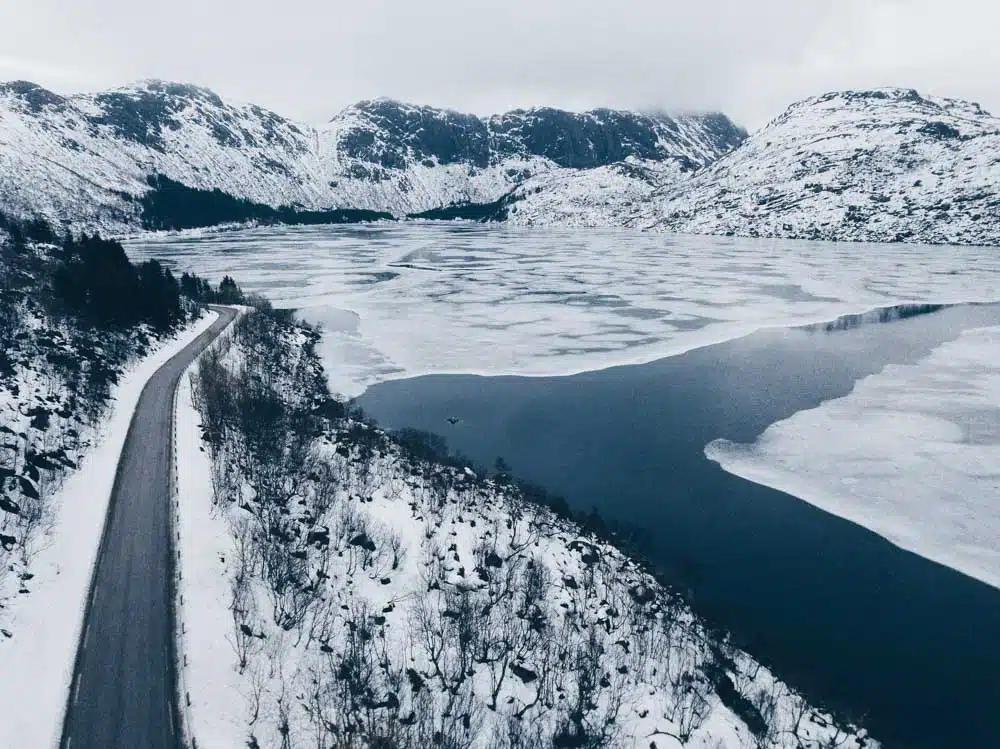
Plus you get gorgeous views of the Storvatnet Lake on the road there too.
Enjoy Lofoten’s striking Arctic beaches
Ramberg Beach (Rambergstranda)

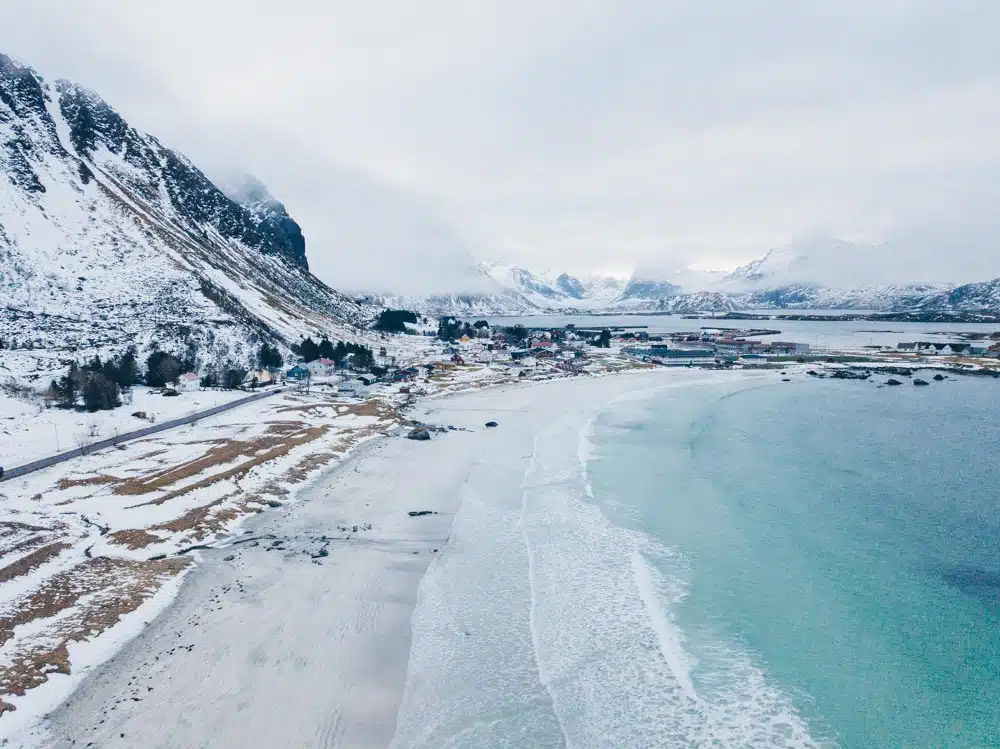
You probably don’t think of coming to the Lofoten Islands to hang out on some beaches… more fool you, because these beaches are STUNNING.
I hate to play favourites (who am I kidding, I love it), but of all the beaches we visited on our Lofoten travels, Rambergstranda was the one that really made my jaw drop.
Milky turquoise sea laps against pale white sand, so fine it could have been imported straight from the Caribbean. Distinctly less Caribbean is the snow and the mountains, but the overall effect is one of pure drama.
Uttakleiv Beach
Uttakleiv is one of Lofoten’s most photographed beaches: a wide sweep of jagged rocks, mountains and brooding sea. You can also camp here during the season.
It felt like all the other beaches had been leading up to this one. Look at the sheer size of it, with the mountains framed by the clouds and some seriously moody sea. Definitely a spot you should visit when you’re in Lofoten.
Unstad Beach + Unstad Arctic Surf

Yes, you read that right. A surf resort. In the Arctic Circle.
Unstad Arctic Surf is one of the most northerly surf spots in the world, luring surfers from near and far with its promise of reliably big waves that roll in from the Norwegian Sea, ending with a crash and a wallop off the coast of Unstad Beach.
Sure, that sounds great… if you’re a surfer.
If you’re not, the surf resort has a reputation as one of the nicest places to stay in Lofoten thanks to its remote location, seaside sauna and hot tub, and stylish cabins and lodges.
Or just pop in and gorge yourself on their cinnamon buns, which are often named as the best in the world (they are truly spectacular). We were distraught when we popped in on our last day, only to be told that the day’s batch weren’t ready yet. Luckily, the owner magicked up a couple for us to try and they were divine.
Other beaches to visit
Flakstad Beach and Haukland Beach are also rather impressive if you have the time to visit.
In summer, Kvalvika Beach is the one everyone wants to reach. There’s no road, so you hike in from Fredvang on a trail of about 6.8km there and back, with some scrambling over boulders near the start.
Hike Reinebringen, Ryten and Kvalvika
I’ve only been to Lofoten in autumn and winter, so I haven’t done these hikes myself, but they’re the reason many people come in summer.
Reinebringen is the big one. Sherpas from Nepal built a stone staircase of almost 2,000 steps up the mountain behind Reine, and the climb takes about an hour to an hour and a half for that view over Reine and the fjords. The trail has been closed at times because of rockfall, and it’s strongly advised against in the winter half of the year, so check its status with the tourist office before you go.
Ryten, at 543m, is the classic viewpoint over Kvalvika Beach, and you can combine the two in a single day. Guided hikes run from Svolvær in summer if you’d rather not go it alone.
Visit the Lofotr Viking Museum
At Borg on Vestvågøya, archaeologists uncovered the remains of an 83-metre Viking chieftain’s longhouse, the largest Viking-era building ever found. The Lofotr Viking Museum has rebuilt it at full size, so you can step inside and get a sense of how a Viking chieftain lived up here.
It sits right on the E10, so it’s an easy stop on the drive between Svolvær and the south. It’s open all year, with shorter hours in winter.
Check out the stockfish racks and learn about how stockfish is made
Spend any amount of time in the Lofoten Islands and I guarantee that you’ll start to notice triangular-shaped wooden structures dotted about all over the place. In the winter months, when they’re festooned with gutted fish drying in the breeze, their purpose is clearer: they’re stockfish racks.
Lofoten’s inhabitants have been making stockfish since the Viking times. Unsalted fish (normally cod) is left to dry on wooden racks to preserve it. After it’s dried, the fish can be used for up to ten years.
You need the perfect conditions to make it. Not too hot, not too cold, a bit like Goldilocks’ porridge, and salty winds to do the drying. Lofoten just happens to have all three.
I learnt all about stockfish on my trip with the Norwegian Seafood Council, including a tour of the warehouse at stockfish producer L. Berg + Sønner, and I tried it for the first time at Paleo Arctic in Svolvær. Short of that, you can visit the Lofoten Stockfish Museum in the village of Å.
Go snowshoeing
If you can brave the cold, snowshoeing is one of the top activities on the Lofoten Islands. Strap on your snowshoes and prepare to crunch your way across the snow, heading deep into the quiet and untouched nature.
The stunning vistas of snow-capped mountains, frozen lakes and icy streams are hella impressive. Not to mention that it’s super fun trying to schlepp across the snow with the huge, flipper-esque attachments stuck to your feet.
Book Your Snowshoeing Adventure Here
Go kayaking
You don’t have to be on a big boat to get out on the water. Guided kayak trips from Svolvær take you out past the harbour and the little islands around town, and in summer, you can paddle around Reinefjorden under the midnight sun.
Book a Guided Kayak Trip From Svolvær
Must-try places to eat in Lofoten

Lofoten is a food lover’s dream, with seafood so fresh it was in the sea that morning. For the full story of my culinary trip, read my Lofoten food guide.
Anita’s Sjomat
No one is ever going to describe Lofoten as a budget destination, so when you find somewhere serving up absolutely deeeeelicious food at reasonable prices, you sit up and pay close attention.
Anita’s, on the little island of Sakrisøy near Reine, is a cafe, deli and hangout all rolled into one, but if you only try one thing, make it the fish sandwich. Served piping hot in a bun, a glorious feast of fish pattie, sauces and salads, it’s a winner. It had been a cold, cold day when I stopped by, so I had the hot chocolate too, and it was dreamy.
Lofoten Food Studio

I am being incredibly serious when I say that my meal at Lofoten Food Studio was one of the best I’ve had. Ever. Yes, really.
Far away from the tourist hubs, in the fishing village of Ballstad, chef Roy Berglund brings his quiet excellence to a chef’s table in an outbuilding of his family home. Using local ingredients paired with skill and panache, he serves up what is undoubtedly the best food in the Lofoten Islands. For me, it was a toss-up between the raw scallop and a parcel of mushrooms in a rich cream and herb sauce.
It’s open all year except January, with a seven-course menu from NOK 2,490. Book ahead.
Du Verden

This chic restaurant on the harbour promenade in Svolvær dishes up tasty meals from an international menu. Food is consistently good, though the service can be a bit wobbly at times.
Børsen Spiseri
If it’s truly authentic food you’re after, Børsen Spiseri, at Svinøya Rorbuer in Svolvær, is one of the best places to dine in Lofoten.
The adorable white beach-shack-esque restaurant overlooks the water and Svinøybrua Bridge, and rustles up some of the finest seafood dishes in Lofoten (and maybe in Norway, it’s just that good).
Paleo Arctic

I’m not normally into hotel restaurants, but every rule has its exception, and in this case, it’s the Paleo Arctic restaurant in the Thon Hotel Lofoten in Svolvær. Go for traditional Norwegian dishes that have been given a modern makeover and a comfortable setting. This is where I tried stockfish for the first time, paired with chorizo, paprika and carrots.
Bacalao

Another winning eatery in Svolvær, Bacalao is a bar-cum-restaurant in a former car workshop on the harbour. As you’d suspect from the name, the fish is very good. Paired with friendly staff and a buzzy atmosphere, it’s a nice place to while away an evening.
Bringen
One of the most famous cafes on the Lofoten Islands, Bringen in Reine is the place to escape the chill and cuddle up with a coffee.
Go for a waffle or a bowl of fish soup with your coffee. It’s the perfect place to grab a late brunch or mid-afternoon snack. Opening hours vary through the year, so check before you make a special trip.
Lofoten Islands map
Love this? Save and Share on Pinterest!
Read more Lofoten + Norway guides
- Lofoten Food Guide: Delving into Lofoten’s Culinary Scene
- Svolvær Travel Guide: The Capital of the Lofoten Islands
- Henningsvær Travel Guide: The Jewel of the Lofoten Islands
- Henningsvær Stadium: Is This the World’s Most Famous Football Pitch?
- Hamnøy Travel Guide: The Most Beautiful Fishing Village in Lofoten
- The Ultimate Norway Travel Guide
- Norway in Winter: Why It’s Worth Visiting
- Best Time and Places to See the Northern Lights in Norway

Discover the top things to do, insider tips and hidden gems in our Norway Travel Guides.
Read the guides →