Get ready to see the night sky as it looked before anyone switched on a light bulb. Where should you set up your chair? Which months bring the Milky Way overhead, and which nights is it nowhere to be seen? And is a tour worth paying for when the park never closes? This guide answers all of it.
Far from the cities in the broiling, barren sands of Death Valley National Park are some of the most spectacular sights you can lay your eyes on. And I’m not just talking about the earth-bound ones.
Stargazing isn’t just for dreamers, and I promise it’s completely bucket list-worthy. You’ll soon understand when you cast your eyes upwards here and bask in the spectacle of lights before you. Anyone who has read this site for a while knows I’m a sucker for a dark sky, and the nights I spent stargazing in the park on a November road trip have stayed with me ever since. The Mesquite Flat dunes after dark left me lost for words, which takes some doing.
Now, you may need to know a little more before you embark: the best places to go, what to bring, and when to go, right down to the month and the phase of the moon. Well, that’s what I’m here to tell you.
So grab a hot mug of something delicious and read on about Death Valley stargazing and what you can expect. Trust me, the park is even more beautiful at night beneath the Milky Way.
Can you see stars in Death Valley?

Absolutely! And I’m not talking about your standard “outer city-limits” stars. I’m talking “front seat to the Milky Way” stars.
In fact, the park is a Gold Tier International Dark Sky Park. The International Dark-Sky Association (now DarkSky International) gave it the title in February 2013, and Gold is the top rating, awarded to places where the night sky is close to pristine. At more than 3.4 million acres, it was the largest dark sky park in the world when it was named, which makes it a perfect playground for laying back and gazing upon faraway galaxies.
Three things make the skies here so good. The park is hours from any big city, the air is bone dry (the valley floor gets less than 2 inches of rain a year), and clear nights are the rule rather than the exception. The park has also swapped the lights at Furnace Creek and Stovepipe Wells for shielded fittings that point down, so even the developed areas stay fairly dark.
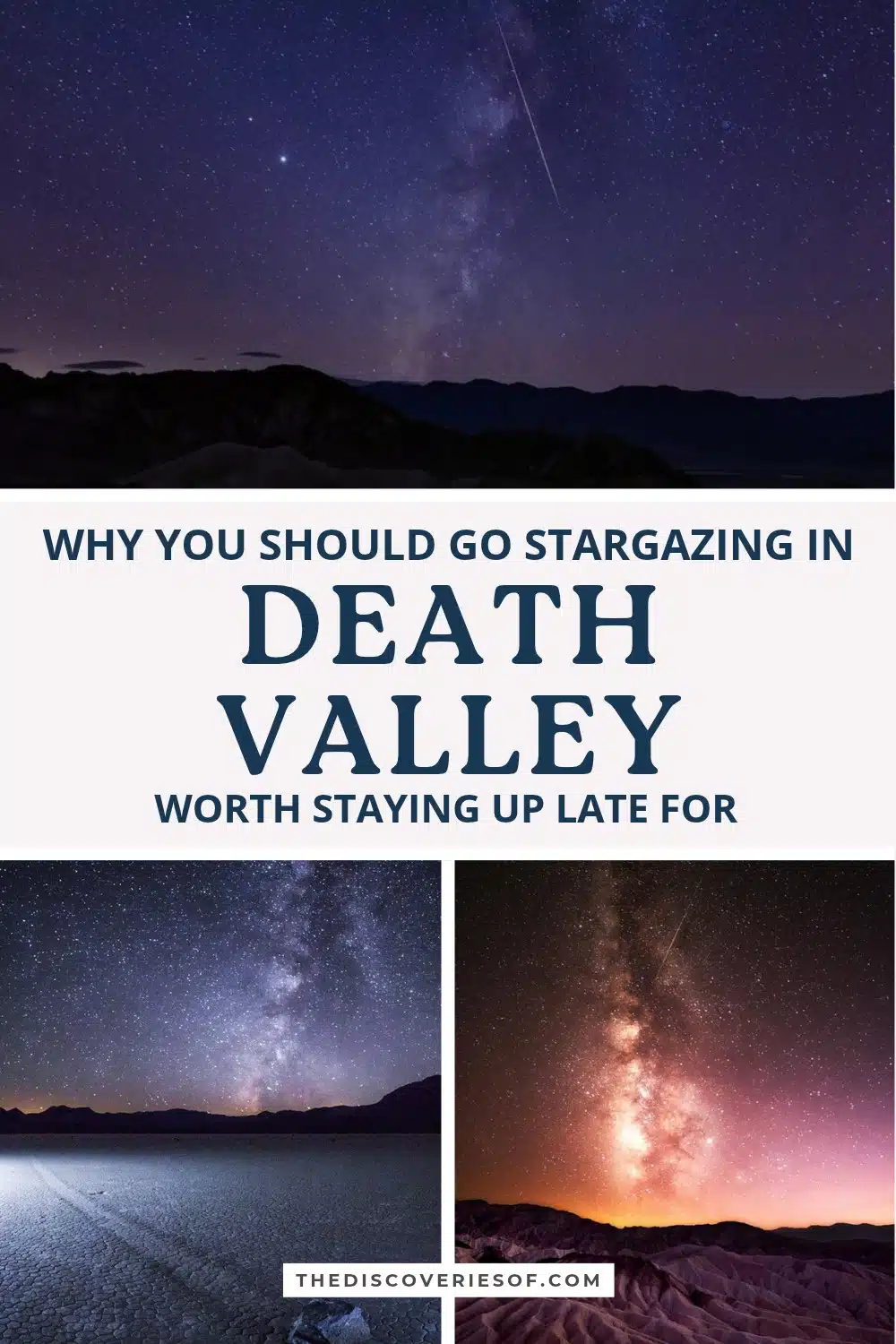
On a moonless night you can see thousands of stars with the naked eye, the Milky Way stretching from one horizon to the other in season, planets, satellites, the International Space Station and, in autumn, the Andromeda Galaxy as a faint smudge. The one blot on the landscape is a pale dome of light on the eastern horizon: that’s Las Vegas, around 100 miles away.
When is the best time for stargazing in Death Valley?

Any clear, moonless night is a good night here, but the best time depends on what you want to see.
For the Milky Way at its brightest, you need the galactic core, the dense, glowing centre of the galaxy that you see in the photos. From Death Valley it first peeps over the south-eastern horizon just before dawn in late February, rises earlier each month through spring, is up for most of the night in June and July, and has slipped into the south-west soon after dark by early October. From November to January it isn’t visible at all.
Then there’s the heat. Summer nights on the valley floor can stay above 100°F (38°C), which makes lying on the sand a lot less dreamy. So the sweet spots are spring (March to May), when the core is up in the small hours and the nights are mild, and late September and October, when it hangs low in the evening sky as the heat breaks.
Winter is better than its reputation, too. The core is missing, but the nights are long and crisp, the bright winter constellations such as Orion and the Pleiades are overhead, ranger programmes run through the season and the Dark Sky Festival takes place in February. Just wrap up: it gets properly cold after sunset.
Whatever the month, check your lunar schedule. The night sky is best during a new moon so that there’s zero interference from the moonglow, and the stars can shimmer in all their brilliance. The few nights either side of the new moon are nearly as good, as the moon is a thin crescent that sets early in the evening or rises just before dawn.
Death Valley’s Milky Way season, month by month
These times are for the middle of each month at Furnace Creek, in Pacific Time (Death Valley, like Las Vegas, is on Pacific Time). They shift by a few minutes from week to week, so check an app such as Stellarium or PhotoPills on the day.
| Month | Milky Way core (in full darkness) | Average low at Furnace Creek |
|---|---|---|
| January | Not visible | 40°F (4°C) |
| February | Briefly, low in the south-east before dawn (about 4.30am to 5am) | 46°F (8°C) |
| March | Before dawn, about 3.30am to 5.30am | 55°F (13°C) |
| April | From about 1.30am until dawn | 62°F (17°C) |
| May | From about 11.30pm until dawn | 73°F (23°C) |
| June | Most of the night, about 10pm to 3.30am | 81°F (27°C) |
| July | From dark (about 10pm) to about 2am | 88°F (31°C) |
| August | From dark (about 9pm) to midnight | 86°F (30°C) |
| September | From dark (about 8.30pm) to about 10.30pm | 76°F (24°C) |
| October | Low in the south-west for an hour after dark, about 7.30pm to 8.30pm | 61°F (16°C) |
| November | Not visible | 48°F (9°C) |
| December | Not visible | 38°F (3°C) |
At this latitude the core never climbs much more than 25 degrees above the horizon, so choose a spot with a clear, open view to the south.
New moon dates for the year ahead
Plan your trip around these dates for the darkest skies:
- 2026: 8 November and 8 December
- 2027: 7 January, 6 February, 8 March, 6 April, 6 May, 4 June, 3 July, 2 August, 31 August, 29 September, 29 October, 27 November and 27 December
Aim to be in the park within about four days of one of them. For a Milky Way trip, a new moon between late March and early October gives you the core and a dark sky together.
The Death Valley Dark Sky Festival
You can also enjoy a more collective experience at the annual Death Valley Dark Sky Festival. There’s an exploration fair, astronomy programmes, astrophotography meetups, and auditorium talks for all sorts of stellar entertainment, with scientists from NASA’s Jet Propulsion Laboratory, NASA Goddard, the SETI Institute and Caltech among the speakers in recent years, and field talks out at spots such as Badwater Basin and Zabriskie Point.
The next festival runs from 5 to 7 February 2027, which happens to fall right on a new moon. Rooms and campsites in and around the park fill up for that weekend, so book as early as you can.
The best spots for a night under the stars

When it comes to stargazing, Death Valley offers plenty of places to choose for your nighttime rendezvous with the stars. As a rule, any large, open area away from the lodges at Furnace Creek and Stovepipe Wells works. Rangers suggest picking somewhere with a little height and a wide view of the horizon, as the mountains can hide a surprising amount of sky from the lowest parts of the valley.
You’re allowed to park along the main roads while you stargaze or take photos, but not to camp beside them, and the park advises against walking off into rough ground in the dark.
Mesquite Flat Sand Dunes
The Mesquite Flat Sand Dunes are one of the finest areas, with wide open skies and mountain vistas on the horizon. They’re the spot I’d send anyone first. Once the day-trippers have gone, the ripples and ridges of sand turn silver under the stars, and it’s every bit as otherworldly as it sounds.
It’s a popular stargazing spot, even if it is about a 30-minute drive from Furnace Creek (and just 2 miles from Stovepipe Wells). Park at the dunes car park off Highway 190 and walk out a few hundred yards; the sand is soft, so take a torch and keep your bearings by the road.
Mesquite Spring Campground and Ubehebe Crater
The best campground in the park for stargazing is the Mesquite Spring Campground, in the far north of the park near Ubehebe Crater. It’s a small, first-come, first-served campground at 1,800ft and one of the darkest places to sleep in the park.
It’s also about as far as you can get in the park from the dim lights of Las Vegas on the far horizon, adding to the depth of the darkness. So if you want to stargaze deep into the night a stone’s throw from your bed, it makes a perfect choice.
Nearby Ubehebe Crater, a volcanic crater around half a mile wide, is one of the spots rangers recommend, and I stargazed close by. The road to it has had its share of flood closures, but the North Highway and Ubehebe Crater Road reopened in December 2025. Scotty’s Castle, further up the same road, is still closed while flood repairs go on.
Harmony Borax Works
If you prefer a foray closer to Furnace Creek, the ruins of Harmony Borax Works sit just north of Furnace Creek and are top-notch for your star-viewing pleasure. The old borax wagons and adobe walls make great foregrounds for photos, there’s a car park and a short paved trail, and rangers have used it for night sky programmes and festival astrophotography meetups.
Badwater Basin
The lowest point in North America makes for an unforgettable night out on the salt. Badwater Basin is about 17 miles south of Furnace Creek, and the white crust stretches for miles under the sky. Because it sits so low, the Panamint Range and the Black Mountains hide the stars nearest the horizon, so it’s better for the sky overhead than for a rising Milky Way. On a full moon, the salt glows bright enough to walk on without a torch.
Zabriskie Point
Zabriskie Point is a favourite with night photographers, and it’s easy to see why: the golden badlands make one of the most dramatic foregrounds in the park, with the Milky Way rising behind them in spring and summer. It’s 5 miles from Furnace Creek, with a car park and a short, steep paved path up to the viewpoint.
Dante’s View
Towering 5,575ft above Badwater Basin on the crest of the Black Mountains, Dante’s View is one of the darkest viewpoints you can drive to. Expect it to be around 20°F colder than the valley floor, and often windy. It’s about an hour’s drive from Furnace Creek, and the last stretch of road is narrow and steep, so it isn’t suitable for long RVs or trailers. It’s also one of the best spots for sunrise and sunset in Death Valley.
Racetrack Playa
For the truly dedicated, and another of the places I stargazed, the Racetrack Playa is famous for its “sailing stones”, rocks that leave long trails across the dried lakebed. It’s as remote as it gets, about 27 miles of rough, rocky dirt road beyond Ubehebe Crater that needs a high-clearance vehicle (four-wheel drive is wise) and tyres that can take sharp rocks. Check the park’s road status before you go, carry a full-size spare, and plan to arrive before dark.
Death Valley stargazing tours and ranger programmes
Stargazing tours here aren’t a dime a dozen; they’re not that common outside of private gatherings by astronomy clubs and organised viewings by the park.
But they do crop up here and there. So you can either settle for a park ranger’s rendition of the night sky or sign up for a stargazing tour with a company like The Oasis.
- Ranger-led night sky programmes: these run during the winter, with rangers introducing the constellations and the science of the night sky at one of the park’s best-known spots, sometimes with telescopes. Dates change from year to year, so check the park calendar or ask at the Furnace Creek Visitor Center when you arrive. Bring a red torch.
- Star parties: the Las Vegas Astronomical Society brings its telescopes to Furnace Creek for star parties co-hosted by the park and the Oasis, with solar viewing by day and stargazing at Fiddler’s Campground after dark. Keep an eye on the Oasis and park calendars.
- The Oasis at Death Valley: the resort’s guided night sky tours are run by Stardust Astrotours and leave from the resort itself, in small groups with an astronomer, high-powered telescopes and a laser pointer to pick out the constellations. All the equipment is provided, so no experience is needed. Tours have to be booked in advance through Stardust Astrotours, so check dates and prices when you book your room.
- From Las Vegas: a few small-group day trips finish with stargazing. The Las Vegas: Death Valley Sunset and Stargazing Day Tour (about 12 hours, from around $249) takes in Dante’s View, Badwater, Artists Palette and Zabriskie Point before stargazing in the Amargosa Valley, and the Las Vegas: Death Valley Day Trip with Stargazing (about 11 hours, from around $399) ends at Death Valley Junction. Both stargaze just over the Nevada border rather than inside the park, but the skies there are still dark.
Top Tip
You don’t need a tour at all. The park is open 24 hours a day, every day of the year, and the only cost is the entrance fee, so a self-guided night with a star app and a camping chair is just as magical.
What to bring for a night of stargazing

No need to fret if you’re a novice stargazer, though there are a few items you might want to bring to make the most of your time scanning the skies in this national park.
Grab a star chart or night sky almanac to help you get your bearings on the stars you’re seeing (a free app such as Stellarium or SkyView does the same job on your phone). A good pair of binoculars is the next item, with excellent magnification and the right optics for long-distance viewing. NASA’s free Spot the Station service will tell you when the International Space Station is passing over.
You’ll also need a red torch. “Why?” I hear you ask. “It’s not a disco.” Maybe not, but you’ll need a torch to move around, and bright white lights will hamper your vision, so you won’t see the heavens as clearly.
On the other hand, red light isn’t as abrasive on your eyes and won’t affect your night vision as badly. Give your eyes a good 30 minutes to adjust to the dark once you arrive, and keep your phone screen dimmed (or in night mode) while you wait.
If you want to get a little more serious about stargazing, then bring a beginner’s telescope and a comfortable fold-up camping chair. A green laser will help you point out celestial objects of interest to others.
Most importantly, pack more warm layers than you think you’ll need, plus a hat and gloves. The desert loses its heat fast after sunset, and on my November trip I learnt just how cold it gets at Dante’s View, waiting for sunrise and convinced my ears were about to drop off. Bring water and snacks too: there are no services out at the darker spots.
Tips for photographing the night sky
Death Valley is one of the best places in the US for astrophotography, and you don’t need a huge kit bag to get started:
- A sturdy tripod matters more than anything else. Pair it with the widest, fastest lens you have (f/2.8 or wider is ideal).
- Start at around ISO 3200, with the aperture wide open and an exposure of 15 to 20 seconds. Go much longer and the stars start to trail.
- Switch to manual focus and focus on a bright star or planet using your screen zoomed in, then leave it there.
- Shoot in RAW and use a remote or the two-second timer so you don’t jog the camera.
- Most recent phones have a night mode that can capture the Milky Way if you rest the phone on something solid.
- Scout your spot in daylight, and keep your torch pointed at the ground when other photographers are nearby. The festival’s astrophotography meetups are a good way to learn from people who do this every month.
Other questions about Death Valley after dark
How do I get to Death Valley?
- From Las Vegas: travelling via Pahrump and California Highway 190 is the most direct route, about 120 miles and two hours to Furnace Creek.
- From Los Angeles: drive along Interstate 15 to Baker, then follow Highway 127 north to Highway 178 or 190. Allow four and a half to five hours.
- From the east: travel along Highway 95 to Highway 373, which meets Highway 190 at Death Valley Junction.
Is it safe to stargaze in Death Valley?
Short answer: yes.
But, I’ll be honest. The most dangerous thing about Death Valley is the heat, which melts away at night, allowing the desert creatures to come slipping out of cracks and burrows. You may see some wonderful wildlife while stargazing, such as kit foxes, bats and, on warm nights, rattlesnakes and scorpions, so watch where you put your hands and feet and use your torch when you walk. Otherwise, it’s safe to go stargazing here.
Carry plenty of water even at night (summer nights can stay above 100°F), tell someone where you’re going, and don’t count on phone signal: it’s patchy at best outside Furnace Creek and Stovepipe Wells.
Do I have to pay to stargaze in the park?
Only the park entrance fee: $30 per vehicle, $25 per motorcycle or $15 per person on foot or by bike, valid for seven days. The America the Beautiful annual pass covers it too (non-US residents pay $250 for theirs). You can pay at the Furnace Creek Visitor Center or the self-service pay stations, and as the park never closes, you can arrive and leave whenever you like.
How cold does it get at night?
Colder than most people expect. Average lows at Furnace Creek drop to around 48°F (9°C) in November and 38°F (3°C) in December, and the temperature falls by roughly 3 to 5°F for every 1,000ft you climb, so viewpoints such as Dante’s View can be close to freezing on winter nights. In summer it’s the opposite problem: lows of 80°F (27°C) and more.
Map
Read next
- Brilliant things to do in Death Valley National Park
- The best places to see sunrise and sunset in Death Valley
- Exploring the Death Valley salt flats
- Mesquite Flat Sand Dunes: Death Valley’s epic dunes
- 3 days in Death Valley: the ultimate itinerary
- Where to go stargazing in the US
Love this? Save and share on Pinterest

Discover the top things to do, insider tips and hidden gems in our USA Travel Guides.
Read the guides →