Golden sea stacks a short walk from the town walls, a church that glitters with carved gold, four kilometres of sand across the river and a fish market that opens at seven. Lagos packs a lot into a small space, and the best of it is within reach on foot.
Lagos was my base when I explored the western Algarve, on a different trip from my week at the other end of the coast. I hired a villa in the town and spent my days in the old town and out along the cliffs, sending my drone up over the coves and sea stacks that make this stretch of coast so famous.
What makes it such a good base is that it’s a real town, not a resort that grew up around a beach. It has walls, churches, a working market and a history that runs from the age of exploration to the darkest chapter of the Atlantic slave trade. The railway line from Lisbon ends here, and buses, boats and footpaths fan out from the centre, so you can get by perfectly well without hiring a car.
This Lagos travel guide covers the old town and its sights, the beaches on either side, the boat trips, what to eat, where to stay and how to get around.
Lagos at a glance
- Where: the western Algarve, on the bay where the Bensafrim river meets the sea, about an hour’s drive west of Faro airport.
- Best for: cliff coves and grottoes, a walkable old town, boat trips and an easy base without a car.
- Getting there: regional trains run to the station at the end of the Algarve line; from Lisbon, change at Tunes, and the trip takes three and a half hours or a little more. Direct coaches from Faro airport take about two hours.
- Getting around: on foot in the centre, by A Onda town bus, by Vamus Algarve regional bus along the coast, and by boat from the marina.
- Time needed: three or four days for the town, the beaches and a boat trip; a week if you want to add day trips along the coast.
- Tourist tax: none at the time of writing, unlike Faro, Albufeira and Portimão.
Explore the old town
The centre of town sits inside a ring of old walls on the west bank of the river, a compact grid of cobbled lanes, tiled façades and small squares. Almost everything worth seeing here is within ten minutes’ walk of everything else, and it’s at its best first thing in the morning, before the day’s boat trippers arrive, or in the evening, when the squares fill up for dinner.
Wander between the squares
Praça Gil Eanes is the heart of the old town, named after the Lagos-born navigator who rounded Cape Bojador on the West African coast in 1434, a turning point in Portugal’s voyages of exploration. In the middle stands João Cutileiro’s 1973 statue of the young king Sebastião, a strange, almost childlike figure that still divides opinion.
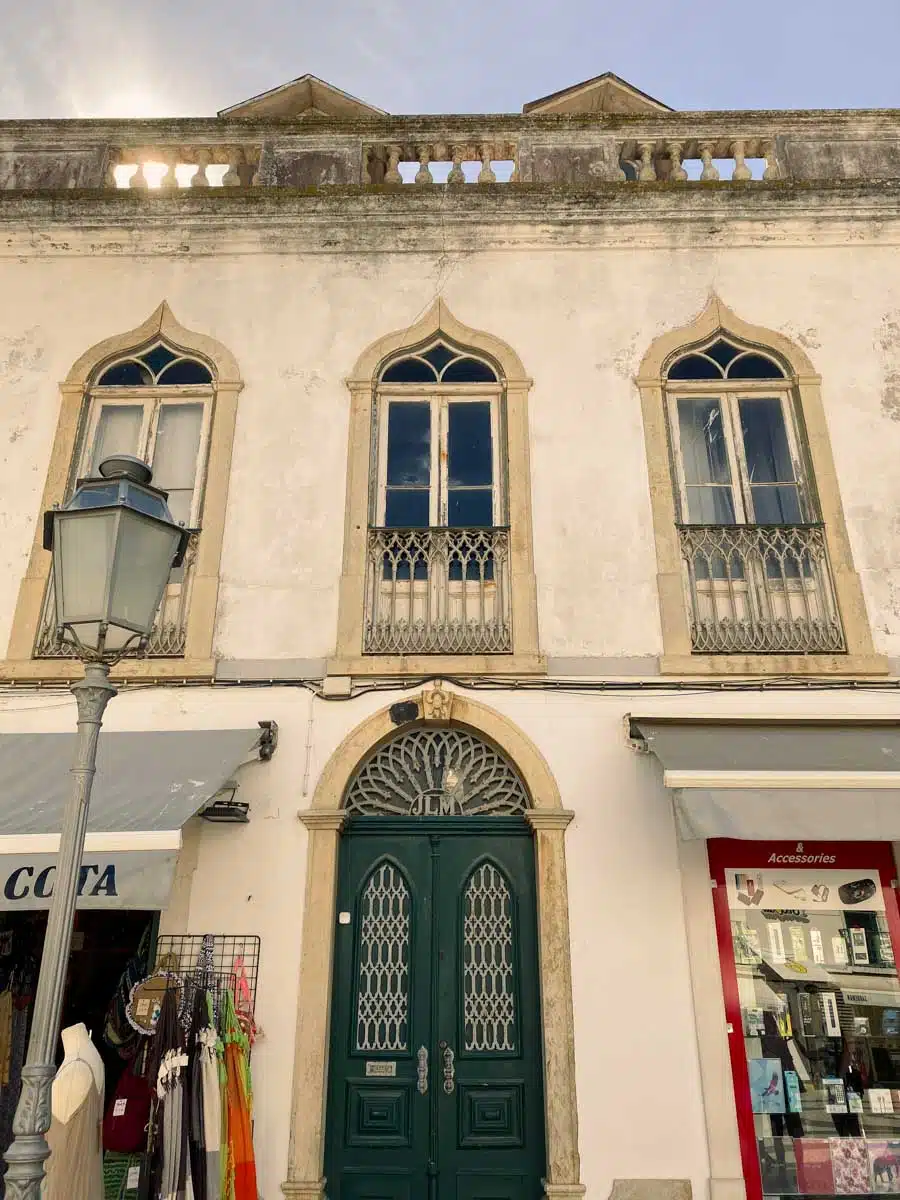
From here, the pedestrian streets running down towards the river are lined with shops, cafés and buildings faced in patterned tiles. Look up as you go: the upper floors, with their wrought-iron balconies and carved window frames, are where the old town’s character really shows.
Step inside the Igreja de Santo António
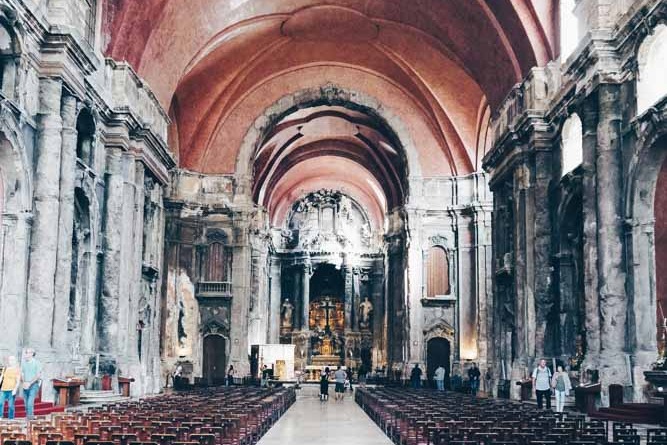
From the street, the little church of Santo António looks like nothing much. Inside, it’s one of the most extravagant baroque interiors in the Algarve, with almost every surface covered in gilded carved wood, a barrel-vaulted ceiling painted with panels and a statue of the saint in a red robe above the altar. It’s a national monument, and it holds a service only once a year, on Santo António’s feast day, 13 June.
You go in through the Museu de Lagos Dr José Formosinho next door, which reopened in 2021 after years of renovation. Its eleven rooms run from religious ivories and a maritime section on the 1759 Battle of Lagos to a cabinet of curiosities collected by its founder.
Tickets
The museum and church are open Tuesday to Sunday, 10am to 1pm and 2pm to 6pm, and closed on Mondays. A ticket costs €3.
Face the town’s history at the slave market
On Praça do Infante D. Henrique, opposite the statue of Henry the Navigator, a modest arcaded building marks one of the most uncomfortable sites in Europe. In 1444, captive Africans brought back by Portuguese ships were sold here, in a sale widely held to be the first public auction of enslaved people in Europe. The building now houses the Mercado de Escravos museum, a small exhibition of texts and images on the slave trade, with tickets at €1.50.
The history isn’t only in the museum. When an underground car park was dug just outside the old walls at Valle da Gafaria, archaeologists uncovered the remains of 158 people, most of them believed to be enslaved Africans, buried between the 15th and 17th centuries, many of them with signs of having been bound. It’s a sobering stop, and an important one for understanding the town’s wealth.
Walk the walls down to the waterfront
Stretches of the town walls, largely rebuilt in the 16th century over older Moorish defences, still run around the old town, and you can follow them past the Castelo dos Governadores and the church of Santa Maria. The town was the capital of the Algarve from the late 16th century until the earthquake of 1755, which destroyed much of the town, and the walls are among the few things that survived it.
Down by the harbour mouth, the square little Forte da Ponta da Bandeira has guarded the river since the 17th century. The fort has been closed to visitors since 2022 while works to shore up its sea-facing walls are planned and carried out, so for now it’s one to admire from the outside, ideally from Praia da Batata next door.
Beaches on both sides of town
Lagos has two very different kinds of beach. To the south of town, the cliffs break up into small golden coves, each one tucked between rock stacks and reached by a staircase. To the east, across the river, Meia Praia is one long, open sweep of sand. Between them, you can find a beach for almost any mood.
Praia da Batata, Estudantes and Pinhão
The coves begin right on the edge of the old town. Praia da Batata, beside the fort, is the closest of all, and it’s popular with families for its gentle water. A tunnel through the rock and a short walk along the cliffs bring you to Praia dos Estudantes, where a small stone footbridge arches out to one of the rock stacks, and then Praia do Pinhão, a pretty little cove at the bottom of a flight of steps.
Praia Dona Ana
About 2km south of the centre, Praia Dona Ana is the classic cove: soft sand, clear water and golden pinnacles standing in the shallows, about 100 steps below the clifftop. It’s also the start of the boardwalks that run along the cliffs to Ponta da Piedade, so it fills up early on summer days.
Praia do Camilo and Ponta da Piedade
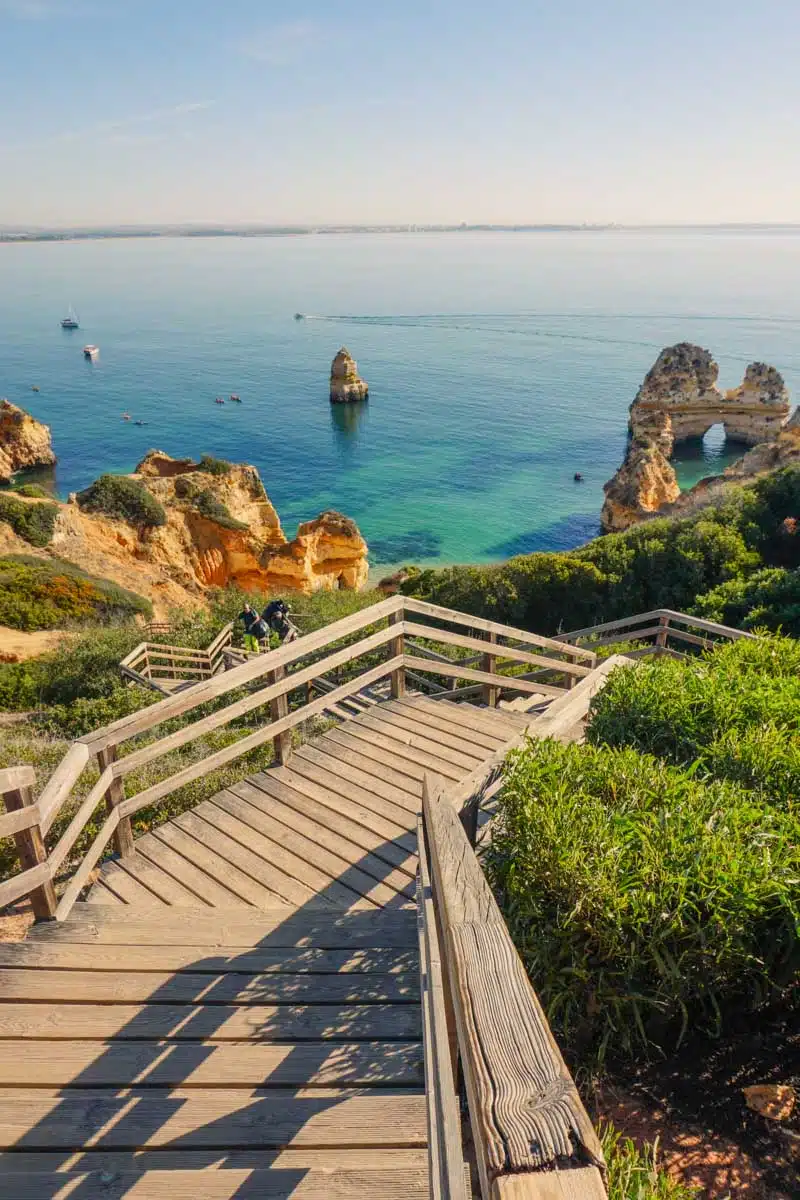
A little further along the clifftop path, Praia do Camilo is the tiny cove at the bottom of the town’s famous wooden staircase, which has been closed since the storms of early 2026. Beyond it, the headland of Ponta da Piedade is a maze of arches, grottoes and sea pillars around a lighthouse. My guide to Praia do Camilo and Ponta da Piedade has the walk, the steps down to the water and the latest on the Camilo closure.
Porto de Mós and Luz
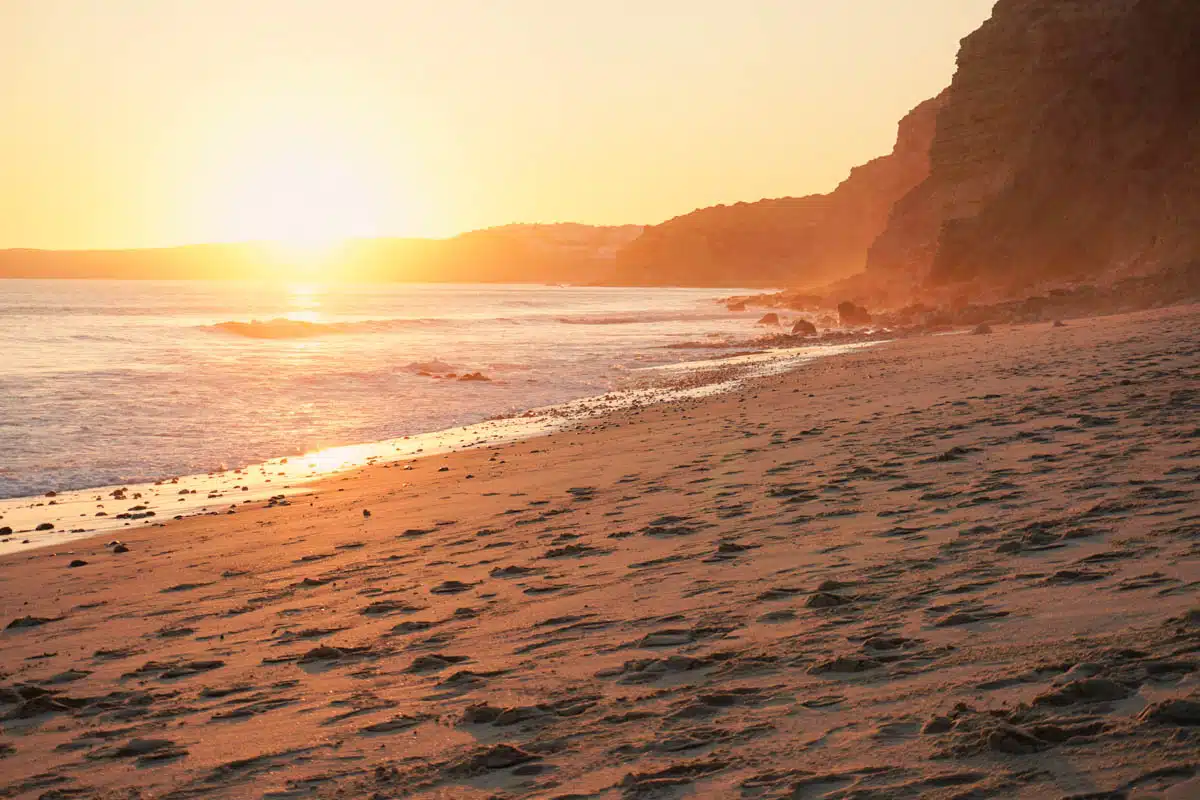
West of the headland, the cliffs open out again at Porto de Mós, a long beach about 3km from the centre with beach restaurants and easier access than the coves. Keep going and you reach Luz, a low-key village about 6km west of the centre with a wide beach watched over by the dark Rocha Negra cliff. Both are on the town bus and regional bus routes, and the clifftop footpath links them for walkers.
Meia Praia
On the other side of the river, Meia Praia stretches about four kilometres east towards Alvor. There are no cliffs to climb down here, just a long line of sand with beach bars, sun loungers and, at the far end, plenty of space to yourself. It’s also the best beach in town for learning to surf, as the waves tend to be gentler than on the west coast. Walk over the footbridge by the marina and along the river to get there, or take the town bus.
Further along the coast
Two of the Algarve’s best-known stretches of coast are an easy day out from here. Praia da Marinha, about 40 minutes’ drive east, is the beach at the bottom of the Seven Hanging Valleys Trail: read my guide to Praia da Marinha. And for every other beach worth knowing on this coast, see my guide to the best beaches in the Algarve.
Top Tip
The 2026 storms affected dozens of beaches across the Algarve, and cliffs in this area can and do fall. Stay behind any barriers, and never pitch your towel right at the foot of a cliff.
Get out on the water
You’ll see the boats lined up along the riverfront and the marina from early in the morning, and getting out on the water is one of the best things to do in town. The coastline makes far more sense from sea level, and a couple of the trips below are the kind you won’t easily do anywhere else in the Algarve.

Weave through the grottoes of Ponta da Piedade
The most popular trip is the short hop round the headland: small boats slip into the caves and through the arches that you can only look down on from the clifftop path. Trips from the marina usually last about 75 minutes and cost from about €20, and guided kayak tours of about two hours run from about €25 to €40. My Camilo and Ponta da Piedade guide compares the options.
Go dolphin watching
Common and bottlenose dolphins feed offshore all year, and several operators run trips out to sea from the marina in fast, open boats. Trips usually last about 90 minutes and cost about €40, and the better ones carry marine biologists who explain what you’re seeing. Spring and summer usually bring calmer seas and better odds of a sighting.
Do
Compare the dolphin-watching trips from Lagos and pick a small group with a biologist on board.
Cruise east to Benagil
Longer cruises head east along the cliffs towards Benagil, passing Praia da Marinha on the way. Remember that you can’t land on the beach inside Benagil Cave or swim in from the sea, so you’ll see it from the boat. For the full picture, including how to get closer by kayak, read my guide to Benagil Cave.
What to eat, and where to buy it
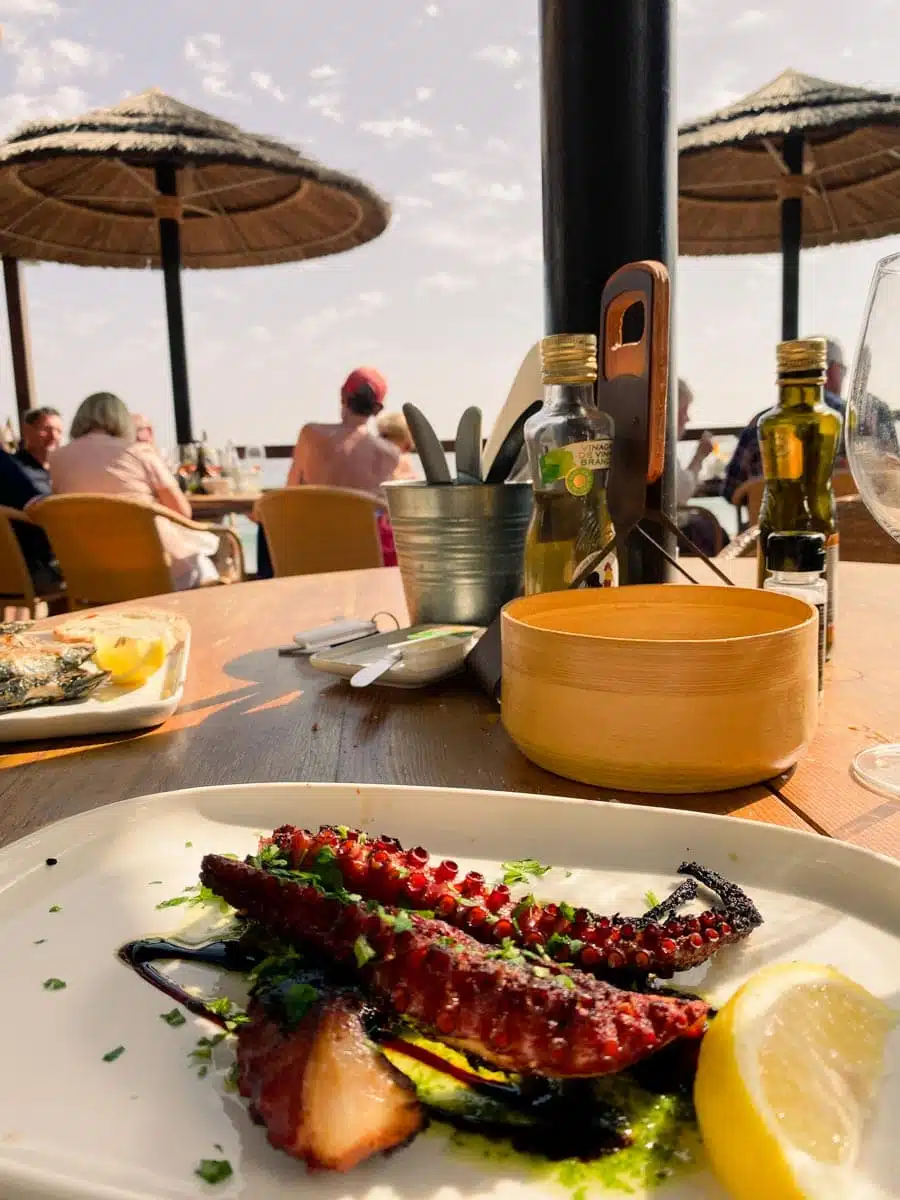
Lagos is a fishing town at heart, and the simplest meals are the best ones: whatever came in that morning, grilled over charcoal and served with boiled potatoes, salad and a wedge of lemon. Look out for sardines in summer, octopus, sea bream and bass all year, and cataplana, the Algarve’s seafood stew, cooked and served in a hinged copper pan and usually ordered for two.
Shop at the markets
To see where the fish comes from, go to the Mercado da Avenida, the municipal market on Rua Portas de Portugal, just off the riverfront Avenida dos Descobrimentos. It’s open Monday to Saturday from 7am to 2pm, and the fish counters are at their liveliest early in the morning.
On Saturday mornings, the Mercado do Levante by the bus station fills up with stalls of local fruit, vegetables and other produce from the hills behind the town, from 7am to 2pm. If you’re staying in a villa with a kitchen, this is where to stock up.
Eat well in and around the old town
The lanes of the old town are packed with restaurants, from simple grill houses to modern places with tasting menus, and the side streets off the main squares are usually better value than the ones with a view. Out of town, the beach restaurants at Meia Praia and Porto de Mós are made for long lunches, and the clifftop restaurants near Ponta da Piedade are the place for a sundowner. Finish with a glass of medronho, the fiery strawberry-tree spirit from the Monchique hills, or one of the Algarve’s almond and egg sweets.
Where to stay in Lagos
I stayed in a hired villa, and it’s the way I’d do it again here, especially with family or friends. The hills behind the town and the coast road out towards Luz are full of villas with pools, gardens and kitchens of their own, which suit long, lazy days and meals made with fish from the market. Browse villas to rent in Lagos and the hills around it for your dates, and book months ahead for July and August.
If you’d rather walk to everything, stay in or just outside the old town. Casa Mãe, just inside the walls, is the boutique choice: an old family home turned hotel, with its own vegetable garden, a pool and a farm-to-table restaurant. Across the river, the Palmares Beach House Hotel sits above Meia Praia, a small hotel aimed at adults, with balconies looking out to sea.
For more options in Lagos and across the country, see my guide to where to stay in Portugal.
Getting there and around without a car
This is one of the few places in the Algarve where you really can manage without hiring a car. The centre, the nearest coves and the marina are all within walking distance of each other, and public transport covers most of the rest.
Arriving by train or coach
The station is across the river from the old town, a short walk over the footbridge by the marina. From Lisbon, take the fast train to Tunes and change for the regional train: the whole journey is between three and a half and four hours. The regional line runs along the coast to Faro and Vila Real de Santo António, so you can also arrive by train from the east of the region.
From Faro airport, direct coaches run to the bus station in about two hours and cost just a few euros. A shared or private transfer takes about an hour, and you can book one before you fly.
Getting around by bus and on foot
The A Onda town buses link the centre with Meia Praia, Ponta da Piedade, Porto de Mós and the outlying villages, and the network is being expanded to 11 lines under a new contract approved in 2026. Routes appear in Google Maps, and the timetables are on aonda.pt.
For the rest of the western Algarve, Vamus Algarve’s regional buses run from the bus station west to Luz, Burgau, Salema and Sagres, about an hour away, and east along the coast.
On foot, the clifftop path from Praia Dona Ana to Ponta da Piedade is the walk everyone does, and it carries on to Porto de Mós and Luz. The town is also the end of the Fishermen’s Trail, the coastal route of the Rota Vicentina: see my guide to walking the Rota Vicentina.
Getting There
Taxis wait outside the bus and train stations, which helps for the beaches and restaurants the buses don’t reach, and for the last stretch to a villa in the hills.
A few tips before you go
- Come in spring or autumn if you can. July and August bring the biggest crowds, the highest villa prices and the busiest boats; in June, September and early October, the sea is still warm enough for a swim and the coves are far quieter.
- Wear shoes with some grip. The coves are reached by steep, uneven steps, and the cobbles in the old town are slippery when polished by years of feet.
- Book boat trips the day before. In summer, the popular departures fill up, and every trip depends on the sea, so keep a spare day in case one is cancelled.
- Plan your sightseeing round Mondays. The museum and the Igreja de Santo António are closed on Mondays, and the markets are closed on Sundays.
- Pair Lagos with the east. For a week covering both ends of the region, follow my week in the Algarve, which starts here, and see my guide to the best things to do in the Algarve for more.
Map
Read next
- A week in the Algarve, from sea caves to a desert island
- Praia do Camilo and Ponta da Piedade, and the best way to see them right now
- The best beaches in the Algarve
- The best things to do in the Algarve
- Where to stay in Portugal
Love this? Save and share on Pinterest
Discover the top things to do, insider tips and hidden gems in our Portugal Travel Guides.
Read the guides →