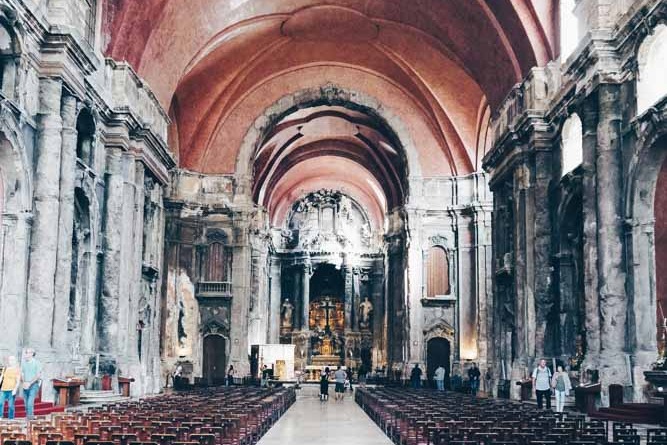

Step in from the bright little square off Rossio and the light changes. The columns are cracked, the stone is stained pink and grey, and the vaulted ceiling glows a dull terracotta. Most of the city’s churches have been gilded and polished back to their best. This one has been left exactly as the flames found it, and the reason goes back five centuries.
I came to São Domingos on a late October walking and tasting tour that started down by the river on Praça do Comércio and worked its way up through the grid of the Baixa to the square in front of the church. At the door, my guide ran through its history in a few minutes: a massacre that began here, an earthquake, a fire, and a congregation that most of Lisbon once turned away.
It sounds like too much for one building. It isn’t. The Church of São Domingos has been at the centre of the city’s best and worst moments since the 13th century, and you can read a good part of that story in the walls themselves. Entry is free and it’s a few minutes’ walk from Rossio, so there’s no reason to pass it by.

São Domingos at a glance
- Where: Largo de São Domingos, at the northeast corner of Rossio in the Baixa.
- Opening hours: 7.30am to 7pm, Monday to Saturday, according to the city’s tourist board. It also opens on Sundays for Mass.
- Entry: free, with no ticket needed.
- Mass: said every day. It’s a working parish church, so plan your look around outside service times.
- Dress: cover your shoulders. Visitors who don’t can be turned away at the door.
- How long: allow 20 to 30 minutes inside, and longer if you stop in the square.
- Nearest metro: Rossio (green line), two minutes’ walk.
From royal church to the start of a massacre
King Sancho II founded the Dominican convent here in 1241, the first of the order in the city, and for centuries its church was one of the grandest in the city. At one point it was the largest. Kings were married here until the monarchy fell in 1910, and royal baptisms and funerals filled the nave too.
It had a darker role as well. The Inquisition’s palace stood on Rossio, where the National Theatre is now, and the Dominicans were its close allies. Those condemned at the autos-da-fé were brought to São Domingos to hear their sentences before being taken out to be executed in the square.
The worst day in its history came on Sunday 19 April 1506. The city was suffering from drought and plague, and the church was full of people praying for relief when some of them claimed to see a miraculous light shining from a crucifix in one of the chapels. A New Christian, one of the Jews forced to convert to Catholicism in 1497, is said to have doubted the miracle out loud. He was dragged out and killed, and the crowd, egged on by Dominican friars and joined by sailors from ships in the harbour, turned on the city’s New Christians.
The killing went on for three days. Estimates of the dead run from several hundred to more than 4,000, and the memorial outside speaks of thousands. King Manuel I, who was away from the capital, had the ringleaders executed, two of the friars among them, closed the convent for eight years and stripped the city of some of its privileges as punishment.
The earthquake, and the story of where it stopped
São Domingos was knocked about by earthquakes more than once. One in 1531 badly damaged the medieval church, and the great earthquake of 1 November 1755, with the tsunami and fires that followed, brought most of it down.
Lisbon tells a better story than that. My guide’s version was that this was the spot where the earthquake stopped, as though something held it back. The records are less kind: what survived was the sacristy and the baroque high altar, designed by João Frederico Ludovice, the architect of the palace at Mafra, and finished only seven years before the earthquake. Rebuilding took more than half a century and wasn’t complete until 1807, and the façade and the walls you see today date from then. Carlos Mardel, one of the architects of the new Baixa, also worked on it.
Top Tip
Look at the high altar first. With its red marble columns and the sculpted Holy Trinity above, it’s one of the few things inside that predates the earthquake, and it gives you a sense of how richly decorated the whole church once was.
The fire of 1959, and why the scars were left
On 13 August 1959, a fire broke out inside the church. It took firefighters more than six hours to bring it under control, and two of them died. By the time it was out, the gilded woodwork, the paintings and most of the statues had gone, and the stone had been cracked and stained by the heat.
Lisboetas were quick to draw a connection. As my guide told it, many believed the fire was a punishment for the massacre that had begun inside the same walls more than 450 years earlier.
The church stayed closed for 35 years. When it reopened in 1994, the restorers made a choice that still surprises visitors: rather than recreate what was lost, they made the building safe and left the damage on show. The walls are unpainted, the statues that survived are still disfigured, the broken stone hasn’t been replaced and the ceiling and altars were painted a deep terracotta. It’s a national monument, and one of the most affecting interiors in the city precisely because nobody tried to hide what happened to it.
A church for Black Lisboetas
The part of the story with the longest reach is about who worshipped here. My guide described São Domingos as the one church in the city that would let enslaved people worship, and said that African priests had said Mass here too.
The history is a little more complicated, and more interesting. By the 16th century, Lisbon had one of the largest Black populations in Europe, many of them enslaved, others free. A brotherhood devoted to Our Lady of the Rosary existed at São Domingos by the end of that century, and in 1551 it was split in two: one branch for the city’s “respectable” white members and the other for its free and enslaved Black members. The Black brotherhood won royal approval for its own statutes in 1565, and Rosary brotherhoods like it spread to other churches in the city and across Portugal’s empire, from Angola to Brazil. São Domingos wasn’t the only church that welcomed Black worshippers, then, but it was where one of their most important brotherhoods began.
That connection hasn’t gone away. The square outside is still a meeting point for Lisbon’s African community, so don’t be surprised to find it busier with locals than with visitors.
What to look for inside
There’s no set route, so take it slowly. The nave is long and dim, and your eyes need a minute to adjust to the light from the high windows.
- The columns: the stone is split and flaked where the heat hit it hardest, and pink and grey where the fire stained it. Run your eye up the nave and you can see where the worst of it was.
- The high altar: Ludovice’s baroque altar at the far end, with its red marble columns, is older than the rebuilt church around it.
- The terracotta vault: painted in 1994, it gives the whole interior its warm, smoky glow.
- The damaged statues: the ones that survived the fire were left disfigured rather than repaired.
- The congregation: this is a working church, and people come in to pray at all hours, so keep your voice down and your camera discreet.
The Largo de São Domingos
The little square in front of the church is worth as much of your time as the interior, and it’s where the story comes full circle.
The memorial to the 1506 massacre
In the middle of the square stands a memorial to the victims of the massacre, unveiled in 2008 after the 500th anniversary of the killing. Designed by Graça Bachmann on a proposal from the city’s Jewish community, it’s a stone block carved with a Star of David. The inscription, in Portuguese, remembers the thousands of Jews who were victims of intolerance and religious fanaticism, murdered in the massacre that began in this square on 19 April 1506, and the base carries a line in Hebrew from the Book of Job: “O earth, cover not thou my blood.”
On a wall facing it, the words “Lisbon, city of tolerance” are written in 34 languages, though they have faded.
A glass of ginjinha
A few steps from the church door is A Ginjinha, the tiny bar that has been pouring ginjinha, the city’s sour cherry liqueur, since 1840. It’s a single small counter with no seating, so most people take their glass out into the square. The only question you’ll be asked is “com elas ou sem elas?”, with or without the cherries. A shot costs around €1.50 to €1.80, and it’s open every day from 9am to 10pm.
Two more historic ginjinha counters are within a minute’s walk: Sem Rival, opened by the present owners’ grandfather at the end of the 19th century, on Rua das Portas de Santo Antão, and Ginjinha Rubi, open since 1931, on Rua de Barros Queirós. Have your glass after the church, not before.
The Palácio da Independência
The palace on the square is where a group of noblemen met in secret in 1640 to plan the uprising that ended 60 years of Spanish rule and put the Duke of Braganza on the throne as João IV. It takes its name from that night and is now the headquarters of the Sociedade Histórica da Independência de Portugal.
Getting to São Domingos
The church is in the heart of the Baixa, so it’s easy to reach from almost anywhere in the centre.
- Metro: Rossio (green line) is two minutes away. Restauradores (blue line) is about five minutes’ walk.
- Train: Rossio station, the terminus for trains from Sintra, is just across the square.
- Tram: the 12E and 15E stop at Praça da Figueira, a short walk east.
- On foot: from Praça do Comércio, walk straight up Rua Augusta to Rossio, then cut across the top right-hand corner of the square. It takes about 15 minutes.
From the church, my tour turned left and climbed straight into Mouraria, the old Moorish quarter. If you want to do the same, my guide to Alfama picks up the walk from here, and my 3 days in Lisbon itinerary fits São Domingos into a full day in the old town.
Map
Read next
- Getting lost in Alfama, the Lisbon quarter the earthquake spared
- 31 things to do in Lisbon, from sidecar rides to a church left scorched inside
- How to spend 3 days in Lisbon
Love this? Save and share on Pinterest
Discover the top things to do, insider tips and hidden gems in our Portugal Travel Guides.
Read the guides →