Golden cliffs, water so clear you can count the rocks on the bottom, and a pair of sea arches that line up into a heart if you stand in just the right spot. The beach is easy to love. Seeing it at its best comes down to the tide, the light and the hour you arrive, so here’s how to get all three right.
Search for the best beaches in the Algarve, and I’d put money on Praia da Marinha turning up on every list you find. It isn’t hard to see why. This is the central Algarve coast at its most theatrical: a short crescent of pale sand under honey-coloured limestone, sea stacks standing offshore, caves and arches cut into the headlands, and a sea that shifts from emerald to deep blue as it deepens.
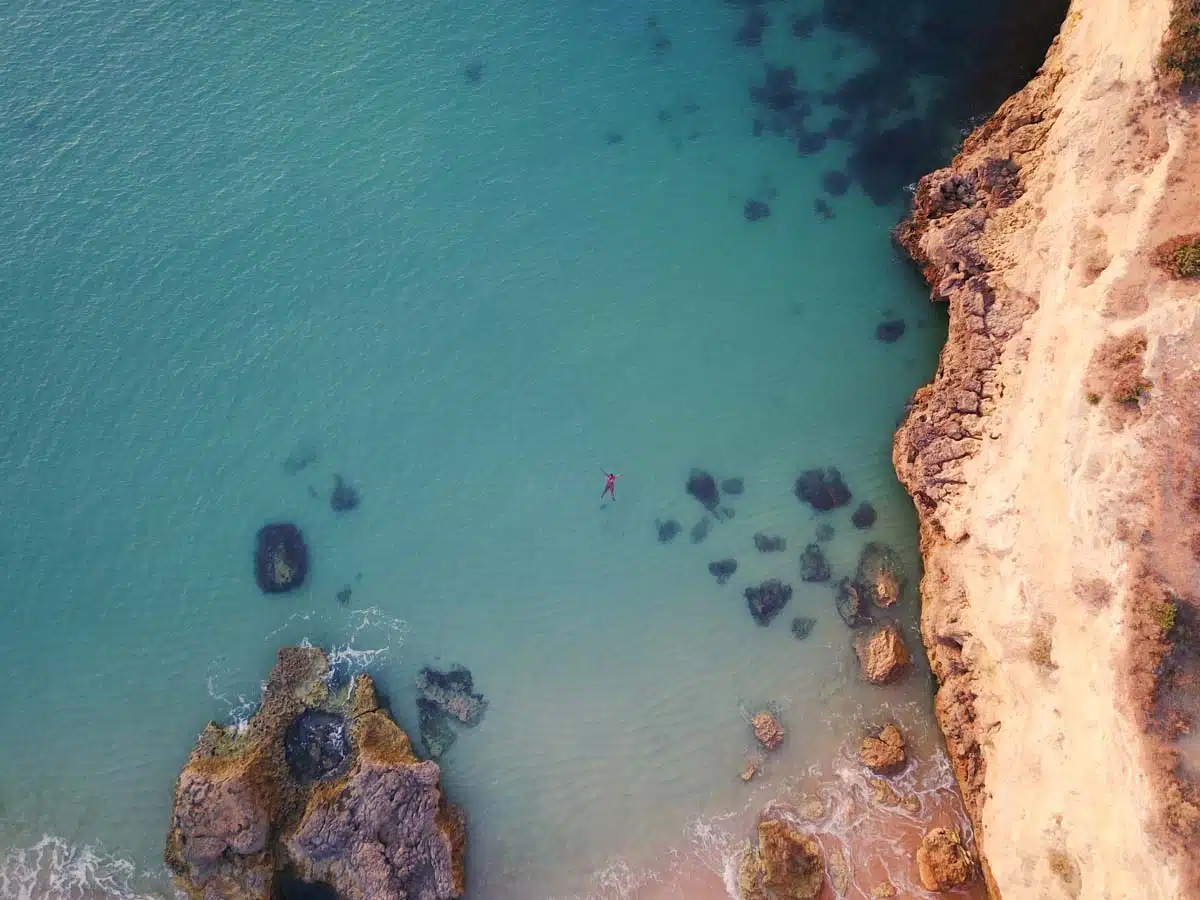
On a trip to the western Algarve, I rented a villa in Lagos and took my drone along this coast, and Marinha was one of the beaches I filmed from above. From the air, you can read how the cliffs were made: the sea has worked away at the soft rock for thousands of years, hollowing out caves, breaking through them to make arches and leaving the harder pillars standing alone in the water.
What the drone doesn’t show you is the practical side: around 150 steps between the clifftop and the sand, car parks that fill soon after sunrise in summer, and a tide that can swallow most of the beach. Plan around those and you’ll have a brilliant day.
Praia da Marinha at a glance
- Where: in the municipality of Lagoa, on the central Algarve coast between Carvoeiro and Armação de Pêra.
- Getting down: about 150 wooden steps from the clifftop, five to ten minutes down. There’s no step-free access.
- Parking: two free gravel car parks at the top, often full within an hour or two of sunrise in July and August.
- Facilities: toilets and a small snack bar at the top only. Nothing on the sand.
- Swimming: sheltered, very clear water, with lifeguards in the summer bathing season.
- Best time: a falling or low tide, early or late in the day, in May, June, September or October.
- Walk: the Seven Hanging Valleys Trail starts by the upper car park.
Why this little beach draws such a crowd
The beach itself is small: a strip of sand at the foot of high cliffs, broken up by boulders, with sea stacks just offshore. What sets it apart is the colour. The limestone glows gold and ochre in low sun, the cliff tops are green with scrub, and the water is famously clear. In 2026 it earned a Gold Quality award for its water from the environmental group Quercus.

Low tide is when it really comes into its own. The sand widens, and you can pick your way between the rock towers to the smaller coves, caves and rock pools on either side, or walk along the shore to the foot of the arches at the western end. At high water, the same rocks are cut off and much of the sand disappears.
Find the heart in the cliffs
Before you head down to the sand, walk west from the top of the steps along the clifftop path. Within a few minutes you reach the viewpoints over the beach’s most famous feature: a double arch in the headland at the western end. From one particular angle, the two openings and the rock pinnacle beside them come together into the shape of a heart. Step a few metres either way and it falls apart again, which is half the fun of finding it.
It’s the view on half the postcards sold along this coast, and it costs nothing. The viewpoint at the top of the steps is worth a pause too, for the classic view straight down onto the sand and the sea stack. Wherever you stand, stay behind the wooden fences and rope barriers. The edges are often undercut, and cliff collapses on this coast have killed people.
The steps down to the sand
About 150 wooden steps wind down from the clifftop, getting steeper towards the bottom. Going down takes five to ten minutes; the climb back up on a hot afternoon is the part people remember. There’s no step-free route, so pushchairs and wheelchairs can’t make it down.
Wear trainers or walking sandals rather than flip-flops, and carry everything you’ll need for the day in one go. A second trip up the steps for a cold drink is a workout.
Swimming and snorkelling
Sheltered by its headlands from the bigger swells, the beach has some of the clearest water on the Algarve coast, and the rocks just offshore make it one of the best spots here for snorkelling. Look for small octopuses, fish and anemones around the boulders. There’s nowhere to hire gear on the beach, so bring your own mask, plus water shoes for the rocks. The Atlantic stays cool: even in August, the sea rarely gets much above 22°C.
Lifeguards are on duty only in the summer bathing season, from June to the end of September. Outside it, you swim at your own risk. Two things are worth knowing before you get in:
- The tide comes in fast. At high tide, the far ends of the beach can be cut off. Check a tide table before you go, and if you swim or wander round the rocks to the next cove, watch the waterline so the sea doesn’t get round behind you.
- Keep away from the base of the cliffs. The limestone is soft and falls happen all along this coast. Pitch your towel well out on the sand, not in the shade under the overhangs.
If you were hoping to paddle, launching and landing kayaks, canoes and paddleboards has been banned here since September 2023, along with five neighbouring beaches. Seeing these cliffs from the water means booking a guided kayak or boat trip from a licensed operator.
Tides, light and the best time to go
The tide matters more than anything else here. Aim to arrive as the tide starts to fall, so the sand grows through your visit rather than shrinking, and you’ll have the coves and rock pools to explore. Any tide app or the Portuguese Hydrographic Institute’s tables will give you the times.
The light changes the place completely. Early in the morning, the beach is at its quietest and the sea is often at its calmest, which suits snorkelling and photographs of the sea stacks without a crowd in them. Late in the day, the limestone turns from gold to orange, and the heart arch is at its best in the last hour before sunset.
May, June, September and October are the best months: the water is pleasant for swimming and you won’t be racing for a parking space at dawn. July and August are hot and very busy, so arrive before 9am. In winter, it’s too cold for most people to swim, but it’s a fine time for the clifftop walk and for photographs without the crowds.
Top Tip
If you can only manage one visit, make it the late afternoon on a falling tide. The day crowds start to leave, and you’ll reach the heart viewpoint just as the cliffs light up.
Photographing the cliffs and the heart
The two shots most people come for are both on the clifftop: the heart from the path west of the steps, and the beach and its sea stack from the viewpoint above the stairs. On the sand, a low tide lets you shoot the arches and rock towers from below, with the cliffs lit warm behind them late in the day.
If you’re bringing a drone, check the rules well ahead. Portugal requires drone operators to register with the aviation authority, ANAC, and flights over beaches or the sea need a permit from the maritime authority, applied for through the local harbour office in advance. Flying over groups of people isn’t allowed, which on a summer beach rules out most of the day, so the realistic window is early morning outside the peak months.
Walking the Seven Hanging Valleys Trail from Marinha
The clifftop path you followed to the heart is the first stretch of the Seven Hanging Valleys Trail, or Percurso dos Sete Vales Suspensos, Lagoa’s waymarked coastal walk. It takes its name from the short, dry valleys along the route that drop towards the sea and stop suddenly at the cliff edge, hanging high above the waves.
The trail starts by the upper car park, and the arches come in the first half kilometre, so even a short walk out to the heart and back gives you a taste of it. The whole route runs for about 5.7km one way, west to Praia de Vale de Centeanes, and takes two and a half to three hours at an easy pace. It’s well marked and moderate rather than hard, with a few short climbs and some rocky ground.
Starting here makes sense, as the parking is easier than at the western end and the morning sun is behind you as you walk west. There’s no shade, no toilets and no bins on the trail, so carry plenty of water, wear proper shoes and take your rubbish home. The path’s popularity has brought litter and erosion, and in July 2026 local guides and tour operators called for a management plan to protect it, so stick to the marked route and keep well back from the edges. The walk is linear: either come back the way you went, or take a taxi back to your car from the far end.
Parking, facilities and getting there
The two free car parks sit on the clifftop at the end of the access road, both on gravel, with a little over 100 spaces between them. That isn’t many for a beach this popular. In July and August they’re often full within an hour or two of sunrise, and once they are, the police sometimes close the road about a kilometre before the beach. Motorhomes aren’t allowed. Outside the peak summer weeks, parking is far easier.
Getting There
The beach is signposted from the N125 east of Lagoa. Allow about 40 minutes by car from Lagos, 25 minutes from Albufeira and 50 minutes from Faro airport. Public transport doesn’t reach it in any useful way, so without a car, take a taxi.
The toilets and the small snack bar are at the top of the steps by the car park, and the bar has long queues in summer. There are no showers, sunbeds or parasols for hire, and nothing at all on the sand, so bring water, food, sun cream and something for shade.
For the rest of this coast, see my guide to the best beaches in the Algarve, and my week in the Algarve builds a day around Marinha and the trail.
Map
Read next
- The best beaches in the Algarve
- How to spend a week in the Algarve
- The best things to do in the Algarve
Love this? Save and share on Pinterest

Discover the top things to do, insider tips and hidden gems in our Portugal Travel Guides.
Read the guides →