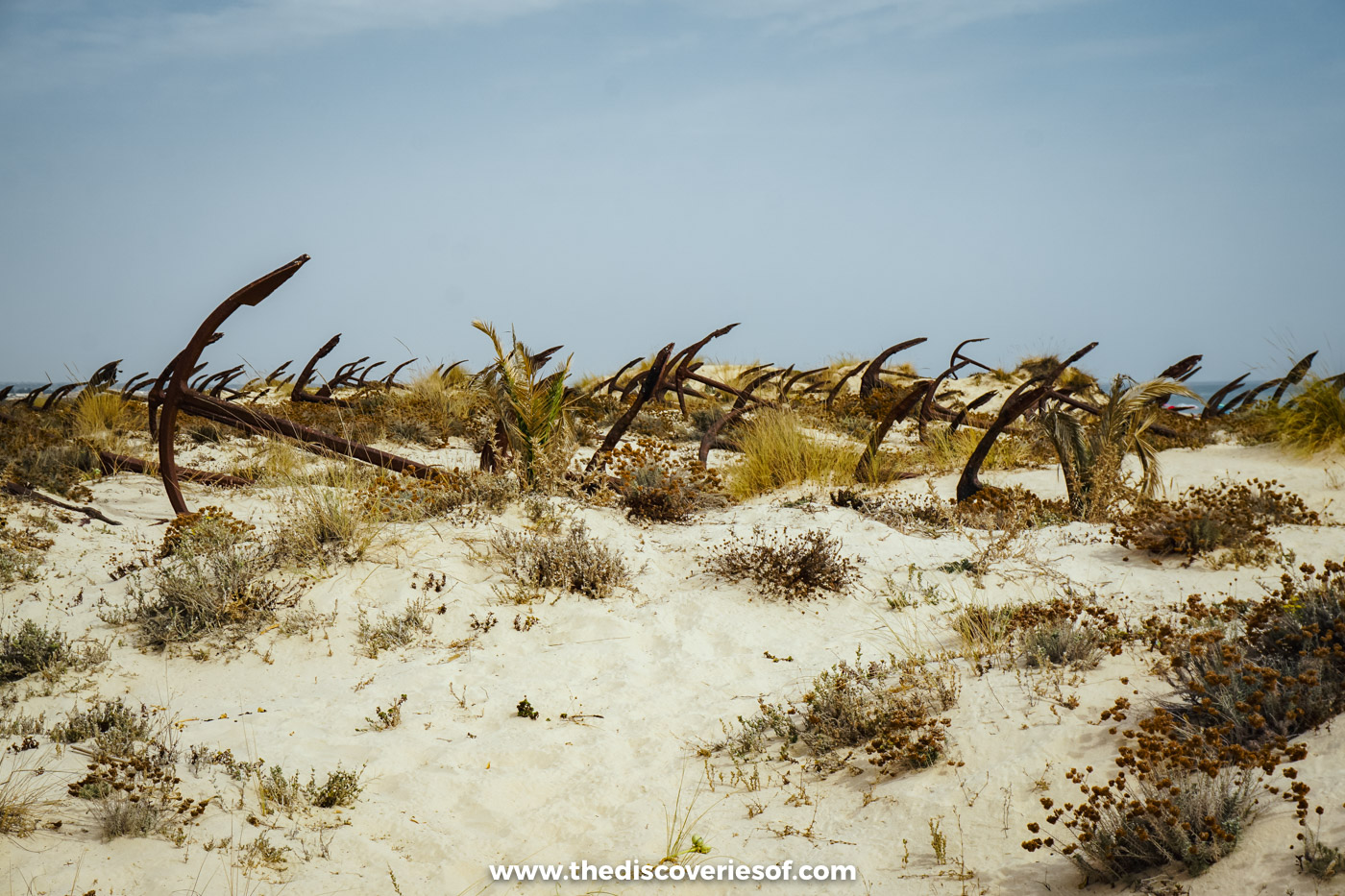
It’s easy to write the Algarve off as high-rises and sunbeds. But somewhere between the salt marshes of the east and the cliffs of the west, there’s a lagoon where dolphins slip in from the open sea, a market hall that has fed the region for more than a century, a lighthouse at the edge of Europe and a beach where rows of rusting anchors lie half-buried in the dunes.
I like to say that there are two kinds of people in this world: those who have visited the Algarve and fallen totally in love with it, and those who are missing out.
I was met with a few raised eyebrows the first time I said I was travelling there. Some people seem to think it’s all high-rise apartment blocks and a bit commercialised.
Those people are wrong.
The turquoise beaches and golden limestone cliffs that Portugal’s southern coast is famous for are definitely worth the trip, but there’s so much more to the region than a towel on the sand. I spent an October week in the east, based in a villa in Quinta do Lago, cycling out to the lagoon, taking a boat to Ilha Deserta, browsing Loulé market and walking in the hills. On another trip, I rented a villa in Lagos, at the western end, and flew my drone over the cliffs and coves.
The two ends of the coast feel like different places, and my week in the Algarve itinerary takes in both. The east is flat, calm and wrapped around the salt marshes and barrier islands of the Ria Formosa. The west is all sea stacks, grottoes and staircases down to tiny coves, until the cliffs run out at the wild Atlantic tip of Europe. Whether you keep to the beaches or head inland, there’s no wrong choice when it comes to things to do in the Algarve. Here’s where to start.
The best things to do in the Algarve
Sail out to Ilha Deserta for dolphins and a beach lunch

In case you didn’t get the memo, Ilha Deserta means “desert island”, and this sliver of sand off Faro very nearly lives up to its name. Officially it’s Ilha da Barreta, one of the barrier islands that shelter the Ria Formosa lagoon. Nobody lives there, and its southern tip, Cabo de Santa Maria, is the most southerly point of mainland Portugal.
The trip across is half the fun. I went out on a little catamaran, with a nature guide on board, run by Animaris, the company behind the boats to the island from the pier beside Faro’s old town. Along the way, the guide helped me pick out oysters and shore crabs, teals and curlews, and then a few dolphins that had swum into the lagoon from the open sea, which were an extra-special surprise.
Once you land, a wooden boardwalk loops across the dunes to a long, empty beach on the Atlantic side. It’s pretty much my favourite beach in the region, and outside the summer holidays you can walk a long way without passing another soul.

The island’s other draw is Estaminé, its only restaurant, which serves fresh fish, seafood and Algarve classics a short walk from the beach. If you love seafood, it should be firmly at the top of your list. The original building burned down in March 2021 and was rebuilt within months, reopening that August. You can book a table online, which is wise in summer.
Top Tip
Ask for a boat trip with a nature guide rather than the straight ferry. It takes longer, but you’ll see far more of the lagoon’s wildlife on the way.
Cycle out to the lagoons of the Ria Formosa

The Ria Formosa Natural Park stretches for about 60 km along the eastern coast, a maze of tidal channels, salt marsh, sandbanks and barrier islands that’s home to flamingos, spoonbills and thousands of wading birds. It gets far less attention than the big resorts, and it’s all the better for it.
My villa in Quinta do Lago was a short bike ride from the lagoon, and following its paths felt a world away from the golf courses: wild and peaceful, at least until one of the flights from the airport round the corner took off. From Quinta do Lago, a long wooden footbridge crosses the lagoon to a beach backed by big dunes.
You don’t need to be staying nearby to see it. From Faro, a Segway tour with birdwatching runs along the lagoon paths near the airport beach, and boat trips leave from Faro, Olhão and Tavira.
Shop for lunch at Loulé market

Drive inland to Loulé on a weekday morning and you’ll find its red-domed market hall in full swing. Built in 1908, the neo-Moorish building was the first covered market for fish, fruit and vegetables in the Algarve, and it’s still open from 7am to 3pm, Monday to Saturday.
Inside, stalls are piled with fish straight off the boats, oranges, figs, almonds, cured hams, cheese and local honey. On longer stays, this is where I’ve always come to stock up for the barbecue, but even if you’re not cooking, it’s worth a look for the sheer theatre of a traditional Portuguese market.
Saturday is the day to go. A producers’ market spills into the streets around the hall from 7am to 1pm, with farmers selling pomegranates, carob, dried figs and whatever else is in season.
Walk the hills behind the coast
Most visitors never see the countryside inland, and they’re missing a trick. On my October week, a tip from the team at my resort had me out hiking in the hills with Terry, a local guide, and it showed me a side of the region you’d never see from a sunbed.
If you’d like to walk on your own, the Rocha da Pena near Salir, about 25 minutes north of Loulé, is a good place to start. A circular trail of 6.7 km climbs onto a limestone plateau, with views south towards the coast from its highest point, 479m up. For something much bigger, the Via Algarviana runs for more than 300 km across the hills from Alcoutim on the Spanish border to the far west.
Fall for Tavira, the region’s prettiest town

I strongly believe that Tavira is a wildly underrated part of the Algarve, and for my money it’s the most picturesque town on the coast.
It straddles the Rio Gilão, with a church on practically every corner and rows of houses with tiled façades and hipped roofs. Cross the old seven-arched bridge, the Ponte Antiga, then climb to the castle, whose walls date back to the Moorish era, for the view over the rooftops from its gardens. Next door, the Gothic-Baroque Igreja de Santa Maria do Castelo holds the tombs of the knights who took the town in the 13th century, and the Praça da República down by the river is particularly elegant.
There are so many things to see in Tavira that I reckon a tuk-tuk tour of the old town might make it easier on your feet and ensure you catch all the best sights. My guide to Tavira has much more.
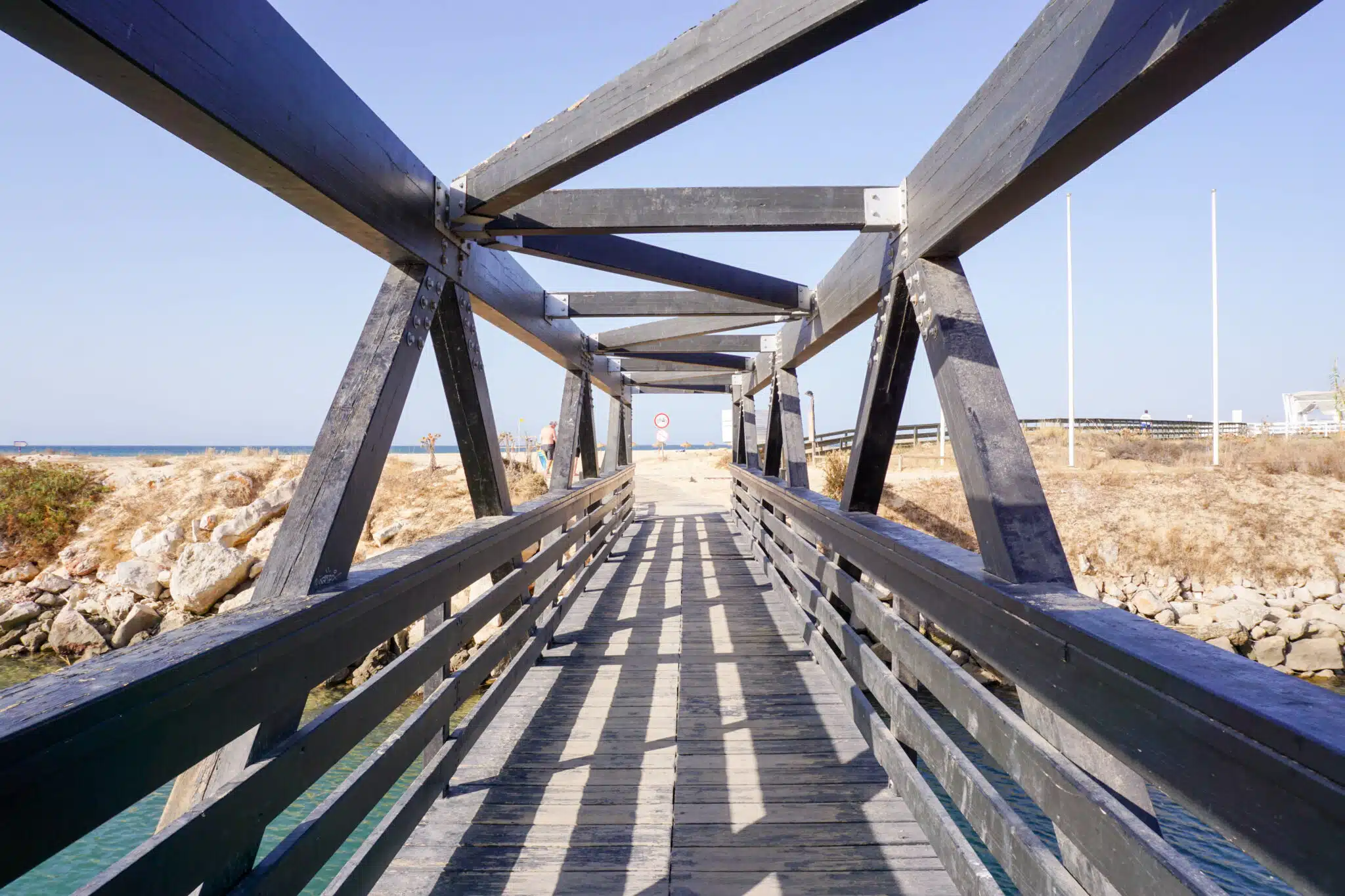
Then make for the beach. I loved Praia do Barril, a wild, windswept stretch of sand west of town. You reach it by crossing a footbridge over the lagoon at Pedras d’el Rei and then either walking about 1.5 km or hopping on the little train (€2) that runs out to the sea. Waiting at the end is the beach’s quirky anchor cemetery: rows of rusting anchors left behind by the tuna fishermen who once worked these waters, half-buried in the dunes. It’s as strange and beautiful as it sounds.
Look across to Spain from Castro Marim and Vila Real de Santo António
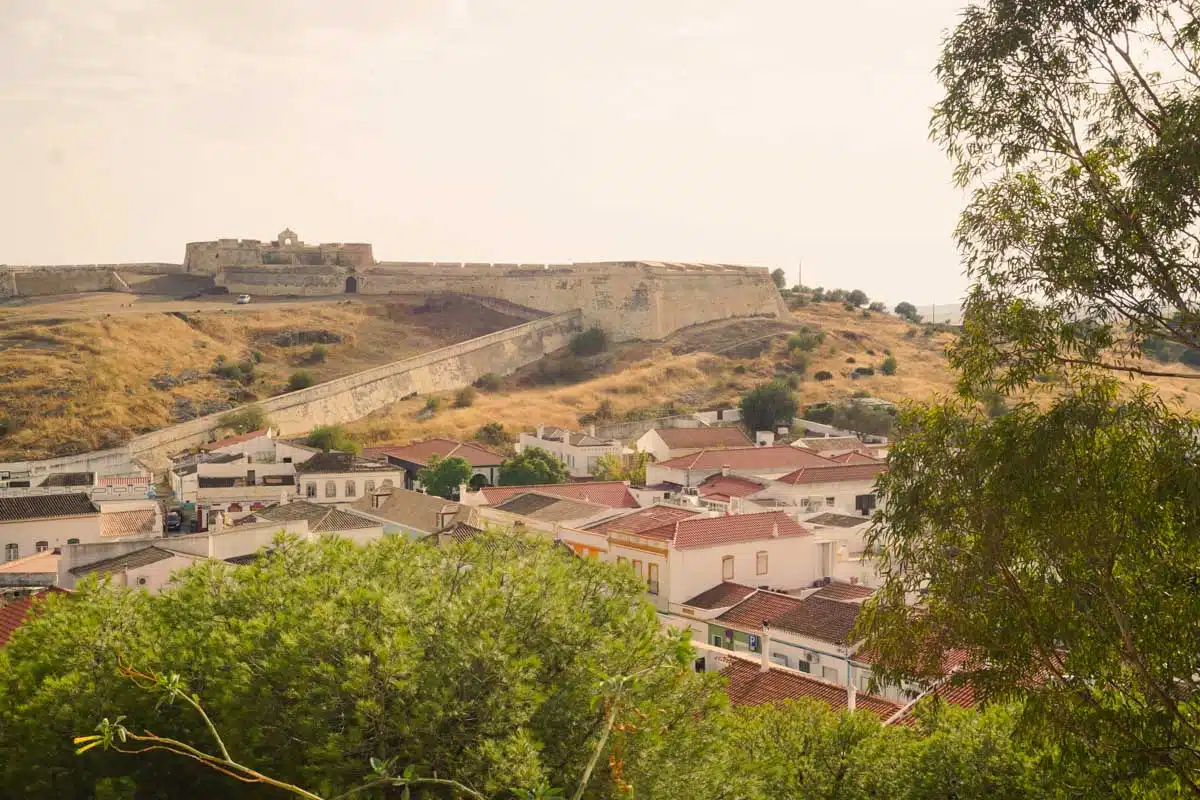
At the eastern end of the coast, the Guadiana river marks the border with Spain, and two very different towns face each other across the marshes.
Castro Marim is an old fortress town that has guarded the river crossing for centuries. Its castle, rebuilt in the 13th century, was the first headquarters of the Order of Christ, and the Forte de São Sebastião on the next hill was added in the 17th century, during the wars with Spain. From the walls, you look straight across the water into Andalucía. Around the town, the salt pans of the Castro Marim nature reserve draw flamingos for much of the year.
A ten-minute drive south, Vila Real de Santo António couldn’t be more different. After the 1755 earthquake, the Marquis of Pombal had it built from scratch in 1774, on the same neat grid as Lisbon’s Baixa, and its pedestrianised streets and tiled main square still feel remarkably ordered. Come for a wander after lunch, stop for a slice of toasted cake and a coffee as the town wakes up after the siesta, then take the little ferry over the river to Ayamonte, in Spain.
Base yourself in Lagos

If you haven’t quite had enough of history yet, Lagos is the place for it. I hired a villa here on my trip to the west, and it makes a brilliant base: big enough for good restaurants and shops, small enough to walk, and surrounded by some of the most dramatic coastline in Europe.
Elegant churches, medieval walls and a sea fort make the old town an intriguing place to wander. Don’t miss the baroque Igreja de Santo António, a riot of gilded woodwork inside, entered through the town museum beside it. On the main square, a small museum in the old slave market tells a darker story: in 1444, Lagos staged what’s often described as the first slave auction in Europe.
The beaches start almost on the doorstep, and the shopping is reasonably priced, so it’s a good place to hunt for souvenirs before a long lunch. From the marina and the riverfront, boats leave all day for the grottoes of Ponta da Piedade and for dolphin-watching trips out to sea.
See Praia do Camilo from the clifftop

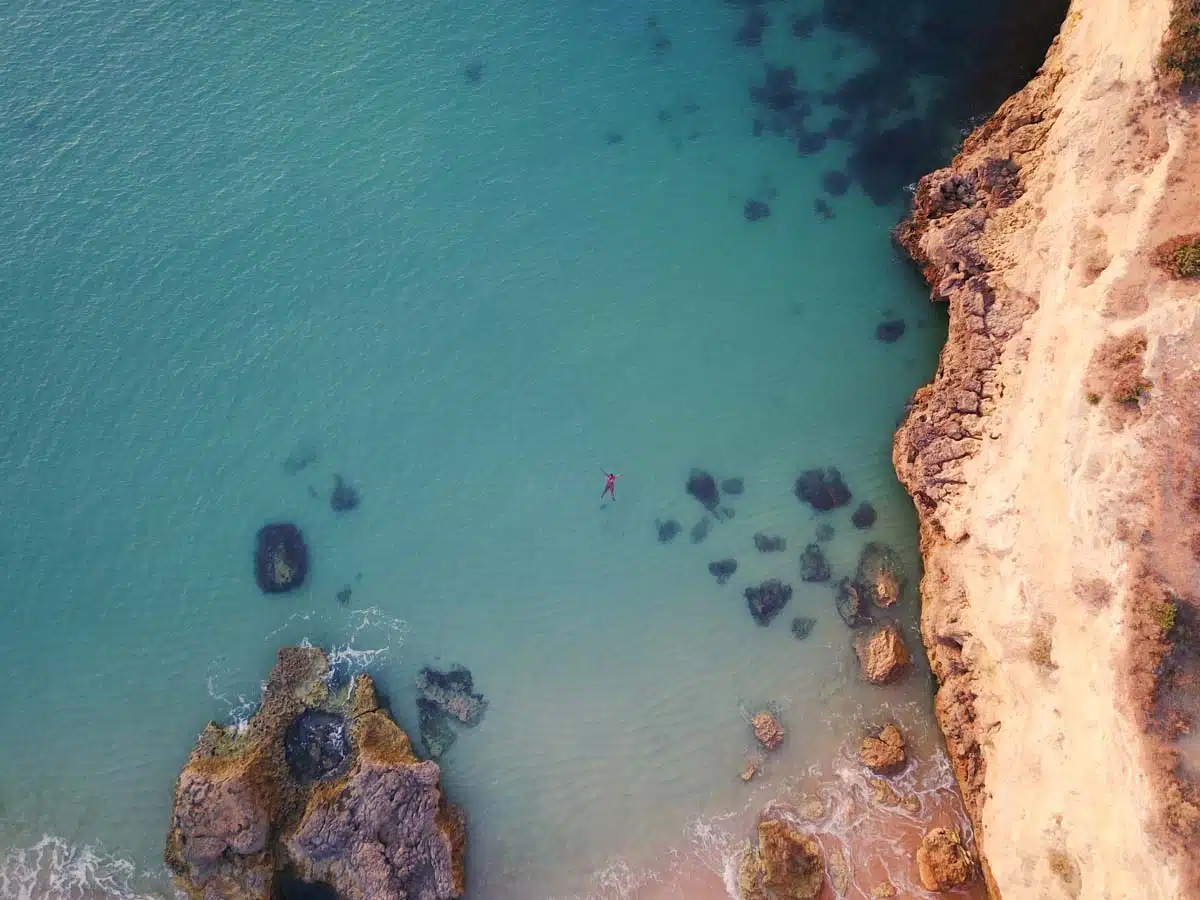
I’ll let you in on a little secret: Praia do Camilo is one of my favourite places to visit in the Algarve. Surrounded by golden rock formations and normally reached by a wooden staircase of about 200 steps, this tiny cove is the ultimate hidden treasure for beach lovers.
The staircase has been closed since storms damaged the cliff it stands on in 2026, with no date set to reopen, so check before you go. For now you can look down on the cove from the clifftop, or see it from the water on a boat or kayak trip around Ponta da Piedade.
The water is clear and emerald, and though a large rock divides the beach, a short tunnel through it leads to the cove on the other side. When the steps reopen, arrive early in summer: the sand fills up fast and shrinks even further at high tide.
At the top, a viewing area makes a perfect spot to watch the sun go down. For dinner, O Camilo, the seafood restaurant on the clifftop just above, has been serving grilled fish for more than four decades, with sunset views over the sea.
Top Tip
The cliffs along this stretch are prone to rockfalls, so keep well back from the edges at the top, and don’t sit at the foot of the cliffs on the beach.
Marvel at the grottoes of Ponta da Piedade
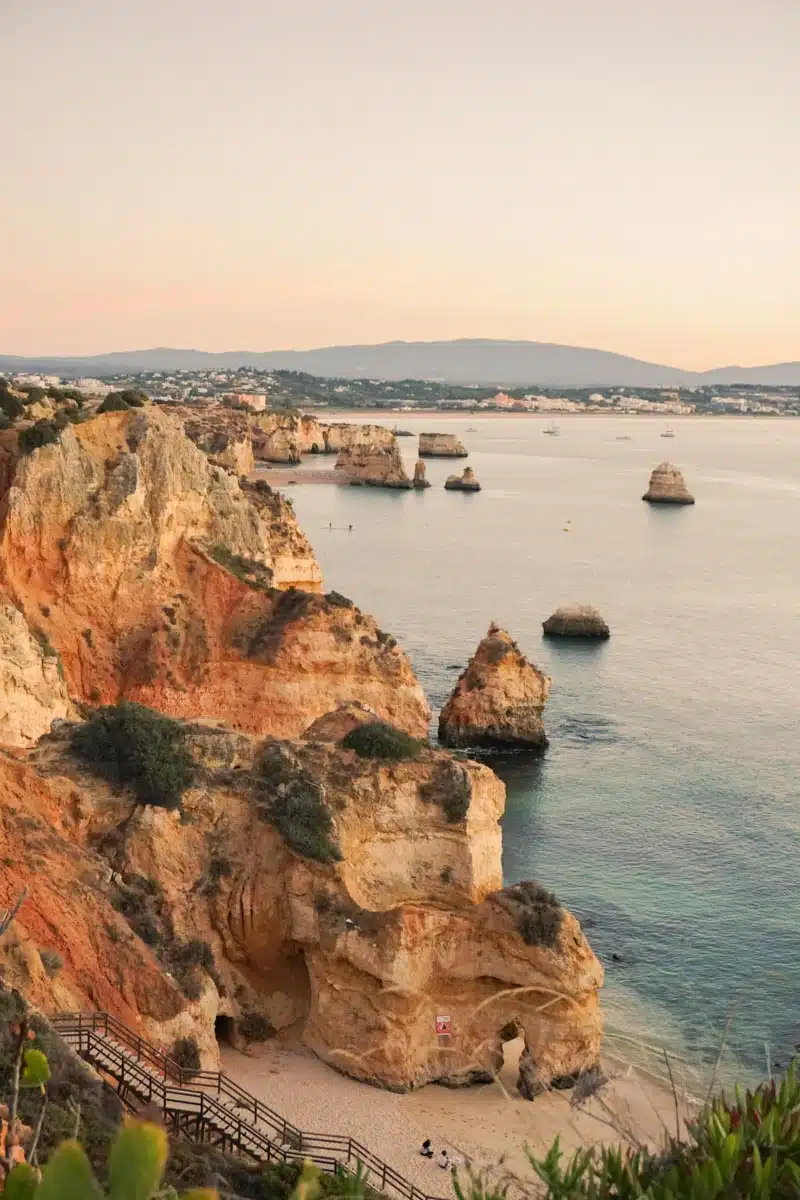
A short walk along the cliffs from Praia do Camilo, this headland has some of the most extraordinary limestone formations I’ve ever seen. Here you’ll find huge sea pillars, hidden grottoes and delicate arches in glorious abundance.
You can see them from the water, on one of the small boats or kayaks that leave Lagos all day or on a longer half-day cruise from Lagos with lunch, or on foot along the clifftop paths and boardwalks. There are 182 steps down to the water at the tip of the headland, and the view of the coves at the bottom is well worth it. Make sure you’re wearing sensible shoes, though: that’s a mistake I won’t ever make again.
The light is best at sunrise or sunset, and the car park fills up quickly in summer, so get there early.
See Benagil Cave from the water

One of the most famous sea caves in the world, Benagil is a domed cavern lit by a round hole in its roof, and it’s a wonder of nature you can’t afford to miss. Since August 2024, you can only go in on a licensed boat or with a guided kayak tour from Benagil: landing on the beach inside and swimming in are both banned. Or look down through the skylight for free from the clifftop path above.
Just don’t try to fly your drone through that hole in the roof. I did, and it ended with a chartered boat and a very sorry-looking drone. Here’s how to visit Benagil Cave now, and the full story of what happened.
Spend a day beach hopping

If you plan on doing nothing else on your trip other than lazing on the best beaches in the Algarve, I don’t blame you.
Warm-toned limestone cliffs and cosy coves make for pleasant beaches with gentle turquoise water. Between Benagil and Armação de Pêra, Praia da Marinha, with its double arch, and little Praia da Albandeira, with a rock arch of its own, are two of the most beautiful on the whole coast. Further east, Albufeira’s beaches are busier: Praia do Peneco, known locally as Praia do Túnel because you reach it through a tunnel from the old town, is a long stretch of warm sand right below the resort.
To link several coves in a day, walk part of the Seven Hanging Valleys Trail, the clifftop path between Praia da Marinha and Praia de Vale de Centeanes, and swim at the lifeguarded beaches along the way.
Explore Faro’s walled old town
The capital of the region, Faro, is where most people land and leave, which is a shame, as its old town is well worth a morning.
Walk in through the Arco da Vila, an early 19th-century gateway topped by nesting storks, into the Cidade Velha, a quiet quarter of cobbled lanes and orange trees inside the old walls. A large earthquake in 1755 damaged the town, so most of what remains dates from the 18th century onward, though the foundations are often Moorish and Roman. Climb the tower of the cathedral for a view across the rooftops to the Ria Formosa, then, for something more macabre, visit the Capela dos Ossos at the Igreja do Carmo, a chapel lined with the bones of more than a thousand monks.
The boats to Ilha Deserta and the other islands leave from the pier just outside the walls, so it’s easy to combine the two.
Catch the ferry from Olhão to Culatra
Olhão, a working fishing town just east of Faro, is the gateway to the islands of the middle lagoon. Start at its two red-brick market halls on the waterfront, one for fish and one for fruit and vegetables, which are busiest on Saturday mornings.
From the jetty next to the markets, public ferries run to Armona and Culatra, two car-free barrier islands with sandy lanes, fishermen’s houses and long beaches on the ocean side. Culatra’s village is one of the last traditional fishing communities on the coast, and a short walk along a boardwalk takes you across to the ocean beach. Ferries are less frequent from October to March, so check the return times before you set off.
Watch the sunset from Cacela Velha
Perched on a low cliff above the eastern end of the Ria Formosa, the hamlet of Cacela Velha is little more than a small fort, a whitewashed church and a handful of houses, but its view is one of the loveliest on the coast. Below, the lagoon opens onto a long sandbar beach that you reach by fishing boat or, at low tide, by wading across.
Come in the late afternoon, when the light turns gold, and stay for oysters at one of the restaurants by the church.
Stroll the marina at Vilamoura
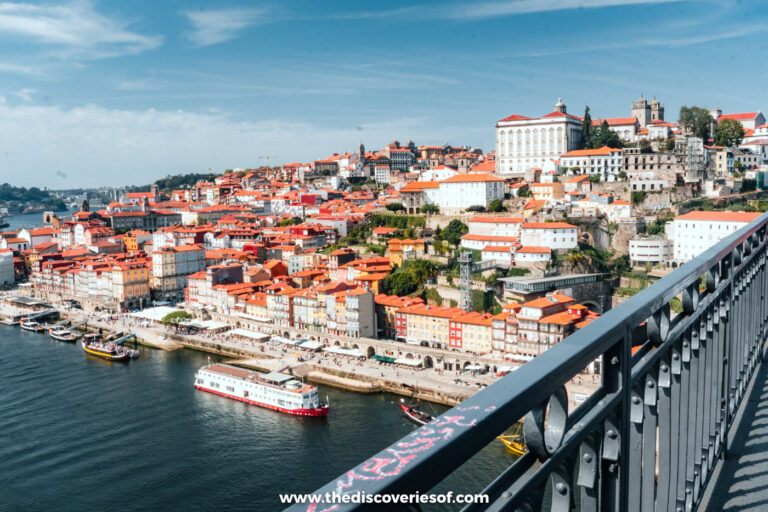
Vilamoura is the region’s most polished resort, built around one of the biggest marinas in Portugal, where yachts line up beside restaurants, bars and designer boutiques.
Five championship golf courses lie in and around the resort, so it’s a firm favourite with golfers, and in August the jet set from Lisbon arrives for its restaurants and nightlife. There are even the ruins of a Roman villa to see if archaeology is high on your list: the site of Cerro da Vila, just behind the marina, has mosaics, baths and a small museum.
End the day with a sunset sail on a luxury yacht from the marina.
Walk the clifftop boardwalk at Carvoeiro
Carvoeiro is one of the prettiest villages on the central coast, a cluster of white houses tumbling down to a small beach between the cliffs. From the old fort and church above the village, a wooden boardwalk of about 570m runs east along the clifftops, with views over the sea caves and tour boats below.
At its far end, steps lead down to Algar Seco, a maze of eroded rock formations, natural pools and blowholes. Access is free and the boardwalk is open around the clock, so it’s lovely at sunset.
Visit Silves and its red castle
This hilltop town is simply gorgeous, with white walls and terracotta roofs a startling contrast to the lush orange groves and vineyards that surround it.
Silves was the capital of the Moorish Algarve, and its iconic castle, built of red sandstone on the hill above the town, is the best-preserved in the region. Walk its walls for views over the river valley, then wander down past the cathedral to the old bridge.
It’s the perfect place to stroll and simply enjoy the architecture and scenery. The valley around it is orange country, and in season you’ll see fruit for sale at the roadside, so it would be rude not to sample a ripe, juicy offering.
Head for the hills of the Serra de Monchique
If you’re more of a country bumpkin than a beach bum (could never be me), this rolling mountain range is going to be your favourite spot. Chestnut and eucalyptus trees line the slopes, and paths meander through woodland that provides some much-needed shade from the summer heat.
Drive up to Fóia, at 902m the highest point in the Algarve, and on a clear day you’ll see right across the western landscape to the sea. In a wooded valley below the town of Monchique, the old spa village of Caldas de Monchique has been drawing visitors to its thermal springs since Roman times, and its spa hotel and restaurant sit in an utterly tranquil setting.
Before you leave, try a glass of medronho, the fiery local spirit made from the fruit of the strawberry tree.
Explore the vibrant city of Portimão
Looking for cool things to do in Portugal? Trust me when I say you’re going to want to head to Portimão.
It’s a lively hub with plenty on offer to quench your cultural thirst, including the excellent Museu de Portimão, in a former sardine cannery on the river, which tells the story of the town’s fishing and canning past. Its beach, Praia da Rocha, is one of the biggest and busiest on the coast, and offshore, four decommissioned navy ships were sunk in 2012 and 2013 to create the Ocean Revival artificial reef, a favourite with divers.
Apart from the standard sunset cruises and boat tours, there’s a pirate ship cruise along the coast to the caves (yes, I did go a little bit overboard with the swashbuckling) for anyone who wants something different.
Slow down in Burgau
Burgau, west of Lagos, has a slower pace of life, and lazing on its beach is one of the best free things to do on this stretch of coast.
Follow the steep cobbled streets of the old fishing village down to the beach, where small boats are still pulled up on the sand, and bask in the sun before a drink at one of the bars above it. It’s a world away from the bigger resorts, especially out of season.
Stand at the end of the world at Cabo de São Vicente
Standing at the lighthouse on top of the cliffs at Cabo de São Vicente, the south-western tip of mainland Europe, it feels as if you’re staring at the edge of the world. Sailors once believed exactly that. The lighthouse, one of the most powerful in Europe, has a small museum about the lighthouses of Portugal, and the clifftop outside is a fine spot for sunset.
Many birds nest among the cliffs, and in autumn huge numbers of migrating raptors pass overhead, which makes it a perfect place for a touch of birdwatching. Sagres hosts a birdwatching festival in early October, if you’re really keen.
On the way, stop at the Fortaleza de Sagres, the vast fortress on a windswept headland that’s linked with Henry the Navigator and the age of Portuguese exploration.
Walk a stage of the Fishermen’s Trail
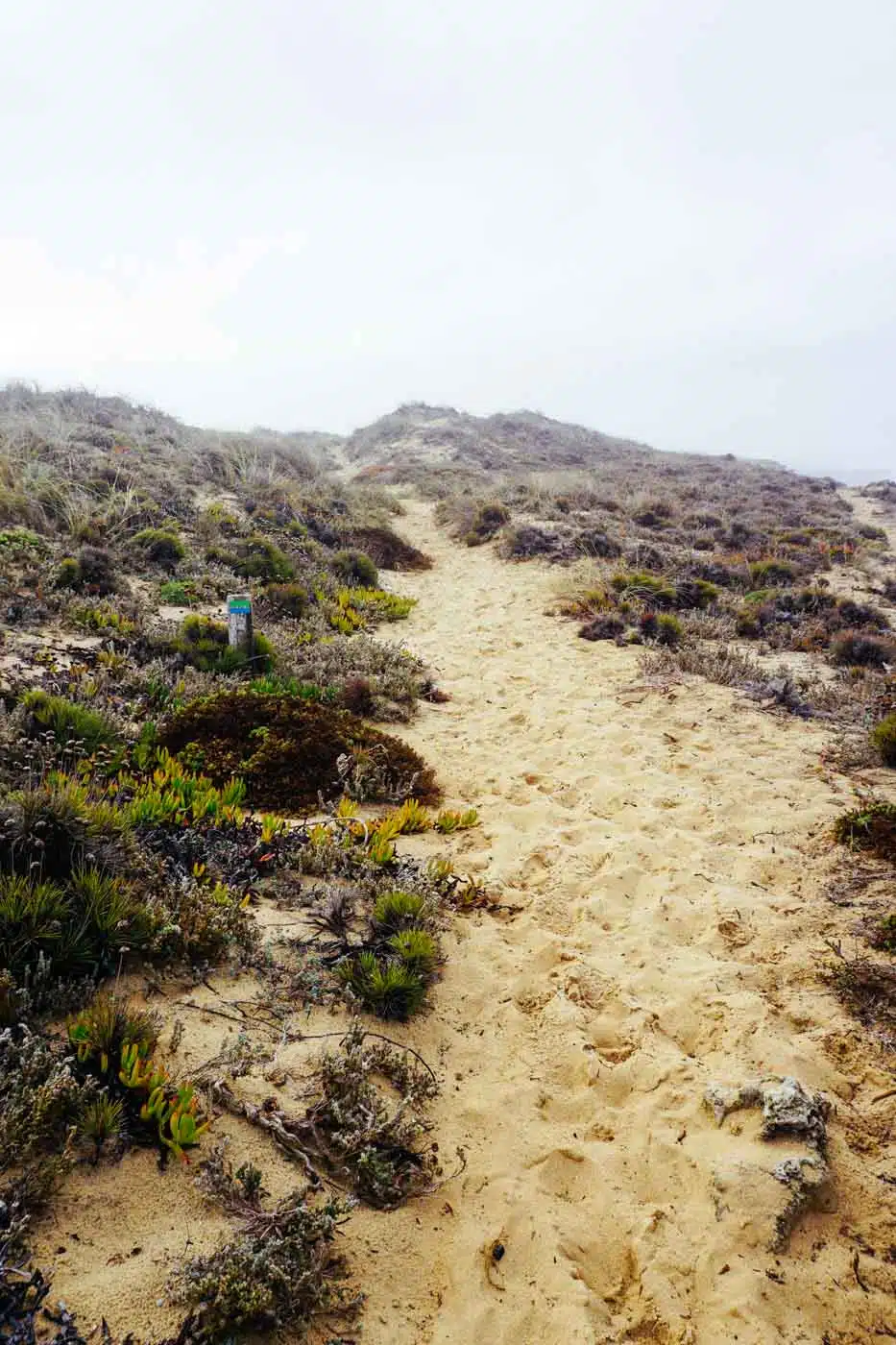
Arguably one of the most scenic coastal trails in the world, the Fishermen’s Trail is part of the Rota Vicentina, a network of footpaths along Portugal’s wild south-western coast. The rugged scenery and mild climate make it one of the great things to do here outside summer: the stages can be walked from September to June.
The trail runs for 226.5 km in 13 stages, mostly along sandy clifftop paths, from the Alentejo coast south into the western Algarve. I walked stretches of it further north, in the Alentejo. There’s accommodation along the entire route, as wild camping isn’t allowed.
Along the way, you’ll pass the Ribat of Arrifana, the ruins of a fortified Islamic monastery founded around 1130. Bring plenty of water and food, as there are long stretches with nowhere to buy either. The stretch further north features in my round-up of the Alentejo’s secret spots.
Learn to surf on the Atlantic coast
The Atlantic is known for its feisty demeanour, so it should be no surprise that the west coast is a great place to learn to surf its foam-topped waves.
The beaches around Aljezur, such as Arrifana, Amoreira and Monte Clérigo, and those around Sagres catch the most reliable swell. Grab your wetsuit, or rent one if need be, and hit the beach. A two-and-a-half-hour surf lesson from Lagos picks the best spot for the day’s conditions and provides all the equipment. Any level of experience, from absolute beginner to savvy amateur, is welcome.
Check out the nightlife in Albufeira
Hitting the clubs for a night of revelry is one of the most popular things to do in the Algarve in summer. Albufeira is the party capital, from the bars around the old town’s main square to the neon-lit Strip in Montechoro, where the music thumps until the early hours.
Don’t be shy about having an espresso (or three) after dinner, because the clubs only get going after midnight. Kiss is one of the longest-running clubs. The weather is irrelevant when you’re partying indoors, so clubbing is one of the best things to do when it rains. Though, I’ll be heading straight to bed instead.
Tips for your trip
- How long to spend. I recommend a minimum of three full days to explore a decent portion of the region, but an ideal amount of time is five days, or a week if you want to see both the east and the west properly. With your holiday a little more spread out, you’ll see more and still have time to relax on those perfect beaches.
- When to go. July and August are the hottest and busiest months, with highs of about 29°C and the sea at its warmest. If you’d prefer to avoid the heat and the crowds, late April to early June or mid-September to late October are better choices. In October, the barbecue on my terrace still saw plenty of use. My month-by-month guide to the best time to visit Portugal has the detail.
- Getting around. Trains from Lisbon reach Faro in about three hours and Lagos in three and a half to four, changing at Tunes, and a regional line runs along the coast. To reach most of the places in this guide, though, you’ll want a car: I’ve never attempted getting between them without one. The A22 motorway along the coast has been toll-free since January 2025.
- Where to stay. For the east, Quinta do Lago puts the Ria Formosa on your doorstep: I stayed in a villa at Four Seasons Fairways, which suits a week or more. For the west, Lagos is the easiest base, with the cliffs and beaches close by and a station at the end of the railway line; Casa Mãe is a lovely boutique option inside the old town walls. Several councils, including Faro, Albufeira, Loulé and Portimão, add a tourist tax of €1 to €2 a night. For other bases, read where to stay in Portugal.
Map
Read next
- How to visit Benagil Cave now you can’t swim in or land on the beach
- The best beaches in the Algarve
- Is a villa at Four Seasons Fairways the best way to do the Algarve?
- A guide to Tavira, the Algarve’s prettiest town
- How to spend one week in Portugal
- 35 of the best things to do in Portugal
Love this? Save and share on Pinterest
Discover the top things to do, insider tips and hidden gems in our Portugal Travel Guides.
Read the guides →