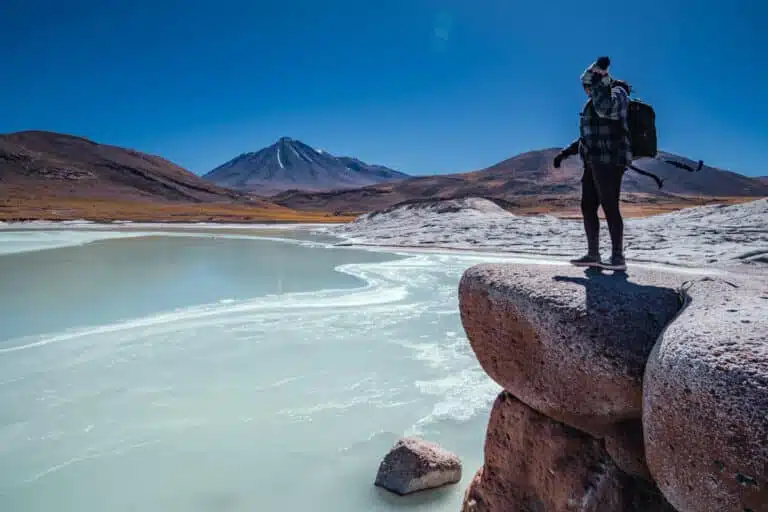
Lagunas Miscanti and Miñiques are two lakes hidden in the volcanic foothills in northern Chile’s Atacama region. Plan your visit to these natural attractions with this insider’s guide, from booking your tickets in Socaire to climbing over the lava to the Miñiques viewpoint.
I missed these lagoons on my first trip to the Atacama, a week-long road trip in a campervan. Big mistake. When I went back to the Atacama in July, I made sure I didn’t miss them a second time.
Some links in this article may be affiliate links, which means we may receive a small commission, at no additional cost to you, if you decide to purchase through one of my recommended partners.
“There are so many stunning sites to tour in the Atacama Desert, so why should I make it a point to stop at this one?”
Good question, and I don’t blame you for asking it. You’ll have your answer once you see the striking blue waters of Lagunas Miscanti and Miñiques juxtaposed with the dark and dramatic volcanoes above them.
Want to know more? I’m spilling the tea on everything you need to know for your trip to this lesser-known spot in the world’s driest desert, including the online tickets, the road up from San Pedro and how to cope with the altitude.
Why visit Lagunas Miscanti y Miñiques?
View this post on Instagram
A post shared by The Discoveries Of – Julianna Barnaby (@thediscoveriesof)
Take a peek on the ‘Gram
I think the real question here is: “Why not?”. This site, among many others in the Atacama Desert, is an aesthetic paradise.
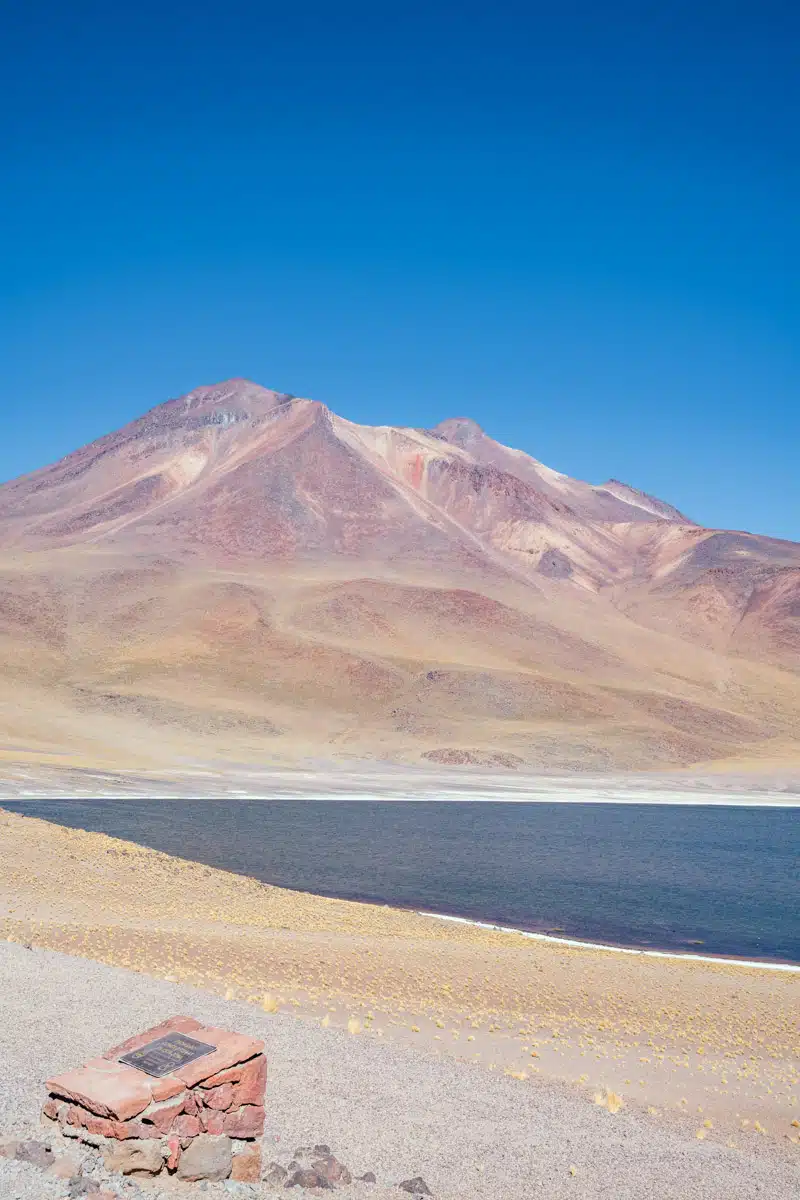
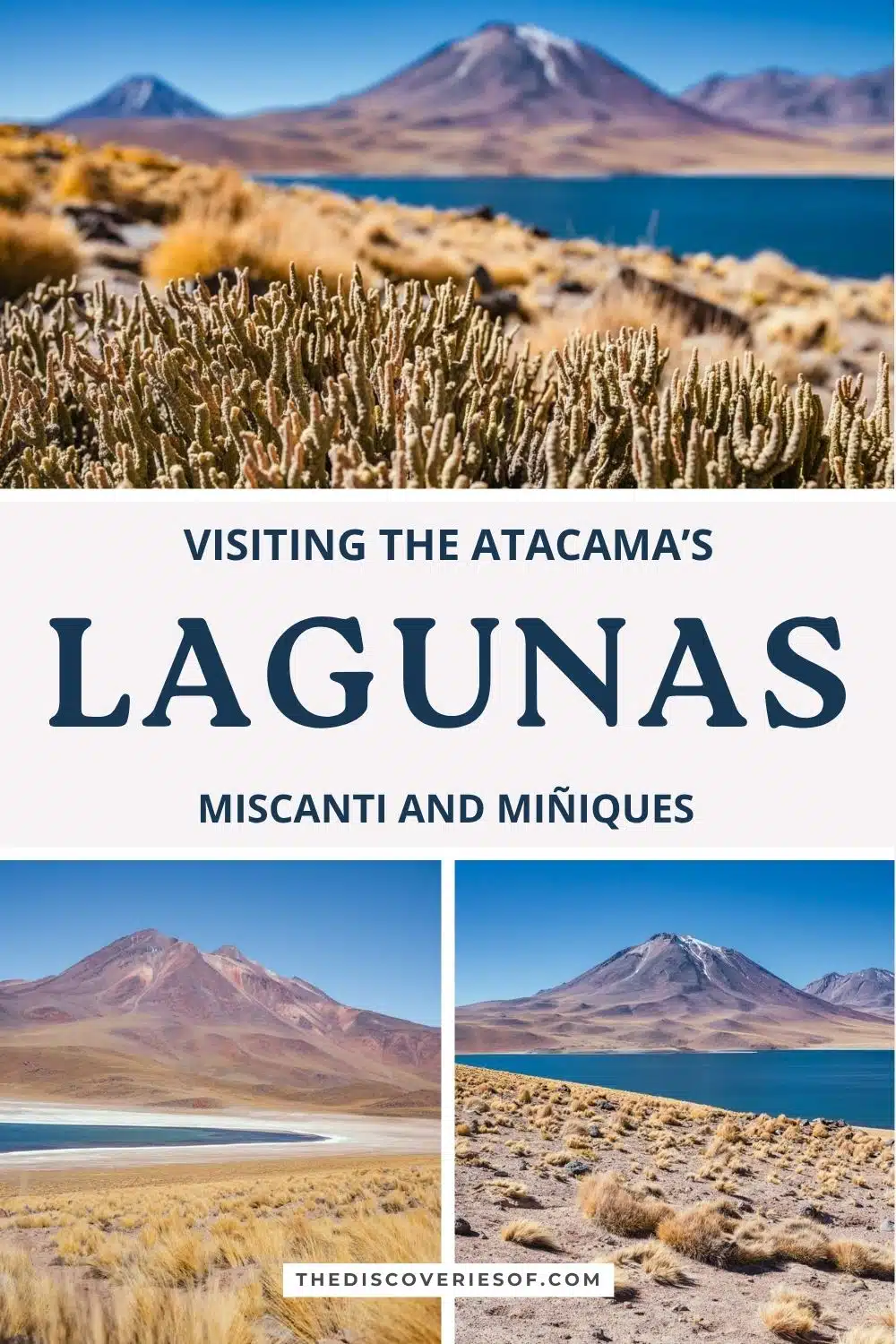
Imagine still landscapes with tufts of yellow grass, densely saturated lagoons and purple-coloured volcanoes all sitting below the brightest blue skies.
These are Lagunas Miscanti y Miñiques, possibly the two most breathtaking bodies of water in the entire desert. A glimmer of hope, in an otherwise inhospitable environment.
There’s no way to get there other than on foot (there is parking nearby). It’s a serene walk, one that takes place in the kind of absolute silence that feels like you’ve travelled into space.
First up, you approach Laguna Miscanti by a designated path marked by a thick trail of rocks till you see its sulphur edges. After that, you continue on the path and climb over an outcrop of lava to the viewpoint over Laguna Miñiques. That’s the only real scramble on the walk, and at over 4,000 metres you’ll feel it, so take it slowly.
What you need to know
Location

Located east-southeast of the Salar de Atacama, the Miscanti and Miñiques lakes sit at the foothills of the Cerro Miscanti and Miñiques volcanoes, about 115km (a two-hour drive) south of San Pedro de Atacama and around 29km beyond the village of Socaire. The lakes are part of the third sector of the Los Flamencos National Reserve, brimming with wildlife and geological wonders. The sector is managed jointly by CONAF, Chile’s national parks agency, and the Atacameño community of Socaire, which runs the tickets and the visitor control.
Two striking blue lakes surrounded by the driest desert on earth! Miscanti, the larger of the two at around 13 square kilometres and up to about 10 metres (33 feet) deep, is brackish, and both rest unspoiled against a magical natural landscape.
Geology: the lakes’ passage through time

This unique and breathtaking appearance is a result of the Pleistocene period, or simply the Ice Age. Water was trapped in the basin more than 20,000 years ago, and a later lava flow from Miñiques volcano created the barrier that now separates the two lakes. The strong winds, arid conditions, the Miscanti and Miñiques volcanoes and the salt flats have all contributed to its distinctive and untouched appearance.
This has all resulted in interesting geological features, including beach terraces, creeks, springs, and sedimentary rocks ranging from the Miocene to the Holocene age.
Though connected, there’s a stark difference in the colour of the two lakes. Miscanti feeds Miñiques Lake, but while the waters flow from one lake to another, they pass through igneous rock, filtering it into a completely different colour. When I stood on the lava between them, Miscanti was a deep, brilliant blue and Miñiques, smaller and slightly lower, a darker cerulean.

Planning your visit to Miscanti and Miñiques lagoons
How to see the lagoons

Try to visit these lakes on a day that’s not so windy, which means you constantly have to check your weather app (Windy.com is good for wind forecasts). On a windless day, you’ll have an opportunity to capture the towering volcanoes reflected in the still water below. The wind often picks up through the day, so an earlier time slot gives you a better chance.
You can also look forward to spotting some unique wildlife, such as flamingos, ducks, families of vicuñas and various birds. Miscanti is an important breeding ground for the horned coot, a rare waterbird that builds nests from piles of stones, and you may well see foxes. Don’t feed them.
The trails are one way, running from north to south, and you have to stay on the marked paths: you can’t walk down to the shore, swim or picnic here. Drones aren’t mentioned in the rules, but the reserve asks visitors to keep the noise down for the sake of the birds, so ask the rangers before you fly.
Top tips for your trip

While the Atacama Desert is not as hot as the Sahara, there are times in San Pedro you’ll find yourself panting in 30°C (86°F) plus temperatures. Up at the lagoons, it’s a different story: it’s much colder, the wind can be bitter, and the sun is fierce, so bring layers, a hat and sunscreen whatever the season. The dry desert air can also affect your nose and throat, so ensure you stay hydrated.
Prepare for altitude sickness since the lakes sit at around 4,120 metres (13,500 feet) above sea level. With the lack of oxygen, you’ll likely feel out of breath, perhaps even dizzy and nauseated. Give yourself at least a day or two in San Pedro, at about 2,400 metres, before you head up here.
Coca tea won’t get rid of your altitude sickness completely, but the locals swear by it (and it’s helped me on several trips in the region), and remember to take deep breaths and take your time when exploring.
Top tip
Coca tea or chewing on coca leaves is a traditional remedy for altitude sickness across the Andes. In Chile, coca leaf is technically a controlled substance, so don’t carry it across borders. Ask your hotel or guide in San Pedro about local herbal teas for the altitude instead, and drink plenty of water as you go over 4,000 metres.
Fill up with fuel and withdraw cash in San Pedro. There’s no petrol station in Socaire, no cash machine, and no phone signal beyond the village.
Address
- Reserva Nacional Los Flamencos (sector 3), off Ruta 23 about 29km south-east of Socaire, San Pedro de Atacama, Antofagasta region, Chile
Opening times and tickets
Monday to Sunday: 9am to 6pm
Tickets are only sold online, through the Socaire community’s website (socairechile.cl), and not at the lagoons. If you’re also visiting Piedras Rojas (listed as the Salar de Aguas Calientes Sur), you have to buy the two together as a pack, which costs foreign adults around CLP 13,000 to 15,000; prices change, so check when you book. You book a time slot, then check in at the control point in Socaire, where staff ask for your QR code and your car’s number plate. Check in an hour before your slot, as times can’t be changed.
The community suspends ticket sales when snow or high winds make the road unsafe, sometimes at short notice, and the lagoons can close after winter snow. The community recommends September to March as the best time to visit, though I went in July, in the middle of winter, and had clear blue skies. Check the website the day before you go, and cancel at least 72 hours ahead if your plans change.
Visiting Miscanti and Miñiques lagoons independently

Calama is the gateway and central transport hub for visitors exploring attractions in San Pedro de Atacama. You can fly into Calama El Loa Airport from whichever major city in Chile you’re based in, and it’s about an hour’s drive from there to San Pedro. Be sure to check Skyscanner for the best ticket prices.
You can rent a car in Calama or San Pedro for your trip to the Laguna Miñiques and Miscanti, allowing you to explore the region freely. Ruta 23 is paved all the way from San Pedro, through Toconao and Socaire, towards the Sico pass into Argentina. The last few kilometres from the main road up to the lagoons are gravel. An ordinary car manages it in dry conditions if you take it slowly, though a higher-clearance vehicle makes life easier. There’s no public transport to the lagoons, so if you’re not driving, you’ll need a tour.
It makes sense to combine the lagoons with Piedras Rojas, as they share a ticket. Piedras Rojas is further along the same road, about 150km from San Pedro, so you can do both in a long day. Keep an eye out for the Tropic of Capricorn sign on the way.
Stop in Socaire on the way
You’ll have to stop in Socaire anyway to check in, so give yourself time to look around. As you climb towards it, the landscape changes at around 3,000 metres and terraced fields appear around this village of a few hundred people, where farmers still grow quinoa and purple potatoes on terraces watered by irrigation channels that go back centuries, to Inca times and beyond. One theory goes that these terraces, or andenes, gave the Andes their name.
See the little church, built of adobe with beams of chañar and cactus wood, and if you’re passing at lunchtime, Cocinería San Santiago serves local cooking made with fresh ingredients. Just outside the village, the Nacimiento canyon is a little oasis full of birds, and the source of Socaire’s water.
Picnics aren’t allowed at the lagoons themselves, so plan your lunch around Socaire. On my visit, I stopped on the way back for a Nayara picnic: Thai chicken curry, rice, quinoa and cauliflower soup with croutons, plus drinks and desserts. Luxury means different things to different people, but to me, there’s no greater indulgence than a stellar meal in the peace and quiet that only comes from being in the middle of nowhere.
Visiting the lagoons on a tour

I saw the lagoons on a private tour from my hotel, with my guide, Rodolfo, who grew up in Calama. If you’re not staying somewhere with its own guides, this full-day guided tour covers the lakes, Piedras Rojas, the rustic Atacameño village of Socaire, Toconao and Chaxa Lagoon and the flamingo reserve, complete with breakfast and lunch. It takes about 10 hours, and park entry fees for the day come to around CLP 29,000 per foreign adult, so check what’s included when you book.
For more options, see my guide to the best Atacama Desert tours.
Where to stay for Miñiques and Miscanti lagoons
Nayara Alto Atacama

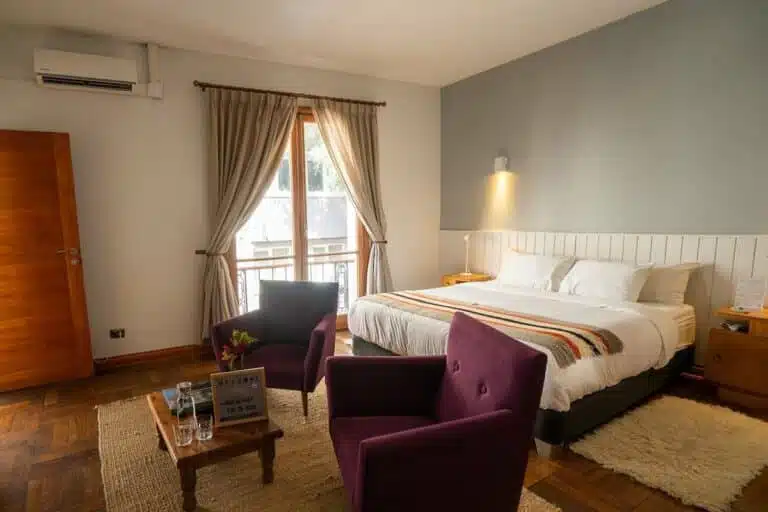
Nayara Alto is a chic resort-esque property ideal for Atacama stargazing as it has an observatory, allowing you to photograph some of the finest photos of the starry skies. It’s where I stayed in July, and its all-inclusive packages come with guided excursions, which is how I got to the lagoons.
It also features top-tier amenities, including a luxe spa area, outdoor showers, hydro-massage baths, a sauna, and a steam room. Blissss. Read my full review.
For more places to stay in and around San Pedro, see my guide to the best Atacama Desert hotels.
Map of the lagoons and the road from San Pedro
Now you’ve visited Lagunas Miscanti and Miñiques, see more of the Atacama
- Explore San Pedro de Atacama and its surrounds with this guide
- The Valle de la Luna: is this the closest thing you can get to Mars on Earth?
- Curious facts about the Atacama Desert
- Stargazing in the Atacama is an experience like no other
- The best things to do in the Atacama Desert
- My Atacama Desert itinerary
- Atacama Desert map: where to find the best sights
Love this? Save and share on Pinterest
Discover the top things to do, insider tips and hidden gems in our Chile Travel Guides.
Read the guides →