Google Maps won’t get you very far, nobody brings you the bill, and the best part of a Korean spa is paid for in cash. A first trip to South Korea is easy once you know the quirks, and these are the ones worth learning before you land.
Planning a first trip to South Korea can feel a little overwhelming, but I’d encourage you to go. It’s a stunning country, and it’s relatively easy to navigate: you just want to do your homework before you fly.
I travelled extensively around Korea in October: Seoul first, then across to Gangneung on the east coast, down through the Confucian academies of Andong to Busan, Mokpo and Jeonju, and finally back to Seoul for a few more days at my own pace. The whole trip ran as smoothly as I could have hoped, and it can for you too.
This guide covers the essentials: the entry rules that changed recently, the apps you’ll actually use, how money works, what to expect in restaurants and spas, and the etiquette that’s easy to get wrong. Here are the South Korea travel tips I’d give any friend before their first trip.
South Korea travel tips for a smooth first trip
Check whether you need a K-ETA before you book

One of my favourite things about travelling to Korea is how little paperwork stands between you and a last-minute trip, if you live in the UK, the US or most of Western Europe. Most visitors from those countries can stay for up to 90 days without a visa.
What you may need is the K-ETA, Korea’s electronic travel authorisation. Under a temporary exemption, passport holders from 22 countries, including the UK, the US, Canada, Australia and much of Western Europe, don’t need one for arrivals up to 31 December 2026. Unless Korea extends the exemption again (it has done so before), you’ll need an approved K-ETA from 1 January 2027.
Applying is simple. Use the official K-ETA website or app (k-eta.go.kr), apply at least 72 hours before your flight and expect to pay 10,000 won (about £6). An approved K-ETA usually covers multiple trips for up to three years, or until your passport expires.
Top Tip
Plenty of lookalike websites charge several times the official fee for the same K-ETA. If the address doesn’t end in .go.kr, you’re not on the government site.
Fill in the e-Arrival Card in the three days before you land
If you’re travelling without a K-ETA, you’ll need to complete the free online e-Arrival Card instead. It replaced the paper arrival card on flights and at the border from 1 January 2026.
You can submit it at e-arrivalcard.go.kr in the 72 hours before you land, and it only takes a few minutes with your passport, flight number and the address of your first hotel to hand. Some airports still kept paper cards during the changeover, but doing it online beforehand saves you a scramble in the arrivals hall.
If you do have a K-ETA, you don’t need the e-Arrival Card at all.
Get an eSIM or SIM card sorted before you fly
Ever landed in a country and frantically scrambled to set up roaming in the terminal, wishing you could find directions to your hotel? Reserve a SIM card or eSIM ahead of time and you won’t have that problem.
Having data from the moment you land means you can check messages, call your hotel and look up which subway line you need without staggering roaming charges. In Korea it matters more than usual, because the map and translation apps you’ll rely on all need a connection.
The three big networks, SK Telecom, KT and LG U+, all sell tourist plans. Seven days of unlimited data costs about 35,000 won (about £20), and you can reserve online and collect a physical SIM from the roaming counters in the arrivals hall at Incheon, or buy an eSIM and install it before you leave home.
Swap Google Maps for Naver Map or KakaoMap

Apologies to the company that seems to be everywhere, all the time, but Google Maps just isn’t much use in South Korea. A long-standing security law kept Korea’s detailed map data on Korean servers, so Google couldn’t give proper walking or driving directions. The government cleared Google to use the data in February 2026, but full navigation is still on its way.
Until it arrives, download Naver Map or KakaoMap. Both are free, both have English menus, and both are far more reliable for walking and public transport directions, right down to which subway exit to use.
While you’re at it, download Papago, Naver’s translation app. It handles menus and signs through your camera better than most, and it’s a lifesaver in smaller towns.
Let the subway, the KTX and a T-money card do the work


Once you land, you’ll love how convenient public transport is. Almost every trip starts at Seoul’s Incheon International Airport, where the AREX express train gets you to Seoul Station in about 43 minutes for around 10,000 won (about £6).
In the cities, the subway and buses make it easy to zip from place to place (although zipping across sprawling Seoul can still take an hour). Buses and the subway couldn’t be simpler: pick up a rechargeable T-money card and tap it on the reader as you get on and off. You can add money at stations, but that can be stressful if you’re rushing for a train, so I found it easiest to charge mine up at convenience stores to carry me over for a day or two. I got around Seoul for less than £4 a day, and I was glad of a full card in the busy stations at rush hour. A single subway ride now costs 1,550 won (about 90p) on a card, and if you’ll use the subway a lot, Seoul’s Climate Card covers unlimited subway and city bus rides from 5,000 won (about £3) a day; the card itself costs 3,000 won.
Between cities, the KTX bullet train is fast and inexpensive, with seats bookable through Korail’s website and app. I rode it from Jeonju back to Seoul, and it was so comfortable, with great views out of the window for most of the ride. Do yourself a favour and upgrade to first class. On my journey from Jeonju to Seoul it cost only around £8 more than a standard seat, and you get more legroom and a better chance of a window seat. First class generally costs 40 to 50% more than standard.
Taxis are plentiful and good value. Uber works in Seoul and the bigger cities by connecting you to licensed taxis, and Kakao Mobility’s K.Ride app is built for visitors and takes overseas cards. Kakao T, the app locals use, is much harder to set up without a Korean phone number and bank card. For routes between cities, my 10-day South Korea itinerary has the train and bus legs, and my 3 days in Seoul covers getting around the capital.
Withdraw some cash and ask for smaller notes

The currency is the won (₩ or KRW). Cards are accepted almost everywhere, but you’ll still want some cash, especially at market stalls, small family restaurants, on day trips to smaller towns and for topping up a T-money card.
You can change money in most big cities, but my preferred choice is to withdraw it from an ATM. Look for machines marked “Global ATM” in banks and convenience stores, which take foreign cards.
When you take out cash, try to get a mix of notes. They come in 1,000, 5,000, 10,000 and 50,000 won notes, and smaller notes are always appreciated by market traders and restaurant owners.
Bring cash for the best part of a Korean spa
Korean spas are a unique experience and I’d highly recommend trying one. Mine was Spa Lei in Sinsa-dong, a women-only spa that’s used to Western visitors. Be warned that you’re naked from start to finish and it’s functional rather than pampering, but you walk out feeling like a brand new person.
Here’s the catch: you can pay the entry fee by card, but you need cash for the scrubs and massages inside. My hour of scrub and massage combined cost about £70. Before a scrub, give yourself half an hour or more moving between the warm pools so your skin softens up. I’ve had plenty of scrubs in my time, and this one was vigorous: the prep pays off. Afterwards, wind down in the separate relaxation room.
Top Tip
The spa runs round the clock apart from a short maintenance window on Tuesday mornings, and admission is now 22,000 won (about £12). Men can’t go in, so mixed groups need a jjimjilbang, a Korean bathhouse with shared lounges, where you wear the loose T-shirt and shorts they hand out in the communal areas. Wherever you go, shower before you get into the baths and leave your swimsuit at home.
Skip the tip and say thank you instead

If you’re visiting from a country where tipping is expected, this might take some getting used to. But trust me, you’re not winning over any bartenders or making friends with your masseuse by leaving extra cash: in fact, it’s often the opposite.
Tipping isn’t something locals do, and good service is simply expected. Some people may feel confused, or even insulted, if you push a tip on them. Upmarket hotels and restaurants sometimes add a service charge to the bill, and that’s all you need to pay.
How do you show your appreciation? Leave as locals do, with a smile and a thank you (감사합니다, gamsahamnida). My guide to Gangneung has some of the best meals I ate in Korea, if you want somewhere to practise.
Call for the bill, or pay at the counter


Unlike in much of Europe, your server won’t hover around waiting to drop the bill after your meal.
Why not? In most restaurants you simply take your bill, or your table number, to the counter by the door and pay on your way out. Some places leave the bill on your table when the food arrives.
At others, you may need to call for help. It didn’t feel natural at first, but I quickly learned to raise my hand and call “저기요” (jeogiyo, “excuse me”) in a loud voice when I needed the bill. Many restaurants now have a call button on the table instead, which saves your blushes.
Beat the queue by sitting on the floor

Popular restaurants get busy, and queues outside the best-known places are part of life. My trick: ask for floor seating. Plenty of traditional restaurants have a raised platform where you sit on a mat at a low table, and the floor tables are often the last to fill.
At Insadong Hangane Bulgogi Jumak in Seoul, nabbing a spot at one of the low tables on the raised platform in the corner got me in faster. My bulgogi set was 18,000 won and arrived as a feast. It’s the lunch stop on day one of my 3 days in Seoul itinerary if you want to try it.
Two things to know before you sit down: you’ll need to take your shoes off before you step up, and sitting cross-legged for an hour is harder than it looks, so stretch first.
Expect to share, and to eat a lot


Korean food is absolutely delicious. From barbecue restaurants that sizzle freshly cut meat at your table to big bowls of seafood soup, many of the best dishes come with more banchan, the free side dishes, than you’ll know how to handle in one sitting.
Some restaurants bring more than a dozen small plates of kimchi, pickles, grilled fish and fresh vegetables with your meal, often for a very fair price. Refills of the banchan are usually free, so don’t be shy about asking.
Many dishes are made for sharing, and barbecue restaurants often expect you to order at least two portions of meat. If you’re travelling as a group, you’ll get the best value, as one or two dishes can easily feed a few people.
Stock up on K-beauty, and claim your tax back

K-beauty has taken the world by storm, and there’s nowhere better to stock up than at the source. Sunscreen, skincare and make-up cost far less than at home, and the choice is overwhelming.
Olive Young’s flagship in Myeongdong is hands-down my favourite spot for its range and its deals. Show your passport at the till and the tax comes straight off. Forget it, and you can still reclaim the tax at the airport with your receipt, which is what I ended up doing: the whole thing took about five minutes.
To qualify, you need to spend at least 15,000 won in one shop. Instant refunds at the till cover purchases of up to 1 million won per receipt and 5 million won per trip. For anything else, scan your passport and receipts at the tax refund kiosks at the airport before you check your bags.
Take your shoes off indoors

If you’re lucky enough to visit a traditional hanok (or any Korean home), take your shoes off as soon as you step inside. Look for the step up into the house, or the line of shoes by the door, as a clue.
The same rule applies at temples, at some guesthouses and in traditional restaurants and tea houses with floor seating. Wear socks you’re happy for people to see.
Check your room for hidden cameras

It isn’t a pleasant thought, but the country does have an issue with hidden cameras, known as molka. They’ve turned up in public toilets, changing rooms and some rental rooms, and the authorities have spent years cracking down on them.
My advice is simple: when you check into your room, have a quick look at things like mirrors, sockets and smoke alarms, and anything pointing at the bed or shower that seems out of place. It takes a minute, and it’s worth making a habit of in budget rentals in particular.
Explore late at night with confidence

Is it safe to travel to South Korea? That’s a resounding yes. One thing I noticed while travelling there is how safe the country feels. Even when I was out at restaurants and bars late at night (Seoul really never sleeps), I never felt unsafe.
That said, take the usual precautions: keep your belongings safe, stick to well-lit areas at night and keep your wits about you, especially when travelling solo.
Save three numbers in your phone: 112 for the police, 119 for an ambulance or the fire service, and 1330, the Korea Travel Hotline, which answers in English around the clock.
Learn to read Hangul (it’s quicker than you think)
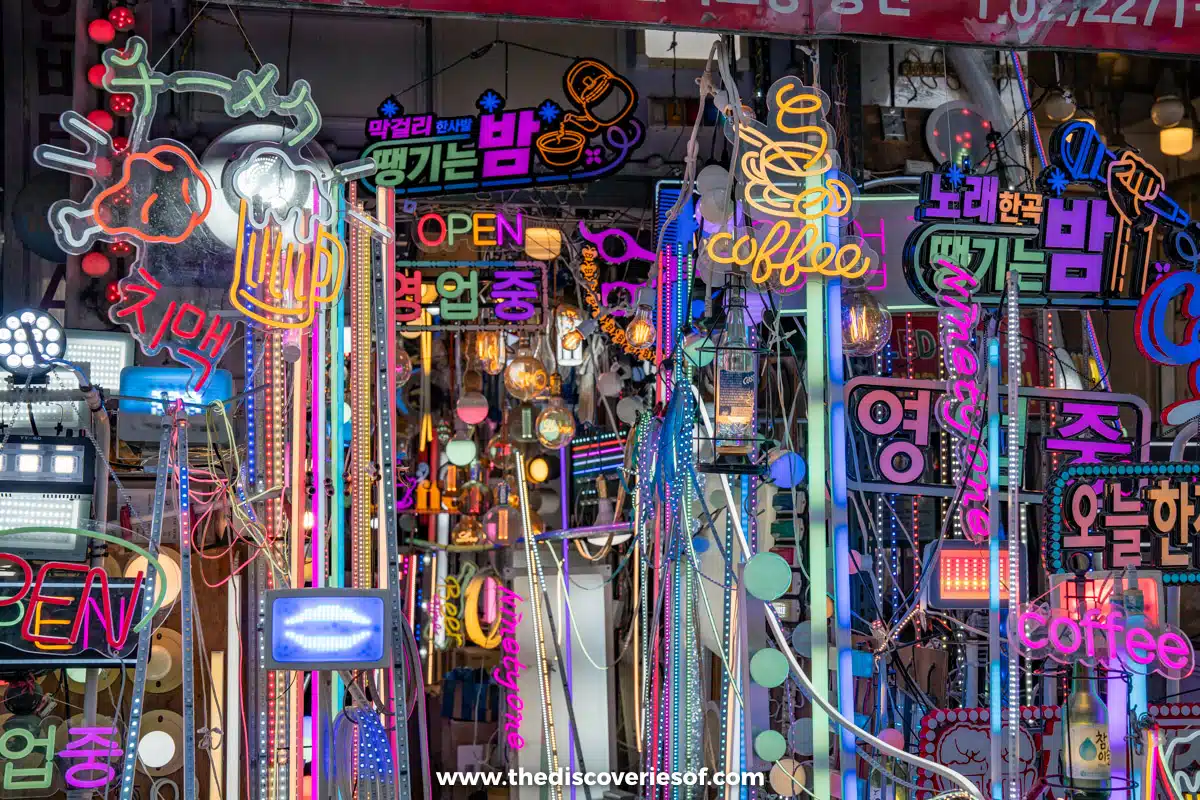
In Seoul, you’ll find English spoken at hotels and some restaurants and bars. But once you get out of the busiest areas, and outside the capital, it helps to know at least some basic Korean.
The good news is that Hangul, the Korean alphabet, was designed in the 15th century to be easy to learn, and there are plenty of free videos online that teach you the basics in an hour or two. Being able to sound out a menu or a station name makes a real difference.
If you don’t have much time, a pocket phrasebook or a translation app will get you by. If you do, an app like Duolingo is a good way to practise before your trip (or on the long flight over). Learn the usual suspects: hello, thank you, how much, and where’s the loo (even the one with a view at N Seoul Tower).
Go in spring or autumn for your first trip

Looking for the best time to visit? Plan your first trip for spring or autumn. The weather is mild, the skies are often clear, and the country looks its best.
I travelled in October, when the palace gardens in Seoul and the hills around Andong turned red, orange and gold, and it was perfect weather for days on your feet. In spring, the cherry blossom usually peaks in early April in Seoul and a little earlier on the south coast.
Summers are hot and sticky, and the monsoon (jangma) arrives from late June to late July, the wettest weeks of the year in Seoul. Winter is cold and dry: quieter, with festive lights in the cities, but you’ll need proper layers.
Avoid Seollal and Chuseok if you can
While January and February are often a good time to find deals on flights, you may want to avoid travelling during Seollal, the Lunar New Year, and Chuseok, the harvest festival in September or early October.
The dates change every year with the lunar calendar. In 2027, the Seollal holiday runs from 6 to 9 February and the Chuseok holiday from 14 to 16 September.
Top Tip
Millions of people head home to their families for both holidays, so trains and buses sell out weeks ahead and roads are jammed for days either side. Some shops, restaurants and attractions close on the day itself, while palaces and big tourist sights get busy with locals who are off work.
Pack for big swings in temperature

What you pack depends very much on when you go. In Seoul, average highs range from about 2°C (36°F) in January, with lows of around -6°C (21°F), to 30°C (86°F) in August. Spring and autumn swing between warm days and cool, damp evenings, with October highs of around 20°C (68°F).
In practice, that means a proper coat, hat and gloves in winter, light breathable clothes and an umbrella in summer, and layers you can add and peel off in spring and autumn.
If you’re not sure what to bring, PackPoint builds a packing list from your dates, destination and plans.
Bring a two-pin plug adaptor
You’re going to need that always-handy universal travel adaptor. Sockets take the round two-pin Type C and Type F plugs used across most of Europe, and the supply is 220V.
If you forget one, convenience stores in the big cities usually sell them.
Give it 10 days if you can


I think 10 days is enough to see the best of South Korea while still giving you time to really explore the cities.
If you only have a week, I’d still recommend Seoul, Busan and Jeonju, so you see a few very different sides of the country. The KTX links all three, so you won’t lose much time travelling.
Look beyond Seoul


You’re likely going to Seoul (and you definitely should), but where else should you go?
My favourites? Jeonju for its food and its traditional hanok village, Busan for Korean War history at the UN Memorial Cemetery (Busan may just have pipped Seoul to be my favourite place in the country), and Andong for Dosanseowon, a Confucian academy by a lake, and a bottle of dry white from the 264 Lee Yuk Sa winery.
If you want beaches and coffee, the east coast city of Gangneung is about two hours from Seoul by KTX. There are brilliant things to do all over the country, and you can read more about them in my guide to things to do in South Korea.
Swap the DMZ tour for Aegibong Peace Ecopark

The DMZ is a strip of land about 4 km (2.5 miles) wide and 250 km (155 miles) long that has divided the peninsula since the armistice ended the fighting in the Korean War in 1953.
Booking a guided DMZ tour isn’t the only way to see the border. Aegibong Peace Ecopark, in Gimpo, is a relatively new alternative about 1.5 hours’ drive from Seoul. From the observatory, you look across the river to North Korea, just 1.4 km over the water, and on a clear day you can pick out North Korean villages and hillsides through the free telescopes. (You can’t see Pyongyang, whatever you may read: it’s about 150 km away.) The day I went, mist hung over the river, so I got more atmosphere than detail.
Tickets
Admission is 3,000 won (under £2), with the shuttle up the hill included, and the park opens 9.30am to 5.30pm. As it’s inside a civilian control zone, carry your passport for the ID check; numbers are capped, so book ahead at busy times.
Sleep in a hanok at least once

You’ll find traditional hanok villages all over the country, including Bukchon in Seoul, Hahoe near Andong and, of course, Jeonju.
The best part is that you can actually stay in one: traditional Joseon-era style houses with courtyards, paper doors and ondol, the underfloor heating once fired from beneath the stone floor, so you sleep on a warm mattress on the floor.
I stayed at Tradition Resort Gureme near Andong, a beautiful place that’s distinctly Korean, with houses arranged like a traditional village. It sits a little outside Andong, so plan on a taxi or a hire car.
Read up on the Joseon dynasty, and on K-pop

Learning a little about Korean culture goes a long way, and it splits neatly into two lessons.
First, hit the history books on the Joseon dynasty, which ruled Korea for more than 500 years until 1897. It’ll help you make sense of the wood, stone and tile hanok houses, the patterns and colours of hanbok, the traditional dress, and which royal palaces to visit.
Popular culture is just as useful, as it helps you make the most of the K-pop and K-drama pop-ups at places like The Hyundai Seoul, where you can load up on gifts from your new favourite stars to bring home for friends.
Drink your coffee iced, like the locals
Want to discover the best coffee scene you’ve never heard of? Koreans take their coffee seriously, and you’ll find independent cafés on every corner. Order it iced, as many locals do whatever the weather.
My favourite city for café-hopping was Gangneung, where almost every coffee shop roasts its own beans and which is known as Korea’s city of coffee. Head for Anmok Coffee Street, a row of cafés facing the beach. If you don’t make it that far, Seoul’s Seongsu and Ikseon-dong neighbourhoods are packed with design-led cafés.
Cover up a little more than you would at home

If you don’t want to be on the receiving end of a few side-eyes, I’d recommend dressing relatively conservatively, particularly outside Seoul and at temples.
Many Koreans cover up even on the beach, with T-shirts, rash vests and hats more common than bikinis. Pack a swimsuit, some shorts and a cover-up for your shoulders, especially if you’re heading to a restaurant or bar afterwards.
Check the air quality before you head out

If you have allergies, a medical condition or are sensitive to air pollution, you may need a mask on some days. Rural areas are far better than the cities, but I was surprised by the air quality in Seoul.
Fine dust tends to be at its worst from late winter into spring, when yellow dust blows in from the deserts to the west, and it can be bad in winter too. Check the official AirKorea app or your weather app before a day of hiking or sightseeing, and plan indoor sights for the worst days. Pharmacies and convenience stores sell KF94 masks.
Pack shoes for the hills

Whenever you visit, pack decent walking shoes. Hiking is something of a national pastime, and you’ll see locals kitted out in full gear on even the gentlest trail.
Even in Seoul, you can climb Inwangsan, 338 m high, for views over the palaces and the city walls, or head to Bukhansan National Park on the city’s northern edge for a proper mountain day.
Join a small-group tour if you’d rather not go it alone

It can be intimidating to visit a country where you don’t know the language or the culture, and booking a guided tour isn’t the only way to do it. The country is very easy to travel independently, especially with the right travel apps on your phone.
If you’d rather not travel solo, a small-group tour takes care of the logistics. G Adventures runs small-group trips round South Korea, taking in Seoul and Busan, that are a good way in for a first visit.
Read next
- How to spend 10 days in South Korea
- How to spend 3 days in Seoul
- 22 things to do in South Korea
- A complete guide to Gangneung, South Korea
- A complete guide to visiting Jeonju’s hanok village
- 15 unmissable things to do in Busan
Love this? Save and share on Pinterest

Discover the top things to do, insider tips and hidden gems in our South Korea Travel Guide.
Read the guides →