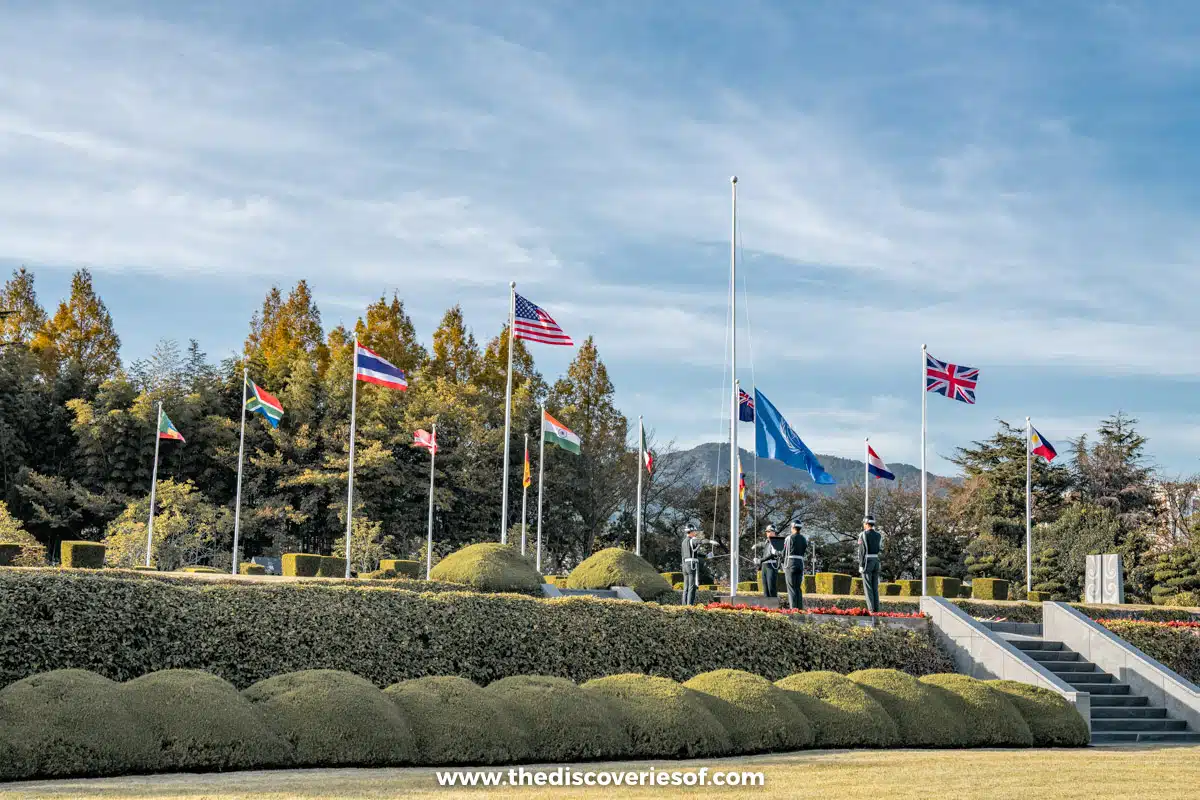

Rows of low headstones run between clipped hedges, the flags of 22 nations lift in the breeze, and the apartment towers of a busy port city rise just beyond the fence. Nowhere else on earth has a cemetery run by the United Nations. Give it time, because this quiet corner of Busan explains more about modern South Korea than almost anywhere else you’ll go.
Of everything I saw in Busan in October, the UN Memorial Cemetery is the place that moved me most. I stayed for a long time, and looking back it’s one of the stops on my trip around South Korea that mattered most.
It’s a place that teaches you as much as it asks you to remember. The short film in the memorial hall taught me a great deal about the war, about the scale of the UN effort to defend the South and about how many lives it cost. By the time it finished I was in tears, and I wasn’t the only one in the room.
This guide covers what to see, how to time your visit for the flag ceremony, the history that explains why the cemetery is here at all, and how to get there.

The UN Memorial Cemetery at a glance
- Where: 93 UN Pyeonghwa-ro, Nam-gu, in southeast Busan. In Korean it’s 재한유엔기념공원 (UN Memorial Park in Korea), which is the name to search for in Naver Map or KakaoMap.
- Opening hours: every day of the year, 9am to 5pm (October to April) and 9am to 6pm (May to September).
- Entry: free.
- Flag ceremonies: the flags were raised at 10am and lowered at 4pm when I visited.
- The film: a documentary of about 12 minutes in the Memorial Service Hall, shown in five languages including English.
- How long: allow at least an hour and a half, and more if you want to watch the film and catch a ceremony.
- Dress: respectful clothing. Visitors in very casual or revealing outfits can be turned away.
- Nearest subway: Daeyeon (line 2), exit 3, then a 15-minute walk.
Start with the film in the Memorial Service Hall
Head first for the Memorial Service Hall, built by the UN and finished in 1964. The Korean architect Kim Jung-up designed it around six support beams and a triangle, and the stained glass inside is made up of 16 lines of colour, one for each of the 16 nations that sent combat troops to Korea.
This is where the documentary plays. It sets out the war and just how big the UN’s part in it was, then turns to individual soldiers and what they gave up. It’s those personal stories that land. By the end I understood far more about the conflict, and about what it cost, than when I’d walked in.
Watching it first changes how you see everything else. The neat rows outside stop being a pretty landscaped garden and become what they are.

Top Tip
Ask at the hall which language the next screening is in. The film is shown in several languages, so you may need to wait a few minutes for the English version.
Why Busan has the only UN cemetery in the world
North Korea invaded the South on 25 June 1950. Within weeks, the North’s army had pushed the South Korean and UN forces back to a small corner of the southeast around Busan (then written Pusan), and for the late summer of 1950 the city was the last foothold on the peninsula. It held. The Pusan Perimeter became the base from which the war was turned around, and the city served as South Korea’s temporary capital while refugees from across the country poured in.
The UN Command opened a cemetery here on 18 January 1951 for the soldiers it was losing. By 1954, around 11,000 had been buried on this hillside. Many were later taken home, the Americans above all, so the graves you see today are a fraction of the original number.
In 1955 the Korean National Assembly offered the land to the United Nations for permanent use as a cemetery, and in December that year the UN General Assembly accepted it. That’s what makes it unique: it isn’t any one country’s war cemetery, but ground set aside for the UN itself. Since 1974 it has been run by a commission of 11 countries, and in 2007 South Korea registered it as a national cultural heritage site.

The nations that rest here
Twenty-two countries answered the UN’s call: 16 sent combat troops and six sent medical units. All 22 flags fly every day over the cemetery’s symbolic area, alongside the blue UN flag.
There are 2,339 people buried here. The largest group by far is British, with 892 graves, followed by Türkiye (462), Canada (382), Australia (281) and the Netherlands (125), then France, the United States, South Korea, New Zealand and a handful of others. The graves are set out by nationality, so you walk from one country’s plot to the next, past the memorials that several nations have added over the years. Türkiye dedicated the first of them in 1960; Colombia added the most recent in 2021.
A few graves tell stories worth looking for. Kenneth Muir, an officer of the Argyll and Sutherland Highlanders, was awarded the Victoria Cross after he was killed on Hill 282 in 1950, and he’s buried here. The narrow stream that runs between the grave area and the lawns is the Daunt Waterway, named after J. P. Daunt, an Australian who died at 17, the youngest soldier in the cemetery.
The burials aren’t only from the war years, either. Veterans who survived it can now ask to be buried alongside their comrades, and some have: Bill Speakman, the British soldier awarded the Victoria Cross for his actions in Korea in 1951, was laid to rest here in 2019.

Time your visit for the flag ceremony
If you can, plan around one of the flag ceremonies. When I visited, the flags were raised at 10am and lowered at 4pm, with an honour guard in dress uniform at the flagpoles in the symbolic area. Times can change, so check with the cemetery office when you arrive.
It’s a short ceremony, but it’s done with real precision and care. Watching soldiers honour the fallen with that much respect, so many decades after the fighting stopped, was one of the most moving things I saw in Korea. Even if you can’t make the times work, the cemetery is a sombre place to spend an hour, and one that still resonates with local people as much as with visitors from the countries whose soldiers are buried here.
The Wall of Remembrance and the Memorabilia Hall
The Wall of Remembrance was completed in 2006. Its 140 stone panels carry the names of 40,896 UN soldiers who were killed or went missing in the war, the thousands with no known grave among them. It goes on for much longer than you expect, and that’s the point.
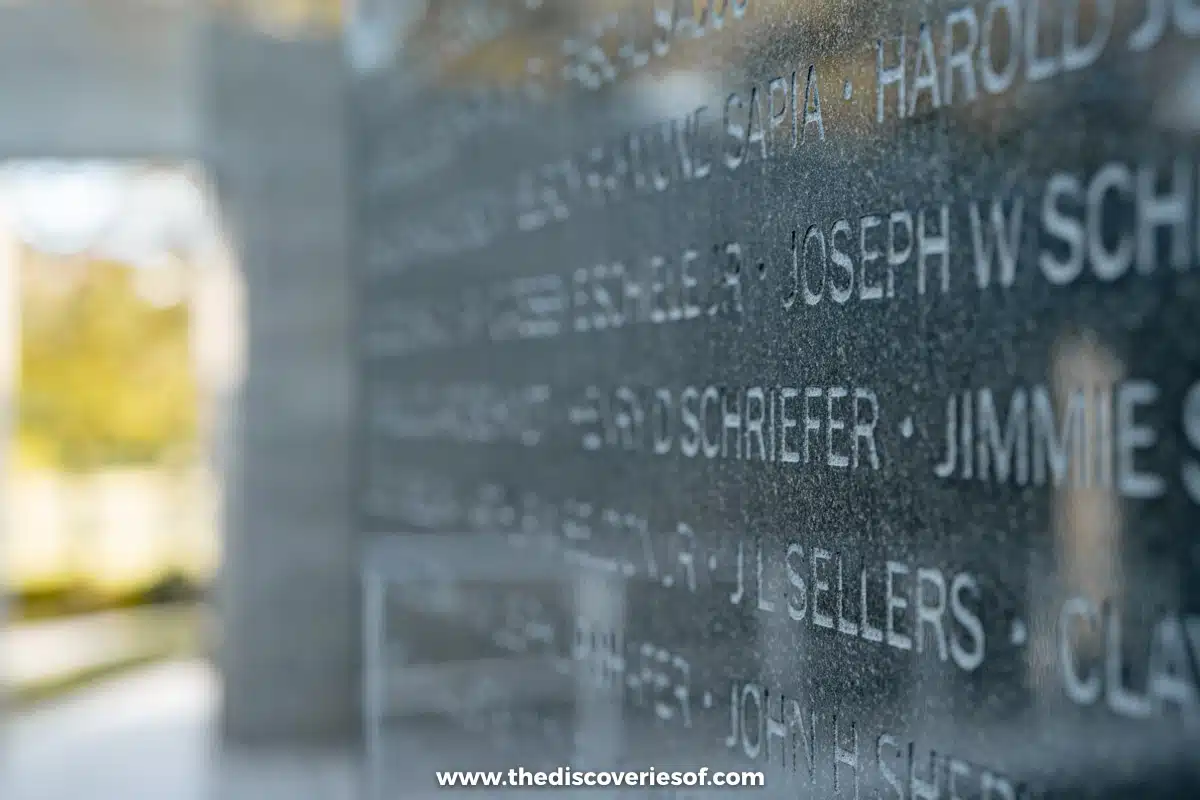
If you’re looking for a relative or someone from your home town, the cemetery’s website has a search for both the graves and the names on the wall. Visitors can bring and lay flowers, and to place them on a particular grave, call in at the office first.
The Memorabilia Hall, built by the UN in 1968, holds photographs of UN troops, artefacts from the war and the first UN flag flown in Korea. A smaller second hall next to it has a permanent exhibition of photographs of the fallen.
Turning toward Busan on 11 November
Every year on 11 November, at exactly 11am Korean time, a siren sounds across the city and everything falls silent for a minute in memory of the UN dead. Veterans and their families in the countries that fought in the war turn toward Busan at the same moment, whatever hour it falls for them (2am in the UK).
The idea came from Vincent Courtenay, a Canadian veteran of the war, and the first Turn Toward Busan was held in 2007. In 2020 South Korea made 11 November an official day of remembrance for UN veterans. The main ceremony is held here, with a 21-gun salute, and a second commemoration marks UN Day on 24 October. If your trip falls around either date, expect the cemetery to be busier and more formal than usual, and well worth it.
Before you go
- Respect the rules. This is a working war cemetery, not a park, so there’s no eating, drinking, smoking, pets, cycling or running inside, and visitors are asked to keep off the grass and to keep their voices down. Food is fine in the public parks next door.
- Photography: personal photos are allowed; commercial shoots are not.
- When to go: autumn is a lovely time to visit, with mild weather and the marigolds in flower, and the double cherry blossoms along the paths are out in mid to late April.
- Parking: cars get 90 minutes free in the car park beside the main gate if you’re visiting the cemetery.
Getting to the UN Memorial Cemetery
- Subway: take line 2 to Daeyeon and leave by exit 3. From there it’s a 15-minute walk. Line 2 also runs to Haeundae and Gwangalli, so you can get here from the beaches without changing.
- Bus: the 134 from Busan Station and the 68 from Seomyeon both stop at the UNMCK bus stop.
- From Gimhae Airport: take the Busan-Gimhae light rail to Sasang and change to line 2 for Daeyeon.
Two museums sit on the same short walk. The Busan Museum, right next to the cemetery, is free and closes on Mondays. The UN Peace Memorial Hall, close by, covers the war and the 22 nations that sent troops or medical help; it’s open 10am to 6pm and also closes on Mondays.
If you’re planning the rest of your time in the city, my guide to the best things to do in Busan and my 3 days in Busan itinerary both fit the cemetery into a wider trip.
Map
Read next
- 20 things to do in Busan, from a glass-floored cable car to blowfish cooked two ways
- How to spend 3 days in Busan, from cliffside temples to blowfish for brunch
- How to spend 10 days in South Korea, from Seoul’s palaces to live octopus in Busan
- 22 things to do in South Korea, from a peek into North Korea to a vigorous spa scrub
- 30 South Korea travel tips to know before you go, from cash to hidden cameras
Love this? Save and share on Pinterest

Discover the top things to do, insider tips and hidden gems in our South Korea Travel Guide.
Read the guides →