In the early 1950s this hillside was a shantytown of about 800 wooden shacks, thrown up by families fleeing the Korean War. Today its houses are painted every shade of pastel, its alleys are lined with murals and sculptures, and more than three million people a year climb its lanes. It’s still home to the people who live here, though, and since the summer it has had visiting hours to prove it.
If you’ve looked at photos of Busan before a trip, I’d bet good money that Gamcheon was in one of them. Those rows of pastel houses tumbling down a steep slope towards the port are the city’s postcard view, and when I visited in October I could see straight away why it’s one of the most popular spots in town. It’s bright, a little bit quirky, and it gazes out over the bay.
The joy of the place is simply walking around. There’s no single sight to tick off: you pick a lane, follow it downhill past murals and tiny galleries, and stop wherever a gap between the houses opens onto the sea. Two things I’d make a point of doing are climbing the 148 steps and heading up to the Haneul Maru observation deck. The view from the top is worth every one of those stairs.
This guide covers the village’s story, what to look out for in the lanes, renting a hanbok, the new visiting hours and how to get up the hill by subway and bus.

Gamcheon Culture Village at a glance
- Where: Gamnae 2-ro, Saha-gu, on the hills west of the old port. The information centre is at 203 Gamnae 2-ro. For directions, look up 감천문화마을 on Naver Map or KakaoMap.
- Entry: free.
- Visiting hours: in the residential lanes, visitors are welcome from 9am to 6pm. This has been on trial since 1 August 2026 and becomes the rule from 1 January 2027.
- Information centre: at the village entrance, open daily from 9am to 6pm. It sells the stamp tour map (2,000 won, about £1) and has a left-luggage service.
- How long: two to three hours to wander without rushing.
- Best time: a weekday morning, before the tour groups and the queue for the Little Prince statue build up.
- Getting there: subway line 1 to Toseong, exit 6, then village bus Seo-gu 2, Seo-gu 2-2 or Saha 1-1 up to Gamjeong Elementary School, about ten minutes up the hill.
From refugee shacks to Busan’s most colourful neighbourhood
Gamcheon’s colours hide a hard history. When the Korean War broke out in 1950, refugees poured into the city, then the wartime capital, and by 1951 nearly half a million had arrived on top of a population of under 900,000. Families built homes wherever they could find space. On this hillside, which had only about 20 houses before the war, some 800 shacks went up almost overnight, side by side and mostly made of cheap wood and metal.
In 1955 the founder of Taegukdo, a small Korean religious movement, moved its headquarters here, and for years the area was known as Taegukdo village, with most of its residents among the faithful. Over the following decades the shacks became two-storey houses, but many were barely updated and the neighbourhood was one of the poorest in the city.

The turnaround began in 2009. Rather than knocking the village down, the Ministry of Culture, Sports and Tourism backed an art project with the wonderful name Dreaming of Busan Machu Picchu, which brought artists in to work alongside residents on murals and street art. A second phase, Miro Miro Alley, turned empty houses and lanes into small galleries and painted trails, and the bright facades and rooftops followed. The project won the top prize at Korea’s national Space Culture Awards in 2016, and the village now draws more than three million visitors a year, most of them from overseas.
Wander the painted lanes

Most visitors arrive on the ridge road at the top of the village and work their way along and down, which is the easiest way to see it. The main lane, Gamnae 2-ro, runs along the hillside past cafes, souvenir shops and craft studios, and the smaller alleys drop away from it between the houses. Painted arrows and signs mark out a route, and staying on it keeps you out of the narrowest residential corners.
Look out for the art as you go. There are birds perched on the rooftops, fish swimming along the walls, little museums in converted houses and a former public bathhouse, Gamnae Eoulteo, that’s been turned into a community space with a cafe, gallery and roof terrace. The village’s most famous resident is the Little Prince, who sits on a wall beside the Desert Fox, gazing out over the rooftops. It’s the one spot where you’ll find a queue, so go early if you want a photo without a crowd.

Top Tip
Buy the stamp tour map at the information centre before you set off. It marks the main artworks and viewpoints, and collecting the stamps along the way gives the wander a loose route. Groups of ten or more now have to buy one.
The shops are worth a browse too. Studios here sell the work of the artists who live and work in the village, alongside postcards, ceramics and an awful lot of brightly painted figurines.
Climb the 148 steps
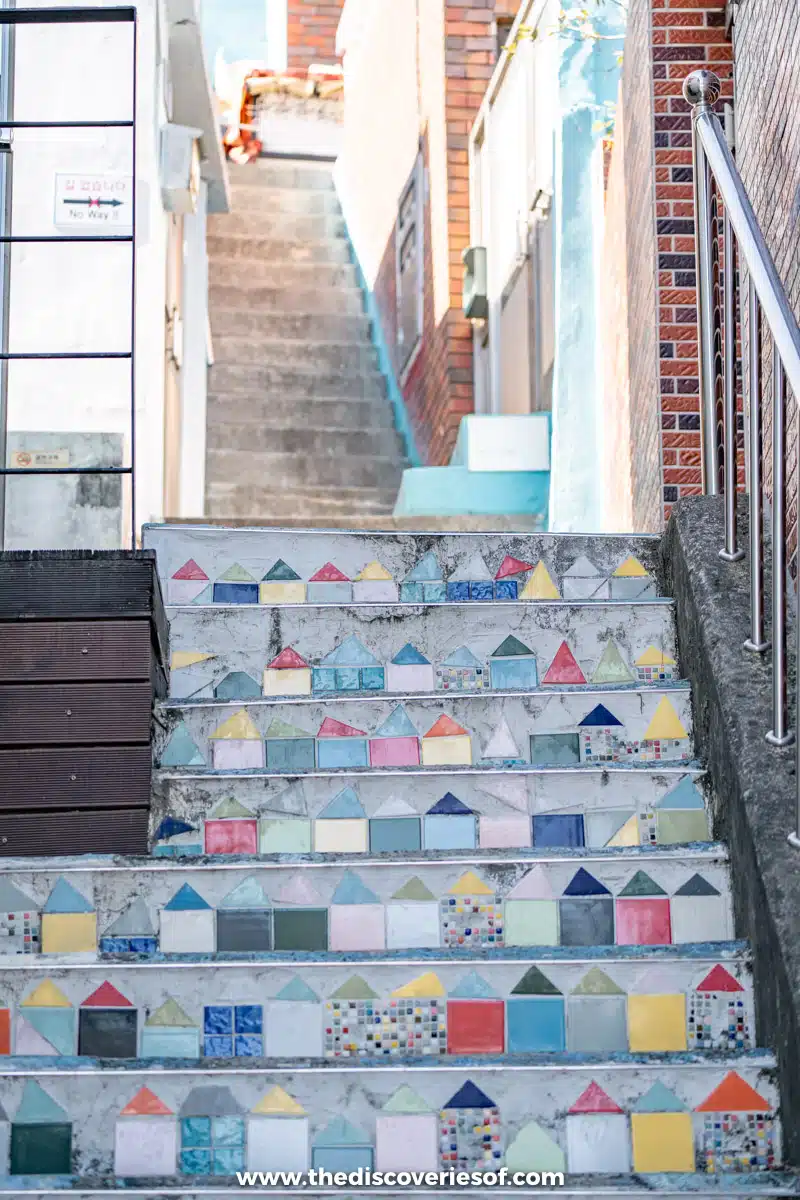
Deeper into the village, a steep staircase of 148 steps cuts up the hillside between the houses. It’s a proper climb, so take it slowly and use the resting spots on the way, but it’s one of the best ways to get a sense of just how steep this slope is and how tightly the homes are packed onto it.
Staircases are everywhere in Gamcheon, and plenty of them are decorated. Some are tiled, some are painted, and some have little houses, fish or flowers set into the risers, so keep an eye on your feet as well as the view.
Take in the view from Haneul Maru

If you want to see the whole village laid out below you, make for the Haneul Maru observation deck. It’s up quite a few flights of stairs, but it’s one of the most photogenic viewpoints I found anywhere in South Korea. Built on the roof of a former house near the village entrance, it looks down over the whole of Gamcheon, with Busan’s main port, Gamcheon harbour and Yongdusan, the hill crowned by Busan Tower, beyond.
From up here you can really see the layout: the houses stepping down the slope in tidy terraces, each roof a different colour, with the cranes and ships of the harbour behind. On a clear day the sea stretches all the way to the horizon.
Rent a hanbok for the lanes

Few places in Busan are better for wearing a hanbok, the traditional Korean dress, and you’ll see plenty of visitors doing just that. There are rental shops in and around the village to kit you out, and a few of the cafes with rooftop terraces make striking (and fairly private) backdrops for photos over the houses.
Whether you do it is up to you. I tried hanbok in Jeonju Hanok Village, and while I’m glad I had the experience, I found it awkward, and that one time was enough for me. If you do rent one, remember that the lanes are people’s front doors, so keep your photo shoots to the main paths and viewpoints.
Visiting hours and the residents’ rules
People still live in almost every one of these houses, and the crowds have taken their toll on the neighbourhood. In August 2026, Saha District made the village a special management area for tourism, the same status as Seoul’s Bukchon, and split it into zones.
- Residential lanes: visitors may only be in the most densely lived-in areas from 9am to 6pm. The rule is being trialled from 1 August 2026 and takes full effect on 1 January 2027.
- Traffic: tour vehicles are restricted on part of Gamnae 2-ro during the same hours, with fines for vehicles from January 2028.
- Groups: groups of ten or more must buy a village map.
- Village guardians: around 35 wardens, working with the residents’ council, patrol the lanes to guide visitors.
- Drones: flying drones over the village isn’t allowed.
Outside the zones with time limits, the same courtesy applies at any hour. Keep your voice down, especially in the evening, don’t open gates or step into doorways and courtyards, and never point your camera into someone’s home. As in Bukchon, the more visitors behave like guests, the longer the lanes stay open to everyone.
When to visit
Go early. Arriving at 9am gives you an hour or so before the coaches arrive and the queue for the Little Prince starts to snake along the wall. Weekdays are calmer than weekends, when the car parks fill up fast.
Spring and autumn are the most comfortable seasons, as the climb is hard work in the heat and humidity of a Busan summer. I was there in October, under clear blue skies, and the colours of the houses popped against them. If you’re in town at the end of October, look out for the village’s alley festival, held each autumn by the district and the residents’ council: in 2026 it runs on 31 October and 1 November, from 10am to 6pm.
Tips for your visit
- Wear proper shoes. The village is all slopes and stairs, and the steps can be steep and uneven.
- Start at the top. Take the bus up to the ridge and let the hill do the work as you wander down, rather than climbing up from the bottom.
- Leave the car. Parking is scarce. The public car park at the entrance charges 100 won per 10 minutes, up to 2,400 won a day, and it’s often full by mid-morning.
- Keep to the hours. Plan to be done with the residential lanes by 6pm, which means arriving by early afternoon at the latest in winter, when the light goes early.
Getting to Gamcheon Culture Village
- By subway and bus: take subway line 1 to Toseong station and leave by exit 6. In front of the university hospital’s cancer centre, catch one of the village buses (Seo-gu 2, Seo-gu 2-2 or Saha 1-1) and get off at Gamjeong Elementary School, about ten minutes up the hill. The village entrance is a short walk straight ahead.
- By taxi: from Nampo-dong or Jagalchi Market it’s a short ride, and handy if there are a few of you. Ask for 감천문화마을.
Gamcheon sits on the west side of the city, close to the Songdo coast, so it pairs well with the cable car and the cliffs on the same day. My 3 days in Busan itinerary puts them together on day one.
Map
Read next
- 20 things to do in Busan, from a glass-floored cable car to blowfish cooked two ways
- How to spend 3 days in Busan, from cliffside temples to blowfish for brunch
- The UN Memorial Cemetery in Busan, from the daily flag ceremony to 40,896 names in stone
- How to spend 10 days in South Korea, from Seoul’s palaces to live octopus in Busan
Love this? Save and share on Pinterest

Discover the top things to do, insider tips and hidden gems in our South Korea Travel Guide.
Read the guides →