On a hillside between two royal palaces, hundreds of wooden houses with curling tiled roofs crowd along steep, narrow lanes, and every so often a gap between them opens onto the glass towers of downtown. Bukchon is one of the prettiest corners of the capital, and these days it comes with a curfew: tourists must be out of its busiest lanes by five o’clock.
I’ll be straight with you about Bukchon Hanok Village, as I was in my notes after walking its lanes in Seoul in October. “Don’t go expecting a quiet and peaceful experience,” I wrote. It’s “very firmly on the tourist trail but it’s a cool experience and an impossibly pretty part of town.”
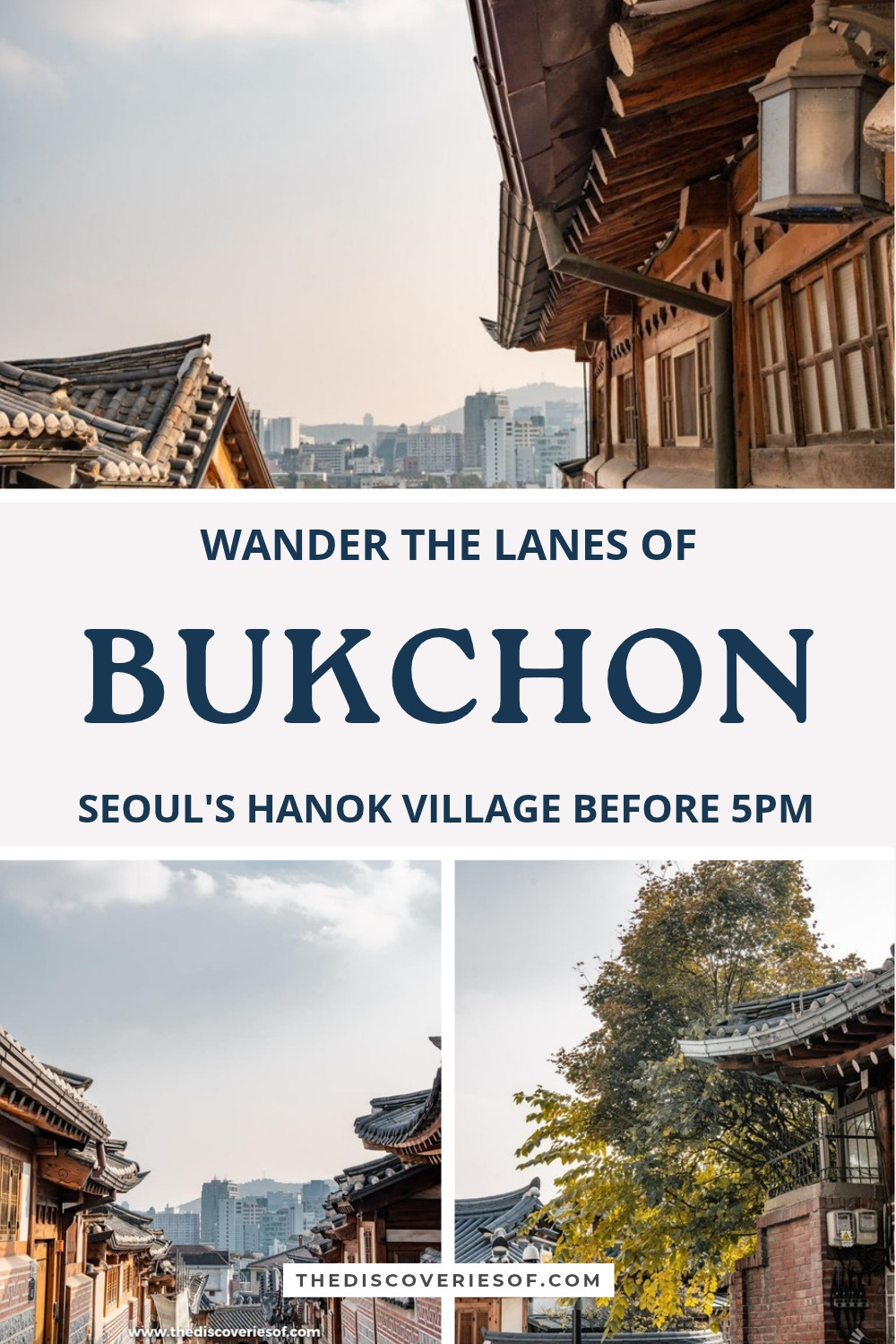
The crowds are real, but so is the payoff. What stays with you is the contrast: rows of traditional houses in the foreground, with the high-rises of the modern city framed behind them. Give yourself at least a couple of hours to stroll the lanes and duck into the little museums, craft shops and tea houses tucked inside the hanok.
There’s one more thing to know before you go. People live here, and the neighbourhood has run out of patience with badly behaved visitors, so parts of it now close to tourists every evening. This guide covers what to see, the rules and when they apply, when to visit and the easiest way in by subway.

Bukchon Hanok Village at a glance
- Where: Jongno-gu, on the slope between Gyeongbokgung and Changdeokgung palaces, north of Insadong. Search for 북촌한옥마을 in Naver Map or KakaoMap.
- Entry: free. It’s a residential neighbourhood, not a ticketed site.
- Visiting hours: in the red zone, the busiest lanes around Bukchon-ro 11-gil, tourists are allowed in from 10am to 5pm only, every day of the year. Outside those hours you can be fined 100,000 won (about £55).
- How long: a couple of hours for the lanes, longer if you stop for tea or a craft class.
- Best time: a weekday, from 10am. Spring and autumn are the prettiest seasons.
- Nearest subway: Anguk (line 3), exit 2 for the main lanes, exit 3 for the Bukchon Cultural Center.
Why it’s worth braving the crowds
The name means “northern village”, because it sits north of the Cheonggyecheon stream and the old main road of Jongno. Under the Joseon dynasty this was where the aristocracy and senior officials lived, close to the palaces they served: a family register from 1906 shows that more than four in ten of the area’s residents still came from noble or official families.
Most of the houses you see today are younger than that history suggests. In the 1910s to the 1930s, as Seoul filled up under Japanese rule, developers split the grand estates into smaller plots and built rows of compact hanok on them, with glass windows and tiled roofs. The best known of them, Jeong Se-gwon, built so many that experts credit him with as many as a third of the new hanok of the colonial period. His aim, his daughter later said, was to keep Koreans living in the heart of the city at a time when the Japanese were moving in.
The result is a neighbourhood of tightly packed courtyard houses, with heavy grey roof tiles that curve up at the eaves, wooden lattice windows and walls of stone and brick. Some are still family homes. Others have become guesthouses, galleries, tea houses and workshops where you can try traditional crafts, which is what makes it such a rewarding place to wander. It was almost entirely hanok as late as the 1960s, and many were knocked down for small blocks of flats in the 1990s, until a scheme with residents from 2001 began to protect what was left.
Top Tip
The views are best from the top of the slope, where the lanes look back down over the rooftops to the city. Walk uphill first, then let gravity take you back down.
The red zone and its visitor curfew
Around 6,000 people live in Bukchon, and in a single year it drew about 6.6 million visitors. After years of complaints about noise, litter, tour buses and strangers peering through windows, Jongno District made it Korea’s first special management area for tourism in July 2024 and divided it into zones.
- The red zone covers about 34,000 square metres around Bukchon-ro 11-gil, the lanes with the famous views and the densest cluster of homes. Tourists may only be there from 10am to 5pm, weekends and holidays included. These are effectively the residents’ quiet hours, and they apply year-round.
- Fines: after a trial period from November 2024, fines of 100,000 won have applied since 1 March 2025. Wardens patrol at five o’clock to ask visitors to leave, give a warning first and fine anyone who stays. Foreign visitors are asked to pay on the spot or before they leave the country.
- What counts as sightseeing: taking photos or video, lingering to look around, and wandering the lanes for reasons other than shopping. Residents and their guests, people staying in a guesthouse, customers of local businesses and anyone simply passing through are exempt.
- The orange and yellow zones, around Bukchon-ro 5ga-gil, Gyedong-gil and Bukchon-ro 12-gil, have no time limits, but staff are stationed there to guide visitors and the district monitors numbers.
- Tour buses: large coaches (more than 16 seats) are now banned from the area’s narrow streets, with a 300,000 won fine for unauthorised buses. If you book a tour, expect to walk in.
The district says the rules have cut noise and complaints. Not everyone is happy: some shopkeepers have campaigned for a later cut-off in summer, when it’s light until well after seven. As of early 2026 the 10am to 5pm window still stood, so plan your visit inside it, and check the signs at the lane entrances when you arrive.

Please don’t drape yourself over people’s doorways
This is the part I feel most strongly about. This is a functioning neighbourhood, and many of these houses are someone’s home. As I put it in my video, “don’t be draping yourself all over doorways and sitting on people’s windows and all of that other influencer in the wild behaviour that is just not okay.”
A few simple rules go a long way:
- Keep your voice down, especially in the narrow residential lanes, where sound carries straight into people’s courtyards.
- Stay on the street. Don’t open gates, step past doorways or pose on private steps and window ledges.
- Ask before photographing people, and don’t point your camera into homes.
- Take your rubbish with you. Public bins are hard to find in Seoul.
- Move along for photos. If you’re blocking a lane for a shot, residents and delivery drivers are trying to get past.
What to see in the hanok lanes
The lanes of Gahoe-dong
The classic Bukchon scenes are in Gahoe-dong, at the heart of the red zone. Gahoe-dong 31 is the best-preserved cluster of hanok in the neighbourhood, where the lanes drop steeply between unbroken rows of tiled roofs, and Gahoe-dong 11 is known for its small museums and workshops. These are the busiest spots of all, so go early in the visiting window and be ready to wait your turn for the view.
Bukchon Cultural Center
To see inside a hanok, head for the Bukchon Cultural Center on Gyedong-gil. It’s housed in a traditional house that once belonged to the Min family, who handled the court’s finances at the end of the Joseon dynasty, and the city opened it to the public in 2002. Entry is free, and it has a small exhibition on hanok and the neighbourhood, rooms where you can sit and rest, and classes in crafts such as embroidery, knot-making and calligraphy.
Tea houses and craft workshops
Many of the hanok have been turned into tea houses, where you sit on floor cushions in a courtyard room, and small studios where you can try traditional crafts or browse for ceramics and lacquerware. They’re the best way to escape the crowds for half an hour, and spending a little money here helps make the case that visitors are good for the neighbourhood.
A free walking tour
Seoul City runs free guided walking tours with volunteer guides, and the hanok village is one of the routes. The walk takes about three and a half hours, starts and finishes at Anguk Station, and is offered in Korean, English, Japanese and Chinese. Book at least three days ahead on the city’s walking tour website.
Renting a hanbok
Lots of visitors rent hanbok, the traditional Korean dress, to walk the lanes, and rental shops line the streets around Anguk and Gyeongbokgung. Wearing one also gets you into Seoul’s royal palaces for free. I tried it in Jeonju and found it a bit awkward; for me, once was enough, but it’s a personal choice. If you do rent one here, it’s all the more reason to be mindful of the residents when you pose for photos.
The best time to visit
Weekday mornings, from 10am, are the quietest time in the red zone. Weekends and public holidays bring the biggest crowds, and tour groups build up through the middle of the day. Aim to finish the red zone lanes by about 4.30pm so you aren’t hurried out at five.
For the seasons, autumn is hard to beat: when I was there in October, the trees between the houses were turning gold against the grey tiles. Spring brings blossom and mild weather, while summers are hot and humid on the steep lanes, and winter can bring snow on the roofs and far fewer people.
How to get there
- Subway: take line 3 to Anguk Station. Exit 2 brings you out at the foot of Bukchon-ro, about a 10-minute uphill walk from the red zone lanes. Exit 3 is closer to the Bukchon Cultural Center on Gyedong-gil.
- On foot from the palaces: the village sits right behind Gyeongbokgung, so it pairs naturally with a morning at the palace. Changdeokgung is on its eastern edge.
- Comfortable shoes: the lanes are steep and some are cobbled or stepped, so leave the heels at your hotel.
The lanes fit easily into a day in the old town: my 3 days in Seoul itinerary puts them on day two, alongside a palace garden and, later on, Gwangjang Market, and Changgyeonggung Palace, my favourite of the palaces I visited, is about a 20-minute walk to the east.
Map
Read next
- 32 things to do in Seoul, from a virtual royal banquet to cocktails in an old teahouse
- How to spend 3 days in Seoul, from royal palaces to a loo with a view
- Jeonju Hanok Village, from a king’s portrait shrine to brewing your own moju
- Explore Changgyeonggung Palace in Seoul, from a royal birthday party in AR to a pond ringed with autumn maples
Love this? Save and share on Pinterest

Discover the top things to do, insider tips and hidden gems in our South Korea Travel Guide.
Read the guides →