This palace has been burned to the ground, rebuilt on a staggering scale, stripped back to a few dozen buildings and patiently pieced together again, and the work still isn’t finished. Behind its great gate wait a throne hall where five kings were crowned, a pavilion raised over a man-made lake and the quiet courtyard where a queen was murdered.
Gyeongbokgung is the most famous palace in Seoul, and when I visited in October it was easy to see why: the scale is on another level, and its gate is something to stand and gaze up at for a while before you even go in.
It wasn’t my favourite of the royal palaces I saw. That honour goes to Changgyeonggung Palace, and if one palace is all you can fit in, I’d point you there for its gardens. But if you can manage two palaces, make this the other one. Inside, the places I’d make time for are Gyeonghoeru, the banquet hall lifted on stone pillars above its pond, and Heungbokjeon, one of the newest halls on the site.
I was there in late October, when the ginkgo trees along the palace walls had turned a brilliant, almost unreal yellow. This guide takes you from the square outside to the far end of the grounds, with the history that explains what you’re looking at, the guard ceremony times, night openings and everything you need to plan your visit.

Gyeongbokgung Palace at a glance
- Where: 161 Sajik-ro, Jongno-gu, at the northern end of Gwanghwamun Square. Search 경복궁 in Naver Map or KakaoMap.
- Opening hours: 9am to 5pm from November to February, 9am to 6pm from March to May and in September and October, and 9am to 6.30pm from June to August. Last entry is an hour before closing.
- Closed: Tuesdays (or the next working day when a Tuesday is a public holiday).
- Tickets: 3,000 won (under £2) for adults. Free for visitors aged 18 and under or 65 and over, for anyone in hanbok, and for everyone on Culture Day, the last Wednesday of the month. Higher prices are planned from 1 January 2027, with the new rates due to be announced in November.
- Changing of the royal guard: 10am and 2pm at Heungnyemun, about 20 minutes, free to watch.
- Free English tours: daily except Tuesdays, from 11am, starting in front of the information office just inside Heungnyemun.
- How long: two to three hours for the main halls; half a day if you want to reach the northern pavilions and the museum.
- Nearest subway: Gyeongbokgung (line 3), exit 5, or Gwanghwamun (line 5), exit 2.
Start on Gwanghwamun Square
I’d begin on the square rather than at the ticket office. It’s a bit of a hodgepodge of buildings, fountains and statues, but walking up it towards the palace, with the mountain Bugaksan rising behind the roofs, is the best possible approach.

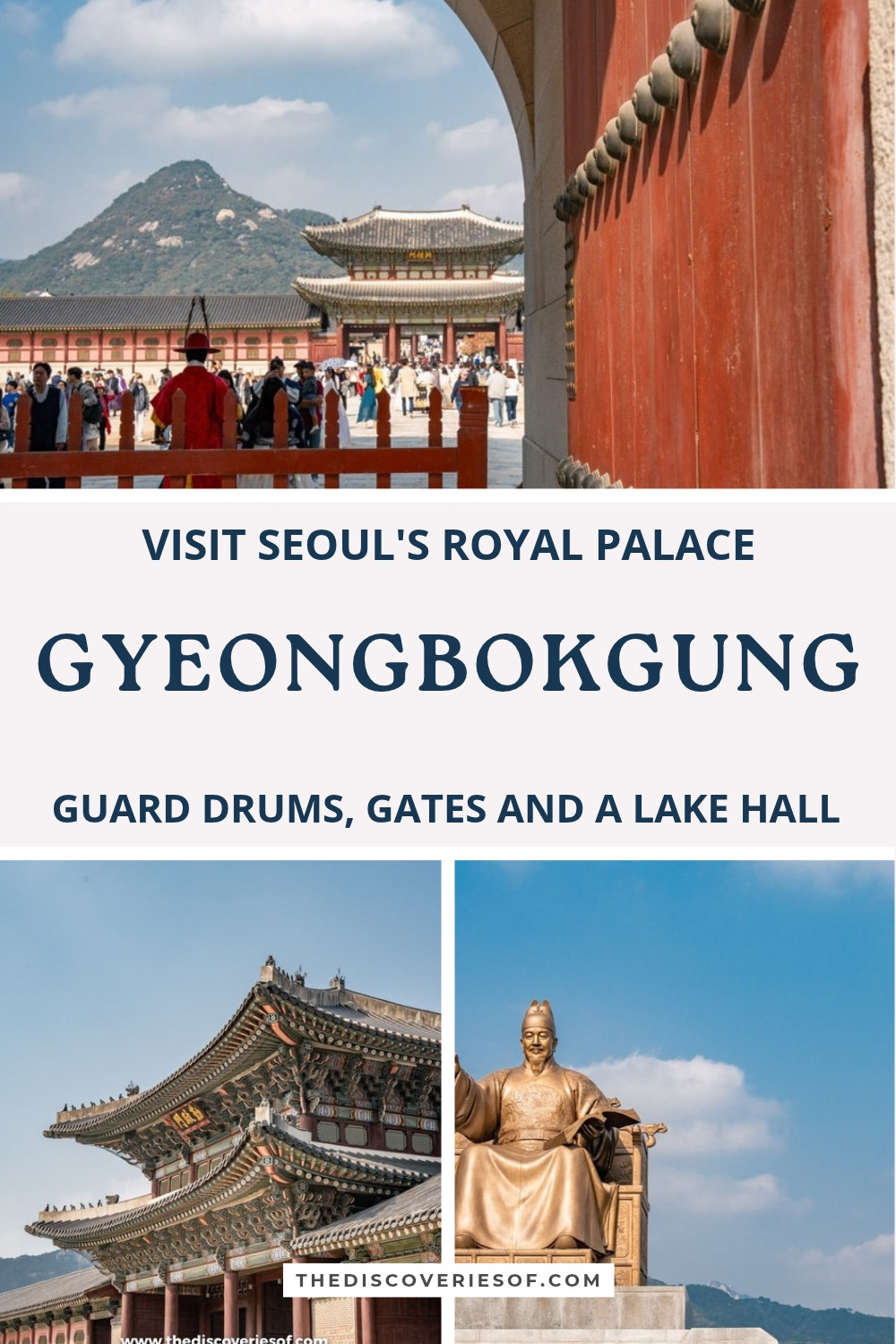
Two statues are worth stopping for. The seated figure, 6.2 metres tall and unveiled on Hangul Day in 2009, is King Sejong, who ruled from 1418 and introduced hangeul, the Korean alphabet, in the 1440s so that people without years of classical schooling could learn to read. Further south, Admiral Yi Sun-sin has stood guard since 1968, beside a fountain called 12.23, after the 12 warships he had left for his most famous victory and the 23 battles he fought against the Japanese invasions of the 1590s. Beneath the statues, a small free exhibition tells both their stories.
The square itself is newer than it looks. It opened in 2009 on what had been a 16-lane road and was rebuilt again between 2020 and 2022, when the traffic was pushed to one side and the space for people more than doubled. It’s where the city comes to celebrate, protest and, on summer evenings, cool its feet in the fountains.
Walk in through Gwanghwamun
Gwanghwamun, the palace’s main gate, is massive: a two-tiered wooden gatehouse on a stone base pierced by three arched passageways, the central one once reserved for the king. A pair of haetae, the mythical lion-like beasts believed to ward off fire and disaster, sit out in front.
The gate’s own story is a fair summary of the palace’s. Completed in 1395 and given its present name in 1426, it burned in 1592 and was rebuilt in the 1860s. In 1926, the colonial authorities pulled down its gatehouse to make way for their new headquarters, and the following year the gate was moved round to the east side of the palace. After its wooden structure burned in the Korean War, it was rebuilt in concrete in 1968, slightly off its original line. Only in 2010 did a wooden Gwanghwamun return to its true position, and in 2023 the raised stone terrace in front of it was restored and the signboard remade in gold characters on black.
When I walked through, a guard in a scarlet Joseon-era uniform was standing at the gate, framing Heungnyemun, the second gate, with Bugaksan rising behind it.
Watch the changing of the royal guard
The guard-changing ceremony is held in the courtyard between Gwanghwamun and Heungnyemun at 10am and 2pm. Around 70 guards in bright silk uniforms, carrying banners and weapons, march in to the beat of drums and the brass and wind of a traditional military band, and the whole ceremony takes about 20 minutes. Because it’s held outside the ticket barrier, you don’t need a ticket to watch.
There’s a shorter ceremony at Gwanghwamun itself at 11am and 1pm, when the gatekeepers take up their posts. Neither runs on Tuesdays, when the palace is closed, and they can be scaled back or cancelled in heavy rain or extreme weather.
Top Tip
The best spots along the rope fill up fast in high season, so aim to be in the courtyard ten minutes before the ceremony starts, then buy your ticket once it’s over and head straight in while the crowd is still outside.
Cross Yeongjegyo to the throne hall
Beyond Heungnyemun, a stone bridge, Yeongjegyo, carries you over a channel of water that marked the boundary of the inner palace. Look over the sides for the stone creatures crouched along its banks, one of them with its tongue sticking out.

The next gate, Geunjeongmun, opens onto the palace’s heart. Geunjeongjeon, the throne hall, rises from a two-tier stone platform under a double roof. It’s the largest main hall of any Joseon palace and a National Treasure, and five kings, among them Sejong in 1418, were crowned here. In the courtyard, two lines of stone markers show where each rank of official stood during state ceremonies.
Look closely and you’ll spot carved animals keeping watch on the balustrades around the platform, and if you peer into the hall itself, a pair of gilded dragons coils across the ceiling above the throne. Behind it, the smaller Sajeongjeon was where the king worked through the business of government each day.
See Gyeonghoeru, the banquet hall over the lake
West of the throne hall is one of the two sights I’d single out. Gyeonghoeru is a huge, open-sided banquet hall raised on rows of stone pillars on its own island in a square, man-made lake, with Inwangsan’s rocky ridge behind it. First built in 1412, it hosted the court’s state banquets and receptions for foreign envoys, and like almost everything here, it was destroyed in 1592 and rebuilt in 1867. It’s a National Treasure, and the soil dug out to make the lake was heaped up behind the royal quarters to form a small garden mound called Amisan.
You can see it perfectly well from the banks, but it’s also open for small guided visits that take you up to the upper floor and then on to Hyangwonjeong. These run from April to October (except during the summer heat, from June to August) on Wednesdays and Fridays at 10am and 2pm, for up to 25 people at a time. Places are booked on the Royal Palaces and Tombs website between nine and three days ahead, with a maximum of two per person, and the visits are in Korean.
Find the detail in Heungbokjeon and the royal quarters
North of the throne hall, the grounds turn domestic. Gangnyeongjeon was the king’s sleeping quarters and Gyotaejeon the queen’s, and both are topped with roofs that have no central ridge tile at all. Behind Gyotaejeon, Amisan is terraced into a little garden whose hexagonal brick chimneys, decorated with plants and animals that symbolise long life, are listed Treasures in their own right. To the east, Jagyeongjeon, built for the queen dowager, has a wall patterned with flowers and another beautifully decorated chimney.

The other sight I’d single out is Heungbokjeon. It was one of the newest additions when I visited, and I thought it was spectacular, with gorgeous detail carved into its wood and stone. King Gojong received foreign envoys here in the late 19th century, and Queen Dowager Sinjeong died here in 1890. The hall was dismantled during the colonial period and rebuilt in 2018, but its painted decoration, the bright patterns known as dancheong, had to wait: a year of painting from June 2025 has finally finished it.
Walk north to Hyangwonjeong and Geoncheonggung
Keep going north and the crowds thin. Hyangwonjeong is a small, hexagonal two-storey pavilion on an island in a lotus pond, reached by a wooden bridge, Chwihyanggyo, which was the longest wooden bridge built over a pond in the Joseon period when it went up in 1873. Bombing in the Korean War destroyed it, and it was rebuilt on the wrong side of the island in 1953; only in 2021 did a new wooden bridge return to its original spot.
Just behind the pond, Geoncheonggung was King Gojong’s private retreat, built in 1873. It was here, in 1887, that electric lights were switched on for the first time in Korea, and here, in 1895, that Japanese agents murdered Gojong’s wife, Queen Min, known after her death as Empress Myeongseong. It’s a quiet, unadorned corner, and all the more affecting for it.
On the way out, the National Palace Museum, in the south-western corner of the grounds, is free and well worth half an hour for the treasures and everyday life of the royal court.
Burned, rebuilt and torn down: the palace’s history in brief
Gyeongbokgung was the first royal palace of the Joseon dynasty, completed in 1395, three years after the dynasty was founded, and named “the palace greatly blessed by heaven” by the scholar and statesman Jeong Do-jeon.
In 1592, during the Japanese invasions, it burned, and for about 270 years it was left as a ruin while the court lived at Changdeokgung. Only in 1865 did rebuilding begin, driven by Heungseon Daewongun, regent for the young King Gojong. By 1888 the palace had around 500 buildings.
Then came the colonial period. From 1910 its halls were auctioned off and pulled down, and by 1945 only about 40 buildings remained. In 1926 the vast stone Government-General Building was completed in front of the throne hall, blocking the palace from the city. It wasn’t demolished until 1995 and 1996.
Restoration began in earnest in 1990. The first phase, finished in 2010, rebuilt 89 buildings and brought the palace back to about a quarter of its original size. A second phase, with another 90 buildings, is due to run until 2045, so what you see is very much still being rebuilt.
See the palace by night
For around a month each spring and autumn, Gyeongbokgung reopens after dark, with the gates, the throne hall and the halls around it lit up. In autumn 2026, it ran from 2 September to 2 October, from 7pm to 9.30pm (last entry 8.30pm), closed on Mondays and Tuesdays.
Tickets are released online through the NOL ticketing site about a week before each run starts, and they sell out quickly. If you miss out, 300 tickets a day are kept back for foreign visitors at the gate, up to two per person, so bring your passport. Entry in hanbok is free at night too.
When to visit Gyeongbokgung Palace
Autumn is my pick. The ginkgo trees turn gold from late October into early November, the maples along the paths go red, and the clear blue skies make the painted roofs glow. Spring is the other peak, when blossom fills the grounds in early April.

Whatever the season, come early. Getting through the gates at 9am gives you an hour of relatively quiet halls before the tour groups arrive and the 10am changing of the guard draws the crowds. Weekdays are calmer than weekends, and on Tuesdays it’s closed.
Tips for your visit
- Wear hanbok for free entry. Rental shops line the streets around the palace. Staff check that the outfit keeps a traditional form, so a jacket with a full skirt or trousers is fine, but heavily modernised costumes can be turned away. I tried hanbok in Jeonju and, honestly, once was enough for me.
- Check the price before you go. Admission is set to rise from January 2027 after 20 years at 3,000 won, and the rules on free entry are under review too.
- Bring water and comfortable shoes. The grounds are big, shade is patchy and there’s a lot of walking on gravel.
- Don’t skip the far end. Most visitors turn back after Gyeonghoeru; Hyangwonjeong and Geoncheonggung are only a few minutes further and far quieter.
Getting to Gyeongbokgung Palace
- Subway to Gyeongbokgung station: take line 3 and leave by exit 5, which brings you out on the west side of the palace grounds, a few minutes from Heungnyemun.
- Subway to Gwanghwamun station: take line 5 to exit 2 and walk north up Gwanghwamun Square to the main gate, about 10 minutes. It’s the more impressive way in.
My 3 days in Seoul itinerary starts with the square and the palace on day one, and my 10-day South Korea itinerary shows how Seoul fits into a longer trip.
Map
Read next
- Explore Changgyeonggung Palace in Seoul, from a royal birthday party in AR to a pond ringed with autumn maples
- 32 things to do in Seoul, from a virtual royal banquet to cocktails in an old teahouse
- How to spend 3 days in Seoul, from royal palaces to a loo with a view
- 22 things to do in South Korea, from a peek into North Korea to a vigorous spa scrub
Love this? Save and share on Pinterest

Discover the top things to do, insider tips and hidden gems in our South Korea Travel Guide.
Read the guides →