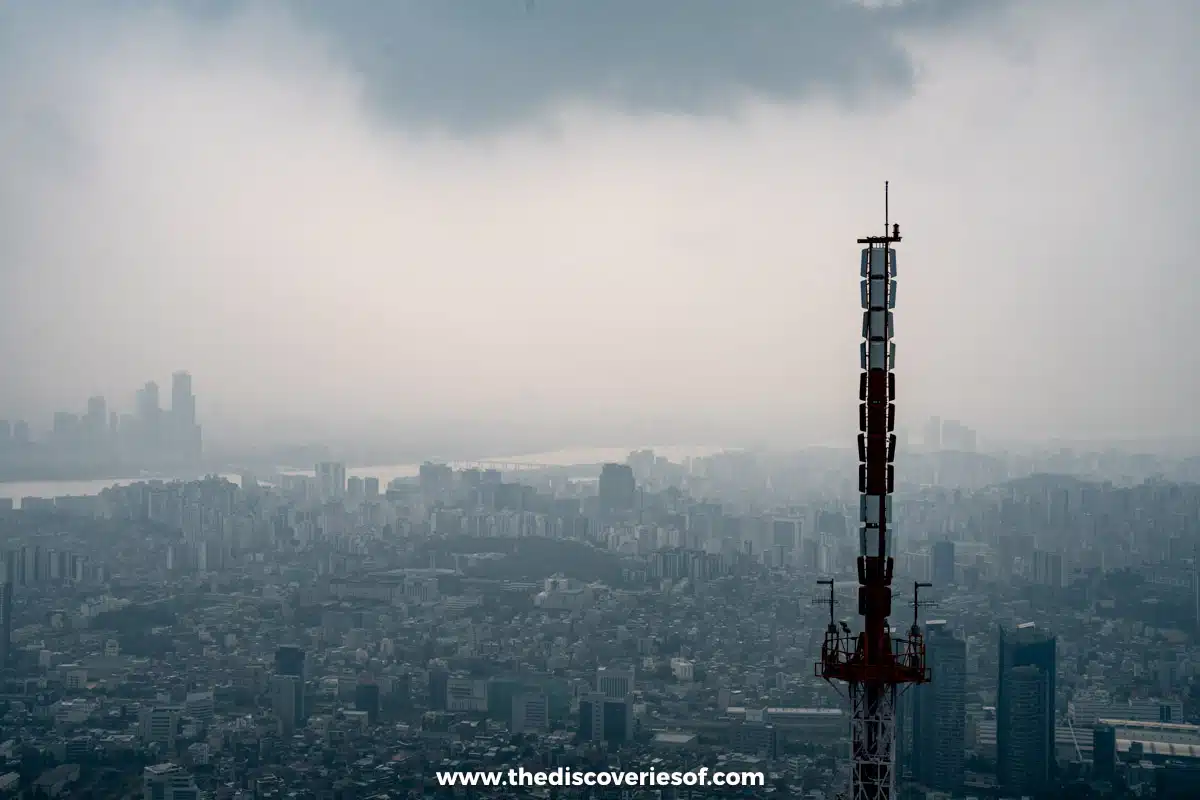

Seoul sprawls across a basin ringed by granite peaks, and the white needle on top of Namsan is the one spot where you can take in all of it at once. Getting up there is half the fun, the deck is the whole point, and the most memorable view in the building isn’t where you’d expect to find it.
I rode the Namsan cable car up to N Seoul Tower in October, when the maples on the mountain had turned orange and red. It was the easy, slightly cheaty way up, and it was packed. If you want to see anything on the ride, you have to be prepared to jostle for a spot by the glass. Win that small battle and the city opens out beneath you as the cabin climbs.
At the top, standing on the big terrace at the foot of the tower, I honestly wondered whether I needed to go any higher. I’m glad I did. The deck gives you the city in every direction, and there’s one more view tucked away inside that’s worth seeking out.
This guide covers the cable car and the other ways up, what’s at the base, whether the observation deck is worth the ticket, what else is (and isn’t) up there, and how to time your visit.
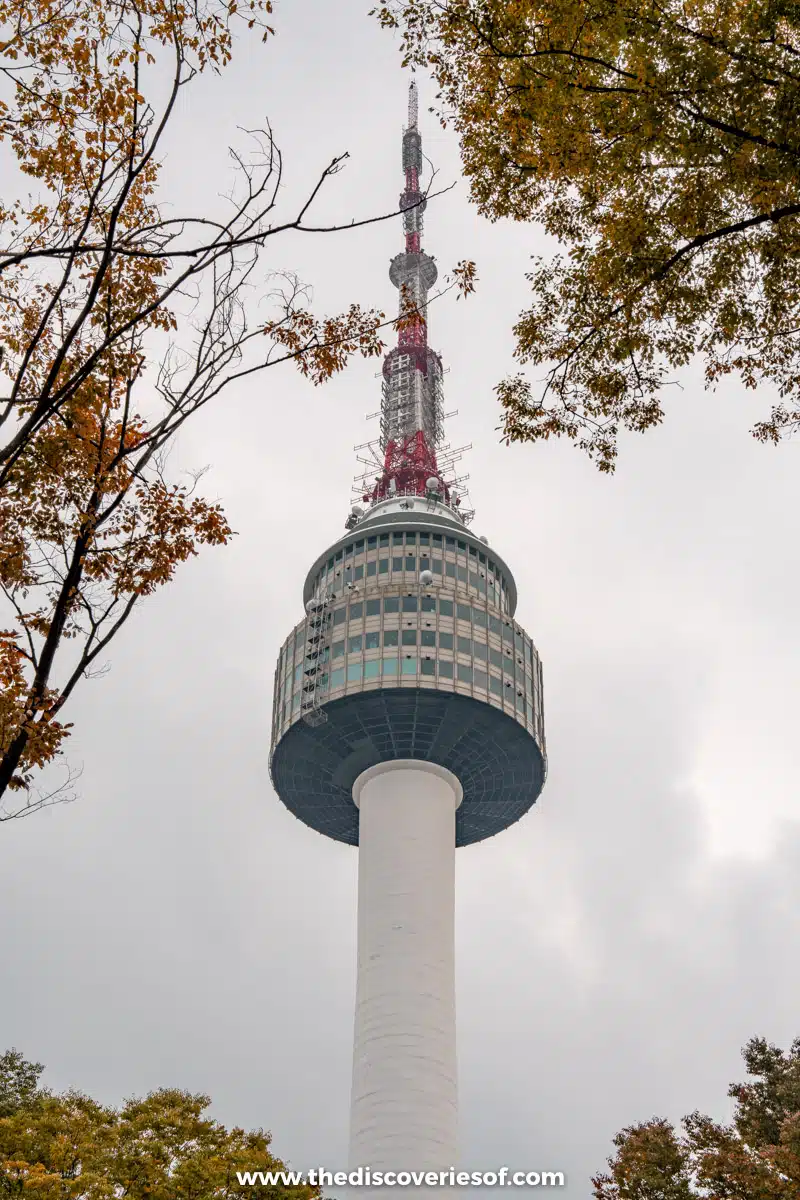
N Seoul Tower at a glance
- Where: 105 Namsangongwon-gil, Yongsan-gu, on the summit of Namsan in the middle of Seoul. Search for 남산서울타워 in Naver Map or KakaoMap.
- Observation deck hours: 10am to 10.30pm Monday to Friday, and 10am to 11pm on Saturdays and Sundays, every day of the year.
- Observation deck tickets: 29,000 won (about £16) for adults and 23,000 won (about £13) for children. The terraces and plaza at the base are free.
- Namsan cable car: adults pay 15,000 won (about £8.50) for a return and 12,000 won for a single; a child’s return is 11,500 won. It runs daily from 10am to 11pm.
- How long: allow two to three hours for the ride up, the terrace and the deck, more if there’s a queue for the cable car.
- Getting there: the cable car’s lower station is about a 10-minute uphill walk from Myeongdong Station (line 4). Buses 01A and 01B also loop up to the tower, and the forest paths take about half an hour on foot.
Ride the Namsan cable car up the mountain
The Namsan cable car has been carrying people up the mountain since 1962, long before there was a tower to visit at the top. The cabins cover roughly 600 metres from the lower station in Hoehyeon-dong to just below the summit, and the ride lasts only about three minutes, so it’s over almost as soon as it starts.
Those minutes are worth fighting for, though. Expect a cabin crammed shoulder to shoulder, and know that the window spots go to whoever is most determined. I made sure it was me, and I was rewarded with the rooftops of the city falling away below as the cabin rose through the trees, with the tower itself coming into view above. It’s not the most dignified way to start a sightseeing trip, but I’d still pick it over the walk.

A return ticket makes most sense, as it costs only 3,000 won more than a single and saves you the walk down. The last return tickets are sold at 10.30pm and the last one-way tickets at 10.45pm.
The cable car is run by a private company and carries only a few hundred people an hour, so at busy times (weekend evenings, holidays, the autumn foliage season) the wait to board can run to an hour or two. Seoul’s city government has been building a public gondola from near Myeongdong Station that would carry far more people, but the work has stalled during a legal dispute with the cable car’s operator and there’s no opening date yet.
Getting There
The lower station is at 83 Sopa-ro, Jung-gu. From Myeongdong Station, walk up through the lanes behind the station, or use the Namsan Oreumi, a free inclined lift near exit 4, to skip the steepest stretch of the climb.
The other ways up
- On foot: several paths climb through the woods from Myeongdong, Namsan Park and the National Theater side. It takes about 30 minutes at a steady pace, and the trails are especially pretty in autumn.
- By bus: the 01A and 01B Namsan circulation buses leave from the Namsan Yejang bus transfer stop near Myeongdong and take about 20 minutes to the summit. Tap on with a T-money card.
- By car: private cars can’t drive up to the tower. The nearest paid car parks are lower down the mountain, including the Namsan Park car park and the National Theater of Korea.
Take your time on the terrace at the base
Step off the cable car and climb the last stretch to the plaza and you reach a wide terrace wrapped around the foot of the tower. It’s free, and the view from here is genuinely good: the office towers of downtown packed below you, the Han River on one side and the mountains on the other. I enjoyed it enough that I stood there debating whether the ticket to the top was worth it.

This is also where you’ll find the love locks: thousands of padlocks, many with names and messages written on them, clipped to the railings around the terraces. The first appeared in 2006, and by 2018 they were estimated to weigh around 82 tonnes. If you want to add your own, a vending machine nearby sells them from 12,000 won. Look out too for Palgakjeong, the octagonal pavilion, and the reconstructed beacon towers of Namsan, which once relayed fire signals across the country to the capital.
Is the observation deck at N Seoul Tower worth it?
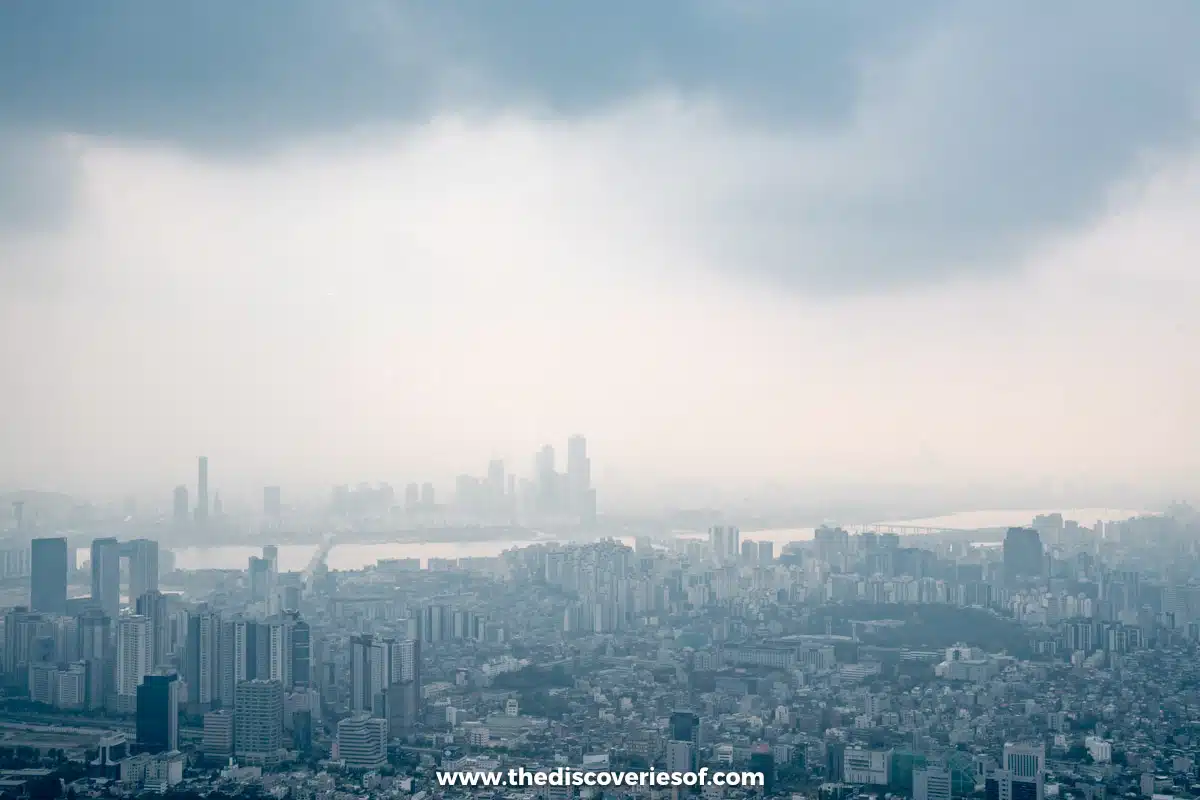
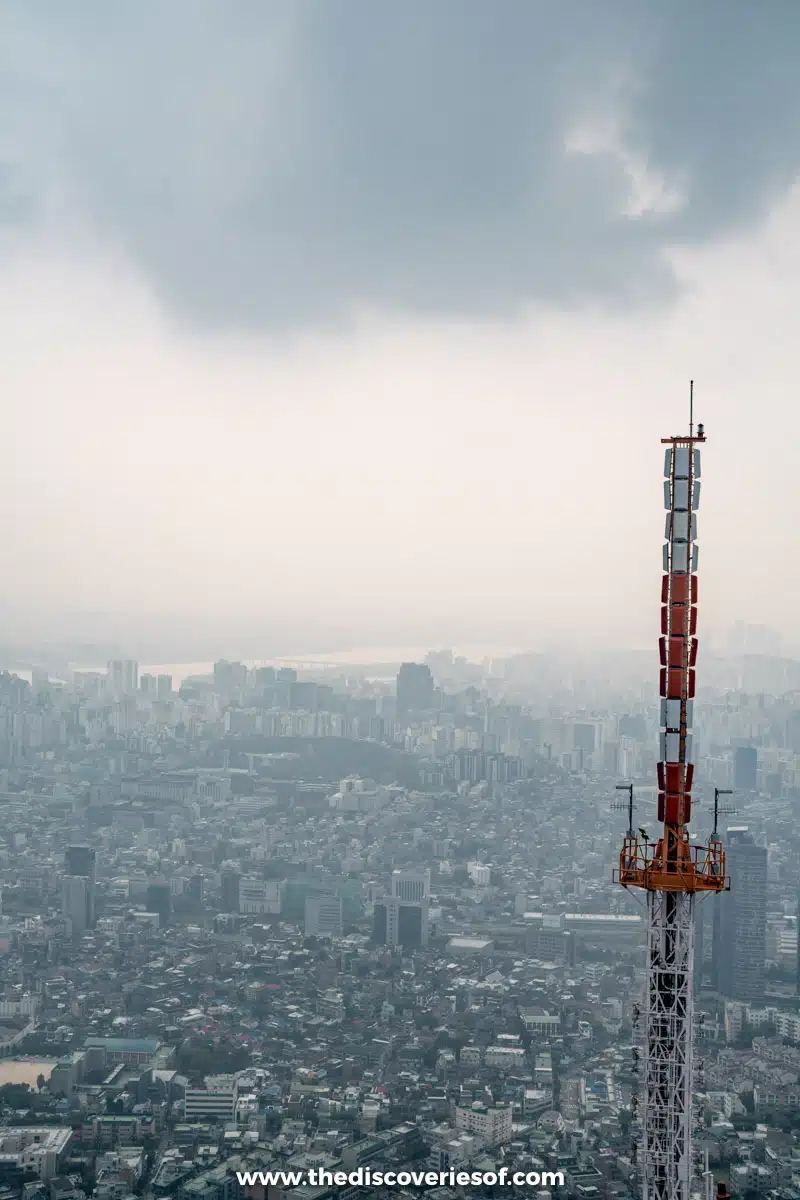
In short, yes. The tower stands 236 metres tall on a mountain that’s already well above the city, so its tip reaches close to 480 metres above sea level. The windows run right the way round, so you can circle the whole deck and pick out a different view at every turn: downtown and the old palace district to the north, the peaks beyond, the Han River curving away to the west and south, and apartment blocks running to the horizon.
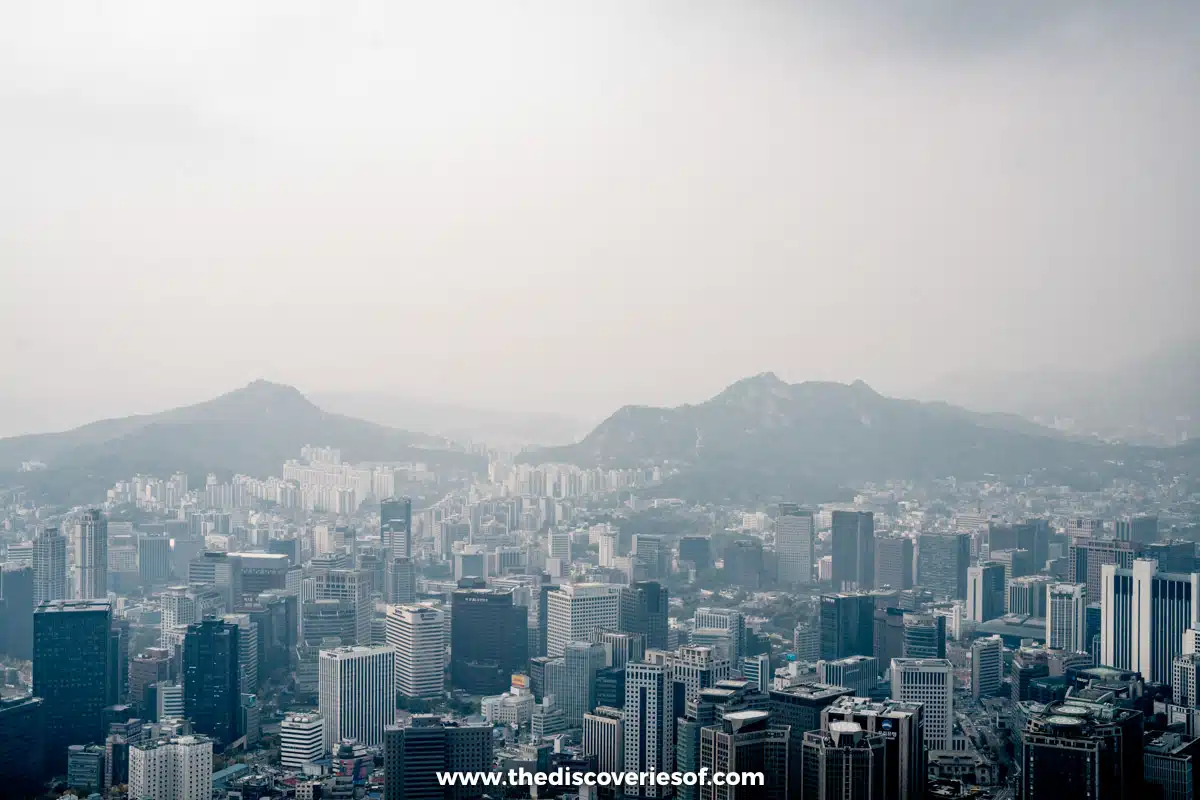
The views really are extraordinary, with the whole city sprawled out beneath you, and they were worth every won even through the haze on the day I went up.
Digital telescopes let you zoom in on individual buildings, and an exhibition space on the deck plays media art about the city. A few landmarks help you get your bearings: the palaces to the north, the river bridges to the south and the 555-metre Lotte World Tower far off to the southeast.
Tickets
Buy observation deck tickets at the tower or online via the tower’s official website, which also sells packages that bundle the deck with a meal. Children under 36 months go free, and there are discounts for disabled visitors and a companion.
Don’t skip the loo with a view
Before you head back down, make a point of visiting the toilets, even if you don’t need to. Each cubicle has a window running from floor to ceiling, so you sit looking straight out over the highways and skyscrapers, with the same panorama that people are paying to see on the deck. It is, admittedly, a very strange experience, but as loos with a view go, this one is hard to beat, and it makes a quirky end to the visit.
What else is at the top (and what isn’t)
Beyond the views, there’s surprisingly little up there. Apart from a rather odd shopping area and somewhere to eat, I didn’t find much else, so don’t plan on filling a whole afternoon at the top.
If you want to linger, book a table. n.Grill is a French restaurant on the seventh floor of the tower that slowly revolves as you eat, serving set lunch and dinner courses. There’s also Korean barbecue, Italian food and a burger counter, plus dessert cafes. Reserve ahead for n.Grill, particularly for a sunset slot.
The tower is also a sight in its own right from the streets below. After dark it’s lit until 11pm (10pm in winter), and the colour of the lights reflects the city’s fine dust levels: blue means the air is clean, green average, yellow bad and red very bad.
A short history of the tower
Work on the tower began in 1969 and it was finished in 1975, built as the first tower in South Korea to carry the signals of several television and radio broadcasters at once. It didn’t open to the public until October 1980. In 2005 the observation floors were renovated and relaunched under the name N Seoul Tower, which is still how most people know it, though you’ll also see it called Namsan Seoul Tower or simply Namsan Tower. It’s still a working broadcast tower today, and it draws millions of visitors a year.
When to go
- Time of day: late afternoon is the classic time, so you see the city by day, at sunset and as the lights come on. It’s also the busiest time for the cable car, so go earlier on a weekday if queues put you off.
- Season: autumn is lovely, with the maples on Namsan turning from mid-October into November, and spring brings cherry blossom along the mountain’s paths. Summer haze and the monsoon can cut the views right down.
- Weather: check the forecast and air quality before you pay for the deck. On a clear day you can see the mountains on every side of the city; on a heavy fine-dust day you may barely see past downtown.

If you’re fitting the tower into a wider trip, my 3 days in Seoul itinerary pairs it with Myeongdong and the sights of downtown, and my round-up of the best things to do in Seoul has plenty more to add.
Map
Read next
- How to spend 3 days in Seoul, from royal palaces to a loo with a view
- 32 things to do in Seoul, from a virtual royal banquet to cocktails in an old teahouse
- How to spend 10 days in South Korea, from Seoul’s palaces to live octopus in Busan
- 30 South Korea travel tips to know before you go, from cash to hidden cameras
Love this? Save and share on Pinterest

Discover the top things to do, insider tips and hidden gems in our South Korea Travel Guide.
Read the guides →