Warm afternoons, cool mornings and palace gardens on the turn: on paper, October is the month South Korea was made for. But how warm is it really, is the sea still swimmable, when do the leaves peak, and which festivals are worth building a trip around? Here’s what to expect, city by city, and how to plan for it.
My own fortnight in South Korea ran from the middle of October to the end of the month. I started in Seoul, took the KTX across to Gangneung on the east coast, then worked my way down through Andong to Busan, along to Mokpo and up to Jeonju, before heading back to the capital for a few more days on my own. In that fortnight I watched the country change colour, from the first hints of yellow in the ginkgo trees to whole hillsides of red and gold.
Apart from one damp, misty day near the border, I had dry weather and blue skies almost all the way round, and that’s a big reason why autumn is the season I’d recommend to anyone planning a first visit. This guide brings together what I saw with the climate averages, this year’s foliage forecast and the festival calendar, so you can decide where to be and when.

South Korea in October at a glance
- Weather: mild and mostly dry. Seoul averages a high of 20°C and a low of 11°C, with only about five wet days in the month. The south is a couple of degrees warmer, and the nights get noticeably colder as the month goes on.
- Autumn colour: the leaves start turning in the northern mountains in early October and reach the cities in the second half of the month. Late October into early November is the peak for most of the mainland.
- The sea: still warm off Busan, at around 24°C to 25°C at the start of the month and 21°C to 22°C by the end, but the official swimming season is long over.
- Daylight: in Seoul, about 11 hours 50 minutes on 1 October (sunrise around 6.25am, sunset around 6.15pm), falling to about 10 hours 40 minutes by the 31st, when the sun sets at about 5.35pm. Korea doesn’t change its clocks, so there’s no sudden jump.
- Public holidays: National Foundation Day on 3 October and Hangul Day on 9 October. In 2027 both fall at weekends, so Monday 4 October and Monday 11 October are substitute holidays, making two long weekends.
- Chuseok: the harvest holiday moves with the lunar calendar. It falls in September in 2026 and 2027 (14 to 16 September in 2027), but in 2028 it lands in early October.
- Best for: autumn colour, palaces, hiking, festivals, food and long days on your feet.
| Place | Average high | Average low | Rain | Wet days |
|---|---|---|---|---|
| Seoul | 20°C | 11°C | 52mm | 5 |
| Gangneung | 20°C | 12°C | 114mm | 8 |
| Jeonju | 22°C | 10°C | 57mm | 7 |
| Busan | 23°C | 15°C | 80mm | 5 |
| Jeju | 22°C | 16°C | 95mm | 7 |
Averages from the Korea Meteorological Administration’s 1991 to 2020 climate normals, rounded.
Is October a good time to visit South Korea?
For most people, yes. The heat and humidity of summer have gone, the monsoon is a distant memory and the cold of winter is still a few weeks off. Clear skies are the norm, which means long views from the mountains and the towers and photos that pop. It’s the most comfortable month of the year for walking, whether that’s a city day of palaces and markets or a proper hike.
There are a few catches. October is peak season for Koreans too, so the famous foliage spots get very busy at weekends, and so do the trains on the holiday weekends. Hotels in Seoul aren’t cheap: I booked my last few nights at the Four Points Josun in Myeongdong fairly late and paid around $250 a night, so book early if you have a particular place in mind. Pack for a wide range of temperatures as well. Early October can still feel like summer in the south, while by the last week of the month the mornings in Seoul can dip into single figures.
The typhoon season is largely over by October, but it isn’t impossible for a late storm to reach the south coast in the first week of the month, as happened in 2018 and 2019. If you’re travelling then, keep an eye on the forecast.
Where to see the autumn colour
Korea’s autumn colour moves from north to south and from the mountains down into the valleys. The first leaves turn on the high peaks of Gangwon in mid to late September, the mountains of the north-east are at their best around the third week of October, and the colour reaches Seoul’s palaces, Busan and the far south from the end of the month into November.
The Korea Forest Service publishes a forecast every September. In 2026 it predicted peaks of 20 October in Seoraksan, 28 October in Songnisan, 4 November in Naejangsan and 6 November on Hallasan on Jeju, with the country as a whole at its best in late October. Expect the dates to shift by a few days from year to year, depending on how warm the late summer has been.
In the cities, two trees steal the show. Maples go a deep red and orange, and the ginkgo trees that line the streets and fill the palace courtyards turn a startling, buttery yellow, usually from the last week of October. One warning about the ginkgo: the fruit that falls from the female trees smells very strongly, so watch where you step.
What October is like, city by city
Seoul: palace gardens and silver grass

The capital is at its most beautiful in the second half of October. In Seoul, I rode the cable car up Namsan when the maples around N Seoul Tower had already gone orange and red, and the views from the top stretched across the city in a soft autumn haze. Down in the palaces, it was the ginkgo’s turn: at Gyeongbokgung, the ginkgo trees by the walls were turning yellow in late October, and the gardens of Changgyeonggung, my favourite of the palaces, were a patchwork of gold and rust around Chundangji pond.
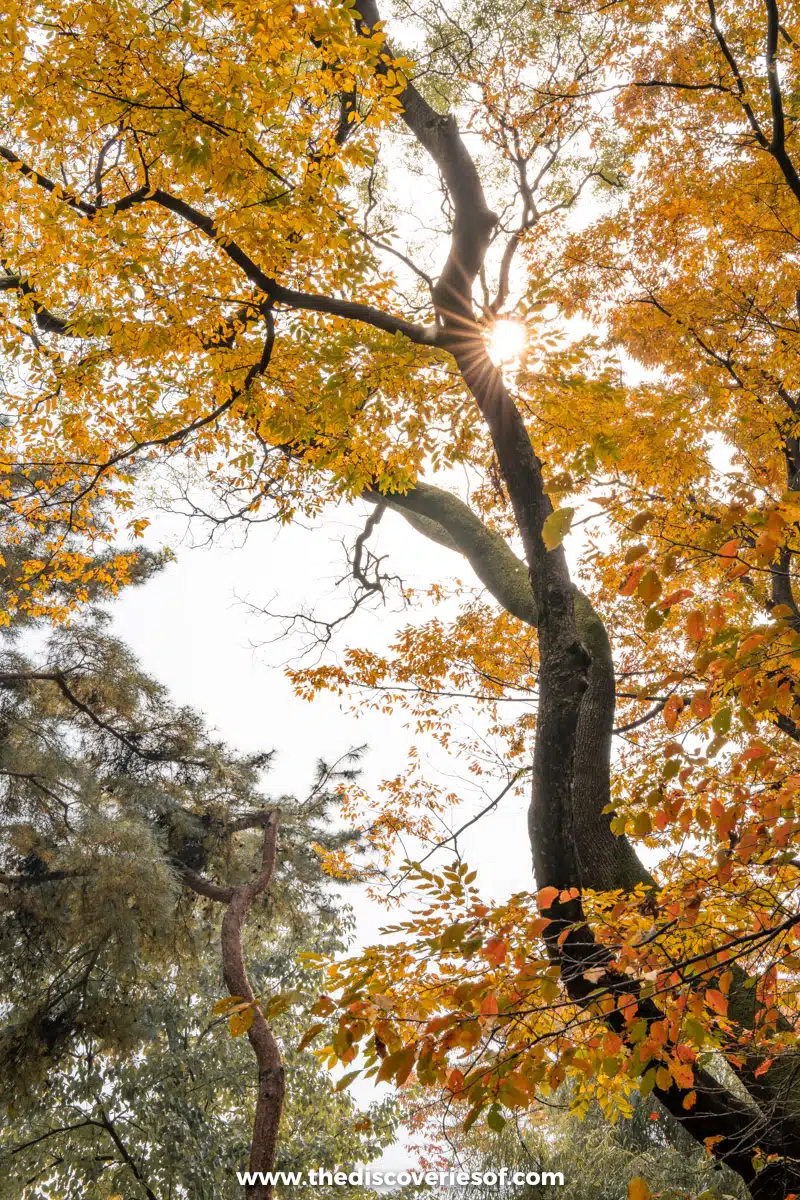
October is also chrysanthemum season. When I walked into Jogyesa, the main temple of Korean Zen Buddhism in the middle of the city, its courtyard was crammed with pots of yellow and red blooms, and stone Buddhas smiled out from among them.

The other autumn spectacle is silver grass, or eoksae. Its feathery plumes catch the low afternoon light across the city’s parks, and the biggest display is at Haneul Park, a former landfill site beside the World Cup Stadium that now hosts the Seoul Silver Grass Festival during the third week of October (17 to 23 October in 2026), with evening light shows.

Not every day is perfect. My trip out to Aegibong Peace Ecopark, on the border north-west of the city, fell on a damp, misty day when North Korea was barely visible across the estuary. The clearest views of the year tend to come just after rain, so a wet day is worth waiting out if a view is the point of the trip.

Evenings get chilly as the month goes on, so bring a warm layer if you plan to be out late. Night openings at the palaces are worth looking out for: Gyeongbokgung’s autumn evening sessions ran from 2 September to 2 October in 2026, so they suit an early October trip better than a late one.
Gangneung and the east coast: the last of the beach days

The KTX makes it easy to swap the city for the sea: Gangneung is about two hours from Seoul. I was there in the middle of the month, when Anmok Beach was bright and sunny with people out on the sand, and I’d definitely recommend the semi-powered railbike that runs beside the sea at Jeongdongjin. It averages 20°C in October, but it’s the wettest place in this guide, with nearly 114mm of rain in a typical October.
Gangneung’s reputation as Korea’s coffee capital comes into its own in autumn, when the Gangneung Coffee Festival takes over the cafés along Coffee Street by Anmok Beach for five days (21 to 25 October in 2026). Inland, the mountains of Odaesan and Seoraksan are among the first places in the country to turn red, which makes the east coast a good choice for the first half of the month.
Andong: golden rice fields and Confucian academies

Andong might be the most rewarding place in the country to be in October. When I visited in the middle of the month, the rice in the valleys around Hahoe Folk Village had turned gold, and from the top of Buyongdae cliff the fields looked like a patchwork quilt. At Dosanseowon, the Confucian academy by the lake, the maples were just starting to turn red around the old tiled roofs.

Andong’s big event, the Andong International Maskdance Festival, runs from late September into the first days of October (it finished on 4 October in 2026), with performances in the city and at Hahoe. Go during the festival for atmosphere, or just after it for quieter villages and better rates. Evenings here are cooler than on the coast, so pack a jumper for the light and water show at the Woryeonggyo bridge.
Busan: beach weather on the way out

Busan is the warmest of the big cities in October, with average highs of 23°C, and the sea holds on to the summer’s heat for longer than the air. When I was there, the water was still mild enough for stand-up paddleboarding off Gwangalli (it got a bit bumpy, but that was part of the fun), and I took a night cruise on a yacht past the lit-up towers of Haeundae and Marine City.
Swimming is a different matter. In 2026, Busan’s official beach season ran from late June to 31 August, with only Haeundae keeping its lifeguards on duty until 15 September. By October, the parasols have been packed away, the beaches are quieter and the sand is better suited to long walks than sunbathing. For sightseeing, though, it’s ideal: I had clear blue skies over Gamcheon Culture Village, and the climb up its steps is far more pleasant in October than in the humid heat of summer.

October is festival season in Busan too. The Busan International Film Festival, the biggest in Asia, fills the cinemas of Haeundae and Centum City for ten days early in the month (6 to 15 October in 2026), so reserve a hotel well ahead if you’ll be in town then. The Busan Fireworks Festival over Gwangalli is now held in November (on 7 November in 2026).
Mokpo and Jeonju: harbour parades and ginkgo courtyards
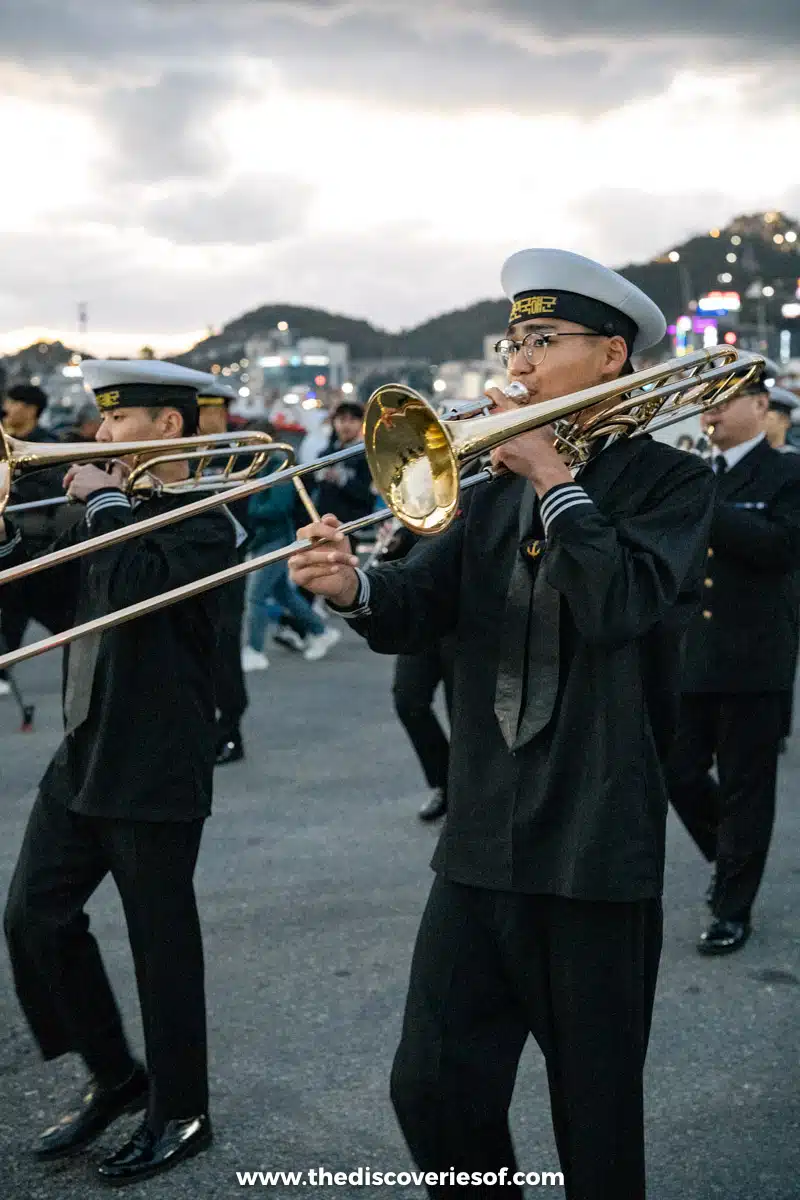
The south-west sees fewer visitors, and October is a lovely time to put that right. My stop in Mokpo happened to coincide with the Mokpo Port Festival, which fills the harbour with seafood stalls, boat rides and an evening parade for three days each October (16 to 18 October in 2026). A short drive north of Mokpo, Hampyeong holds a huge chrysanthemum exhibition at its Expo Park through the month (1 October to 1 November in 2026).

Jeonju was my last stop before Seoul, in the second half of the month. The weather was warm and dry, the ginkgo trees around the Confucian school at Jeonju Hyanggyo had just started to turn gold, and the town was in a festive mood. With an average low of 10°C, it has the coldest October nights of the cities in this guide, so it’s worth taking a warm layer for an evening in the hanok village. The Jeonju Bibimbap Festival is held early in the month (2 to 4 October in 2026, at Deokjin Park).

Jeju: milder, windier and silver with grass
The island stays mild into October, with average highs of 22°C and lows of 16°C, but it’s wetter and windier than the mainland, so pack for changeable weather. Its autumn calling card is silver grass: the volcanic cones, or oreum, turn silvery with plumes in October, and the leaves on Hallasan peak in early November.
Festivals and events in October
Most festival dates for next October won’t be confirmed until the summer, so use these 2026 dates as a guide and check with the organisers before you book.
- Late September to early October, Andong: the Andong International Maskdance Festival (25 September to 4 October in 2026).
- Early October, Jeonju: the Jeonju Bibimbap Festival (2 to 4 October in 2026).
- 3 October: National Foundation Day, a public holiday.
- Early to mid October, Jinju: the Jinju Namgang Yudeung Festival, when thousands of lanterns float on the Nam River (3 to 18 October in 2026).
- Early to mid October, Busan: the Busan International Film Festival (6 to 15 October in 2026).
- 9 October: Hangul Day, the public holiday that celebrates the Korean alphabet.
- Mid October, Mokpo: the Mokpo Port Festival (16 to 18 October in 2026).
- Second half of October, Seoul: the Seoul Silver Grass Festival at Haneul Park (17 to 23 October in 2026).
- Late October, Gangneung: the Gangneung Coffee Festival (21 to 25 October in 2026).
- All month, Hampyeong: chrysanthemum displays at Hampyeong Expo Park (1 October to 1 November in 2026).
- 31 October and 1 November, Busan: the Gamcheon Culture Village alley festival (in 2026).
One date that has moved: the Seoul International Fireworks Festival on the Han River, for years an October fixture, was held in early September in 2026.
Getting around by KTX in October
The KTX high-speed train is the best way to cover a lot of ground in a short autumn trip. I rode it out to Gangneung early in my trip and back to Seoul from Jeonju at the end, and found it quick, good value and comfortable, with lovely scenery out of the window.
- Book early. Since 1 October 2026, KTX and other Korail tickets go on sale two months before departure rather than one. Seats on the holiday weekends around 3 and 9 October and on Friday evenings and Sunday afternoons sell out fast, so book as soon as your plans are fixed.
- Know the journey times. Seoul to Busan is roughly a two-and-a-half-hour ride (standard seats start at about 59,800 won), Seoul to Gangneung about two hours, and Seoul to Jeonju from about an hour and three quarters. For Andong, the KTX-Eum from Cheongnyangni takes about two hours.
- Consider first class. It costs more than standard but the seats are wider and roomier, a real bonus on a long journey.
- Pick a side. In autumn, a window seat earns its keep: the views of the hills and the rice fields along the way are part of the experience.
For a route that strings these cities together by rail, see my 10-day South Korea itinerary.
Before you go
- Pack layers. T-shirts for the afternoons, a jumper and a light jacket for the evenings, and comfortable shoes for the hills and palace grounds. By the end of the month, a warmer coat is worth having for Seoul and Jeonju after dark.
- Check the entry rules. The temporary exemption that lets UK, US and other visitors skip the K-ETA runs until 31 December 2026. Unless it’s extended, you’ll need an approved K-ETA for an October trip next year, so check before you book. My South Korea travel tips cover the K-ETA, the e-Arrival Card and the apps to download.
- Plan around the holidays. Chuseok is the one to avoid. It falls in September in 2027 but moves into early October in 2028, when trains, roads and sights are packed and some restaurants close.
- Go early or on a weekday. The palaces, Bukchon and the foliage spots near Seoul are busiest on weekend afternoons in late October. Arrive at opening time for the best light and the fewest people.
- Eat with the season. Autumn brings new-season rice, chestnuts, persimmons and roasted sweet potatoes from street carts. For the dishes worth seeking out all year, see what to eat in South Korea.
Still weighing October against other months? South Korea is one of my best places to go in October, and the travel tips above cover spring and the rest of the year.
Map
Read next
- How to spend 10 days in South Korea, from Seoul’s palaces to live octopus in Busan
- 30 South Korea travel tips to know before you go, from cash to hidden cameras
- 22 things to do in South Korea, from a peek into North Korea to a vigorous spa scrub
- Changgyeonggung, the Seoul palace I’d choose over all the others
- Andong travel guide: Hahoe Folk Village, Confucian academies and the town’s famous braised chicken
- The best places to go in October: 22 holiday destinations for sun and adventure
Love this? Save and share on Pinterest

Discover the top things to do, insider tips and hidden gems in our South Korea Travel Guide.
Read the guides →