

The Jerónimos Monastery (Mosteiro dos Jerónimos) is the building that made Belém famous: a riverside masterpiece of carved limestone, built with the riches of the spice trade, that holds the tomb of Vasco da Gama. It’s one of Lisbon’s must-see sights, and it rewards a little planning.
There’s not much I remember about my first trip to Lisbon, years ago. I’d been interrailing around Spain and Portugal on the tightest budget ever (think cartons of wine for €1 and a lot of meals consisting of bread and cheese).
I’d wandered around a lot, visited jazz clubs and that was about it… until I visited Belém and the Jerónimos Monastery.

At 17 I was a dutiful diarist, so I can tell you exactly what I thought of the Jerónimos Monastery the first time…
“I’ve never seen anywhere so amazing, so peaceful… The Jerónimos Monastery was awesome!”
Clearly, there were not enough exclamation marks to help me describe my feelings. Why have words when you can use punctuation? They do the same thing, right?!
Even so, when I stepped into the monastery again on a January weekend in Lisbon, my feelings were exactly the same. I’ll save myself the embarrassment of trying to describe it.
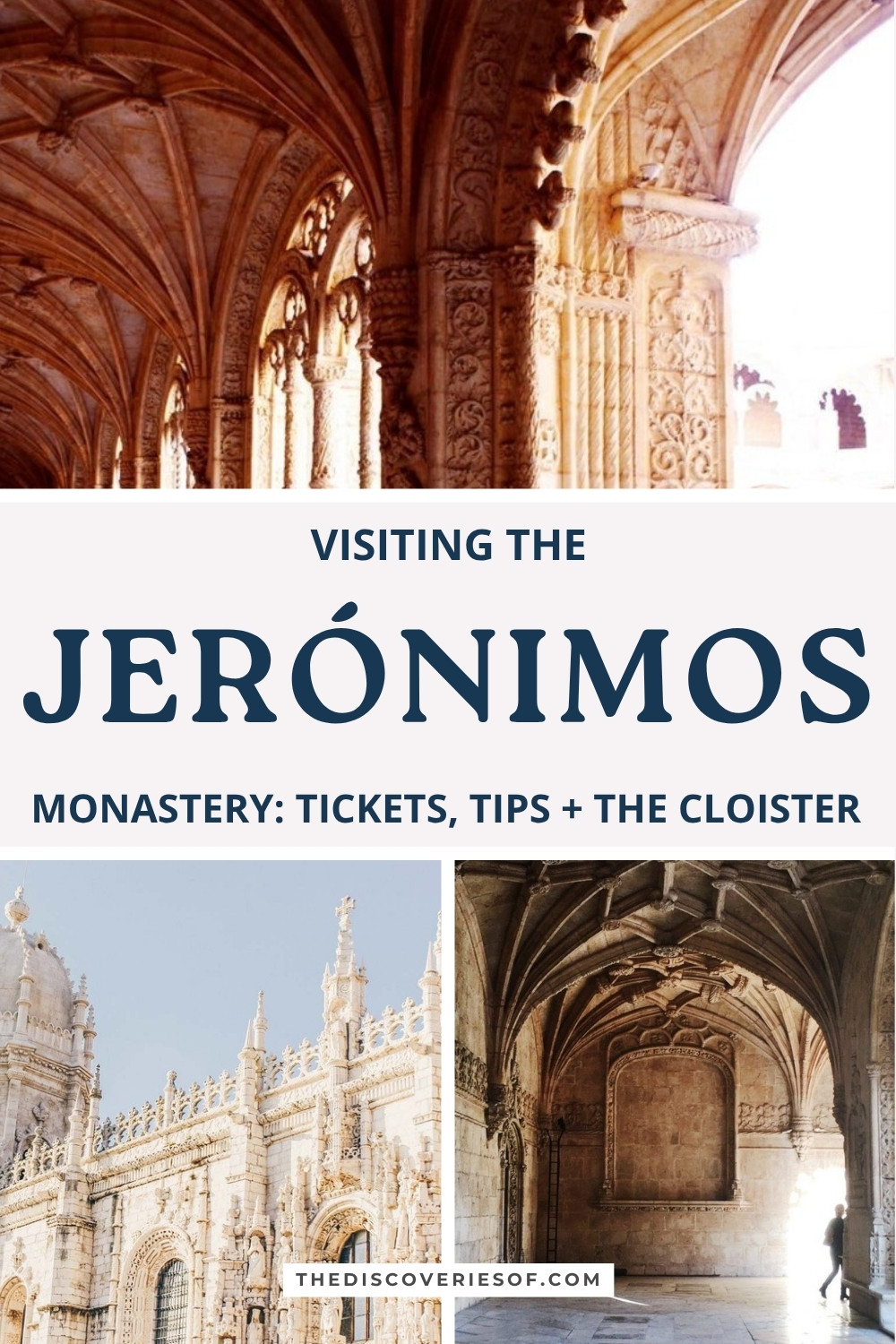
Here is a picture instead.

Why visit the monastery?
You’re probably beginning to see why the monastery is famous for being one of the most beautiful buildings in the city. Together with the Belém Tower, it has been a UNESCO World Heritage Site since 1983.

Lisbon is known for many things, but Belém stands out as one of the areas that played a pivotal role in history. This is where the caravels of the Age of Discovery set sail, and where Vasco da Gama is said to have spent the night before his 1497 voyage to India praying in the small chapel that stood on this spot.
A day trip to Belém with a visit to the monastery, the Belém Tower and the Monument to the Discoveries is a must for any visitor to the city. All three are within a 15-minute walk of each other.
However, the monastery is not just a pretty façade.
The monastery has played an important role in the city’s history throughout the years and now stands as one of Lisbon’s main attractions.

The monastery church, Santa Maria de Belém, houses the tombs of several important figures in Portuguese history, including King Manuel I, who built it, and the famous seafarer Vasco da Gama, who lies opposite a memorial tomb to the poet Luís de Camões. The historian and writer Alexandre Herculano is buried in the chapter house, and the poet Fernando Pessoa has rested in the cloister since 1985.

The church itself is free to enter (it has its own entrance), and the tall, palm-like columns of its nave are worth a look even if you’re short on time. The paid ticket is for the cloister and the monastery rooms around it, including the old refectory, lined with 18th-century tiles.
If you’re lucky, you may be able to time your visit to coincide with one of the temporary exhibitions that are sometimes held in the monastery’s upper rooms.
Top Tip
The church keeps shorter hours than the cloister, and it’s closed to sightseers during services: it’s usually open from 10.30am on weekdays and only in the afternoon on Sundays.
Manueline architecture, Portugal’s own Gothic

The building showcases the ornate features of Manueline architecture, a style that is unique to Portugal. Manueline architecture features an eye-catching combination of late Gothic, Moorish and Renaissance styles, and decorates almost everything with the sea: twisted ropes, coral, shells, armillary spheres and exotic plants brought back by the explorers.
The façade of the building extends over an impressive 300 metres and is constructed from a pale local limestone (lioz), quarried in Ajuda, Rio Seco, Alcântara, Laveiras and Tercena.

Taken as a whole, the effect is pretty dramatic. But it’s only when you start to look at the smaller details that you see the elaborate handiwork present in each part of the construction.
The South Portal is the visual crux of the monastery’s exterior, despite it only being a side entrance to the church. It was built between 1516 and 1518 by João de Castilho and features Our Lady of Belém with the Child, surrounded by statues of apostles, prophets and saints, with Henry the Navigator standing on the pillar between the two doors.
Above the doors, two carved panels show scenes from the life of Saint Jerome, the translator of the Vulgate and the patron of the Hieronymite monks who lived here.
After marvelling at the outside, you should walk through into the cloisters (which were also designed by Castilho). The cloister is spread out over two floors, and almost every surface is decorated with the carvings and stonework that make the monastery so special. Don’t skip the upper level, which looks down into the courtyard.
Up on the hill behind the monastery, the little Chapel of St Jerome (Ermida de São Jerónimo), also known as the Restelo Hermitage, is a world away from the crowds. It’s a simple rectangular building with conical pinnacles at the corners and a carved stone rope along the roofline. Look out for the gargoyles at roof level, which have a view of the Tagus and the Belém Tower.
History of the monastery

Construction of the monastery began in 1501, commissioned by King Manuel I to give thanks for Vasco da Gama’s return from India, and it took roughly a century to complete.
King Manuel was determined that the monastery would be a grandiose building and hired several esteemed architects to achieve that vision.
These architects included Diogo de Boitaca, master of the Igreja de Jesus in Setúbal, João de Castilho of Spain, Diogo de Torralva and Jerónimo de Ruão (1530 to 1601). Together, they created the “jewel in the crown” Manuel required and an outstanding piece of Manueline architecture.
The original designs were late Gothic. By the time the monastery was complete, its design had evolved to include touches of the Plateresque and the Renaissance.
Much of the vast amount of money required for the monastery’s construction came from the so-called “pepper money”, a tax on the profits of the spice trade with Africa and the East.
Manuel chose the Order of St Jerome, also known as the Hieronymites, to occupy the monastery. The monks said daily mass for the souls of Prince Henry the Navigator and King Manuel I. They also heard the confessions of, and gave spiritual help to, the sailors who set out from Belém.
In 1755 a devastating earthquake struck Lisbon, causing wholesale destruction of much of the city. Though the monastery suffered some damage, fortunately it wasn’t severe. It has also been subject to a number of projects to restore it to its former glory.

The monks occupied the monastery until 1833, when the religious orders in Portugal were dissolved and the monastery was vacated. The wings built later along the façade now house the National Archaeology Museum and the Navy Museum.
Today, the Jerónimos Monastery stands as a monument to the Age of Discovery and as a mausoleum for King Manuel I and his successors.
Planning your visit to the Jerónimos Monastery
Tickets and time slots
A ticket for the cloister costs €18 for adults. Visitors aged 13 to 24 and over 65 pay half price (€9), and children aged 12 and under go free. The church is free.
Entry runs on timed slots, and in the busy months they can sell out days ahead, so book a date and time on the official Museus e Monumentos de Portugal online ticket office before you go. The queue at the door can be long in summer, and a booked slot is the way round it.
The free first Sunday of the month has gone: free days are now for residents of Portugal only.
If you’re seeing a lot of sights, the Lisboa Card includes free entry to the cloister (you still book a slot online with your card number), as well as public transport. The official ticket office doesn’t sell a combined ticket with the Belém Tower, which is €15 on its own and has its own timed slots.
Take a tour
It’s one thing to walk around the monastery reading a leaflet and another with an incredibly knowledgeable tour guide.
This small-group tour of Belém and the monastery includes your cloister ticket and covers the church and Vasco da Gama’s tomb, along with the Monument to the Discoveries and Pastéis de Belém (make sure you’re hungry).
Don’t miss Pastéis de Belém
The famous custard tarts are said to have started life in this monastery, and the bakery that has made them to the same secret recipe since 1837 is a few minutes’ walk away on Rua de Belém. The takeaway queue often snakes down the street, but my tip is to head inside and grab a seat in the tearooms instead, as there’s often no wait for a table.
Address
Praça do Império, 1400-206 Lisbon, Portugal
Getting there
- Tram: 15E from Cais do Sodré towards Algés; get off at the Mosteiro Jerónimos stop, right outside. Tram 28 doesn’t go to Belém.
- Bus: several routes stop outside, including the 714, 727, 728 and 729.
- Train: the Cascais line from Cais do Sodré to Belém station, then a ten-minute walk.
Opening times
Tuesday to Sunday, 9.30am to 5.30pm (last entry 5pm).
Closed: Mondays and 1 January, Easter Sunday, 1 May, 13 June and 25 December.
Map
Read next
- The best things to do in Lisbon
- Visiting the Monument to the Discoveries in Belém
- Planning your trip to the Belém Tower
- LX Factory, Lisbon’s coolest spot
- Unmissable places to visit in Portugal
- One week in Portugal: the perfect Portugal itinerary
- Portugal travel tips
Love this? Save and share on Pinterest
Discover the top things to do, insider tips and hidden gems in our Portugal Travel Guides.
Read the guides →




