
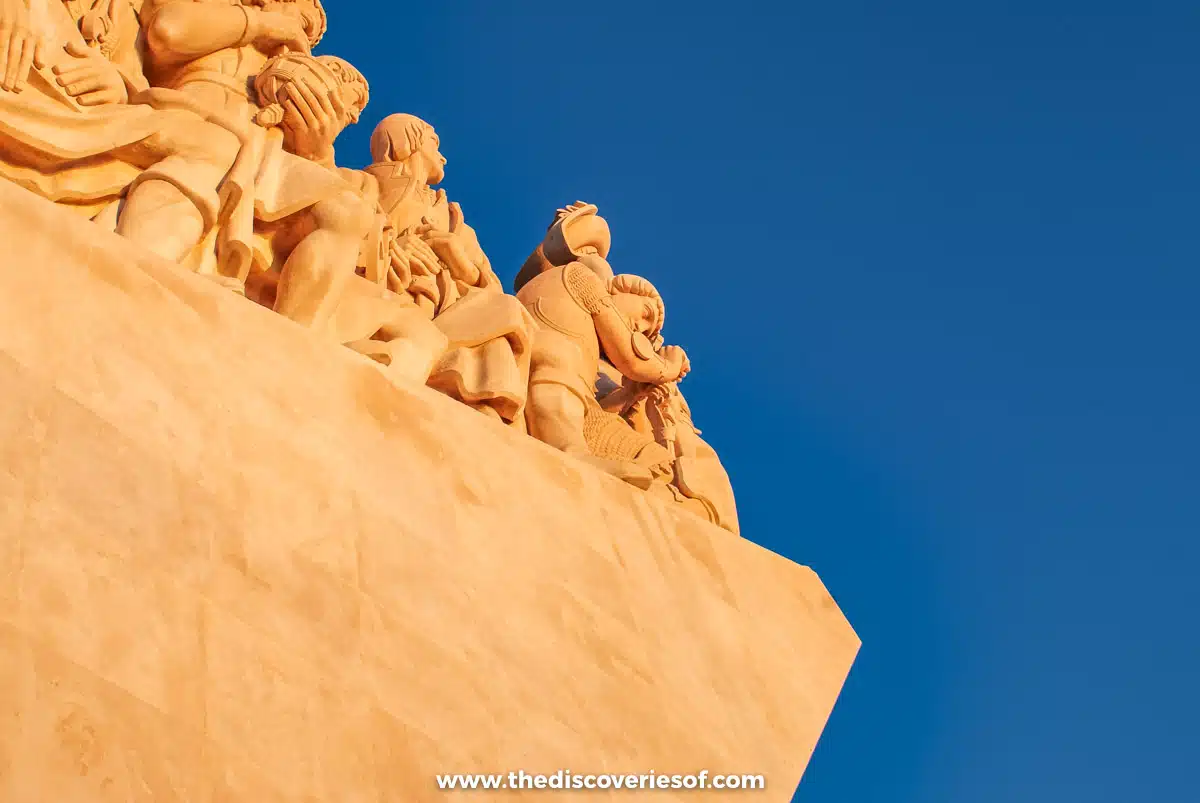

The Monument to the Discoveries (Padrão dos Descobrimentos) sails out over the Tagus in Belém, with Henry the Navigator at the prow and a crowd of kings, explorers and poets lined up behind him. Here’s who to look out for, how to get up to the viewpoint and how to fit it in with the rest of Belém.
The Monument to the Discoveries (or Padrão dos Descobrimentos in Portuguese) is set on the banks of the Tagus river, a short walk away from the Jerónimos Monastery and the Belém Tower in Lisbon.
The explorers’ monument is one of my favourite places in the city and a must on any Lisbon itinerary. Belém itself feels miles away from the busy city centre, never more so than when you stand and stare out from the viewpoint at the top.
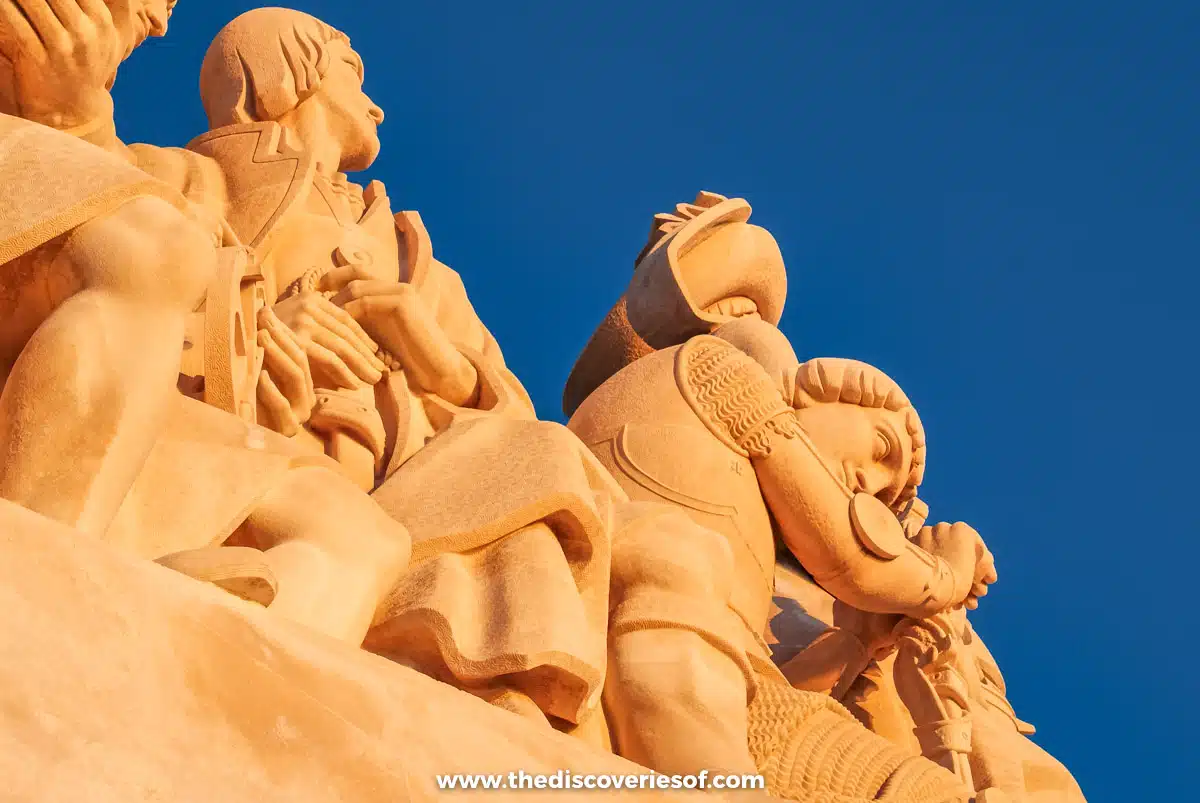
A trip to the Padrão dos Descobrimentos is worth it for the views alone. Head up to the terrace at the top of the monument for a view out over almost all of Belém and the Tagus flowing out to the sea, with the 25 de Abril Bridge upstream and the Cristo Rei statue on the far bank.
A lift takes you up to the sixth floor, and a narrow staircase of 42 steps climbs the rest of the way to the terrace.
Top Tip
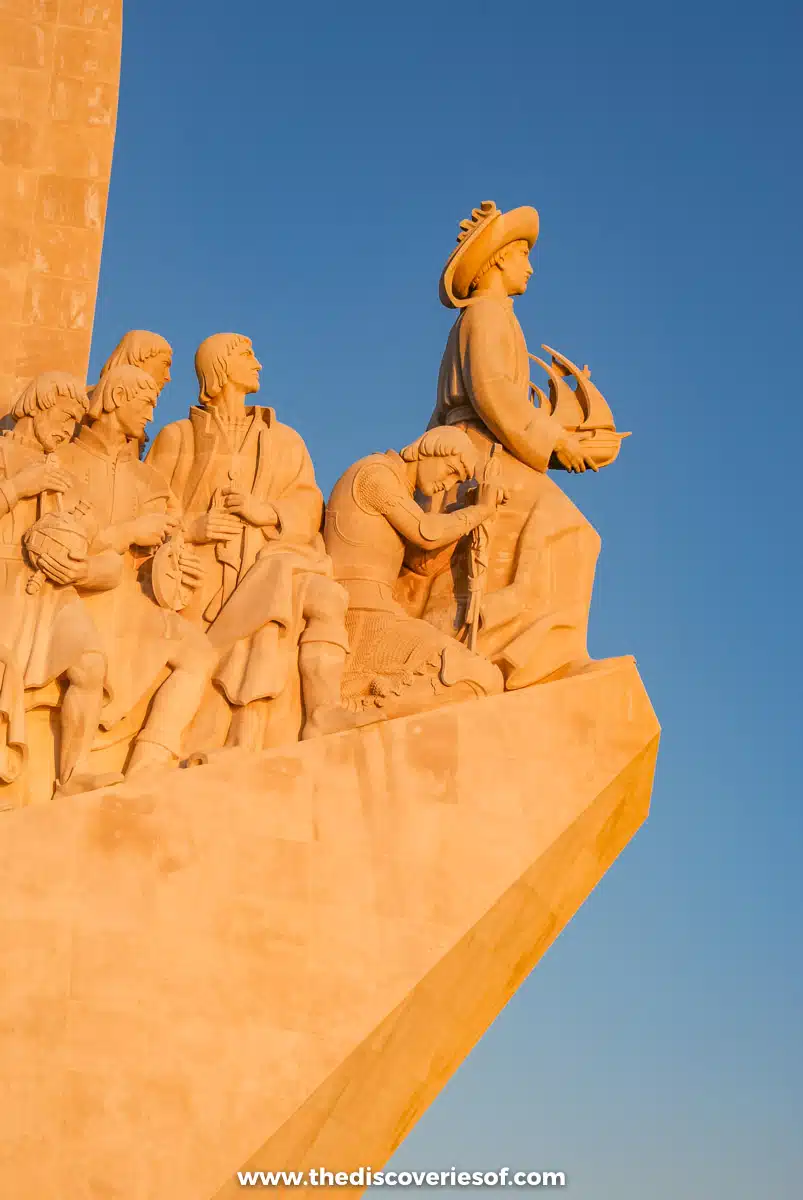
Time your trip for sunset. Watching the stonework of the monument, the monastery and the tower take on a golden hue during the last light of the day is undoubtedly one of the city’s best photo opportunities. Every photo of the monument on this page was taken in the half hour before the sun went down on a January afternoon.
Why the monument was built twice
This iconic structure has an interesting history too. The Portuguese architect José Ângelo Cottinelli Telmo originally designed the Padrão dos Descobrimentos along with the sculptor Leopoldo de Almeida.
The first version was a temporary showpiece for the Portuguese World Exhibition (Exposição do Mundo Português), which opened in Belém in June 1940. The exhibition marked 800 years since the founding of Portugal and 300 years since it regained its independence from Spain, and it was a celebration of empire staged by Salazar’s Estado Novo regime, at a time when Portugal was keeping itself neutral in a Europe at war.
That original was built from iron, cement and plaster rather than stone, and it was demolished by 1943. A permanent version was commissioned 18 years after the exhibition, in 1958.
The permanent version replicated Cottinelli Telmo’s design in concrete, rose-tinted stone from Leiria and limestone from Sintra, enlarged to stand 56 metres tall. It was inaugurated in August 1960 to mark the 500th anniversary of the death of Henry the Navigator.
Henry was the prince largely credited with instigating Portugal’s Age of Discoveries. Portugal’s maritime trade and exploration during that period played an instrumental role in the development of the country over the next few centuries and beyond.
In the past, many of Portugal’s ships departed via the Tagus, and Belém was their last port of call in their home country for months or years at a time.
Even the famous explorer Vasco da Gama set off on his voyage to India from here in 1497. Belém was clearly the obvious choice for the location of the Padrão dos Descobrimentos.
It has never been without its critics: it was built to glorify an empire, and that colonial past is debated far more openly in Portugal today than it was in 1960. Since 1985 it has been a cultural centre, with an exhibition space, an auditorium and the viewpoint inside.
Spotting the who’s who of Portugal’s past
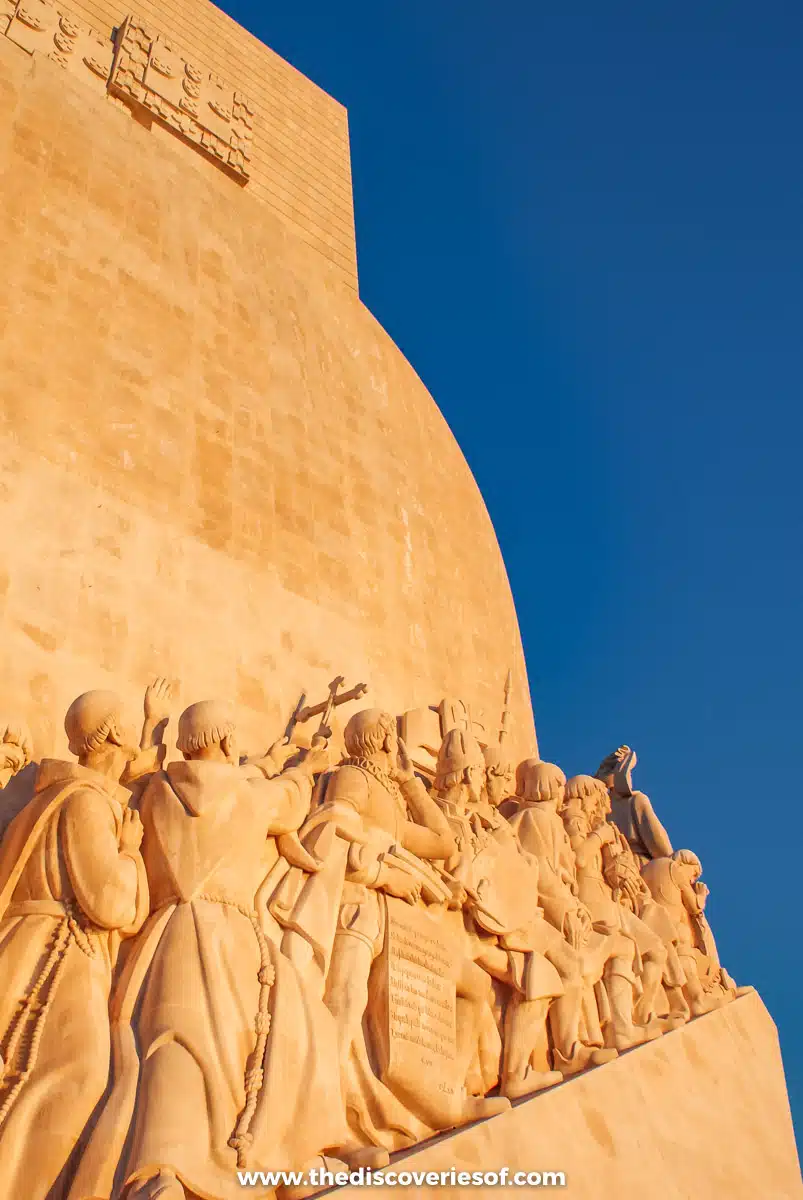
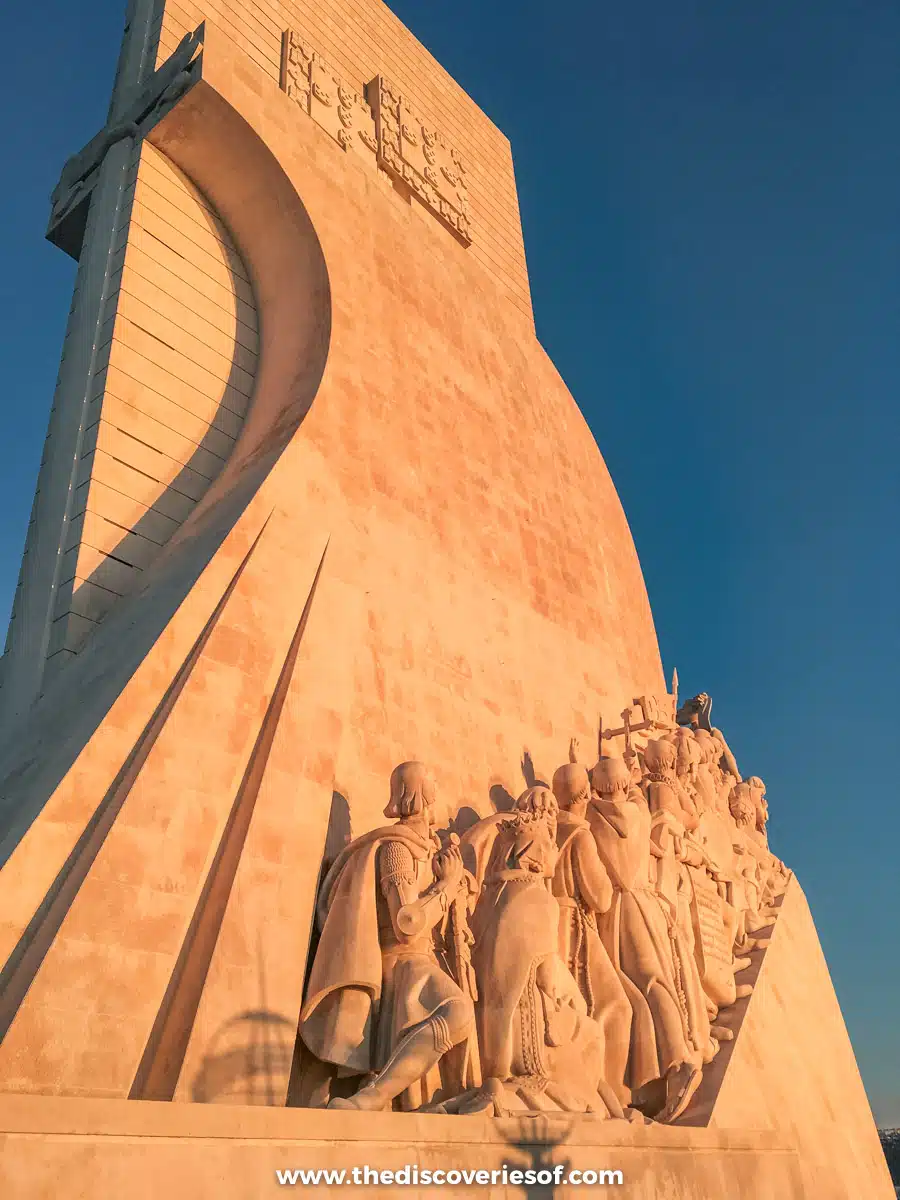
The monument’s structure represents a ship with its sails aloft, ready to depart down the Tagus and out into the Atlantic.
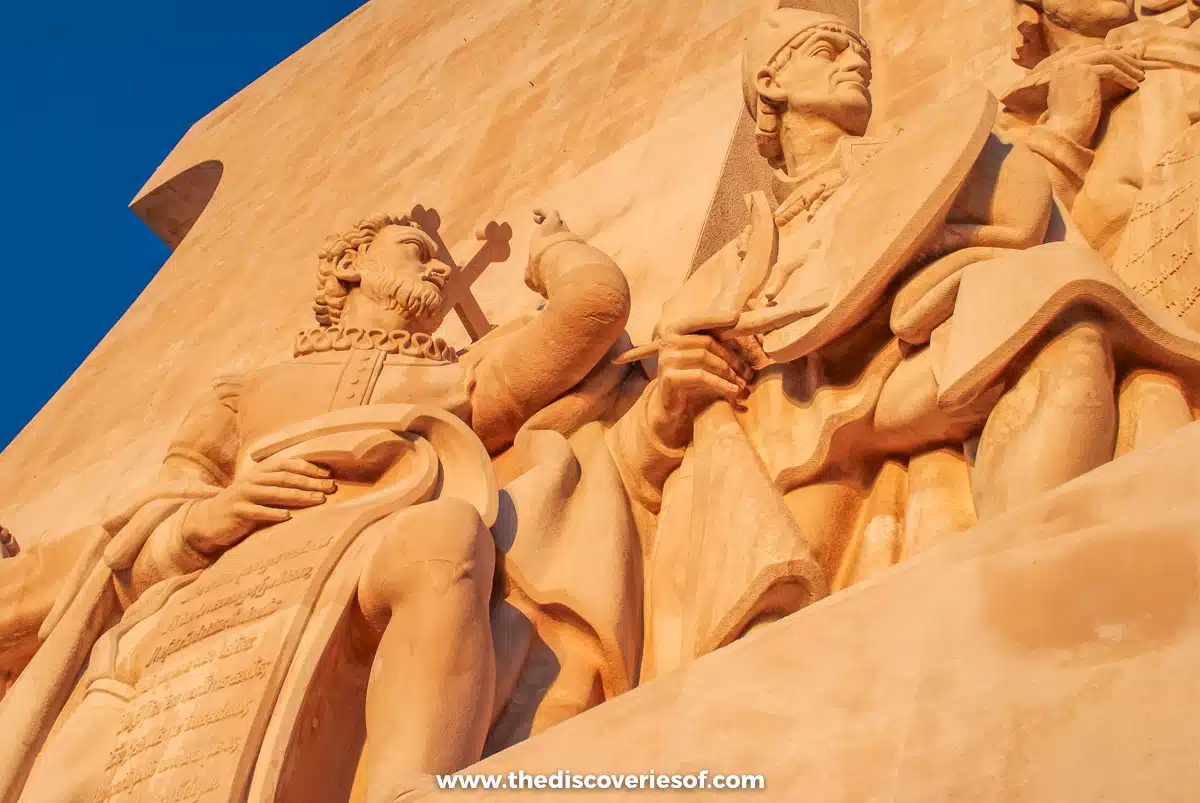
Its sides are decorated with carved sculptures of many of the most important figures in Portugal’s maritime history: monarchs, navigators, cartographers, missionaries, chroniclers and artists.
Keep your eyes open and you can spot the who’s who of the Portuguese past. At the very front is Henry the Navigator, nine metres tall and holding a model ship, leading the other figures out to sea.
Figures featured include the poet Camões (he’s the one holding verses from his epic, The Lusiads), King Manuel I (the one carrying an armillary sphere), Vasco da Gama and Magellan. There are 33 of them in total, counting Henry, with 16 on each side, which would make for a very long list.
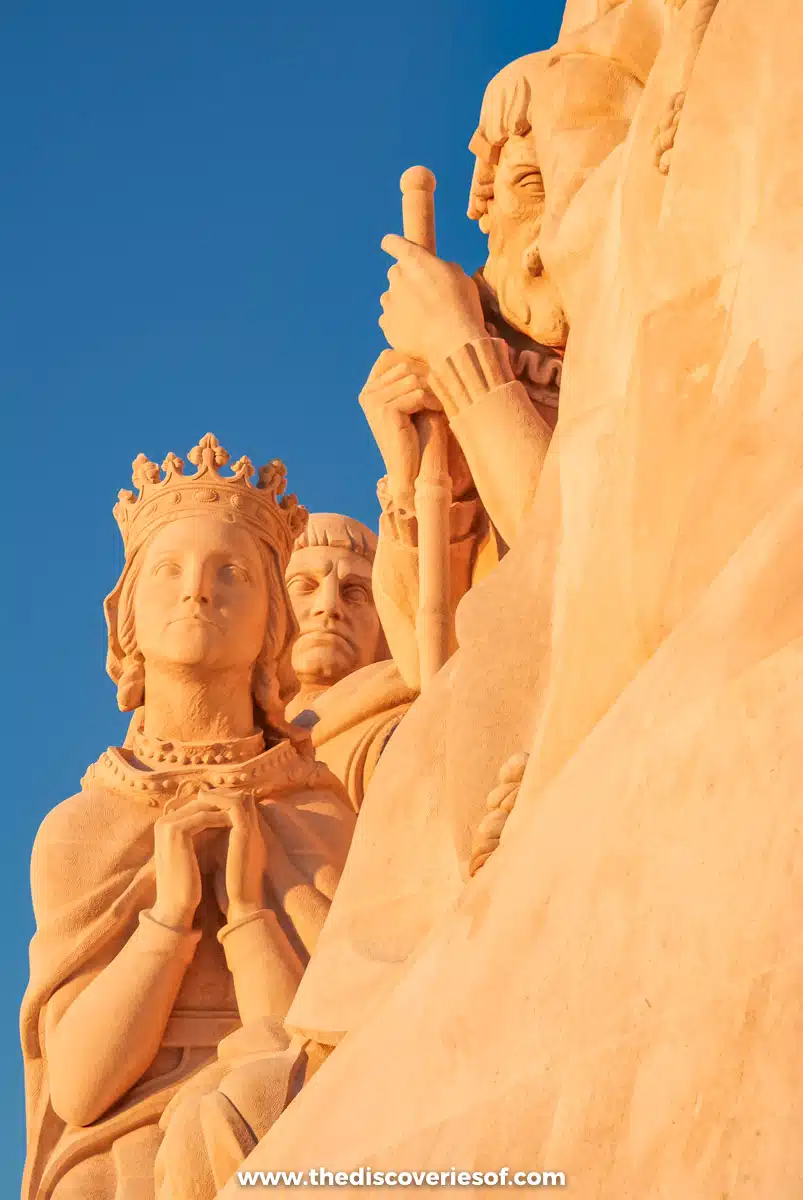
My personal favourite is Queen Philippa of Lancaster (Filipa de Lencastre in Portuguese), her hands clasped in what I like to think of as a combination of hope and thoughtfulness. She was Henry the Navigator’s mother but also an early-day influencer.
No one could work the court quite like good old Philippa, which perhaps explains why she was so involved in international affairs. A daughter of John of Gaunt, she married King João I in Porto in 1387, sealing the alliance between England and Portugal, and she is the only woman on the whole monument. Go bad-ass Queen Philippa.
Look down at the compass rose
Before you head inside, take a look at the square in front of the monument. The giant compass rose set into the paving is 50 metres across and was a gift from South Africa, inaugurated in August 1960.
At its centre is a 14-metre map of the world in coloured limestone, with ships and dates marking the main routes of Portuguese exploration in the 15th and 16th centuries. It’s best appreciated from the viewpoint above.
What’s inside
Inside the monument, take the opportunity to walk through the exhibitions on the different levels. There’s a temporary exhibition space on the lower floor and an auditorium, and at weekends and on public holidays a short film is screened as part of the full ticket.
Top Tip
There’s an ever-changing rota of exhibitions and events held inside the monument. It’s always worth checking what’s on in advance on the official website.
Planning your visit to the Padrão dos Descobrimentos
Address: Av. Brasília, 1400-038 Lisboa, Portugal
Getting there
- Tram: the 15E from Praça da Figueira or Cais do Sodré towards Algés. Get off at the Mosteiro Jerónimos stop, cross the Praça do Império garden and take the underpass beneath the road and railway to the riverfront, about ten minutes in all.
- Train: the Cascais line from Cais do Sodré to Belém station takes under ten minutes. Cross the footbridge by the station and the monument is a few minutes’ walk along the river.
- Bus: the 728, 714, 727, 729 and 751 all stop in Belém.
Opening hours
The monument is open every day:
- March to September: 10am to 7pm (last entry 6.30pm).
- October to February: 10am to 6pm (last entry 5.30pm).
It’s closed on 1 January, 1 May and 24, 25 and 31 December.
Tickets
A full ticket, which covers the viewpoint, the exhibition and the film, costs €10. Visitors aged 13 to 25 pay €5 and over-65s pay €8.50, and children under 12 go free.
If you only want to see the exhibition, there’s a cheaper exhibition-only ticket for €5, but the viewpoint is the reason most people come.
Entry is free with the Lisboa Card, which also covers public transport and the cloister at the Jerónimos Monastery. You can buy tickets at the ticket office on the day or online through BOL, the monument’s official ticket seller.
Make a day of it in Belém
The monument sits between Belém’s two other big sights, and all three are within about 15 minutes’ walk of each other. The Jerónimos Monastery is just across the road and gardens (€18 for the cloister, with timed slots), and the Belém Tower is along the river to the west (€15, in half-hour slots with a cap of about 900 visitors a day, closed Mondays).
Unlike the other two, the monument doesn’t need a slot booked in advance, so it’s the easy one to fit around your other times. Save it for last if you can, and you’ll be on the terrace for the late light.
Map
Read next
- The coolest things to do in Lisbon
- Visiting the Jerónimos Monastery
- Belém Tower is open again: what you need to know
- Getting lost in Alfama
- Cervejaria Ramiro: what to order and how to get in
- Is the Four Seasons Hotel Ritz Lisbon worth the splurge?
- Unmissable places to visit in Portugal
Love this? Save and share on Pinterest
Discover the top things to do, insider tips and hidden gems in our Portugal Travel Guides.
Read the guides →






One Comment
Comments are closed.