


South Korea’s second city packs beaches, hillside villages, seafood markets and a temple on the rocks into one long stretch of coast, and it’s far too spread out to see on a whim. This itinerary splits it into three days that each stay on one side of the city, from the painted lanes of Gamcheon to the skyscrapers of Haeundae, with a morning at one of the most moving places in the country. Come hungry: there’s blowfish two ways, live octopus and the best steak of the trip.
Many people think of Busan as Korea’s second city and little more, a beach stop to tack on after Seoul. It deserves much more of your time than that. The port on the south-east tip of the peninsula grew from a fishing town into a refuge for a million people during the Korean War, and you can still read that story in its steep hillside neighbourhoods, its markets and the cemetery where the soldiers who defended it lie. Then there’s the coast: golden beaches, cliff walks, a suspension bridge lit up every night and a skyline that rivals anything in Asia.


I visited Busan in October as part of a two-week trip around South Korea, and it was straight up one of the highlights. In fact, it may just have pipped Seoul to the prize for my favourite destination in the country. Whether I was looking out over the sea from the Songdo Cloud Trail in the morning or back at the glittering lights of the city from a yacht at night, it was beautiful everywhere I went.
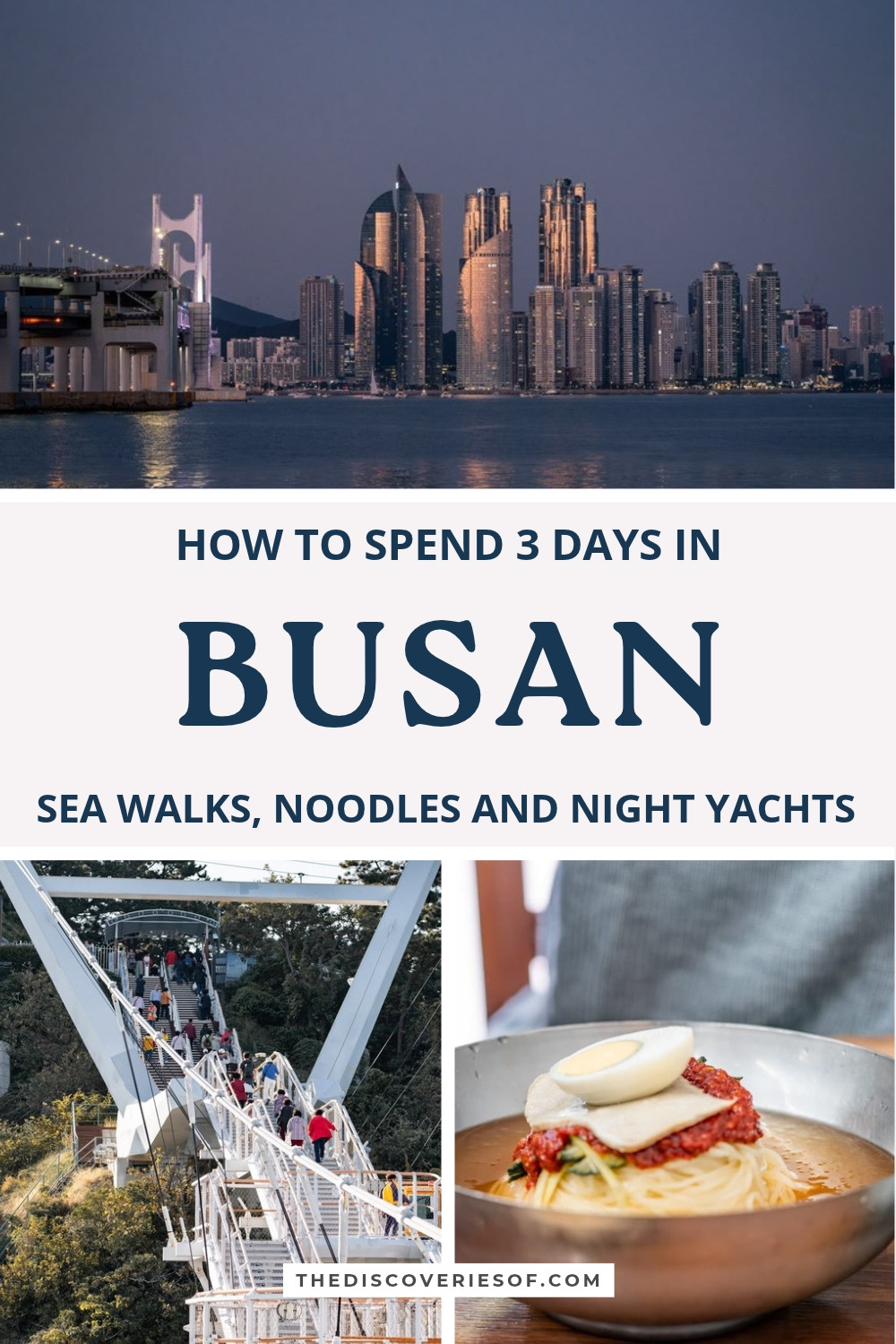
This plan for 3 days in Busan is built around the places I loved and the timings that make them work. Day one covers the west of the city: Gamcheon, a cable car over Songdo Bay and sunset on Yeongdo island. Day two is the one I’d never skip: a morning at the UN Memorial Cemetery, then sashimi, paddleboarding and the bay by night. Day three heads east, to a temple on the rocks, a capsule ride along the coast and the 100th floor of the city’s tallest tower.
You’ll find tips on getting around, what to pack and when to go at the end, plus three ideas if you can stretch your trip.
Your 3 days in Busan at a glance
- Day 1: Nampo, Gamcheon, Songdo and Yeongdo. Street food around Gukje Market, Gamcheon Culture Village, the Songdo Cloud Trail, the Busan Air Cruise, Huinnyeoul Culture Village and cold noodles at Choryang Milmyeon.
- Day 2: the UN Memorial Cemetery and Gwangalli. The UN Memorial Cemetery, a sashimi lunch at Bangpajae Hoetjip, paddleboarding at Gwangalli Beach and an evening yacht cruise on the bay.
- Day 3: Haeundae and the east coast. Blowfish at Geumsubokguk, Haedong Yonggungsa Temple, the Blue Line Park Sky Capsule, BUSAN X the SKY and dinner at Korean Steak Grill.
- Have more time? The Oryukdo Skywalk and the Haeparang trail, Jagalchi Market, or a day trip to Gyeongju.
Day 1: Nampo, Gamcheon, Songdo and Yeongdo

Day one stays in the old west of the city, where Busan began. You’ll start in Nampo-dong, the market district by the old port, then head up into the hills for Gamcheon, out to the coast at Songdo and across the water to Yeongdo, the island that guards the harbour. It’s a day of views and stairs, so wear shoes you can climb in. Everything is within a short taxi ride of the next stop, and taxis here are cheap: most of today’s hops cost around 10,000 won or less.
Graze your way around Gukje Market

Start the day where Busan shops. Gukje Market grew up after liberation in 1945, when returning Koreans began trading on an empty lot left behind by the departing Japanese, and it boomed during the Korean War as refugees poured into the city and sold whatever they could. Its covered alleys still sell just about everything, from fabric and kitchenware to army surplus and souvenirs, and the 2014 film Ode to My Father made it famous across the country.
Right next door, the streets around BIFF Square and Gwangbok-ro are lined with street food stalls. The one to queue for is ssiat hotteok, a sweet fried pancake split open and stuffed with sunflower seeds, pumpkin seeds and pine nuts, which costs about 2,000 won. Look out for eomuk (fish cake skewers in broth) and tteokbokki (spicy rice cakes) too, and eat standing at the stall, as the locals do.
Top Tip
The spicy milmyeon you’ll see on menus around here is a Busan classic, but save it: you’ll have the real thing at Choryang Milmyeon tonight.
Wander the painted lanes of Gamcheon Culture Village


Gamcheon Culture Village is one of the most popular spots in Busan, and for good reason: it’s colourful and quirky, with great views out to the bay. Its story starts in the 1950s, when refugees from the Korean War crowded onto the hillside and built homes side by side, mostly from cheap wood and metal. Many were left untouched for decades, and the area became one of the poorest in the city.
In 2009, artists and residents began a village art project, with backing from the Ministry of Culture, Sports and Tourism, and they turned the hillside into a maze of pastel houses, murals and installations. The best known is the Little Prince and the Desert Fox, a statue of the pair sitting on a wall gazing out over the rooftops (expect a queue for photos).

Wander the lanes without a plan, then climb to the Haneul Maru observation deck for views over the village itself and down to the harbour. If you’d like a souvenir of your route, the information centre near the entrance sells a stamp map for a couple of thousand won. You can also rent a hanbok, the traditional Korean dress, to wear as you stroll: it’s one of the best backdrops in the city for photos.
This is still a residential neighbourhood, and most of the houses are lived in. Keep your voice down and don’t wander into doorways or courtyards.
Getting There
Take subway line 1 to Toseong station, exit 6, then hop on bus Saha 1-1, Seo-gu 2 or Seo-gu 2-2 outside the Busan University Hospital Cancer Center. It’s about ten minutes up the hill. Entry is free, but since August 2026 visitors have been asked to keep to the residential lanes between 9am and 6pm, and the shops keep roughly the same hours.
Do
If you’d rather have a guide, this walking tour of Gamcheon and Jagalchi Market covers both with the stories behind them.
Walk out over the waves on the Songdo Cloud Trail

Next, head down to Songdo, which opened in 1913 as Korea’s first public beach, and breathe in some salty sea air on the Songdo Cloud Trail. The 365-metre walkway curves out from the beach over the water to a little rocky islet, Geobukseom (Turtle Island), and sections of its floor are made of glass, so you can watch the waves underneath your feet.
Even if you’re a bit funny with heights, it’s not so bad at all. You’ll get great views of the lighthouse, the open sea and Songdo Bay, and the statues on the islet tell a local legend of a fisherman and a mermaid who fell in love in the East Sea.


It gets its name from the mornings, when low cloud often hangs over the island and the walkway seems to disappear into it. Time your visit for early morning if you can: you could easily swap it with Gamcheon and come here first. If you can only make it later, don’t worry, as the skyline looks great at night from the end of the walkway.
Tickets
The Cloud Trail is free and open from 6am to 11pm, though it can close in bad weather. It’s quicker to take a taxi here from Gamcheon than public transport.
Fly over the bay on the Busan Air Cruise

The Busan Air Cruise, which opened in 2017, is one of the best things to do in the city and an absolute must. The 1.62 km cable car whisks you out over the bay from Songdo Beach to Amnam Park, with rugged cliffs and water under your feet, and as you walk around the headland at the far end, the whole city is spread out before you.


Book the Crystal Cruise if you can: you get a car with a glass floor and more windows, and it’s well worth the impulse upgrade. There’s also a slightly strange rooftop park at the Songdo Sky Park station. Ignore the weird growling gorillas and go up for yet more views of the city.
Tickets
A return trip costs 19,000 won (about £11) in a standard car or 24,000 won (about £14) in a Crystal Cruise car, and one-way tickets are available too. The Air Cruise opens at 9am and closes at 8pm from December to February, 10pm in July and August and 9pm the rest of the year, with the last tickets 30 minutes before closing.
Catch the sunset at Huinnyeoul Culture Village


Just across Namhang Bridge on Yeongdo island is one of the coolest urban walks I’ve ever discovered. Huinnyeoul Culture Village is a strip of whitewashed houses on the cliffs above the sea, and its painted walls, steep staircases and ocean views have earned it the nickname the Santorini of Korea.
Walk the cliff-top lanes through the village, then take one of the staircases down to the Jeoryeong Coastal Walk, a flat path that runs about 800 metres along the water below. At the end is the Huinnyeoul coastal tunnel, a 70-metre passage cut through the rock in 2018, and its entrance, with the sea and the skyline framed in the arch, is the shot you’ve probably seen on social media. It’s even better at sunset.
As with Gamcheon, people live here, so keep the noise down and don’t open any gates or doors.
Getting There
From Nampo station (line 1), exit 6, cross the road and take bus 7, 71 or 508 for about 12 minutes to the Huinnyeoul Culture Village stop, then follow the stairs down.
Slurp cold wheat noodles at Choryang Milmyeon

After all those stairs, you’ll be ready for dinner. Choryang Milmyeon, a short walk from Busan Station, is a friendly neighbourhood restaurant with a steady crowd of locals, and it serves the city’s signature dish.
Milmyeon is Busan’s take on naengmyeon, the cold noodle soup from the north, and it has a history. During the Korean War, the UN sent shiploads of wheat to the city as aid, while farmers couldn’t grow enough rice or buckwheat to feed the refugees, so cooks began making the noodles with wheat flour instead. The dish stuck, and today it’s as much a part of Busan as the beaches.

The cold noodles come with a spicy sauce and a separate broth you pour over them. Yes to this. Order the noodles, but also try their dumplings, which are huge and excellent. It’s great value too: when I went, it came to under £10 a head, and a bowl costs about 7,000 to 8,000 won now.
Top Tip
The restaurant fills up fast at mealtimes, so go early or late. From Busan Station (line 1), take exit 7 and walk straight ahead: it’s on the left, a few doors past the KB Bank.
Getting to Busan
The KTX bullet train is the easy way to arrive. Trains from Seoul Station to Busan Station take around two and a half hours and cost from about 59,800 won (about £34) in standard class, and the station is a short ride from Nampo and right by Choryang. If you’re flying, Gimhae International Airport (PUS) is about 30 minutes west of the centre by the light rail and subway, or by limousine bus to Haeundae.
Suggested stay: Grand Josun Busan
I stayed at Grand Josun Busan, which sits about a minute’s walk from Haeundae Beach. Haeundae is the best base for three days here: it’s on subway line 2, close to the beach, Korean Steak Grill and BUSAN X the SKY, and it’s the stop for the bus out to Haedong Yonggungsa. The hotel has an indoor pool, a sauna and a big breakfast buffet, and its ocean-view rooms look straight out over the sand. My guide to things to do in Busan has more on where to base yourself.
Check prices and availability at Grand Josun Busan or check all accommodation in Busan
Day 2: the UN Memorial Cemetery and Gwangalli

Day two starts with the most important stop in this itinerary. Busan’s role in the Korean War is everywhere in the city once you know to look for it, and the UN Memorial Cemetery tells that story better than anywhere else. Give it the whole morning. After lunch above a fish market, spend the afternoon on the water at Gwangalli and the evening on a yacht, watching the city light up.
Pay your respects at the UN Memorial Cemetery


You can’t overstate the importance of Busan (then Pusan) in the Korean War. In the summer of 1950, with North Korean forces sweeping south, it was the last city standing, the heart of the Pusan Perimeter where UN troops held the line. It became the temporary capital, a safe haven for refugees and the port through which troops and supplies from around the world poured in. The UN sent forces to defend South Korea from 1950 to 1953, and tens of thousands of them never went home.
The UN Memorial Cemetery is the only United Nations cemetery anywhere in the world. It was dedicated in 1951, in the middle of the war, and today around 2,300 soldiers and a handful of non-combatants from 11 countries lie here, most of them from the UK, Turkey and Canada. The Wall of Remembrance carries the names of more than 40,000 UN soldiers who were killed or went missing in the war.

This was one of the most moving places I visited in South Korea, and I spent a long time here. Start with the introductory film in the hall by the main gate. It delves into the war and the scale of the UN effort through the stories of individual soldiers and their sacrifices, and it taught me a lot about the conflict and how many lives were lost. I was in tears by the end of it, and I wasn’t the only one.
Then walk slowly through the grounds, past the national sections, the fountains and the immaculate gardens, and time your visit for the flag raising or lowering ceremony (at 10am and 4pm when I went). It’s an emotional experience to see the soldiers honoured with such respect so many decades after the war ended.
If you’re in Busan on 11 November, the cemetery is the focus of Turn Toward Busan, when veterans and their families around the world turn towards the city at 11am Korean time for a minute’s silence.
Tickets
Entry is free. The cemetery is open daily from 9am to 5pm from October to April and until 6pm from May to September. It’s about a 15-minute walk from Daeyeon station (line 2), exit 3. The film runs for about 13 minutes, with an English version.
Choose your own sashimi at Bangpajae Hoetjip

When you think of sashimi, you probably think of Japan. But Koreans eat plenty of it too, and they call it saengseon-hoe. Busan, as one of the busiest ports in the world, is the place to try it, and the classic way to eat it is above a fish market.
Bangpajae Hoetjip, near Gwangalli Beach, works exactly like that. You choose your fish downstairs, then it’s sliced and brought up to your table, beautifully presented with fresh vegetables, herbs and dipping sauces.

If you have an adventurous palate, this is also the place to try san-nakji, or live octopus. Strictly speaking, the octopus is killed just before it’s served, but the pieces are still moving when they reach you, dressed with sesame seeds, sesame oil and spring onions. It was actually pretty tasty, but it’s a bit of a weird experience: I’m not exaggerating when I say you have to bite down hard to make sure none of the suckers catch on your tongue or throat. Not for the faint of heart.

Getting There
From Daeyeon station, take line 2 towards Haeundae to Namcheon or Gwangan station. The restaurant is in Namcheon-dong, a short walk from the western end of Gwangalli Beach.
Paddleboard beneath Gwangan Bridge
After lunch, walk down to Gwangalli Beach. Haeundae may be the more famous beach, but Gwangalli has the better view: the 7.4 km Gwangan Bridge, a double-decker suspension bridge, sweeps across the bay in front of you, with a wall of high-rises behind.
The best way to see it is from the water. The bay is perfect for stand-up paddleboarding: it’s calmer than the open sea, but it can still get a bit bumpy, as I found on my paddle out. That’s part of the fun, and it’s easy enough to climb back on if you fall in. You can rent a board at the Gwangalli SUP Zone on the beach, which charges about 30,000 won (about £17) for three hours, or book a session with a local surf school such as Crazy Surfers, which includes a short lesson.
Stay on the beach after dark, when the bridge is lit up in shifting colours. On Saturday nights, a drone show lights up the sky above the bay at 7pm and 9pm from October to February and 8pm and 10pm from March to September, with lasers added on the first and third Saturdays of the month.
Watch the city light up from the Diamond Bay yacht


The perfect way to end the day is on the water, watching the city’s lights reflected in the bay. Diamond Bay runs 50-minute tours on a 72-foot catamaran from its terminal in Yongho Bay, near Igidae Park. Get your sea legs on: it jets around the bay past Gwangan Bridge, the skyscrapers of Marine City and Haeundae, and it’s a fun way to see the city from a different angle.

Book the night tour on the Haeundae course, which leaves daily at 6.30pm, 7.30pm and 8.30pm. There are daytime sailings too, on the Oryukdo or Haeundae course depending on the weather.
Top Tip
Book ahead online, arrive at least 30 minutes before you sail to fill in the boarding form and bring photo ID. The boat won’t wait for latecomers.
Day 3: Haeundae and the east coast
Your final day heads east, along the coast beyond Haeundae. You’ll start with one of the city’s most famous dishes, ride out to a temple on the rocks, come back along the coast in a tiny capsule and end with views from the 100th floor and the best meal of the trip.
Brave blowfish for brunch at Geumsubokguk

The fish that’s so poisonous that if it’s prepared incorrectly you can die? Sign me up. Blowfish (bok in Korean, better known abroad by its Japanese name, fugu) is a Busan speciality, and Geumsubokguk, Haeundae Head Store, specialises in it. Its clear blowfish soup, bokguk, is a famous hangover cure, which makes it a very Busan brunch.
Before you get too worried about impending death, rest assured you’re in good hands: chefs need a special licence to prepare blowfish, which has to have its toxic organs removed with great care.
I had it two ways: in a clear broth, which is the restaurant’s signature but honestly wasn’t my favourite, and in a teriyaki-style sauce, which was excellent. The meaty flavour of the fish stood up really well to the sweet and savoury sauce, and I kept going back for more.
Top Tip
The restaurant is open around the clock, and a bowl of bokguk costs from about 14,000 won (about £8), depending on the type of blowfish. It’s a few minutes’ walk from Haeundae station.
See Haedong Yonggungsa, the temple on the rocks

Next, head out of the city centre to Haedong Yonggungsa, a Buddhist temple built right on the rocks above the sea. Most of Korea’s great temples are tucked away in the mountains, which makes this one, with the waves crashing below its halls, all the more striking.
The most popular story of its origin is that the monk Naong Hyegeun was told by a sea god in a dream to build a temple on this coastal cliff, and he founded it in 1376, under the Goryeo dynasty. It was destroyed during the Imjin War with Japan in the 1590s, and most of the buildings you see today date from a restoration that began in the 1970s. That doesn’t detract from the experience at all.


The path in leads past a row of stone statues of the Chinese zodiac animals and down a long flight of stone steps to the main complex. Daeungjeon, the main hall, is the focal point, with its painted eaves and tiled roof, and a small bridge leads out to a viewpoint where you can look back at the whole temple clinging to the shore. Then climb to the great seated statue of Gwaneum, the goddess of mercy, on the rise above for the view along the coast.

Tickets
Entry is free, and the temple is open from 5am to around 9pm: come at dawn if you want to see the sun rise over the sea before the tour groups arrive. Take bus 181 from Haeundae station to the Haedong Yonggungsa stop (about 25 minutes), or a taxi for about 12,000 to 18,000 won.
Do
Short on time? This full-day tour of Busan includes the temple, with the transport taken care of.
Pootle back along the coast on the Blue Line Park Sky Capsule
Looking for a fun way back to Haeundae? Haeundae Blue Line Park has turned a stretch of the old Donghae Nambu railway line, abandoned in 2013 when the line was moved inland, into one of the prettiest rides on the coast. From the temple, take a short taxi or bus ride to Songjeong and catch the Beach Train, a slow, open-sided tram that runs along the shore, as far as Cheongsapo.
At Cheongsapo, swap to the Sky Capsule, a cute little aerial car that runs on a rail 7 to 10 metres above the ground for about 2 km to Mipo, near the western end of Haeundae Beach. Hop in and pootle your way along the coast: the views over the sea are lovely, and the brightly coloured capsules are totally adorable. The ride takes about 30 minutes.
Tickets
The Sky Capsule charges per capsule (two to four people), at around 50,000 won (about £28) for two one way; the Beach Train costs 8,000 to 10,000 won a ride. Book online in advance, as capsules often sell out at weekends, and check the last departure: capsules run from 8.30am, with the last ones between 6pm and 7.30pm depending on the season. This coastal day tour with the Beach Train takes care of the tickets.
Look down 100 floors at BUSAN X the SKY

Busan is an ultra-modern city, and nowhere shows it off like the Haeundae LCT Landmark Tower. At 411.6 metres, it’s the second-tallest building in Korea, and BUSAN X the SKY, its observatory on the 98th to 100th floors, is the highest viewpoint in the city.
The fun starts in the lift. As you shoot up to the 100th floor, the screens show you rising up the tower in a virtual hot air balloon, which I admit distracted me from the fact that I was climbing a quarter of a mile into the sky. The views from up top were insane, really: you can see all the way along the coast from Gwangan Bridge to Dongbaekseom Island.
Unlike at N Seoul Tower, the view isn’t the only attraction. The Shocking Bridge was the most unique (if legitimately terrifying) feature: a glass-floored platform where you can dare to look straight down 100 floors. Down on the 98th floor, there’s a Starbucks that bills itself as one of the highest in the world, and it’s a great place to watch the city’s lights come on.
Tickets
Entry costs 27,000 won (about £15) for adults, with discounts if you book online ahead. It’s open daily from 10am to 9pm, with the last tickets at 8.30pm.
Finish with steak on the bone at Korean Steak Grill

End your time in Busan on a high at Korean Steak Grill (전설의 우대갈비 해운대직영점). It’s difficult to pick a favourite restaurant from my trip around South Korea, but I have to be honest: this was it.
Korean barbecue is famous around the world, with its marinated meats cooked at the table and brightly pickled vegetables and spicy sauces on the side. Here, the star is simply incredible steak on the bone: staff walk enormous ribs to your table and grill them in front of you, then cut them into small pieces for you to tuck into. The restaurant is on the third floor of a building on the beachfront road, a short walk from Haeundae Beach, so it’s lively and buzzy (especially later in the evening), and the booths are perfect for sharing with friends.
Top Tip
Go with a group if you can, as the ribs (42,000 won for a 370g rib) are served for a minimum of two people, and you’ll get to try more of the menu. It’s open daily from about 11am to 10pm, with last orders around 9.10pm.
Have more time? Add these to your itinerary
Walk the Oryukdo Skywalk and the Haeparang trail
On day two, you can squeeze in another of the city’s skywalks after the UN Memorial Cemetery. The Oryukdo Skywalk, about 15 minutes away by taxi, is a horseshoe-shaped glass walkway that juts 15 metres out from a 35-metre cliff, with views of the Oryukdo islets, a cluster of rocky islands at the mouth of the harbour. It’s free and open from 9am to 6pm (7pm from June to September).
If you’d like to make a day of it, the skywalk is also the start of the Haeparang trail, a 750 km coastal path that runs all the way to the border with North Korea. Course 1 follows the cliffs for about 17 km to Haeundae, past Igidae Park, Gwangalli and Dongbaek Island (allow six hours or more), but you can cut it short at Gwangalli Beach and pick up the rest of day two from there.
Feast on seafood at Jagalchi Market

Busan is one of the busiest ports in the world, so it’s no surprise that its seafood is among the best in the country. Jagalchi Market, on the waterfront in Nampo-dong, is the largest fish market in South Korea, and it’s a fascinating place to wander, with tank after tank of fish, shellfish, sea squirts and octopus brought in by the boats each day.
The fun is in eating it. Choose what you want on the ground floor, and the stallholder will send it up to one of the restaurants on the second floor to be prepared for an extra charge, or simply sit down upstairs and order from the menu. It’s not the cheapest way to eat, but it’s very fresh. The market opens from 5am to 10pm (the upstairs restaurants from 9am) and closes on the first and third Tuesdays of the month. It fits easily into day one, a few minutes’ walk from Gukje Market.
Take a day trip to Gyeongju
Gyeongju, the capital of the Silla kingdom for nearly a thousand years, is often called the museum without walls, and it makes a brilliant day trip. The KTX gets you from Busan Station to Singyeongju station in about 30 minutes (from about 13,600 won), and local buses 60 and 61 run on to the centre. Alternatively, the slower train or the express bus from Nopo terminal takes about an hour to the heart of town.
With a full day, see Cheomseongdae, a 7th-century stone observatory that’s one of the oldest in Asia, and the grassy royal tombs of Daereungwon next door. Learn about Silla history at the Gyeongju National Museum, which is free, and stop at Bunhwangsa, a temple founded in 634, or Bulguksa and the Seokguram grotto, both UNESCO World Heritage Sites, in the hills outside town. Stay into the evening for Donggung Palace and Wolji Pond, which are lit up beautifully after dark.
Watch my Busan video
Subscribe on YouTube and discover new destinations.
Map
Handy tips for planning your 3 days in Busan

Top tips
- Sort your entry before you fly: UK and US passport holders are exempt from the K-ETA travel authorisation until 31 December 2026. Without one, fill in the free e-Arrival Card online in the three days before you land. My South Korea travel tips have the rest.
- Use Naver Map or KakaoMap: Google Maps still doesn’t give proper walking or driving directions in South Korea, so download one of these before you go.
- Skip Uber: the subway and buses are cheap and easy, and the Kakao T app is the best way to call a taxi.
- Upgrade on the KTX: first class on the bullet train is well worth the extra money for the comfortable seats and great views.
- Book ahead for the popular rides: the Sky Capsule, the Diamond Bay yacht and the Air Cruise all get busy at weekends, so buy tickets online a day or two before.
What to pack
- Comfortable trainers: Gamcheon and Huinnyeoul are all stairs and slopes.
- Swimwear and a cover-up: for the beach and paddleboarding in summer, as Koreans tend to dress fairly modestly away from the sand.
- A refillable water bottle: for the long walking days.
- A universal travel adapter: South Korea uses the European-style two-pin Type C and Type F plugs, at 220V.
Best time to visit
Spring (April and May) and autumn (September to November) are the best times to visit, with warm days and clear skies. The cherry blossoms usually come out in late March and early April, and in October, when I visited, the weather was still mild enough to paddleboard. July and August are hot and humid, with the busiest beaches, and the monsoon rains arrive in early summer. Winter is cold but bright, and the Haeundae Light Festival fills the beach with light displays from late November to January. Fine dust and yellow dust from the mainland are worst in late winter and spring, so check the air quality forecast if you’re sensitive to it.
Getting around
Busan has four subway lines, and line 2 links Haeundae, Gwangalli and the UN Memorial Cemetery, while line 1 runs through Nampo and Busan Station. Buy a rechargeable T-money or Cashbee card at a convenience store and tap in and out as you go. Taxis are plentiful and cheap by European standards, and they’re often the quickest way between the hillside stops on day one.
Read next
- The best things to do in Busan
- How to spend 3 days in Seoul
- 10 days in South Korea: the perfect South Korea itinerary
- Things to do in South Korea
- South Korea travel tips
Love this? Save and share on Pinterest

Discover the top things to do, insider tips and hidden gems in our South Korea Travel Guide.
Read the guides →




