Planning a weekend in Washington DC and not sure where to start? Use this step-by-step itinerary, written by a former DC local, with an optional third day if you can stay a little longer.
When you think of Washington DC, you might think of light grey buildings, iconic monuments, and family-friendly museums.

Look about right?
I don’t blame you for any of that, but what most people miss when they visit is the more unconventional things to do in DC, like the city’s charming neighbourhoods, vibrant parks, delicious food, and fun, quirky art displays.
Straying not far out of the main tourist drags will take you to these unique hidden gems that not many visitors get to see.
Instead of bringing you the obvious “2 days in Washington DC” post that everyone and their mother writes for the Internet, here are my less-conventional recommendations for how to spend a fun weekend in the capital, from my time living there.
Rather than museums and monuments, you’ll find local art, food markets, and hidden alleyways in this guide. And if you have a third day, I’ve added one at the end that takes in the best of the Smithsonian, Georgetown and the waterfront.
So, ahem, what are you waiting for? Read on for my top tips on how to spend an awesome weekend in Washington DC!
Some links in this article may be affiliate links, which means we may receive a small commission, at no additional cost to you, if you decide to purchase through one of my recommended partners.
Your weekend at a glance
- Friday evening: happy hour, soup dumplings in Chinatown and the monuments lit up at night.
- Day 1: local art spaces, Shaw and Blagden Alley, then a night out on U Street.
- Day 2: farmers’ markets, a big brunch, an afternoon in the parks and dinner on 14th Street.
- Day 3 (optional): the Smithsonian museums on a quieter weekday, Georgetown and sunset at The Wharf.
Weekend in Washington DC: a step-by-step itinerary
Arrival: Chinatown and monuments by night

One of the classic things to do in DC, if you arrive early enough on a Friday night, is to hit up a local bar for happy hour. Happy hour is one of DC’s greatest traditions, with discounts on food and drinks almost anywhere you go.
Since many people here work in the government or in nonprofits, the bars start to fill up on weekday evenings at 5 pm on the dot. Some of my favourite happy hours in Washington DC are at ChurchKey, the beer-lover’s bar on 14th Street with dozens of drafts, and the tapas bar Boqueria on M Street near Dupont Circle, where happy hour runs daily from 3 pm to 6 pm. (Commissary, another of my old happy hour haunts, closed in 2024.)
Afterward, make your way to Chinatown. Although this area gets a lot of tourist crowds due to the Capital One Arena and the Convention Center, there are a few small gems in this historically Asian neighbourhood of DC.
The first is xiao long bao, a steamed traditional pork soup dumpling you can find in a few places around the city. Reren Lamen & Bar, a restaurant on 7th Street in Chinatown, serves this elusive, flavourful treat alongside bowls of fresh lamen noodles.

In my opinion, one of the best ways to see some of the city’s most beautiful monuments and buildings is by night, when the city streets empty out but the structures still stand beautifully lit.
After dinner, take an evening stroll in the National Mall area, where you can see the Capitol building, the Smithsonian museums, the Washington Monument, the WWII Memorial, and the Lincoln Memorial illuminated against the night sky. You can also take a guided night tour of DC, a two-and-a-half-hour trolley tour that stops at the Lincoln, Vietnam and Korean War memorials and the MLK and FDR memorials, so you see all of the best sights by night in the city.
Day 1: underground art, neighbourhood charm and pop-up bars
Morning: local art galleries and renovated industrial spaces

If you’re willing to forego the main art museums on the National Mall for something a little more local, start your weekend in Washington DC by heading to some of the city’s more local exhibits.
ARTECHOUSE, on Maryland Avenue SW just off the National Mall, offers interactive exhibits, usually with engineered light displays and wild colours. Dupont Underground is a converted urban industrial space inside a long-abandoned streetcar station beneath Dupont Circle that features rotating local art exhibits, talks, and musical performances. It’s usually open on Friday evenings and weekend middays.
Or, if you’re looking for something different, head to the Renwick Gallery, the Smithsonian’s free gallery of contemporary craft and decorative art right by the White House, or Culture House DC (formerly Blind Whino), a former church wrapped in psychedelic murals, for some fascinating (and free) art installations.
Top Tip
These spaces keep changeable hours. ARTECHOUSE is usually open Thursday to Sunday for general admission, and the Renwick closes now and then while it changes over exhibitions, so check each one’s website the week you go.
Even if you’re not an art aficionado (I’m definitely not), you can find something you love or find fascinating in one of these places!
Afternoon: explore DC’s local neighbourhoods

One of the best things about Washington DC is its fun, quirky, and unique neighbourhoods. Home to some of the best photo spots in DC as well as many local businesses, the neighbourhoods are a great place to see a different side of the city.
After you explore some of the city’s weird and wacky art installations, head to Shaw, one of my favourite neighbourhoods in Washington DC. Here, you can stop into Blagden Alley, a hidden backstreet of murals and cobblestones, and pick up a coffee from La Colombe, or grab a delicious dinner at Tiger Fork, which has been serving Hong Kong-style barbecue, chow fun and fried rice in the alley since 2017.
The famed, Instagram-worthy 7th Street Pop Up Bar, whose themes included cherry blossoms, Game of Thrones, Halloween, and more, closed for good in 2020. The tradition lives on, though: the kitschy Christmas pop-ups Miracle and Sippin’ Santa take over DC bars every winter, and plenty of other bars put on their own themed takeovers for Halloween and cherry blossom season, so see what’s on while you’re in town.
If you still have some daylight hours left, I recommend simply wandering around one of the many vibrant neighbourhoods in the city. Some fun and interesting neighbourhoods to explore in DC include Takoma Park, Adams Morgan, Georgetown, Capitol Hill, and U Street Corridor.
Speaking of U Street, if you’re hoping to go out and experience some of DC’s nightlife, this is a great place to end up. Packed with local bars and clubs, U Street is where all of the locals go to party. My favourite speakeasy (yes, like a legit hidden bar) in the city used to be The Gibson on U Street, but sadly it closed at the start of 2024 after 15 years. These days, try the Back Room at Capo Italian Deli in Shaw, which you reach by walking through a freezer door at the back of the deli, or The Mirror downtown, where the bar’s name is your clue to finding the entrance.
Day 2: brunch, urban markets and green spaces
Morning: farmers’ markets and foodie brunch

What comes as a surprise to many people is that DC actually has a ton of markets. From farmer’s markets to indoor food halls, flea markets, and more, there is a lot to see on weekend mornings before the partiers wake up for their Sunday brunch.
For fresh produce and local food items, check out the Dupont Circle Farmer’s Market, which runs on Sundays from 8:30 am to 1:30 pm. It’s my favourite farmer’s market in the city, because it spans a few blocks and seemingly has everything. Alternatively, if you’re looking for international snacks and food stalls, try Union Market, a short walk from the NoMa-Gallaudet Metro station, where dozens of local food vendors share a converted warehouse and La Cosecha, a hall dedicated to Latin American food, sits right next door.
If you’re looking for a hybrid, which boasts produce, food items, and artisan goods, head to Eastern Market and peruse the many street stalls, which run on Saturdays and Sundays from 9 am to 4 pm. There’s really no shortage of markets in DC… the trouble is deciding which one to actually visit!
Top Tip
Eastern Market’s historic 1873 market hall is the oldest continually operating public market in DC. Duck inside for the famous blueberry-buckwheat pancakes at Market Lunch if you want a no-fuss Capitol Hill breakfast.
Next, head to brunch at one of DC’s famous brunch spots. Purple Patch in Mount Pleasant is a local favourite for Filipino fusion foods (the ube chicken and waffles is to die for!). Founding Farmers’ sister restaurants, Farmers Fishers Bakers on the Georgetown waterfront and Farmers & Distillers near Mount Vernon Square, offer a fantastic buffet brunch on weekends from 9 am to 2 pm, but be sure to come hungry as it’s fixed price. The original Founding Farmers near the White House serves its brunch à la carte.
Rose’s Luxury on Barracks Row doesn’t do brunch, but it’s now a Michelin-starred favourite for new American dinners from Wednesday to Saturday, so book ahead if you want to try it while you’re on Capitol Hill.
If you prefer to wander around the city, some great neighbourhoods to find brunch places are Capitol Hill, 14th Street, and Dupont Circle.
Afternoon: outdoors and green spaces

After brunch (weather permitting), spend the afternoon outdoors, exploring some of Washington DC’s green spaces and parks. There are so many in the city, which offer respite from the concrete sidewalks and the grey buildings all over. Some of the city’s most beautiful green spaces include:
- Rock Creek Park, more than 1,700 acres of forest with miles of trails right in the middle of the city
- The C&O Canal, whose towpath starts in Georgetown
- The National Arboretum, free and open daily from 8 am to 5 pm, home to the old Capitol columns
- Great Falls (~30 minutes outside the city), where the Virginia side costs $20 per car, paid by card only
- Meridian Hill Park
If you head to Meridian Hill Park around 3 PM on a Sunday, you’ll likely run into a huge drum circle. This is one quirky DC tradition you can’t miss if you’re in the area! Sit down and join in the rhythm-making, hula-hooping fun, or simply spectate and people-watch from the sidelines. The park’s lower section and its cascading fountain reopened in May 2026 after a renovation, so it’s looking better than ever.
Evening: local eats
Finish off your weekend with a final dinner in one of DC’s fabulous 14th Street restaurants. There are loads to choose from here, for all different price points and flavour palates.
My absolute favourite was Compass Rose, which offered delicious drinks and international small plates from many corners of the world (think South Korea, Georgia the country, and the Mediterranean) in a cosy, home-owned environment. It closed in 2025, but the same 14th Street space has reopened as Sook, an all-day cafe, market and wine bar that still serves Georgian khachapuri, the famous cheese-and-egg bread boat. Toast to your fabulous 2 days in Washington DC!
Have more time? Add a third day

With 3 days in Washington DC (or more!), you can head to the National Mall on a weekday, when it is much less crowded, and check out some of the Smithsonian museums. Then spend the afternoon in Georgetown and finish at the waterfront.
Day 3: Smithsonian museums, Georgetown and The Wharf
Morning: the National Mall on a weekday
The free Smithsonian museums are some of my personal favourites in DC, and a weekday morning is the time to see them before the school groups and weekend crowds arrive. Most open at 10 am and close at 5:30 pm. If you’re travelling with family and are looking for things to do in Washington DC with kids, the museums are a fantastic option: the dinosaurs and the Hope Diamond at the National Museum of Natural History and the spacecraft at the National Air and Space Museum are easy wins.
One of the newest Smithsonian museums, the National Museum of African American History and Culture (NMAAHC), is a fantastic one, but you need a free timed-entry pass in order to get in.
Tickets
NMAAHC passes are free. Advance passes are released online 30 days ahead on a rolling basis, and a batch of same-day passes goes online at 8:15 am each day. Check the National Air and Space Museum’s website for its free timed passes too.
The Newseum, which used to be my favourite museum in DC, closed at the end of 2019, and its building on Pennsylvania Avenue is now the Johns Hopkins University Bloomberg Center. For a similar dose of history, head to the National Archives Museum on Constitution Avenue instead, where the Declaration of Independence, the Constitution and the Bill of Rights are on display in the Rotunda. Entry is free, and it’s open daily from 10 am to 5:30 pm.
Between museums, do as the locals do and people-watch on the Mall. Grab a bench, pick up a bag of popcorn and watch the world go by; it can often lead to some pretty funny or interesting insights about the humans of DC.
Afternoon: Georgetown on foot and on the water
In the afternoon, head west to Georgetown, which was a busy port town long before Washington DC existed. Georgetown is always full of energy, and whether it’s people dancing on the banks of the river or runners darting through crowds of shoppers, it’s a really fun place to be as a visitor in DC. There’s no Metro station here, so walk about 20 minutes from Foggy Bottom-GWU, or take a bus or ride-share.
Start at the Old Stone House on M Street. Built in 1765, it’s one of the oldest buildings in DC, and it’s free to visit: the grounds are open daily from sunrise to sunset, though only the ground floor kitchen and shop are open inside at the moment.
Then walk a stretch of the C&O Canal towpath, which starts in Georgetown and runs all the way to Cumberland, Maryland, or head down to the river. If you love being outdoors, or are looking for a unique, romantic thing to do in the city, go kayaking in DC and explore the city from the water. You can rent a kayak or paddleboard at the Key Bridge Boathouse at the western end of the Georgetown waterfront in the warmer months, and exploring the city from the water will give you a unique perspective that not many visitors get to see.
For a drink with a side of history, stop at Martin’s Tavern on Wisconsin Avenue, which opened in 1933 and has hosted a string of US presidents. You can even request to sit at Booth 3, where JFK proposed to Jackie in 1953.
Evening: sunset at The Wharf
Finish the day on The Wharf, the waterfront district on the Washington Channel in Southwest DC, a short taxi or ride-share from Georgetown. It’s lined with shops, restaurants and bars, with piers and waterfront terraces that make it a lovely spot for a drink at sunset, and the Anthem, a 6,000-capacity concert venue, if you want to catch a show.
Before the sun goes down, wander along to the Municipal Fish Market. Dating back to 1805, it bills itself as the oldest continuously operating open-air fish market in the US, and as well as the catch of the day on ice, its stalls sell ready-to-eat meals like gumbo and fried shrimp. From The Wharf, the Potomac Water Taxi also runs to Old Town Alexandria and National Harbor, with seasonal service starting in March.
If your extra day falls on a Friday in summer, swap The Wharf for Jazz in the Garden, the free Friday evening concerts in the National Gallery of Art’s Sculpture Garden from late May to mid-August (passes are released through a weekly online lottery). When I first moved to DC, this was one of the first events I ever went to!
Or swap the city for a day trip
But, if you’re starting to get a little tired of the city, don’t worry! There are also several fabulous day trips from Washington DC that you can take.
In my opinion, one of the most fun and charming is nearby Annapolis, Maryland, the maritime town on the Chesapeake Bay. When I lived in DC and needed to disconnect for a while, I’d pack my backpack and head to Shenandoah National Park, a few hours west in Virginia.
If you like hiking, there are several national and state parks with dozens of hikes near Washington DC. History lover? There are a ton of beautiful historic sites to explore. Farms and flowers more your thing? We’ve got those nearby, too. There’s literally something for every kind of traveller during a weekend in Washington, DC!
Handy tips for planning your trip to DC
When to visit Washington DC

Washington DC is a great year-round destination. However, if you want to maximise mild weather and fewer crowds, I recommend coming to the city in autumn (September to early November).
During the fall, the trees are all different colours, the weather is cool and breezy, and the summer break crowds have died down around the better-trodden areas of the city.
Spring time is also a nice time of year to explore, since the DC cherry blossoms begin to bloom around many areas of the city in late March and early April. However, it does get a bit crowded due to the annual National Cherry Blossom Festival, which runs for several weeks from late March to mid-April. The Tidal Basin’s seawall was rebuilt in 2024 and 2025, and hundreds of new cherry trees were planted around it in spring 2026. Just pack for anything: DC’s spring weather can swing from warm sunshine to cold rain in a single day.
I created a complete guide on cherry blossom season in DC: check it out for the top local tips!
How to get to Washington DC
Getting to Washington DC is a piece of cake.
There are three airports in the DC area: Reagan National Airport (DCA), Dulles Airport (IAD), and Baltimore-Washington Airport (BWI). By far, the easiest airport to get to and from is Reagan National Airport. It’s about a 15 minute drive from the city, or a 15 to 20 minute ride on the Blue or Yellow Metro lines from the station connected to the terminals.
Dulles is now on the Metro too: the Silver Line runs from a station in front of the main terminal straight through downtown, taking just under an hour to Metro Center. From BWI, take the free shuttle to the BWI Rail Station, then a MARC or Amtrak train to Union Station. There are also plenty of shuttles and ride sharing options to get into the city from all three.
Washington DC also has a train station (Union Station) that services most of the other major cities on the East Coast via Amtrak, and also serves as a hub for several bus companies like Greyhound and FlixBus, which leave from the bus deck there.
What to pack for Washington DC

The weather in Washington DC can be pretty unpredictable, so in addition to your typical travel wardrobe, I recommend bringing the following:
Umbrella, raincoat, and/or waterproof boots: It rains a lot in the city and you don’t want to be caught unprepared!
Good walking shoes: Between the Mall, the markets and the neighbourhoods, you’ll cover a lot of ground on foot.
Battery pack: You’ll be on the go most of the time, so bring a portable charger to keep your phone and camera happy.
Water bottle: You’ll be doing a lot of walking, so be sure to stay hydrated with a reusable water bottle. I love my Hydro Flask water bottle for travel: it keeps my water icy cold the entire day.
Sunglasses and sunscreen: In some parts of the city, there isn’t great tree cover. Take care of your skin and eyes by bringing the appropriate protection.
A contactless card and a little cash: Most places take cards, and you can tap a contactless card or phone on the Metro, but a few market stalls still prefer cash.
Where to stay in Washington DC

With over 500 different hotel options in the city, and even more opportunities to rent an Airbnb, it can be overwhelming to figure out where to stay in Washington DC. But don’t fear! There are a couple of neighbourhoods in the city that are prime locations for those of you who want to stay in a central area, but not too close to the highly touristed parts.
If you’re hoping to be able to walk places but still want the neighbourhood feel, I recommend staying on 14th street near Logan Circle, or somewhere in the Dupont Circle/Adams Morgan area. These popular neighbourhoods have plenty of green spaces, restaurants, shops, and nightlife to explore, and Dupont Circle is on the Red Line for easy access to downtown and Union Station.
One of my favourite hotels in the city is The LINE Hotel in Adams Morgan. It’s a local hangout, and you can often see locals hanging out over a cocktail or with an open book in the lobby. Built in a converted church, The LINE is a lovely, chic boutique hotel to stay in during your weekend in Washington DC.
Click here to check reviews and compare prices for hotels in Washington, DC
Getting around Washington DC
You don’t need a car in Washington DC, and having one here may actually cause you more frustration and irritation. Unless you’re planning on taking a day trip out of the city, I strongly recommend you skip the car rental and use public transportation or ride sharing instead.
The DC Metro System is much easier to use during your short stay in the city. Weekday fares range from $2.25 to $6.75 per ride depending on your entry and exit points, dropping to just $2.25 to $2.50 after 9:30 pm and all weekend.
To use the metro, you can simply tap a contactless credit or debit card or your phone at the faregates. Alternatively, buy a SmarTrip card, which costs $2 plus the amount you’d like to load, or add a SmarTrip card to Apple Wallet or Google Wallet.
You can also catch Uber or Lyft here. And, of course, there’s always a taxi or two cruising the streets should you need to hail one. Note that the red DC Circulator buses you may remember stopped running at the end of 2024.
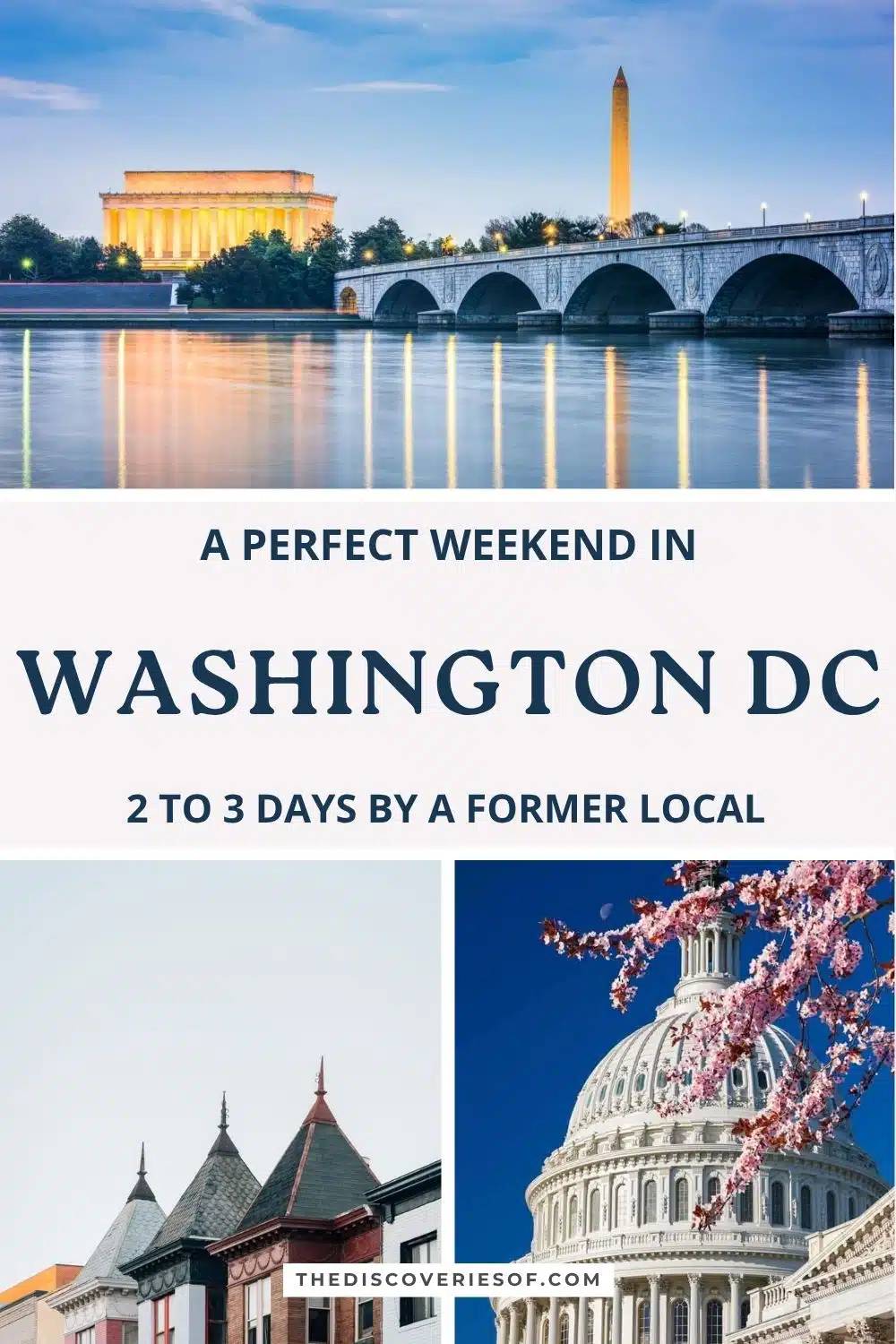
Love this? Save and share on Pinterest

Discover the top things to do, insider tips and hidden gems in our USA Travel Guides.
Read the guides →