The tomb of Ramses IX is one of the first you reach in the Valley of the Kings, with a wide, painted corridor and one of the most striking burial chamber ceilings in the valley. Here’s what to see inside and how to plan your visit.
Ramses IX’s tomb is the one most visitors see first. Its broad entrance sits right by the main path near the start of the Valley of the Kings, and it’s one of the tombs included in the standard ticket.
I chose it as one of my three tombs when I visited the valley in June on a private tour, along with Merenptah (KV8) and my favourite, the tomb of Tausert and Setnakht (KV14).
It’s a tomb of two halves. The first corridor, painted while the king was still alive, is as fine as anything on the standard ticket. The rest was finished in a hurry after his death, which is why the decoration changes as you go deeper, before it ends in a burial chamber with a spectacular ceiling.
Tomb of Ramses IX at a glance
- Location: in the central part of the Valley of the Kings, close to the entrance, a couple of minutes’ walk from Tutankhamun’s tomb
- Ticket: included in the standard Valley of the Kings ticket (750 EGP for three tombs), when it’s on the open list
- Size: about 105 metres long, on a straight, gently sloping line with no steep stairs
- Time needed: 15 to 25 minutes
- Best time: first thing in the morning or late afternoon, as it’s one of the busiest tombs in the valley
- Photography: phones are free to use; no flash
Who built KV6?
Ramses IX ruled Egypt for about 18 years, around 1129 to 1111 BC, in the 20th Dynasty. It was a time when royal power was fading, and his reign is best known for something that happened just outside his tomb: the great tomb robbery scandals.
Papyri from his reign, such as the Abbott Papyrus and the Leopold-Amherst Papyrus, record official inspections of royal tombs in western Thebes and the trials of the thieves who had broken into them, complete with their confessions. They’re some of the most vivid records of crime to survive from ancient Egypt, and they show how vulnerable the royal tombs already were.
Ramses IX’s own mummy didn’t stay in his tomb either. It was moved in antiquity to the royal cache at Deir el-Bahari, where it was found in 1881. Today it’s in the Royal Mummies Hall of the National Museum of Egyptian Civilisation in Cairo.
Why visit the tomb of Ramses IX?
It’s an easy tomb to see. It’s close to the visitor tram stop, and its wide corridors slope gently down without the steep stairs of tombs like Merenptah’s, so it’s a good choice if you’re short on time or energy.
It’s also one of the best introductions to how a royal tomb was decorated, because you can see the stages. The first corridor is finished and colourful, the middle sections are more hurried and the pillared hall was never finished at all, while the burial chamber was painted at speed in a striking palette of yellow, dark blue and black that’s unusual in the valley.
What you’ll see inside, room by room
The entrance and the first corridor
KV6 has one of the largest entrances in the valley: a broad stairway divided down the middle that leads to the gate. On the lintel, Ramses IX adores the sun disc, with the scarab of the morning sun inside it, flanked by Isis and Nephthys.
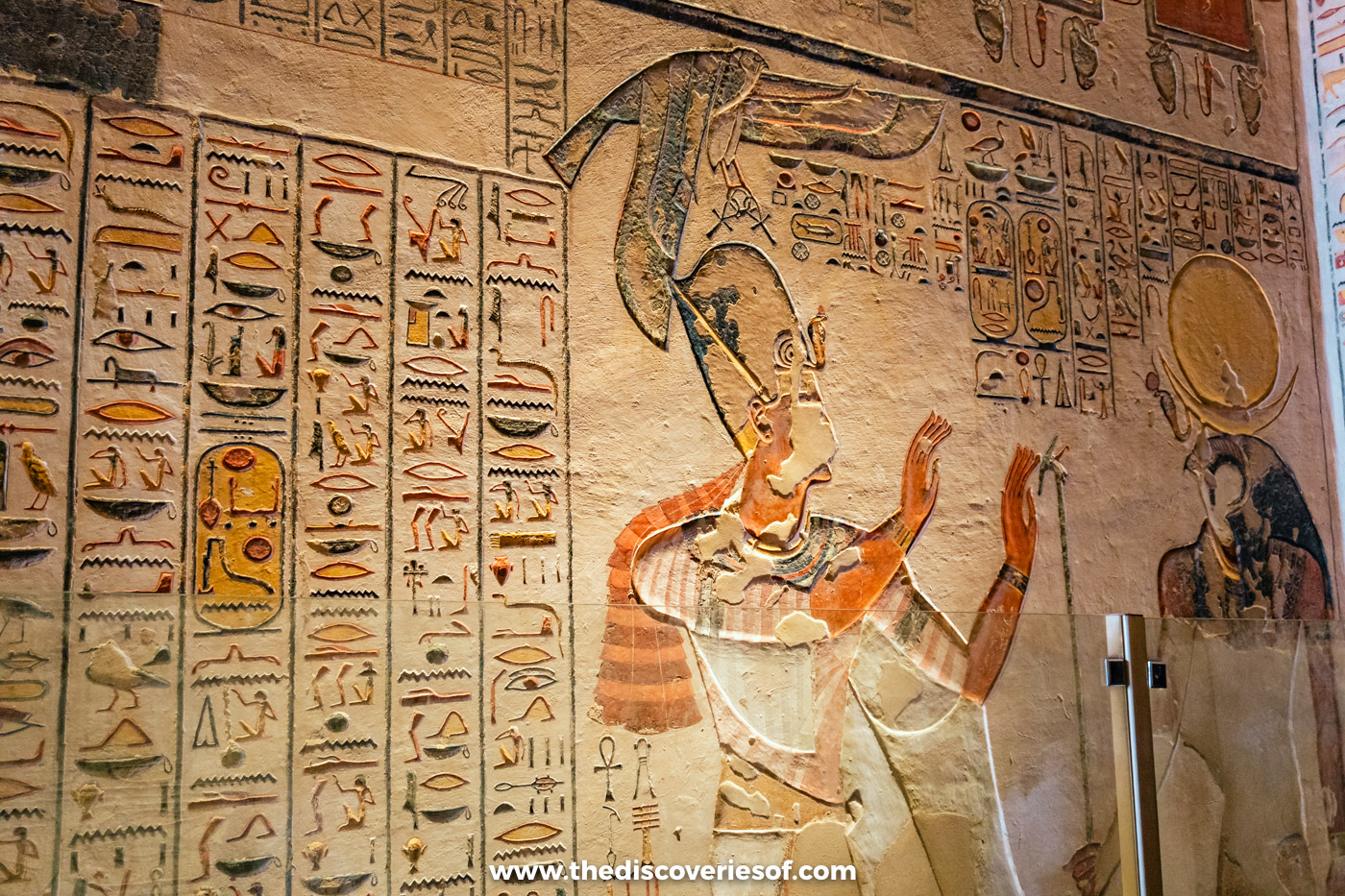
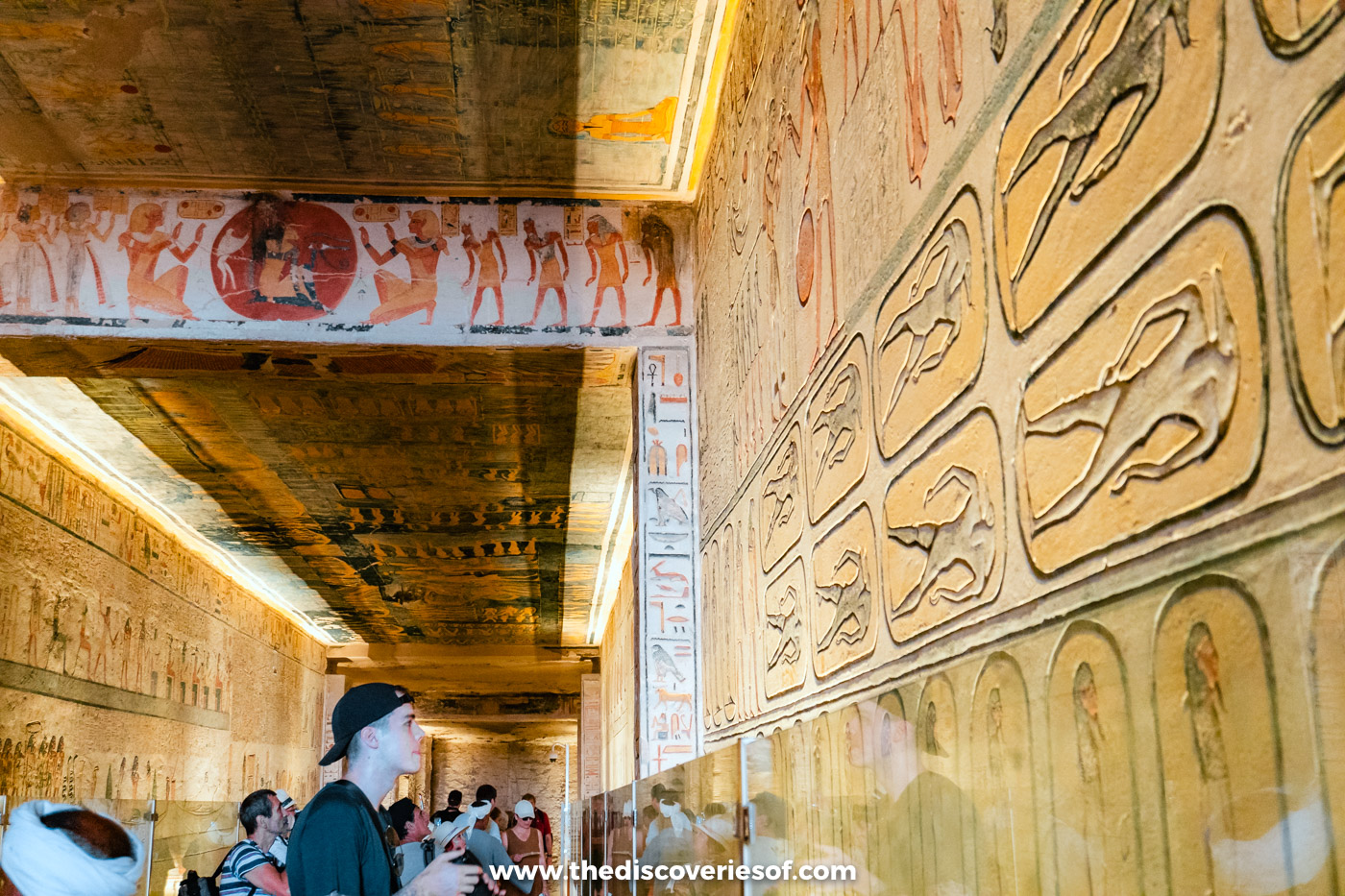
Inside, the long first corridor is the highlight. On the left wall, the king makes offerings before Ra-Horakhty and Osiris, followed by the Litany of Ra, with its rows of figures in cartouche-shaped frames that represent the many forms of the sun god. On the right, he offers to Amun-Ra-Horakhty, followed by the goddess Meretseger and the first section of the Book of Caverns.
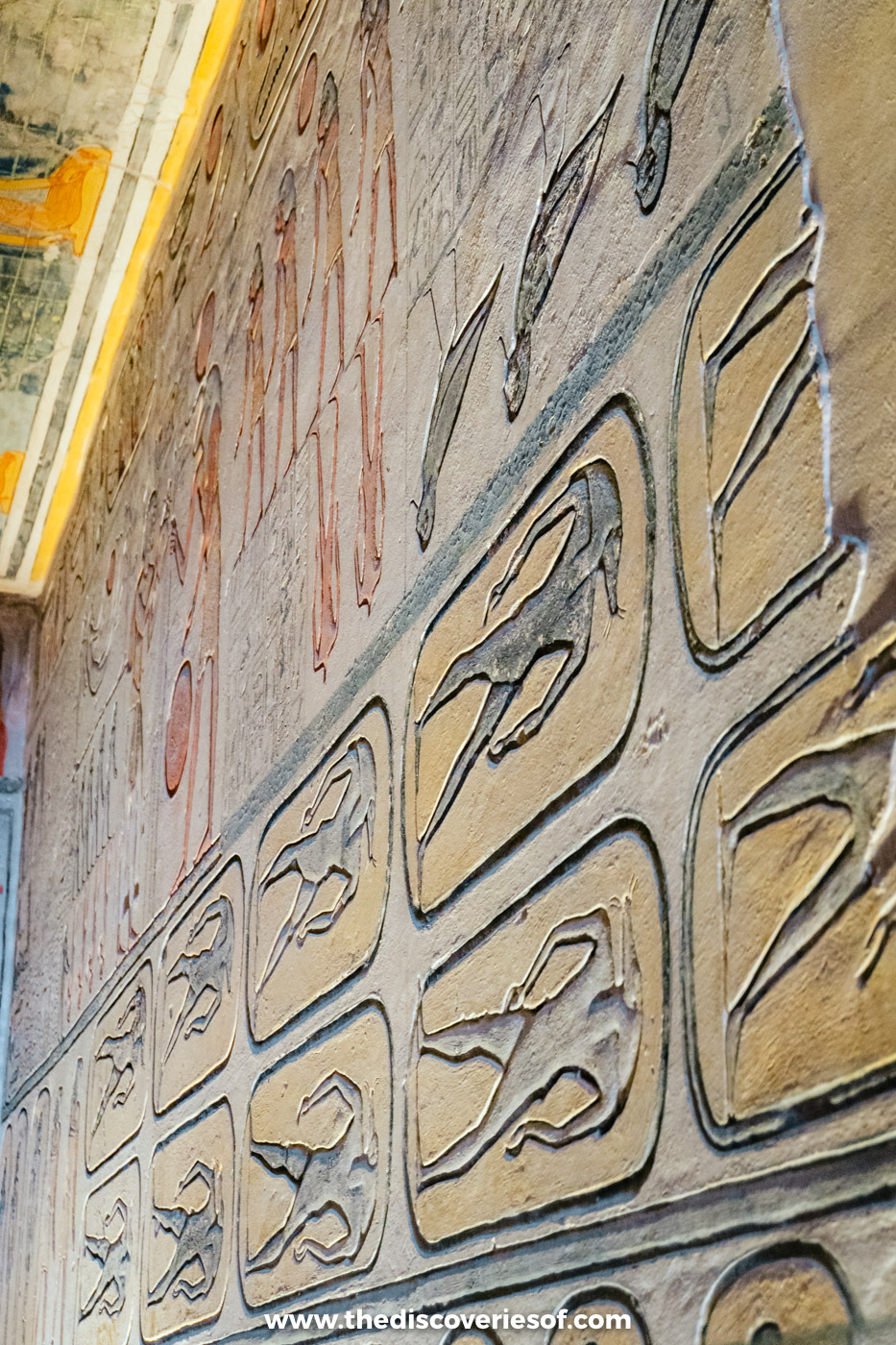
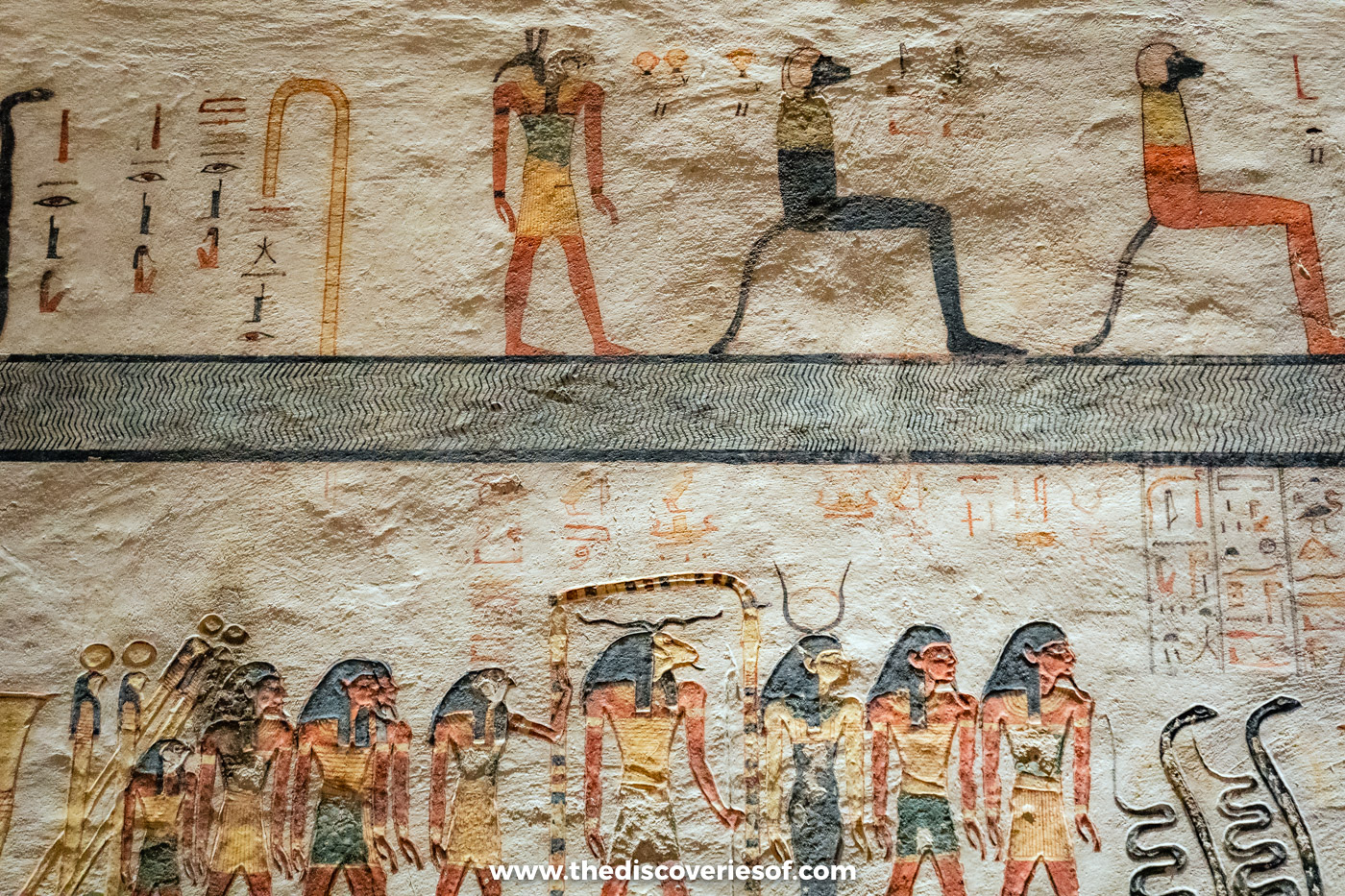
Look out for the four small side chambers cut off this corridor: none of them was ever finished or decorated. High up on the walls, you’ll also spot some of the more than 50 graffiti left by Greek, Roman and Coptic visitors, proof that the tomb has been open since antiquity.
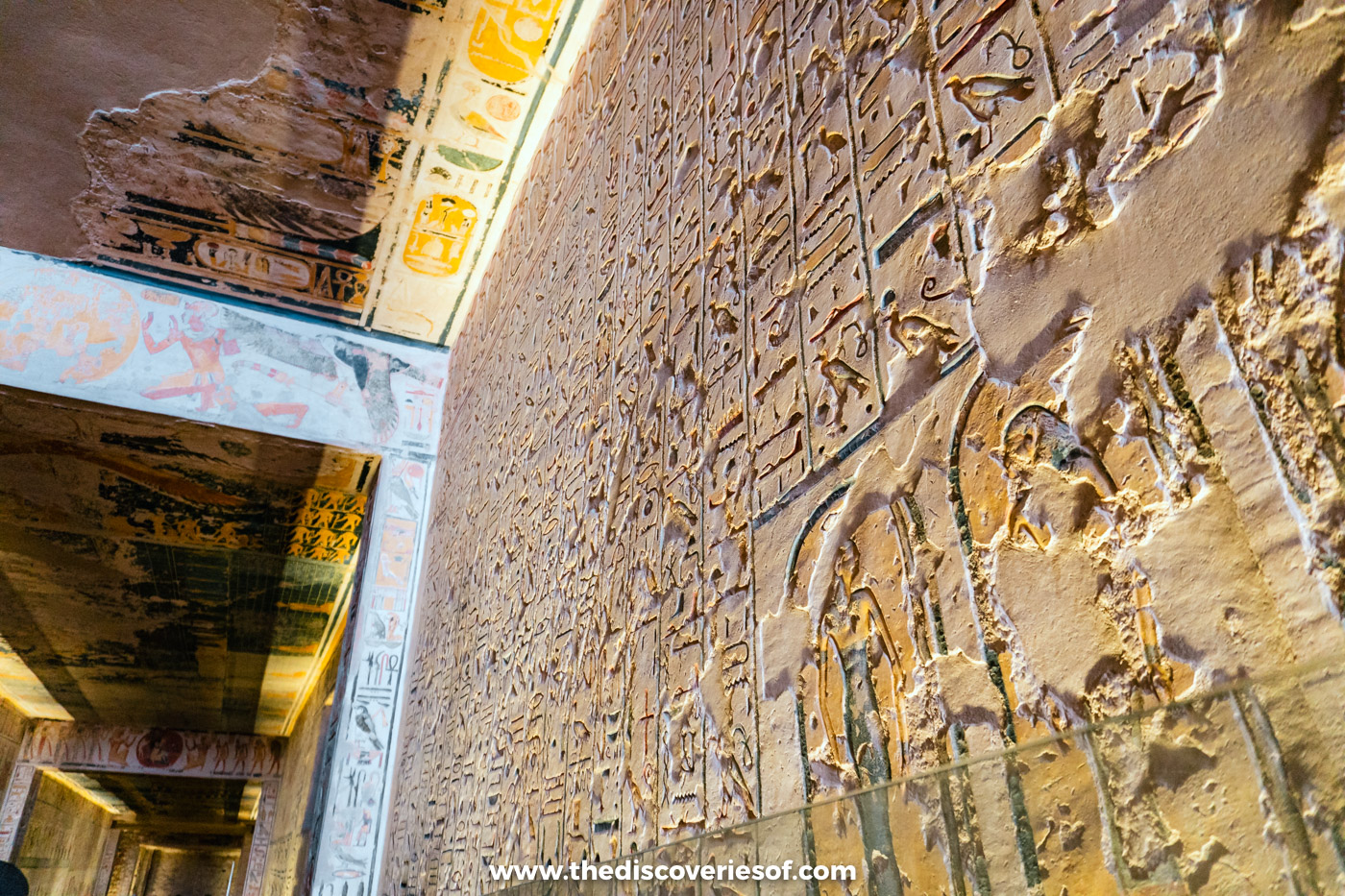
The second and third corridors
The second corridor continues the Litany of Ra and the Book of Caverns, with spells from the Book of the Dead, and its ceiling is covered with constellations, star tables and the list of decans used to tell the time at night.
The third corridor has hours two and three of the Amduat, the book of the sun’s journey through the night, on the left. On the right is something you won’t see anywhere else in the valley: an enigmatic scene of upside-down figures in circles, alongside the king as a reclining Osiris.
The unfinished pillared hall
Next comes a small chamber with priests performing the Opening of the Mouth ritual, then a pillared hall with two pairs of pillars on either side of a central ramp. It’s plain and unfinished: work stopped when the king died, and the decorators moved straight on to prepare the burial chamber.
The burial chamber
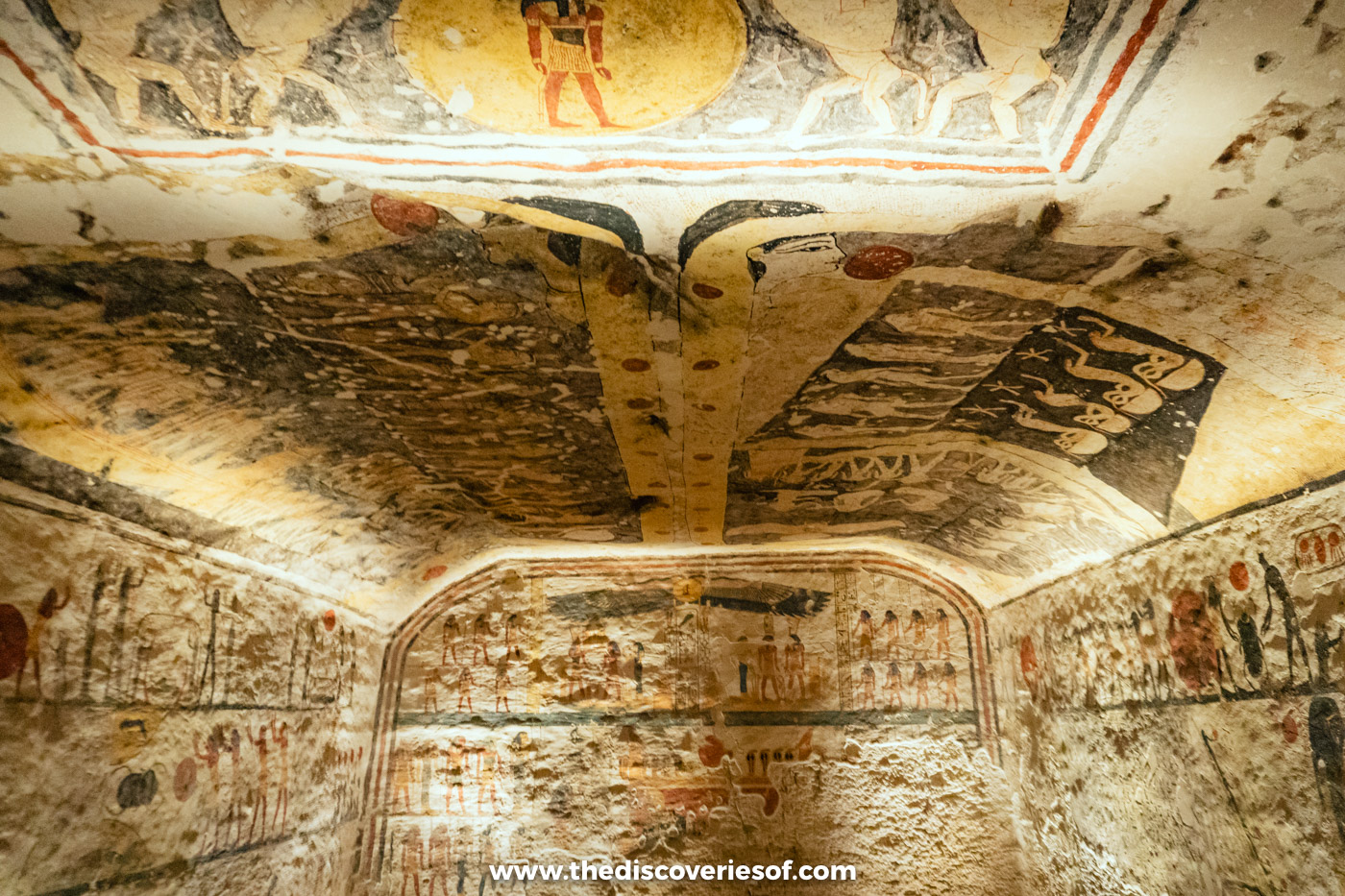
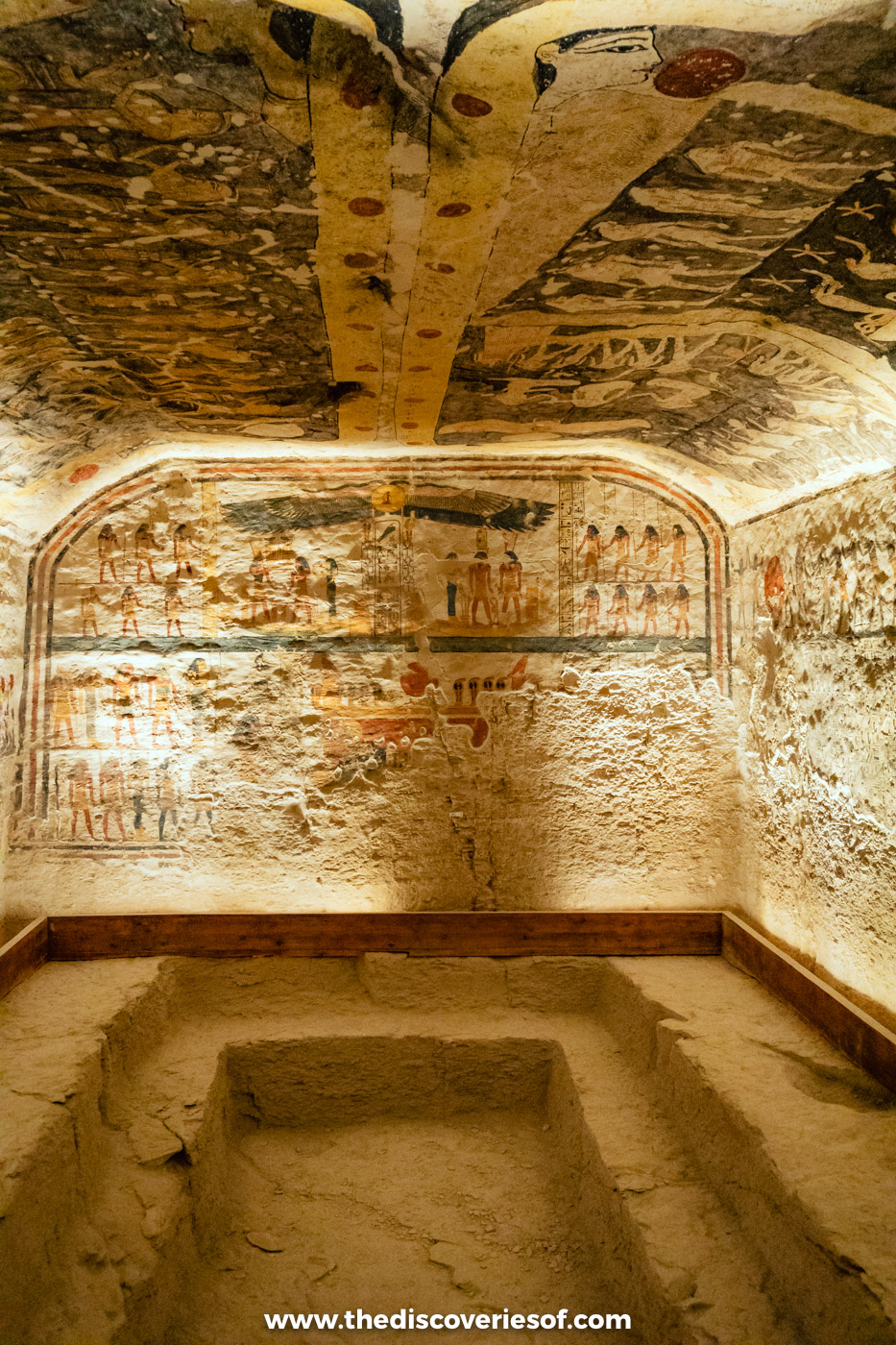
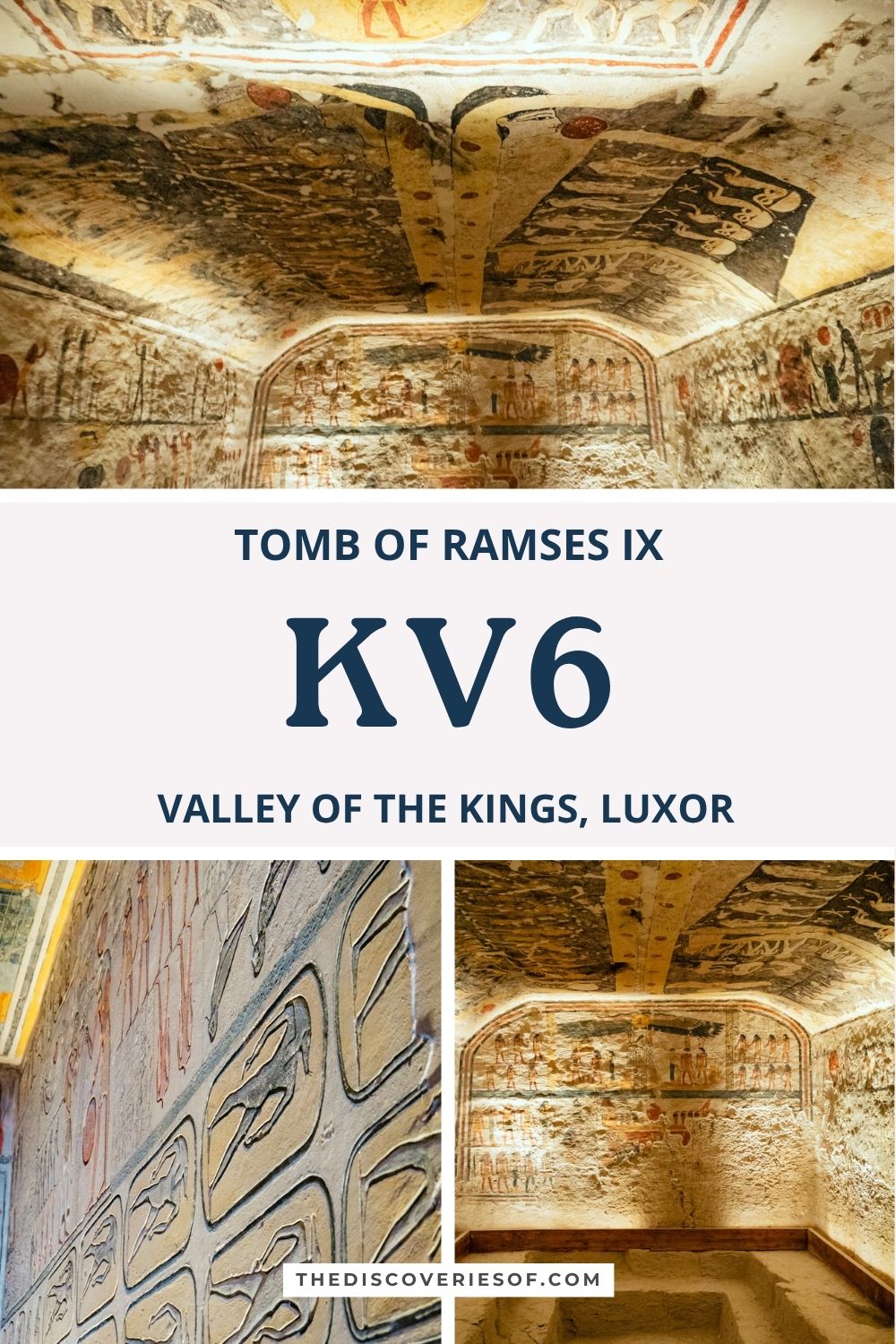
The ramp leads down into the burial chamber, the reason many people choose this tomb. Across the vaulted ceiling, two huge figures of Nut, the sky goddess, stretch back to back on a deep blue-black background, with the Books of Day and Night: the sun travels through her body each night and is reborn at dawn.
The side walls have scenes from the Book of Caverns and the Book of the Earth, and on the rear wall, gods stand before the king in a barque, while Horus revives the king as Osiris below. The lower parts of the walls have flaked away, but the colours higher up are still rich.
The sarcophagus has long since vanished, but the shallow two-tiered pit cut to hold it is still there in the floor.
Tickets and opening hours
KV6 is included in the standard Valley of the Kings ticket, which costs 750 EGP (375 EGP for students) and covers any three tombs on that day’s open list. Tombs rotate for conservation, but KV6 is one of the most consistently open, and visitor reports list it as open in 2026.
The valley is open daily from 6am to 5pm (some official listings give a 4pm close in winter). Pay by bank card at the visitor centre ticket office, and allow about 20 EGP for the tuff-tuff (tram) up to the tombs.
Tickets
If you have budget for an extra, the tomb of Ramses V and VI (KV9, 220 EGP) is close by and has a similar double Nut ceiling, on an even grander scale.
How to get to KV6
From the visitor centre, take the tuff-tuff or walk up to the main part of the valley. KV6 is one of the first tombs you reach, on the main path near the start of the valley, between the tombs of KV5 and KV55 and just a short walk from Tutankhamun’s tomb (KV62).
The Valley of the Kings is on Luxor’s West Bank, about 40 to 45 minutes by road from the East Bank hotels or a short taxi ride from the West Bank. See my Valley of the Kings guide for how to get there, tours and the other tombs.
Tips for visiting KV6
- Beat the queue: KV6 is one of the most popular tombs, and queues can build from mid-morning, so see it first thing or later in the afternoon.
- Look up: the ceilings are as important as the walls here, from the star tables in the second corridor to Nut in the burial chamber.
- Don’t rush the first corridor: it’s the best-preserved part of the tomb, and the glass panels mean you can get close to the reliefs.
- Pair it well: combine it with a tomb at the top of the valley, such as Tausert and Setnakht (KV14), and with Tutankhamun’s tomb next door.
- Stay nearby: I stayed at El Mesala Hotel on the West Bank, a short drive from the valley. See my guide to where to stay in Luxor for more.
Watch my Luxor video
Subscribe on YouTube and discover new destinations.
Map
Read next
- Visiting the Valley of the Kings: a practical guide
- Tomb of Tausert and Setnakht (KV14): a visitor’s guide
- Tomb of Merenptah (KV8): a visitor’s guide
- Visiting the tomb of Tutankhamun in Luxor
- The best things to do in Luxor
- The ultimate Egypt itinerary
Love this? Save and share on Pinterest

Discover the top things to do, insider tips and hidden gems in our Egypt Travel Guide.
Read the guides →