The tomb of Prince Khaemwaset in the Valley of the Queens is small, bright and beautifully painted, with Ramses III guiding his son through the afterlife. Here’s what to see inside and how to plan your visit.
The Valley of the Queens doesn’t make it onto nearly as many itineraries as the Valley of the Kings, which is a total win for you. I visited it on my private tour of the West Bank, and it was empty when I was there.
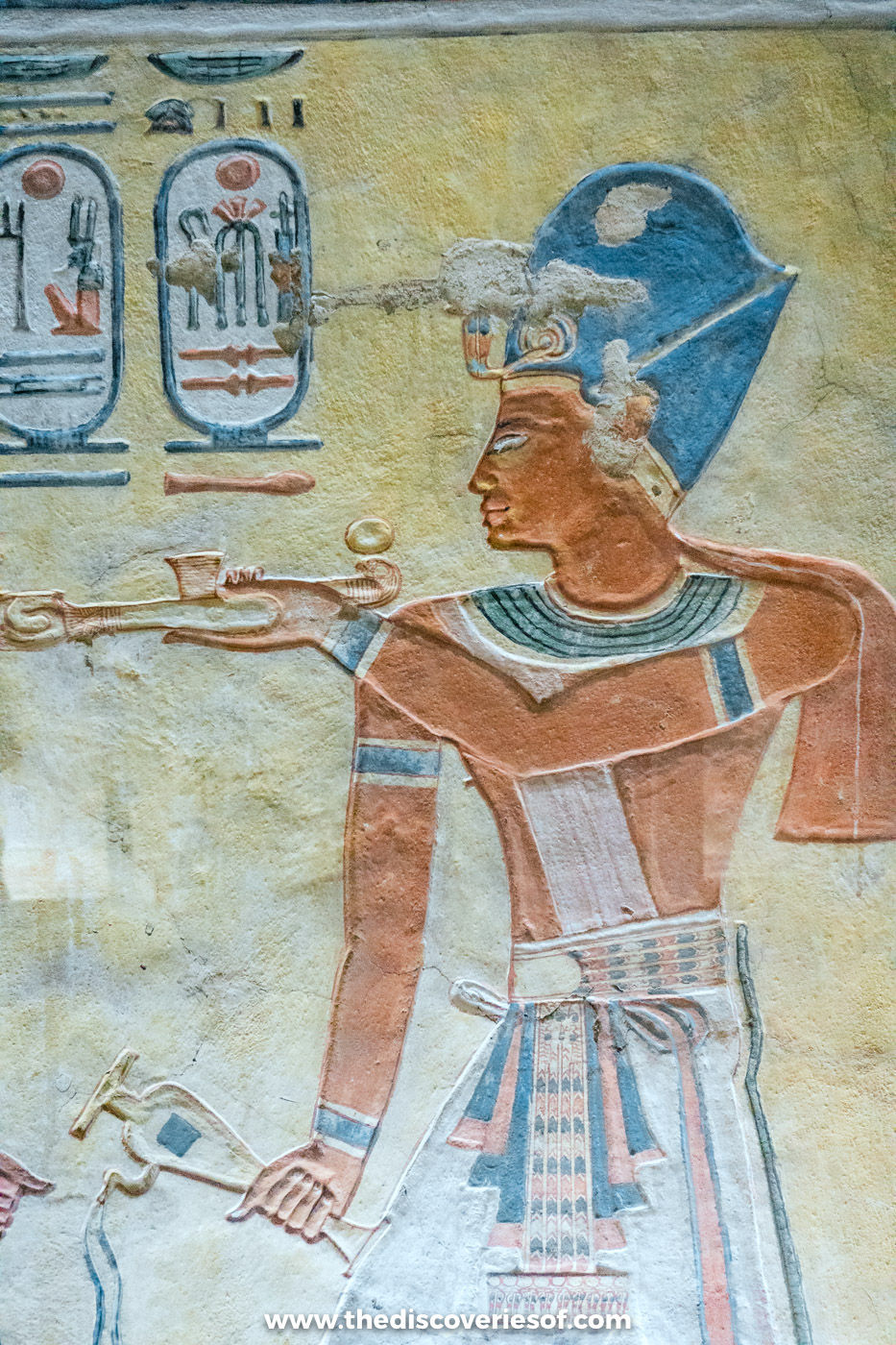
The tomb of Khaemwaset, numbered QV44, is one of the best reasons to go. It’s much smaller than the great royal tombs across the hill, but its paintings are some of the brightest and best preserved in Luxor, with deep blues, reds and golden yellows. The scenes are full of character: the pharaoh Ramses III leads his young son by the hand through the gates of the underworld and introduces him to the gods.
Tomb of Khaemwaset at a glance
- Location: at the end of the south branch of the Valley of the Queens, on Luxor’s West Bank
- Ticket: included in the Valley of the Queens ticket (220 EGP, 110 EGP for students), when it’s on the open list
- Size: a short corridor with two side chambers, a burial chamber and an inner room
- Time needed: 10 to 15 minutes in the tomb, or an hour for the valley’s open tombs
- Best time: early morning, before the heat; the Valley of the Queens is quieter than the Valley of the Kings at any time
- Photography: phones are free to use; no flash
Who was the prince buried in QV44?
Khaemwaset was a son of Ramses III, the last great warrior pharaoh of the New Kingdom, who ruled from around 1186 to 1155 BC. He’s listed eighth among the princes carved on the walls of Ramses III’s temple at Medinet Habu, and at one point he held the title “king’s first son of his body”.
His titles also included sem-priest of Ptah, an important role at the great temple of Ptah in Memphis, where he probably spent his life. That makes him an echo of a more famous Khaemwaset, the son of Ramses II, who was High Priest of Ptah at Memphis a century earlier. Ramses III modelled much of his reign on Ramses II, and even named his sons after his predecessor’s.
Despite the paintings showing him as a boy, Khaemwaset didn’t die young. He outlived his father and was buried during the reign of his brother, Ramses IV, who finished the tomb.
Why visit the tomb of Khaemwaset?
It’s all about the colour. Painted on smooth plaster, the scenes in QV44 have kept vivid blues, greens, reds and yellows, and in the inner rooms the painting survives right down to floor level. It’s a joy to see how bright an Egyptian tomb could be.
It also tells a touching story. Several of Ramses III’s sons were buried in this valley, and their tombs share a theme: the king, wearing a series of different crowns, acts on his son’s behalf, presenting him to the gods and leading him through the dangers of the underworld. Khaemwaset, shown with the sidelock of youth worn by royal children, follows behind.
And it’s quiet. Most visitors to the Valley of the Queens come for Nefertari’s tomb, and with that tomb closed indefinitely, the valley sees far fewer people than the Valley of the Kings.
What you’ll see inside, room by room
The corridor
A short, slightly sloping ramp, now under a shelter, leads to the entrance. The doorways were widened after the tomb was finished to fit the prince’s large granite sarcophagus, and you can still see the carved, but unpainted, figures of Isis and Nephthys on the inner gate.
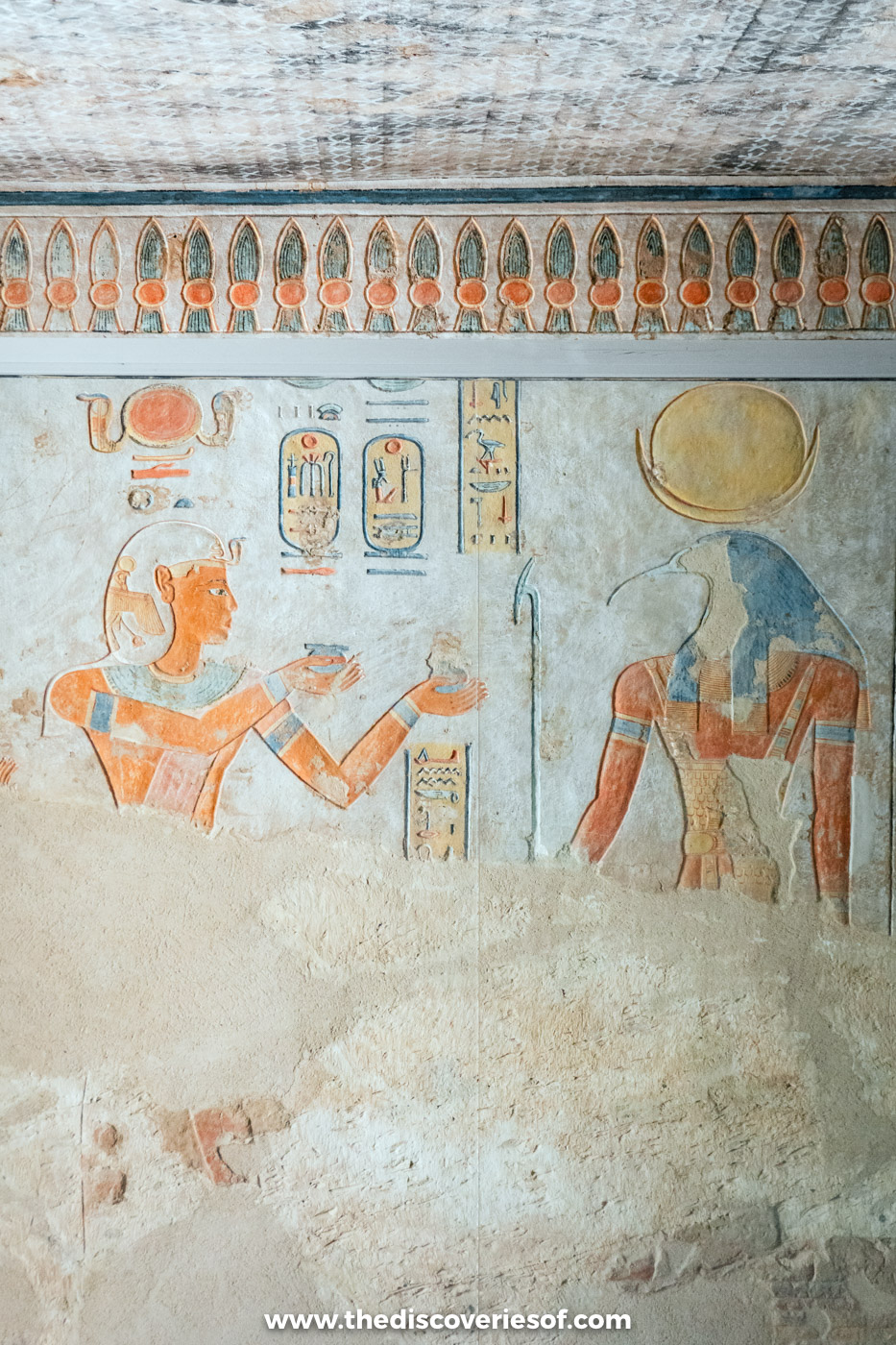
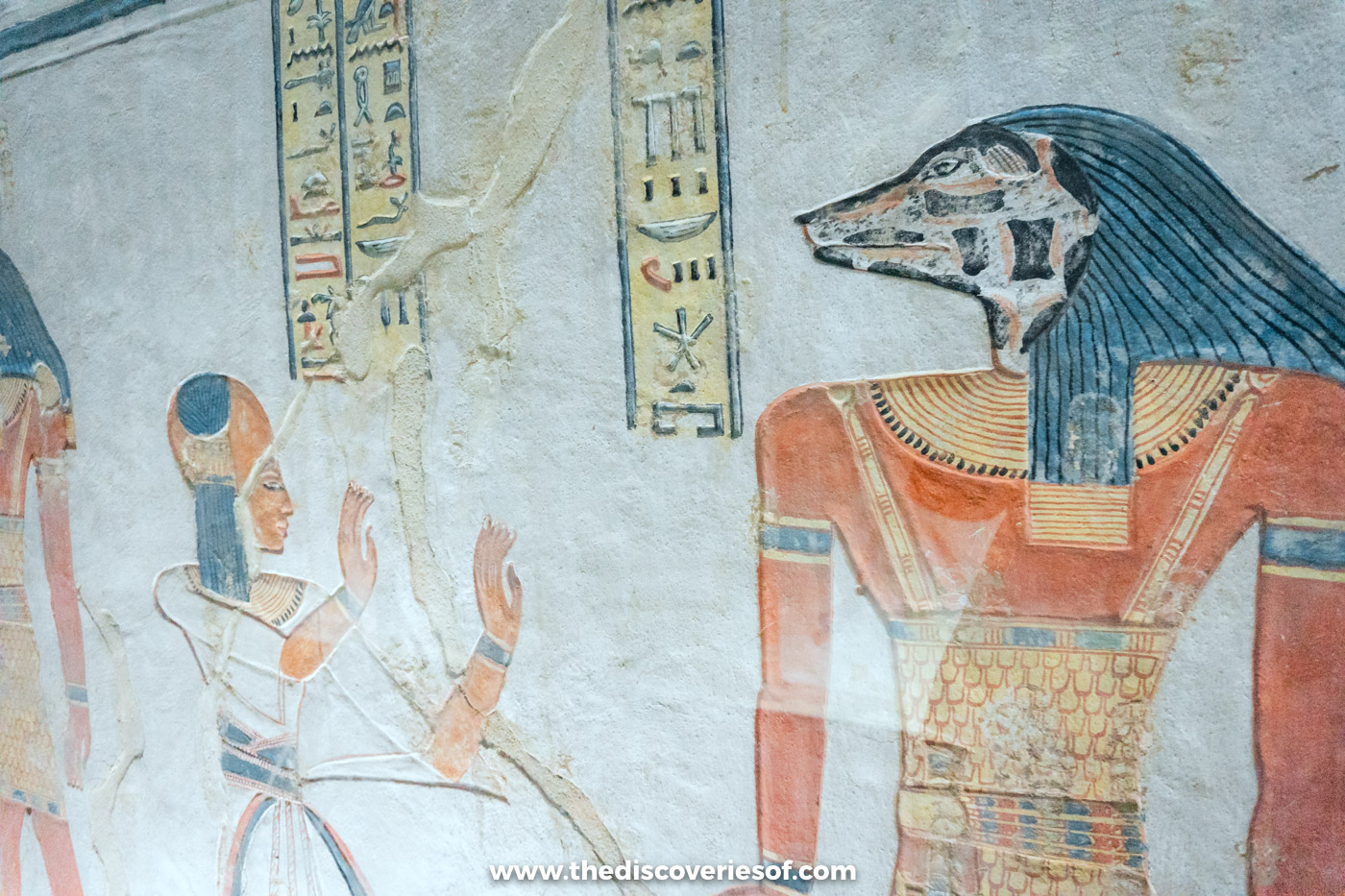
The corridor is the place to see Ramses III at his finest. Under a ceiling of stars and a frieze along the top of the walls, the king and the prince make offerings to a series of gods, among them Ptah, Thoth, Anubis, Ra-Horakhty and Geb. Throughout, the king is the dominant figure, wearing a different crown in different scenes, from the blue war crown to elaborate feathered headdresses, while the prince follows him.
The side chambers
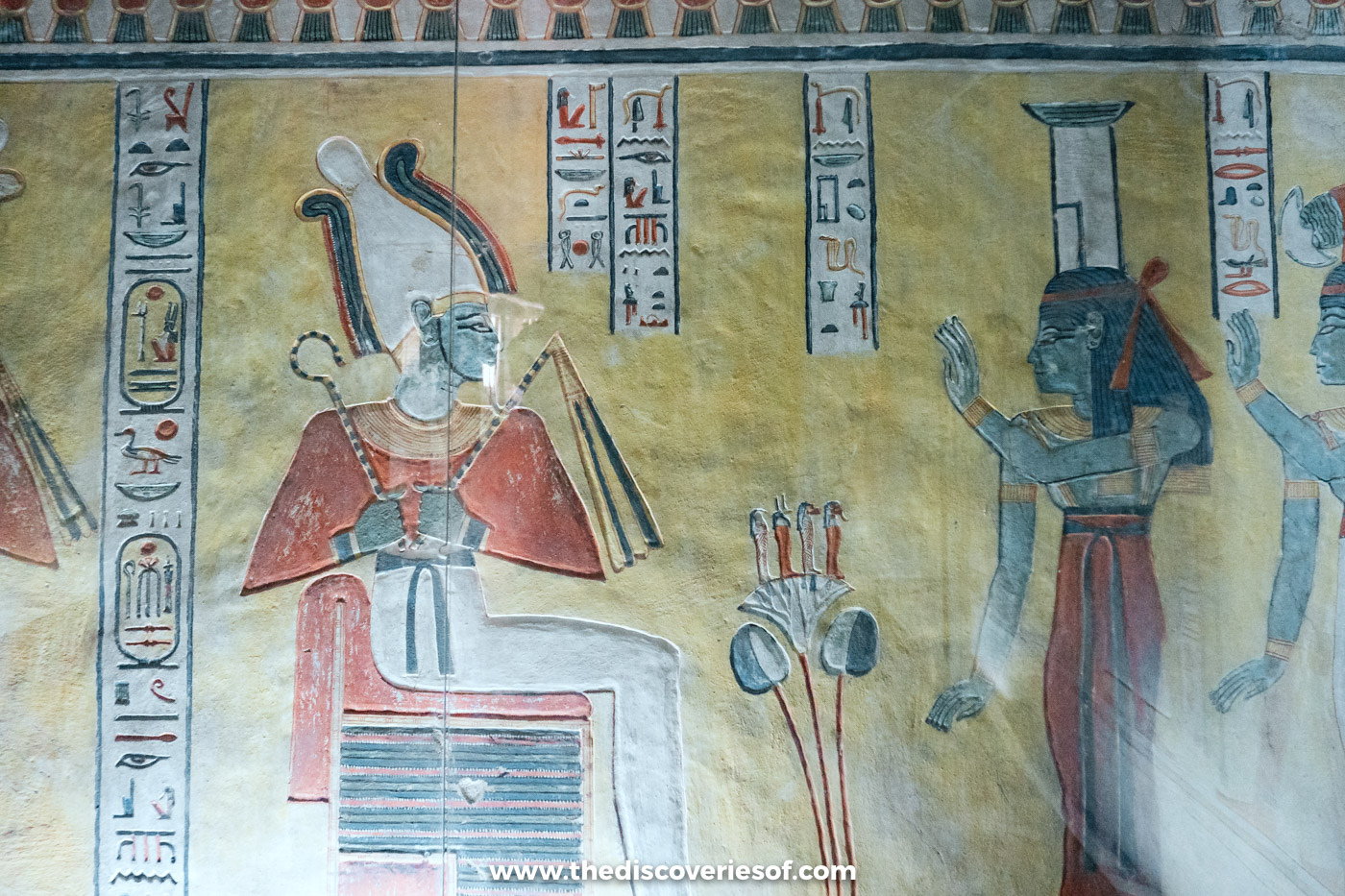
Two small side chambers open off the corridor. Here, unusually, Khaemwaset appears alone, without his father, still wearing his sidelock of youth.
In one chamber, the main scene shows Osiris seated on his throne, with Isis and Nephthys adoring him. In the other, Isis stands before Osiris and Nephthys before the funerary god Ptah-Sokar. On the side walls, the prince makes offerings to the gods, including the four Sons of Horus, the protectors of the internal organs.
The burial chamber
The burial chamber has a barrel-vaulted ceiling, and the pit for the sarcophagus is cut into its floor. Its walls show spells 145 and 146 of the Book of the Dead: the king and the prince pass through the gates of the underworld, each guarded by demons, and the king speaks to the gods for his son.
The badly damaged lower part of his granite sarcophagus is still in the tomb, while the red granite lid is in the Egyptian Museum in Turin.
The inner room
The tomb ends in a small inner room that Egyptologists sometimes call the “room of rebirth”. The prince doesn’t appear here at all. Instead, the king adores Osiris, with the goddesses Isis and Neith on one side and Nephthys and Serqet on the other, in scenes about the sun’s rebirth and new life after death. Look out for the brightly painted djed pillars, symbols of Osiris and stability, on the doorway.
The tomb’s later history
The tomb was discovered in February 1903 by the Italian Archaeological Mission led by Ernesto Schiaparelli. It had been used again and again for burials centuries after Khaemwaset, and the excavators found it packed with mummies and more than 40 wooden coffins from the 22nd to the 26th Dynasties.
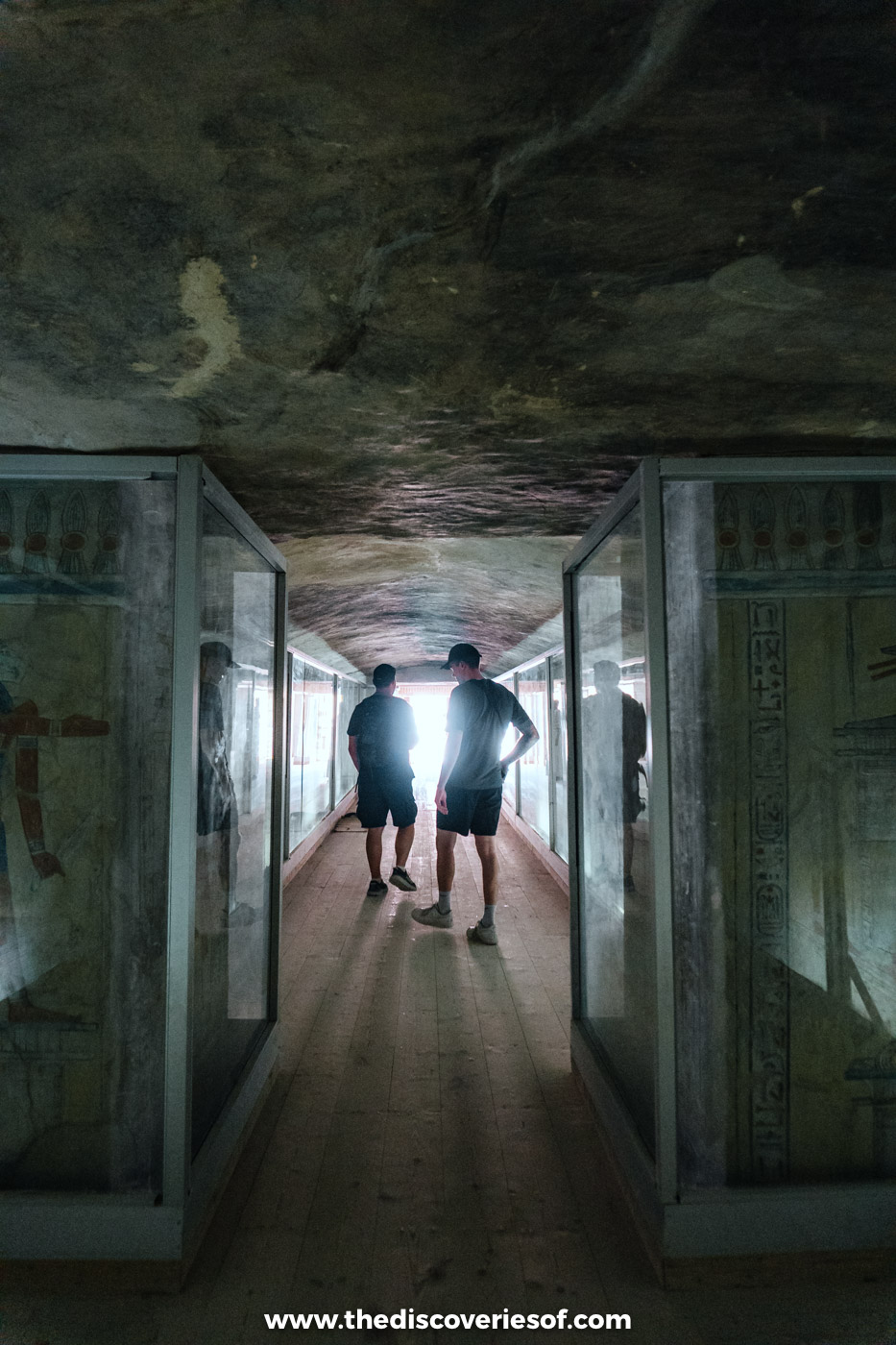
Many finds went to Turin, where the Egyptian Museum holds the prince’s sarcophagus lid. Conservators have treated the paintings several times since the 1990s, and today glass panels, wooden walkways and lighting protect them.
The Valley of the Queens
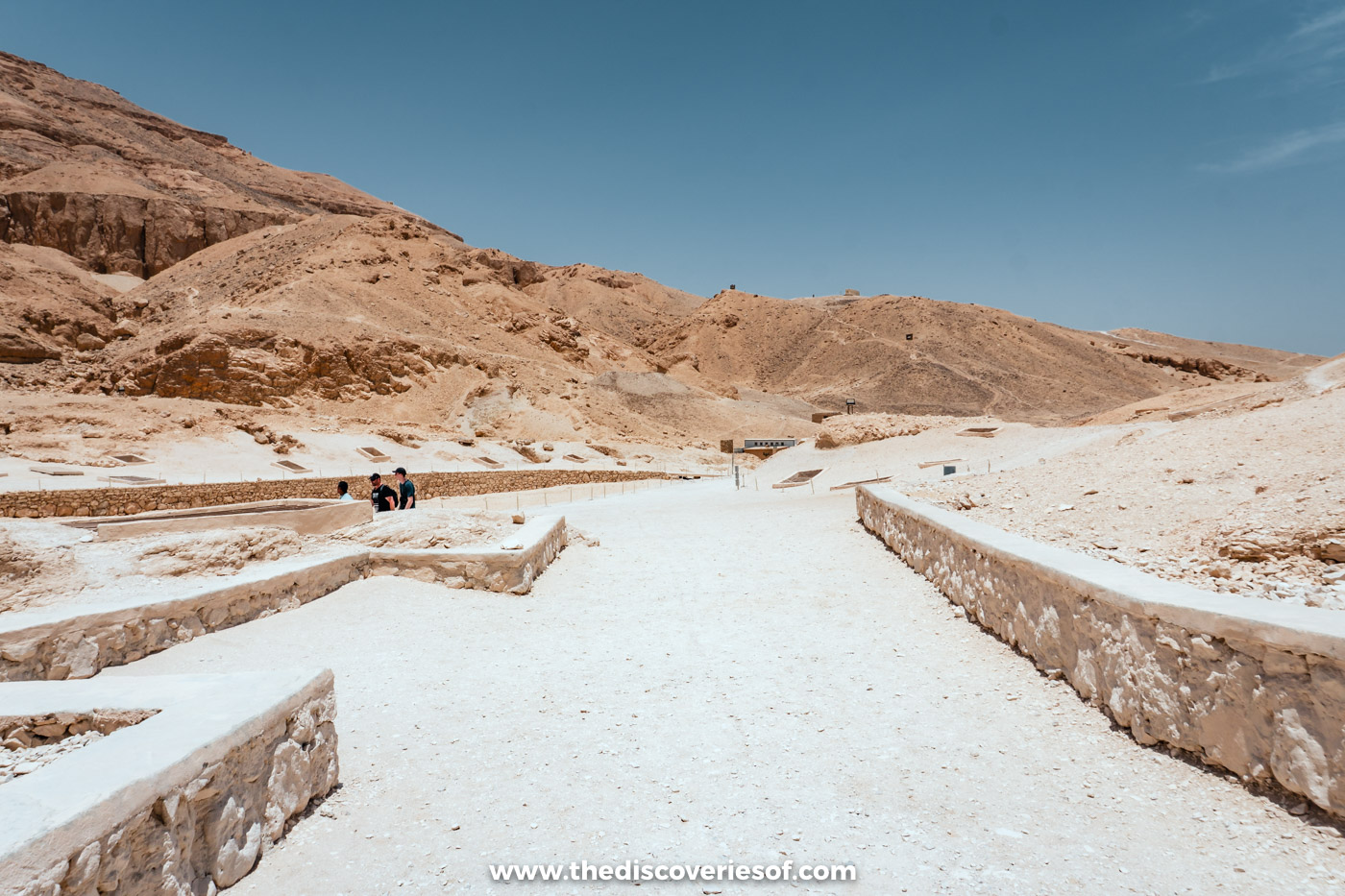
The ancient Egyptians called this valley Ta-Set-Neferu, often translated as “the place of beauty”. More than 90 tombs have been found here, for queens, princes, princesses and royal officials of the 18th to 20th Dynasties.
The ticket usually includes a small group of open tombs. In 2026, visitor reports list the tombs of Khaemwaset (QV44), Queen Tyti (QV52) and Amenherkhepshef (QV55), another son of Ramses III with a very similar painted tomb. Open tombs rotate, so check the list at the ticket office.
The valley’s most famous tomb, Nefertari’s (QV66), is closed indefinitely, and there’s no word on if or when it will reopen. If it does, it needs its own ticket, and I’d say it’s absolutely worth it. Read my guides to the Valley of the Queens and Nefertari’s tomb for more.
Tickets and opening hours
The Valley of the Queens ticket costs 220 EGP (110 EGP for students) for foreign visitors and covers the open tombs on the day. It’s open daily from 6am to 5pm, with earlier closing in winter on some official listings.
Ticket offices at Luxor’s sites are cashless, so bring a bank card, plus a little cash for tips and toilets. The Luxor Pass covers the Valley of the Queens if you’re planning to see a lot of sites.
Tickets
Buy your Valley of the Queens ticket at the ticket office at the valley entrance and check which tombs are open that day before you go in.
How to get to the Valley of the Queens
The Valley of the Queens is at the southern end of the Theban hills on the West Bank, close to Medinet Habu and the workmen’s village of Deir el-Medina. It’s a short drive from the Valley of the Kings and the Mortuary Temple of Hatshepsut, so it’s easy to combine all three in a morning, as many West Bank tours do.
From the East Bank, allow around 40 minutes by road via the Luxor Bridge, or take the public ferry across the Nile and a taxi from the West Bank landing. A private tour or driver is the easiest option. This private tour of the West Bank’s Kings and Queens covers both valleys with a guide.
Tips for visiting QV44
- Go early: the valley is exposed and very hot by midday, and there’s little shade between the tombs.
- Take your time: QV44 is small, so it’s easy to linger and look for the details: the king’s changing crowns, the prince’s sidelock and the stars on the ceiling.
- Combine it with QV55: if it’s open, the tomb of Amenherkhepshef is close by and tells a similar story, so you can compare the two princes.
- Pair it with the Valley of the Kings: see my Valley of the Kings guide to plan a full day on the West Bank.
- Stay nearby: I stayed at El Mesala Hotel on the West Bank, a short drive from both valleys. See my guide to where to stay in Luxor for more.
Watch my Luxor video
Subscribe on YouTube and discover new destinations.
Map
Read next
- Visiting the Valley of the Queens: a practical guide
- Visiting Queen Nefertari’s tomb in Luxor
- Visiting the Valley of the Kings: a practical guide
- Tomb of Tausert and Setnakht (KV14): a visitor’s guide
- Visiting the Mortuary Temple of Hatshepsut in Luxor
- The best things to do in Luxor
Love this? Save and share on Pinterest

Discover the top things to do, insider tips and hidden gems in our Egypt Travel Guide.
Read the guides →