

White Sands in New Mexico is one of the US’s lesser-known national parks, but it shouldn’t be. Discover the best things to do in White Sands National Park, from scenic drives and dune hikes to sledging, sunset strolls and moonlit walks.
Prepare to be transported to a world straight out of a science fiction film, where brilliant-white dunes stretch as far as the eye can see.
Welcome to White Sands, where the world’s largest gypsum dunefield stretches across 275 square miles of the Tularosa Basin, offering a truly extraordinary stop for explorers embarking on a New Mexico road trip. The sand here isn’t made of silica, like most dunes, but of gypsum, which is what makes it so dazzlingly white.
It’s one of the most unique national parks in the United States. I’m not kidding: fossilised human footprints found here have been dated to between 21,000 and 23,000 years ago, among the oldest evidence of people anywhere in the Americas. But when people visit White Sands, they mostly come for the sand dunes, and I don’t blame them.
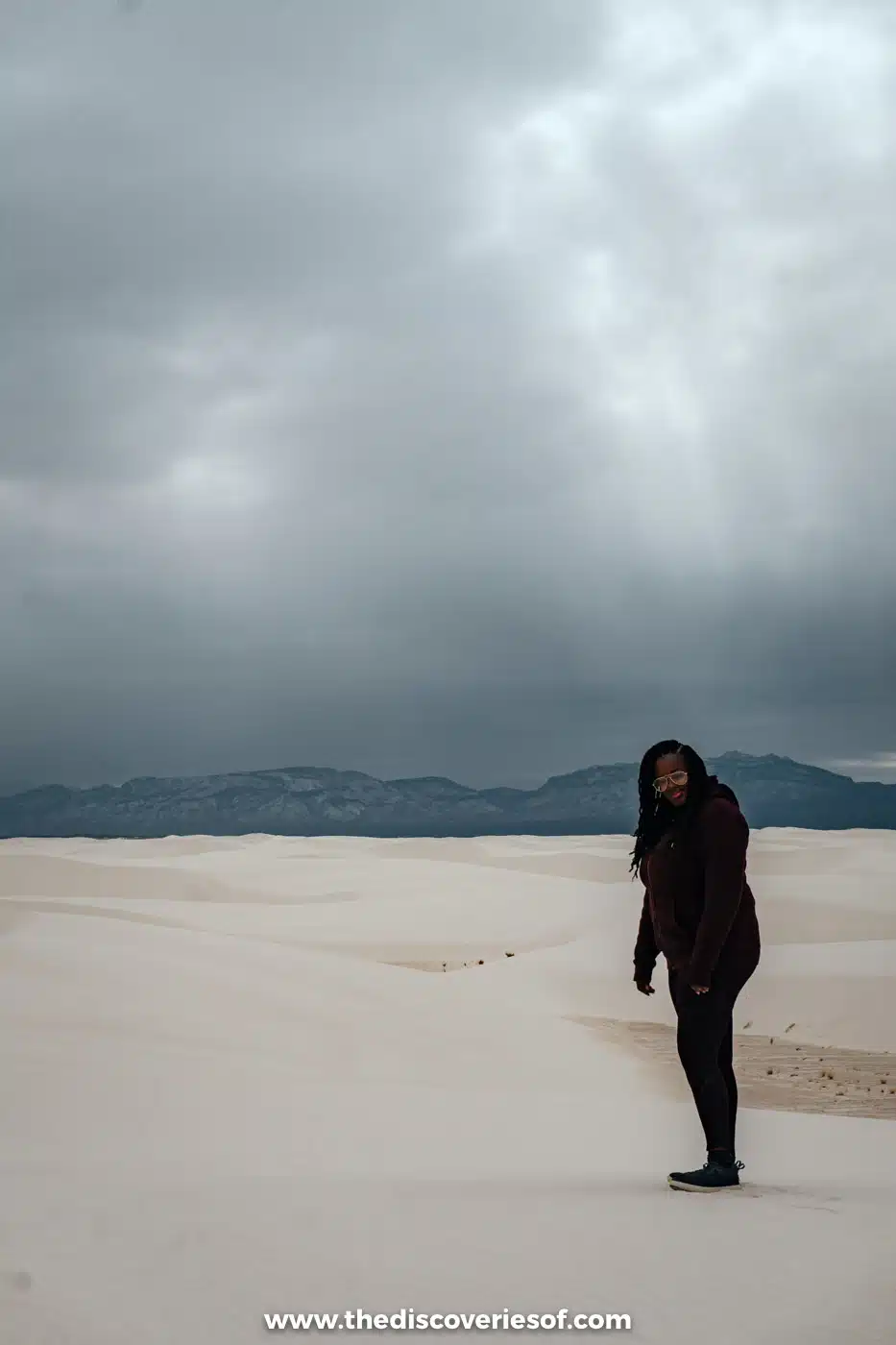
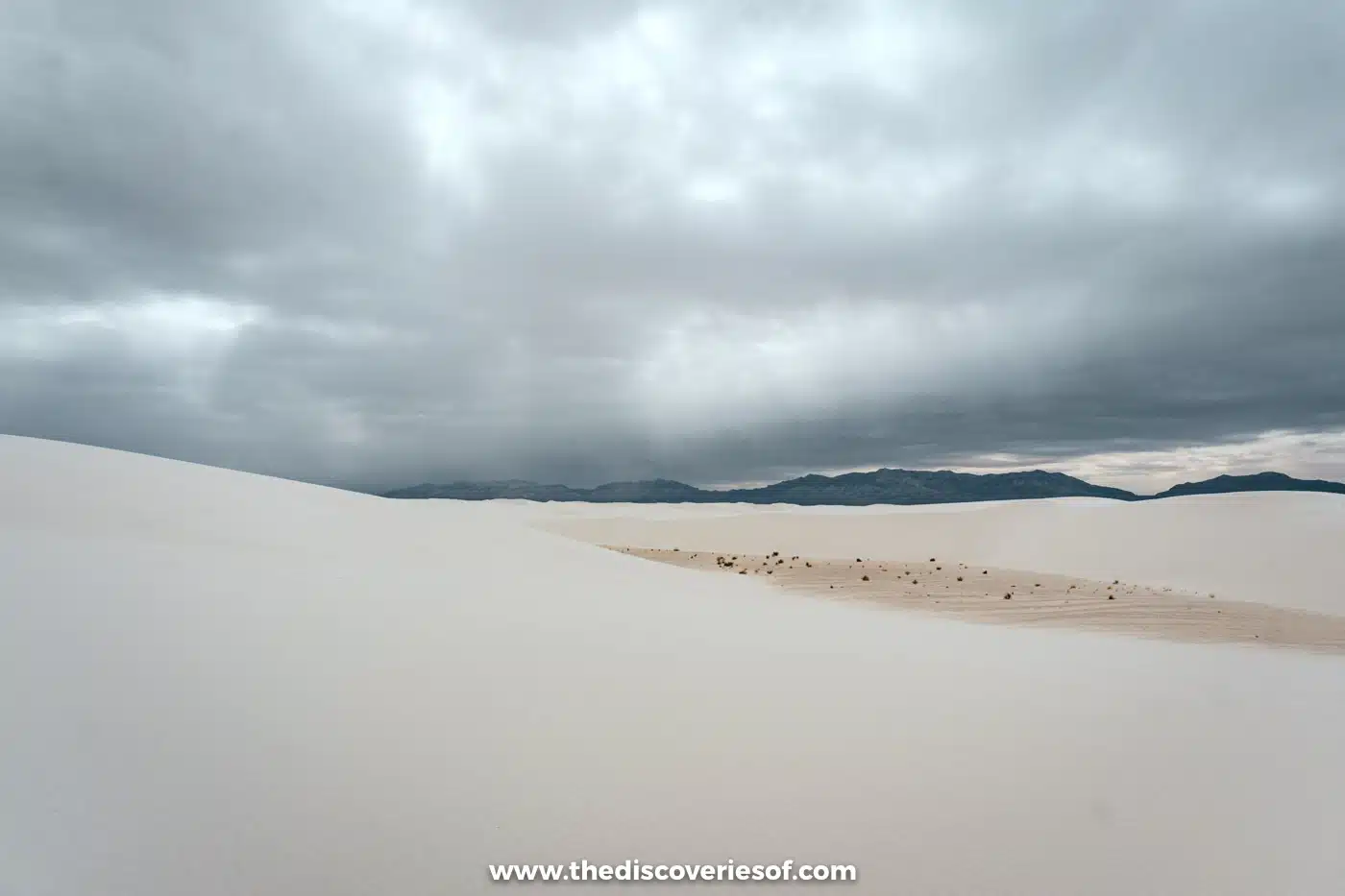
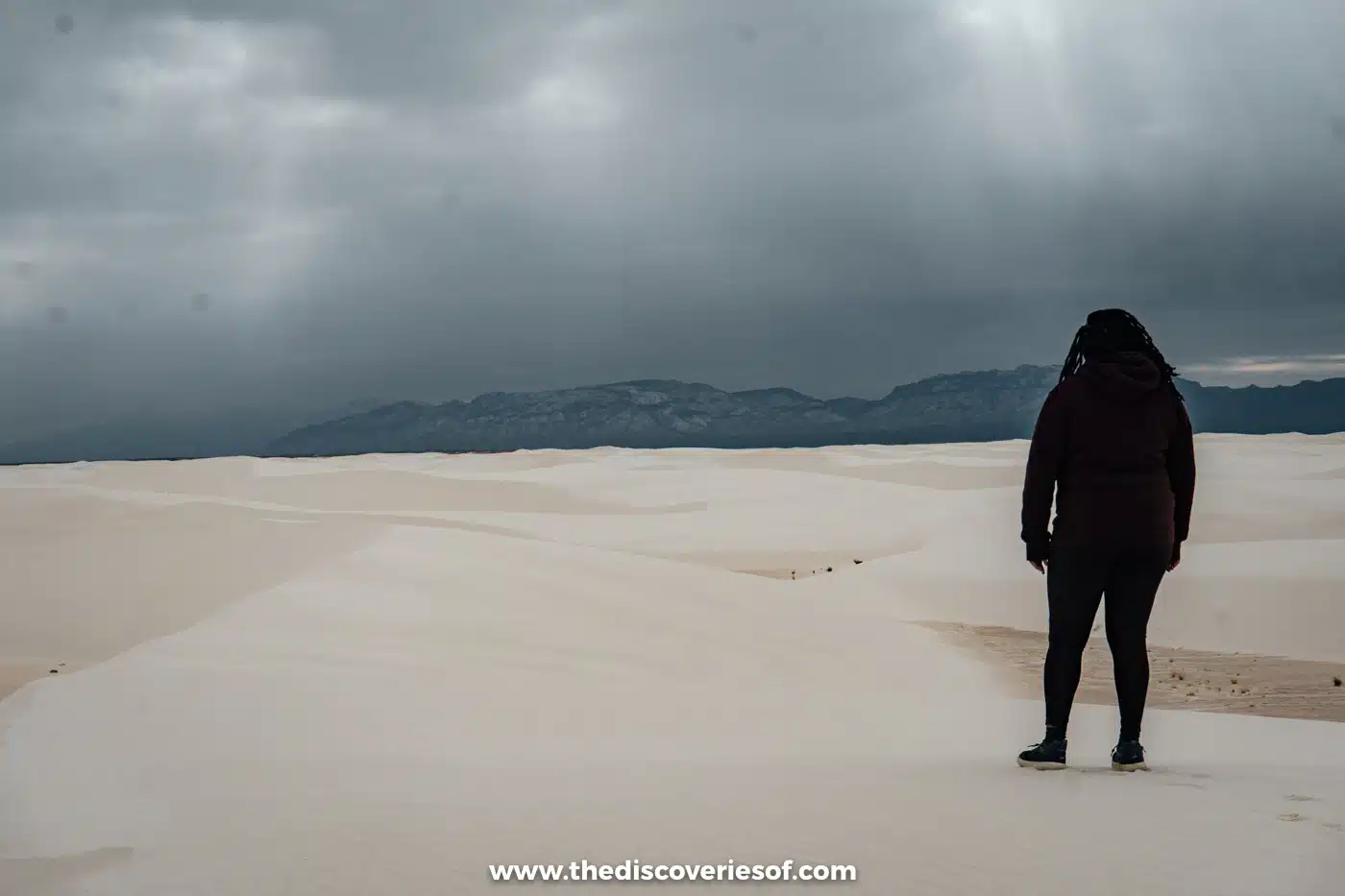
I visited in February, on a road trip through the Southwest. I didn’t have the best weather (it rained for part of the day), but the upside was a blissfully quiet park. I drove Dunes Drive, walked the Interdune Boardwalk and tackled the Alkali Flat Trail, which was pretty hard work. Unlike many other national parks, you can really see the highlights here in a day.
Below, you’ll find everything I recommend, from the hikes (with distances, times and difficulty for each trail) to the ranger-led walks that are worth planning your visit around, plus a few brilliant stops just outside the park.
Let’s get into it, shall we? Here’s what you need to do in White Sands National Park.
The best things to do in White Sands National Park
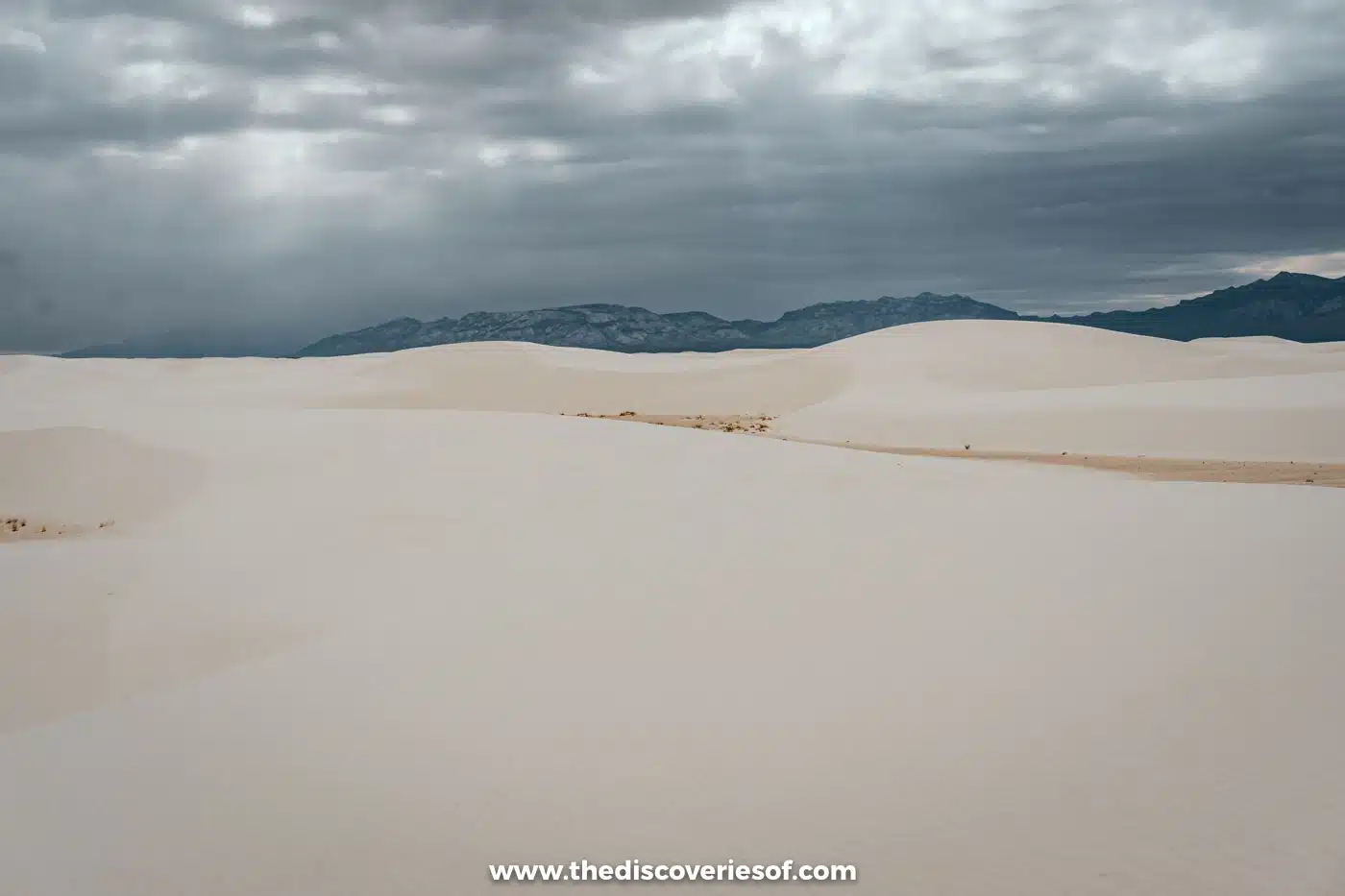
Drive into the heart of the dunes on Dunes Drive
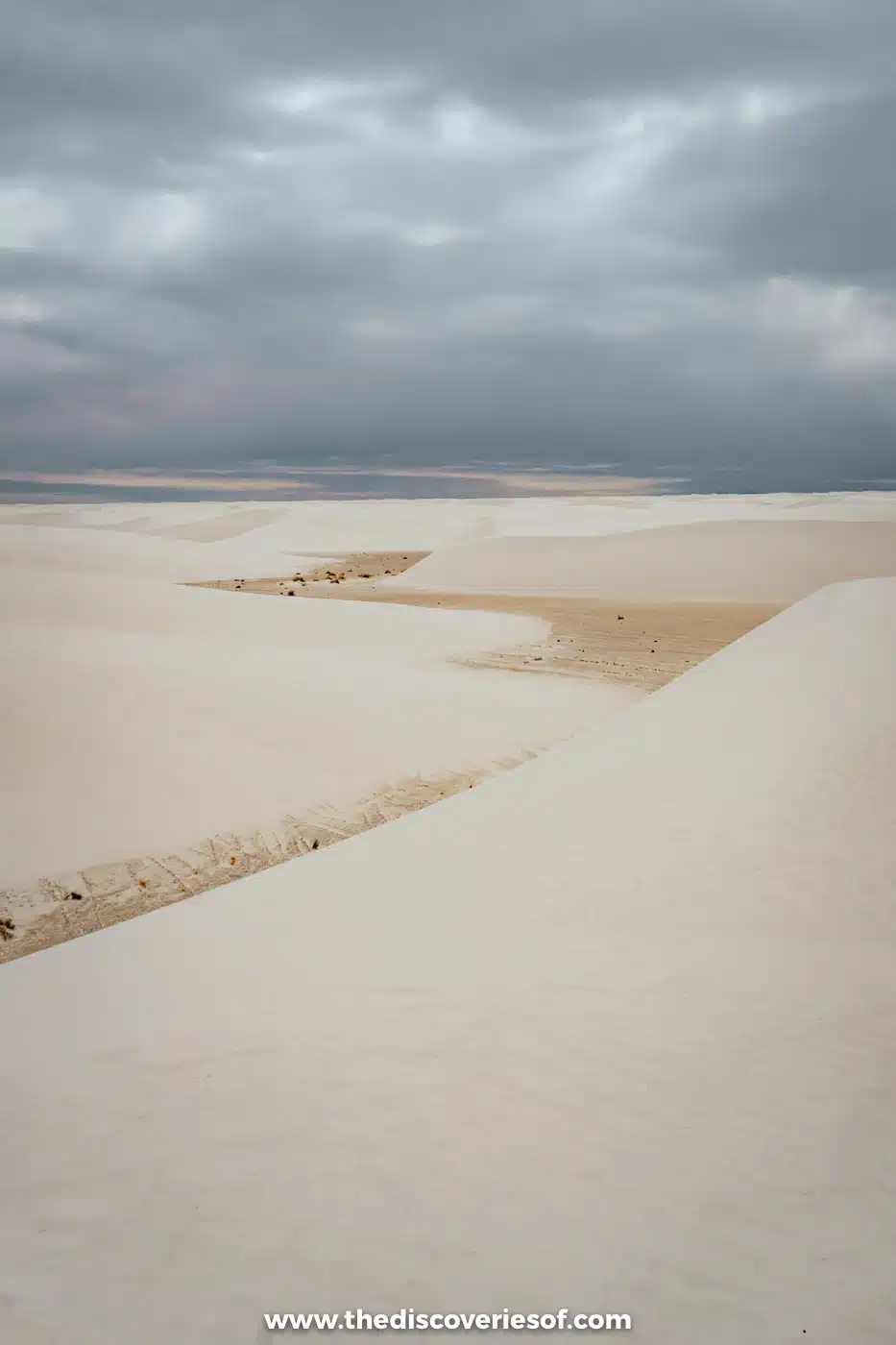
First up: Dunes Drive. This scenic road runs 8 miles (13 km) from the visitor centre into the heart of the dunefield, so it’s a 16-mile round trip, and it’s a brilliant way to see all of the park’s highlights, especially if you only have one day in the area.
You’ll start at the visitor centre, before heading straight into the white gypsum dunes, which create a stunning contrast against the sky (or, on my visit, against some rather dramatic rain clouds). The first five miles are paved, and the last three are hard-packed gypsum that wends its way between giant dunes.
The drive itself takes around 45 minutes without stops. However, the route is adaptable, so you can stop off at the pullouts, picnic areas and trailheads along the way. Every trail in the park starts from Dunes Drive, from the short Playa Trail to the Alkali Flat Trail, the longest and most challenging hike in the park.
It’s a magnificent experience and a terrific way to see the park. It’s also the drive I did in February: just take it slowly after rain, as the gypsum road can be slippery when wet.
Top Tip
Dunes Drive can close for up to three hours at a time when the neighbouring White Sands Missile Range is testing. Check the park’s closures page the day before you go.
Stroll the Interdune Boardwalk
Distance: 0.4 miles (650 m) round trip. Time: about 20 minutes. Difficulty: easy, and fully accessible for wheelchairs and pushchairs.

Short and sweet: that’s the Interdune Boardwalk in a nutshell. If you’re looking for a more leisurely way to explore the park, be sure to walk it. It’s an easy raised boardwalk that takes you through the heart of some of the smaller dunes, and it offers some incredible views of the dunefield and the Sacramento Mountains without much walking at all.
The trailhead is 4.5 miles from the visitor centre along Dunes Drive, so it’s a great spot to start exploring the park. I walked it on my February visit.
Okay, so this isn’t really a hike. However, it is a brilliant opportunity to learn about the geology, the formation of the dunes and the desert plants and animals that call the park home: panels along the way explain how they’ve adapted to life in the dunes. Unlike the other trails, it has no colour-coded markers. Not that you’ll need them: you simply follow the boardwalk.
Top Tip
Check before you go: the National Park Service has listed the boardwalk as closed at times since a 2024 aircraft crash nearby, so look at the park’s alerts or ask at the visitor centre. Sledging isn’t allowed around the boardwalk either, so save the sledge for the dunes further along Dunes Drive.
Take on the Alkali Flat Trail (if you’re up for a challenge)
Distance: 5 miles (8 km) round trip. Time: about 3 hours. Difficulty: strenuous.
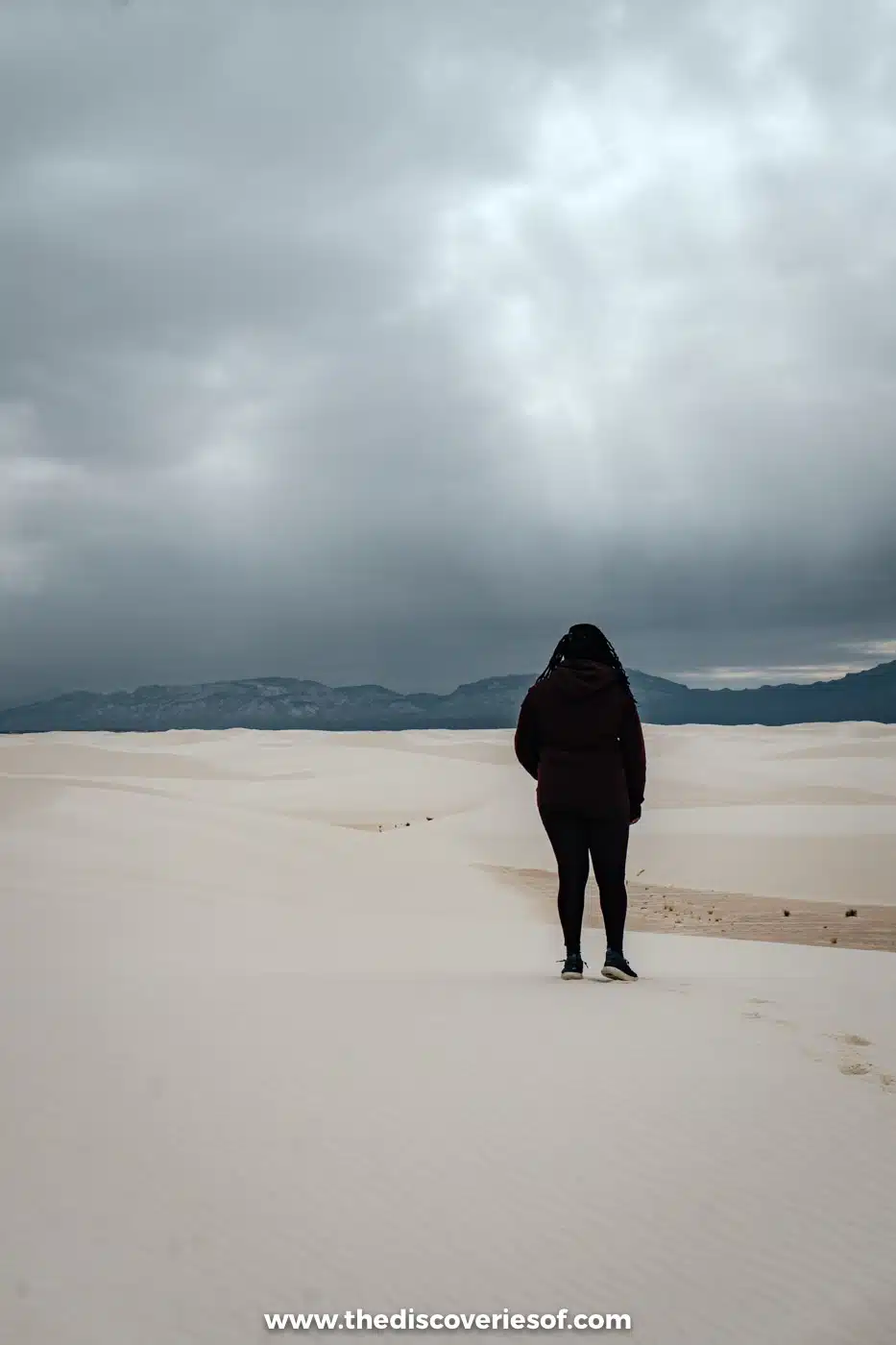
The Alkali Flat Trail is the longest and most challenging of all the hiking trails in White Sands National Park. Don’t let that put you off, though. This is tough! It’s a marked trail over some of the park’s biggest dunes, about 2.5 miles out to the edge of Alkali Flat, the dry lakebed of the ancient Lake Otero, and back again. You’ll find the trailhead about seven miles from the visitor centre.
Despite its name, this trail is anything but flat. You’ll be hiking up and down dunes of around 60 feet the entire way, and through sand the whole time, so don’t attempt it unless you’re ready for a challenge.
If I have to be honest, this wasn’t my favourite trail, as it was pretty hard work. But the views were incredible, and you get right into the midst of the sand dunes.
Make sure you follow the red markers with a diamond symbol to stay on track. It’s not too tricky, but it would be easy to get lost, which would be a huge mistake out here. If you can’t see the next marker (blowing sand can hide them), turn back.
Top Tip
There’s no shade, water or toilets along the trail, so you need to be prepared. The park recommends carrying at least a gallon (4 litres) of water per person, not starting the hike if it’s 85°F (30°C) or hotter, which rules out the middle of the day in summer, and being off the trail by sunset. And if you spot any debris, don’t touch it: the park is surrounded by a missile range, so report it to a ranger.
Sledge down the dunes
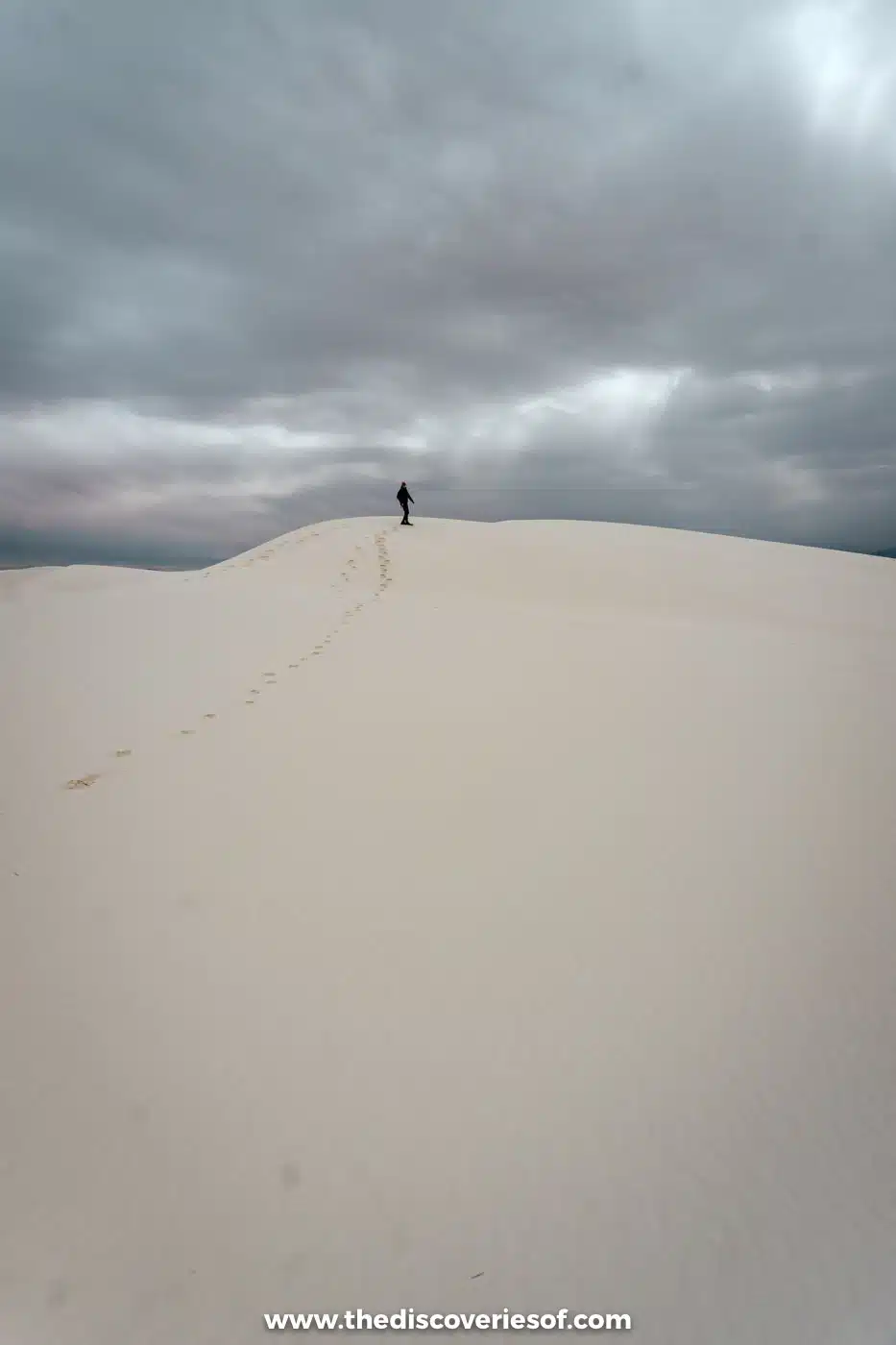
A fun thing to do in White Sands, New Mexico, is sledging down the dunes. Yeah, that’s right, you can sledge down sand, just like with snow. I went sledging on my rainy February visit. If you ask me, sandboarding and sledging the dunes are some of the best things to do in New Mexico.
To start, you’ll need a waxed plastic snow saucer. You can rent or buy one at the White Sands Trading Post, the gift shop at the visitor centre, but I recommend bringing your own if you have one. Just be prepared for a workout: climbing back up the dunes with a sledge can be a real challenge!
It’s ridiculously fun, but for the best time, the park’s website advises choosing a dune with a gently sloping face and a level run-off, well away from the road, car parks and vegetation. Sit or lie with your feet pointing downhill (never head first), don’t stand up, and keep a close eye on young children.
Stop at the visitor centre for ranger tips
Bear with me here. I get it, as usually visitor centres don’t have much to do. This one is the exception, though, and it’s where I started my visit. It’s housed in a Pueblo Revival adobe complex built in the 1930s, with exhibits on the history, geology and wildlife of the dunes, and a 17-minute park film that plays every 30 minutes from 9am.
Also, this is one of the best (and only) spots to fill your water bottle, go to the bathroom and grab anything to eat if you forgot something for your picnic: there’s no water anywhere in the dunefield, and the Trading Post sells bottled water and pre-packaged snacks alongside the sledges. The nearest restaurants and petrol stations are in Alamogordo.
You can also ask the rangers for recommendations and important info, like which trails suit you, how the wind is behaving and whether any missile tests are planned. It’s well worth stopping by before you head out along Dunes Drive.
Catch a desert sunset on a ranger-led stroll
Distance: about half a mile. Time: 45 minutes to an hour. Difficulty: easy, over soft sand and a few moderate dunes.

White Sands boasts majestic dunes, panoramic views of the San Andres and Sacramento mountains and the tranquil Lake Lucero. But one of the best ways to experience the park’s natural beauty is by watching the sun go down, as the dunes turn from white to pink and gold.
A ranger-guided sunset stroll is the perfect way to do it. These leisurely walks run on Fridays, Saturdays and Sundays all year (staffing and weather permitting), and they’re timed to finish as the sun sets: the start time moves from 4pm in midwinter to 7pm in midsummer. You’ll learn about the park’s geology, plants and animals as you go.
The best part is that the stroll is completely free (you just pay the park entrance fee) and you don’t need to book. Meet at the Sunset Stroll sign, on the left just past the Backcountry Camping Loop Trail car park, about eight miles from the fee station.
Top Tip
The stroll goes off the road and over sand dunes, so it isn’t wheelchair or pushchair accessible. If you’d rather watch the sunset on your own, any of the pullouts towards the end of Dunes Drive will do, but keep an eye on the park’s closing time.
Look for animal tracks on the Dune Life Nature Trail
Distance: 1-mile (1.6 km) loop. Time: about an hour. Difficulty: moderate, with two steep dunes.

For the best way to learn about the flora and fauna that thrive in the Tularosa Basin, go on the Dune Life Nature Trail. It takes you into the dunes without too much effort, though you will have to climb two steep dunes of soft, loose sand. I walked it on my February visit.
The Dune Life Nature Trail is where two worlds meet. Sitting on the edge of the dunefield, about 2.5 miles from the visitor centre, it crosses from desert scrub into gypsum dunes. Follow the blue trail markers with a club symbol, and you’ll find yourself in the most vegetated section of the dunefield.
This is also where a lot of the park’s wildlife lives, but you may not see it. Why? Most desert animals are shy (and nocturnal), so look out for their tracks in the sand to get an idea of what went on the night before: lizards, kit foxes, rodents and beetles all leave their marks. In spring, look out for prairie gentian flowering near the start of the trail.
Watch the landscape change on the Playa Trail
Distance: 0.5 miles (800 m) round trip. Time: about 30 minutes. Difficulty: easy and flat.
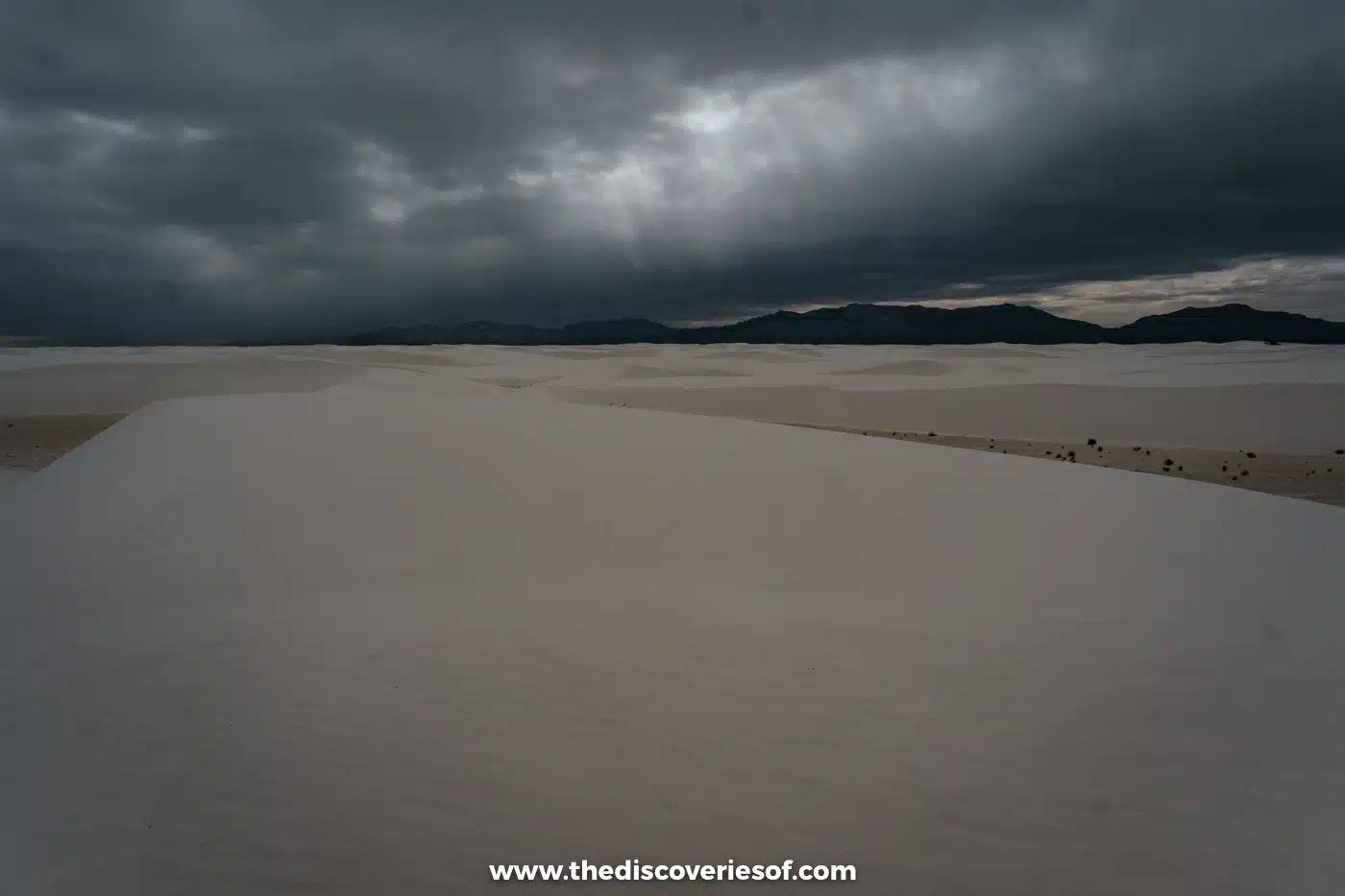
The Playa Trail is another short hike you should make time for, and it’s particularly good if you’re on a road trip and don’t have a lot of time to explore the park. It’s also a gentle warm-up for both experienced and novice hikers, and I walked it on my February visit too.
You’ll find the trailhead about 2.5 miles from the visitor centre. Follow the green trail markers with a heart symbol, and look out for the signs along the path, which explain this chameleon landscape.
What’s most exciting about the Playa Trail is that its scenery keeps changing. A playa is a shallow, low-lying dry lakebed: after heavy rain it can fill with water, at other times it’s crusted white with growing gypsum crystals, and in drier spells it’s a (much less photogenic) brown. Stay on the trail, as footprints damage the fragile biological soil crust.
Top Tip
Download or print a park map before you go. Phone signal is patchy, and the colour-coded trail markers can be hard to spot when the wind has been blowing the sand around.
Walk the Backcountry Camping Loop Trail (no camping for now)
Distance: 2-mile (3.5 km) loop. Time: about 1.5 hours. Difficulty: moderate, with several steep dunes.
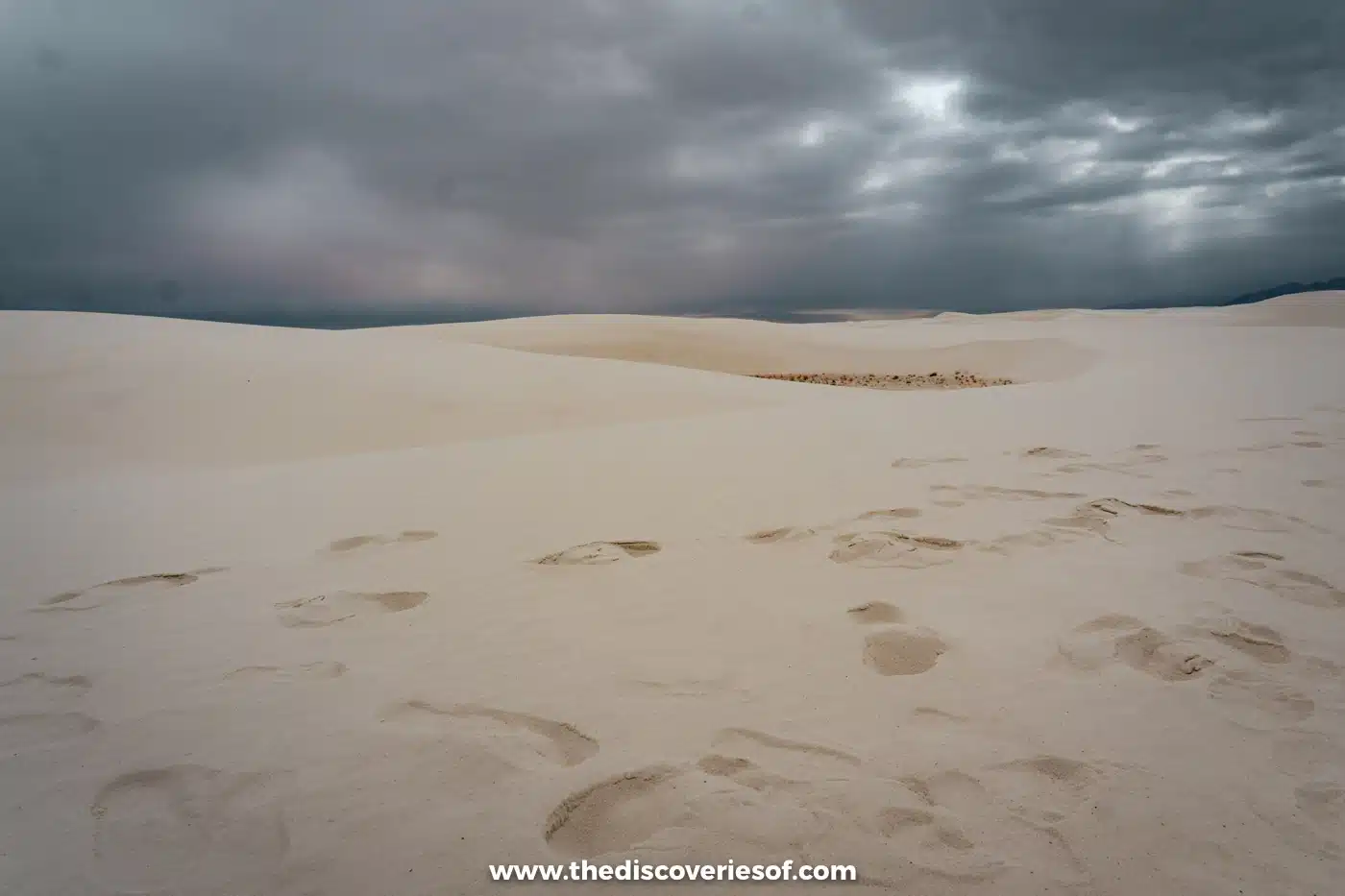
Short on time? The Backcountry Camping Loop Trail is a great alternative to the Alkali Flat Trail for those on a flying visit. It treats you to expansive views of snow-white gypsum dunes without such a long walk. The trail has orange markers with a spade symbol and starts about six miles from the visitor centre, past some vegetation and several steep dunes.
It was built for backpackers heading out to the park’s ten backcountry campsites, where you could once spend a night beneath star-studded skies amongst the dunes. Take my advice, though, and don’t plan your trip around it: backcountry camping is currently closed, and the park says no date has been set for it to reopen. For now, no overnight stays are permitted anywhere in the park.
I’ll level with you, though: even when it was open, camping here was very basic, with no water, toilets or shade. Like most of the hikes here, the trail has no shade either, so bring sunscreen, a cap and plenty of water, and ask at the visitor centre whether the loop itself is open before you set out.
Hike the dunes under a full moon
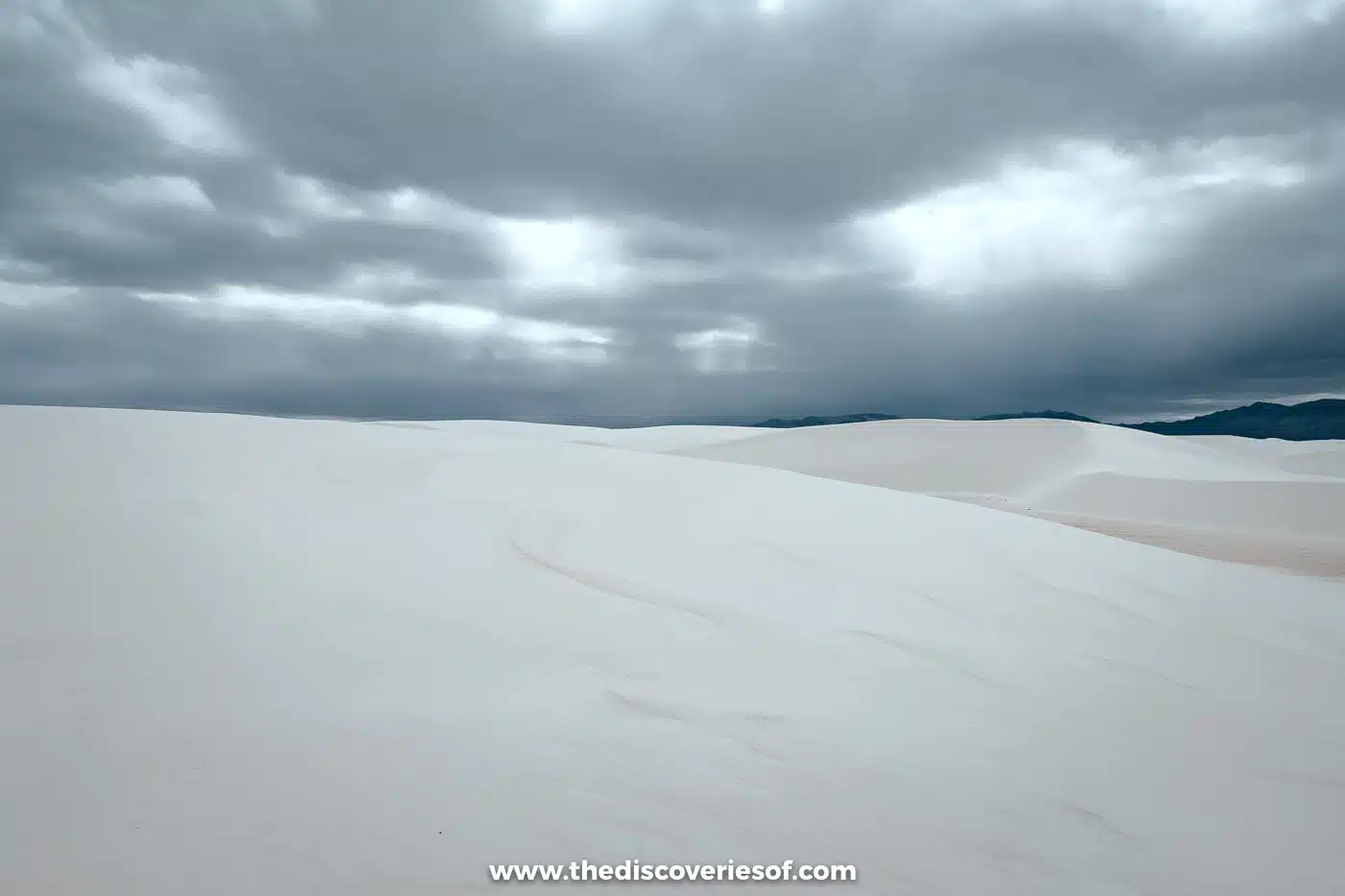
One of the main reasons I, and so many others, love White Sands is that it’s in the middle of nowhere. With no big cities nearby to cause pesky light pollution, the night sky here is spectacular, and moonlight on the white sand is something else.
That said, the park closes in the evening, at a time that changes through the year (around 9pm in midsummer, much earlier in winter), so it’s hard to see after dark on a normal day. Thankfully, I have a solution for you.
Once a month from March to November, rangers lead a Moonlight Hike on a night close to the full moon. It’s a one-mile walk rated moderate, with steep dunes and soft sand, and check-in is at the Dune Life Nature Trail 30 minutes before the start. If you’re lucky enough to time your trip just right, it’s a magical experience.
From May to October, the park also holds Full Moon Nights, when it stays open two hours later than usual on the night of the full moon, with free live music, talks and guest presenters on some dates (park entry fees still apply).
Tickets
Book the Moonlight Hike on Recreation.gov. Tickets go on sale one month before each date at 8am Mountain Time, often sell out within minutes, and there’s no waiting list, so set an alarm.
Rustle up a picnic
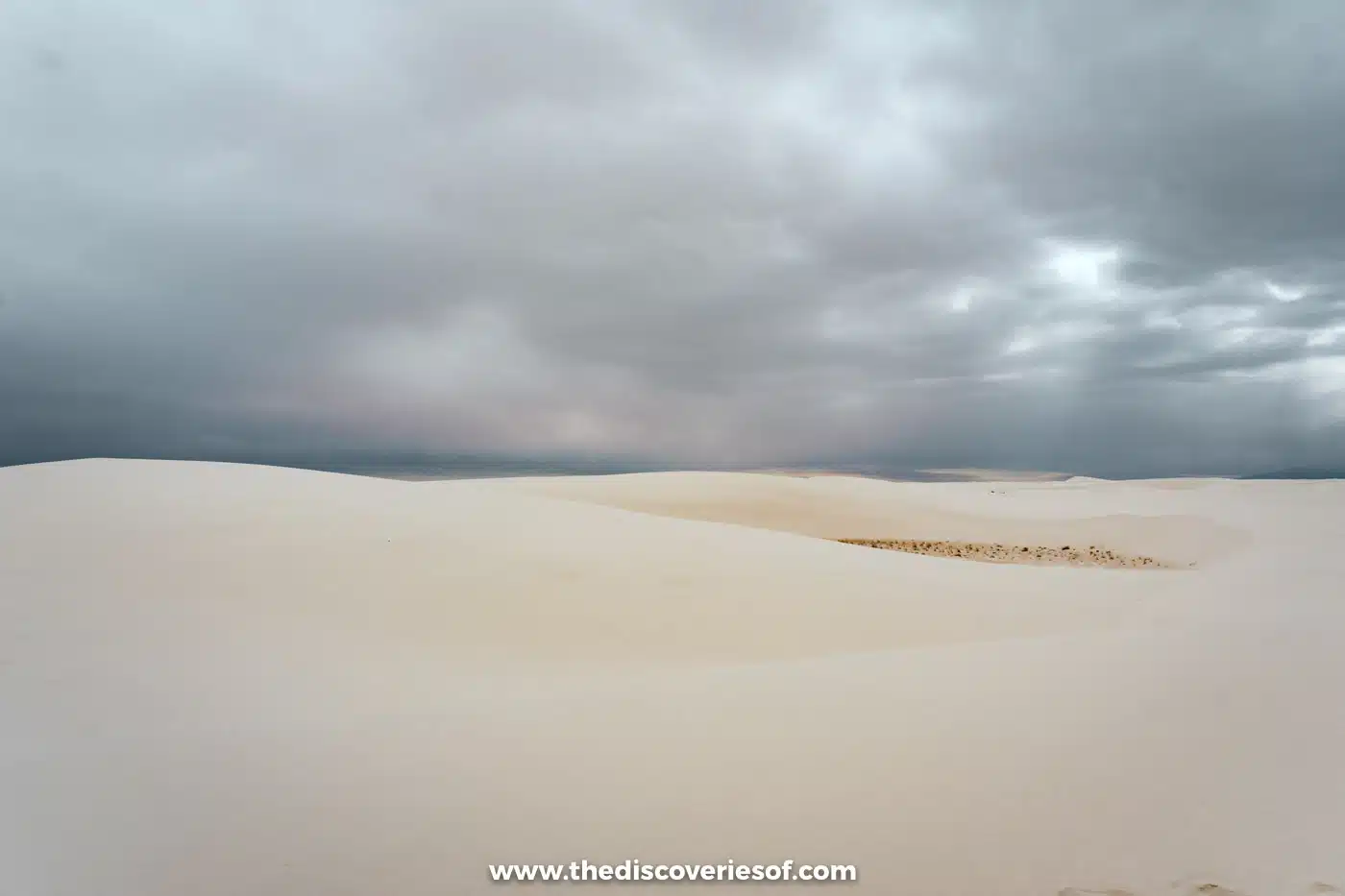
Okay, so these activities are full of fun, but after a while of sledging and hiking, you’ll probably want some lunch. And what better way to eat than a picnic overlooking the magnificent dunes? That’s exactly what I did.
Luckily for you, the park has three picnic areas off Dunes Drive, Yucca, Roadrunner and Primrose, with 62 shaded tables between them. Trust me, you’ll be happy these provide sun cover, as it can get relentlessly hot here (bring high-SPF sunscreen).
Every table has an elevated grill, and you can bring your own grill to use in the picnic areas and at the Dunes Drive pullouts. Leave the charcoal in the park grills and douse it with water, and take your own charcoal home with you. Groups can book the Group Use Area, while the Roadrunner pavilions are first come, first served.
Join a ranger tour to Lake Lucero

If you’re looking for a truly once-in-a-lifetime experience, visit Lake Lucero on a ranger-guided tour. This dry lakebed in the south-west corner of the park is where the dunes are born: gypsum washed down from the surrounding mountains forms selenite crystals here, which the wind breaks down into the grains that build the dunefield.
What’s more, it’s a fun walk, as you see exposed selenite crystals up close, and the rangers are knowledgeable about the area’s geology and history. The tour runs once a month from November to March, starting at 10am. You meet at the Small Missile Range gate at mile marker 175 on US 70, then drive your own car in a ranger-led caravan 17.5 miles across missile range land to the trailhead, followed by a 1.5-mile round-trip walk over rough, uneven ground. Plan to be outside for several hours.
Tickets
Book the Lake Lucero tour on Recreation.gov. Tickets go on sale one month before each tour at 8am Mountain Time and sell out fast. Bring plenty of fuel and a spare tyre, as there are no services on the way.
Explore Alamogordo
Once you’ve had enough of sandy toes and desert hikes, it’s time to head back to civilisation, and one of the top things to do near White Sands National Park is to visit Alamogordo, about 15 miles east of the visitor centre. It’s where I stayed, at the Home2 Suites, and it’s the most practical base for the park.
There are a couple of things to do in and around the town. The New Mexico Museum of Space History tells the story of the region’s rocket and space research, with the International Space Hall of Fame, the John P. Stapp Air and Space Park and the New Horizons Dome Theater and Planetarium (it’s closed on Tuesdays, and the fifth floor is closed for renovation). The Alameda Park Zoo, which opened in 1898, is one of the oldest zoos in the Southwest.
It’s also where you’ll find restaurants, coffee and petrol. For Mexican food, Rizo’s Restaurant on North White Sands Boulevard does fajitas, carne asada and breakfast burritos (it’s closed on Mondays). Heading north on US 54, stop at McGinn’s PistachioLand to see the world’s largest pistachio, a 30-foot sculpture, and try the pistachios grown on the farm. Thank me later.

See thousands of petroglyphs at Three Rivers
About an hour’s drive north of the park, the Three Rivers Petroglyph Site is one of the best places in the Southwest to see rock art up close. More than 21,000 petroglyphs cover a basalt ridge above the Tularosa Basin, carved by the Jornada Mogollon people between about AD 200 and 1450 by chipping away the rock’s dark surface: masks, birds, bighorn sheep and geometric designs.
A rugged half-mile trail climbs along the ridge from the visitor shelter, with views across the basin to the Sacramento Mountains. A second short trail leads to a partially excavated village. The site is run by the Bureau of Land Management, 17 miles north of Tularosa on US 54.
Tickets
Day use costs $7 per vehicle. The site is open year-round, and its visitor centre opens from 9am to 4pm (closed on Tuesdays and Wednesdays). Pets aren’t allowed on the trails.
Hike into Dog Canyon at Oliver Lee Memorial State Park
Where the Sacramento Mountains rise sharply from the desert floor, about 24 miles south-east of the park, Oliver Lee Memorial State Park sits at the mouth of Dog Canyon, a spring-fed canyon cutting into the escarpment. It’s 8 miles south of Alamogordo on US 54, then 4 miles east on Dog Canyon Road.
The big draw for hikers is the Dog Canyon Trail, a strenuous route that climbs more than 3,000 feet up the canyon towards the rim of the mountains, so most people walk a section and turn back. Expect a big view back across the Tularosa Basin to the white line of the dunes.
The park also has one of the closest developed campgrounds to White Sands, with electric and dry sites and showers, which makes it a handy base now that the park itself has no overnight stays. Entrance construction is under way until about December 2026, and the historic Oliver Lee ranch house is closed for renovation.
Visit the White Sands Missile Range Museum
The missile range that surrounds the park is the reason for those road closures, and its museum tells the story. The White Sands Missile Range Museum, off US 70 east of Las Cruces, covers the history of the range, from the early rocket tests with captured V-2s to the Trinity Site, where the first atomic bomb was detonated in 1945. Outside, Missile Park displays dozens of rockets and missiles.
Getting in takes a little planning, as the museum is on an active military base. Every visitor needs a visitor’s pass and a background check from the Las Cruces Gate Visitor Control Center (US citizens need a REAL ID-compliant ID and can pre-register online at least 24 hours ahead; non-US citizens need a passport). You then leave the car and walk about five minutes to the museum.
Tickets
The museum opens from 10am to 4pm, Tuesday to Saturday (closed on federal holidays), and Missile Park is open from dawn to dusk daily. The Visitor Control Center is usually closed at weekends, when passes are issued at the gate.
Tips for visiting White Sands
- Hours, fees and closures: the park opens at 7am every day except Thanksgiving and Christmas Day, and closing time varies through the year. Entry is $25 per vehicle and valid for seven days. The America the Beautiful pass covers it too ($80 for US residents, $250 for non-residents from 2026), so it’s always worth buying if you’re going to visit more than a couple of national parks in a year. Check the closures page the day before: missile tests can close Dunes Drive, and US 70 between Alamogordo and Las Cruces, for up to three hours.
- When to go: it’s really quiet in the winter months, and February was blissfully crowd-free, though I didn’t have the best weather (it was raining for part of the day). Summer is busier and can get ridiculously hot, spring brings strong winds, and autumn is the sweet spot. My guide to the best time to visit White Sands has the month-by-month detail.
- What to bring: the sun can be brutal (and deadly), and the white sand reflects it straight back at you, so wear sunscreen and a hat and bring plenty of water: a gallon per person per day, in a big water bottle or two. Bring a buff, sunglasses and closed-toe shoes to protect you from the sand. No need to thank me.
- How long to spend: you can see the highlights in one day, from Dunes Drive and the Alkali Flat Trail to sledging and the boardwalk. Las Cruces is about an hour away and El Paso about an hour and a half, while Albuquerque is around three and a half hours each way, so it works better as a stop on a road trip than a day trip from there.
- Where to stay: with no overnight stays in the park, base yourself in Alamogordo, the closest town. I stayed at Home2 Suites by Hilton Alamogordo, a clean, great-value hotel with super-spacious rooms and kitchenettes, less than half an hour’s drive from the park, and the Hampton Inn Alamogordo is another good choice. More options, including campgrounds, in my guide to where to stay near White Sands.
Map
Read next
- When’s the best time to visit White Sands National Park?
- Where to stay near White Sands National Park
- The best hikes in New Mexico
- Things to do in New Mexico: what to do in NM
- The ultimate New Mexico road trip
- Brilliant things to do in Arizona
- The ultimate Arizona road trip
- Unmissable things to do in Tucson
- Hikes in Saguaro National Park
Love this? Save and share on Pinterest

Discover the top things to do, insider tips and hidden gems in our USA Travel Guides.
Read the guides →




