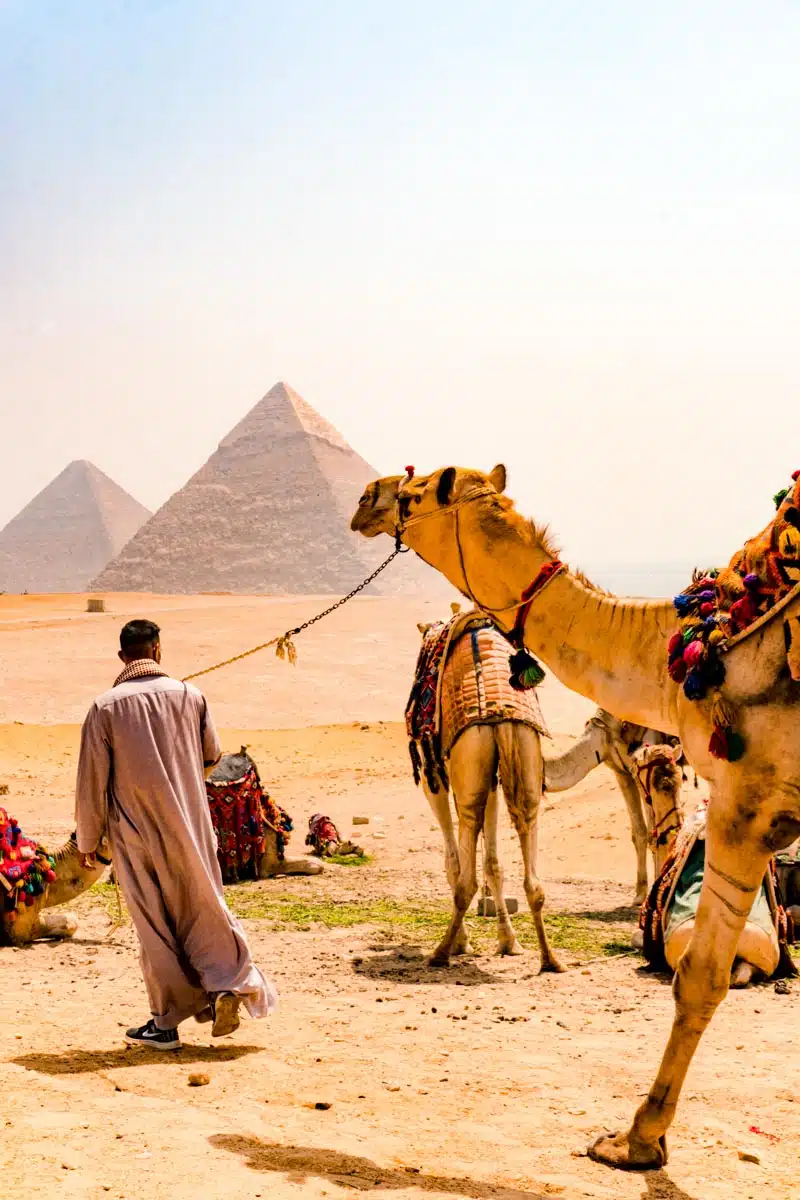
The Pyramids of Giza are the last of the Seven Wonders of the Ancient World still standing, and seeing them in person is every bit as surreal as you’d hope. Here’s how to plan your visit, what to see on the plateau, and whether it’s worth paying extra to go inside.
Can we talk about the pyramids for a minute?
I’d seen them in so many photos and films that I half expected them to feel familiar. They didn’t. Khufu, Khafre and Menkaure: together they’re a striking triumvirate that I am not ashamed to say I lost my sht over when I saw them in real life. Did I have a minor “moment” standing in front of a structure that has been there for more than 4,500 years? Yes.
I visited on the first full day of my Egypt trip in late May, and I paid extra to go inside the Great Pyramid, which meant crawling up a tunnel about a metre high and a metre wide in the sweltering heat to reach Khufu’s burial chamber. More on that below.
This guide covers the essentials: tickets and opening hours (including the new visitor entrance and the shuttle buses that now run around the plateau), what to see in the order you’ll reach it, how to get there, and the scams to watch out for.
At a glance
- Location: the Giza Plateau, on the west bank of the Nile, about 15 to 20 km from central Cairo
- Ticket: 700 EGP for adults, 350 EGP for students; going inside the Great Pyramid is an extra 1,500 EGP
- Opening hours: daily from 7am; last entry about an hour before closing (5pm in summer, 4pm in winter)
- Getting in: the main entrance is now the visitor centre on the Fayoum road, and free electric shuttle buses link the main sights
- Payment: card only (Visa or Mastercard) at the ticket office
- Time needed: three to four hours, more if you go inside a pyramid
- Best time: as soon as it opens, before the heat and the tour coaches
Why the Pyramids of Giza live up to the hype
Are these pyramids really worth the trip? In short: yes.
They’re the centrepiece of “Memphis and its Necropolis”, a UNESCO World Heritage Site that stretches from here to Dahshur, and they were built by one of the world’s oldest civilisations. The Great Pyramid, built for the pharaoh Khufu (known in Greek as Cheops) around 2560 BC, is the only one of the Seven Wonders of the Ancient World still standing. It was the tallest structure made by human hands for nearly 3,900 years, until the spire of Lincoln Cathedral overtook it in the 14th century.
The three main pyramids belong to three generations of the same royal family, of Egypt’s Fourth Dynasty. Khufu built the first and largest. His son Khafre (Chephren) built the second, and the Sphinx is thought to have been part of his complex. Menkaure (Mycerinus), probably Khafre’s son, built the third and smallest.
Each pyramid was the heart of a funerary complex, with a mortuary temple against its east face, a causeway down to a valley temple near the edge of the Nile floodplain, and smaller pyramids and tombs for queens and courtiers around it. The pyramids were meant to protect the king’s body for the afterlife, along with everything he would need there, though their treasures were plundered in antiquity.
How were the pyramids built?
According to the Greek historian Herodotus, it took 100,000 men 20 years to build the Great Pyramid. But Herodotus was writing some 2,000 years after the event, so there are questions about the validity of his claims.
The reality is that no one is quite sure exactly how they were built, but archaeology has filled in a lot of the picture. Excavations south of the plateau have uncovered the town where the workers lived, with bakeries, breweries and barracks, and the tombs where they were buried, close to their kings. They weren’t slaves, as people once assumed, but a skilled, organised and fed workforce, probably numbering in the low tens of thousands at any one time, with farmers rotating in to help.
The Great Pyramid alone contains around 2.3 million blocks, most of them limestone quarried on the plateau itself, with finer white limestone for the casing brought from Tura across the river and granite for the burial chamber shipped some 900 km from Aswan. In 2013, archaeologists found papyri at Wadi al-Jarf on the Red Sea, including the logbook of an official called Merer, which records his team ferrying casing stones from Tura to the building site during Khufu’s reign.
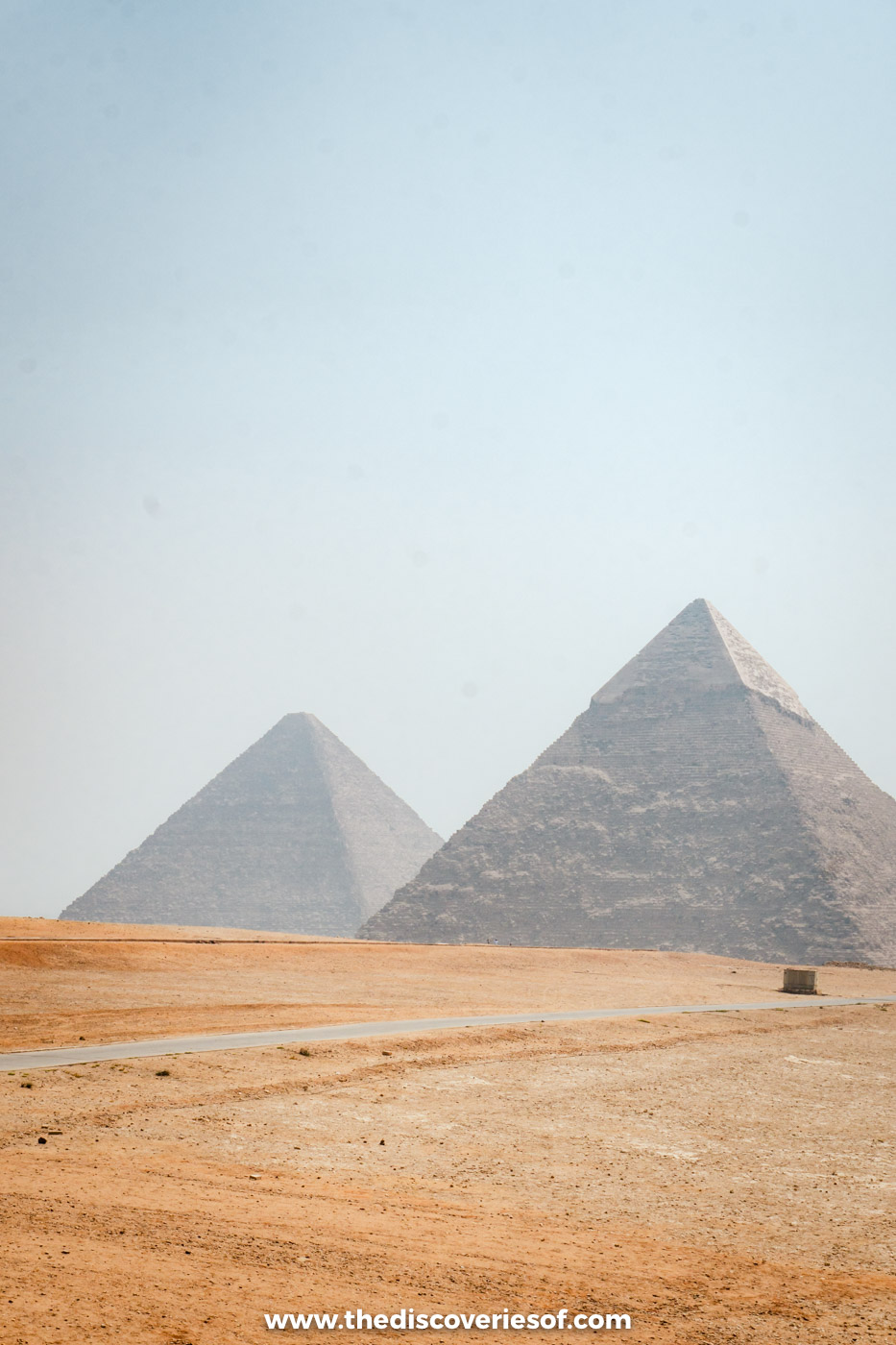
The pyramids would have looked very different originally, with a smooth, polished casing of white limestone that would have gleamed in the desert sun. Most of it was stripped away in the Middle Ages, much of it after an earthquake in 1303, and reused to build medieval Cairo. That’s why you now see the stepped core blocks, and why Khafre’s pyramid, with a patch of casing still clinging to its top, looks different from the other two.
What you’ll see on the plateau
The new visitor centre is on the south side of the plateau, so most people now start at the panoramic point and Menkaure’s pyramid and work round to the Sphinx and the Great Pyramid, or take the shuttle straight to the Great Pyramid first if they have a ticket to go inside. The free electric buses stop at the panorama, each of the three pyramids, the Sphinx and the Khufu area.
The Great Pyramid of Khufu
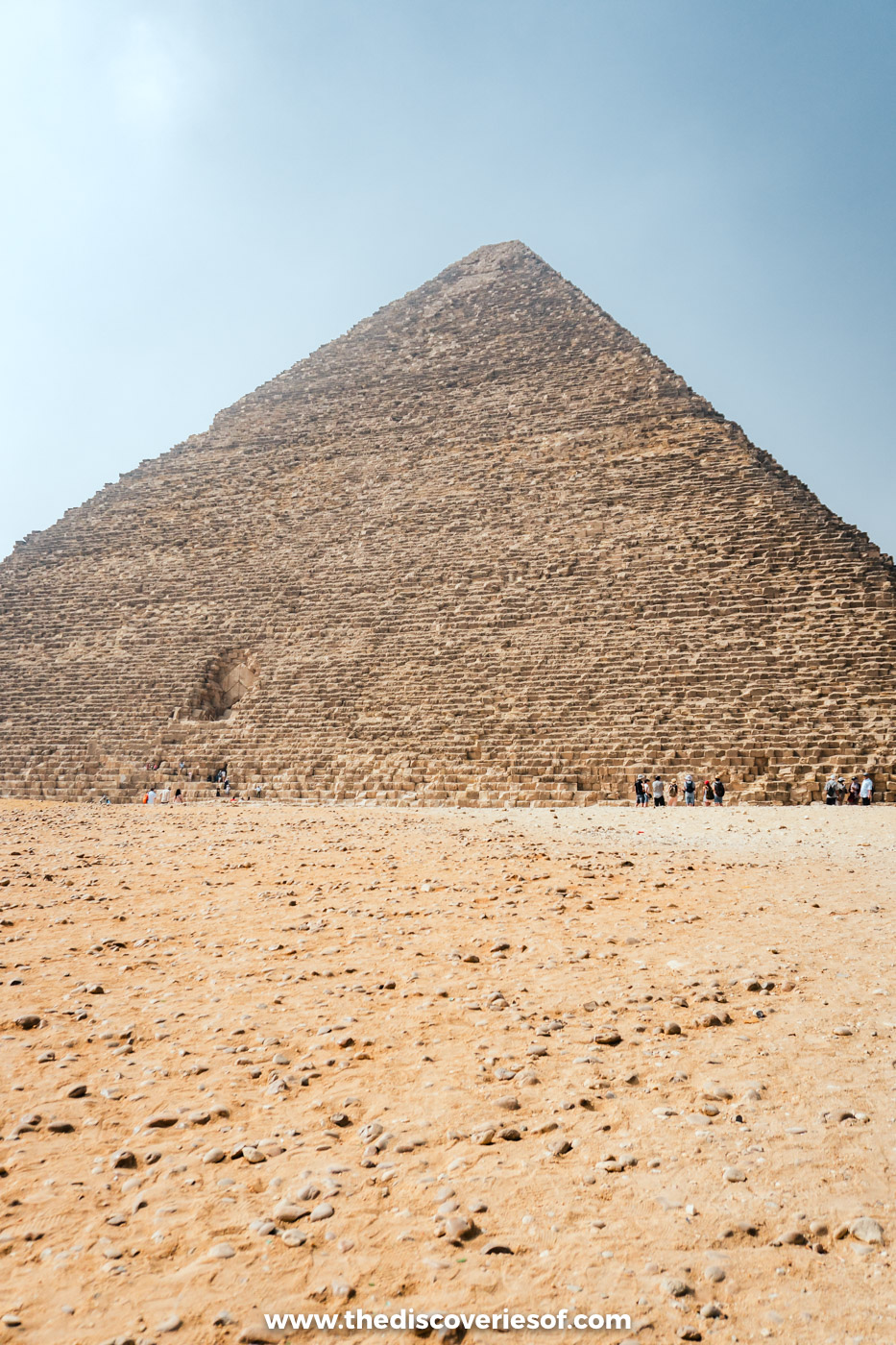
Nothing quite prepares you for the size of it. The Great Pyramid was about 146 metres tall when it was finished. It’s now around 138 metres, having lost its top courses and its casing, and each side of its base is about 230 metres long. Up close, the individual blocks are taller than your waist, and you can see visitors dotted along the lower courses for scale.
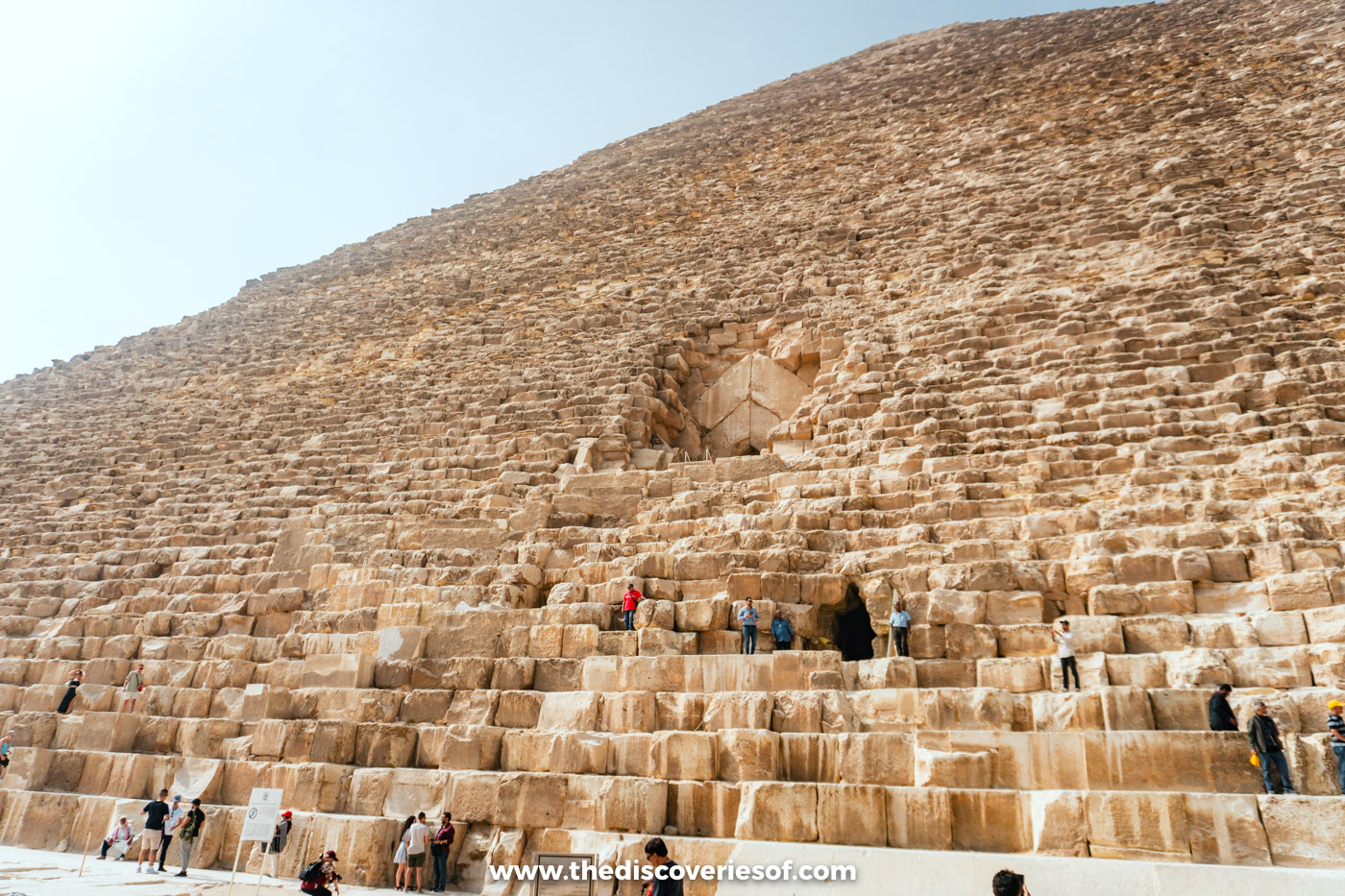
The entrance for visitors is on the north face, a few courses up. It isn’t the original entrance (you can see that higher up, under its great gabled blocks) but a tunnel said to have been forced by the men of the Abbasid caliph al-Ma’mun in the ninth century.
Going inside the Great Pyramid
If you think the pyramids are incredible from the outside, wait until you get inside. I opted to go inside the Great Pyramid and would definitely recommend you do the same.
There isn’t a tonne to see inside, but I’d still recommend it because a) how often do you get to say you went inside the Great Pyramid of Giza; and b) doing so is actually kind of crazy. You have to crawl upwards through a tunnel that’s about 1m by 1m in the sweltering heat before you emerge into a grand gallery, followed by the King’s Chamber with its (long-empty) sarcophagus.
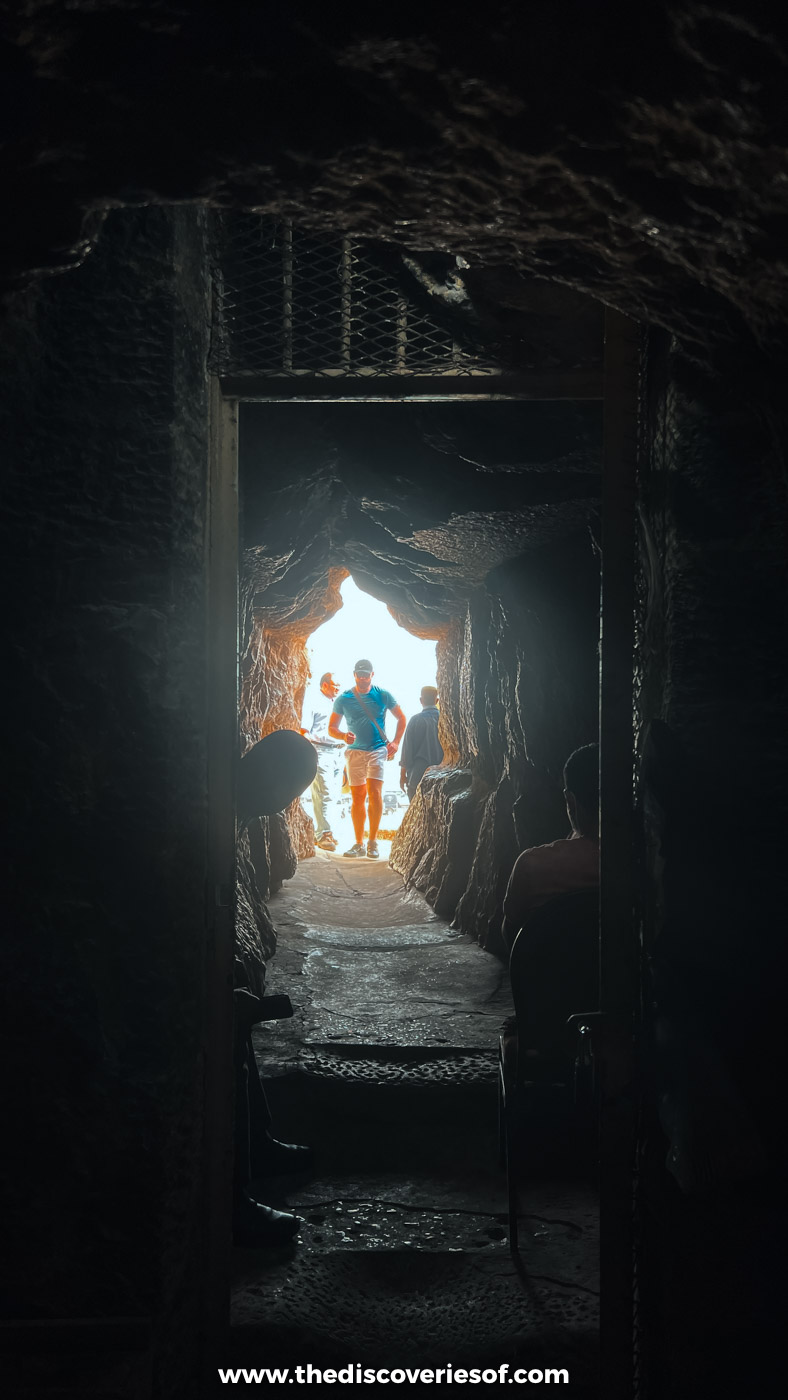
That tunnel is the ascending passage: around 39 metres of stooping and shuffling up a steep wooden ramp, with people coming the other way. Then the ceiling suddenly soars. The Grand Gallery is about 47 metres long and more than 8 metres high, with walls that step inwards as they rise, and it’s one of the most extraordinary spaces to survive from the ancient world.
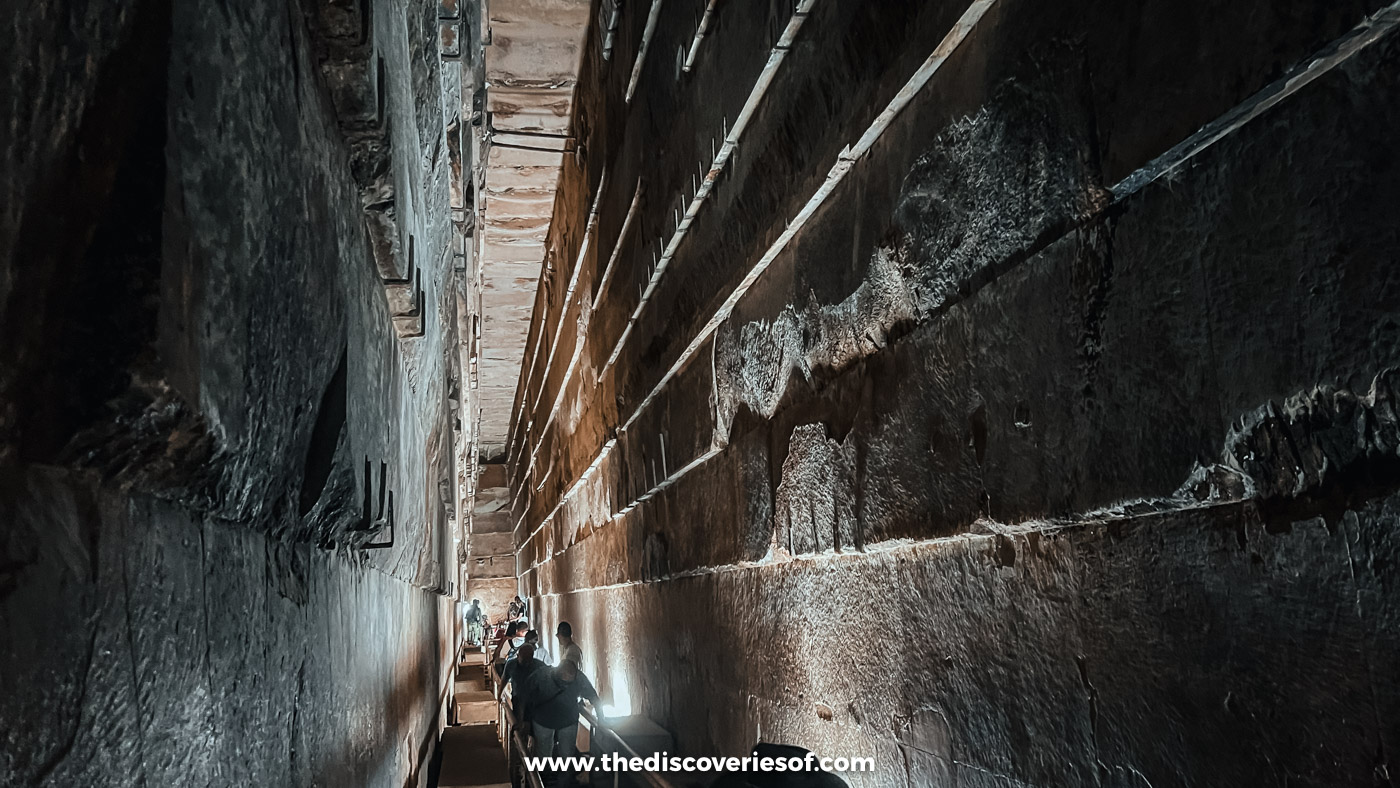
At the top, you duck through a low antechamber into the King’s Chamber, built entirely of red granite from Aswan. It’s bare apart from the lidless granite sarcophagus at its western end. It was quite a surreal experience, and I’ll warn you: it’s probably not one for the claustrophobic. But there was something about standing inside an ancient wonder of the world and seeing Khufu’s sarcophagus.
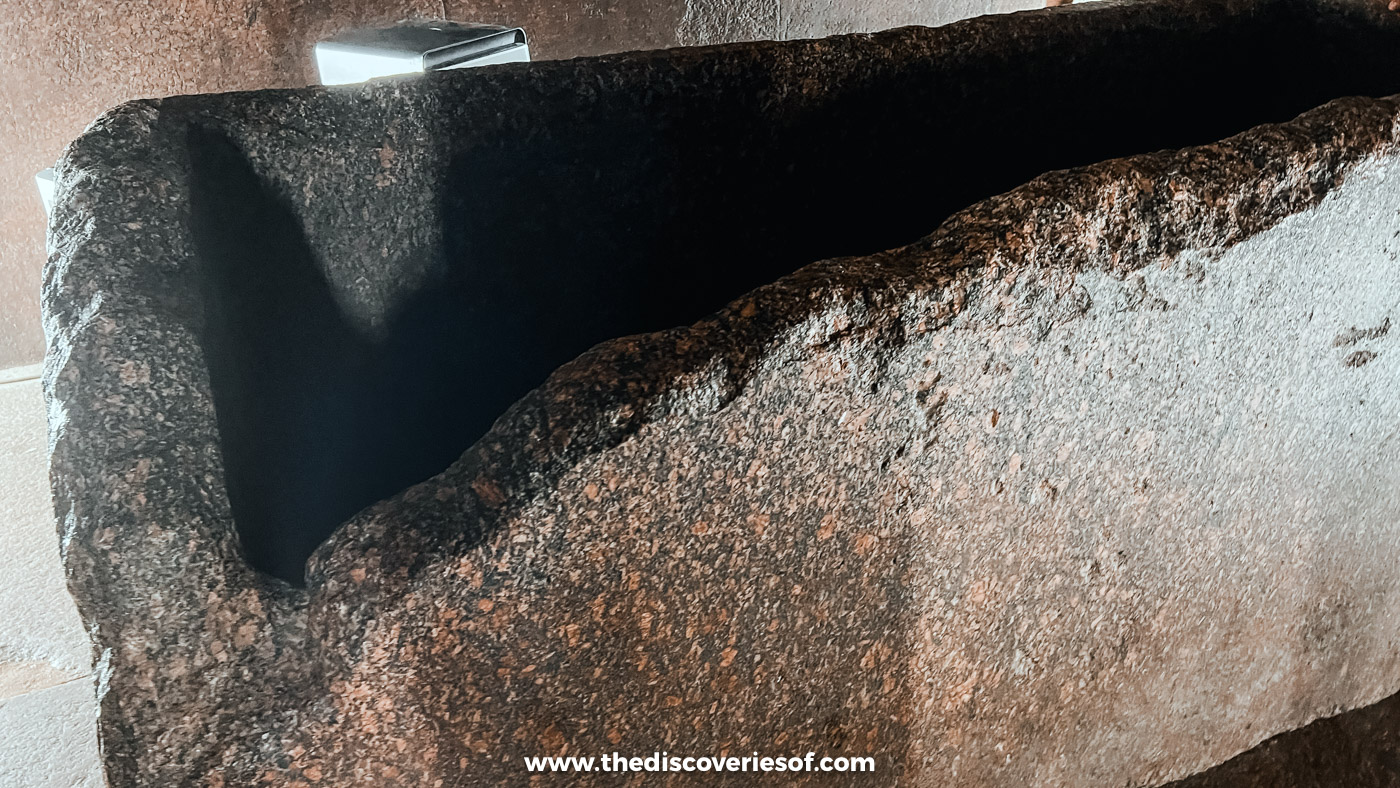
Want to take a sneak peek? Here’s what it looked like when I went in.
The extra ticket costs 1,500 EGP, and numbers are capped at around 150 a session, so buy it when you arrive, or online in advance. It’s hot, humid and steep inside, with handrails but not much room to pass, so give it a miss if you have mobility problems or don’t like tight spaces. Allow 30 to 45 minutes. If the price puts you off, Khafre’s pyramid is a much cheaper way to see inside one.
The Pyramid of Khafre
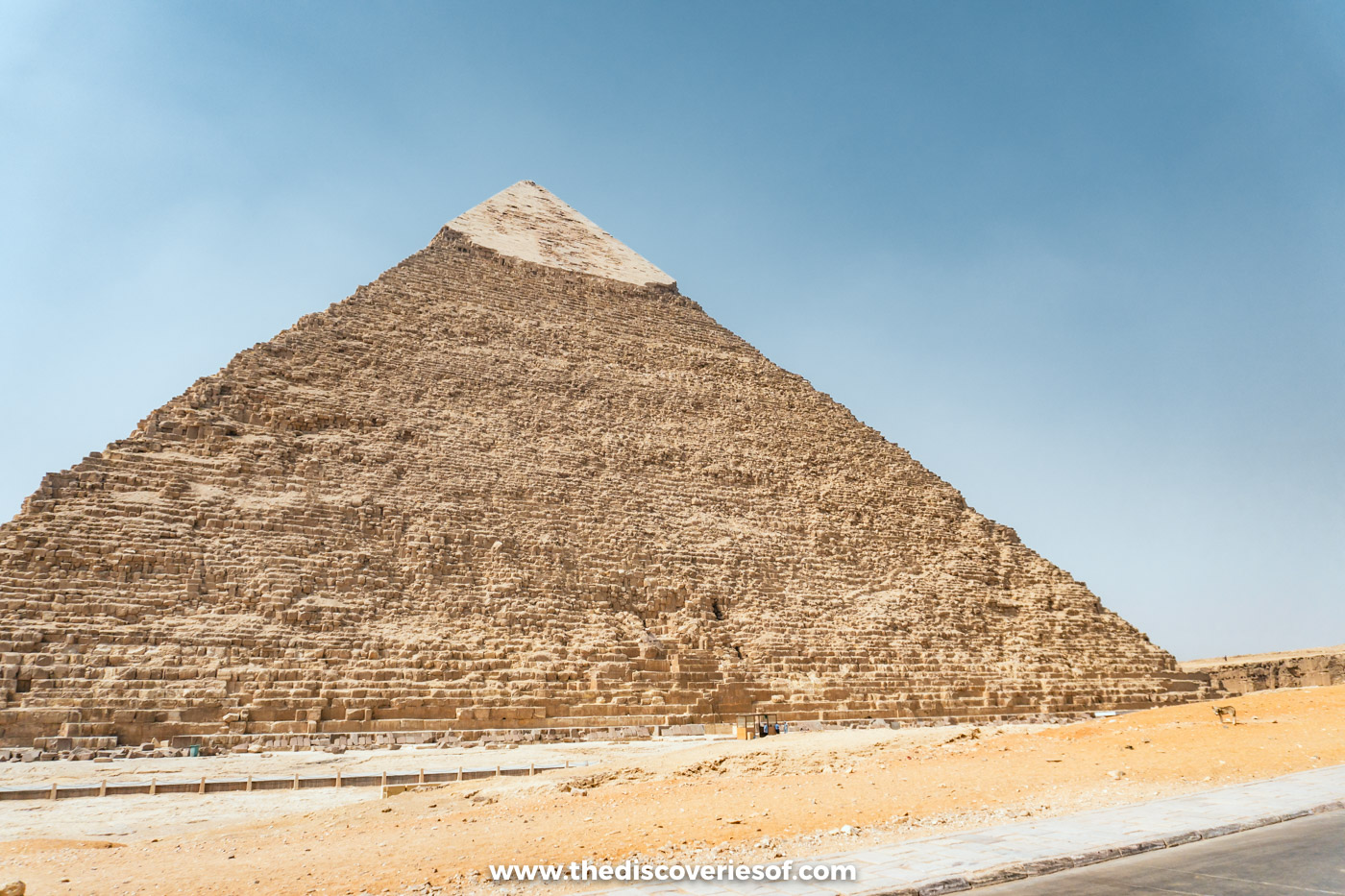
The second pyramid was built for Khufu’s son Khafre. It was a little shorter than his father’s (about 143 metres originally, 136 metres now), but it stands on higher ground, so from many angles it looks like the tallest of the three. Look for the cap of smooth casing stones near the summit: it’s the best idea you’ll get of how all three once looked.
Inside, a descending and then horizontal passage leads to a burial chamber cut into the bedrock, with Khafre’s granite sarcophagus sunk into the floor. On the wall, look out for the graffiti left by the Italian explorer Giovanni Belzoni, who found the way in in 1818. The extra ticket costs around 280 EGP, and it’s usually much quieter than the Great Pyramid.
The Pyramid of Menkaure and the queens’ pyramids
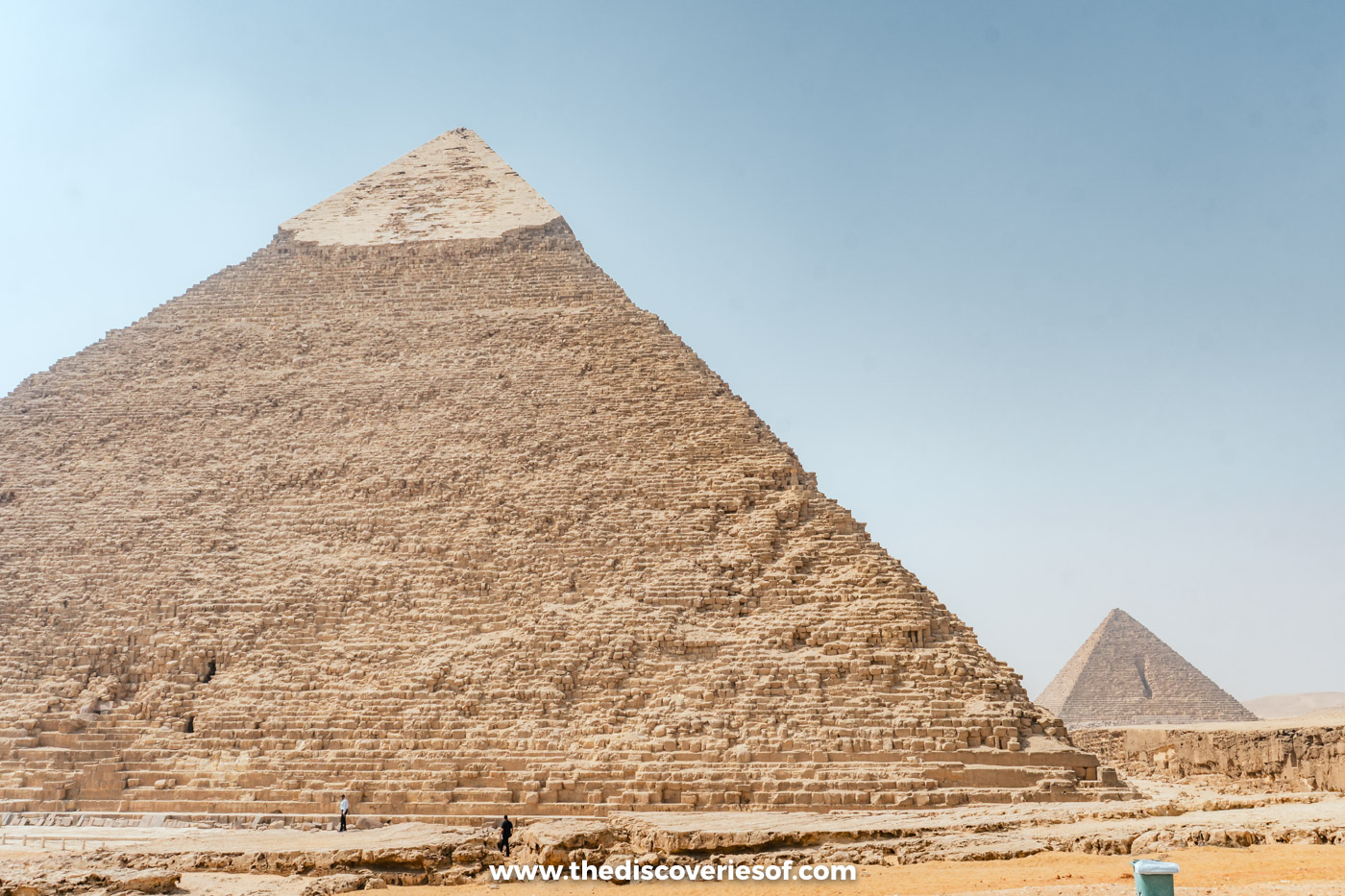
The third pyramid, built for Menkaure, is much smaller, at around 65 metres originally, but it was the most lavishly finished: its lower courses were cased in red granite from Aswan, and some of it is still in place. Three small queens’ pyramids stand in a row on its south side. The interior has its own ticket (around 280 EGP) when it’s open, but it closes from time to time for restoration, so check at the ticket office.
The Sphinx and the Valley Temple
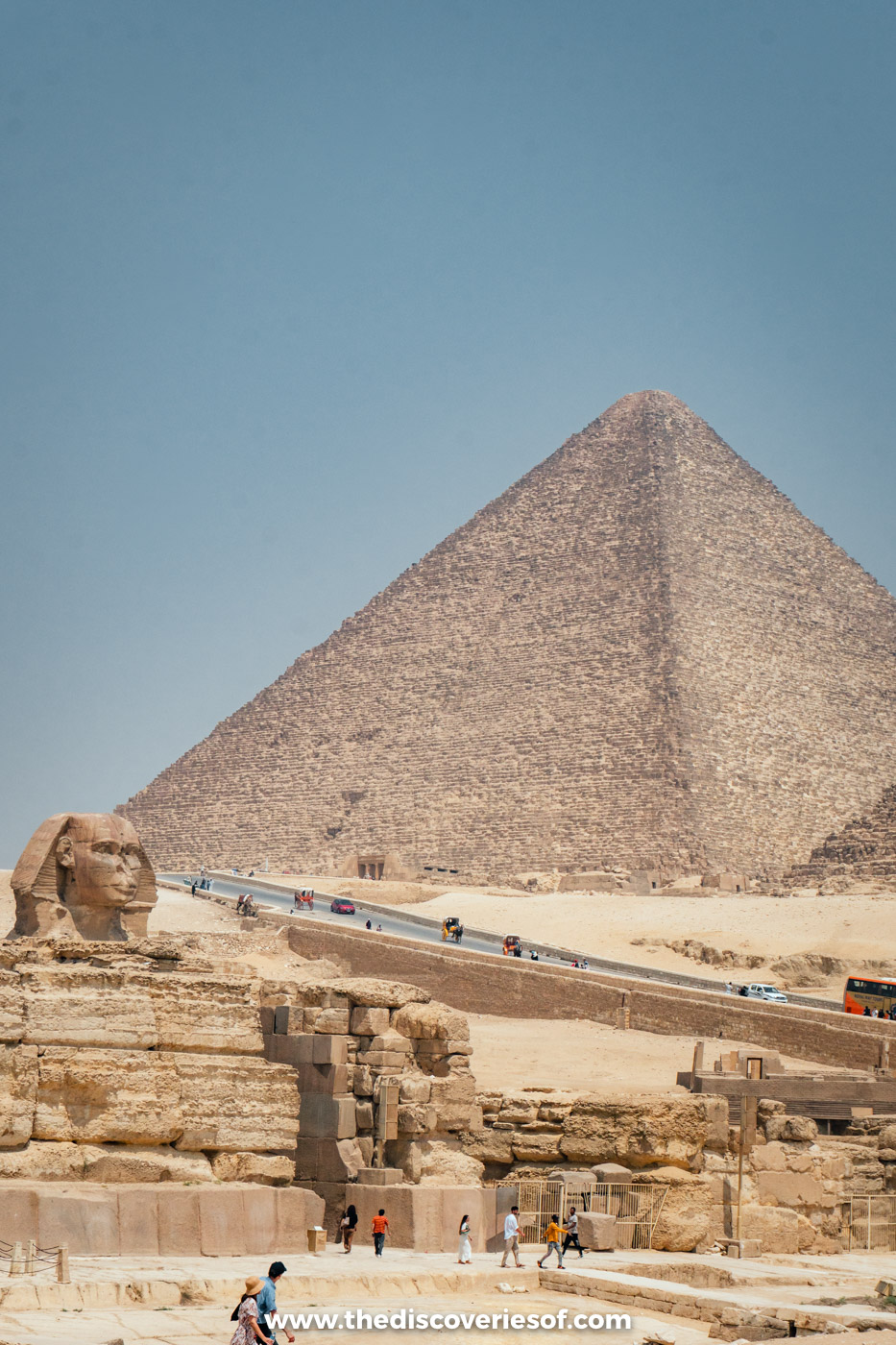
If the pyramids are the must-see, the Sphinx isn’t far behind. Carved from a single outcrop of limestone bedrock, it’s about 73 metres long and 20 metres high, with the body of a lion (for power) and the head of a king (for wisdom).
It’s usually thought to have been built for Khafre, as part of his funerary complex, an idea supported by its position beside his causeway and by the likeness of its face to other depictions of him. Others say otherwise, and historians have argued over it for centuries. Why not take a look for yourself and see what you think?
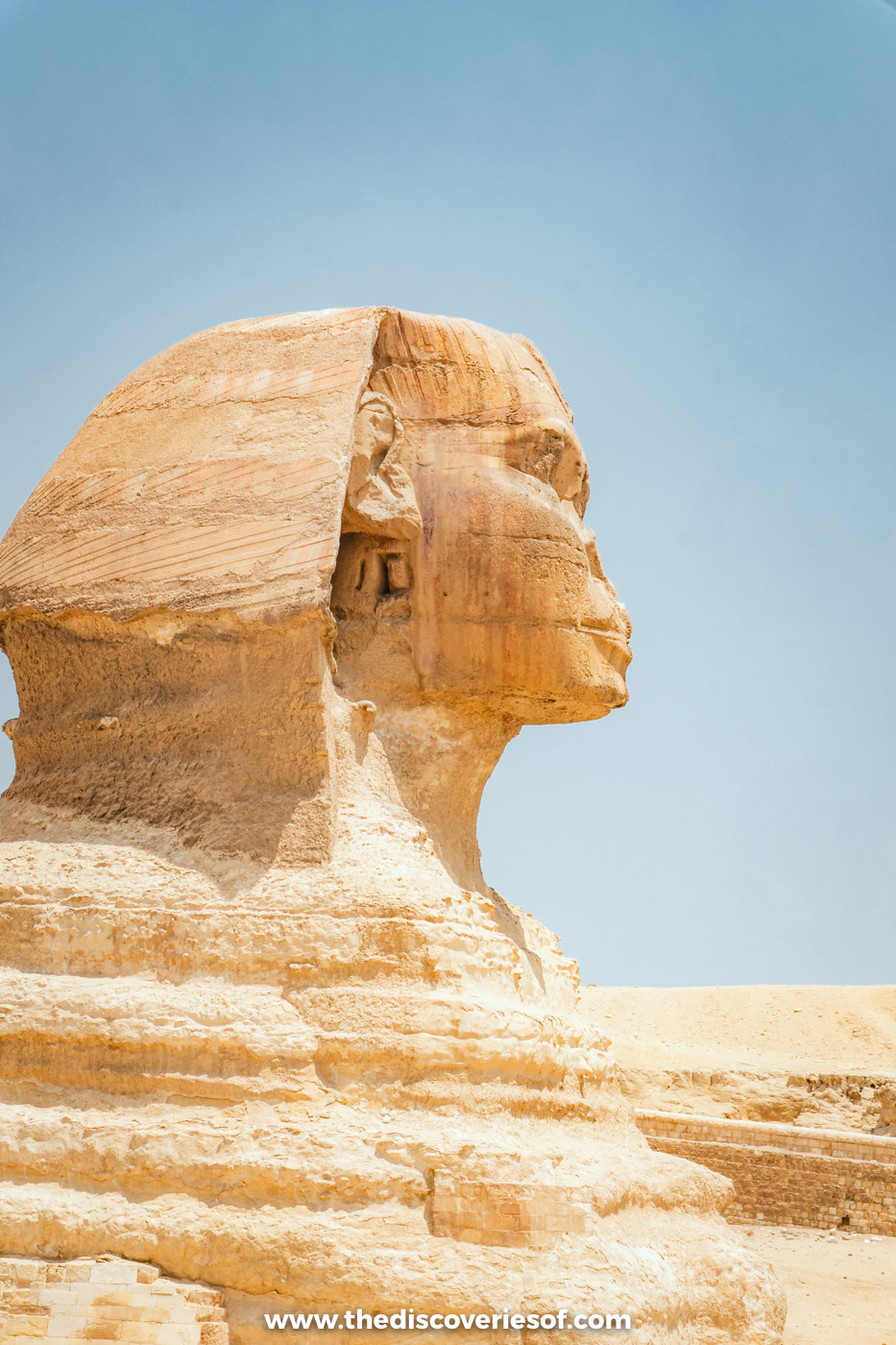
You’ll notice the Sphinx is missing its nose and its beard. Nobody knows for certain when the nose was lost (the story that Napoleon’s soldiers shot it off is a myth). Fragments of the beard are in the British Museum in London and the Egyptian Museum in Cairo.
You can’t walk up to the Sphinx itself, but the path from the Valley Temple of Khafre brings you out on a terrace right in front of it. Don’t rush the temple: its core blocks of limestone are even bigger than the pyramids’ (some weigh more than 100 tonnes), and its halls are lined with polished red granite from Aswan.
The panoramic point
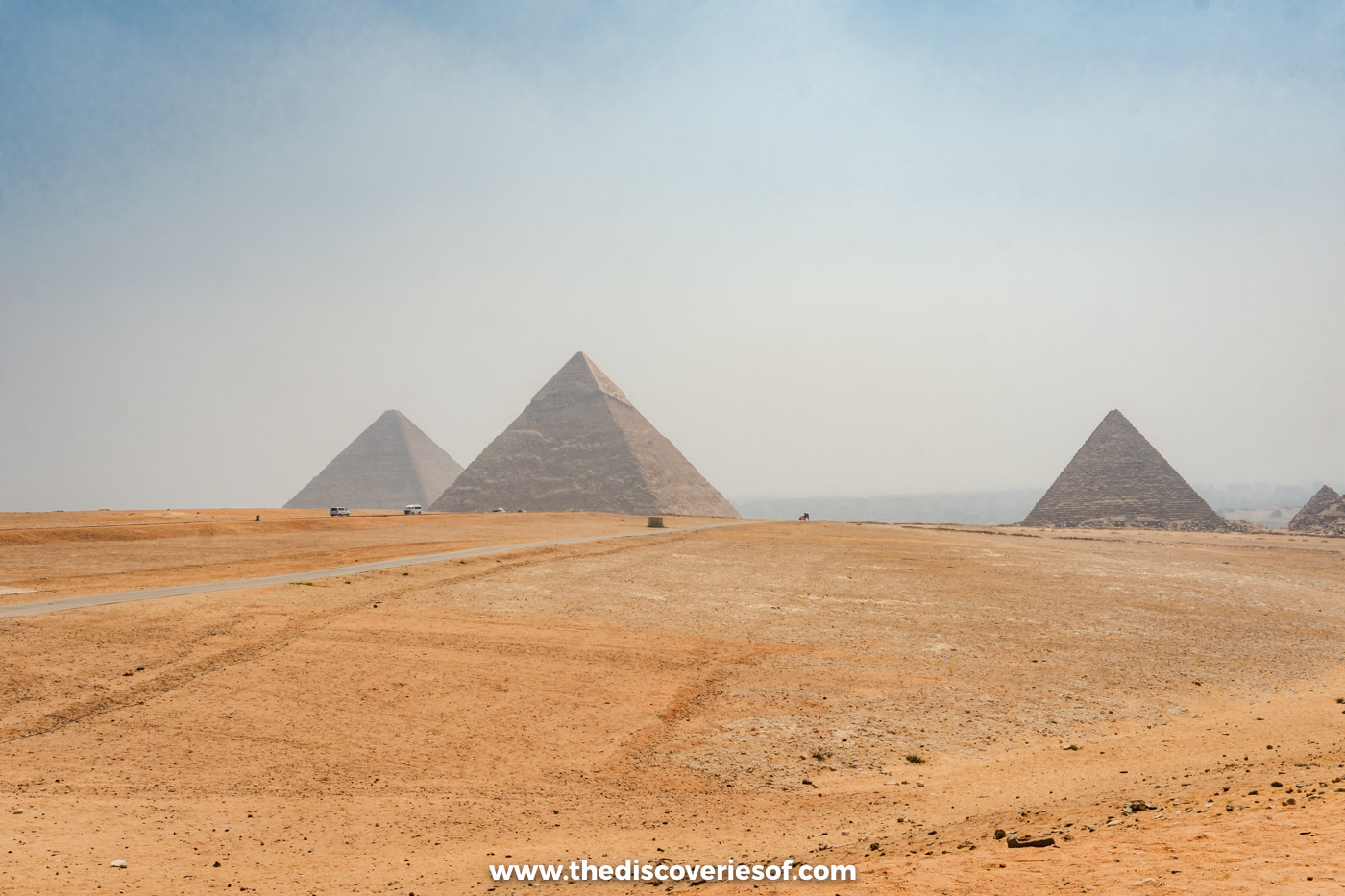
For the classic view of all three pyramids together, go to the panoramic point, on the desert ridge to the south-west of Menkaure’s pyramid (my guide’s tip, and it’s a good one). The shuttle bus stops here. It’s the best place for photos, and on a clear morning you can see the three main pyramids and the queens’ pyramids lined up across the sand.
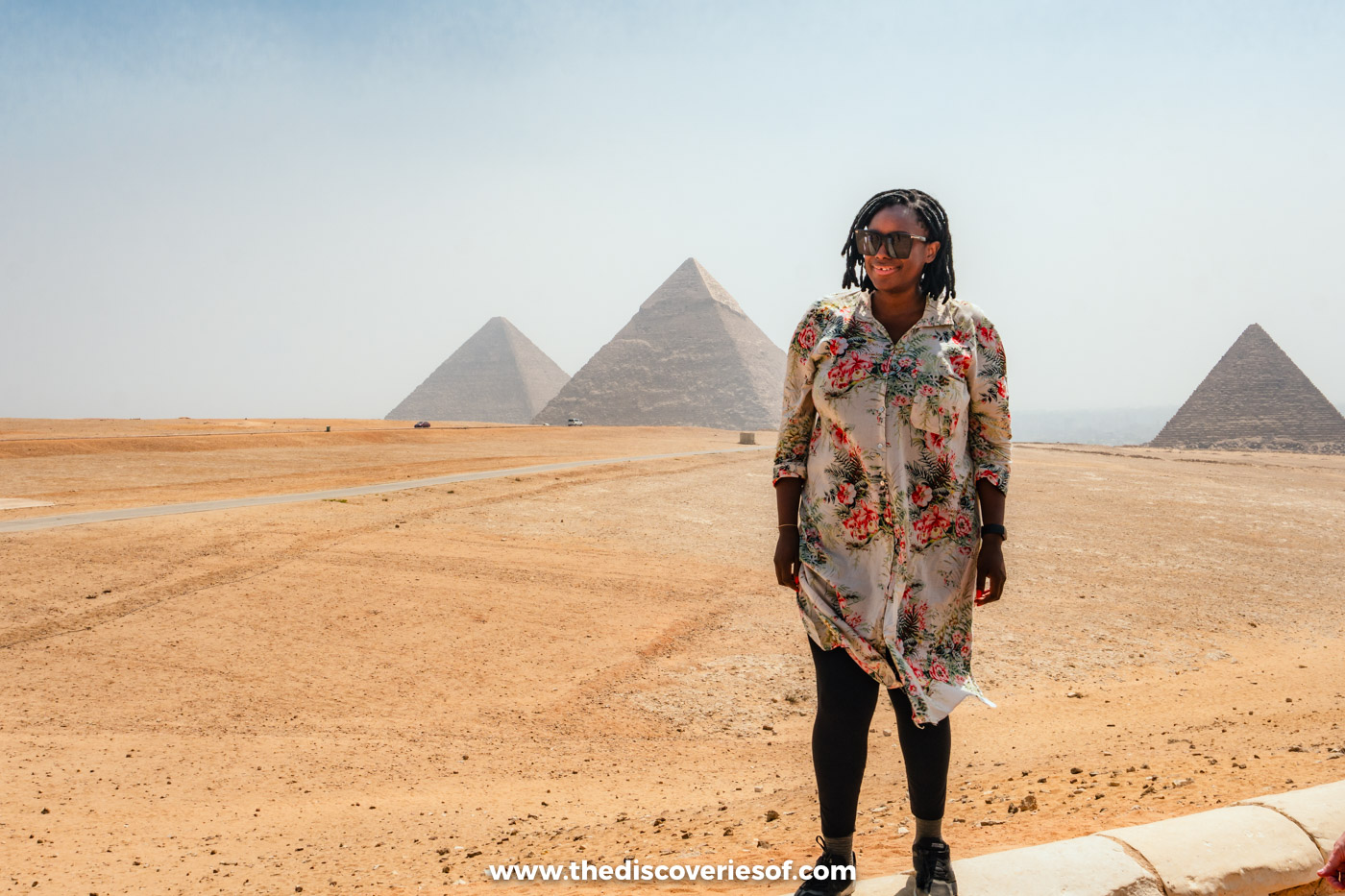
Where’s the Khufu boat?
Until 2021, a museum beside the Great Pyramid displayed Khufu’s boat, a 43-metre cedar vessel found in a pit next to the pyramid in 1954 and painstakingly reassembled from more than 1,200 pieces. The boat has since moved to the Grand Egyptian Museum, about 2 km away on the edge of the plateau, where it’s displayed in its own gallery along with a second boat that’s still being reassembled. The old boat museum on the plateau is closed.
The Grand Egyptian Museum is also where you’ll now find the whole of the treasure from Tutankhamun’s tomb, including his golden mask, so it pairs perfectly with a morning at the pyramids.
Tickets and opening hours
The general ticket costs 700 EGP for adults and 350 EGP for students with a valid international student card, and covers the plateau, the Sphinx terrace and the Valley Temple. The insides of the pyramids are extra:
- Great Pyramid of Khufu: 1,500 EGP, limited numbers per session
- Pyramid of Khafre: around 280 EGP (prices have varied, so check the board)
- Pyramid of Menkaure: around 280 EGP, when open
- Tomb of Meresankh III: around 200 EGP, for a beautifully painted tomb of Khafre’s queen in the cemetery east of the Great Pyramid
Ticket offices are cashless, so bring a Visa or Mastercard (two cards, ideally). You can also book online at egymonuments.com and show the QR code at the gate, which is the easiest way to make sure of a Great Pyramid slot. Your ticket is for a single entry, so if you leave the plateau you’ll have to buy another to come back.
The plateau opens at 7am every day. It closes at 5pm in summer and 4pm in winter, and the last tickets are issued an hour before closing, so arriving early is always better. During Ramadan, hours are shorter.
Getting there
You can get to the pyramids from central Cairo in two ways: by taxi or ride-hailing app, or on a tour.
By Uber or Careem: this is the easiest way. Set your destination as the Giza Pyramids visitor centre on the Fayoum road (not the old entrance by the Mena House hotel). The journey is about 15 to 20 km from Downtown or Zamalek and takes 40 minutes to an hour, depending on the traffic.
By metro and taxi: the metro doesn’t reach the pyramids, but you can take Line 2 to Giza station and pick up an Uber from there for the last few kilometres. It saves little time once you add the second leg, so most people go by car all the way.
Inside the plateau: private cars and tour coaches can no longer drive around the plateau. Instead, free air-conditioned electric shuttle buses run between the visitor centre, the panoramic point, the three pyramids, the Sphinx and the Khufu area, every few minutes. You can also walk, but the distances are bigger than they look and there’s no shade.
Should you go with a guide?
Independently, it’s cheaper of course, and you’ll have as much time as you like. That said, there’s nothing like learning about the history of the pyramids in situ, and a good guide will help you make sense of the site. I’m a geek, so I wanted all the history, and would my visit to the pyramids have been the same without my brilliant guide? Not at all.
Visiting on a tour is also the most convenient option, with transport and tickets sorted. A half-day private or group tour includes hotel pick-up, entry tickets, a guide, water and lunch, and takes about four hours. It starts at around $30 per person.
For a full day, this tour of the pyramids, the Sphinx and the Grand Egyptian Museum adds the museum and lunch, with an Egyptologist guide and hotel pick-up, and is one of the best-reviewed tours in Cairo. Check exactly which tickets are included before you book if you want to go inside the Great Pyramid.
Scams and touts to watch out for
The pyramids are well policed, but they’re also where you’ll meet some of the most persistent hustlers in Egypt. My guide’s advice boiled down to this: nothing in Egypt is free. Here’s what to expect.
- Fake ticket checks: when you go into the pyramid complex, it’s likely you’ll encounter at least one person who pretends to be an official, says your ticket isn’t valid, or demands a “fine” for taking photos. Ignore them. Your ticket is checked at the gate, and that’s it.
- Camels and horses: a photo with a camel will cost you money, and so will “just sitting on it”. Operators now work from designated areas, but if you want a ride, agree the full price first, including the ride back, as rides are often priced one way.
- “Gifts”: people will press a scarf, a scarab or a postcard into your hand as a present, then ask for payment. Politely hand it back.
- “It’s closed”: anyone outside telling you the pyramids are closed, or that you need their help to get in, is after your money. Keep walking.
- Toilets: expect to pay a few EGP to use a toilet outside your hotel, and they don’t always have paper, so carry change and tissues.
The site has an official complaints hotline, 19349, if you have a problem.
When to go
The most comfortable months to visit are from October to April, when daytime temperatures are pleasant and nights can drop below 10°C. December to February is peak season, so expect bigger crowds.
Summer is cheaper and quieter, but it’s insanely hot, regularly over 40°C. I went in late May, and it was hot, but early morning was perfectly manageable. Whatever the season, go first thing: the light is softer, the plateau is quieter, and you’ll be done before the midday heat.
Tips for your visit
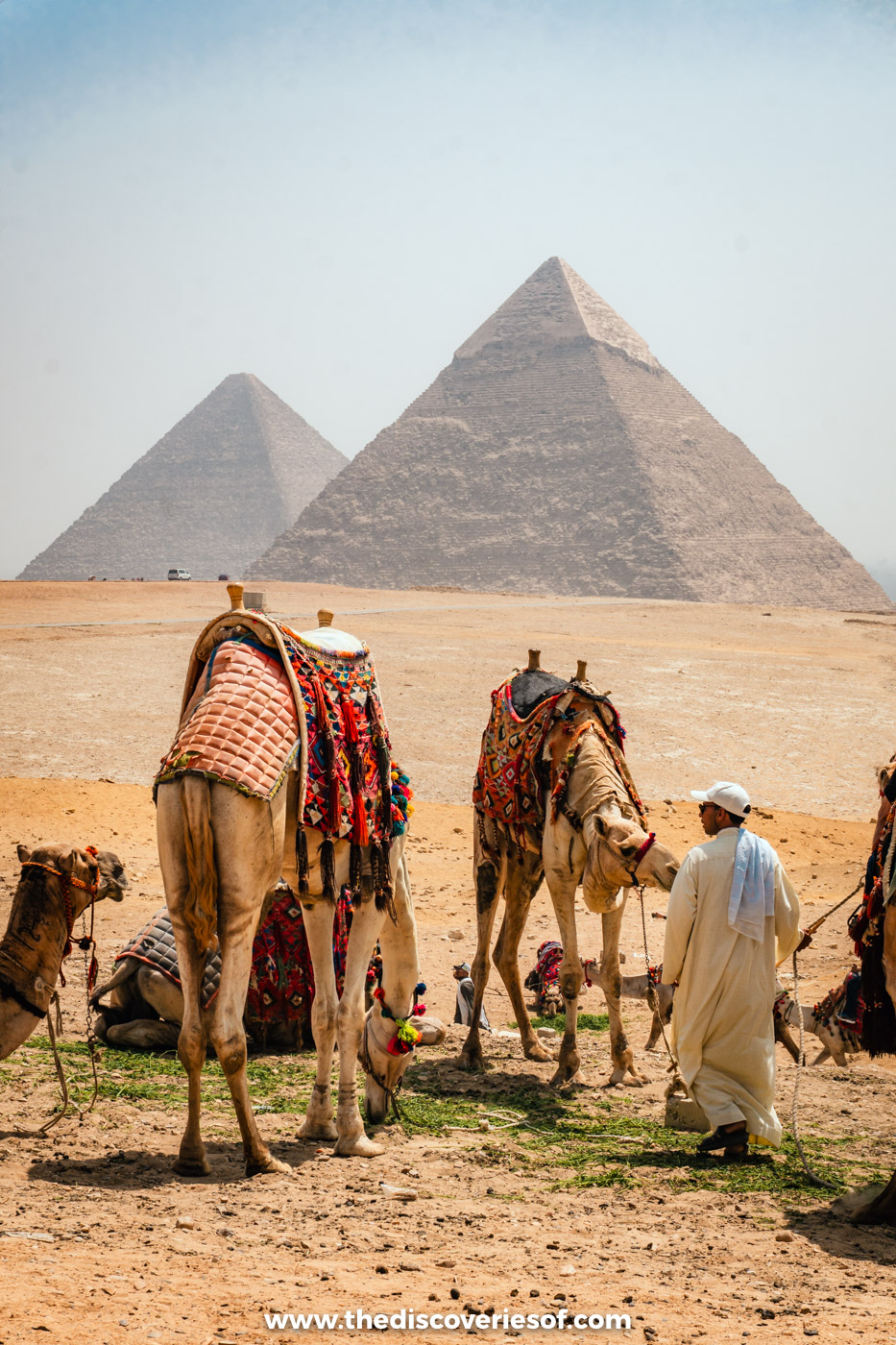
- Dress for heat and dust: wear light, breathable fabrics like cotton and linen, comfortable shoes for walking on sand and uneven ground, a hat and sunglasses. Covering shoulders and knees isn’t a rule here, and you’ll see people in shorts, but loose, light layers are cooler and more respectful elsewhere in Egypt. I lived in harem pants, loose tops, maxi dresses and kimonos on my trip (my Egypt packing list has the rest), and in winter you’ll want a warmer layer for the evenings.
- Carry water and snacks: there’s little shade and limited food on the plateau, though there’s now a restaurant by the panoramic point.
- Bring small notes: you’ll need cash for tips, toilets and drinks, even though tickets are card only.
- Come back after dark: the sound and light show projects the story of the pharaohs onto the Sphinx and the pyramids most evenings, watched from the terrace in front of the Sphinx. Reviews of the show itself are mixed, so another way to see it is over a rooftop dinner facing the pyramids, which includes the show when it’s running. Check the show times and languages before you go.
- Where to stay: I spent my first nights at the Pharaohs Hotel, a simple budget hotel in Dokki near the Nile, and my last night at the Kempinski Nile Hotel Garden City, a welcoming high-end hotel on the river with a rooftop pool. Both are 30 minutes to an hour from the pyramids by car, depending on the traffic. If you want to wake up to a pyramid view, stay in Giza instead: see my guide to the best places to stay in Cairo.
Watch my Egypt video
Subscribe on YouTube and discover new destinations.
Map
Read next
- A step-by-step Egypt travel itinerary
- The best things to do in Cairo
- Two days in Cairo: the perfect Cairo itinerary
- The best places to stay in Cairo
- The best day trips from Cairo
- What to wear in Egypt
- 20+ things you need to know before travelling to Egypt
- Visiting the Valley of the Kings: how to pick your tombs
- The best things to do in Luxor
Love this? Save and share on Pinterest

Discover the top things to do, insider tips and hidden gems in our Egypt Travel Guide.
Read the guides →