The Ojos del Salar are a pair of small, perfectly round lagoons in the middle of the Atacama’s great salt flat. Here’s what they are, whether you can swim, how to get there and how to combine them with Laguna Cejar and Tebinquinche.
It’s not exactly a secret that I love the Atacama Desert. I’ve been to Chile four times, and the Atacama has drawn me back twice: first on a week-long campervan road trip in February, then in July with a private guide. It never ceases to blow me away, and spending so much time there has meant I’ve been able to explore at my leisure, seeing the well-known spots and the lesser-known gems.
The Ojos del Salar are one such gem: two small, deep pools whose likeness to a pair of eyes gives them their name (it translates as the eyes of the salt flat). They sit a few kilometres from Laguna Cejar and Laguna Tebinquinche, so most people see all three in one afternoon.
Ready to find out more about these natural curiosities in the heart of the desert? Let’s explore.
Some links in this article may be affiliate links, which means we may receive a small commission, at no additional cost to you, if you decide to purchase through one of my recommended partners.
Why visit the Ojos del Salar?
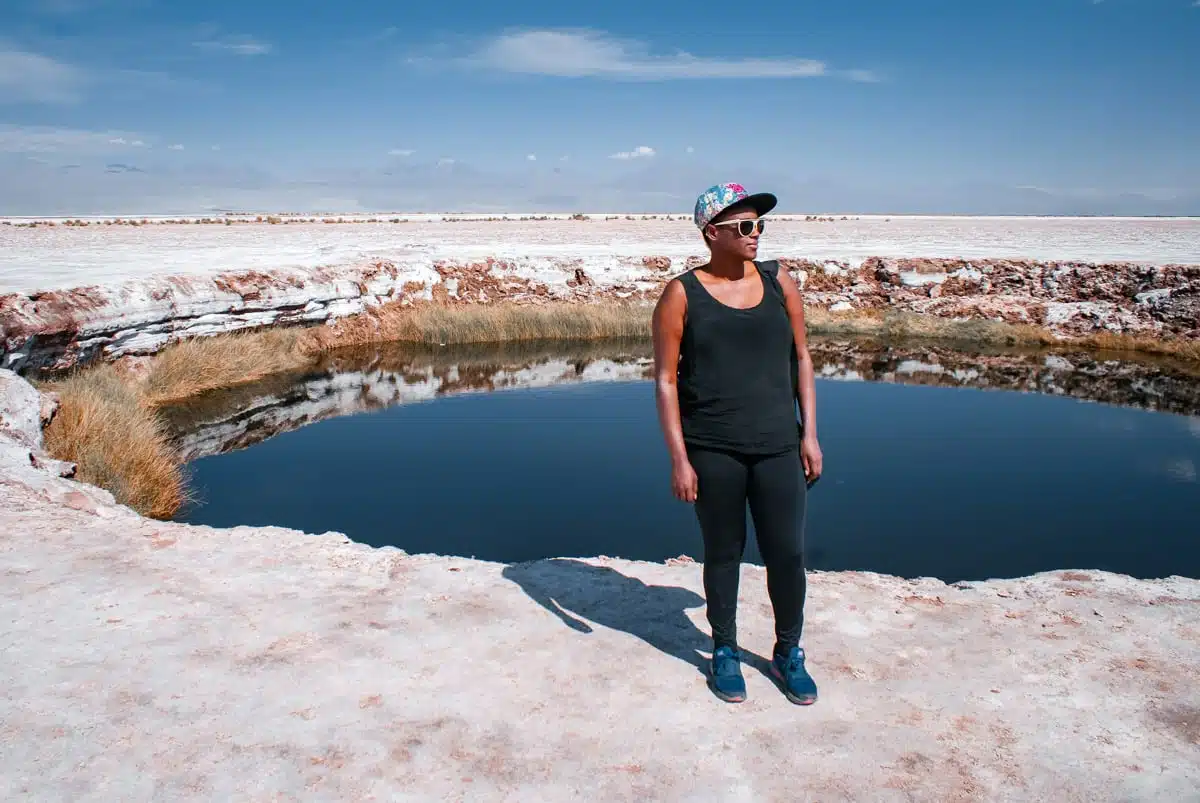
I mean… why shouldn’t you? When else do you get the chance to stand on the rim of a pair of deep blue pools in the middle of a giant salt flat?
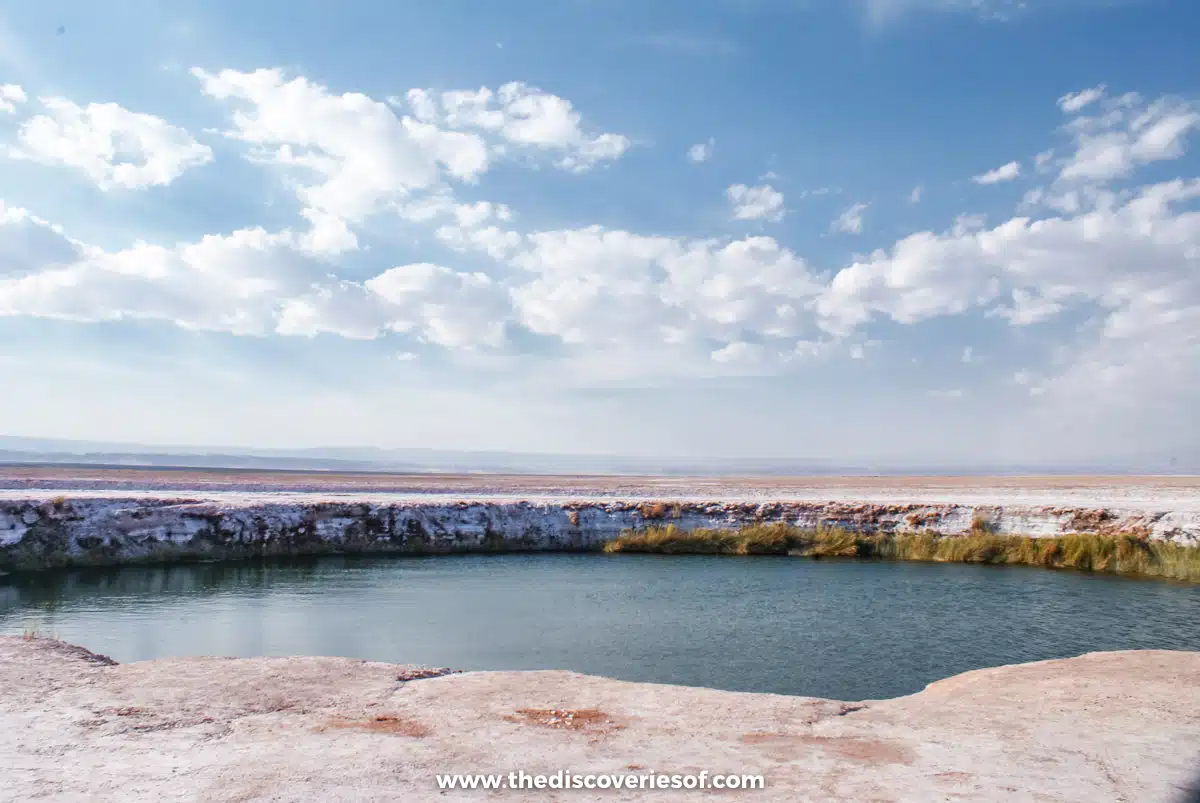
I stopped here in the afternoon on my campervan road trip, on my way to Laguna Tebinquinche for sunset. There’s no ticket office and no visitor centre, just the two pools, the white crust around them and a ring of volcanoes on the horizon. On a calm day the water is so still that it mirrors the clouds perfectly.
If you’re a confident swimmer, the classic thing to do is jump off the banks into the cool water, which is the perfect respite from the fierce desert sun (read the swimming section below first, though, as it’s not the same as floating in Cejar). Otherwise, simply sit back and admire the scenery.
Top Tip
I would only recommend jumping into the lagoons to confident swimmers, since there’s no shallow water and it’s quite an effort to climb back onto the natural banks. One of the lagoons is easier to climb out of than the other, so check the banks before you jump in!
What are the eyes of the salt flat?
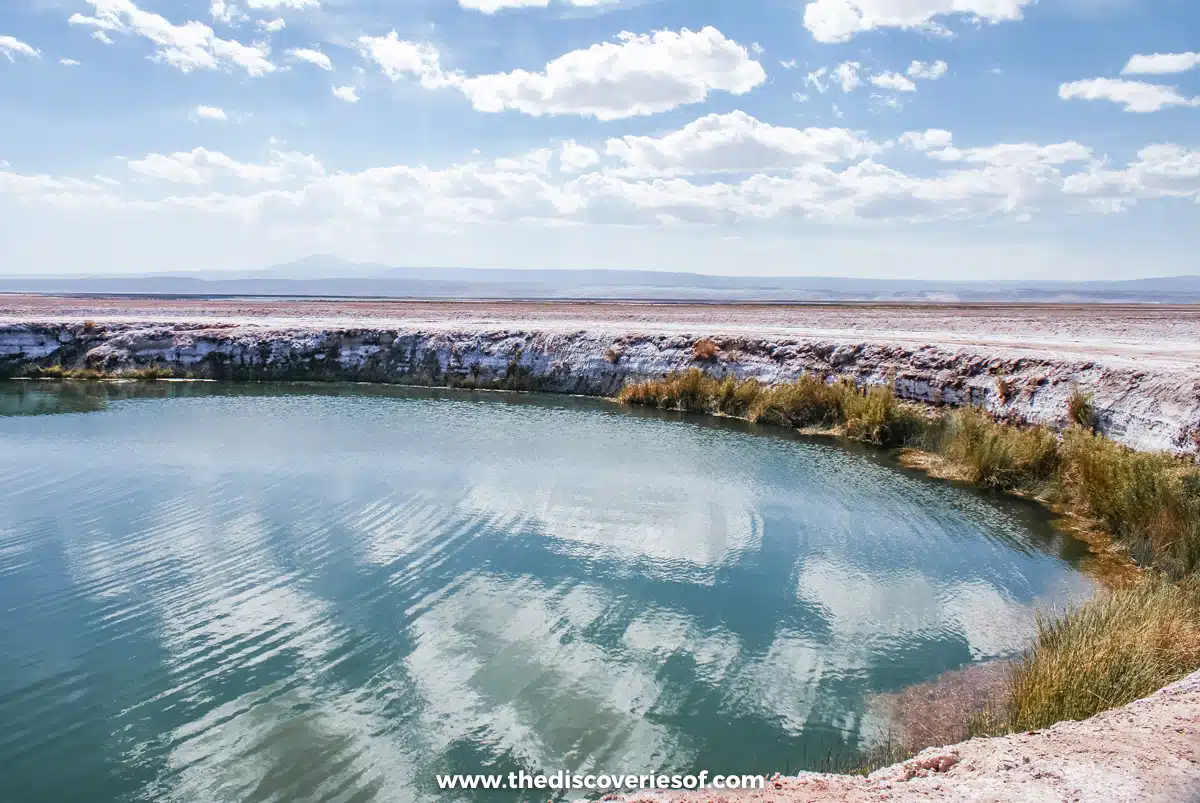
The pools are dotted across the arid plains of the Salar de Atacama, about 25 kilometres south of San Pedro de Atacama as the crow flies. They’re literally in the middle of nowhere, encircled by salt and grasslands that foxes use for hiding (cute).
They look like a pair of deep blue eyes peering up at you, with gleaming white salt crust chiselling their edges. Reeds and algae grow around the banks, and if you’re lucky you might spot a flamingo or two feeding on the wider salt flat.
The setting is the Salar de Atacama itself, the largest salt flat in Chile and the third largest in the world, covering around 3,000 square kilometres at an average altitude of about 2,300 metres. It’s also one of the world’s biggest sources of lithium.
How did they form?
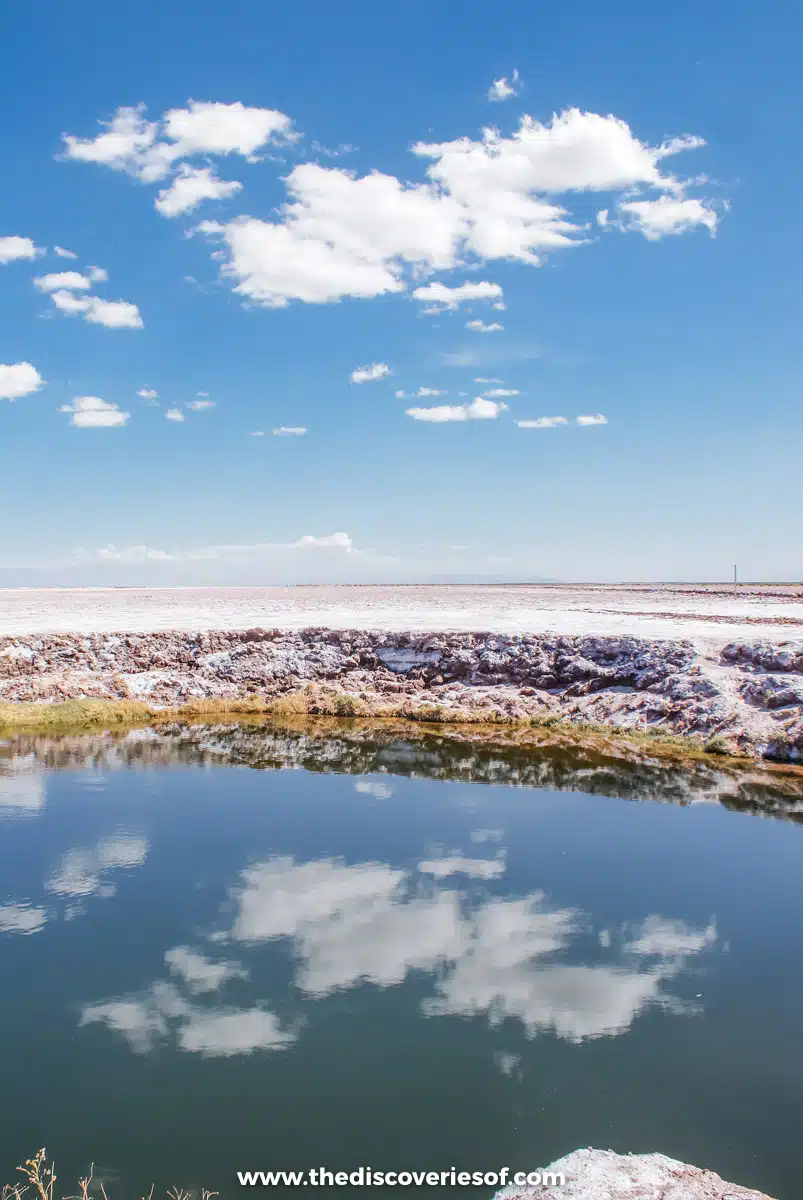
Nobody seems entirely sure. The usual explanation is that the Ojos are collapse holes: water flowing underground towards the salar dissolved the salts beneath the crust, and the ground above caved in, leaving two openings where the groundwater reaches the surface. Locals like to say they have no bottom. They are certainly deep, with sheer sides and no shallow end.
What matters for visitors is that their water is fresh, or only slightly salty, unlike the brine at nearby Laguna Cejar. That means you won’t bob about on the surface as you would at Cejar: if you get in, you’ll be swimming, not floating.
Can you swim in the Ojos del Salar?
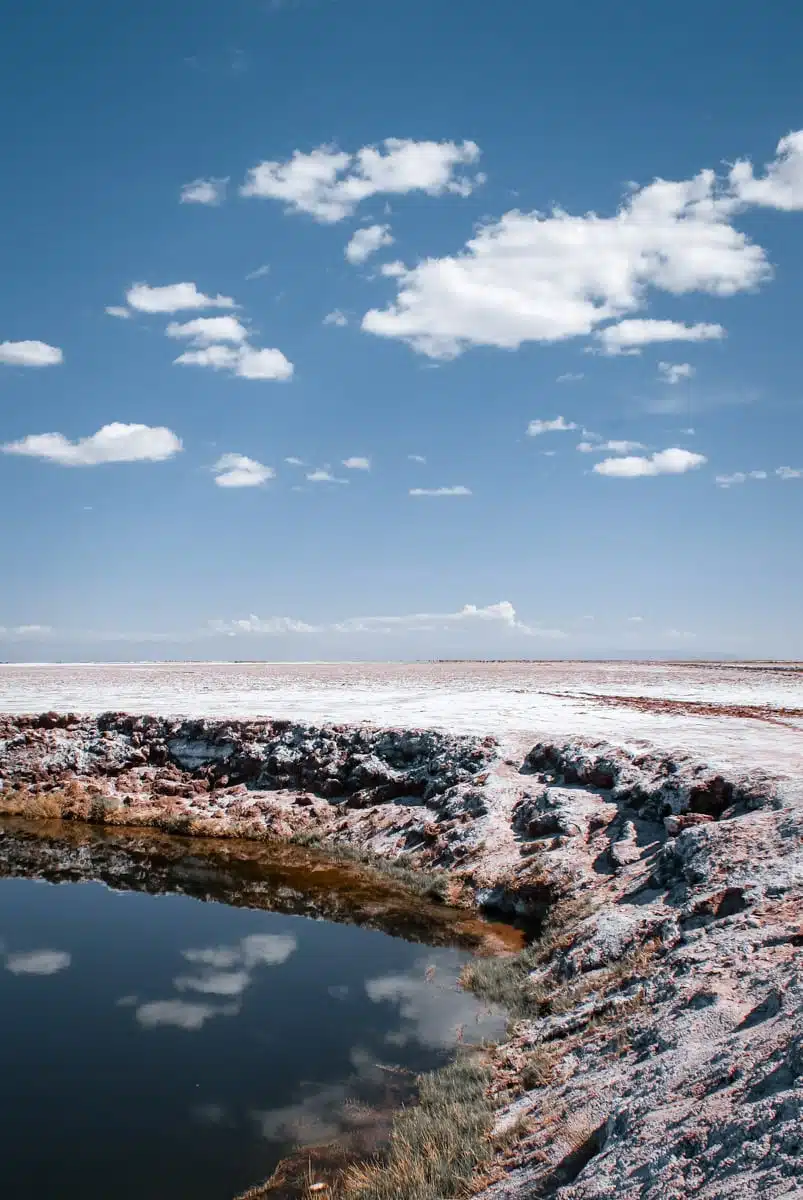
This is the question everyone asks, and the honest answer is that it’s a grey area. There’s no ticket office, lifeguard or published set of rules at the Ojos, unlike Cejar, where the local community runs the site and lets visitors swim in one lagoon only. Tour operators still describe the larger pool as the one people swim in, but some visitors have been told the Ojos are off limits for conservation reasons.
My advice is simple. If there’s a sign on the day saying no swimming, respect it. If there isn’t, only get in if you’re a strong swimmer, never go in alone, and pick the pool with the easier bank to climb out on before you jump. The water is cold all year, there’s no shallow edge to stand on and nobody is there to help if you get into trouble.
Whatever you decide, don’t go in wearing sunscreen. Sunscreen has caused damage to some of the lagoons in the area, which is why Cejar now asks swimmers not to wear any. And don’t use the pools to rinse off after Cejar: bring your own fresh water for that.
Planning your visit
Location and coordinates
There’s no address, but the coordinates are -23.13661099201217, -68.23496418095112. The pools are about 9 kilometres south of Laguna Cejar and about 2 kilometres east of Laguna Tebinquinche, on the gravel tracks that cross this part of the salt flat. Download an offline map before you set off, as there are few signs out on the salt flat.
Opening times and tickets
There’s no gate at the Ojos, no fixed opening hours and no separate entrance fee. Plan to visit in daylight, though: the tracks are unlit, and the lagoons around them run to their own hours.
The two neighbours work differently. Laguna Cejar is run by the Solor Atacameño community and sells tickets online only, for a set date and time slot. Adults pay CLP 15,000, over-60s CLP 10,000 and children up to 12 CLP 5,000, paid by card when you book, and you get a QR code on your phone. Arrive 15 minutes before your slot (more than 15 minutes late and your ticket is blocked) and you can stay for an hour. Cejar has been closing on Tuesdays, so don’t plan your day around it then. Tebinquinche is on land looked after by the Coyo community, which charges CLP 6,000 for adults and CLP 3,000 for 5 to 17-year-olds, in cash at the entrance.
Getting there
You can rent a car in Calama or San Pedro de Atacama. It takes around 45 minutes to an hour to drive from San Pedro: head south on Route 23 towards Toconao, turn off for Laguna Cejar at kilometre 1118, follow the signed gravel road for about 8 kilometres to Cejar, then carry on along the tracks to the Ojos and Tebinquinche. You don’t need a 4×4 in normal conditions, but the gravel is corrugated in places, so take it slowly, stay on the existing tracks and check the roads after any rain.
Alternatively you can book onto a guided tour of Ojos del Salar. The tour also visits the stunning Laguna Cejar and Tebinquinche, and takes about five hours with hotel pick-up. Another option is this Cejar, Tebinquinche and Ojos del Salar tour, which finishes with a drink at sunset; on that one the entrance fees (CLP 21,000 in total) are extra and paid in cash. Whichever you choose, check that the operator has a confirmed Cejar time slot for your group, since Cejar only admits visitors with a booked ticket.
Cycling is possible too, but it’s a long, hot ride of 30 kilometres or more each way, much of it on gravel, so only attempt it early in the day with plenty of water.
Combining the Ojos with Laguna Cejar and Tebinquinche
The three sights sit close together on the northern edge of the salt flat, and the classic order is Cejar first, the Ojos second and Tebinquinche for sunset. That’s how the tours do it, and it’s the easiest way to plan it if you’re driving too: book a Cejar slot that leaves you an hour or two for the Ojos before sunset.
Laguna Cejar and Laguna Piedra
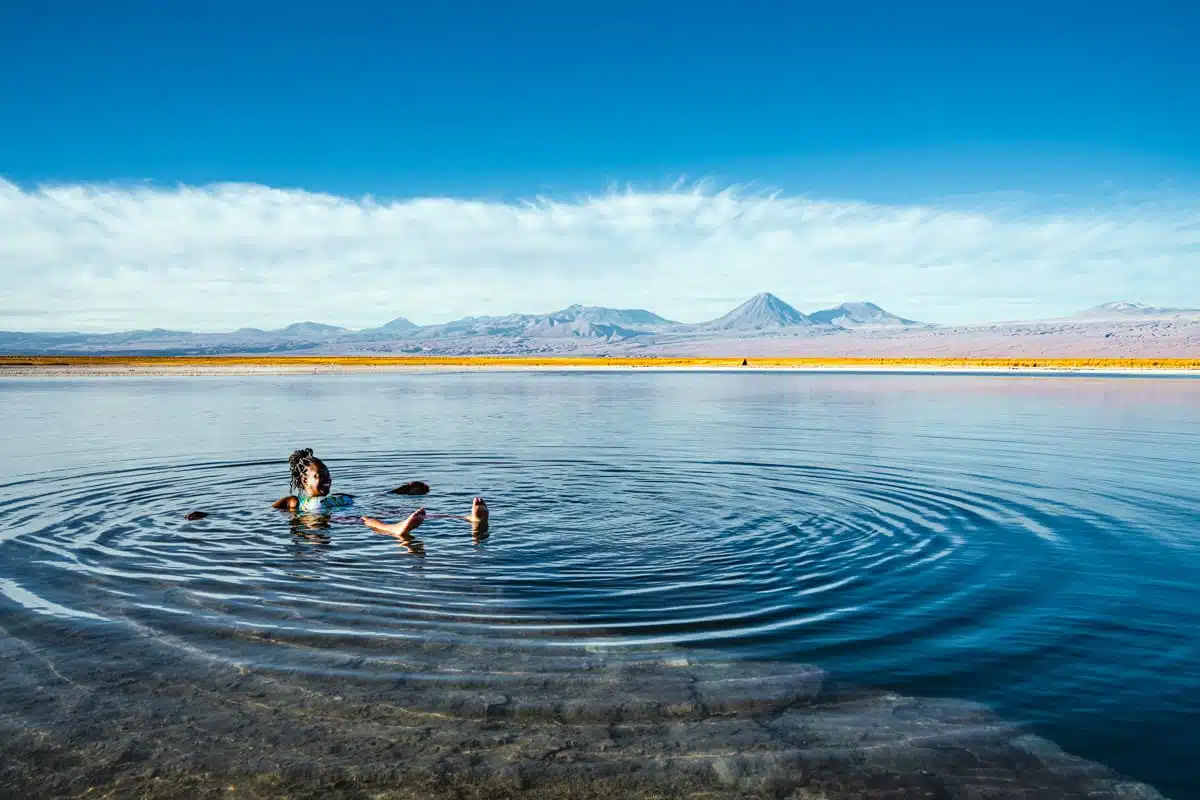
My July trip started the moment I landed: straight into the jeep and off to Laguna Cejar. Most of the Atacama’s salt lagoons are off limits for swimming, but here you can strip down to your swimmers and float like you’re in the Dead Sea. You’ll never make it down to the bottom, no matter how hard you try, thanks to the salt water’s buoyancy.
My top tip? Don’t get your face wet. The salt stings if it gets in your eyes, and the site’s own rules now say to keep your head above the water. Strictly speaking, the swimming happens in Laguna Piedra, the smaller lagoon in the Cejar complex, as Cejar itself is kept for wildlife watching. Swims are limited to 20 minutes and children under six can’t go in the water. Do carry on past it to see the neighbouring lagoon, which is a favourite with the local flamingos.
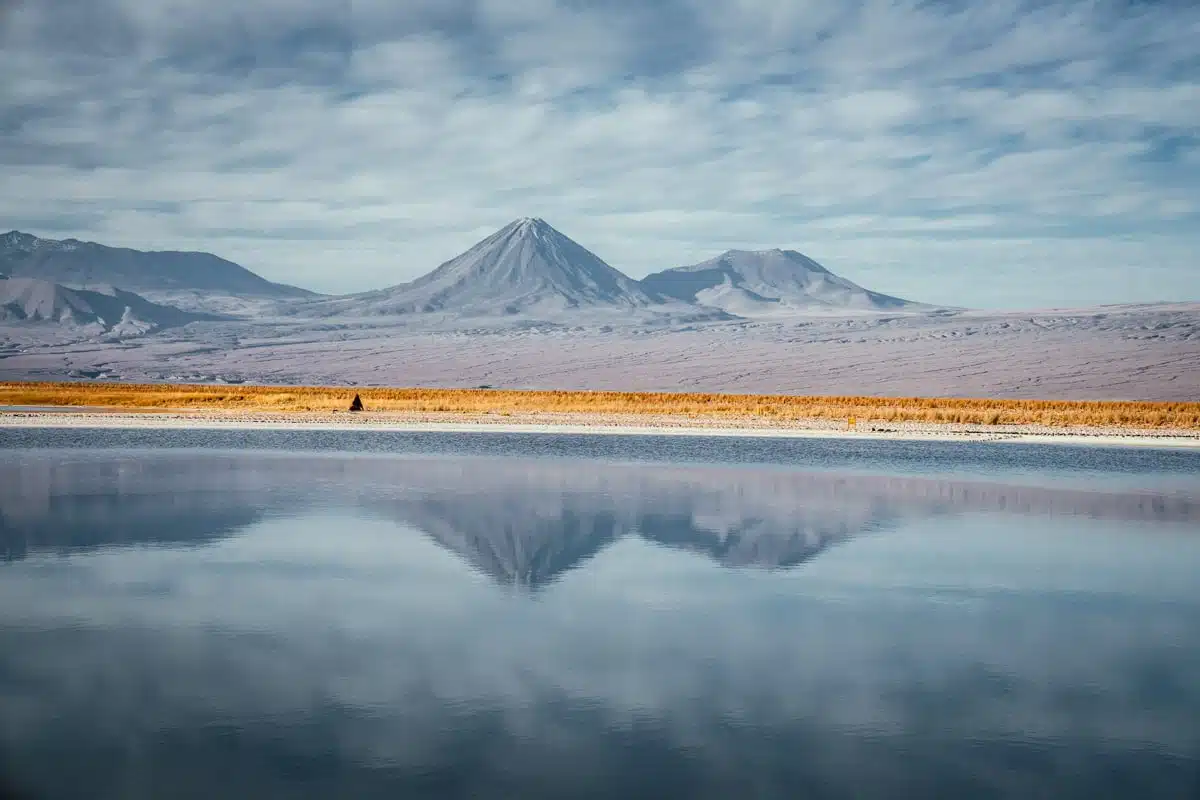
The site has showers for rinsing off the salt (no soap or shampoo), but nothing is sold there, so bring your own water and snacks for afterwards. Eating, drinking, picnics, drones, smoking and pets aren’t allowed inside, and you need to stay on the marked paths.
Laguna Tebinquinche
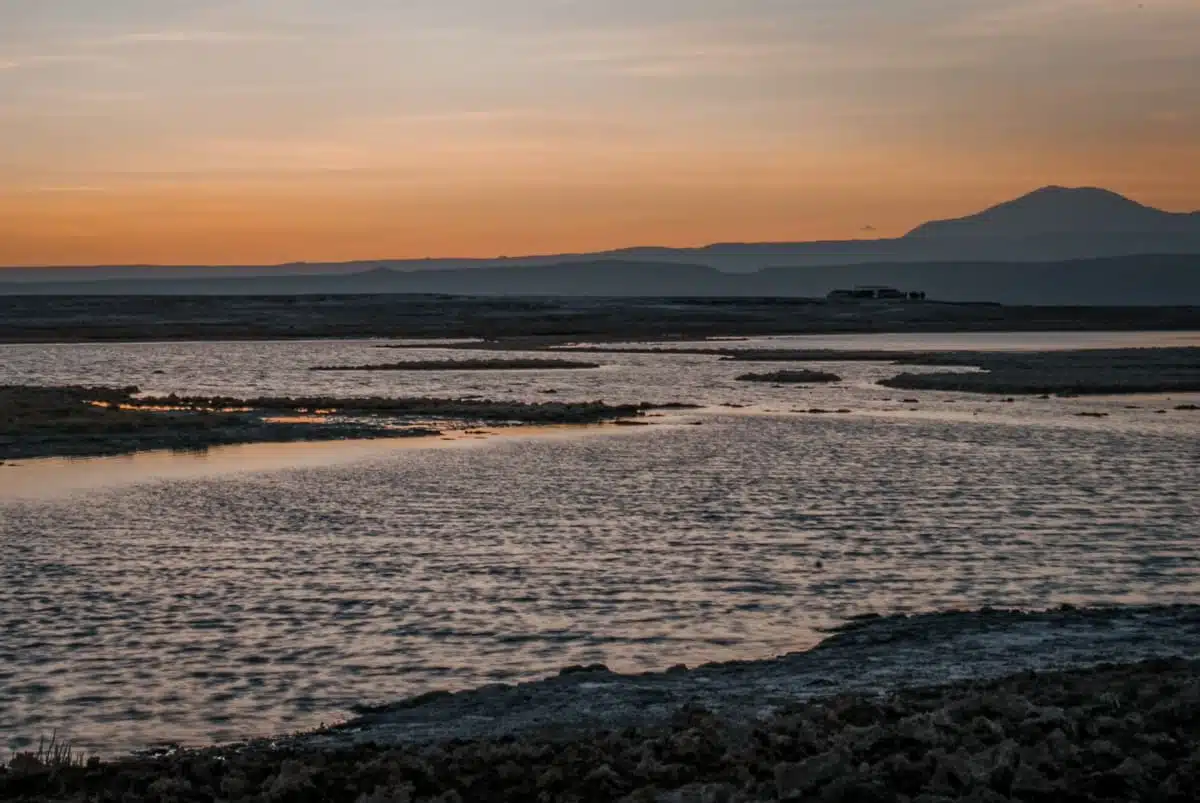
From the Ojos it’s only a couple of kilometres to Laguna Tebinquinche, a large, shallow saltwater lake that’s at its best at sunset, when its surface catches the fiery sky so completely that it feels like you’re surrounded by molten lava. It isn’t a swimming lake, but there are short walking trails across the salt, flamingos at a distance and microbialites in the shallows, mineral structures built up by microbes that are considered some of the earliest evidence of life on Earth.
On my road trip I carried on here straight from the Ojos, watched the sunset, then sat on the shore with a glass of wine as the stars and planets came out one by one. You can see more of it in my Atacama Desert photos.
Best time to visit
The Atacama is dry all year, so there’s no bad season, just trade-offs.
- Time of day: go in the afternoon and finish at Tebinquinche for sunset. For the best reflections in the Ojos, aim for when the air is still, as the wind tends to pick up across the salt flat as the day goes on.
- Summer (December to March): the warmest days for a swim and the busiest time of year. Summer storms in the high Andes, mainly in January and February, can occasionally close roads after heavy rain, and Cejar refunds tickets when that happens.
- Winter (June to August): clear, sunny days but cold water and freezing nights. I floated at Cejar in July, in the middle of the southern winter, under a clear blue sky, but the water is well below body temperature at this time of year, so keep your swim short and have a warm layer ready.
- Spring and autumn: a good middle ground, with mild days and fewer crowds than the summer holidays.
What to bring
- Swimwear and a towel, plus sandals or water shoes, as the salt crust is sharp underfoot.
- Plenty of fresh water, both to drink and to rinse the salt off after Cejar.
- A hat, sunglasses and a long-sleeved top. The sun is fierce, and since you shouldn’t wear sunscreen in the lagoons, covering up is the best protection.
- A warm layer for when you get out of the water and for sunset at Tebinquinche.
- Cash in pesos for Tebinquinche, and your Cejar QR code downloaded to your phone.
- Snacks for the drive, as there’s nothing to buy between San Pedro and the lagoons.
Staying safe
- Acclimatise first. The lagoons sit at around 2,300 to 2,400 metres, so spend at least a day in San Pedro before you visit, drink plenty of water and go easy on alcohol the day before.
- Respect the water at the Ojos. They’re deep, cold and steep-sided, with no lifeguard. Never swim alone, and if you’re not confident, enjoy them from the bank.
- Keep your head up at Cejar. Salt in your eyes, ears and mouth is painful, and the water isn’t safe to drink.
- Protect the lagoons. Don’t wear sunscreen, oil or cream in any of the water, don’t use soap, and stay on the paths and existing tracks so you don’t damage the salt crust.
- Drive carefully. Take it slowly on the gravel, don’t drive onto the salt crust, and set off with a full tank and plenty of water.
For more ideas nearby, see my guide to the best things to do in the Atacama Desert, and my Atacama Desert map to see where the lagoons sit in relation to everything else.
Read all Atacama guides
Map of the Ojos del Salar and nearby lagoons
Read more Atacama guides
- San Pedro de Atacama guide
- Things to do in the Atacama Desert
- 3-day Atacama itinerary
- How to visit the Valle de la Luna
- My Atacama Desert map
- Incredible Atacama Desert photos
Love this? Save and share on Pinterest

Discover the top things to do, insider tips and hidden gems in our Chile Travel Guides.
Read the guides →