Pastel silk skirts swish past palace gates, and every few steps someone is posing for a photo in front of an old tiled roof. Renting a hanbok has become one of the most popular things a visitor to South Korea can do, and it comes with a perk that sounds too good to pass up. Before you book a slot, though, there are a few things worth weighing up.
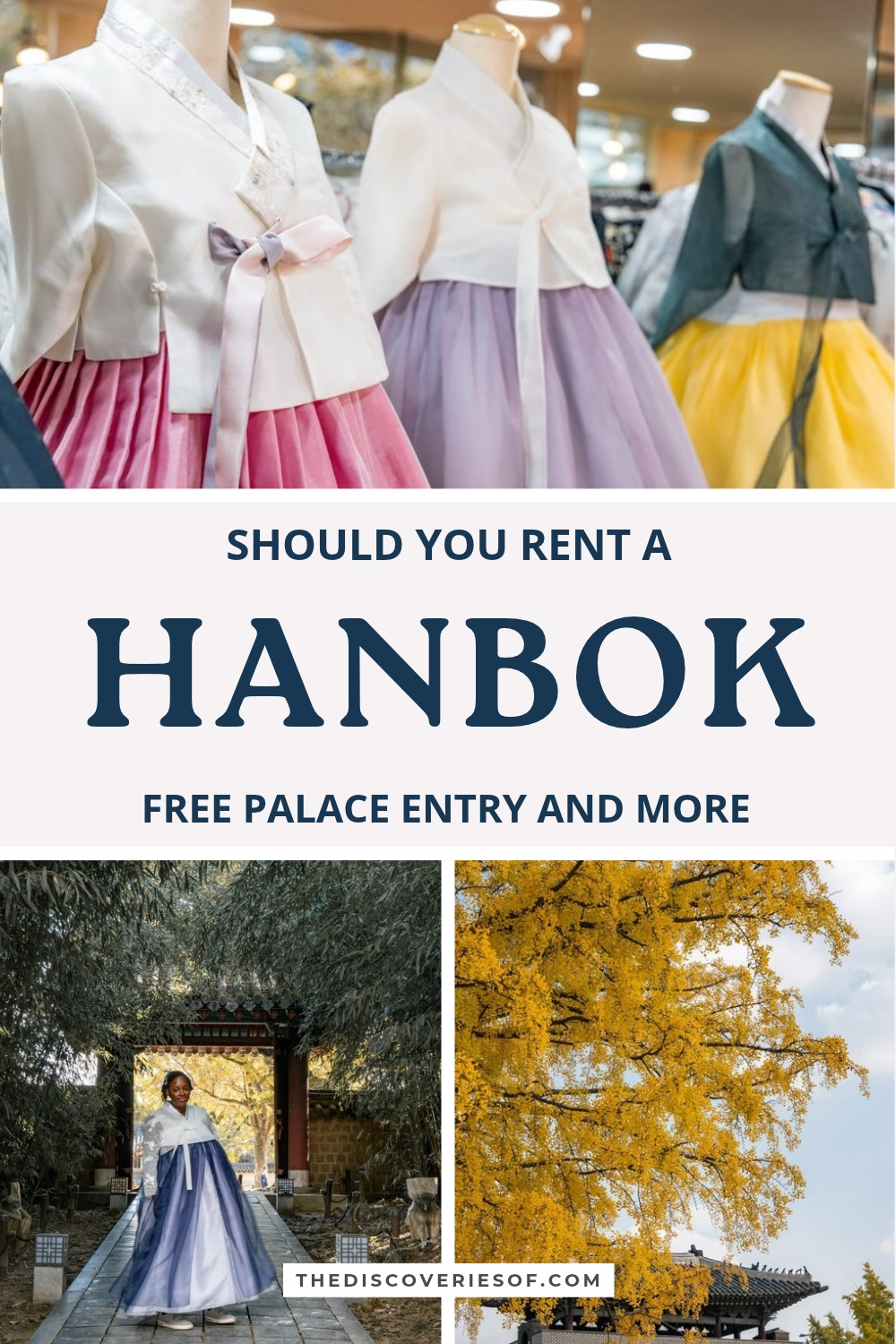
I rented a hanbok in Jeonju in October, on a fortnight’s trip around the country, and walked around the hanok village and Gyeonggijeon Shrine in it. Mine was a white jacket over a full, layered skirt in shades of blue and lilac, and I kept my own trainers on underneath.
I’ll be straight with you: I found the whole thing awkward. Was I appreciating Korean culture or appropriating it? That question stayed with me the entire time I had it on. At the same time, it was a genuinely unusual experience, and it gave me a different way of interacting with the streets and buildings around me.
Would I tell you that you have to try it? No. It’s a personal call, and plenty of visitors love it. For me, the one time was enough.
This guide covers what a hanbok is, whether it’s OK for a foreign visitor to wear one, the free palace entry rules and what counts as hanbok at the gate, what renting one costs, where to go in Seoul, Jeonju and Busan, and how to wear it respectfully.

The short answer: who it suits
It depends on what you want out of it. Rent one if:
- You’re curious about the dress itself. Wearing one is the quickest way to understand how the dress moves, how the jacket ties and why the skirt is cut so full.
- You’d like photos in a palace or hanok village. That’s why most people do it, and the settings are spectacular, especially in autumn.
- You’re visiting several royal palaces in one day. Free entry adds up a little, though the savings are small (see below).
Think twice if you’d feel self-conscious, if you’re short of time (choosing, changing and returning eat into a morning), or if it’s very hot: most rental hanbok come in several layers of easy-care synthetic fabric.
What a hanbok is

The word simply means “Korean clothing”. The form most people picture comes from the Joseon dynasty, which ruled Korea from 1392 to 1897, and it has two core parts:
- Jeogori: a short jacket with an overlapping collar, fastened at the chest with a long ribbon tie called a goreum.
- Chima or baji: for women, a full wrap-around skirt that ties high above the waist; for men, loose, roomy trousers gathered at the ankle.
Over these, men often wore a vest and a long overcoat called a durumagi, and women might add a norigae, a tasselled ornament that hangs from the tie or skirt. Unmarried women wore their hair in a single plait finished with a ribbon, the daenggi, which is why so many rental shops offer to braid your hair.
For most of the 20th century, it slipped out of daily life and became something Koreans wore for weddings, the first birthday of a child and the big holidays of Seollal (Lunar New Year) and Chuseok. That has been changing. In July 2022, the custom of wearing hanbok, known as hanbok saenghwal, was designated a national intangible heritage, and in March 2026 the National Assembly passed a law to promote the hanbok industry. There’s a push, too, to have it recognised by UNESCO by 2030.
Is it OK for foreigners to wear a hanbok?
It’s the question that stayed on my mind in Jeonju, so it’s worth taking seriously.
The short version is that South Korea actively wants you to. The free palace entry scheme was introduced in 2013 to encourage people to wear hanbok, and the government runs an annual Hanbok Culture Week, with events across Korea and at Korean cultural centres abroad. Rental shops are a big local business, and visitors in hanbok are an everyday sight around the palaces.
What does draw criticism is the costume end of the market. Korean commentators have complained about rentals with dress-like hoop skirts, heavy gold printing and accessories of uncertain origin, which they argue lose the clean lines and quiet dignity of the real thing. The palace authorities have said the point of dressing up shouldn’t be the free ticket alone.
So the answer is less about who wears it and more about how. Choose a style that respects the original form, wear it properly, and treat the places you visit in it as somewhere people live and worship, not a film set. If it still doesn’t sit right with you, as it didn’t entirely with me, there’s no obligation: you’ll see just as much in your own clothes.

Free palace entry: what counts as hanbok
Anyone in hanbok gets in free at the royal palaces of Seoul, Jongmyo Shrine and the Joseon royal tombs. That covers Gyeongbokgung, Changdeokgung, Changgyeonggung and Deoksugung, and it applies to foreign visitors as well as Koreans. It works at the palaces’ evening openings too.
Staff do check outfits at the gate, and the official guidelines are clearer than you might expect:
- Top and bottom, both. You need a jeogori and a separate skirt or trousers. A jeogori with jeans, or a hanbok skirt with a T-shirt, doesn’t qualify.
- The collar matters. The jacket must keep its overlapping collar, and the ties or buttons must be done up. A one-piece dress made to look like hanbok won’t pass.
- An overcoat alone won’t do. Throwing a durumagi, a royal robe or a cheollik (a long robe popular with men) over ordinary clothes isn’t treated as hanbok.
- Modern styles are fine. Both traditional and modernised outfits are accepted, as long as they keep the basic form. Since 2019, anyone can wear the style traditionally worn by the other gender.
Visitors report that enforcement varies from day to day, and the most theatrical outfits may be turned away, so stick to the rules above and you’ll be fine.

How much does it save you? Less than you’d think. Gyeongbokgung and Changdeokgung cost 3,000 won (under £2) for adults, while Changgyeonggung, Deoksugung and Jongmyo cost just 1,000 won, prices that haven’t changed since 2005. The Secret Garden at Changdeokgung is a separate timed tour that still has to be booked. The rental, not the ticket, is the real cost.
Top Tip
Palace admission may change. The Korea Heritage Service has been considering its first price rise in 20 years, and in October 2026 it said it was reviewing its free-entry schemes, including the one for hanbok, with the timing still undecided. Check the Royal Palaces and Tombs Center website before you go.
What renting one costs
Prices vary with the shop, the style and how long you keep the outfit. As a guide, around the palaces in Seoul:
- Basic, 2 to 4 hours: about 15,000 to 25,000 won (£8 to £14).
- Themed or premium, 2 to 4 hours: about 25,000 to 40,000 won (£14 to £22), for finer fabrics, embroidery and more choice.
- All day: about 35,000 to 50,000 won (£19 to £28).
Jeonju is a little cheaper. Hanboknam’s branch in Jeonju Hanok Village charges 10,000 won (about £6) for 90 minutes in a basic outfit, 20,000 won and up for a themed one, and from 55,000 won for premium silk with hair styling and accessories.
What’s included differs too, so read the small print:
- Usually included: the jacket, skirt or trousers, a petticoat, a small bag for your things and a locker for your own clothes and luggage.
- Often extra: shoes (around 5,000 won), hairpieces, hats and ribbons (2,000 to 3,000 won each), and hair styling, which ranges from free simple braids at some shops to 45,000 won for a full royal updo with a wig at others.
- ID: most shops ask for your passport or another ID.
- Late fees: the clock starts when you leave the shop, and late returns are charged in 10-minute blocks, so build in time for queues at the palace gates.
At Hanboknam, for example, you can try on up to two outfits and have half an hour to choose before your rental time starts. Many shops sell slots online in advance, and some don’t take same-day bookings, so reserve the day before in busy seasons.
Where to rent a hanbok
Around Gyeongbokgung and Bukchon, Seoul

The biggest cluster of rental shops is on the streets west and south of Gyeongbokgung, especially around Gyeongbokgung Station (line 3), with more near Anguk Station and the gates of Changdeokgung. Hanboknam, one of the best-known chains, has branches by Gyeongbokgung and Changdeokgung and in Bukchon, open from 9am to 7pm or 7.30pm (the Changdeokgung branch closes on Mondays). Most shops keep similar hours, and some close on Tuesdays, when Gyeongbokgung does, so check before you set your heart on a date.
A classic route is to rent near Gyeongbokgung, see the palace and the changing of the guard, then walk east through the lanes of Bukchon Hanok Village. Remember that the busiest Bukchon lanes are open to tourists only from 10am to 5pm, so plan your loop around that.
Jeonju Hanok Village

If you want a whole neighbourhood of traditional houses as your backdrop, Jeonju is hard to beat. Dressing up and wandering the lanes is one of the big draws of Jeonju Hanok Village, which is where I tried it, and on a sunny weekend it can feel as though half the crowd is in traditional dress. Rental shops line the streets around Gyeonggijeon Shrine, and the shrine’s bamboo grove and painted halls, Jeondong Cathedral and the courtyard at Jeonju Hyanggyo are the favourite spots for photos.
The village is about an hour and three quarters from Seoul by KTX, so it works as a long day trip or, better, an overnight stop. My Jeonju travel guide covers the rest of the city.
Do
To have it all booked for you, this Jeonju hanbok and choco pie experience bundles an outfit with a class where you make the chocolate pies the city is known for.
Gamcheon Culture Village, Busan

Busan has no royal palaces, but the colourful hillside of Gamcheon Culture Village makes one of Busan’s best backdrops for traditional dress. Shops in and near the village rent outfits by the hour, and a few rooftop cafés double as quieter, semi-private spots for photos over the houses. It’s steep, though, with plenty of steps, so a shorter skirt and comfortable shoes help.
Traditional, modern or fusion: choosing your hanbok
Rental racks generally split into three types:
- Traditional: closest to the Joseon form, in silk or a silk-like fabric with a plain or subtly patterned skirt. These pass any gate check and photograph beautifully.
- Modern (gaeryang) hanbok: simplified cuts, shorter or lighter skirts, sometimes zips instead of ties. Comfortable, and fine for free entry if they keep a proper jacket and skirt or trousers.
- Fusion or “premium” styles: lace, glitter, gold foil, tulle overskirts and hoops. Fun for photos, but these are the outfits critics object to, and the most likely to be questioned at a palace gate.
Choose a colour you’ll be happy with in a hundred photos, ask the staff to tie the goreum properly (it’s surprisingly fiddly), and check the hem: a skirt that brushes the ground will be grey by lunchtime.
How to wear it respectfully
- Remember people live here. Bukchon and Jeonju’s hanok village are working neighbourhoods. Please don’t drape yourself over anyone’s doorway, perch on their window ledges or pose in private courtyards. It’s influencer behaviour, and it’s not OK.
- Keep paths clear. At the palaces, step aside for photos rather than blocking gates and stairways, and follow the signs where buildings are roped off.
- Behave as you would in your own clothes. Palace staff can refuse entry to anyone dressed or behaving inappropriately, hanbok or not.
- Dress for the weather. In October you’ll be comfortable in the middle of the day, but mornings and evenings are cool, so a cardigan or light jacket underneath helps. In summer, go early; in winter, wear thermals underneath.
- Travel light. You’ll have only a small bag, so leave your luggage in the shop’s locker and carry just your phone, cards and passport.
When to go
The most comfortable months are April and May, and late September into early November, which also bring the prettiest backdrops, from cherry blossom to the gold of the ginkgo trees. Weekday mornings are quietest at the palaces.
October has an extra draw. Hanbok Day falls on 21 October, and Hanbok Culture Week runs around it, with exhibitions and events at Gyeongbokgung and across the country. In 2026 it ran from 19 to 25 October, and visitors in hanbok got discounts at some big attractions, including 35% off at N Seoul Tower and half-price entry at Lotte World. Dates and offers change each year, so check before you travel.
For more on planning your trip, my 10-day South Korea itinerary takes in both Seoul and Jeonju, and my South Korea travel tips cover money, transport and apps.
Map
Read next
- Inside Jeonju Hanok Village, where more than 700 traditional houses fill the old town
- Gyeongbokgung Palace guide: guard ceremonies, night openings and a hall on a lake
- Wander Bukchon Hanok Village, Seoul’s prettiest lanes (before the 5pm curfew)
- 32 things to do in Seoul, from a virtual royal banquet to cocktails in an old teahouse
Love this? Save and share on Pinterest

Discover the top things to do, insider tips and hidden gems in our South Korea Travel Guide.
Read the guides →