

Copenhagen’s street food scene is popping. From a sprawling harbourside yard of shipping containers to glass-and-iron food halls and a Sunday producers’ market that moves around the city, here are the nine Copenhagen food markets you shouldn’t miss.
Who else loves street food? You know, that uniquely wonderful phenomenon where you can walk up to a stall, order something tasty and be tucking into your feast within minutes. My hand is firmly up. I hope yours is too.
I’ve been coming back to Copenhagen for years, and its food markets are where I always end up: they’re the best way to eat well here without a white tablecloth or a three-figure bill. Copenhagen isn’t short on a street food hotspot or two, and hunting out the city’s best markets should be firmly on your list of must-do Copenhagen activities.
These are the places to know.
Street food markets in Copenhagen
Reffen


Reffen is the centrepiece of Copenhagen’s street food scene: an outdoor food market built from shipping containers on the waterfront at Refshaleøen. Around 35 food stalls, ten bars, a handful of workshops and its own brewery are spread across a 12,000 square metre site, with views across the harbour towards the Opera House and the city skyline.

The stallholders are eclectic: Filipino spice, full racks of ribs, vegan burgers, Japanese ramen, wood-fired pizza, craft beer, all united by a commitment to quality ingredients and sustainability. Reffen’s founders previously ran the now-legendary Paper Island market, and the same ethos carries through: creative, independent, constantly evolving. I’ve tried to pick a favourite vendor and simply can’t. Really, it’s better to say that I haven’t had a bad meal here, and you should just pick whatever you fancy on the day.


Seasonal note: Reffen is open from mid-March to the end of September, with a shorter autumn season running into early November, and it closes over the winter. Go prepared for Copenhagen weather even in summer: there are braziers, but the site is largely open air. The wider island is earmarked for redevelopment over the coming years, so Reffen’s long-term future is tied to those plans.
Getting there: Harbour bus 991 or 992 to Refshaleøen (free with the Copenhagen Card DISCOVER, but only about every 20 minutes; one Sunday we missed ours and waited 45 minutes for the next one, so check the timetable before you go), or bus 2A from the city centre via Central Station, every 10 or so minutes.
Torvehallerne

Torvehallerne is the covered food hall at the heart of the city, sitting steps from Nørreport station in twin glass-and-iron pavilions. It’s the easiest Copenhagen food market to slot into a day of sightseeing, and among the most rewarding.
OK, so it’s easy to get to, but why should you visit? Well, I have two questions for you. Do you have tastebuds? Do you get hungry? If the answer to both is yes, shuffle along to Torvehallerne.
Unlike Reffen, Torvehallerne is as much a working food market as it is a street food destination: locals buy their fish, fruit, cheese and charcuterie here alongside visitors grazing through the stalls. Walking around, I was struck by the emphasis on quality produce, something that carries through to the street food too. If you’re staying somewhere with a kitchen, it’s the best place in town to stock up.


If you’re even remotely interested in Danish food, the smørrebrød at Hallernes Smørrebrød is essential: buttered rye bread piled with herring, smoked salmon, roast beef or whichever topping takes your fancy, done with the care it deserves. Rørt is the place for classic smørrebrød done in a more contemporary style, Grød does excellent porridge and risotto, and Ma Poule’s duck sandwiches have a cult following. In summer, Hija de Sanchez sets up its outdoor taco stand here too. Wash everything down with a coffee from Coffee Collective, a glass at the VinVeto II wine bar, or pick up a bottle from Mikkeller & Friends’ bottle shop.
Getting there: Less than a minute from Nørreport station. About as central as it gets. Torvehallerne is open from 10am daily (until 7pm on weekdays and 6pm at weekends), and some stalls serve coffee and pastries from 7am.
Broens Street Food

Broens Street Food (formerly Broens Gadekøkken, the Bridge Street Kitchen) is a compact harbourside market strung along the waterfront between Nyhavn and Christianshavn, right beside the Inderhavnsbroen footbridge. It’s the easiest market to reach on the sightseeing circuit, and the one with the best people-watching: benches face out over the canal, with boats and harbour ferries passing continuously in front of you.
The stall lineup is smaller and more curated than Reffen’s, with more than a dozen vendors including Hija de Sanchez for tacos, Rørt for smørrebrød, Haddock’s for fish and chips and District Tonkin for banh mi. The standout dish is the Strangas Greek fries: a heap of crispy fries loaded with spicy sauce and feta that works like Greek-style poutine. A Gasoline Grill stall also operates here, serving the burgers that have earned a serious local following.
In winter, the outdoor seating area transforms into an ice rink (it reopens on 30 October 2026), one of the more charming cold-weather options in the city.
Getting there: Walk five minutes across the Inderhavnsbroen bridge from Nyhavn, or take the Metro M1 to Kongens Nytorv or Christianshavn. Food is served from 11:30am until 8pm (9pm on Fridays and Saturdays).
Tivoli Food Hall
Right beside the old Tivoli Gardens, the Tivoli Food Hall is worth knowing about as a reliable indoor option, and importantly, you can walk in free from the street, so you don’t need a Tivoli Gardens ticket to eat here.
If Reffen is the scrappy, creative side of Copenhagen’s street food scene, Tivoli is its more upmarket and more polished cousin. I wasn’t quite convinced on my first visit: there were too many big names and too few truly independent businesses for me to get that excited. That said, the mix has got better, with around 15 stalls including Hallernes Smørrebrød, Gorm’s pizza and Strangas, and the location makes it a worthy contender for a quick bite in the centre. It’s open daily from 11am to 10pm.
Getting there: Right next to Copenhagen Central Station. As central as it gets.
Kajen at Fisketorvet
Copenhagen’s newest significant food destination opened in April 2024 at the Fisketorvet waterfront shopping centre in Vesterbro, and it’s well worth knowing about. Kajen spans 6,500 square metres across four floors, with over 30 food concepts running from street food stalls on the ground level to casual dining restaurants above, all with direct views of Copenhagen Harbour.
The rooftop terrace above the food hall is the real draw: one of the better harbour vantage points in the city, with the waterfront and skyline spread out in front of you. The food ranges from Asian street food and Mexican to Italian and Danish specialities. Being attached to a shopping centre gives it a somewhat different atmosphere to the independent outdoor markets, but the harbour setting and the variety make it worth adding to the list, particularly for year-round visits when Reffen is closed.
Getting there: Fisketorvet is at Havneholmen 5, Vesterbro. Dybbølsbro S-train station is immediately adjacent.
Nørrebro Street Food
Nørrebro is Copenhagen’s most multicultural neighbourhood, and its street food market reflects that. It sits on the square between Nørrebro station and Nørrebro Bycenter, and in late 2025 it gained an indoor hall with around ten stalls, so it now works whatever the weather. It’s a far more local crowd than the harbourfront markets, and a good excuse to explore one of the city’s liveliest areas.
Getting there: Right outside Nørrebro station (S-train and Metro M3).
Gårdhaven Streetfood
Tucked into the courtyard of the Amager Centret shopping centre, Gårdhaven is a small outdoor street food market with a handful of bars that most visitors never find. Stalls include Malaysian Mamak by Belanja, Indian Dhaba, Mexican El Patrón and SmashTak for smash burgers. It’s open daily from late morning into the evening.
Getting there: Reberbanegade 3, a short walk from Amagerbro Metro station (M2).
BaneGaarden
Set in nine old railway barns built in 1909, BaneGaarden is an organic food and culture hub in the green belt of southwest Copenhagen. There’s the PERRON bakery, a handful of street food stalls and a seasonal restaurant, with plenty of outdoor space between the barns. Opening hours vary through the year, so check before you go.
Getting there: Otto Busses Vej 45, about 15 minutes’ walk from Enghave Plads Metro station.
One for summer Sundays: Grønt Marked
From May to late summer, Grønt Marked brings local farmers and food producers into the city every Sunday, moving between neighbourhoods each week: Gammelholm (opposite Nyhavn) on the first Sunday of the month, Litauens Plads in Vesterbro on the second, Skjolds Plads in Nørrebro on the third and John Winthers Plads in Frederiksberg on the fourth. It’s the closest thing Copenhagen has to a classic farmers’ market, and a lovely way to spend a Sunday morning.
Plus: dinner in Kødbyen

Kødbyen, Copenhagen’s Meatpacking District, used to host a summer weekend food market in its white-painted yards. The market has since closed, but the neighbourhood still boasts some of the city’s best restaurants and bars, and it’s worth the trip on its own.

If you only have time for one sit-down meal in Copenhagen, Kodbyens Fiskebar, the neighbourhood’s celebrated fish restaurant and part of the Michelin Guide’s 2026 selection, is the one I’d choose.
Getting there: About a five-minute walk from Copenhagen Central Station. Plenty of buses stop nearby.
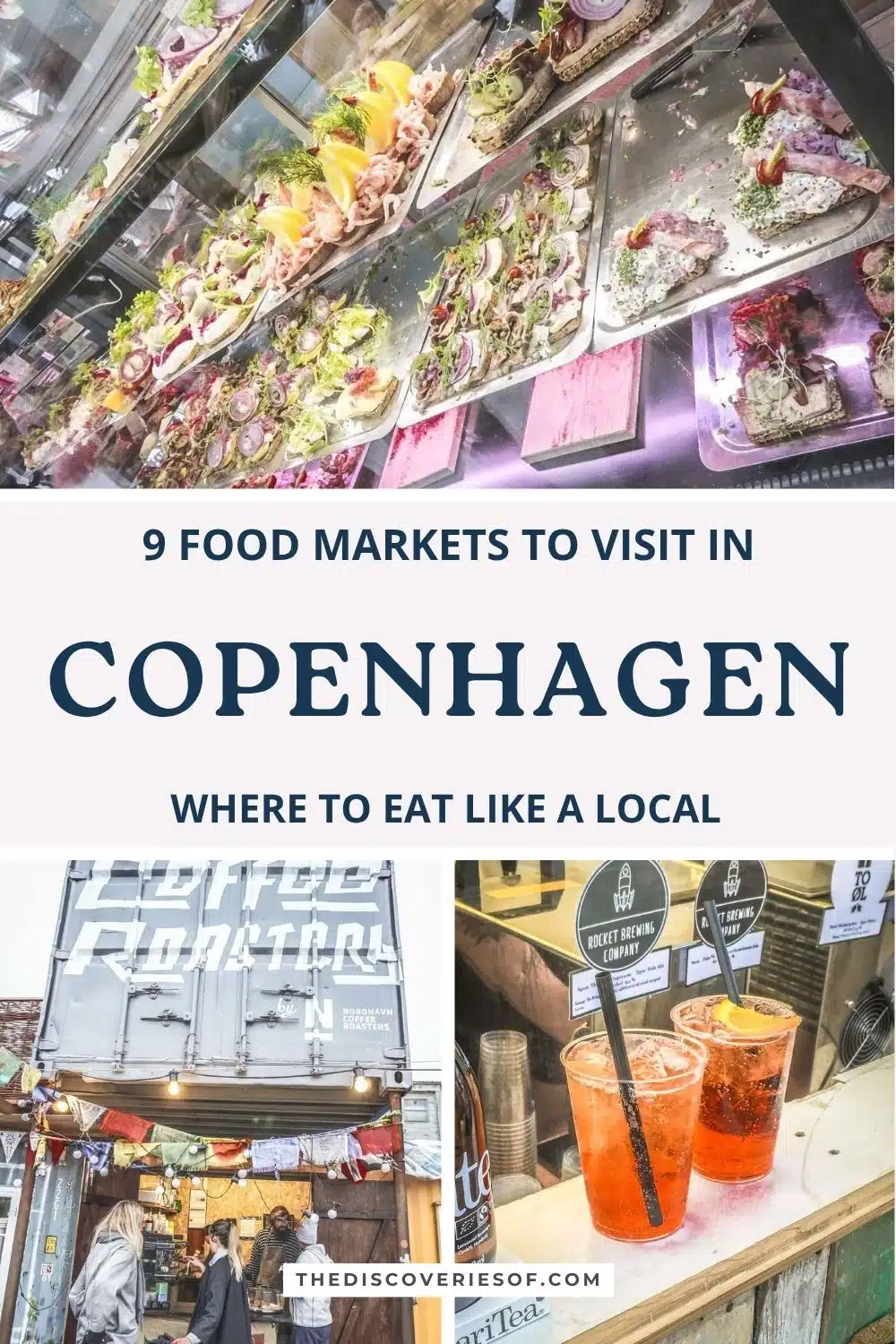
Love this? Save and share on Pinterest!

Discover the top things to do, insider tips and hidden gems in our Denmark Travel Guide.
Read the guides →




