
Discover how to see the cherry blossoms in Washington DC: when peak bloom happens, the best places to see them (crowded and quiet), and how to plan your trip around them.
Every spring, the city of Washington, DC turns into a pastel pink wonderland with the annual blossoming of the cherry trees.
When the cherry blossoms in Washington DC are in full bloom, it’s an absolutely incredible sight. Pink and white blossoms line the Potomac River, the monuments, and DC’s historic neighbourhoods for one of the most picturesque events of the year.
Many visitors and locals descend upon Washington, DC’s sidewalks each year to see this flowery spectacle. To help you plan your trip and make the most out of your visit, I wrote this guide to the city’s cherry blossom season.
Whether you’re a tourist or a local in DC, I’ll help you scope out the best places to see cherry blossoms in DC, when the best times are to go, and what has changed around the Tidal Basin since its seawall was rebuilt.
Some links in this article may be affiliate links, which means we may receive a small commission, at no additional cost to you, if you decide to purchase through one of my recommended partners.
Planning your trip: frequently asked questions
When is cherry blossom season in Washington DC?
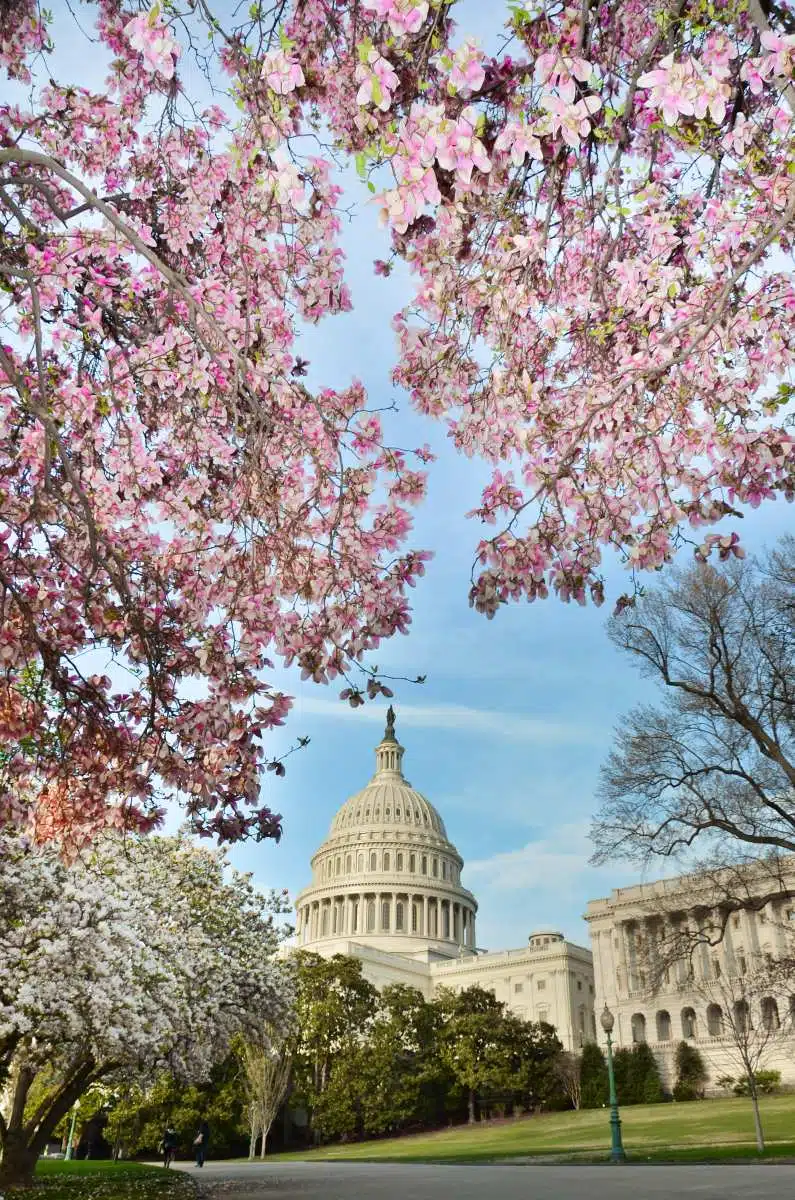
In general, cherry blossoms in Washington, DC bloom anywhere from late March to early April. Each year, depending on the weather and temperature in the earlier months of the year, the peak bloom date changes.
The National Park Service, which looks after the trees around the Tidal Basin and the National Mall, says peak bloom most often falls between the last week of March and the first week of April. The extremes show how much it can move: the earliest peak on record was 15 March (in 1990) and the latest was 18 April (in 1958). In recent years it has tended to come early, with peak bloom on 17 March in 2024 and 26 March in 2026.
“Peak bloom” has a precise meaning here: it’s the day when 70% of the Yoshino cherry blossoms around the Tidal Basin are open. The trees usually look their best for several days either side of it, and cool, calm weather stretches the show out, while heavy rain or wind can strip the petals in a day. A hard frost at the wrong moment can be devastating: in March 2017, a late freeze destroyed about half of the blossoms.
If you can only pick one weekend months in advance, aim for the end of March or the very start of April and keep your plans flexible. If you miss the Yoshino peak, don’t despair. The Kwanzan cherries, with their frilly, deep pink double flowers, bloom about two weeks later, so a mid-April trip can still be a pretty one (more on where to find them below).
How is peak bloom forecast?
Forecasting peak bloom is notoriously tricky, and the NPS says it’s almost impossible more than about ten days ahead. Its horticulturists track a sample of Yoshino trees through five stages before peak bloom:
- Green buds: small nodes appear at the ends of the twigs.
- Florets visible: the nodes grow larger and you can make out tiny florets.
- Extension of florets: the nodes fill out and begin to burst.
- Peduncle elongation: the flower stems stretch and the petals begin to show.
- Puffy white: pink-tinged white blossoms erupt from each bud. Peak bloom usually follows within days.
The official forecast is usually announced in early March (in 2026 it came on 5 March, predicting peak bloom between 29 March and 1 April) and is then refined as the buds move through each stage. Follow the NPS on social media (@NationalMallNPS, using #BloomWatch) for daily updates, and check back on the independent Cherry Blossom Watch website, which tracks the forecasts and the bloom stages every season.
When is the National Cherry Blossom Festival?
Around the peak bloom date, the city of Washington, DC hosts the annual National Cherry Blossom Festival, where there are tons of family activities, a popular road race, and plenty of opportunities to see these famous flowers. It commemorates the gift of 3,020 cherry trees from the mayor of Tokyo, Yukio Ozaki, to the city in 1912.
The festival runs for three weeks or so, from late March to mid-April. The 2027 festival runs from 20 March to 11 April, and the main events are:
- Opening ceremony: 20 March.
- Blossom Kite Festival: 27 March, on the Washington Monument grounds.
- Petalpalooza: 3 April, a day of live music and family activities at Navy Yard.
- Credit Union Cherry Blossom Ten Mile Run and 5K: the 10-miler is on 4 April and the 5K on 3 April. Entry is by lottery, which opens on 14 December 2026 and closes on 5 January 2027.
- National Cherry Blossom Festival Parade: 10 April.
- Sakura Matsuri Japanese Street Festival: 10 and 11 April.
Check the official festival website for the full calendar, as smaller events, ticketed parties and pop-ups are added through the winter.
Do I have to go to the Cherry Blossom Festival activities to see them?
Absolutely not! In fact, if you want to avoid the crowds in Washington, DC, I recommend that you skip the main festival events and explore the cherry blossoms early in the morning (before activities start) or in less-popular areas.
I’ve got a bunch of suggestions for you below on popular and off-the-beaten-path places to see the blossoms all around the city.
What has changed at the Tidal Basin?
If you haven’t been for a while, the Tidal Basin looks a little different. Its old seawall had been sinking for decades, and at high tide the paths flooded twice a day, drowning the roots of the trees along the water’s edge. In 2024, the National Park Service started rebuilding the seawalls around the Tidal Basin and along the Potomac River in West Potomac Park, and 306 trees had to be removed for the work. That included “Stumpy”, the scrappy, half-dead Yoshino that became an internet favourite; arborists took cuttings first, and clones of Stumpy are being grown on for replanting around the basin.
The rebuild finished well ahead of schedule. In spring 2026, 426 new trees were planted, 269 of them cherries, and the restored walkway reopened in April 2026: it’s wider, smoother and step-free, so it’s far easier going with a stroller or wheelchair than the old, waterlogged path. For the 2027 season, the full loop should be open again, but expect the newly planted cherries along the rebuilt stretch to be noticeably smaller than the mature trees elsewhere for a few years yet. If any areas are fenced off to protect the young trees, the NPS posts alternative routes and alerts on its website.
What is the weather like during cherry blossom season in DC?
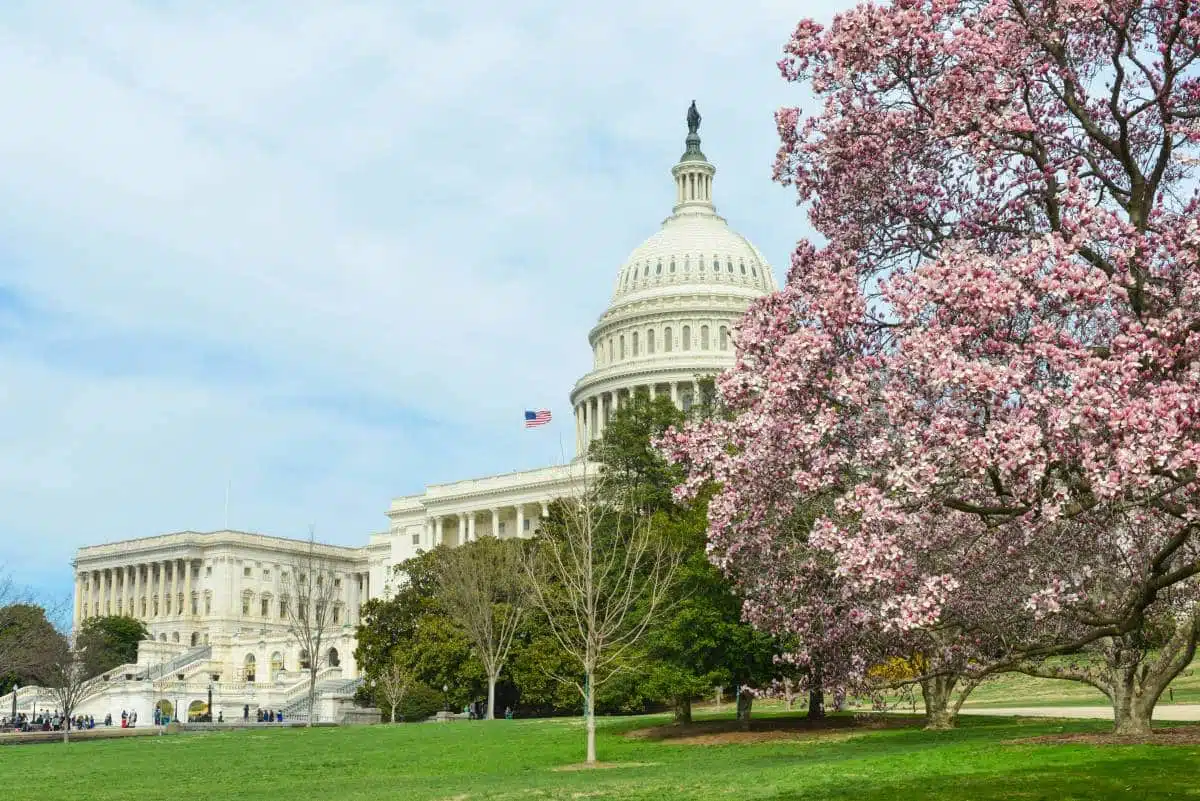
The weather in springtime in DC can be really unpredictable.
One day, it’s sunny and warm, and the next, it’s cold, rainy, and windy. Sometimes, the weather changes that drastically within a single day. Yeah. DC weather is temperamental AF.
To give you an idea, the average high in early April is around 17°C (63°F) and the average low around 7°C (44°F), but a warm, sunny afternoon followed by a near-freezing morning is entirely normal.
With that said, it’s important to come prepared for a wide variety of weather conditions. For your trip to DC for the cherry blossoms, I’d recommend bringing the following in addition to your normal weekend trip wardrobe:
- A rain jacket and/or umbrella
- Fleece sweater
- A large handbag
- Good walking shoes
- Your camera
- Warm layers for a sunrise visit (it can be close to freezing at dawn)
- A portable phone charger, as you’ll be taking more photos than you think
Where should I stay to see the cherry blossoms?
Washington DC is a super walkable city and, in the main areas, you can see a lot of the most famous cherry blossoms on foot.
The closest areas to stay for the cherry blossoms are Downtown and Chinatown, with The Wharf a good alternative just south of the Tidal Basin. Cherry blossom season is the busiest and most expensive time of year for DC hotels, so book as early as you can. I recommend the following options to see the cherry blossoms.
The St. Regis Washington, D.C.
Located in the downtown area, two blocks from the White House, the St. Regis Washington DC is one of the finest luxury properties in the city.
Personally, I treated my family to a staycation here and was totally googly-eyed over the lavish decor, beautiful furnishings, and proximity to literally all of the main attractions in the city. Plus, they offered a free champagne toast every night, and the hotel still sabres a bottle of champagne in the lobby each evening.
Motto by Hilton Washington DC City Center (formerly the Pod DC)
On H Street on the Chinatown edge of Downtown, the hotel that used to be the Pod DC is now Motto by Hilton Washington DC City Center, and it’s still a fantastic mid-range option. While the rooms are small, prices are typically lower than most hotels in the city and it’s a great location to walk to DC’s main attractions, with Gallery Place Metro station right on the doorstep.
InterContinental Washington DC The Wharf
If you’d like to be within walking distance of the blossoms rather than a Metro ride away, The Wharf is the closest hotel district to the Tidal Basin: from here it’s roughly a 20-minute walk along the water to the Jefferson Memorial. The InterContinental is one of the smartest hotels on the waterfront, with river views from many of its rooms and plenty of restaurants on the doorstep.
For more options in every price range, area by area, see my guide to where to stay in Washington DC.
How can I get around Washington DC?
Washington DC is a really easy city to get around: it’s small, not too congested, and has great public transit options.
First of all, it’s totally walkable in the main downtown areas and the surrounding neighbourhoods. Where it’s not walkable, you can easily get around the city by Metrorail or bus, or call one of the city’s ride-sharing or taxi services (Uber, Lyft and taxis are all available).
Metrorail fares currently range from $2.25 to $6.75 one-way depending on how far you travel, and local buses cost $2.25. You can tap a contactless bank card or your phone at the faregates, so there’s no need to buy a SmarTrip card for a short trip. Consult the WMATA website for timetables, routes and service changes. The red DC Circulator buses you may remember stopped running at the end of 2024.
Capital Bikeshare is another good way to hop between viewing spots, at $1 to unlock a bike plus 15 cents a minute, with docks all around the National Mall.
During the festival, I wouldn’t drive into the city centre unless you have to. There’s no dedicated parking lot for the Tidal Basin, the metered spaces along Ohio Drive and around the memorials fill up by mid-morning on peak weekends, and temporary closures and time limits are common. If you do drive, the unmetered parking around East Potomac Park and Hains Point is your best bet, though it means a longer walk to the basin.
Where to see the cherry blossoms in Washington DC
The Tidal Basin
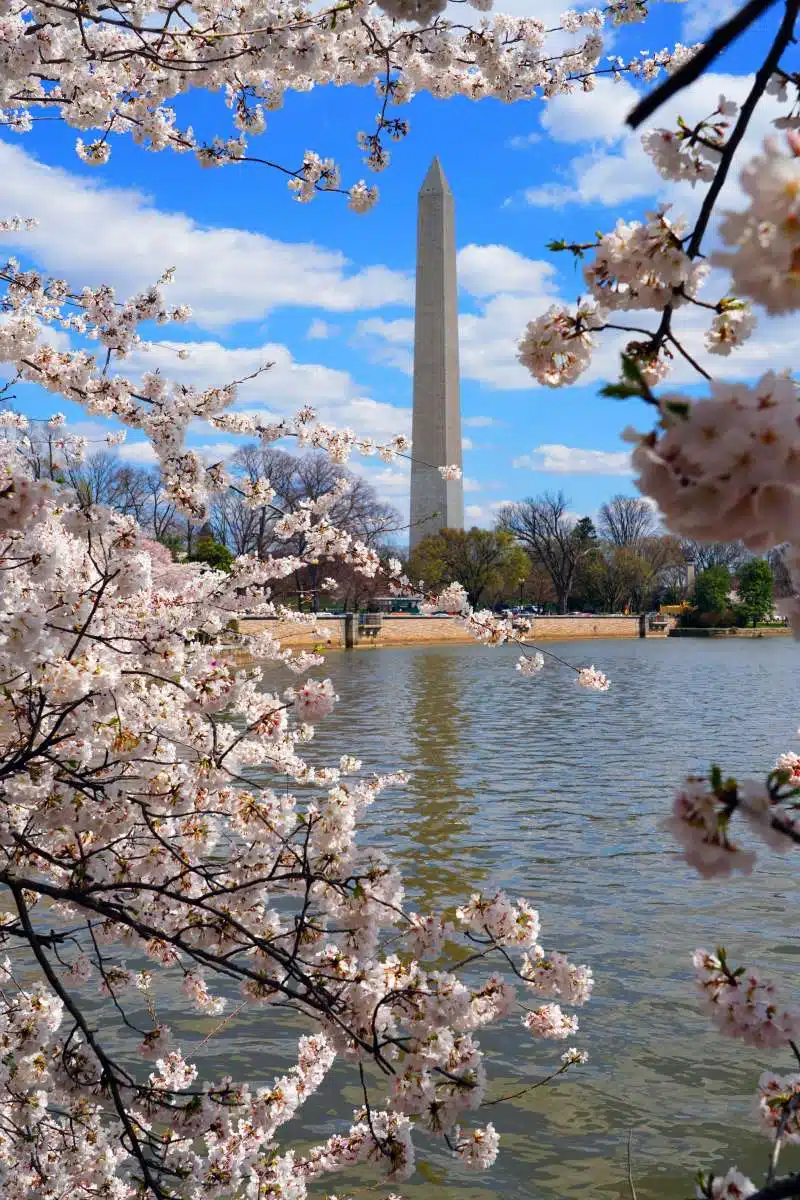
The Tidal Basin is the quintessential place to see the cherry blossoms in Washington DC. Located on the waterfront right next to the Jefferson Memorial, this park area has trails and sidewalks to explore the blossoms, with a loop of about two miles around the water.
It’s the area of the city where the cherry trees are most condensed, meaning you’ll likely see blossoms everywhere you look here! The NPS cares for around 3,800 cherry trees in the park, and about 70% of them are Yoshinos, the cloud-white, faintly pink variety that rings the Tidal Basin and spills north onto the Washington Monument grounds. Look out for the first two trees from the original 1912 gift, planted by First Lady Helen Taft and Viscountess Chinda, the wife of the Japanese ambassador: they still stand on the northern bank, near the John Paul Jones Memorial.
Additionally, this is where most of the festivities for the National Cherry Blossom Festival occur, and also one of the most popular (read: crowded) areas to see the cherry blossoms in DC.
While here, you can snap shots of the Washington Monument and the Jefferson Memorial amongst the pink and white blooms. The Martin Luther King, Jr. Memorial and the Franklin Delano Roosevelt Memorial are also right on the water, and the Japanese Lantern, a 17th-century stone lantern given to the city by Tokyo in 1954, makes a lovely subject when it’s framed by blossom.
You can also rent a paddle boat and paddle around the basin to see the cherry blossoms from the water. It’s a fun activity to do on a sunny day in the spring! The boats go out from the Tidal Basin Boathouse (1501 Maine Avenue SW) and take up to four people, and they’re rented by the hour (about $38 to $40 per boat). The swan-shaped boats have been retired, sadly, and during peak bloom the boats are walk-up only, so get there early.
How to get there: Take the Metro and get off at the Smithsonian station (Blue/Orange/Silver line) and walk about 10 minutes to the Tidal Basin. On the busiest days, Metro suggests using L’Enfant Plaza, Federal Triangle or Archives instead, which are about a 20-minute walk away and much less crowded. Or, simply walk from your Downtown accommodation.
Top Tip
Go at sunrise. The light on the Jefferson Memorial is beautiful, the paths are almost empty for the first hour, and photographers line the water’s edge opposite the memorial for the reflection shot. By 10 am on a peak-bloom weekend, the paths can be shoulder to shoulder.
The National Mall
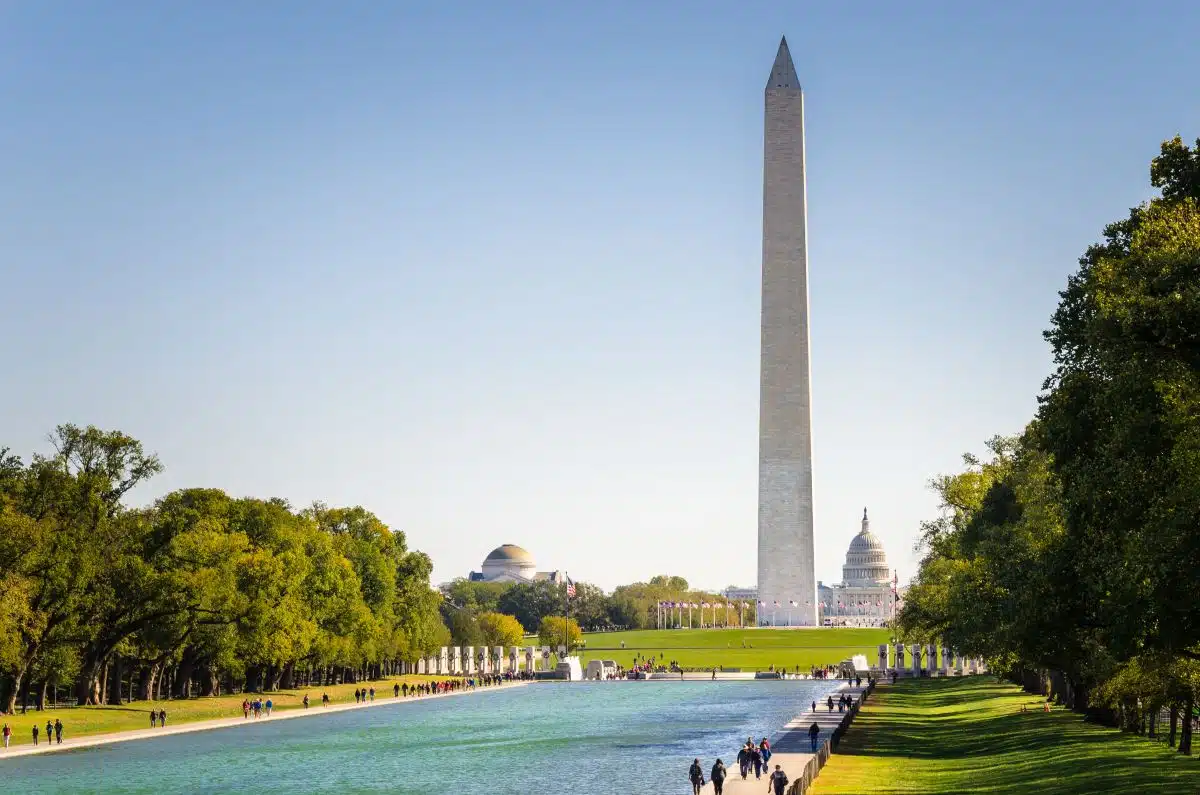
While there are fewer trees on the National Mall than at the Tidal Basin, it’s still a great spot to catch lots of blossoms, with trees clustered sporadically from the Capitol Building all the way to the Washington Monument, where the Yoshinos from the Tidal Basin spread up the slopes of the Monument grounds.
On nice days, the National Mall is a perfect place to stroll outside, catching views of some of the city’s most iconic sights with some cherry blossoms in between.
Plus, while you’re here, you can catch some of DC’s best museums: the many (free) Smithsonian museums are my personal favourites. The Newseum, which used to be another favourite of mine, closed at the end of 2019, and its building on Pennsylvania Avenue is now the Johns Hopkins University Bloomberg Center.
Pro tip: For a bird’s-eye view of the blossoms ringing the Tidal Basin, head up the Washington Monument. Its observation level is 500 feet up, and entry is free, though you need a timed ticket: book online on Recreation.gov (tickets are released at 10 am, 30 days ahead, with a $1 booking fee), or join the queue for same-day tickets at the Washington Monument Lodge on 15th Street, which opens at 8:45 am.
How to get there: Take the Metro and get off at the Smithsonian station (Blue/Orange/Silver line). Or walk from your Downtown accommodation. Either of these options will leave you directly on the National Mall!
The National Arboretum

A lesser-known but absolutely beautiful place to see cherry blossoms in DC is the US National Arboretum.
Located in Northeast DC, a couple of miles east of Union Station, it’s a bit trickier to get to, but well worth the hassle. You’ll leave the crazy crowds of the National Mall and the Tidal Basin for a more peaceful, tranquil haven of almost 450 acres.
Here, you’ll find trails all around the park area, many of which have pink and white cherry blossoms during the peak bloom season. The arboretum grows a far wider range of flowering cherries than the Tidal Basin, so different trees bloom from early March into April, and its self-guided cherry tour (in the arboretum’s free app) links around 40 stops along a three-mile loop that you can walk, cycle or drive. During your visit, you can also see the National Capitol Columns, 22 Corinthian columns that once stood on the East Portico of the Capitol, and enjoy other various plant species in the park, including the National Bonsai and Penjing Museum.
Entry and parking are free, and the grounds are open daily from 8 am to 5 pm (last entry at 4:30 pm).
How to get there: There’s no Metro station nearby and it’s a little tricky to get here by bus, so I’d recommend visiting using a ride-sharing service, a taxi, or by renting a car. There’s also a Capital Bikeshare dock outside the R Street entrance if you’d rather cycle.
Kenilworth Park & Aquatic Gardens
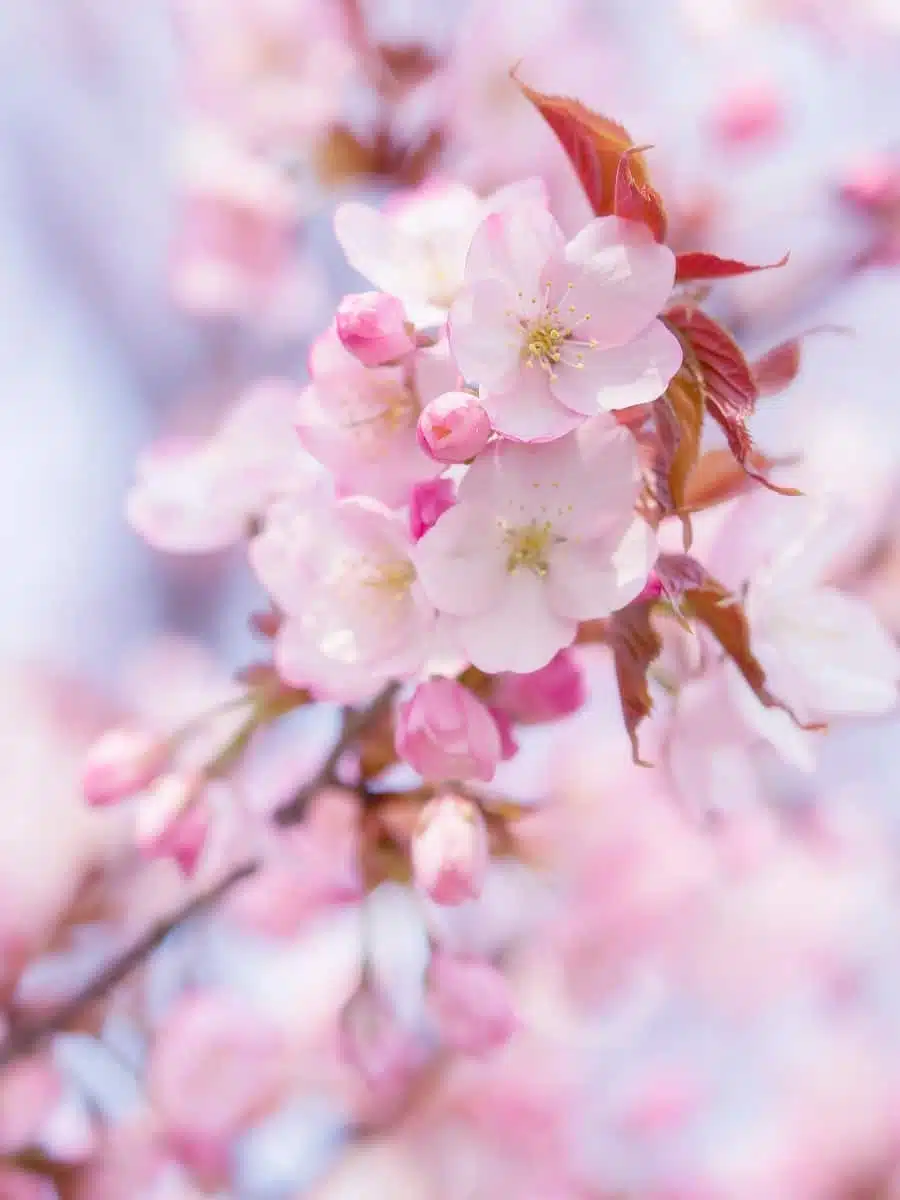
If you’re hoping to get even more peace and quiet while admiring the annual cherry blossoms, head to Kenilworth Park & Aquatic Gardens, one of the city’s prettiest parks, in my opinion.
Kenilworth Park is where most of the cherry blossoms are, but the aquatic gardens are lovely and worth visiting if you’re already in the area. Run by the National Park Service, they’re the only national park site devoted to water plants, and their boardwalks lead out through ponds and marshland along the Anacostia River.
In the springtime, around peak bloom season, you can spot some beautiful cherry blossoms lining the grounds of the park. Even upon entering the park, you can already see dozens of cherry trees lining the area, and if you’re lucky, you might even get the views to yourself.
Entry is free, and outside the summer months the gardens are open daily from 8 am to 4 pm.
How to get there: You can get to Kenilworth Park & Aquatic Gardens via Metro: take the Orange Line to Deanwood, leave by the Polk Street exit and cross the pedestrian bridge over Kenilworth Avenue, then follow Douglas Street to Anacostia Avenue (the NPS website has step-by-step directions). However, I’d recommend driving, as it’s a little bit out of the way.
East Potomac Park & Hains Point
Located along the Potomac River, East Potomac Park is home to a large number of DC’s cherry blossoms.
The park is on a peninsula southeast of the Tidal Basin and the Jefferson Memorial, and tends to be a bit more peaceful than the Tidal Basin during peak bloom times. Many of its trees are Kwanzans, which flower about two weeks after the Yoshinos, so it’s the best place in the city to catch the blossoms if you’ve arrived after the main peak. The loop around the peninsula to Hains Point, at its southern tip, is around four miles, with views across the water to the Wharf on one side and Virginia on the other.
A visit to East Potomac Park is a great way to extend your visit to the Tidal Basin or get some exercise along the river on warm days. There’s free parking around the park and the golf course, but note that the park closes overnight.
How to get there: Continue southeast from the Tidal Basin past the Jefferson Memorial along the sidewalks and you’ll arrive in East Potomac Park.
Dumbarton Oaks, Georgetown
Hidden behind high walls in Georgetown, the gardens at Dumbarton Oaks are a series of terraced “garden rooms” spilling down a hillside, and in spring the slope known as Cherry Hill is planted with several varieties of flowering cherry. It’s one of the most romantic places to see the blossoms in the city, and the timed entry keeps the numbers down.
The gardens are open Tuesday to Sunday afternoons (2 pm to 6 pm, with last entry at 5:30 pm, from mid-March). From 15 March to 31 October you need a ticket, which is sold only online, in advance: none are sold at the gate or on the day, so book ahead for blossom season. For more of Georgetown’s quieter corners, see my guide to non-touristy things to do in Washington DC.
How to get there: There’s no Metro station in Georgetown proper. Take a bus to Wisconsin Avenue and R Street, walk up from Dupont Circle (about 20 minutes), or take a rideshare.
Congressional Cemetery
Founded in 1807, Historic Congressional Cemetery in Southeast DC, near the Anacostia River, is the resting place of dozens of members of Congress and a surprisingly lovely place to see cherry blossoms. A row of cherry trees lines the main path through the middle of the grounds, framing the little chapel at the end, and its mix of varieties (including Yoshino, Kwanzan and Higan) means some trees flower before the Tidal Basin and some after it.
It’s a working cemetery and a popular spot with local dog walkers, so treat it with respect.
How to get there: The cemetery is at 1801 E Street SE. Potomac Avenue Metro station (Blue/Orange/Silver line) is around a 10-minute walk away.
Capitol Hill: Stanton Park and Lincoln Park
If you’re staying on Capitol Hill, you don’t need to go far to find blossom. Stanton Park, a small square a few blocks northeast of the Capitol, is ringed with cherry trees, and Lincoln Park, about half a mile further east on East Capitol Street, has wide lawns and blossoming branches reaching over its statues. Both are residential squares where locals walk their dogs and push strollers, so they stay peaceful even at peak bloom. Combine them with a wander through the neighbourhood’s rowhouse streets and a stop at Eastern Market.
How to get there: Stanton Park is about a 10-minute walk from Union Station (Red line).
Cherry blossom tours in Washington DC
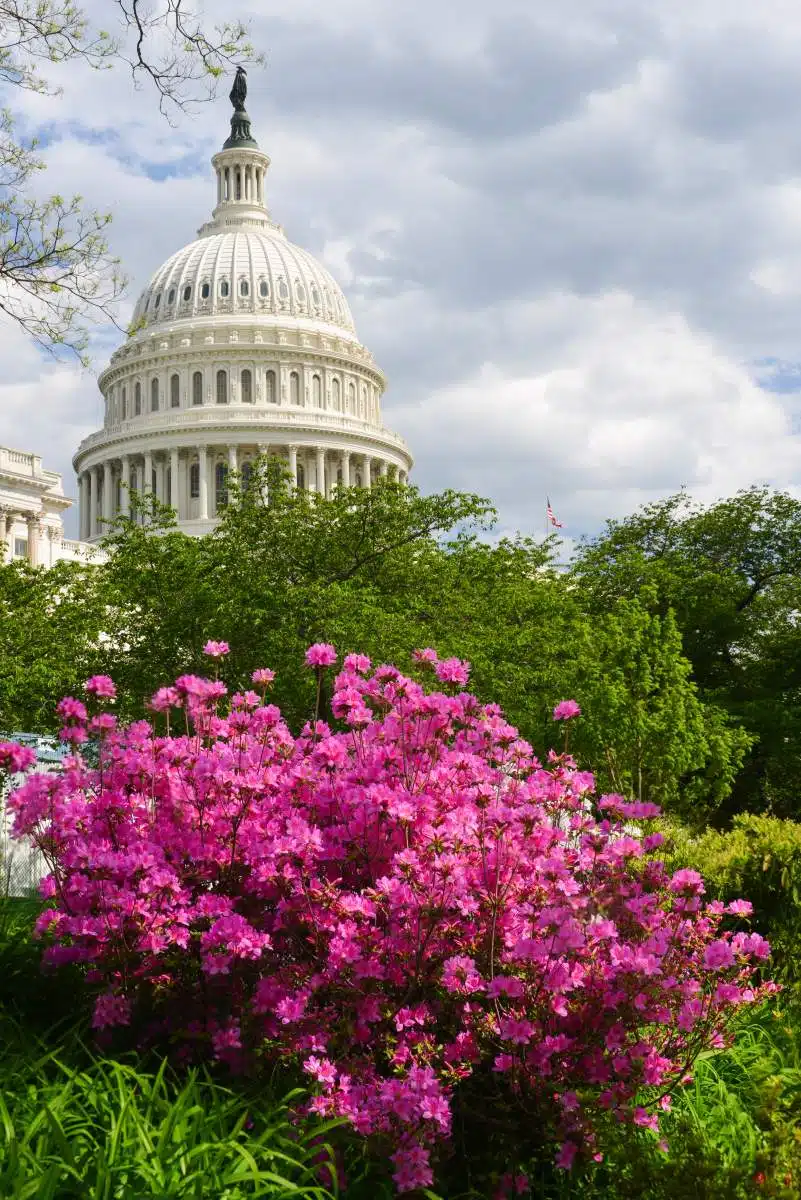
If exploring the city on your own makes you anxious, don’t fret!
There are a ton of awesome guided tours, short and long, that you can take to see the blooms and learn more about their history. Here are a few fun cherry blossom tours to consider:
- By boat: The Potomac River is a great vantage point for seeing the city in spring. Several boat tours depart from Georgetown’s waterfront, including this 45-minute Potomac River sightseeing cruise, which passes the Kennedy Center, the Lincoln Memorial and the Jefferson Memorial. Others leave from The Wharf.
- On a bike: Whiz through the streets of DC on two wheels and see the amazing cherry blossoms on the cherry blossom bike and e-bike tour. Many DC locals love getting around by bike, and this is a great way to experience the city and see some of the best spots for cherry blossoms along with an expert guide. The two-hour tour runs during the festival and stops at the Tidal Basin and the Martin Luther King, Jr., FDR, George Mason and Jefferson memorials.
- With a walking tour: There’s really no better way to see and learn about the cherry blossoms in DC than on foot with a local guide, who will share the history and fun facts about the trees as you go. Browse the walking tours in DC: many of the monuments and memorials tours pass the Tidal Basin and are perfect for seeing the spring blooms in the city!
Places to see cherry blossoms near DC
If you’ve got extra time and want to see even more cherry blossoms, here are a few places near DC (in neighbouring Virginia and Maryland) where you can see stunning displays of cherry blossoms. For more ideas, see my guide to day trips from Washington DC.
- Arlington National Cemetery (Arlington, Virginia): A visit to Arlington National Cemetery is one of the most moving day trips from Washington, DC, and is especially beautiful in the springtime, when you can see cherry blossoms along the cemetery’s many pathways. The whole cemetery is an accredited arboretum. It’s open daily from 8 am to 5 pm, and it’s right by the Arlington Cemetery Metro station on the Blue line.
- Meadowlark Botanical Gardens (Vienna, Virginia): Located in Vienna, Virginia, Meadowlark Botanical Gardens boasts an impressive number of cherry trees, without the crowds of Washington DC. Don’t miss its Korean Bell Garden. Adult admission is $9. If you have a car, it pairs well with one of the hikes in Northern Virginia.
- Kenwood (Bethesda, Maryland): If you’re looking for beautiful homes lined with cherry trees (AKA a super picturesque, laid-back neighbourhood), visit Kenwood, a residential area in Bethesda, Maryland, where a developer planted around 1,200 cherry trees in the 1930s and 1940s to attract buyers. The best streets for cherry blossom viewing are Kenwood Avenue, Kennedy Drive, and Dorset Avenue. Visitors can’t park on the neighbourhood’s streets, so come by rideshare or park further away and walk in.
- Centennial Park (Howard County, Maryland): If you’re late to the cherry blossom party, no worries. In Howard County’s Centennial Park, near Ellicott City, you can typically see cherry trees in full bloom up to two weeks after the Tidal Basin peak, as the county’s trees are mostly Kwanzans. Look for the Founders Grove, the first grove planted by the local charity Blossoms of Hope. The charity also runs its annual Cherrybration events, which raise money for people affected by cancer and are a lot less crowded than DC’s festival. The park is open daily from 7 am to sunset.
Map
Read next
- A weekend in Washington DC: the perfect 2 to 3 day itinerary
- Where to stay in Washington DC: the best neighbourhoods and hotels
- 43 non-touristy things to do in Washington DC besides museums and monuments
- 21 spectacular day trips from Washington DC
- 19 charming hikes in Northern Virginia
- More Washington DC travel guides
Love this? Save and share on Pinterest


Discover the top things to do, insider tips and hidden gems in our USA Travel Guides.
Read the guides →