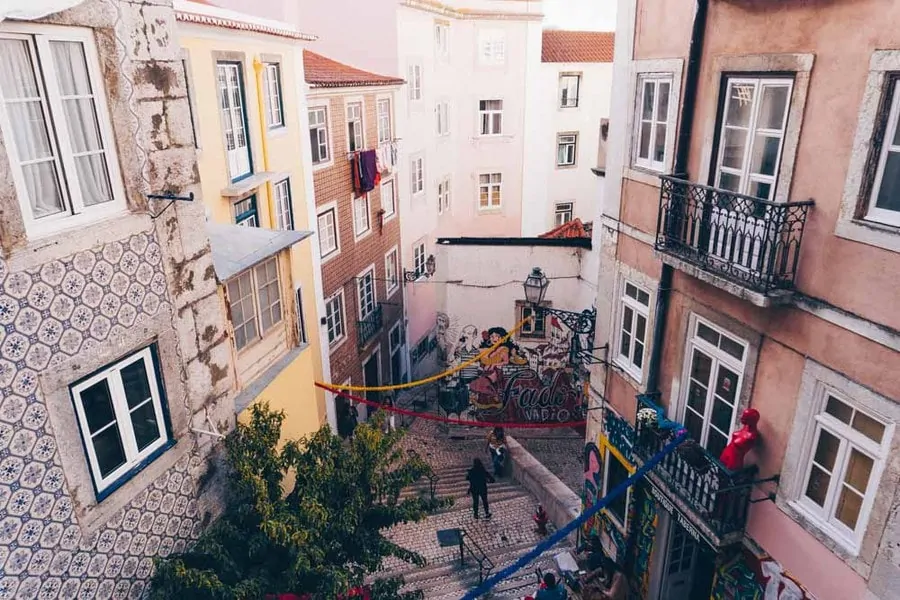
Lanes too narrow for a car, steps that suddenly reveal a slice of the Tagus, washing strung between balconies and the sound of fado drifting out of a doorway after dark. Alfama is the oldest corner of the Portuguese capital and one of the few that came through 1755 standing. Here’s how to get under its skin, from the walk I’d do first to the petiscos I rate, plus the quarter next door where fado was born.
I’ve visited Lisbon time and again, and each trip has shown me a little more of it. Alfama is small, a hillside wedged between the castle and the Tagus, but it packs in more history per square metre than anywhere else in town: Roman foundations, a Moorish fortress, a cathedral begun the year the city changed hands, and a maze of alleys laid out long before anyone thought of street plans.
The trouble is that it’s very easy to walk through and miss almost all of it. On an October trip, I explored it with a historian, which is still the best way I know to get under its skin. On the same trip, a walking and tasting tour took me through the Baixa, past the scorched Church of São Domingos and into Mouraria, on the far side of the castle hill, which most visitors never reach.
This guide pulls all of that together: what to see, where to eat, where to hear fado and how to tackle the hills without losing the will to live.
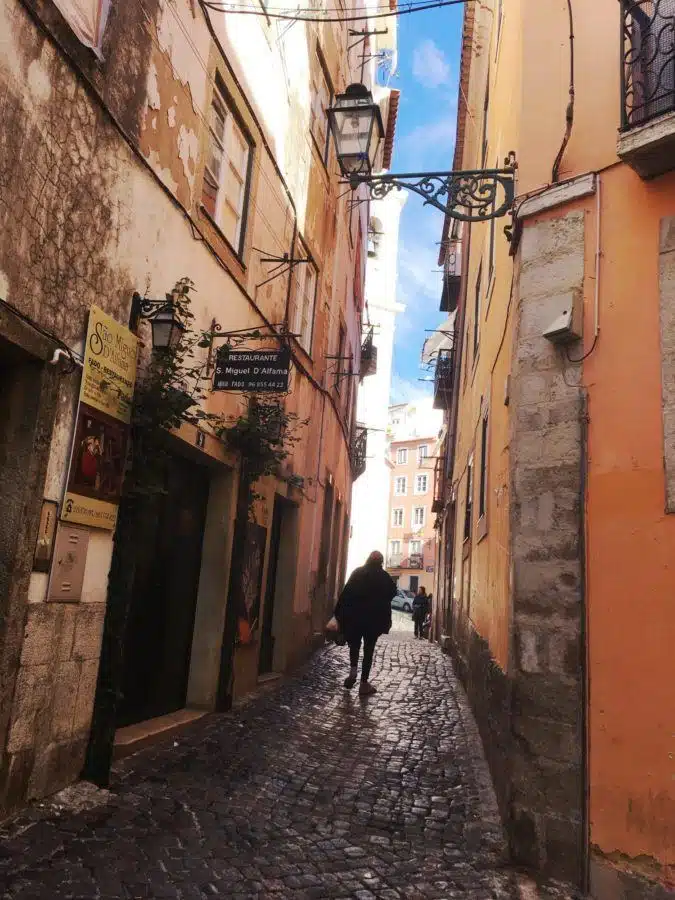
Alfama takes its name from the Arabic al-hamma, the baths or springs, after the hot springs that bubbled up here under Moorish rule. When Afonso Henriques took Lisbon in 1147, the old Moorish town on this hill became the heart of the new Christian city, and over the centuries it slid from a fashionable address to a working fishermen’s and dockers’ quarter. It survived thanks to what lies beneath: when the earthquake, fire and tsunami of 1 November 1755 flattened the lower town, the bedrock under these lanes held, and what you walk through today is a street pattern that predates the disaster.
The best things to do in Alfama
Take a history tour from the castle down to the cathedral
A history tour won’t be everyone’s idea of a holiday, but for this neighbourhood I’d put it top of the list. Mine took two and a half hours with a knowledgeable and friendly historian, starting up at São Jorge Castle and finishing at the Sé, and I came away knowing the quarter’s past and its present.
That’s the point of doing it with someone who knows. The quarter is a microcosm of the country’s history, settled in turn by Romans, Visigoths and Moors, and it was once a tight-knit community where families lived their whole lives. Its growing popularity has changed that, and a good guide will tell you both stories.
The route itself is the ideal way to see the neighbourhood, too. Starting at the top and working downhill means the views open up as you go and your knees do most of the work in one direction.
Top Tip
Book your history walk for the morning. You’ll have the lanes to yourself before the tour groups and cruise passengers arrive, and the light on the river is softer.
Start high at São Jorge Castle

It makes sense to begin where my tour did, at the top. Under Moorish rule, this hilltop was walled and fortified in the 11th century as a lookout and a last line of defence, and after the conquest it became a royal residence until the kings moved down to the riverside palace in the 16th century.
What you see today is partly a 20th-century reconstruction, but the views are the real thing: the whole of Alfama tumbling down to the Tagus on one side and the Baixa’s grid on the other. Walk the ramparts and towers, look out for the peacocks in the gardens, and catch the guided camera obscura session in the Tower of Ulysses, which projects a live view of the city onto a dish in a darkened room (it’s included in the ticket but depends on the weather).
Tickets
€17 for adults, €8.50 for 13 to 25-year-olds and €14 for over-65s; under-12s go free. Open daily from 9am to 9pm from March to October and 9am to 6pm from November to February, closed 1 January, 1 May and 24, 25 and 31 December. Queues can be long in summer, so a skip-the-line ticket with a guide saves time.
It also features in my round-up of the best castles in Portugal.
Watch the light go from Portas do Sol
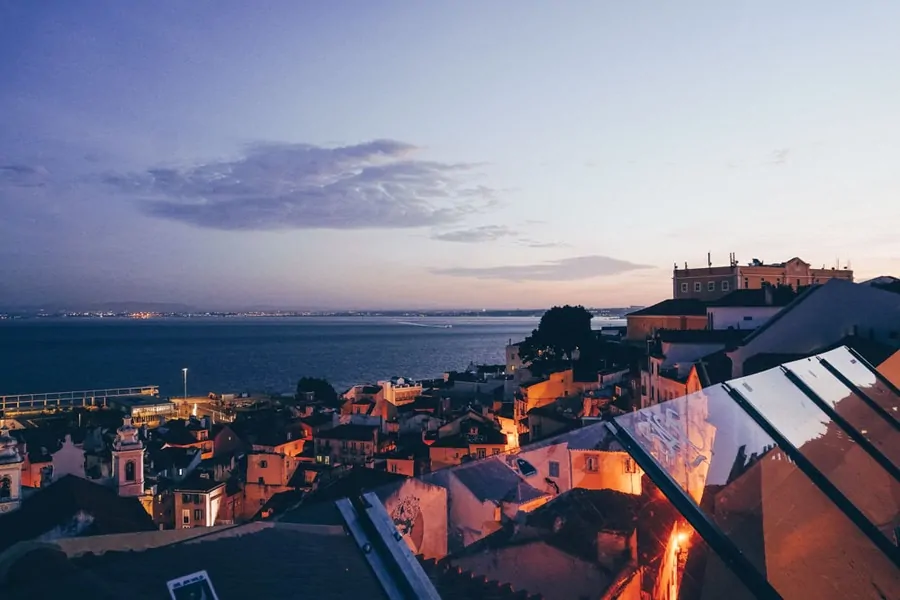
Portas do Sol takes its name from one of the gates in the old Moorish wall, and it’s now the best-known viewpoint in the neighbourhood. From the square, the white dome of the National Pantheon and the twin towers of São Vicente de Fora rise out of a jumble of terracotta roofs, with the river spreading out beyond.
Come at sunset, when the whole scene turns gold and then pink. There’s a café terrace on the square, and it’s the perfect place to nurse a cocktail while the last light fades over the water.
Santa Luzia is just a few steps downhill, with a tiled pergola draped in bougainvillea and two panels of azulejos on its outer wall, one showing Praça do Comércio before the earthquake and the other the Christian siege of the castle in 1147. If you still have energy, the higher viewpoints at Graça and Senhora do Monte are a stiff climb further up, and my guide to the best things to do in Lisbon rounds up the rest of the city’s miradouros.
Facing Portas do Sol, the Museum of Portuguese Decorative Arts fills a 17th-century palace with furniture, silver and tiles, a quieter stop when the viewpoint is busy.
Step inside the Sé

My history tour finished at the cathedral, and it’s an appropriately weighty full stop. Work began on the Sé in 1147, straight after the conquest, on the site where the city’s main mosque is thought to have stood, and with its crenellated towers it looks as much like a fortress as a church.
Inside, the Romanesque nave is plain and dark, and the treasury and high choir upstairs hold the cathedral’s silver and vestments. The cloister is the part to linger over: excavations here have dug down through the city’s history to a Roman street and the remains of Islamic-era buildings.
The church across the square, Santo António, stands where the city’s patron saint is said to have been born in the 1190s.
Tickets
€7 (€5 reduced) for the nave, high choir and treasury; under-6s go free. Open Monday to Saturday, 10am to 6pm from November to May and 9.30am to 7pm from June to October. Closed to visitors on Sundays and holy days.
Eat petiscos at A Muralha
These days, plenty of places in the old quarter serve tired food at inflated prices, but if you know where to look, there are still gems. A Muralha Tapas e Vinhos, down at the bottom of the hill near the cruise terminal and a few doors from the Fado Museum, is one of them.
It’s a small, unassuming room serving traditional Portuguese petiscos alongside wines from around the country. Honestly, everything I tried was a delight: a fresh, zingy octopus salad, a flaming morcela (blood sausage) and a tart, crumbly sheep’s cheese, all the better for a glass or two of wine you won’t find at home.
It’s at Rua do Jardim do Tabaco 104 and opens Monday to Saturday from mid-morning until after midnight. It’s closed on Sundays. For more of my favourite tables in the city, see my guide to the best restaurants in Lisbon.
Hear fado where it grew up
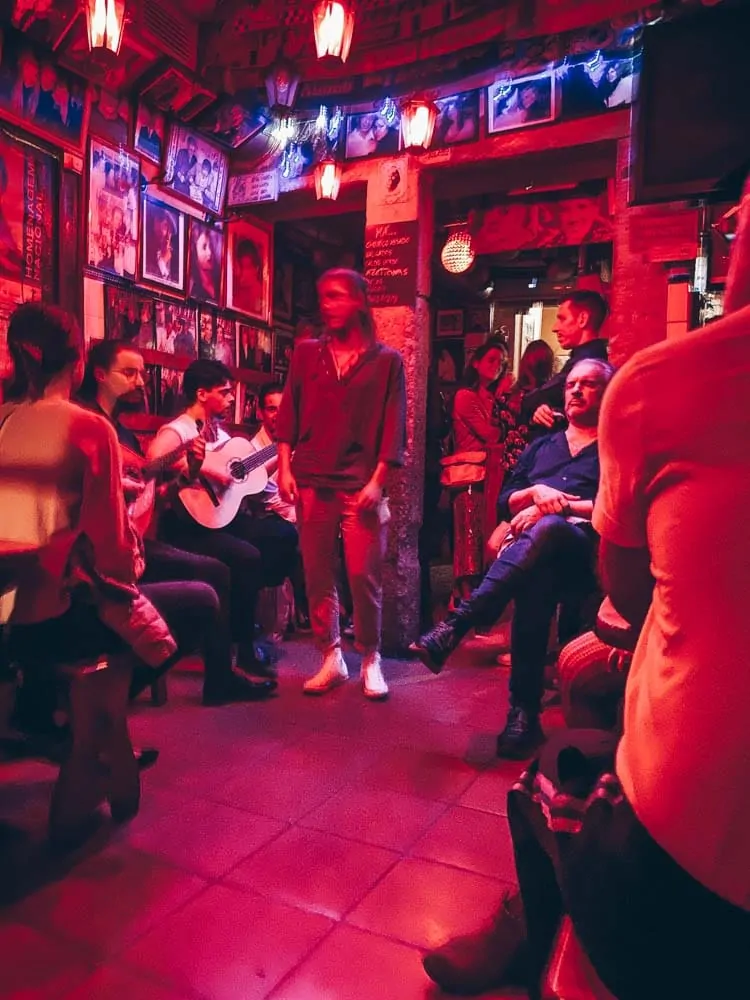
Fado is the soundtrack to this part of the city. The music of longing and hard luck grew up in the poorer quarters by the river, Alfama and Mouraria among them, and in 2011 UNESCO added it to its list of the world’s intangible cultural heritage.
There are two ways to hear it. The fado houses serve dinner with professional singers, and you’ll be expected to stay quiet while they perform: Parreirinha de Alfama and Mesa de Frades, in a tiled former chapel, are two of the best known. Then there are the tascas, where fado vadio (amateur fado) means anyone from the neighbour to the waiter might stand up and sing; Tasca do Chico has a branch on Rua dos Remédios.
To understand what you’re listening to, start at the Museu do Fado on Largo do Chafariz de Dentro, a small museum on the music’s history, its singers and the Portuguese guitar, with plenty of recordings to listen to.
Tickets
The Fado Museum costs €5 for adults, with an audio guide included. Open Tuesday to Sunday, 10am to 6pm (last entry 5.30pm), and closed on Mondays.
Drink ginjinha from a doorway
Ginjinha, the sour cherry liqueur, is Lisbon’s drink of choice, and the old quarter is the place to try it the way locals do: a quick shot from a hole-in-the-wall bar or from someone’s front door, sometimes served in a little chocolate cup. Pop into a tiny bar or two as you wander for a taste of the homemade stuff. It’s sweet, strong and cheap, and very easy to have one more of than you meant to.
Hunt for treasure at the Feira da Ladra
I love a flea market, and the Feira da Ladra (literally, the thieves’ market) is one of the best I’ve been to. It spreads across Campo de Santa Clara, behind São Vicente de Fora, on Tuesdays and Saturdays, setting up soon after dawn and packing away in the early afternoon.
The market’s roots go back to the Middle Ages, and it has been held on this square since the late 19th century. Expect everything from antique furniture and azulejos to old records, militaria, second-hand books and upcycled clothes, alongside plenty of junk.
Top Tip
Get there by about 10am, before the best pieces go, and bring cash: most stalls don’t take cards. Be wary of antique tiles, which may have been taken from historic buildings, and haggle on anything pricey.
Climb the National Pantheon and São Vicente de Fora
The two great white landmarks on this side of the hill are both worth going inside. The National Pantheon started life as the Church of Santa Engrácia in the 17th century and took so long to finish (the dome was only completed in 1966) that “obras de Santa Engrácia” is still Portuguese slang for a job that never ends. Today it holds the tombs of national heroes, among them the fado singer Amália Rodrigues and the footballer Eusébio, with memorials to Vasco da Gama, Henry the Navigator and Camões. Climb up to the terrace around the dome for a 360-degree view.
Next door, the Monastery of São Vicente de Fora was founded by Afonso Henriques just after the conquest, “outside the walls” as its name says. The present building is late Renaissance, and it’s lined with azulejos, including 38 panels illustrating La Fontaine’s fables. There’s also the pantheon of the Braganza kings and a roof terrace with views of the castle and the river.
Tickets
The National Pantheon costs €10 and opens Tuesday to Sunday, 10am to 6pm from April to September and until 5pm from October to March, with the last entry half an hour before closing. São Vicente de Fora costs about €8.
Find André Saraiva’s giant tiled mural
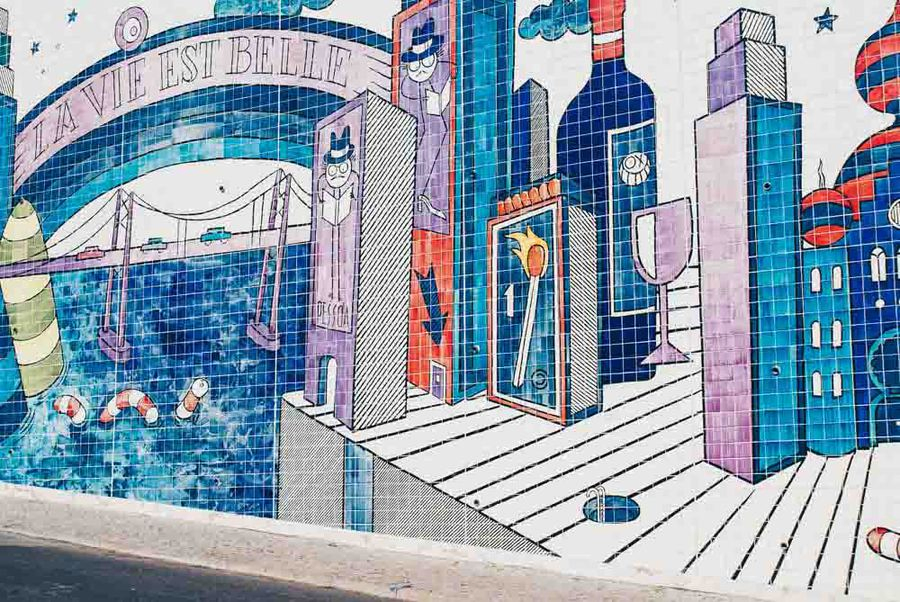
Street art is everywhere in this part of town, but my favourite piece is opposite the Pantheon. André Saraiva’s mural runs along the wall of the Jardim Botto Machado, more than 50,000 hand-painted tiles covering 864 square metres, and it’s packed with the places that shaped the artist’s life, from Lisbon to Paris and New York.
I tracked it down on a January trip, on a tip from Catarina, who looked after the press at the hotel where I was staying. It pairs perfectly with a Tuesday or Saturday morning at the flea market just behind it.
Ride Tram 28 through the lanes
The yellow Tram 28 squeezes through the neighbourhood on its way from Martim Moniz to Campo de Ourique, passing the Sé and stopping by Portas do Sol and Santa Luzia, and it’s a good way to save your legs on the climb. It’s also very crowded and a favourite of pickpockets, so ride it early in the morning or late in the day, keep your bag in front of you and buy a day ticket beforehand rather than paying on board. The shorter 12E loop from Praça da Figueira also climbs past Santa Luzia and is usually quieter.
Go in June for Santo António
If you can time your trip for June, do. The Festas de Lisboa take over the city all month, and the night of 12 to 13 June, the eve of Santo António’s feast day, is when the old quarters go wild. Squares and alleys fill with street parties (arraiais) strung with paper garlands, grills smoke with sardines, people buy little pots of basil (manjericos) for their sweethearts, and the neighbourhood marching groups parade down Avenida da Liberdade. Book your hotel well ahead and expect noise until dawn.
Walk on to the scorched Church of São Domingos

My October walking and tasting tour began on Praça do Comércio and climbed through the downtown grid to São Domingos, just off Rossio, and that’s the best way to approach Mouraria from below.
Few churches in the city carry so much history. In 1506, a massacre of the city’s Jews started on its steps. Two and a half centuries later the great earthquake left it badly damaged, and in 1959 fire tore through the interior. When it reopened, the scorched pink stone and cracked columns were left as they were, and the effect is haunting. My guide also told me that it was long one of the few churches where enslaved Africans could worship, and where African priests said mass.
My guide to the best things to do in Lisbon has more on the church.
Turn left into Mouraria

From São Domingos, my tour turned left and straight into Mouraria, which my guide described as the city’s most eclectic neighbourhood, in terms of both class and race. After the conquest, the Moors who stayed were moved outside the walls to this slope below the castle, and it has been home to newcomers ever since: today the streets around Martim Moniz, Rua do Benformoso and Largo do Intendente are home to communities from South Asia, China and Africa, with grocers and canteens to match.
It’s also the birthplace of fado. Maria Severa, the 19th-century singer often described as the first great fadista, lived and died here, and her house on Largo da Severa is now the fado restaurant Maria da Mouraria, where you can hear the music on the street where it was born.
The tour fed me well along the way: a São Jorge cheese from the Azores, aged for a minimum of four months and eaten with quince marmalade; cured ham from Bísaro pigs, a free-roaming northern breed that fattens up on chestnuts over the winter; bread from three cereals, milled and delivered to the shop daily; and a seven-year-old tawny, a young port that still had its red colour but tasted drier and looked deeper than a ruby.
Before you go
- Wear proper shoes. The streets are steep, cobbled and polished smooth, and slippery after rain. Two free public lifts, starting on Rua dos Fanqueiros in the Baixa, take a good chunk out of the climb towards the castle, and bus 737 runs up from Praça da Figueira to the castle gate.
- Getting there: the nearest metro stations are Santa Apolónia and Terreiro do Paço on the blue line, both at the bottom of the hill, and Martim Moniz on the green line for Mouraria.
- Time it right: the lanes are at their best early in the morning and in the evening. In the middle of the day, especially when cruise ships are in at the terminal below, the main routes up to the castle get very busy.
- Where to stay: for atmosphere, stay in the old quarter itself: Memmo Alfama has a rooftop terrace and pool with views over the rooftops to the river, and Santiago de Alfama is a boutique hotel in a restored 15th-century palace. For a treat further from the crowds, see my Four Seasons Hotel Ritz Lisbon review, and my guide to where to stay in Portugal covers the rest of the city.
Map
Read next
- The best things to do in Lisbon
- The best restaurants in Lisbon
- André Saraiva’s tiled mural in São Vicente de Fora
- Castles in Portugal worth the climb
- Is the Four Seasons Hotel Ritz Lisbon worth the splurge?
- LX Factory: shops, restaurants and street art
- One week in Portugal: the perfect itinerary
Love this? Save and share on Pinterest
Discover the top things to do, insider tips and hidden gems in our Portugal Travel Guides.
Read the guides →