André Saraiva’s Lisbon street art isn’t sprayed on a wall: it’s hand-painted on more than 50,000 tiles, and it runs for close to 200 metres beneath a garden in São Vicente de Fora. Here’s where to find it, what to look for and what to pair it with.
I was in Lisbon for a weekend in January, researching a few articles, gallivanting about and generally wishing that I lived in this super-cool city.
One of the things that really blew me away was the street art that you can find dotted around the different neighbourhoods.
Of everything I tracked down that weekend, my favourite was André Saraiva’s tiled mural in São Vicente de Fora.

André Saraiva’s mural was commissioned by the city council and the parish of São Vicente, and promoted by MUDE (the Design and Fashion Museum), with the tiles made by Viúva Lamego, one of Portugal’s historic tile factories.
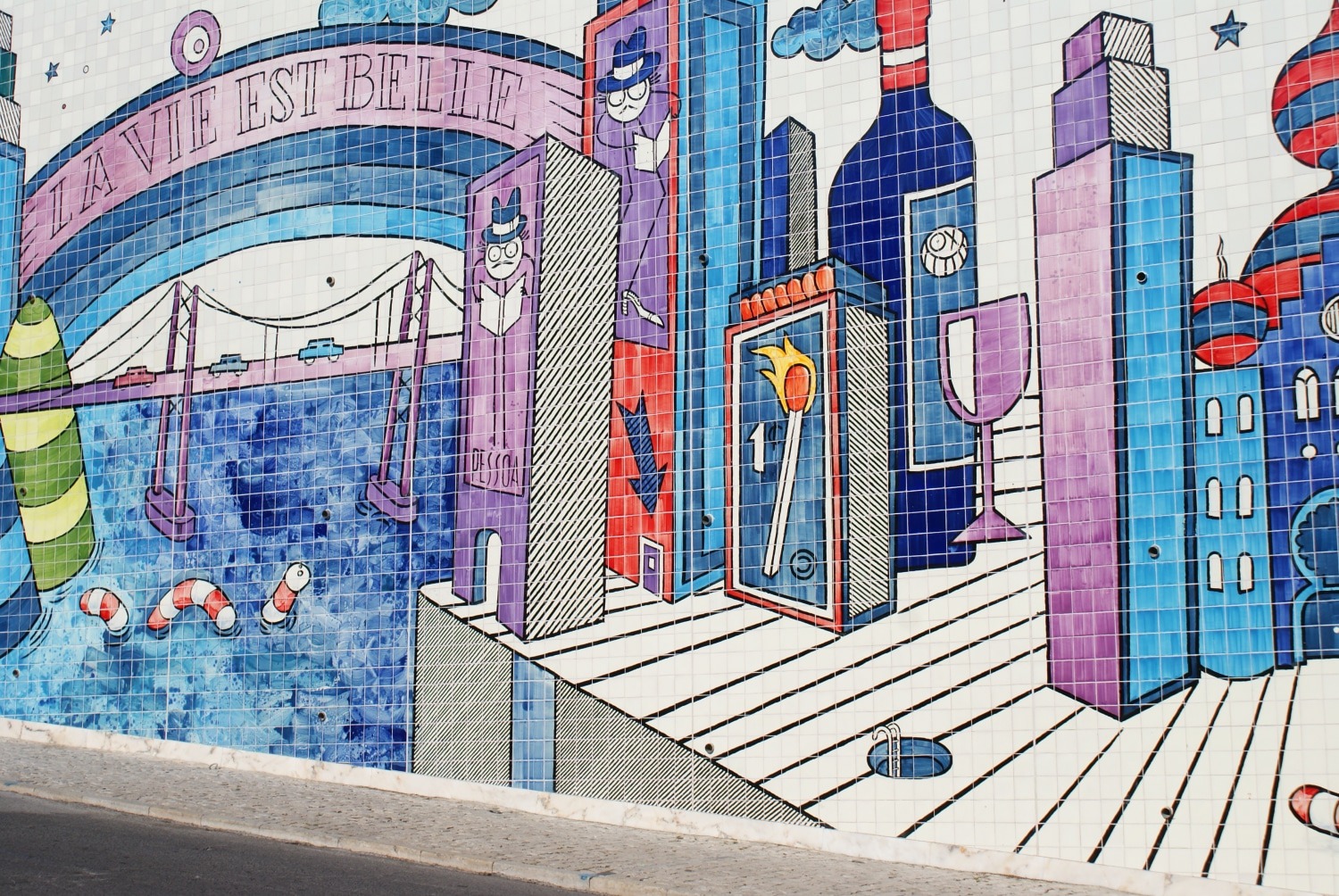
At around 188 metres long and more than 1,000 square metres, it’s one of the largest pieces of street art in the city and showcases urban art on a scale that is rarely seen in big cities. Saraiva himself has called it his Sistine Chapel.
Who is André Saraiva?
André Saraiva was born in Uppsala, Sweden, in 1971 to Portuguese parents, and grew up in Paris, where he came to fame for his street art in the 1980s. He has been a central figure on the urban art scene ever since, and these days he’s as well known for his nightclubs (Le Baron among them), hotels and fashion collaborations as for his walls.
Of course, you’re no true artist if you don’t have an alter ego. Saraiva is also known as André or Mr. A, after the signature top-hatted, winking character he started tagging around Paris in the mid-1980s and has since painted across cities on every inhabited continent.
You could stumble across Saraiva’s mural by chance (it’s across the square from the Panteão Nacional, and the neighbourhood of São Vicente de Fora has a popular flea market twice a week), but I didn’t leave it to luck.
I was tipped off by the lovely Catarina at the Four Seasons Hotel Ritz Lisbon, where I was staying. The moment she heard I was heading out to spy out some of Lisbon’s street art, she told me to go and find Saraiva’s urban mural (thanks, Catarina).
What to look for in the mural
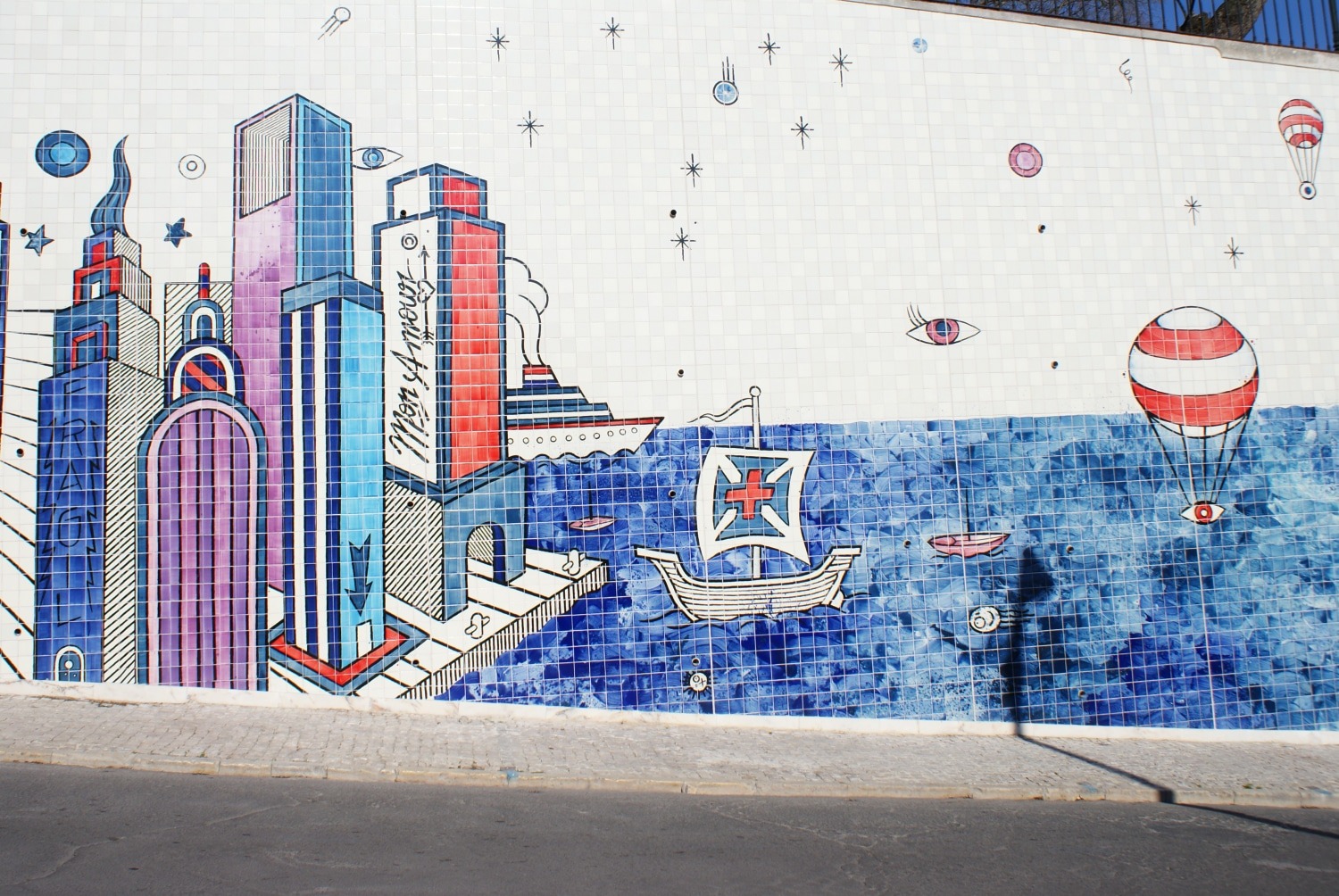
The mural was unveiled in October 2016, and it took about a year and a half to make, with a team of artisans hand-painting more than 50,000 tiles (52,738, to be exact) at the factory before they were fixed to the wall. Its playful brushstrokes and bright colours are certainly eye-catching, to say the least.
It uses the traditional blue and white of Portuguese azulejos as its base, but the painting is loose and graffiti-like rather than delicate, and the pinks, greens and purples are pure Saraiva.
The mural, however, is much more than a pretty picture: it captures stories from Saraiva’s life. He describes the wall as his dream city.
Many, as you’d expect, are based in Lisbon and Portugal: look for caravels and cruise ships on a tiled Tagus, the Santa Justa lift, São Jorge Castle, the Cristo Rei statue and a redrawn Fernando Pessoa. But if you look carefully, you’ll also spot some from further afield, like the Eiffel Tower and the skyscrapers of New York, two cities where Saraiva has also lived, and a book by the French poet Jacques Prévert. Mr. A pops up all over the wall, so make a game of counting him.

Finding the mural, and what to pair it with
The mural runs along the retaining wall beneath the Jardim Botto Machado, a small garden on Campo de Santa Clara, facing the square where the flea market sets up. It’s outdoors and free, so you can see it whenever you like.
- Getting there: tram 28E stops at Voz do Operário, a few minutes’ walk up the hill, or it’s about ten minutes’ walk (uphill) from Santa Apolónia metro and train station.
- Feira da Ladra: the city’s oldest flea market fills Campo de Santa Clara every Tuesday and Saturday from 9am to 6pm, with antiques, vinyl, tiles and plenty of bric-a-brac. Go in the morning for the best rummaging, and come on one of those days to see the mural and the market together.
- Panteão Nacional: the white dome across the square is the National Pantheon, the former church of Santa Engrácia, which took nearly 300 years to finish. Climb to the terrace for views over the river and Alfama. It’s open Tuesday to Sunday, 10am to 5pm from October to March and 10am to 6pm from April to September, closed on Mondays; adult tickets are €10, and entry is free with the Lisboa Card.
- São Vicente de Fora: the monastery behind the market has cloisters lined with 18th-century azulejos, a good counterpoint to Saraiva’s modern take on the same craft.
- Alfama: the mural sits on the edge of Alfama, so it’s easy to fold into a morning wandering its lanes down towards the Sé. My guide to Alfama has the rest of the quarter.
Is this your favourite street art in Lisbon? If you have suggestions for cool Lisbon street art or urban art, I’d love to hear from you!
Map
Read next
- The best things to do in Lisbon
- Why you need to visit LX Factory, Lisbon
- Visiting Belém Tower, Lisbon
- Four Seasons Hotel Ritz Lisbon review
- One week in Portugal: the perfect Portugal itinerary
Love this? Save and share on Pinterest
Discover the top things to do, insider tips and hidden gems in our Portugal Travel Guides.
Read the guides →