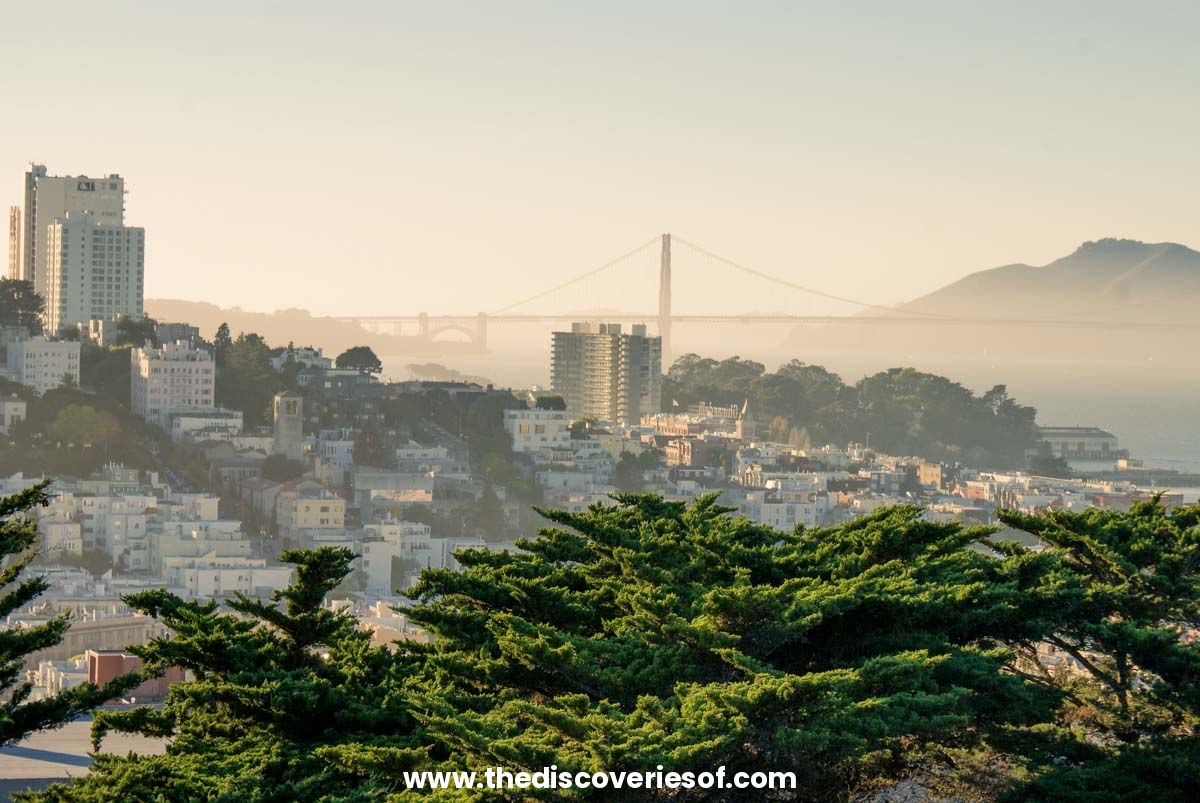

Why is the Golden Gate Bridge orange rather than gold? Which prison island still lets you walk its cellblocks? And where in the city does a whole cinema sing along? These are the landmarks that make this hilly, foggy city what it is, with the prices, opening hours and timing tricks that help you see them properly.
Hopping between famous landmarks is the best way to get to know a city, if you ask me. And San Francisco is packed with them.
Of all the big American cities I’ve been to, this is still my favourite, and it more than lives up to the hype. On my trips here I’ve got happily lost in Golden Gate Park, wandered the cellhouse on Alcatraz, slurped oysters at the Ferry Building and stood under the Castro Theatre’s sing-along marquee with my camera.
From the epic Alcatraz Island to the postcard-ready Golden Gate Bridge and the historic buildings peppered between them, it’s safe to say you’re spoiled for choice.
But where do you start? Maybe your time in the city is limited. Or maybe you’re spending a leisurely couple of weeks here and want to make sure you’re packing in all the top spots. That’s where I come in.
These San Francisco landmarks start with the famous icons, then move on to the neighbourhood favourites, the moving one you can ride and the buildings that shaped the skyline. Under each one you’ll find what it costs, when it opens and anything you need to book. If you’re short on time, my 48 hours in San Francisco itinerary strings the best of them into two days, and my guide to things to do in San Francisco covers the museums, beaches and day trips beyond them.
The most famous landmarks in San Francisco
Walk out over the Golden Gate Bridge

The Golden Gate Bridge spans the Golden Gate, the narrow strait where San Francisco Bay meets the Pacific, and links the city to Marin County. When it opened in May 1937 its 1,280m (4,200ft) main span was the longest in the world. The whole bridge runs for about 2.7km (8,981ft), and its towers rise 227m (746ft) above the water.
And the colour? It’s International Orange, chosen partly because it stands out in the fog and partly because it suits the hills around it. The name comes from the strait, not the paint.
Famous for being one of the most beautiful bridges on earth, nothing beats seeing it up close and personal. You can stroll along its east sidewalk, admire it from the viewpoints at either end or drive over it. After all, did you really visit San Fran if you didn’t snap a million photos of the red bridge? Nah, I didn’t think so either.
The best way to arrive, if you ask me, is on foot through Golden Gate Park and the coastal trails beyond it, catching glimpses of the towers through the trees before the whole thing finally opens up in front of you. The south end has a welcome centre and Fort Point tucked beneath the span; the north end has Battery Spencer, where the classic postcard shot looks back across the bridge to the city.
Free to walk. Pedestrians use the east sidewalk only: 5am to 6:30pm in winter (Standard Time), 5am to 9pm in summer. Welcome centre open daily, 9am to 6pm. Driving south into the city carries a toll.
Top Tip
Summer is fog season, when the towers can vanish for days. September and October usually bring the clearest views, and late afternoon light is lovely on the orange steel.
Do time on Alcatraz


Sitting about 2km (1.25 miles) off the shore is one of the world’s most famous prisons. Though small, this island has had a long history as a military fortification, prison and lighthouse: its lighthouse, first lit in 1854, was the first on the US West Coast.
If you’re a little bit of a true crime aficionado, this is one of San Francisco’s historical landmarks you should certainly make time for.
You heard that right. Alcatraz served as a federal prison from 1934 to 1963 and held some of the most notorious prisoners in American history, among them Al Capone, George “Machine Gun” Kelly and Robert Stroud, the so-called Birdman of Alcatraz. It closed because it cost far too much to run, and from 1969 to 1971 it was occupied by Native American activists, whose painted messages you can still see on the water tower.
Hollywood has filmed it, and set stories on it, so often (my own favourite is Murder in the First) that the island arrives with a ferocious reputation. Walking the cellblocks with the audio tour in your ears lives up to it. The ferry from Pier 33 is worth the ticket on its own, with the skyline sliding past on one side and the Golden Gate Bridge on the other.
A plan to turn the island back into a working federal prison has made headlines since May 2025, and the White House asked Congress for $152 million towards it in April 2026, but for now it’s run by the National Park Service and tours run as normal.
Intrigued yet? You can hear more of these stories on a two-day tour that includes an Alcatraz ticket.
Ferries leave from Pier 33 with Alcatraz City Cruises, the only authorised operator. Day tour $47.95 for adults, night tour $59.65, including the cellhouse audio tour.
Top Tip
Tickets sell out weeks ahead in summer and around holidays. Book with Alcatraz City Cruises or a tour that includes the landing ticket, and check that a “bay cruise” actually stops on the island.
Climb the Filbert Steps to Coit Tower

Rising slenderly from the top of Telegraph Hill, Coit Tower has been part of San Francisco’s skyline since 1933. It was paid for with money left to add to the city’s beauty by Lillie Hitchcock Coit, a wealthy eccentric famous for chasing fire engines, and stands 64m (210ft) tall.
Getting there is half the story. The Filbert Street Steps from the waterfront seem to go on forever: expect burning thighs and a moment, about halfway, when you question the whole idea. Keep going. Look back as you go, too, because almost every step comes with a better view, and the gardens either side are some of the prettiest corners of the city.
Inside, the ground floor is lined with murals painted in 1934 by some 25 artists under a New Deal art programme, showing Californian life during the Depression. They caused a stir when they were unveiled and were restored in 2014. Then take the lift to the top for the breathtaking panoramic views over the bay and the city.
Murals free to see. Lift to the observation deck $10 for non-resident adults ($7 for San Francisco residents). Open daily, 10am to 6pm from April to October and 10am to 5pm from November to March.
Graze your way around the Ferry Building

Hungry? One of the most famous buildings in San Francisco just so happens to be as much of a foodie haven as it is beautiful. Opened in 1898, the Ferry Building has a 75m (245ft) clock tower modelled on the Giralda bell tower of Seville’s cathedral, and it still sends ferries across the bay from the piers behind it.
The Ferry Building is filled with farmers and food vendors offering goods such as honey, coffee, cheese, pizza, pastries and more (yum).
Oysters are my weakness, and Hog Island Oyster Company is where I always give in: a plate of super fresh raw ones with a cold glass of white wine. Not an oyster person? Then don’t leave without sampling an empanada from El Porteño or a coffee from Red Bay.
Plus, the building has gorgeous views of the Bay Bridge from the waterfront promenade outside.
Free to wander; shops and restaurants set their own hours. The Ferry Plaza Farmers Market runs on Tuesdays and Thursdays (10am to 2pm) and Saturdays (8am to 2pm), when it’s at its best.
Get lost in Chinatown

Here’s your chance to visit the oldest Chinatown in North America, founded in the late 1840s. Along with the Mission and the Castro, it’s one of my favourite neighbourhoods in the city, and walking through the Dragon Gate at Grant Avenue and Bush Street feels like stepping into a completely different place.
It’s vibrant, with bustling streets meandering past bakeries, souvenir shops, herbalists, boozy cocktail lounges and karaoke bars. Foodies will hunger for the many dim sum joints, the egg custard tarts at Golden Gate Bakery (famous for keeping irregular hours, so check the sign in the window) and the Golden Gate Fortune Cookie Factory on Ross Alley, where you can watch the cookies being folded by hand.
You can do more exploring, of course, apart from overindulging. Climb to the top floor of Tin How Temple on Waverly Place, founded in 1852 and one of the oldest Chinese temples in the country, or visit the Chinese Historical Society of America Museum, in a former YWCA building designed by Julia Morgan.
Free to explore. Tin How Temple asks for a small donation and doesn’t allow photos inside.
Browse the shelves at City Lights Bookstore

Allen Ginsberg, Jack Kerouac, Lawrence Ferlinghetti: even if you’ve never read the Beat poets, you’ll know their names.
Ferlinghetti co-founded City Lights in 1953 as a paperback bookshop, and it soon became the Beats’ clubhouse and publisher. In 1957 the police arrested its manager for selling Ginsberg’s Howl, and the obscenity trial that followed ended with a judge ruling the poem had First Amendment protection, a landmark for free speech. In 2001 the city made the shop an official landmark, the first time a business rather than a building had been given that status.
Whether you love the Beats or hate them (personally, I can’t get on with Kerouac: Big Sur is fine, but On the Road grates), it’s a joy to browse its creaky floors, from the poetry room upstairs to the basement. Jack Kerouac Alley runs right beside it, and Vesuvio Cafe, the Beats’ old bar, is across the alley.
261 Columbus Avenue. Free to browse; open daily.
Photograph the Painted Ladies

The picturesque Painted Ladies of San Francisco are famed for their candy colours, and I LOVE them. The best-known are the seven Victorian houses at 710 to 720 Steiner Street, often called “Postcard Row” or the “Seven Sisters”. Developer Matthew Kavanaugh built them between 1892 and 1896 and lived next door.
“Painted ladies” is the name for any Victorian or Edwardian house painted in three or more colours to pick out its details, and it caught on after a 1978 book of that name. Their dramatic bay windows, decorative gables and turrets make them one of the most photographed sights in the city, and you’ll know this row from the opening credits of Full House.

They’re private homes, so admire them from the pavement or, better still, from the grassy slope of Alamo Square park opposite, where the downtown skyline rises behind the rooftops.
Top Tip
Fancy a close-up? Head to Steiner Street at Hayes Street. Late afternoon light falls on the facades, and the park opposite is the classic viewpoint.
Lose your bearings in Golden Gate Park

A chance to catch your breath away from the city hustle and bustle awaits you at Golden Gate Park.
It’s an urban park with a whopping 1,017 acres for the public to relish, about 20% larger than New York’s Central Park (sorry, New Yorkers). On my first trip to the city I vastly underestimated just how big it is, but getting a bit lost among the meadows, lakes and woods is all part of the fun. Combining it with a walk to the Golden Gate Bridge is a no-brainer.
Inside the park you’ll find the de Young museum, the California Academy of Sciences, the Japanese Tea Garden (the oldest public Japanese garden in the US, laid out in 1894), the glasshouse Conservatory of Flowers and even a small herd of bison. JFK Promenade through the middle of the park is car-free, which makes it lovely on foot or by bike.
The park is free and open from 5am to midnight. The Japanese Tea Garden and the Conservatory of Flowers charge non-residents an entry fee.
Catch a show at the Castro Theatre

I wouldn’t normally tell you to go to the cinema on a city break. But the Castro Theatre isn’t any old cinema. Opened in 1922 with a Spanish Colonial Baroque facade and that glowing neon sign, it’s the heart of the Castro, San Francisco’s famous LGBTQ+ neighbourhood, and its sing-along screenings and costume contests are the stuff of legend.
It closed in February 2024 for a $41 million restoration and reopened in February 2026, with removable seats downstairs so it can host concerts as well as films (the original seats are still in the balcony) and a new organ. Check the programme and book ahead: a sing-along here is something you won’t get at your local multiplex.
429 Castro Street. Ticket prices vary by event.
Raise a glass at Twin Peaks Tavern
Where do I begin to describe this iconic bar that makes its way onto almost every San Francisco itinerary? The vintage decor, the merrymaking atmosphere and the classic cocktails could only mean one thing: pure enjoyment.
It opened as a neighbourhood tavern in 1935. In 1972 Mary Ellen Cunha and Peggy Forster took it over and made it a gay bar with something radical for the time: full-length, clear plate-glass windows, so customers could be seen from the street rather than hiding behind blacked-out glass. It’s thought to be the first gay bar in the country to do so, and in 2013 it became an official city landmark.
The friendly vibes, daily chatter and prime spot on the corner of Castro and 18th Street, right by the Castro Theatre, make it the perfect place for a drink before or after a show.
401 Castro Street. Open from noon (Monday to Wednesday), 8am (Thursday to Saturday) or 10am (Sunday) until 2am.
Read the walls of Balmy Alley

I’m a sucker for street art, and the city’s finest is packed into Balmy Alley, a single block in the Mission District.
The murals took off here in the early 1970s, and in the mid 1980s a group of artists covered the alley in works protesting the wars in Central America. Since then, the walls have been repainted again and again by artists tackling human rights, immigration and the city’s never-ending argument over gentrification. Provocative, bright and constantly changing, it rewards a slow walk.
It might only be a block long, but there’s nowhere else quite like it. Pair it with a burrito in the Mission and a look at the Women’s Building on 18th Street, wrapped in its own enormous mural.
Between 24th and 25th Streets, from Treat Avenue to Harrison Street. Free.
Step back to 1776 at Mission Dolores
The oldest intact building in San Francisco is a modest whitewashed chapel in the Mission. Misión San Francisco de Asís, known as Mission Dolores, was founded in 1776, and the adobe chapel you see today was finished in 1791, its thick walls standing firm through the earthquakes of 1906 and 1989. It’s the only intact mission chapel of the 21 founded in California under Father Junípero Serra’s order.
Inside, look up at the ceiling, painted in Ohlone designs, before walking out to the small cemetery and garden, where the graves of early Californian settlers sit beside a memorial to the thousands of Ohlone and other Native people buried here. Film fans may recognise it from Hitchcock’s Vertigo. The grand basilica next door dates from 1918.
Open Monday to Friday, 10am to 4pm, and Saturday and Sunday, 10am to 5pm; suggested donation $10.
Ride a cable car

Yes, a landmark you can ride. Andrew Hallidie ran the first cable car up Clay Street in 1873, and San Francisco’s is now the last manually operated cable car system in the world. In 1964 the cars became one of the first moving National Historic Landmarks.
Three lines still run: Powell to Hyde (the prettiest, past Lombard Street and down to the bay), Powell to Mason, and California Street. A ride is pretty much compulsory, and it spares your legs the worst of the hills. To see how the whole system works, drop into the free Cable Car Museum on Mason Street, which is also the working powerhouse, with the giant wheels winding the cables beneath the streets.
A single ride costs $9: pay the conductor or buy on the MuniMobile app (a rise to $12 is planned for January 2027).
Top Tip
The queues at the Powell and Market turntable can run to an hour. Walk a few stops up the line and hop on there instead, or ride the quieter California Street line.
Wind down Lombard Street
The “crookedest street in the world” is a single brick-paved block of Lombard Street between Hyde and Leavenworth Streets, where eight hairpin bends zigzag down Russian Hill between banks of hydrangeas. The bends were added in 1922 because the slope was too steep for cars.
You can drive down it at walking pace, but it’s more fun to walk the steps on either side and take the classic photo from the bottom at Leavenworth Street. The Powell to Hyde cable car stops at the top.
Free. It’s a residential street, so keep the noise down.
Take a nostalgic trip to Fisherman’s Wharf

Fisherman’s Wharf sits on the northern waterfront and sees probably the most visitors of anywhere in San Francisco. Why? Well, I’m not quite sure, but the answer is probably that this quaint neighbourhood packs in more for families to do than anywhere else.
I’m not kidding: there are souvenir shops, seafood restaurants, street performers and the Cannery shopping centre in a converted 1907 fruit cannery. Don’t miss the Musée Mécanique on Pier 45, a free-to-enter hall of antique arcade machines, and the historic ships at Hyde Street Pier. Grab a Dungeness crab cocktail from the street stalls (crab season usually runs from winter into spring) and a loaf of sourdough from Boudin. The waxworks have gone (Madame Tussauds closed in 2024), and Ripley’s Believe It or Not, a Wharf fixture for nearly 60 years, closes for good on 1 December 2026.
Plus, you can take in fantastic views of the Golden Gate Bridge and Alcatraz from here, while Ghirardelli Square is just around the corner.
Meet the sea lions on Pier 39

Sure, most locals and seasoned visitors consider Pier 39 a tourist trap, but I think it’s still worth a visit for newbies or if you have extra time. The picture-perfect views over the bay are mesmerising, and it’s a short walk from the Alcatraz ferry at Pier 33.
The real stars are the sea lions. They started hauling out on the pier’s K-Dock after the Loma Prieta earthquake in 1989, took it over within months and never left; in 2024 the count passed 2,100. You’ll also find the Aquarium of the Bay, an arcade, street performers and numerous restaurants and shops. An hour here can easily stretch into an entire afternoon.
Free to visit.
Top Tip
The sea lions are around all year, but numbers usually dip in June and July, when many head south to breed in the Channel Islands. Autumn and winter are the best times to see them in force.
Sweeten up at Ghirardelli Square

Ghirardelli Square is a famous spot in San Francisco for (you guessed it) chocolate. The Ghirardelli company moved its factory into these red-brick buildings in 1893, and the giant illuminated sign on the roof has lit up the waterfront since 1923. When the factory moved out, the complex became one of the first old industrial sites in America turned into shops and restaurants, opening in 1964.
At the Ghirardelli Chocolate Experience shop you can watch the chocolatiers make the brand’s hot fudge, fill a tin from the pick-and-mix squares and tackle a hot fudge sundae in a room that looks out over the bay towards Alcatraz. It makes for the perfect date too, as these confections might be the love potion you need to spark some romance. And you can sample some, obvs.
900 North Point Street. The Chocolate Experience opens daily from 9am.
Wander the colonnades at the Palace of Fine Arts
Brace yourself for a magical artistic experience dipped in elegance at the Palace of Fine Arts. Located in the Marina District, this monumental structure is one of my favourite places in San Fran, with its grand rotunda reflected in a lagoon.
Architect Bernard Maybeck designed it for the 1915 Panama-Pacific International Exposition, which celebrated the opening of the Panama Canal and the city’s recovery from the 1906 earthquake. It was only ever meant to be temporary, built of plaster and wood, and it was the one building San Franciscans couldn’t bear to lose: it was rebuilt in concrete in the 1960s and restored again in 2011. Look up at the weeping women on top of the colonnade, leaning over boxes that were meant to hold plants.
It offers a relaxing stroll around the lagoon, with ducks and swans swimming serenely in the water. The Palace of Fine Arts Theatre, in the building behind the rotunda, hosts events, concerts and talks.
Grounds free and open daily.
Look up at the Transamerica Pyramid
The skyscraper that sums up the city’s skyline is a white, 48-storey pyramid. William Pereira’s Transamerica Pyramid was controversial when it went up in 1972, and at 260m (853ft) it was the tallest building in San Francisco until Salesforce Tower overtook it in 2018. Its pointed crown is lit up at night.
Foster + Partners finished restoring the tower and its grounds in 2024, and while the upper floors are offices, you can walk into the lobby, with its café and shops, and sit in Redwood Park next door, a pocket of nearly 50 redwoods planted in 1974 that now stand more than 30m tall.
Lobby and Redwood Park free; no observation deck.
Admire the Bay Bridge at night

Known locally as the Bay Bridge, the San Francisco-Oakland Bay Bridge actually opened six months before the Golden Gate, in November 1936. It’s two bridges joined by a tunnel through Yerba Buena Island: a double suspension bridge on the San Francisco side and, since 2013, a gleaming single-tower span on the Oakland side.
It may not hear as many camera clicks as its more famous neighbour, but it’s a magnificent sight, especially as night falls. The original eastern span was replaced after the 1989 Loma Prieta earthquake, when a section of its upper deck collapsed.
The best show is after dark. The Bay Lights, an art installation of 48,000 LEDs strung along the western span’s cables, came back in March 2026 after three dark years and now twinkles in ever-changing patterns from dusk to dawn. Watch from the Embarcadero near the Ferry Building or Rincon Park.
Spend an afternoon at SFMOMA

The San Francisco Museum of Modern Art (SFMOMA) opened in 1935 as the first museum on the West Coast devoted to modern art, and today it’s one of the biggest in the country, in Mario Botta’s striped building and the rippling white extension added in 2016. While it may not give off the same ethereal vibes as the Palace of Fine Arts, it’s still worth your attention.
SFMOMA displays works from renowned artists such as Frida Kahlo (look out for her 1931 double portrait Frieda and Diego Rivera), Henri Matisse and Gerhard Richter. Richard Serra’s huge walk-through steel sculpture Sequence sits in a free gallery on the ground floor.
Plan for two to three hours at least. Though if you’re a little bit of an art nerd (like me) and want to admire each piece thoroughly, expect to spend an entire afternoon at the museum.
$30 for adults; under 19s free. Open 10am to 5pm (noon to 8pm on Thursdays); closed Wednesdays.
Tour the dome of City Hall
San Francisco’s City Hall is one of the finest Beaux-Arts buildings in America. Arthur Brown Jr designed it to replace the hall destroyed in the 1906 earthquake, and it opened in 1915 with a dome that rises 307ft (94m), about 42ft taller than the dome of the US Capitol. In the 1989 earthquake the dome moved four inches; it now sits on base isolators designed to ride out the next one.
It’s packed with history: Marilyn Monroe and Joe DiMaggio married here in 1954, Mayor George Moscone and Supervisor Harvey Milk were assassinated here in 1978, and in 2004 it hosted some of the first same-sex weddings in the US. Step inside to see the marble staircase under the rotunda, where couples still pose for wedding photos.
Free to enter, Monday to Friday, 8am to 6pm. Docent tours on Fridays at 11am and 1pm: sign up at the kiosk in the Goodlett Place lobby.
See a performance at the War Memorial Opera House

San Francisco Opera’s home, the War Memorial Opera House, opened in 1932 and is one of the grandest stages in the country. The company itself dates from 1923 and is known for commissioning world premieres, so if you’re seeking a night of classical music (and even new works), this opera house will give you goosebumps.
It’s also where San Francisco Ballet stages its much-loved Nutcracker every December (the company danced the first full-length Nutcracker in America in 1944), and the 1945 conference that drew up the United Nations Charter met on this stage, with the charter signed in the Veterans Building next door. You can see why this one’s made it into this guide.
You can buy tickets and find out more about upcoming events on the San Francisco Opera website.
301 Van Ness Avenue. Box office open Monday 10am to 5pm and Tuesday to Saturday 10am to 6pm (Saturdays in season only), and until curtain on performance days.
Watch the sun set from Twin Peaks

Not every landmark is a building. Twin Peaks, the pair of grassy hills rising almost 300m (about 920ft) near the geographic centre of the city, gives you the best 360° view in town: Market Street running straight as an arrow to the Ferry Building, the downtown towers, both bridges and, on a clear day, far across the bay.
Head to the viewpoint at Christmas Tree Point, or follow the path to the top of either peak. It’s a steep walk up from the Castro, so many people drive or take a taxi. Bring a jacket, as the wind up here is fierce even in summer, and come in the late afternoon to watch the city lights come on.
Free and open at all times.
How to see San Francisco’s landmarks without wearing yourself out
- To fit in most, if not all, of these landmarks in your trip, I reckon you would need to spend a full week in the city. Short on time? The unmissable ones are the Golden Gate Bridge and park, Alcatraz, the Painted Ladies and Fisherman’s Wharf, and you can see them in two or three days.
- Book Alcatraz first. It’s the one landmark that regularly sells out, sometimes weeks ahead, so lock in your ferry slot and plan the rest of your days around it.
- San Fran is often foggy with a cool sea breeze, but that doesn’t stop the sun from beating down on you at any given moment. So it’s best to dress in layers and prepare to shed some throughout the day, even in summer.
- You’ll thank me for wearing your most comfortable shoes: getting around this hilly city on foot is often the best option. Save your legs on the steepest stretches with the cable cars, buses and Muni Metro, using a Clipper card or the MuniMobile app.
- Where to stay: Fisherman’s Wharf and Union Square put you within walking distance (or a cable car ride) of most of these landmarks. The Argonaut Hotel, in an old cannery warehouse on the Wharf, and Hotel Zeppelin, off Union Square, are both good bases. For more neighbourhoods and hotels, see my San Francisco travel guide.
Map
Read next
- 48 hours in San Francisco: the perfect two-day itinerary
- Unmissable things to do in San Francisco
- One day in San Francisco
- Where to stay in San Francisco
- Los Angeles landmarks worth your time
- The ultimate West Coast USA road trip
Love this? Save and share on Pinterest

Discover the top things to do, insider tips and hidden gems in our USA Travel Guides.
Read the guides →