Jagged white peaks, an inky black fjord and a car ferry with views you won’t forget: a road trip through the Lyngen Alps is the best day out from Tromsø, and you can do it yourself in a hire car.
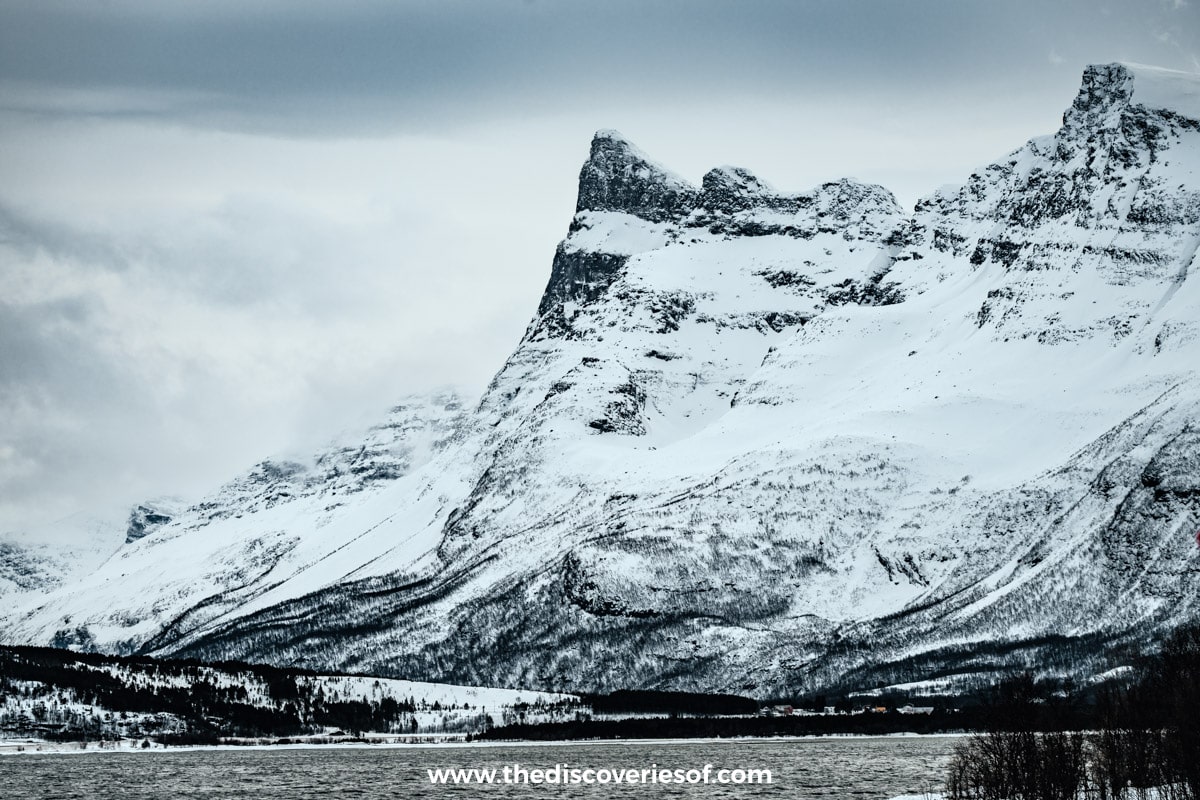
I just loved this part of my trip. So many people book a couple of nights in Tromsø, head out on a Northern Lights tour, swing by the Arctic Cathedral and the cable car, and that’s it. But one thing that really surprised me was just how beautiful the areas around the city are, and nowhere more so than the Lyngen Alps.
On a March trip, my partner and I drove from central Tromsø out to Breivikeidet, took the car ferry across Ullsfjorden to Svensby, and carried on through the little settlements of Lyngseidet and Oteren. We made a detour to see Otertind up close, did some short walks around its base, then drove back to Tromsø on the E6 and E8. It was a road trip through some of the most beautiful panoramas in northern Norway.
This Lyngen Alps road trip guide covers the route I took and the alternatives, the ferries and what they cost, winter driving, daylight through the year, where to eat and stay along the way, and where to look for the Northern Lights.
Some links in this article may be affiliate links, which means we may receive a small commission, at no additional cost to you, if you decide to purchase through one of my recommended partners.
The Lyngen Alps road trip at a glance
- Start and finish: Tromsø.
- Classic loop: Tromsø, Breivikeidet, ferry to Svensby, Lyngseidet, along the Lyngenfjord to Oteren, a detour to Otertind, then back to Tromsø on the E6 and E8.
- Distance: around 200 km, plus the Otertind detour.
- Driving time: about four hours behind the wheel, plus the 20-minute ferry. In winter, allow a full day.
- Ferries: Breivikeidet to Svensby (about 20 minutes) on the classic loop. Lyngseidet to Olderdalen (about 40 minutes) if you extend the trip to Kåfjord.
- Best for: mountain scenery, photography, winter light, and the Northern Lights if you stay overnight.
Where are the Lyngen Alps?
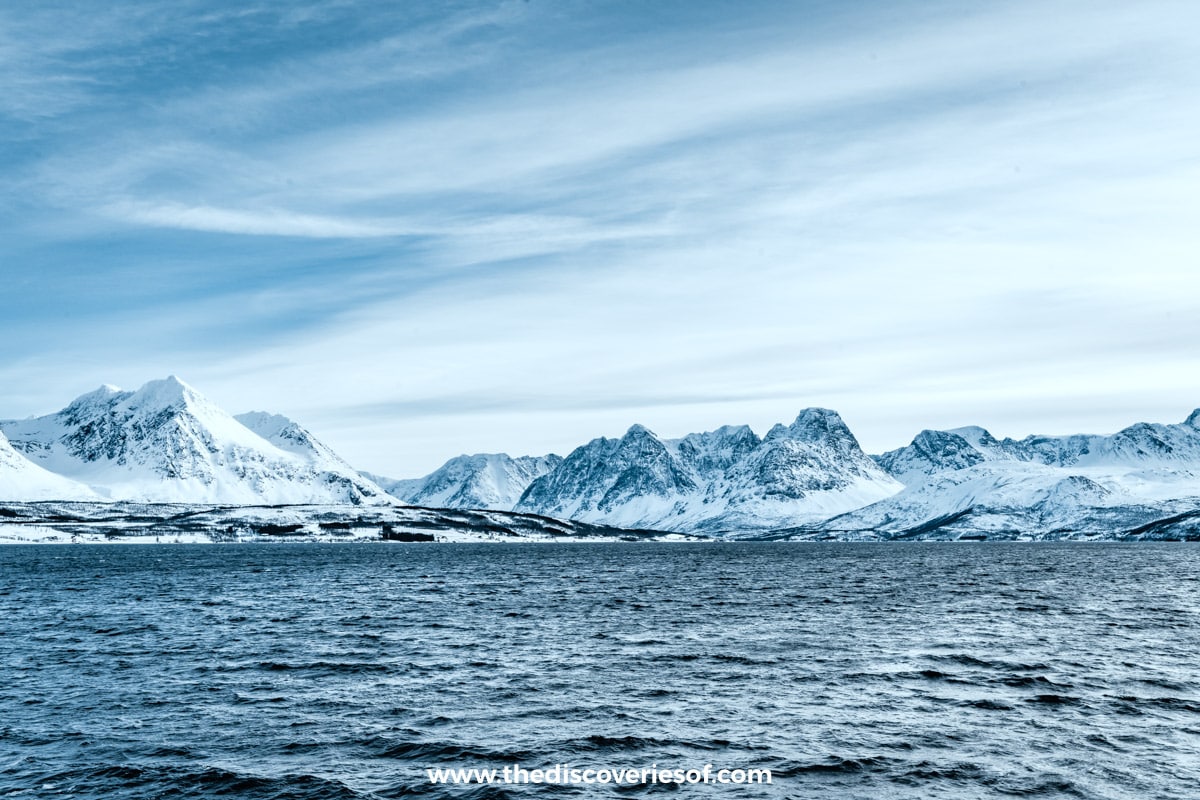
The Lyngen Alps run down the spine of the Lyngen peninsula, east of Tromsø, between Ullsfjorden on one side and the long Lyngenfjord on the other. They’re some of the highest and most dramatic mountains in northern Norway. The tallest, Jiehkkevárri, reaches 1,834 metres, which makes it the highest peak in Troms, and the range is studded with glaciers. A large part of it is protected as the Lyngsalpan landscape protection area.
They feel properly wild, but they’re not far away at all. You can be on the ferry within an hour of leaving the city, and that’s what makes this such a good self-drive day trip.
Route options from Tromsø
There are three ways to do it, depending on how much time you have and whether you want to take the ferries.
The classic loop via the Breivikeidet ferry
This is the route I drove, and the one I’d recommend for a first visit.
Cross the Tromsø Bridge and follow the E8 south for about 20 km to Fagernes, then turn onto road 91 and follow it to the ferry quay at Breivikeidet, around 45 km from the city in total. The ferry takes you across Ullsfjorden to Svensby, and from there road 91 carries on for about 22 km over the hills to Lyngseidet, on the Lyngenfjord.
At Lyngseidet, turn south onto road 868, which runs for about 42 km along the western shore of the Lyngenfjord to Oteren, at the head of the fjord. Otertind is a short detour south from Oteren into Signaldalen. Then pick up the E6 for 19 km to Nordkjosbotn, and the E8 for the final stretch, around 70 km, back to Tromsø.
You can drive it in either direction. I’d go clockwise, the way we did, so you’re on the ferry in the morning and finishing on the fast main roads, rather than racing the last ferry back in the dark.
The long way round, with no ferry
If you’d rather not depend on the ferry timetable, you can reach Lyngseidet by road the whole way. Take the E8 to Nordkjosbotn, the E6 to Oteren, then road 868 north along the Lyngenfjord. It’s about 130 km and takes around two hours.
This makes sense as an out-and-back trip to Otertind, which is close to Oteren, or if you’re driving late in the evening after the ferries have stopped. You do miss the crossing, though, and that was one of my favourite parts of the day.
The big circle via Kåfjord
With an overnight stay, you can loop all the way around the Lyngenfjord. Drive the classic route to Lyngseidet, then take the second ferry across the Lyngenfjord to Olderdalen, in Kåfjord. From there, the E6 follows the eastern shore of the fjord south through Skibotn to Oteren, with views straight back across the water to the peaks you’ve just driven under. Visit Otertind on the way, then return to Tromsø via Nordkjosbotn.
The views of the Lyngen Alps are arguably even better from the eastern shore, because you see the whole wall of mountains rising out of the fjord.
Stop by stop along the route
Breivikeidet and the ferry to Svensby
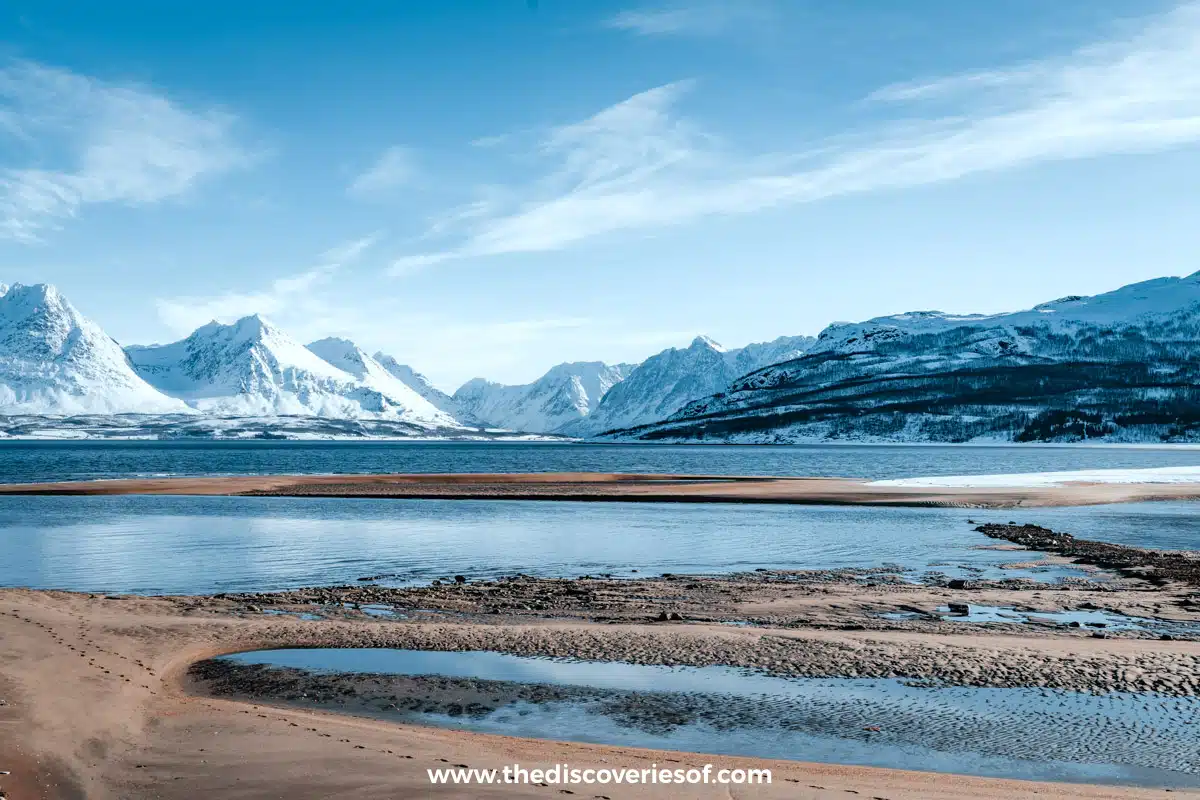
The drive out to Breivikeidet, through the Breivikdalen valley, is a lovely warm-up, with snowy mountains on both sides. At the quay, you just join the queue and drive on.
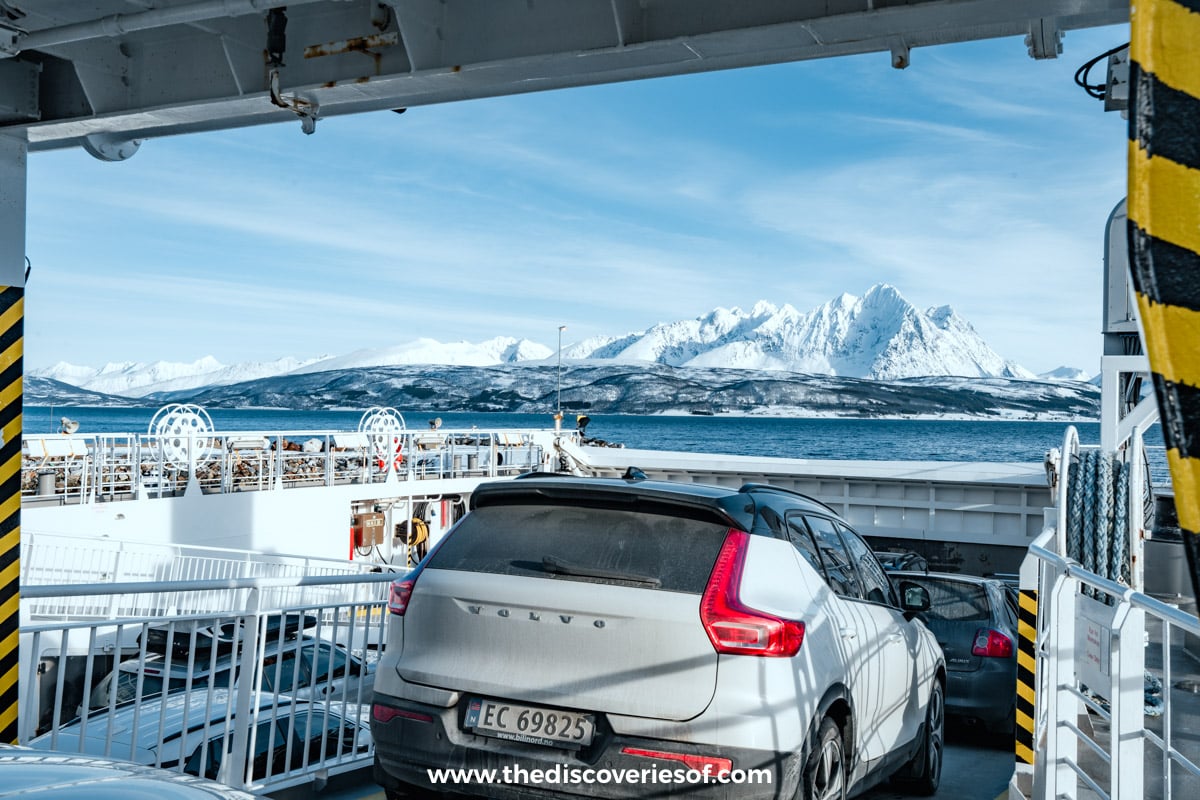
The ferry was great, and very scenic. When we set off, it felt like a completely normal temperature (it had been hovering around four degrees), but as soon as you get out into the fjord, the wind chill is mad. Definitely wrap up warm if you’re going to get out of the car on the ferry, and you should, because the views are just huge. They’re vast. You’re surrounded by mountains, and the fjord below is inky black.
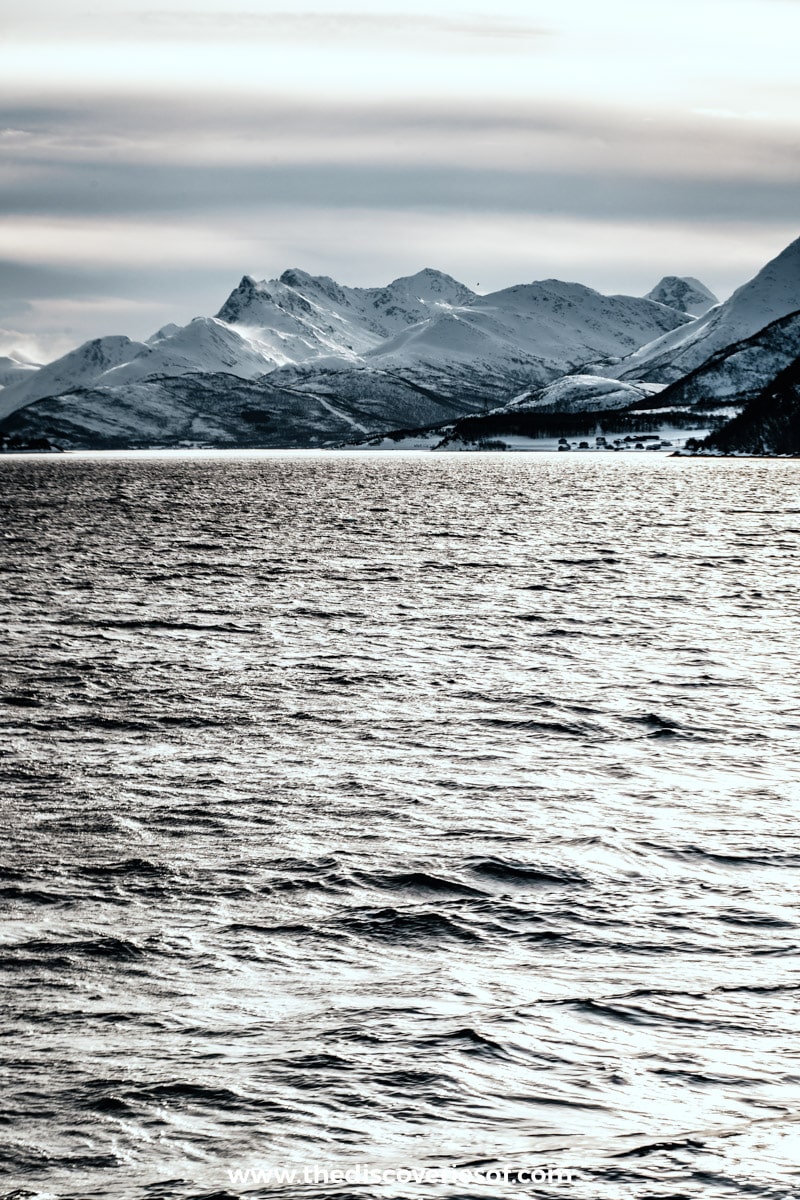
The crossing takes about 20 minutes. The ferries on this route are run by Norled, they sail all year, and you don’t book ahead: it’s first come, first served. Sailings run roughly hourly from early morning until around 10.30pm. The full timetable is on Svipper, the Troms public transport site (it’s route 191), and it can change at short notice, so check it the day before.
Passengers travel free. For a standard car under six metres, the fare is around NOK 104 each way, or around NOK 73 for an electric car. Payment is automatic through AutoPASS, which reads your number plate, so with a hire car the rental company will usually bill you afterwards.
Top Tip
Note the time of the last ferry back before you set off. If you stay out late for the Northern Lights on the Lyngen side and miss it, the road home via Oteren and Nordkjosbotn takes about two hours.
Svensby
Svensby is little more than a ferry quay and a scattering of houses, but it’s a well-known base for ski touring, and it’s your first proper look at the peaks up close. From here, road 91 climbs over the neck of the peninsula and drops down to Lyngseidet, about half an hour away.
If you have time, the road north from Svensby runs up the peninsula’s west side to Nord-Lenangen, a quiet fishing village with a couple of good local-food restaurants, and on towards Lyngstuva at the northern tip. It’s a long detour, so I’d save it for an overnight trip.
Lyngseidet
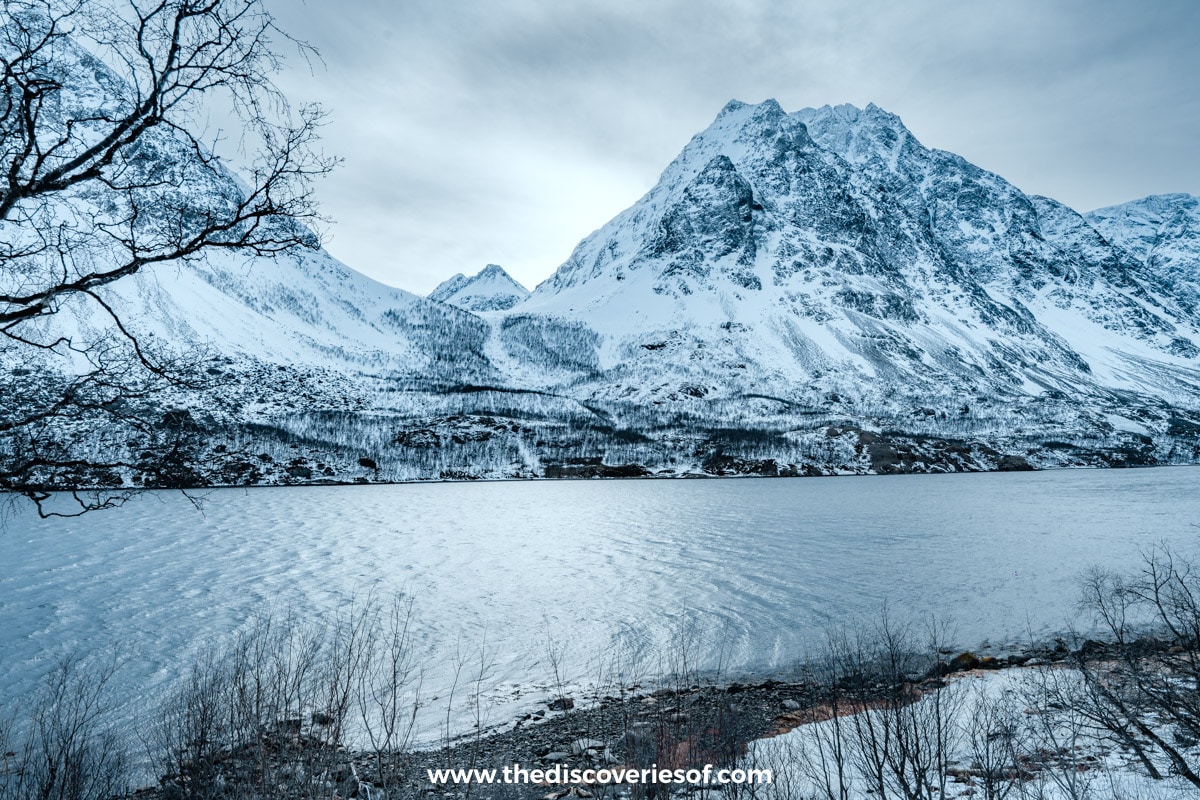
Lyngseidet is the main village in Lyngen and the hub of the area, sitting on a narrow isthmus with the Lyngenfjord on one side. It’s been a trading place since the 1700s and has some protected old buildings, plus Lyngen Church, an 18th-century wooden church built in the shape of a cross, right in the centre. This is also where you’ll find the ferry to Olderdalen, a petrol station and shops, so it’s a good place to stop, stretch your legs and stock up.
Just south of the village is Solhov, a huge wooden building completed in 1924 as a folk high school, and said to be the largest timber building in northern Norway. It’s now a guesthouse.
Whisky fan? The Aurora Spirit distillery, which calls itself the world’s northernmost whisky distillery, is at Årøybukt near Lyngseidet, in a former NATO base. It runs guided tours with tastings on set days of the week (Tuesdays, Thursdays and Saturdays in winter, according to Visit Lyngenfjord), so check and book ahead rather than turning up. If you’re driving, the tour itself has no age limit, but you’ll want to leave the tastings to your passengers.
For a short detour, road 311 runs north from Lyngseidet to Koppangen, a tiny settlement at the end of the road with views up to the glaciers.
Along the Lyngenfjord to Oteren
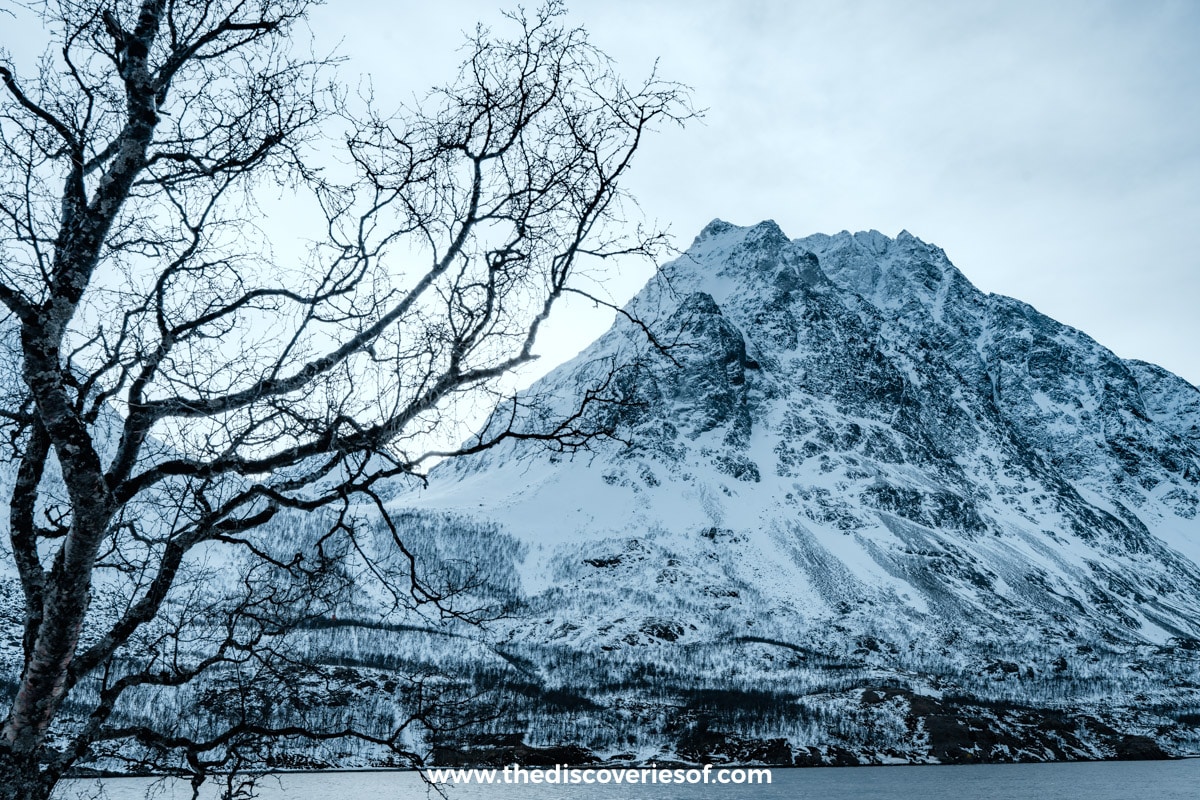
From Lyngseidet, road 868 hugs the western shore of the Lyngenfjord all the way south to Oteren. This is the stretch where you’re driving right beneath the mountains, through small settlements, with the fjord on your left. Driving on these meandering roads around the frozen mountains truly puts things in perspective.
There are pull-ins along the way, so take your time and stop for photos, but only where it’s safe to pull off completely, as the road is narrow in places. There’s an avalanche-prone stretch at Pollfjellet, protected by an avalanche shed and radar warning that can close the road automatically, so after heavy snow, check the road status before you set off (more on that below).
Oteren itself, with neighbouring Hatteng, is the administrative centre of Storfjord municipality, at the innermost point of the fjord.
Otertind and Signaldalen
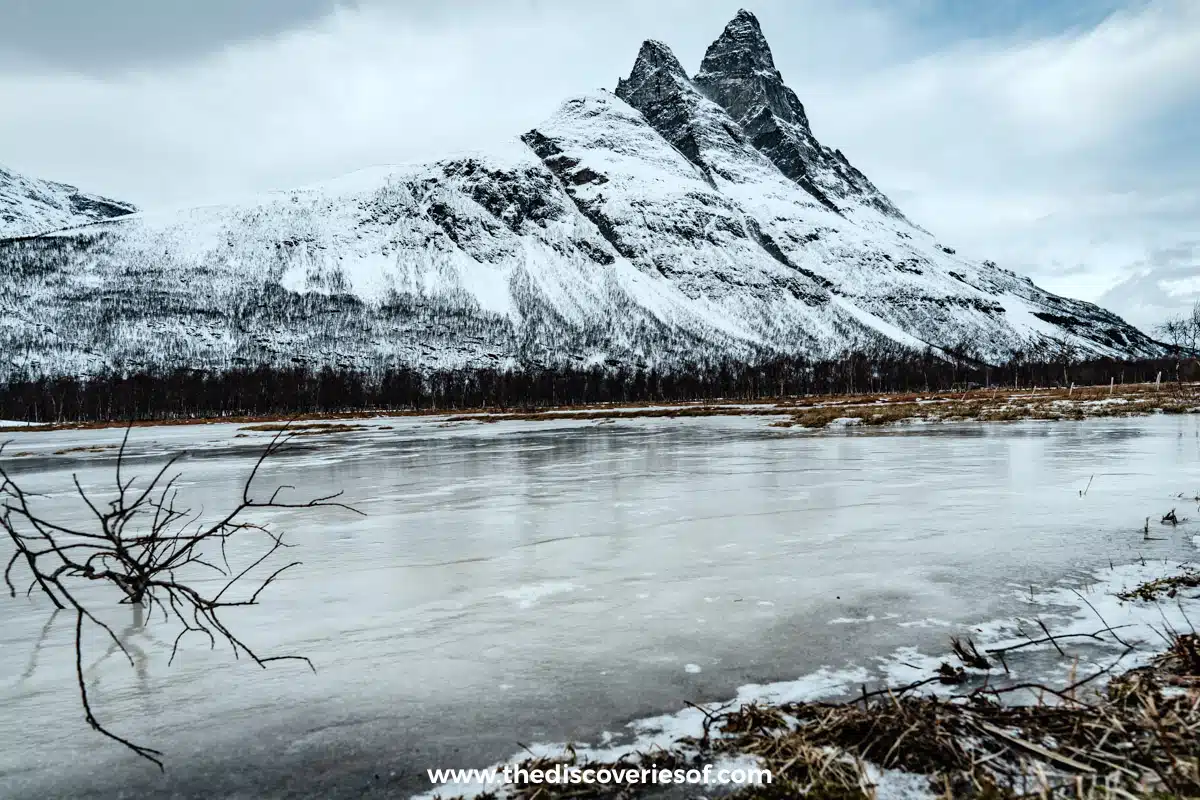
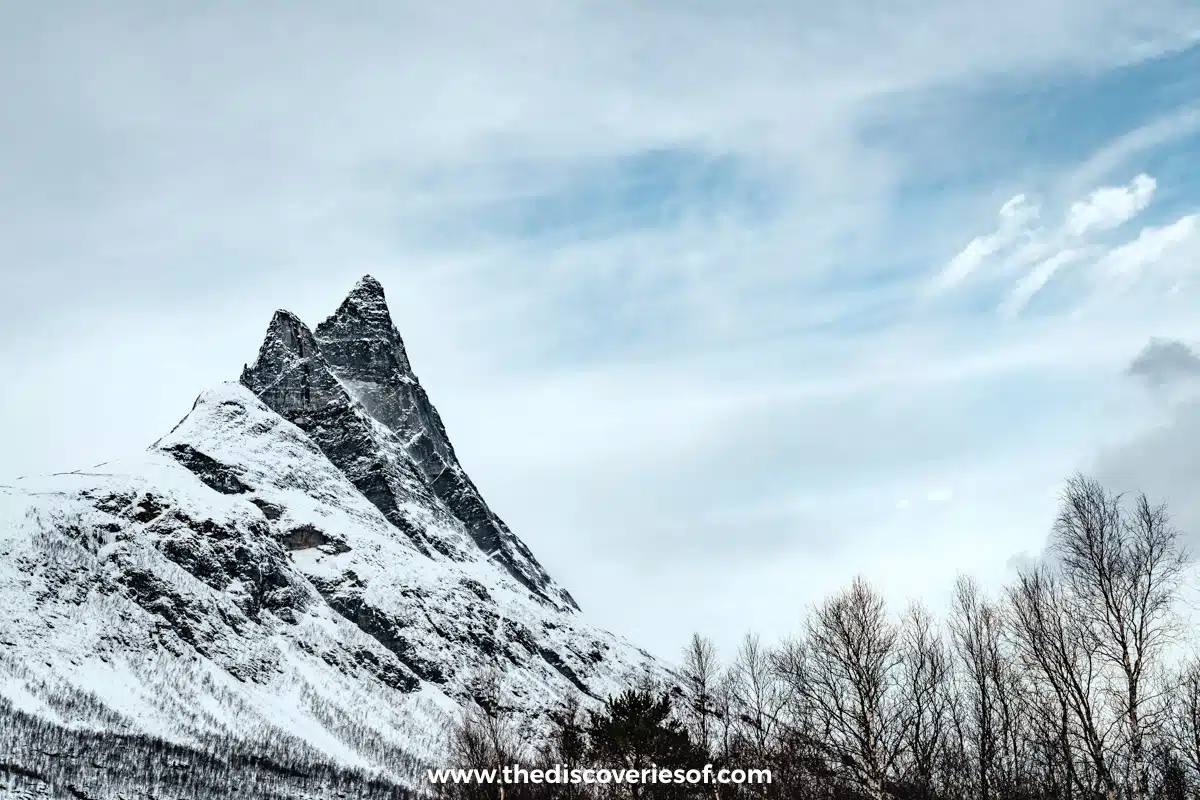
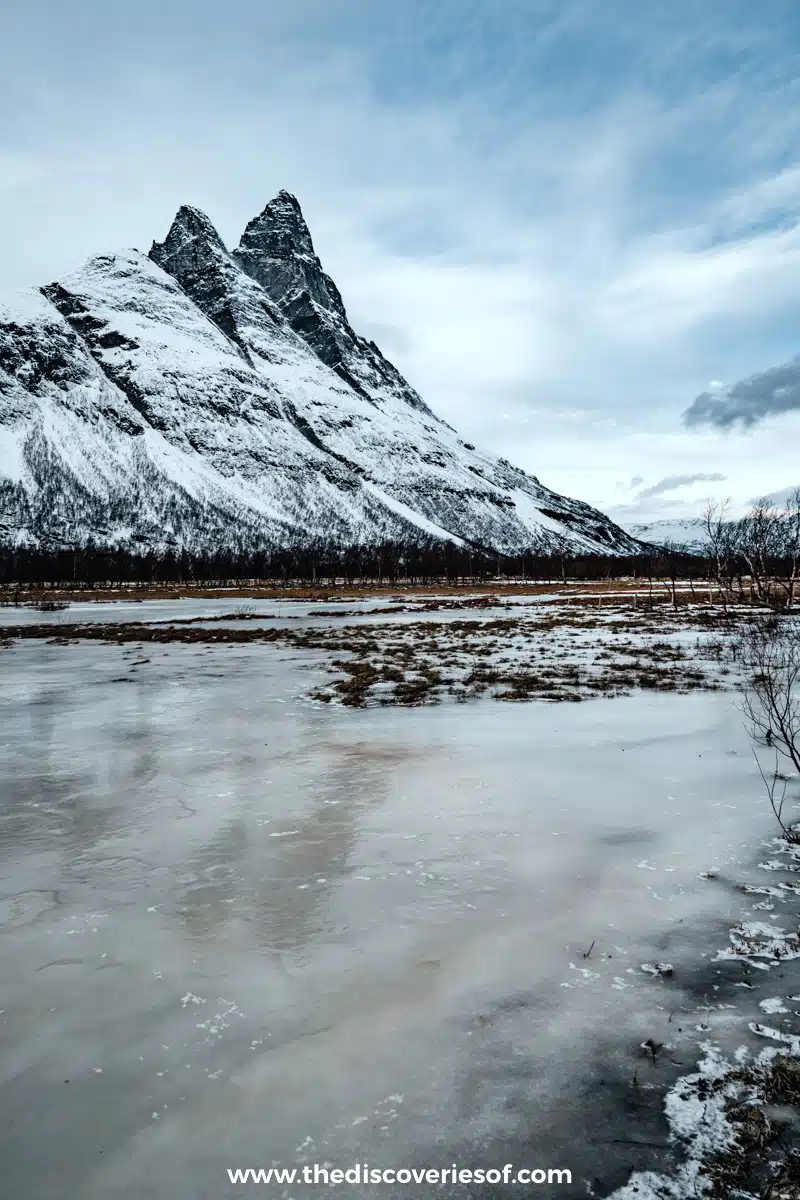
We made a little detour here, because I’d heard Otertind was spectacular, and it really was. We pulled in by the river alongside the Signaldalen road, which gives you a clear view of the peak across the water. I mean, wow. It’s sometimes called the Matterhorn of the North (or the Matterhorn of the Arctic), which gives you an idea of its crazy, distinctive shape: a sharp twin-peaked pyramid of around 1,360 metres, standing on its own at the mouth of Signaldalen.
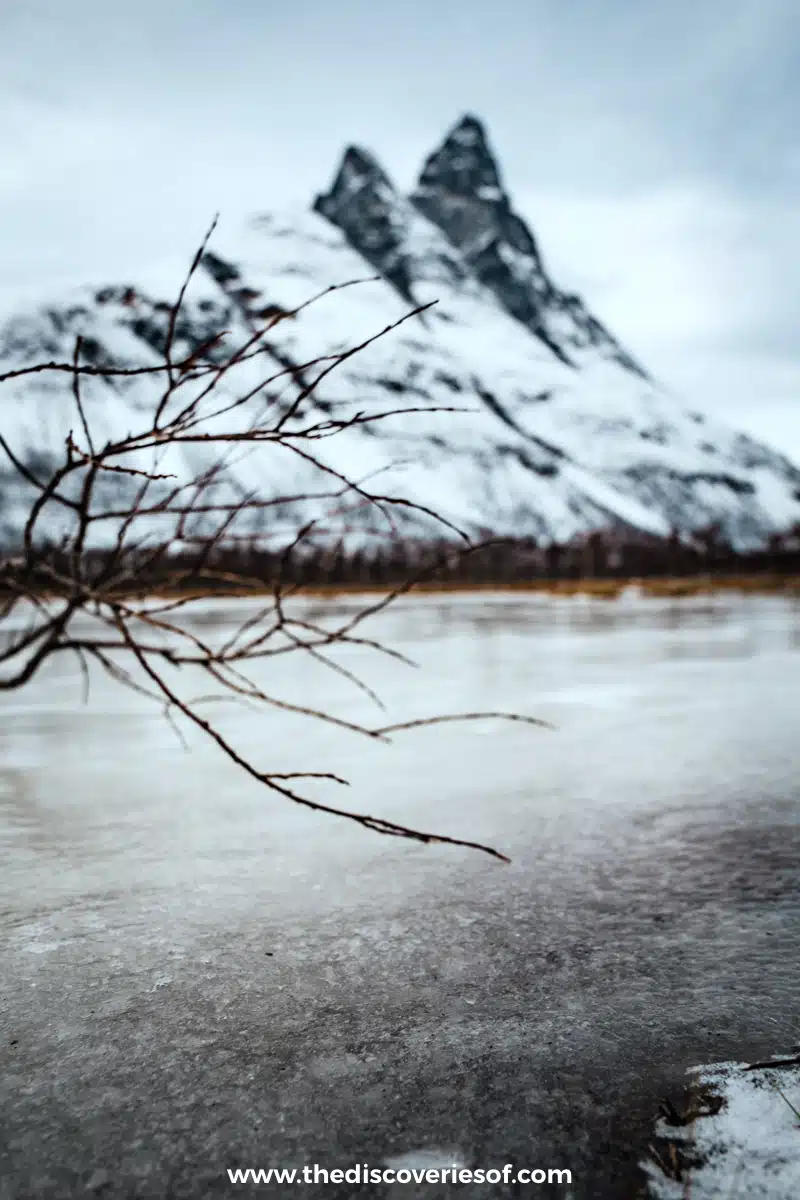
To get there, turn south from Oteren onto the road into Signaldalen. The mountain fills the view within a few minutes, and the best photo spots are by the river, where the water is often frozen in winter and reflects the peak in calmer months. If you drive the classic loop, it’s a bit of a detour, but it’s absolutely worth it.
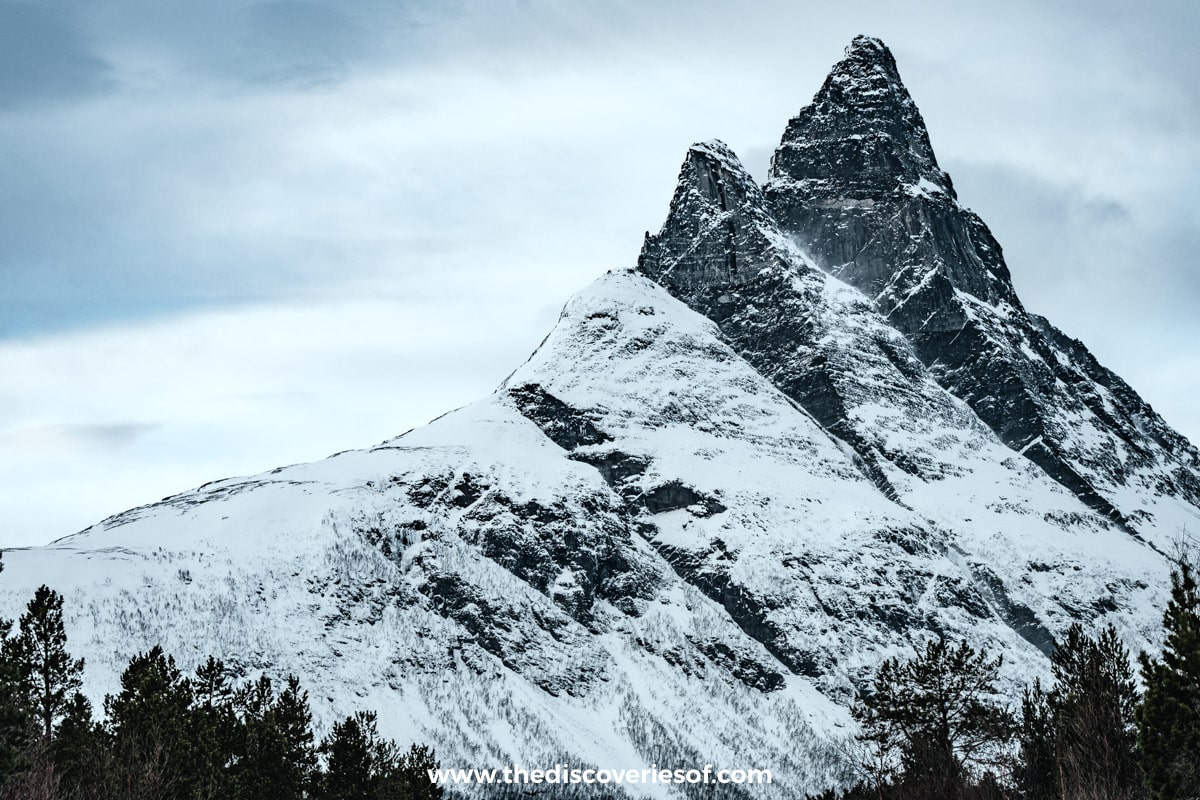
The area around it is beautiful for walking. Obviously, in the middle of winter no one’s climbing to the top of the mountain (certainly not me, and the summit is a technical climb for experienced mountaineers in any season), but we did some short walks around the base, and I’d definitely recommend it. Wear boots with good grip, and pull-on snow grips if you have them, as the ground can be icy.
Signaldalen itself is a long, quiet valley with high mountains on both sides, settled by farmers from southern Norway in the 1800s. It’s worth driving a little further in if you have the light.
Back over Balsfjord
From Oteren, the E6 takes you west to Nordkjosbotn, a junction village at the head of Balsfjord, where you join the E8 back to Tromsø. It’s the fastest part of the drive, on well-kept main roads, and the views over Balsfjord are a lovely end to the day. Nordkjosbotn has a petrol station with fast chargers and a traditional café, so it’s a good last stop.
Extending to Kåfjord and Skibotn
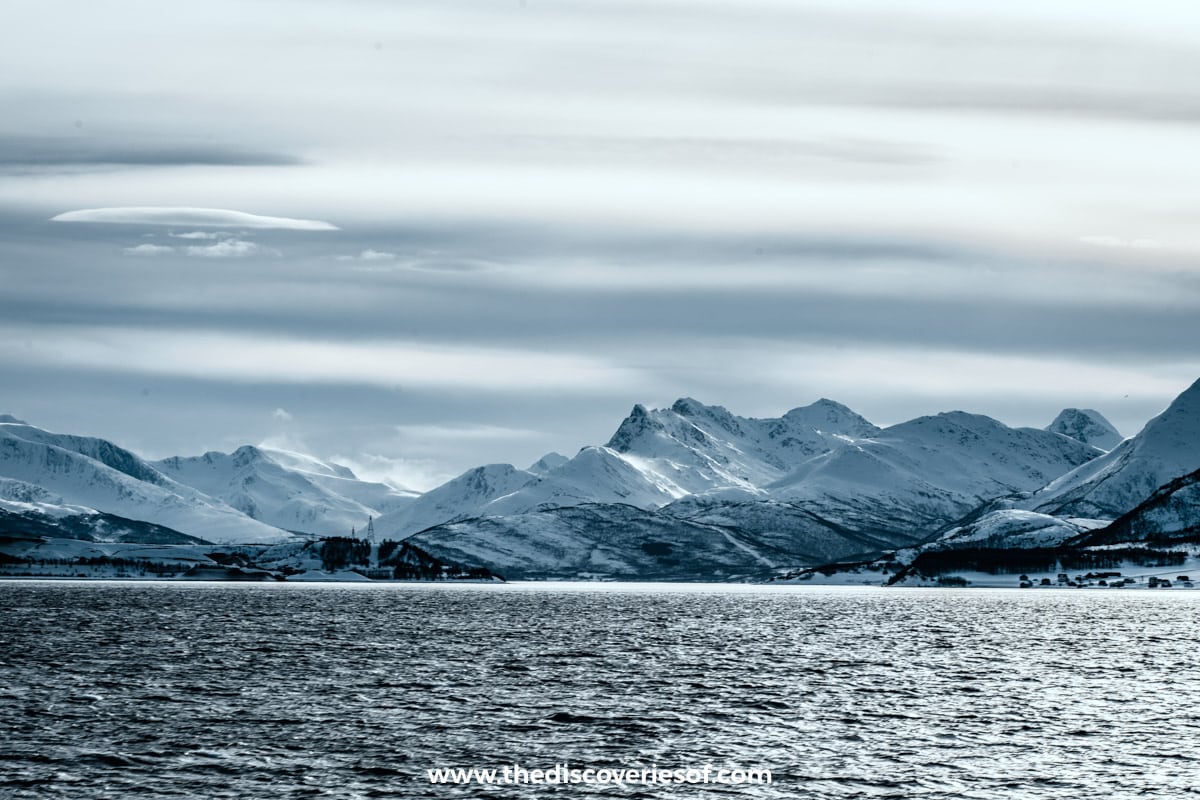
If you take the Lyngseidet to Olderdalen ferry, you cross the Lyngenfjord itself in about 40 minutes. It’s route 190, also run by Norled. Passengers travel free, and a standard car under six metres costs around NOK 152 (around NOK 106 for an electric car). There are fewer sailings than on the Svensby crossing, so plan your day around it.
On the far side, a few stops are worth knowing about:
- Kåfjord: Manndalen hosts Riddu Riđđu, one of the world’s leading festivals of Indigenous music and culture, each July. In Kåfjorddalen, about 15 km off the E6 at Birtavarre, the Gorsa bridge crosses a 153-metre-deep canyon. The walk to it (1.8 km each way from the small car park) is only practical from around June to early autumn, as the valley road isn’t ploughed in winter.
- Spåkenes: north of Olderdalen, facing the Lyngen Alps across the fjord, with glass-roofed igloos and a restaurant at Lyngen North (see below).
- Skibotn: statistically, Skibotn has the most clear-weather days in Norway and is one of the driest places in the country. For centuries, it hosted the largest market in Nord-Troms, and the E8 branches off here up Skibotndalen towards Kilpisjärvi and Finland.
Winter driving tips
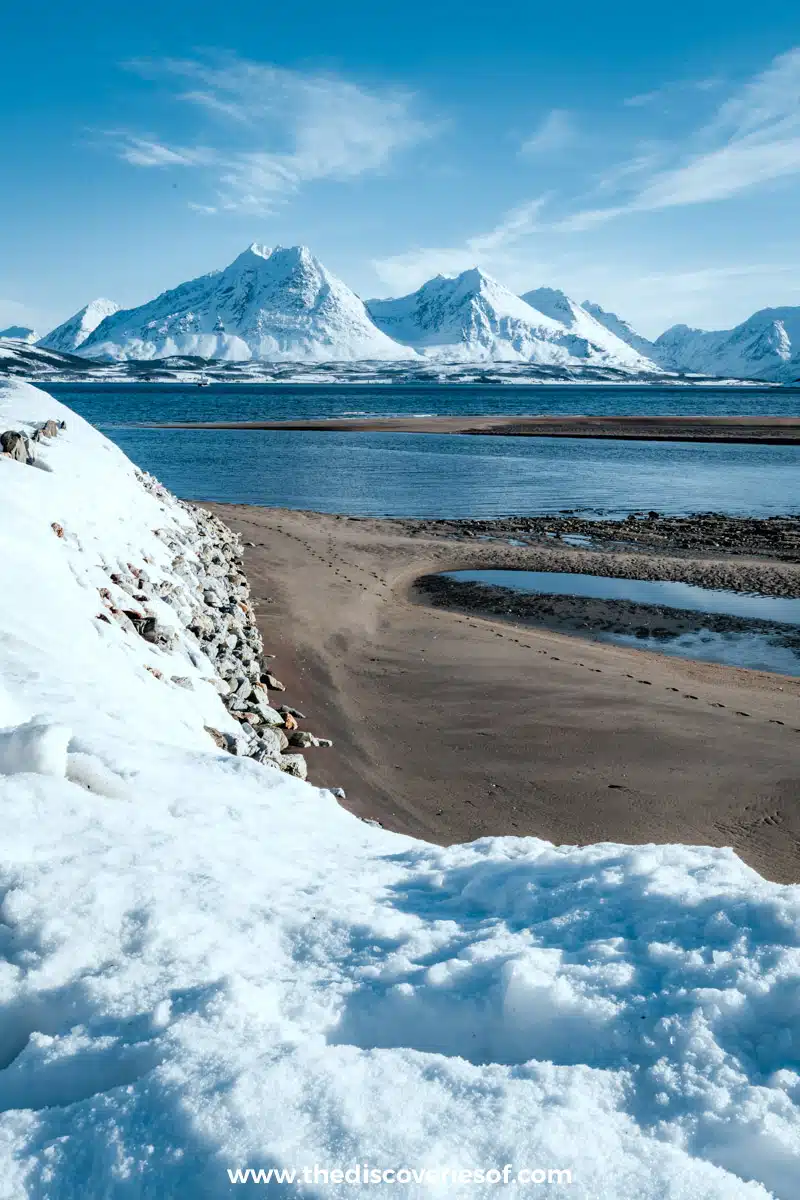
I’d really recommend hiring a car for your Tromsø trip, particularly if you’re staying more than a couple of nights. The city is lovely, but where Tromsø really comes into its own is the surrounding area, and the Lyngen Alps are the best example of that. That said, this is proper winter driving, so here’s what to know.
- Expect snow and ice. Tromsø averages around 160 days a year with at least 25 cm of snow on the ground, and the roads can be very snowy and quite icy. Drive slowly, leave big gaps and brake gently.
- Winter tyres are a must. All rental cars have them in the winter months, and in the far north the winter tyre season runs from mid-October to the end of April. A four-wheel drive is good to have, and a hire car with heated seats is a joy after a walk in the snow.
- Check the roads before you go. The Norwegian Public Roads Administration’s traffic information shows closures, convoy driving and avalanche warnings, or call 175 from a Norwegian number. Roads like 868 can close at short notice after heavy snow or strong winds.
- Watch for reindeer and moose. They wander onto the roads, especially in the dark, and a reindeer won’t move just because you’d like it to.
- Fill up before you leave. Fuel stations are spread out. There are petrol stations in Lyngseidet, Nordkjosbotn and Skibotn, and fast chargers for electric cars at Nordkjosbotn and Skibotn.
- Respect the drink-driving limit. It’s just 0.02% in Norway, so in practice, don’t drink at all if you’re driving.
- Book ahead. Hire cars, especially four-wheel drives, get booked up early in winter, so reserve yours when you book your flights.
- Pack for the stops, not the car. Layers are key: a thick winter coat, a hat, gloves and boots with good grip. Norwegians have a saying that there’s no bad weather, only bad clothing, and they’re right.
Top Tip
Keep an eye on the weather as well as the roads. I’ve got loads of weather apps on my phone, and Windy Premium has been the most reliable one for Tromsø, for both wind and cloud cover. On a windy day, the ferry crossing and the exposed stretches by the fjords can be bitter, so plan your stops for the calmer, clearer part of the day.
Daylight through the year
Light makes or breaks this drive, and at nearly 70 degrees north it changes dramatically through the year. These are approximate hours from sunrise to sunset at Lyngseidet. In the valleys, the mountains hide the low sun for longer.
- Polar night (late November to mid-January): the sun doesn’t rise at all. In Tromsø, it runs from roughly 27 November to 15 January. You still get a few hours of deep blue twilight around midday, which is beautiful but short, so I wouldn’t attempt the full loop at this time of year. Stick to the long way round to Otertind, or join a tour.
- February: around five hours of daylight at the start of the month, rising to over seven by mid-February.
- March: around nine and a half hours on 1 March and more than eleven by mid-March. This is the sweet spot for the drive: deep snow, long golden light, and still dark enough at night for the Northern Lights. It’s when I went.
- April: around 14 hours at the start of the month and 16 by mid-April, with snow still on the peaks. It’s peak ski-touring season.
- Midnight sun (late May to late July): the sun doesn’t set at all. You can drive the loop at any hour, and the summer hikes, like the trail to the Steindalsbreen glacier, open up.
- Autumn: around 15 and a half hours on 1 September, falling to about 11 by early October and nine by mid-October. September brings autumn colours and the first Northern Lights of the season.
- November: under seven hours at the start of the month and around four by mid-November.
Where to eat along the way
This is a rural area, and places to eat are few and far between, with opening hours that change with the seasons. My advice is to take a packed lunch, snacks and a flask, and treat anything you find open as a bonus. We stopped in Lyngseidet to eat, and we also had snacks in the car, which I’d really recommend: there are long stretches with nothing open, especially in winter.
- On the ferries: Visit Lyngenfjord says both ferries have a café on board, handy for a hot drink on the crossing.
- Lyngseidet: Arctic Grill and Alperosa Café do fast food, burgers and takeaways, and the petrol station sells burgers and hot dogs. Lyngseidet Gjestegård serves a fuller menu, but only opens on request, so contact them before you go.
- Nord-Lenangen: if you take the detour north from Svensby, Bøteriet, run by XLyngen, and Emmer by Eliassens Matkunst both focus on local food. Book ahead.
- Nordkjosbotn: the traditional café at Vollan Gjestestue serves homemade food with local ingredients, and is open daily until 9pm.
- Kåfjord and Skibotn: Lyngen North’s restaurant at Spåkenes is à la carte (reserve online), and there’s a café at the Nordkalottsenteret by the E6 in Skibotn.
Top Tip
Eating out in Norway is expensive, and even more so in remote areas. If you’re staying overnight, book somewhere with a kitchen and stock up at the supermarket in Tromsø or Lyngseidet.
Where to stay in the Lyngen Alps
You can easily do the classic loop as a day trip from Tromsø, which is what we did. But if you want to hike, ski, extend to Kåfjord or watch for the Northern Lights away from any city glow, it’s worth spending a night or two. Here are a few places to look at. For more options, including the city and the aurora cabins around it, see my guide to where to stay in Tromsø.
- Aurora Fjord Cabins, Lyngseidet: a set of small modern cabins, each facing the fjord through floor-to-ceiling windows, with its own kitchen and bathroom. Go for the Deluxe Cabin if you can, as it has a private jacuzzi with a jaw-dropping view of the mountains.
- Solhov, Lyngseidet: the historic 1924 guesthouse just south of the village, with views of the fjord and mountains. Rooms share bathrooms, so it’s a good budget base for active trips.
- Lyngen Lodge, Djupvik: a family-owned boutique lodge on the far shore of the Lyngenfjord, with just eight rooms, a sauna and an outdoor hot tub looking straight across at the Lyngen Alps. It’s especially popular for ski touring in spring, and on clear nights you may see the Northern Lights from the lodge itself.
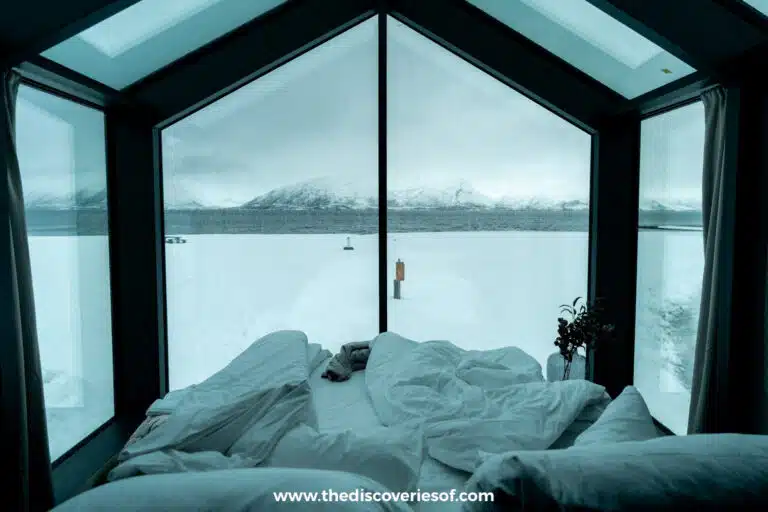
- Lyngen North, Spåkenes: glass-roofed igloos facing the Lyngen Alps across the fjord, with an on-site restaurant. If you loved the idea of lying in bed watching for the aurora, this is the Lyngen version.
- Vollan Gjestestue, Nordkjosbotn: about an hour from Tromsø at the junction of the E6 and E8, with hotel rooms, a traditional café and snowshoe hire in winter. It’s a practical stop if you’re doing the long way round or heading on south.
Northern Lights in the Lyngen Alps
Lyngen is one of the best areas around Tromsø for the Northern Lights. There’s very little light pollution, the mountains and fjords make incredible foregrounds, and Otertind is supposed to be a great Northern Lights viewing point too. The season runs from around September to late March.
Two things make it especially good for chasing the aurora. First, the weather on the eastern side of the mountains is often different from the coast, and Skibotn has the most clear-weather days of anywhere in Norway, so when Tromsø is socked in with cloud, the inner Lyngenfjord is often worth a look. The University of Tromsø even runs an aurora research observatory just outside Skibotn. Second, Oteren and Otertind are on the main road, so you can reach them at night without relying on a ferry.
In my experience, it’s the cloud, not the calendar, that decides whether you see them. On my best night in Tromsø, I spent hours mapping the cloud forecast on Windy Premium against known viewing spots, then drove out to Oldervik, where it was completely clear, and watched the lights dance for two hours. I’ve written up everything I learned in my guide to chasing the Northern Lights in Tromsø.
Top Tip
If you’re not confident driving on snow and ice in the dark, don’t chase the lights out here yourself. Book a Northern Lights chase tour from Tromsø, and let the guides find the clear skies for you.
Here’s my vlog of chasing the Northern Lights around Tromsø, which gives you a feel for what a night out looks like.
Seeing the Lyngen Alps without driving
Don’t want to drive? You still have options.
- Take a tour. This full-day snowmobile safari in the Lyngen Alps, run by XLyngen, takes you across Ullsfjorden on the ferry and then out on the snowmobiles for around an hour and a half, with a homemade lunch. It’s around eight hours in total from Tromsø and very well reviewed.
- Take the bus to the ferry. In winter (December to March), the Arctic Route bus from Best Arctic runs daily from central Tromsø to the ferry at Breivikeidet. It’s a fun way to do the crossing without a car, but you’ll need to arrange transport beyond Svensby.
Is the Lyngen Alps road trip worth it?
Absolutely. I think it’s a real shame that so many people go to Tromsø and don’t explore the areas and islands around it. If you have a car and a clear day, the Lyngen Alps should be at the top of your list, alongside Kvaløya, Ersfjord and Sommarøy. For how it fits into a short break, see my 3-day Tromsø itinerary, and for everything else to do in the area, my guide to things to do in Tromsø in winter.
Read more about Tromsø and the Northern Lights
- 19 incredible things to do in Tromsø in winter
- How to chase the Northern Lights in Tromsø
- 3 days in Tromsø: the perfect Tromsø itinerary
- Where to stay in Tromsø
- My ÆRA Tromsø review
- A Sámi reindeer experience in Tromsø
- Norway in winter
- When’s the best time to see the Northern Lights?
Love This? Save and Share on Pinterest

Discover the top things to do, insider tips and hidden gems in our Norway Travel Guides.
Read the guides →