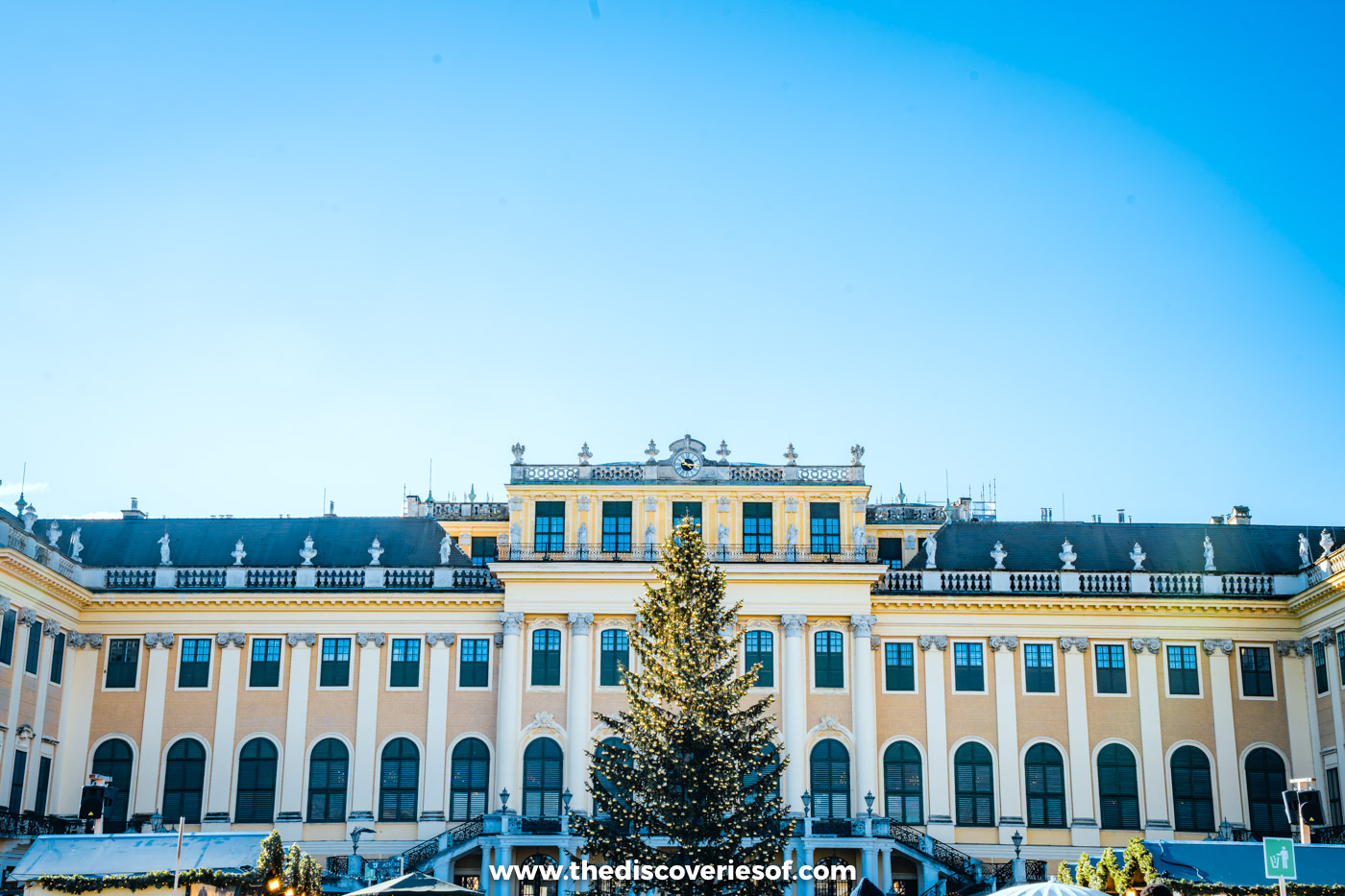

From mid-November, the old town is strung with lights, and every street gets its own design. The best of them fit into a single walk of about three kilometres, past a plague column, an imperial palace and Roman ruins, with Christmas markets along the way. Time it right and the whole route glows gold against a deep blue sky.
I walked these streets on my first evening in the city, in November, and I’d planned the whole afternoon around them. I even took an outdoor table under the heaters at Café Sacher, purely so I could finish my Sachertorte in time for blue hour, then set off up Kärntner Straße as the lights came on.
A couple of weeks earlier I’d filmed my London Christmas lights walk, so I thought I already knew festive. We do Christmas well in London, but this city takes it somewhere else entirely: chandeliers, gold rain and swinging cylinders of light, strung between some of the grandest baroque facades in Europe.
This route links the best of Vienna’s Christmas lights, 17 lit streets and squares in the old town, from the Opera end of Kärntner Straße to Freyung. It includes a short add-on loop east of the cathedral, and there’s a map at the end with a pin for every stop.
Vienna’s Christmas lights walk at a glance
- The main walk: Kärntner Straße (with Annagasse and Neuer Markt), Stephansplatz, the Graben and its side streets, Kohlmarkt, Michaelerplatz, Tuchlauben, Bognergasse, Am Hof, Freyung and Herrengasse
- The add-on loop: Wollzeile, Rotenturmstraße and Bauernmarkt, starting and finishing at Stephansplatz
- Distance: about 3km for the main walk and 1.2km for the loop, flat and mostly on pedestrian streets
- Time: allow one and a half to two hours, plus half an hour for the loop and longer if you stop at the markets. My own walk from the Opera to Am Hof took a little over an hour
- When to start: around 3.45pm from late November to Christmas, just before sunset
- When the lights are on: switched on on 12 November this season and lit until early or mid-January, from late afternoon until about 11pm or midnight
- Start: Karlsplatz U-Bahn (U1, U2, U4), by the State Opera. Finish: Herrengasse U-Bahn (U3)
- Cost: free
Top Tip
Aim to reach the Graben at blue hour, the half hour or so after sunset when the sky turns a deep, glowing blue. Gold chandeliers against that sky are the picture everyone is after, and the moment passes quickly.
Kärntner Straße to St Stephen’s
1. Kärntner Straße
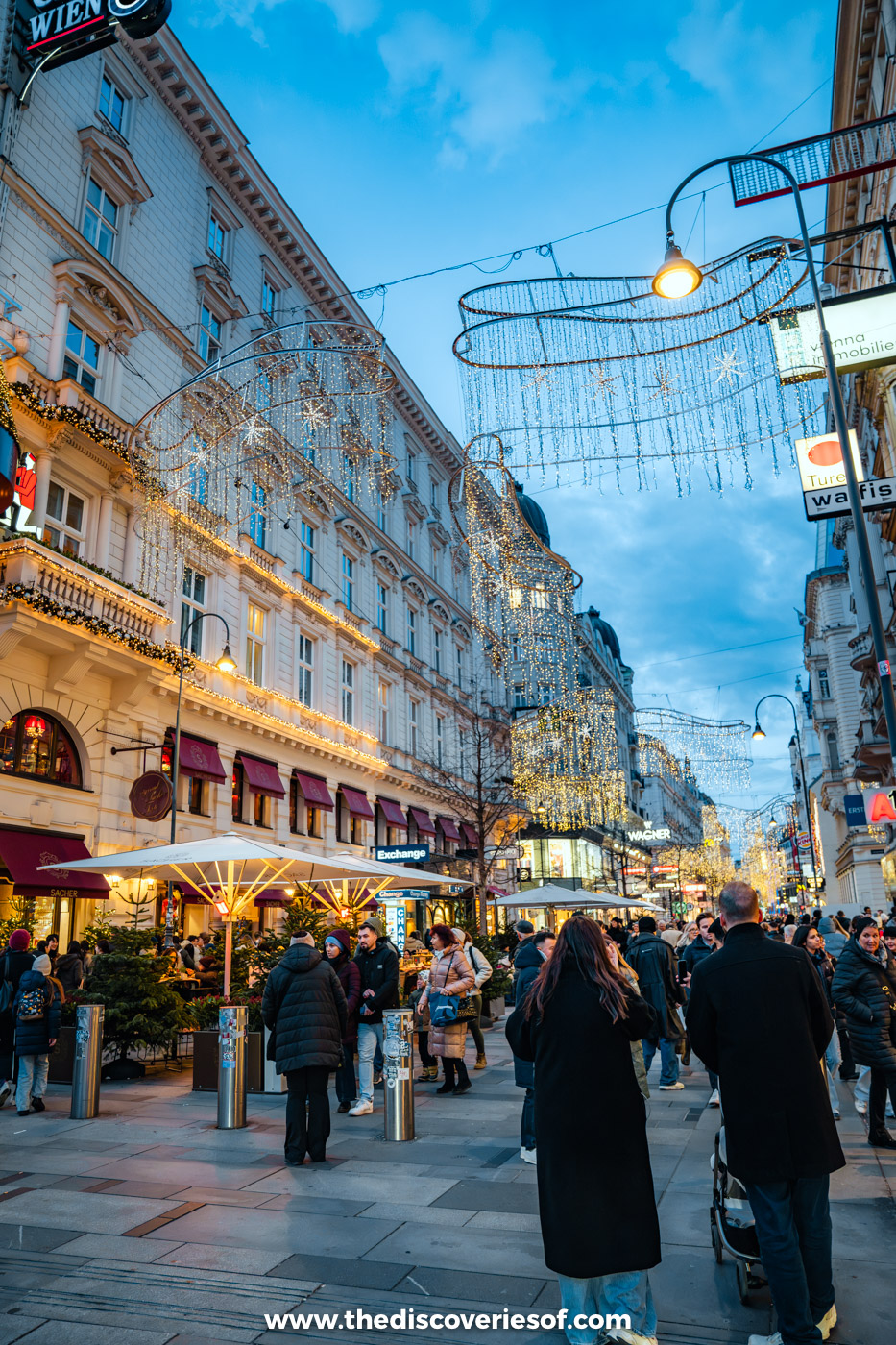
Start at the Opera end of Kärntner Straße, the city’s main pedestrian shopping street, which runs for about 750 metres to the cathedral. The Sacher corner sits at the bottom, so it’s an easy place to warm up with a coffee and a slice of cake first.
Its lights are 54 huge oval fixtures, each up to six metres wide, hung around 11 metres above the street. Curtains of white and gold strands fall from every hoop, dotted with stars, and as the sky darkens they stack up one after another all the way to Stephansplatz.
Top Tip
Look up on Kärntner Straße in daylight too. The fixtures are studded with crystals that catch the sun, so they sparkle even before they’re switched on.
2. Annagasse
A short way up Kärntner Straße, turn right for a quick look down Annagasse. This narrow baroque lane has one of the cleverest displays in the city: its lights spell out the opening notes of Silent Night.
It’s only a few steps off the main drag but far quieter, with St Anne’s Church halfway along. Walk in far enough to read the melody overhead, then double back to Kärntner Straße.
3. Neuer Markt
Cross to the other side of Kärntner Straße and cut through to Neuer Markt, the square where this season’s lights were officially switched on. Forty-eight “Sisi stars” hang here, modelled on the diamond star ornaments Empress Elisabeth wore in her hair and lit from inside their engraved patterns.
This season they’ve been joined by light-up reindeer decorated with flowers, adding around 10,000 lights to the square. The baroque Donner Fountain stands in the middle, and the Capuchin Crypt, where generations of Habsburgs are buried, is on the square.
4. Stephansplatz
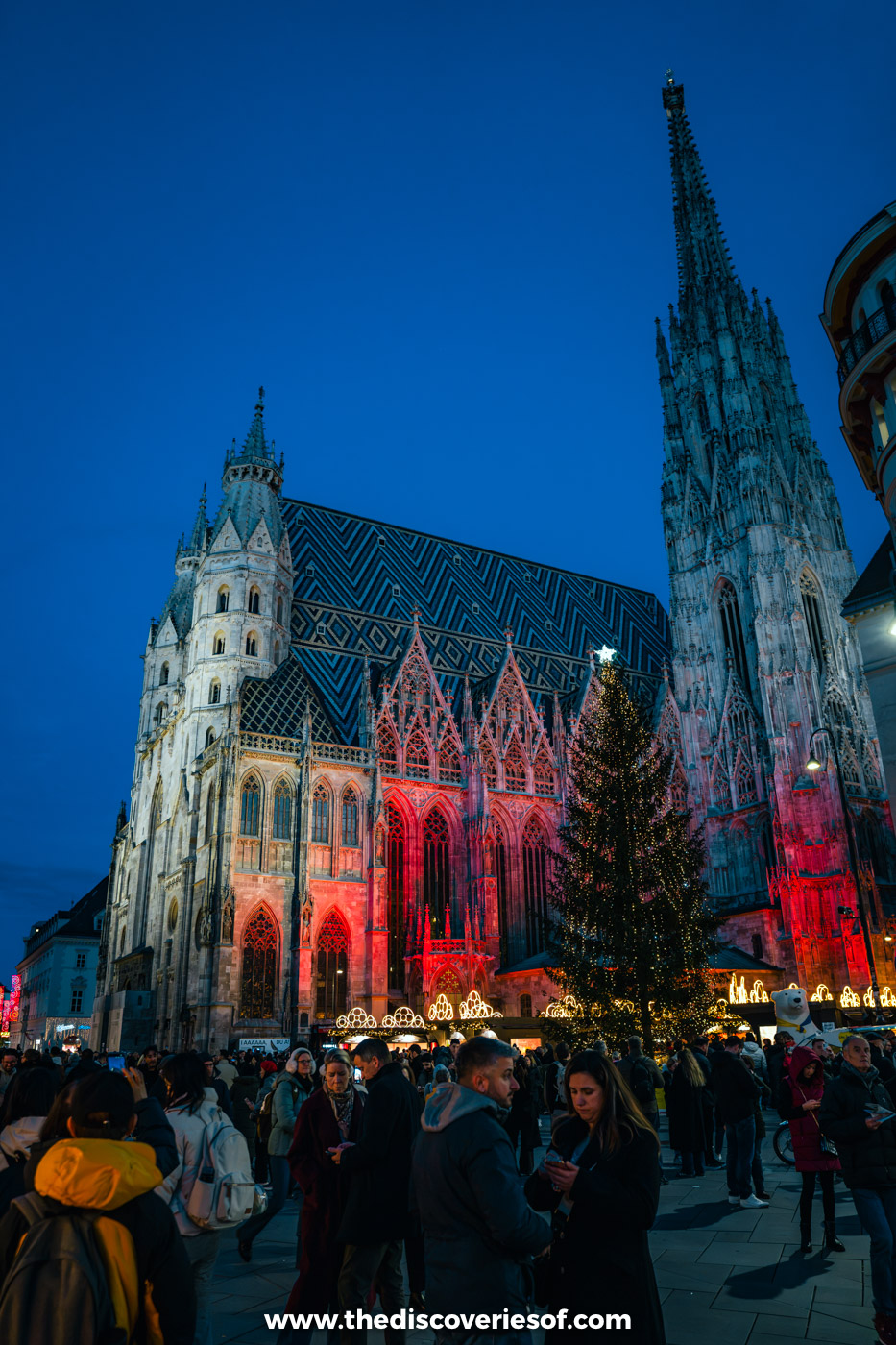
Back on Kärntner Straße, carry on to St Stephen’s Cathedral, with its patterned tile roof and 136-metre south tower. I’d climbed the tower’s 343 steps earlier that day, but the cathedral is at its most dramatic after dark, lit up behind its Christmas tree.
The square has its own small Christmas market, which is easy to miss because most of its huts are tucked behind the church rather than out front. Loop round the side of the cathedral for a Glühwein before you go on.
Add-on loop: Rotenturmstraße and the streets east of the cathedral
Three more lit streets sit just north-east of Stephansplatz, and they make a loop of about 1.2km that brings you back to the cathedral. Walk it here, before the Graben, or save it for the end of the evening.
Getting There
Staying near the Danube Canal? Start at Schwedenplatz (U1, U4), walk up Rotenturmstraße to Stephansplatz, and take in Bauernmarkt and Wollzeile from there.
5. Wollzeile
From the top of Rotenturmstraße, Wollzeile heads east towards the Ring, lit as one of the old town’s official Christmas shopping streets. It’s a street I got to know well.
I had dinner at Plachutta, at No. 38, where I went for a hefty steak and béarnaise sauce, and my 9.45pm table was the only slot left when I booked a couple of days ahead. On my last day I stumbled into a tiny sweet shop along here selling handmade marzipan and icing decorations for cakes, and left with something to take home.
6. Rotenturmstraße
Rotenturmstraße runs between Stephansplatz and Schwedenplatz, and this was my way into the old town: I walked up it from my hotel across the Danube Canal. Its oversized red baubles have hung over the street every Advent for many years.
The name comes from the Roter Turm, the red tower it once led to. Just off it is Lugeck, where I had a classic Wiener Schnitzel with potato salad, lingonberry jam and a glass of Grüner Veltliner after my first evening’s walk.
7. Bauernmarkt
Turn left along Lichtensteg to the Hoher Markt, where the Art Nouveau Anker Clock forms a bridge between two buildings, then take Bauernmarkt back south towards the cathedral. It’s lit as part of the city’s official scheme too.
The name goes back to the farmers who sold their own produce here, first recorded in 1440, when the stalls dealt mainly in milk, cheese, lard, cabbage and grapes. Bauernmarkt brings you out a few steps from Stephansplatz, ready for the Graben.
Top Tip
Come back to the Hoher Markt at noon one day. That’s when all the figures on the Anker Clock parade across its bridge, each to music from its own era.
The Graben and its side streets
8. The Graben and the Trattnerhof
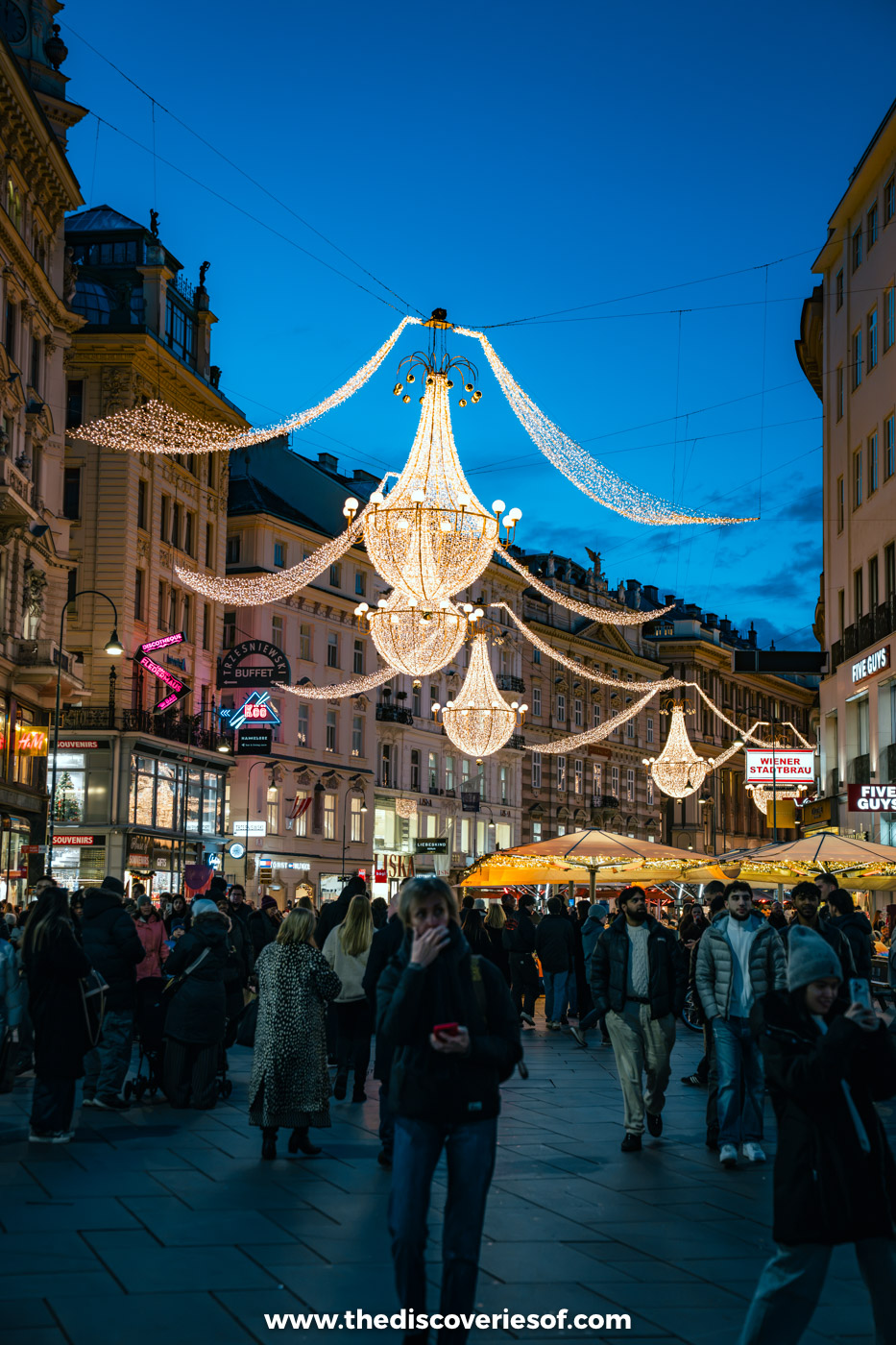
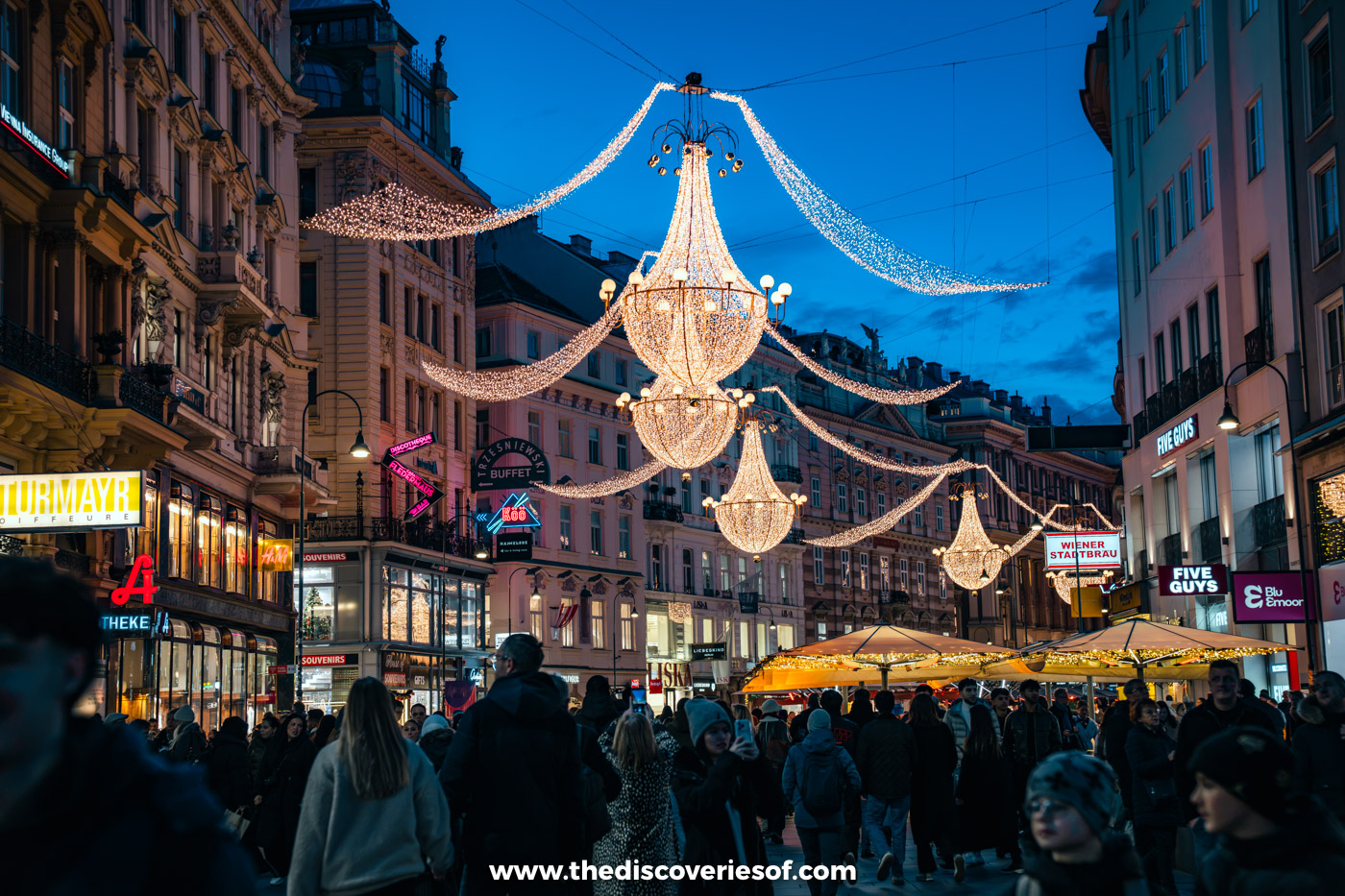
Walk past the cathedral’s west front and the Graben opens up ahead. I’d walked along it in daylight and thought it was beautiful, with its grand baroque buildings. When I came back at blue hour and caught sight of the chandeliers, my first words were “oh wow”: the lights lift it into something spectacular.
Giant chandeliers made of light hang one behind another down the street, linked by swooping garlands, and the warm gold against that blue sky is magical. The current set went up in 2023, made by MK Illumination, a Tyrolean family firm, and the Trattnerhof passage off the north side of the street is lit as part of the same display.
The name means ditch. According to the City of Vienna’s history wiki, the street follows the ditch outside the Roman fortress of Vindobona, filled in around 1200 as the city grew. It has been a Christmas shopping street for centuries, too: the nativity and Christkindl markets moved here in 1600 and stayed until 1761.
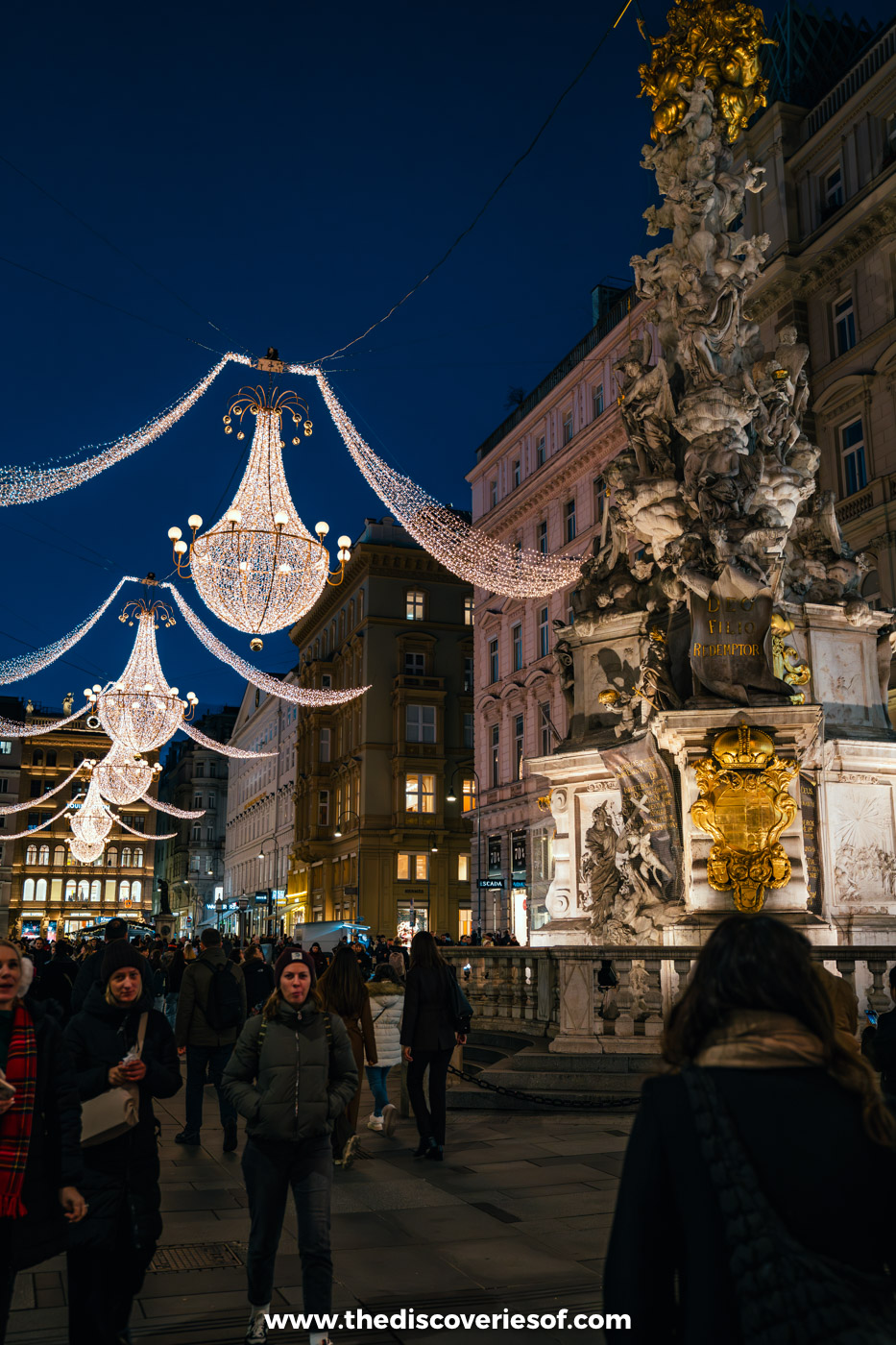
Halfway along stands the Pestsäule, the Plague Column. When plague swept through the city in 1679, Emperor Leopold I vowed to raise a monument in thanks once it had passed, and the finished column was unveiled in 1693, with the emperor himself kneeling in prayer near the top.
It’s quite something to see. Surrounded by Christmas shoppers and twinkling lights, it’s a sobering reminder of one of the darkest chapters in the city’s past.
Top Tip
For the classic shot, stand beside the Plague Column and look down the street, so the chandeliers line up behind each other with the column’s gilded top catching their light.
9. Spiegelgasse
Three lit side streets run south off the Graben, and the first two make a mini loop of about 500 metres. Turn left down Spiegelgasse, a narrow street of independent shops that’s lit as one of the old town’s official Christmas streets.
At the bottom, turn right along Plankengasse, the short lane that links Spiegelgasse with Neuer Markt, to reach Dorotheergasse.
10. Dorotheergasse
Walk back up Dorotheergasse to the Graben. It’s lit for the season too, and it’s home to the Dorotheum, the city’s grand old auction house.
Right at the Graben end, at No. 1, is Trześniewski, which has been making its open-faced Brötchen since 1902. I had lunch there that day: rye bread piled with smoked salmon, cream cheese and a kick of horseradish, plus herring with egg and pickled onion, washed down with a Pfiff, a dinky eighth of a litre of beer.
Top Tip
Make Trześniewski your pre-walk snack. You order at the counter, it’s quick and affordable a few minutes from the cathedral, and a couple of Brötchen with a Pfiff will keep you going until dinner.
Kohlmarkt to the Hofburg
11. Kohlmarkt
At the far end of the Graben, turn left into Kohlmarkt. The lights change completely here, into a canopy of gold that falls like rain, and when I arrived they were literally twinkling.
Today Kohlmarkt is one of the most upmarket streets in the city, lined with luxury boutiques, so I loved finding out that it’s named after the charcoal sellers who once traded here. It was a lot less glamorous back then.
Look straight ahead as you walk and the gold frames the dome of the Michaelertrakt, the Hofburg wing at the end of the street. The Hofburg was home to the Habsburg emperors for more than 600 years.
Halfway down, at No. 14, is Demel, the old court confectioner. I came back on my last day to taste its rival Sachertorte and ended up raving about the goulash instead.
12. The Roman ruins on Michaelerplatz
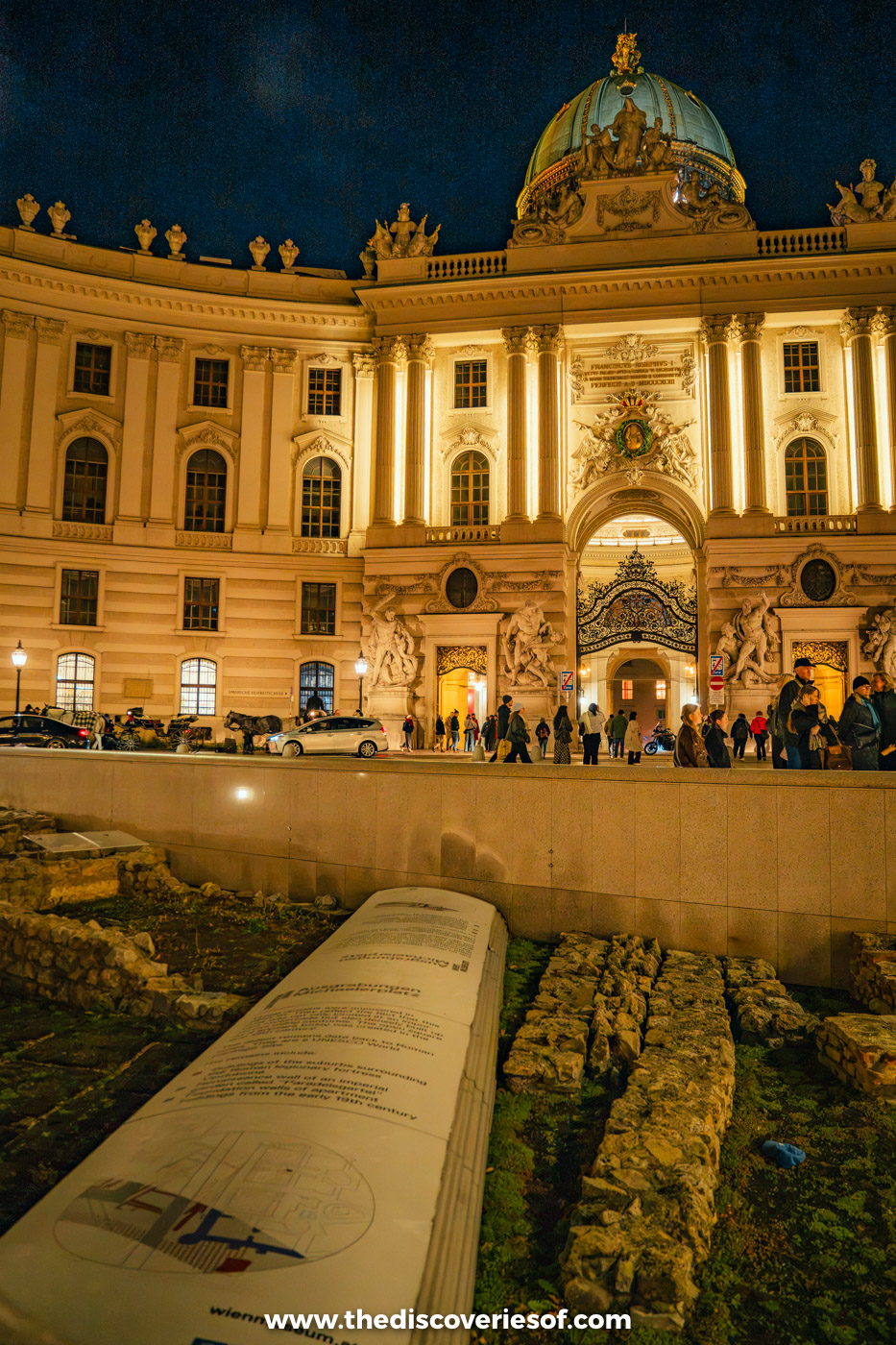
Kohlmarkt spills out on to Michaelerplatz, and the contrast couldn’t be more striking. Behind you are the Christmas lights and the shoppers, ahead the Hofburg rises on a huge scale with its gilded dome and ornate facade, and at your feet are Roman ruins.
They’re the remains of the civilian settlement that grew up around the Roman fortress of Vindobona. Excavations between 1989 and 1991 uncovered Roman buildings with heated floors and wall paintings, as well as medieval and later layers, and the architect Hans Hollein designed the open display that you see today.
What struck me most is that nobody knew they were there until then, even though this has been a busy square for centuries. Generation after generation lived their lives right on top of them without realising, a reminder of just how many layers of history this city is built on.
Top Tip
The ruins sit in an open, lit pit in the middle of the square, so you can see them for free at any hour. Read the information panels around the edge to work out which walls are Roman and which came later.
The Palaisviertel: Tuchlauben to Freyung
Walk back up Kohlmarkt (you get its gold rain twice) to the corner where it meets the Graben. The streets north of here form the Palaisviertel, the old quarter of aristocratic palaces, and they’re lit together as one area: Tuchlauben, Bognergasse, Naglergasse, Heidenschuss, Strauchgasse, Seitzergasse and Freyung.
13. Tuchlauben
From the corner, glance right down Tuchlauben, which runs north-east to the Hoher Markt. Its name comes from the cloth merchants who once sold their wares under the arcades (Lauben) here.
14. Bognergasse
Then carry straight on into Bognergasse. I loved the lights on this short street, because they move.
Glowing cylinders hang above the road, and on my evening there was just enough of a breeze to set them rocking ever so slightly. After the crowds on the Graben, it was oddly soothing, and it’s the point where it sinks in that no two streets in the old town share a design.
Top Tip
Slow down on Bognergasse. The gentle sway of the cylinders is the whole charm of this street, and you’ll miss it if you hurry through to the market.
15. Am Hof
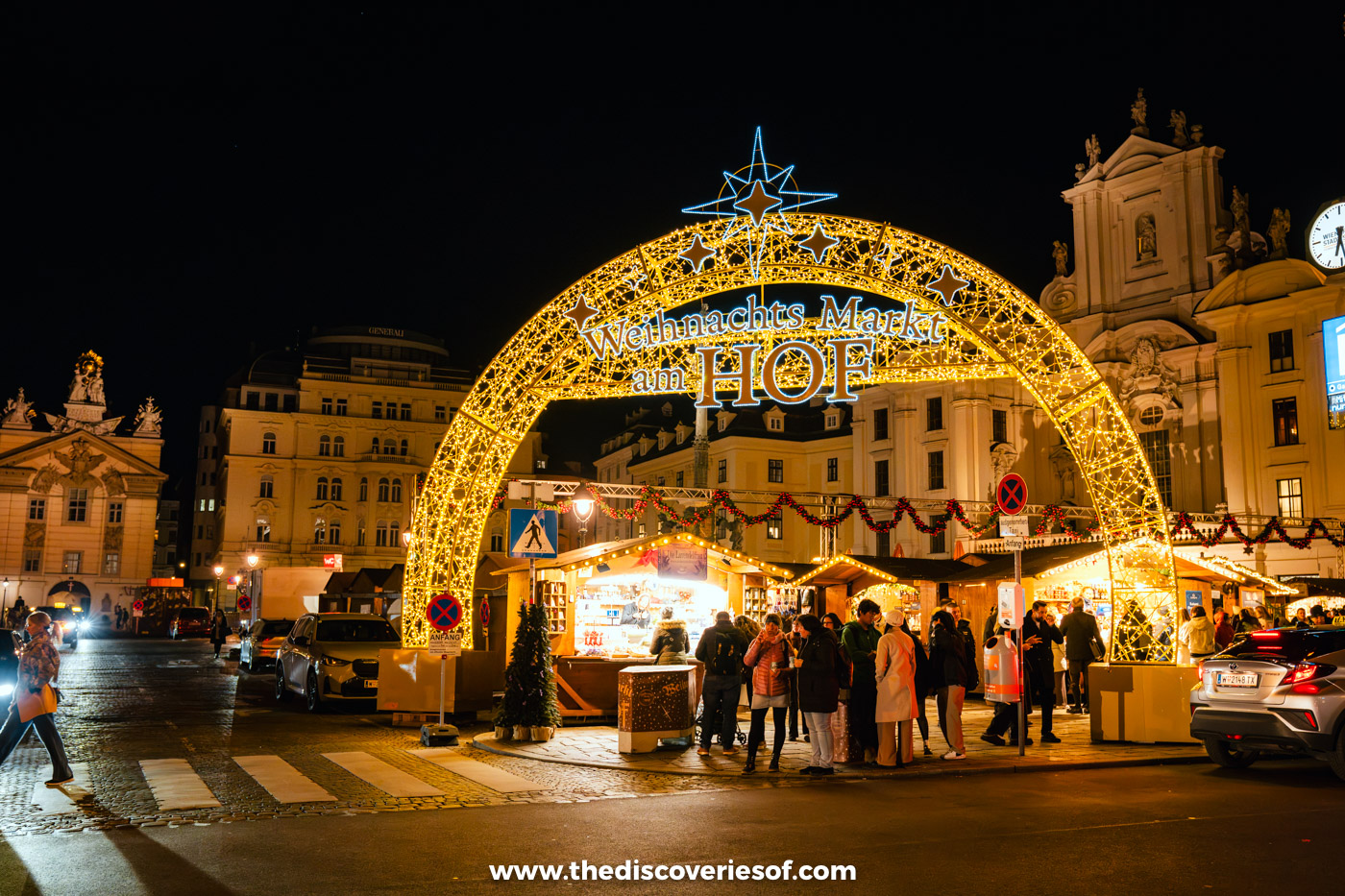
Bognergasse opens on to Am Hof, among the most ancient squares in the old town. My first glimpse of its glowing arch and rows of wooden huts, with the smell of grilling sausages drifting over, was exactly what a Christmas market should look like.
Warm up with a Glühwein and do some gift shopping, because most of the stallholders here make what they sell. My guide to the Am Hof Christmas market has what to eat, drink and buy.
Do
Want company from here? This Christmas market food and drink tour starts beside Am Hof and leads on to markets further out.
16. Freyung
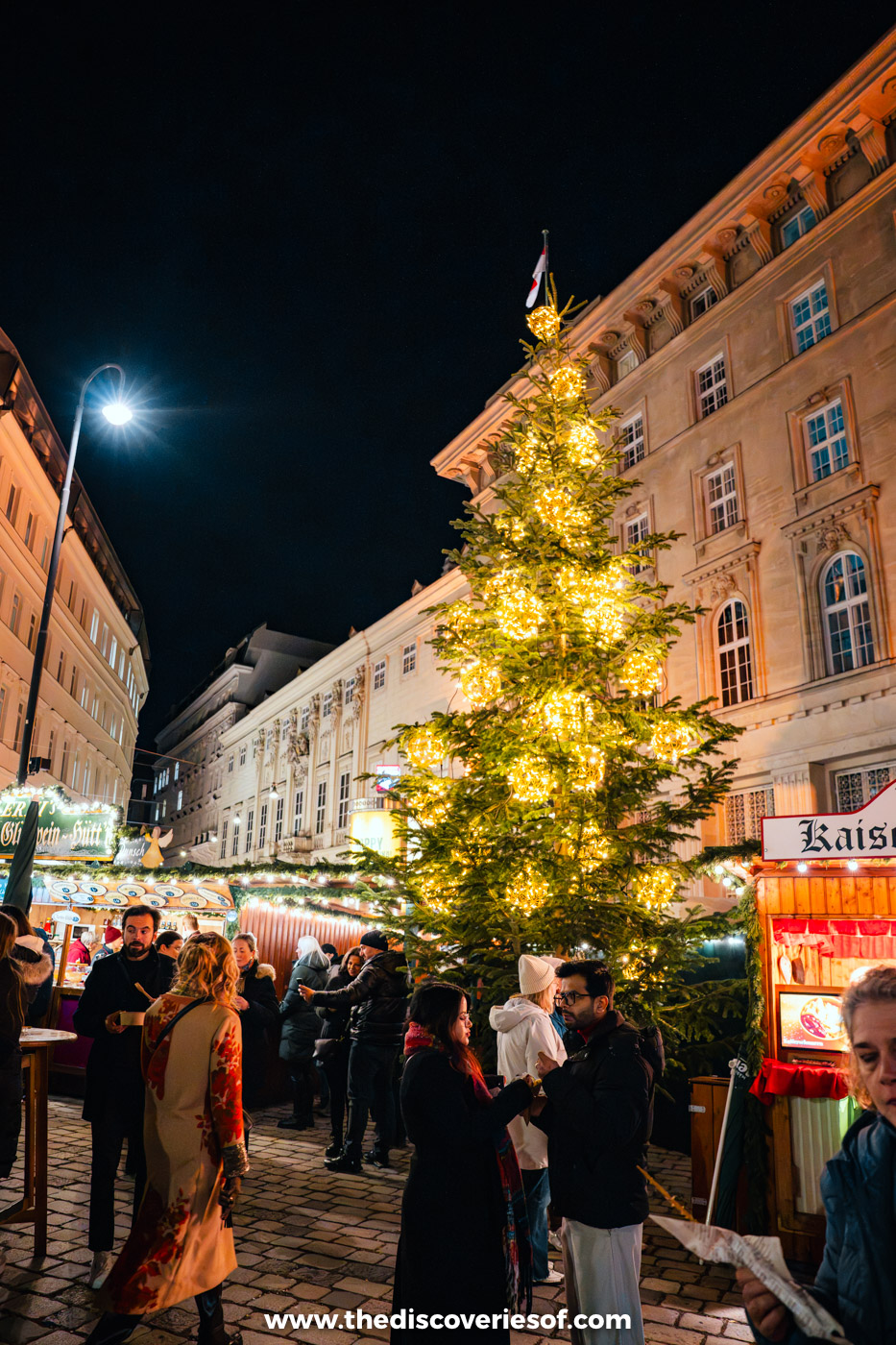
Follow Heidenschuss out of the corner of Am Hof and, almost before you’ve noticed, you’re on Freyung. I knew it was close, but it’s only paces away, and its own Christmas market peeps out from under the palace fronts.
The name means freedom: the monastery here once gave sanctuary to people on the run. Its market dates back to 1764, and on my visit I lost myself in a shop crammed with hand-decorated baubles, cute enough to trigger a serious bout of what I can only call cuteness aggression.
17. Herrengasse
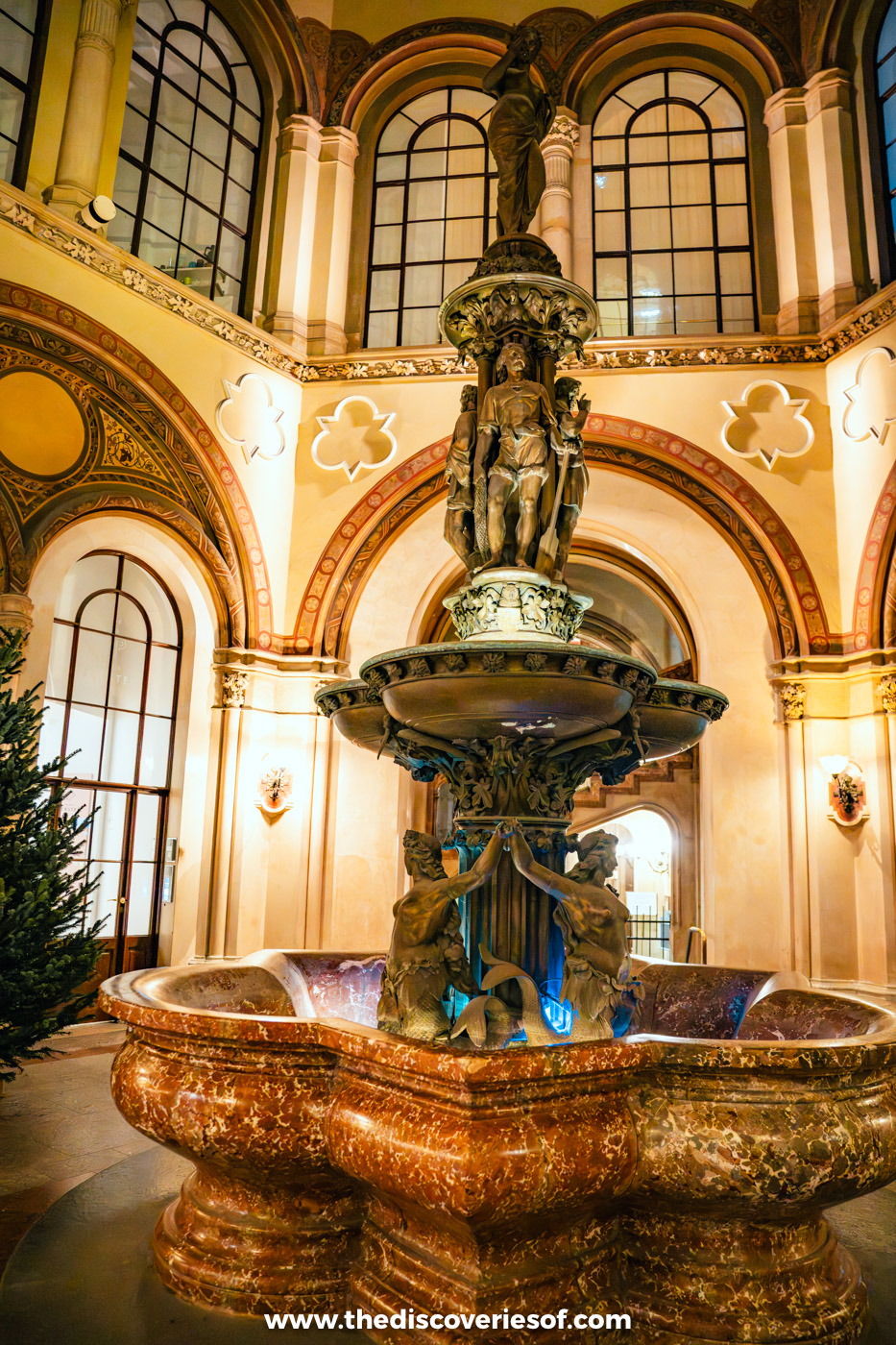
Finish by walking south down Herrengasse, the “lords’ street” lined with aristocratic palaces, which is lit for the season and leads back to Michaelerplatz. Towards the southern end, Wallnerstraße, also lit, links it to Kohlmarkt.
At the Freyung end is Palais Ferstel, whose arcaded passage is worth a detour indoors, and on its Herrengasse corner is Café Central, the most famous coffee house in the city. It was top of my list, but it’s closed for renovation, so it will have to wait for another trip.
Don’t
Plan your evening around Café Central. It has been closed for renovation since March, so warm up in another coffee house nearby until it reopens.
Herrengasse U-Bahn station (U3) is at the southern end of the street. If you’ve still got energy, the Wiener Christkindlmarkt at Rathausplatz, with its lit-up park, is about ten minutes’ walk west of Freyung.
When to go, what to wear and how to get home
When to see the lights
This season the lights were switched on on 12 November, across 30 shopping streets and districts, 13 of them in the old town. They usually stay up until early to mid-January and shine from late afternoon until around 11pm or midnight, though each street sets its own hours.
Sunset is around 4pm from late November to the end of December, so set off from the Opera at about 3.45pm and you’ll reach the Graben for blue hour. Weekday evenings are calmer. On the Saturdays in December, Kärntner Straße and the Graben fill with shoppers.
Don’t
Leave it until late in the evening if you want photos. The lights stay on, but the blue sky that makes them glow turns to black within an hour of sunset.
What to wear
Layers, gloves and comfortable shoes: you’ll spend a lot of this walk standing still and looking up. It was a mild 7°C on the evening I walked the route, but by my last morning it was snowing so hard that I had to duck into a doorway for shelter.
Getting there and getting home
Start at Karlsplatz (U1, U2 and U4) by the State Opera, or at Schwedenplatz (U1 and U4) if you’re doing the loop first. Stephansplatz (U1 and U3) sits in the middle of the route, and Herrengasse (U3) is at the finish.
The U-Bahn runs until around midnight, and all night every 15 minutes on Friday and Saturday nights and before public holidays.
Beyond the old town
Seventeen more streets are lit outside the centre. The pick are Neubaugasse in the 7th district, with three-dimensional moons and 25-pointed stars, Josefstädter Straße in the 8th, with 120 giant blue baubles, and the inner stretch of Mariahilfer Straße. The tourist board’s Christmas lights page has the rest.
Map
Every stop below is pinned and numbered in the order you’ll reach it, with the add-on loop as stops 5 to 7.
Read next
- SO/ Vienna review: spacious rooms, views both ways and breakfast 18 floors up
- Inside the Sisi Museum at Vienna’s Hofburg, where an empress hung gym rings in her dressing room
- 3 days in Vienna, with time for Habsburg palaces, grand coffee houses and two rival Sachertortes
- Sacher or Demel? Where to eat Sachertorte in Vienna, and the cake war behind it
- What Vienna in winter is really like, with Christmas markets, coffee houses, balls and a chance of snow
- St Stephen’s Cathedral in Vienna: exploring the two towers, catacombs and an emperor’s tomb
- 11 Vienna Christmas markets, and the one to save your gift shopping for
- The Am Hof Christmas market, where Vienna’s makers sell their own work
- Visiting the Wiener Christkindlmarkt at Rathausplatz, where the ice rink winds through the park
- London’s best Christmas lights: a walking tour from Covent Garden to Marylebone
- Why Covent Garden at Christmas is the most festive corner of London
- Best places to visit in December: 29 warm and wintry escapes
- 25 stunning places to visit in Europe in winter
- Schnitzel, strudel and a sausage at midnight: what to eat in Vienna, and where to order it
- Trześniewski review: are Vienna’s century-old open sandwiches still the best quick lunch in town?
Love this? Save and share on Pinterest
Discover the top things to do, insider tips and hidden gems in our Austria Travel Guide.
Read the guides →