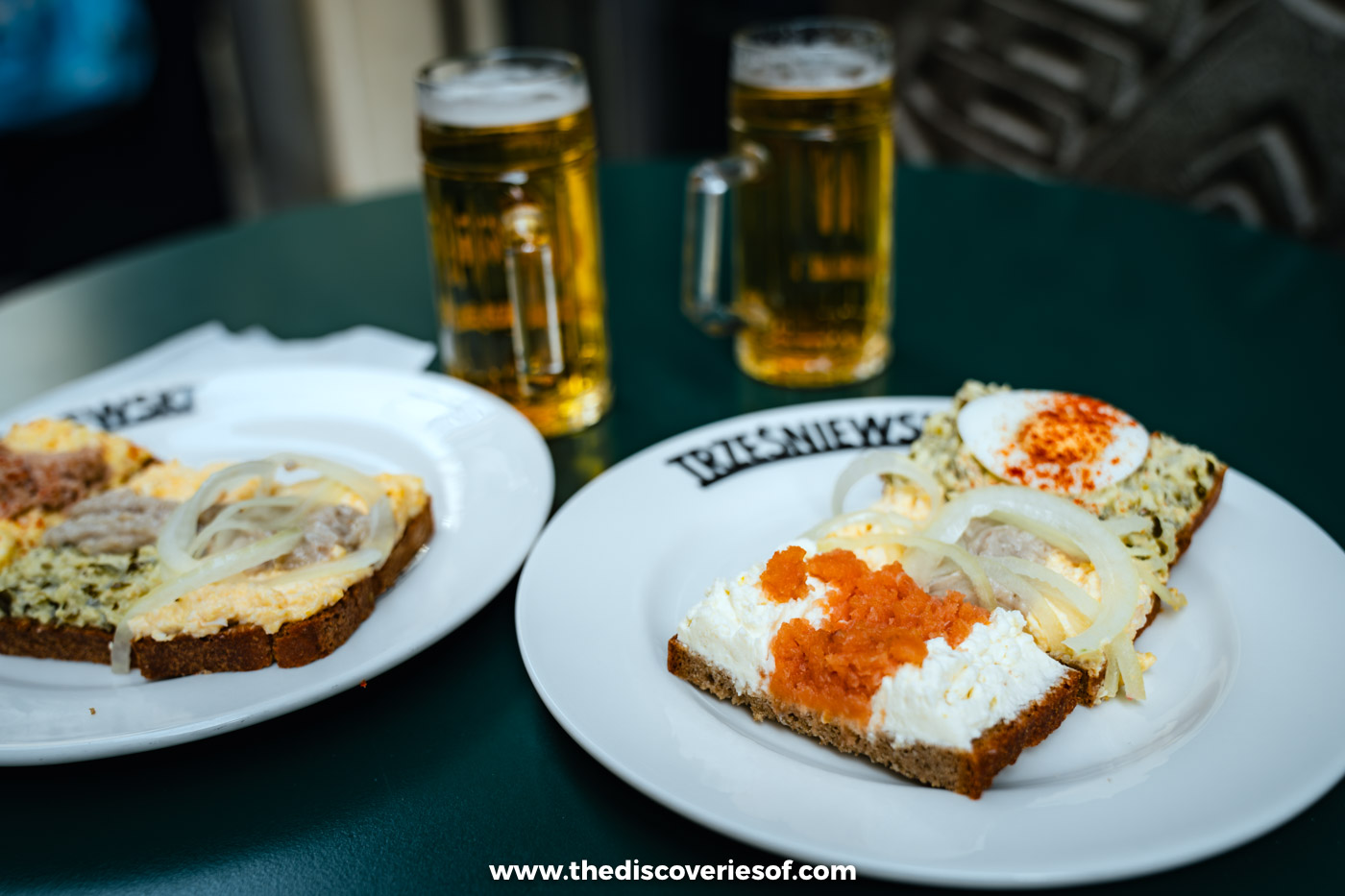

Bite-sized slices of rye bread, each spread by hand with a fork, beer served in eighth-of-a-litre measures, and a counter that has barely changed its recipes since 1902. Here’s how Trześniewski works, what to order and whether it lives up to the legend.
Lunch at Trześniewski goes something like this. You step in off Dorotheergasse, run your eye along a counter lined with little rectangles of dark rye bread (each one piled with a different creamy spread), point at the ones you want and carry them off on a small platter.
Then you order a beer. A very, very small beer.
The ritual dates back to 1902, when Kraków-born Franciszek Trześniewski opened his first shop in Vienna. By the 1920s he was cutting the bread into small pieces so nobody needed cutlery or even a plate, and today 18 of the 25 spreads on the counter are still the originals.
That’s a lot of history resting on one slice of rye. So does it still hold up? I made it one of my first stops in Vienna, straight after climbing the south tower of St Stephen’s, and ate my way through three of them.
This review covers how the counter works, the Brötchen I ordered, what else is worth pointing at, prices and opening hours, and whether it deserves a spot in your Vienna plans. Let’s get to it.
Quick verdict
Go. If you’re after a fast, cheap lunch that’s genuinely good and only a few minutes’ walk from St Stephen’s, this is it. The spreads are rich and creamy, the quality is far higher than the price suggests, and the Pfiff is a wonderfully charming way to drink a beer.
Just know what you’re signing up for: it’s a snack stop, not a long lunch, and you’ll want three or four Brötchen if you’re properly hungry. The service is brusque (fine by me, but it’s the reason this isn’t a five), while the food and the value are excellent.
My rating: 4/5
What eating at Trześniewski is like
How the counter works
Brötchen are open-faced sandwiches, and here they’re small enough to finish in three or four bites. The system couldn’t be simpler: head inside to the counter, choose your Brötchen, and they’re served up on a little platter for you to take to a table.
The spreads are still applied by hand, with a fork. A team of about 80 people makes them fresh each day, and the exact recipes are a closely guarded secret (the company hints that part of it lies in the way the eggs are boiled).
Top Tip
Most Brötchen are named after their main ingredients, so a few words of German go a long way at the counter: “mit Ei” means with egg, “Kren” is horseradish, “Gurke” is gherkin and “Zwiebel” is onion
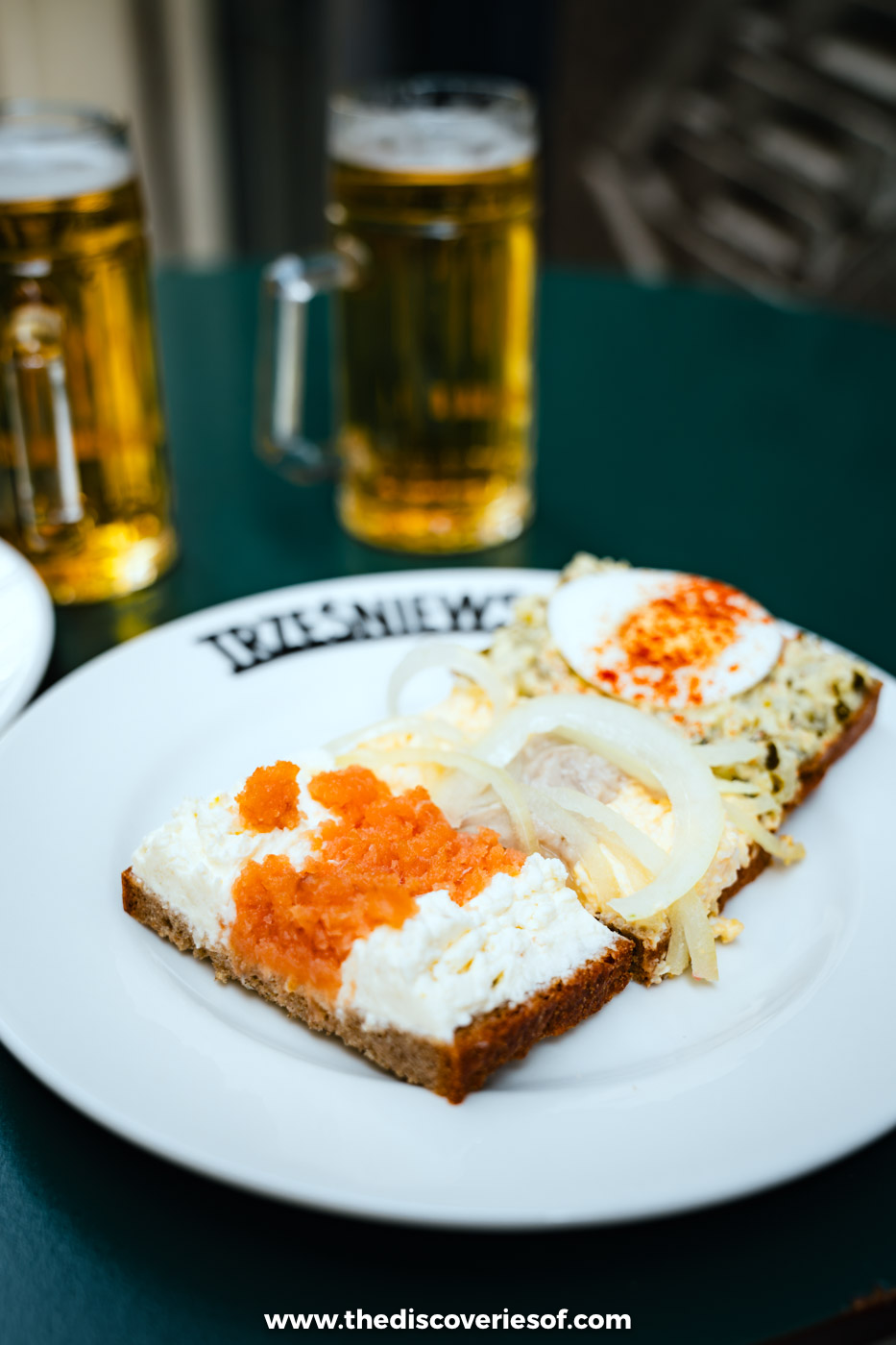
Smoked salmon on horseradish cream cheese
My first bite was the smoked salmon one, and it set the tone. Very good, and very creamy, with a little hit of horseradish that really lifts the whole thing.
On the menu it’s listed as Räucherlachs auf Krengervais: smoked salmon on cream cheese whipped with horseradish. If you only order one, start here.
Herring with egg and onion
Next up was herring, with egg and pickled onions. It’s punchy, salty and exactly what you’d want with a cold beer. I did note at the time that my breath was going to be a delight for the rest of the afternoon (plan your meetings accordingly).
Gherkin and egg
The third was gherkin and egg, which is essentially egg with a sharp, crunchy edge. It’s a lot of egg, I’ll be honest. But the quality was very, very good, and it’s the one to pick if fish isn’t your thing.
The Pfiff: beer by the eighth of a litre
Tradition says your Brötchen come with a Pfiff, a beer measured at one-eighth of a litre. It’s an unusual size anywhere else, and it arrives in a tiny glass mug that’s so cute it’s almost silly.
Personally, I think it’s genius. I’m a very slow beer drinker, so a beer of this size is about the right amount for me, and plenty to wash down a herring Brötchen. The beer comes from the city’s own Ottakringer brewery and is tapped fresh.
What else to order at the counter
There are 25 Brötchen on the menu, plus the odd seasonal special. The range covers meat, fish and vegetarian spreads, with vegan and lactose-free options too, so nobody gets left out.
- Speck mit Ei (bacon and egg): the bestseller, so popular that the company named a website after it.
- Tafelspitz mit Kren und Gurke: the famous Viennese boiled beef, with horseradish and gherkin, on a slice of rye.
- Trüffel-Ei mit Schinken: truffled egg with ham, the slightly fancier choice.
- Matjes mit Zwiebel and Schwedischer Hering: two takes on herring, for anyone who liked the sound of mine.
- Geflügelleber: chicken liver, rich and smooth.
- Linse mit Roter Rübe and Apfel-Sellerie mit Roter Rübe: lentil, or apple and celery, each with beetroot, for a meat-free plate.
- Pikantes Ei, Paprika and Pfefferoni: the spicier end of the counter.
Traditionally, the Viennese stop in for one or two with a Pfiff. For a proper lunch, three or four is a better bet.
Do
Want to taste more of the city’s food in one go? This food and coffee walking tour starts on Stephansplatz and includes a Jause of open sandwiches at the Viktor-Adler-Markt, coffee on the Graben, a seated lunch and a sausage stand
A Viennese lunch with 120 years of history
Franciszek Trześniewski opened his first shop on Tiefer Graben, a short walk away, and moved to Dorotheergasse 1 soon afterwards. The Dorotheergasse shop is still the company’s oldest branch, and its flagship.
His idea was a practical one. Turning the toppings into spreads made the sandwiches easy and tidy to eat, and cutting the bread small meant they could be eaten without cutlery or a plate. Around 1939 his daughter, Maria, took over and ran the business until 1978, adding the boxed parcels it still sells today.
What I love is that the Viennese have been eating essentially the same lunch here for well over a century. One taste of those spreads and you can see exactly why nobody has felt the need to change it.
What I loved
- The quality for the price. In the centre of most big cities (London very much included), finding somewhere good, quick and affordable this close to the main sight is hit and miss. Here it’s a few steps from St Stephen’s, and it’s excellent.
- The smoked salmon and horseradish Brötchen. Creamy, with just enough heat.
- The Pfiff. A beer sized for slow drinkers, and a tradition that’s half the fun.
- The speed. Point, eat, go. It’s a quick, easy refuel between sights.
- The sense of history. It’s a lunch the city has been eating since 1902, served in its original home.
The catches
- It’s a snack, not a sit-down meal. Each Brötchen is a few bites, so think of it as a refuel between sights rather than a long, lazy lunch.
- The service is brusque. The staff behind the counter are quick and to the point, and nobody is going to talk you through the menu. I didn’t mind, but don’t expect a warm welcome.
- It gets busy. The city’s tourist board puts it at around 5,000 Brötchen a day at the Dorotheergasse branch alone, so expect a line at the counter at peak lunchtime.
- Fish breath is real. The herring and onion is worth it, but maybe not right before a date.
- The Pfiff is tiny. If you like a proper pint, you’ll be ordering a second one (or a third).
Don’t
Leave Trześniewski for Christmas Eve or New Year’s Eve. There’s no counter service on 24 or 31 December, and holiday orders have to be placed online by midday the day before
Prices, opening hours and practical information
- Address: Dorotheergasse 1, 1010 Vienna, just off the Graben in the old town.
- Opening hours: Monday to Friday 8.30am to 7.30pm, Saturday 9am to 6pm, and Sundays and public holidays 10am to 5pm. Check the Dorotheergasse branch page before you go, as holiday hours change.
- Prices: Trześniewski’s own online shop lists every Brötchen at €1.80. Drink prices, including the Pfiff, aren’t published online, so check at the counter.
- Booking: it’s a walk-in counter, so there’s nothing to book. Just turn up and join the line.
- Getting there: take the U1 or U3 to Stephansplatz, then walk along the Graben for about five minutes. Dorotheergasse runs off its southern side.
- Accessibility: the branch is listed as accessible for wheelchairs and pushchairs.
- Other branches: there are 13 around Vienna, including the Hauptbahnhof, the Westbahnhof and Mariahilfer Straße (which has a garden), plus one at Vienna Airport (Terminal 1).
- Taking them home: you can buy mixed boxes to take away, or order online for courier delivery in the city.
Top Tip
Sunday hours are shorter (10am to 5pm), so on a Sunday aim for an early lunch rather than a late-afternoon snack. On weekdays, the counter opens at 8.30am, which makes for a very Viennese second breakfast
Is Trześniewski worth it?
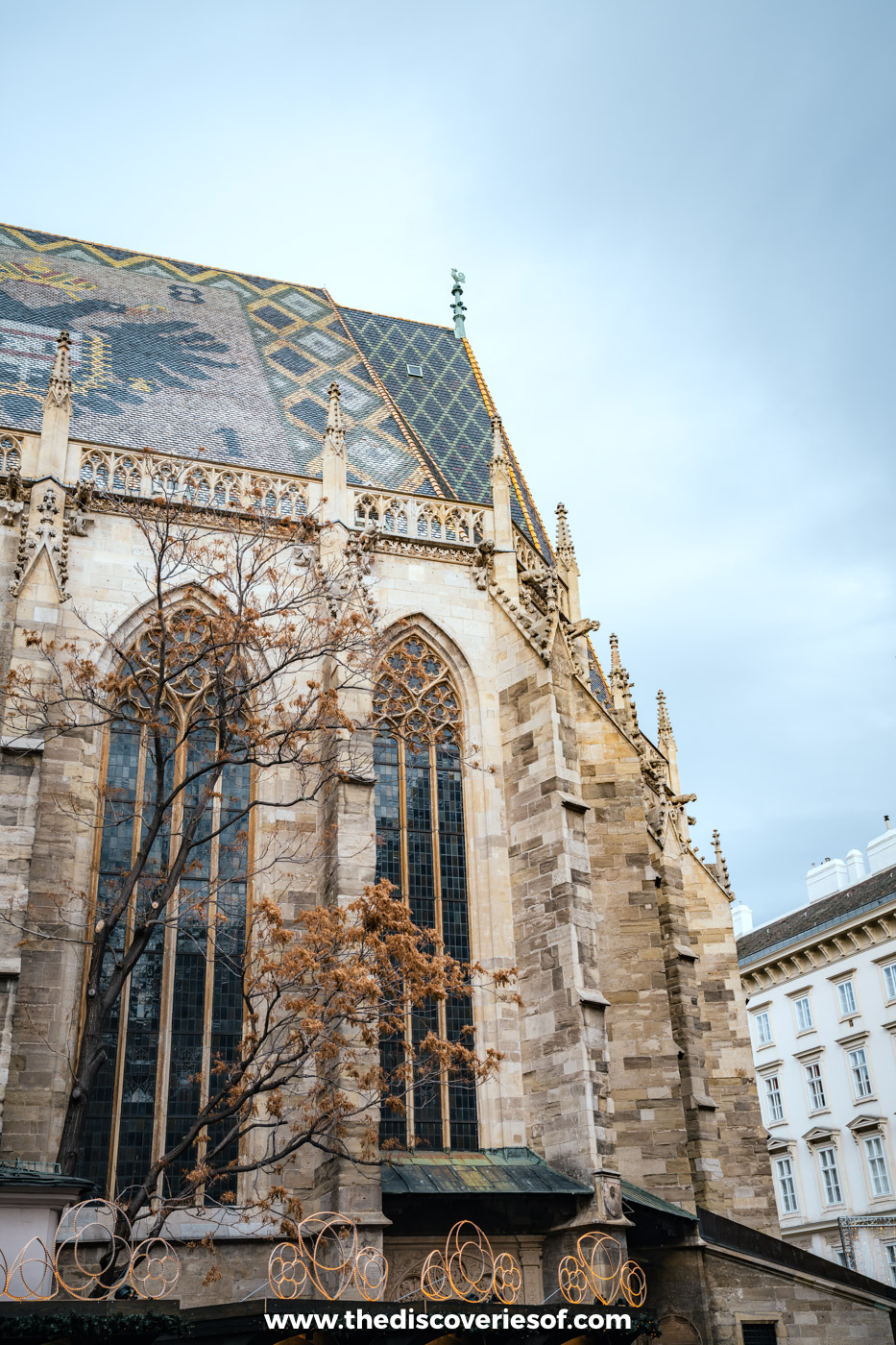
Yes. A few minutes from the city’s most famous church, where you’d expect overpriced sandwiches and tired coffee, Trześniewski serves Brötchen of a seriously high standard for a couple of euros each. I loved it.
It won’t replace a sit-down lunch of schnitzel or Tafelspitz, and it isn’t trying to. But as a quick, cheap and very Viennese refuel between sights, with a beer sized for the slowest drinker in the group, it’s a must. Order the smoked salmon with horseradish, add a Pfiff, and you’ll see why the city hasn’t changed its lunch order in over a century.
The one thing that keeps it off a five is the service, which is brusque at best. The food is great, though, and for what you pay it’s excellent value.
My rating: 4/5
Quick answers before you go
How do you pronounce Trześniewski?
The company spells it out as “Tsche-schni-ef-ski”. The name is Polish, after its Kraków-born founder.
What is a Pfiff?
A Pfiff is a small beer of one-eighth of a litre, about 125ml. It’s the traditional partner for Brötchen at Trześniewski, where the beer comes from the Ottakringer brewery.
How much does lunch here cost?
Each Brötchen is €1.80 in the company’s online shop, so a lunch of three or four with a Pfiff comes to well under what you’d pay for a sit-down meal in the old town.
Is it open on Sundays?
Yes. The Dorotheergasse branch opens on Sundays and public holidays from 10am to 5pm, but there’s no counter service on 24 and 31 December.
Are there vegetarian and vegan Brötchen?
Yes. Plenty of the 25 are meat-free, from the egg, tomato and paprika spreads to lentil with beetroot, and the range now includes vegan and lactose-free options.
Can you take Brötchen away?
Yes. Ask for them to take away at the counter, or buy one of the mixed boxes. You can also order online, though delivery is only within Vienna and Linz.
Map
Read next
- 3 days in Vienna, with time for Habsburg palaces, grand coffee houses and two rival Sachertortes
- St Stephen’s Cathedral in Vienna: exploring the two towers, catacombs and an emperor’s tomb
- Sacher or Demel? Where to eat Sachertorte in Vienna, and the cake war behind it
- Inside the Sisi Museum at Vienna’s Hofburg, where an empress hung gym rings in her dressing room
- What Vienna in winter is really like, with Christmas markets, coffee houses, balls and a chance of snow
- How to see Vienna’s Christmas lights in one walk, from ballroom chandeliers to Roman ruins
- 28 of the best city breaks in Europe, and how long to give each one
Discover the top things to do, insider tips and hidden gems in our Austria Travel Guide.
Read the guides →