
For more than 800 years, Vienna has grown up around one church. Its patterned roof, its lopsided towers and the bones beneath its floor all tell part of the city’s story, and this guide walks you through every corner of it, with the tickets, timings and tips to plan your visit.
St Stephen’s Cathedral is the absolute heart of Vienna. Climbing its south tower was the first thing I did when I arrived in the city in November, and I came back on my last morning to see the inside, which felt like the right way to begin and end a trip.
In between, I kept finding myself back on Stephansplatz: on the way to the Graben, at the Christmas market round its far side, and looking up at it after dark.
The Stephansdom, as the Viennese call it, rewards far more than a quick look, so this guide covers it from the catacombs to the towers.
The cathedral at a glance
- Where: Stephansplatz, in the 1st district (Innere Stadt), at the top of Kärntner Straße and the end of the Graben.
- What it is: Vienna’s cathedral and the seat of its archbishop, the largest church in the city and the tallest in Austria.
- Entry: free just inside the doors; €8 each for the interior, either tower and the catacombs, or €29 for all of them.
- Time needed: an hour for a quick visit, or three hours to see the interior, the catacombs and a tower.
- Nearest U-Bahn: Stephansplatz (U1 and U3).
Top Tip
The cathedral is open for prayer from 6am (7am on Sundays) until 10pm, so you can always step into the free area at the back, even outside sightseeing hours
Eight centuries of history in brief
A Romanesque parish church
Building began on the first church here in 1137, when Vienna was still part of the Diocese of Passau, and it was consecrated in 1147. A second Romanesque church followed in the early 1200s.
Its west front, with the Giant’s Door and the two Heathen Towers, survived a city fire in 1258 and is still the oldest part of the building you can see today.
Rudolf IV’s Gothic cathedral
The church grew Gothic in stages. A new choir was added between 1304 and 1340, and in 1359 Duke Rudolf IV, remembered as “the Founder”, laid the foundation stone for the Gothic nave and the south tower.
The south tower was finished in 1433, and for a time it’s said to have been the tallest building in Europe. St Stephen’s only became a cathedral in 1469, when Emperor Frederick III won Vienna its own bishop.
Mozart’s cathedral
The building has seen a lot of history, and Mozart is part of it. He married Constanze Weber here on 4 August 1782, and in 1791 he was appointed assistant to the cathedral’s Kapellmeister, months before he died.
His funeral blessing was held at the cathedral in December 1791, by tradition in the Crucifix Chapel on its north side. He wasn’t buried here, though: his grave is in St Marx cemetery, outside the old city walls.
Top Tip
Mozart’s music is still part of the cathedral’s calendar, with his works in the Advent concerts and his Requiem on the anniversary of his death
The 1945 fire and the rebuild
The cathedral came through two Ottoman sieges, but in April 1945, in the last days of the Second World War, fires in the surrounding buildings spread to it. The wooden roof structure burned completely, the great Pummerin bell crashed to the floor and the interior was badly damaged.
Within weeks of the fire it was decided to restore the cathedral to its pre-war form. The new roof was finished in 1950, and the cathedral reopened on 26 April 1952, the same day the recast Pummerin was blessed.
The architecture to look out for outside
The tiled roof and its eagles
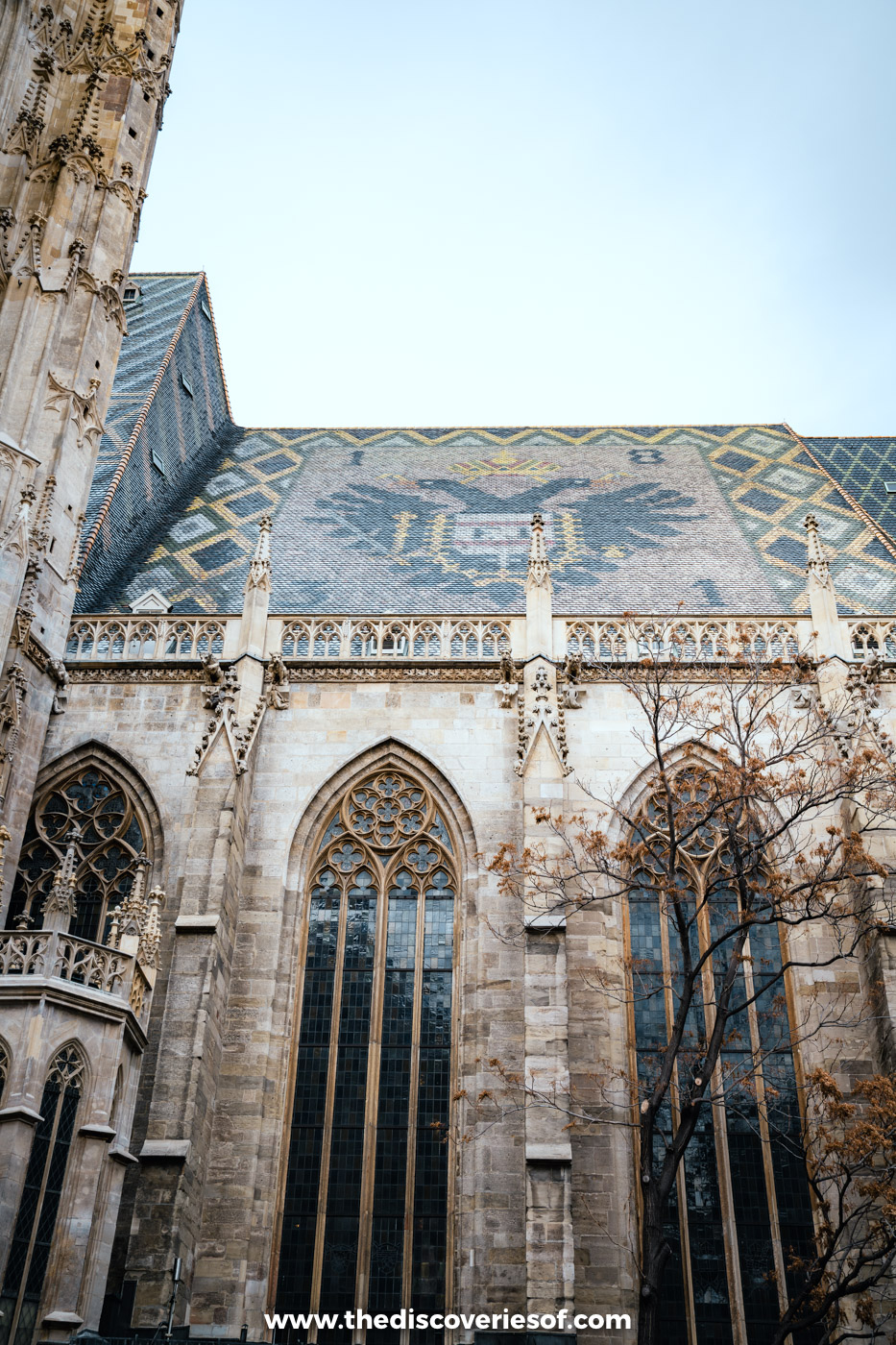
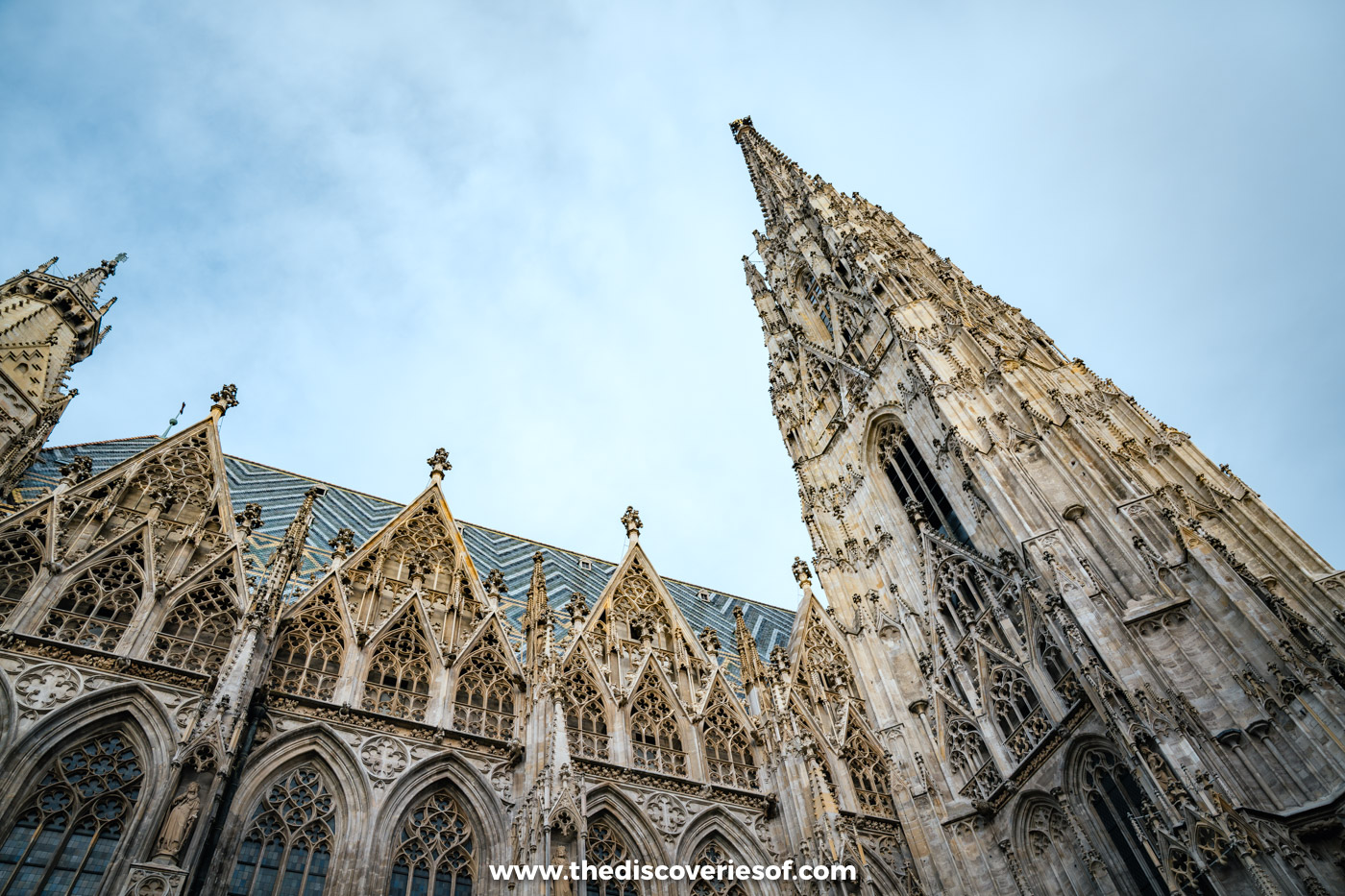
Before you go in, look up. The steep roof is covered in glazed, coloured tiles, around 230,000 of them, and on the south side they form the Habsburg double-headed eagle.
The roof was rebuilt on a steel frame after the fire. The eagle on the south side carries the date 1831, and on the north side you’ll find the coats of arms of Vienna and the Republic of Austria, dated 1950, the year the new roof was finished.
I’d been told the tiles look spectacular from the south tower, and they do. From above you see the whole zigzag pattern up close, which you can’t really take in from the ground.
Top Tip
The eagle faces the south side of the square, by the tower entrance. For the coats of arms, walk round to the north side, opposite the Dom Museum
The Giant’s Door and the Heathen Towers
The main entrance on the west front is the Riesentor, or Giant’s Door, a Romanesque portal from around 1230. Its name probably comes from an old word for a funnel-shaped doorway, though Viennese legend credits a giant’s bone found nearby, which was really a mammoth’s.
Christ sits in judgement above the door, over a frieze of dragons and devils. The portal is under scaffolding until the end of 2026, but the two Heathen Towers either side are clear to see.
Look at the wall to the left of the door for two iron rods, 15th-century measuring standards that buyers used to check their cloth. To the right is a small “O5” scratched into the stone, the secret sign of the Austrian resistance against the Nazis.
Do
Walk all the way round the outside before you go in. The O5 sign, the old measuring rods and the Capistran pulpit on the outside wall, where St John of Capistrano preached in 1451, are all free to see
The Steffl and the unfinished north tower
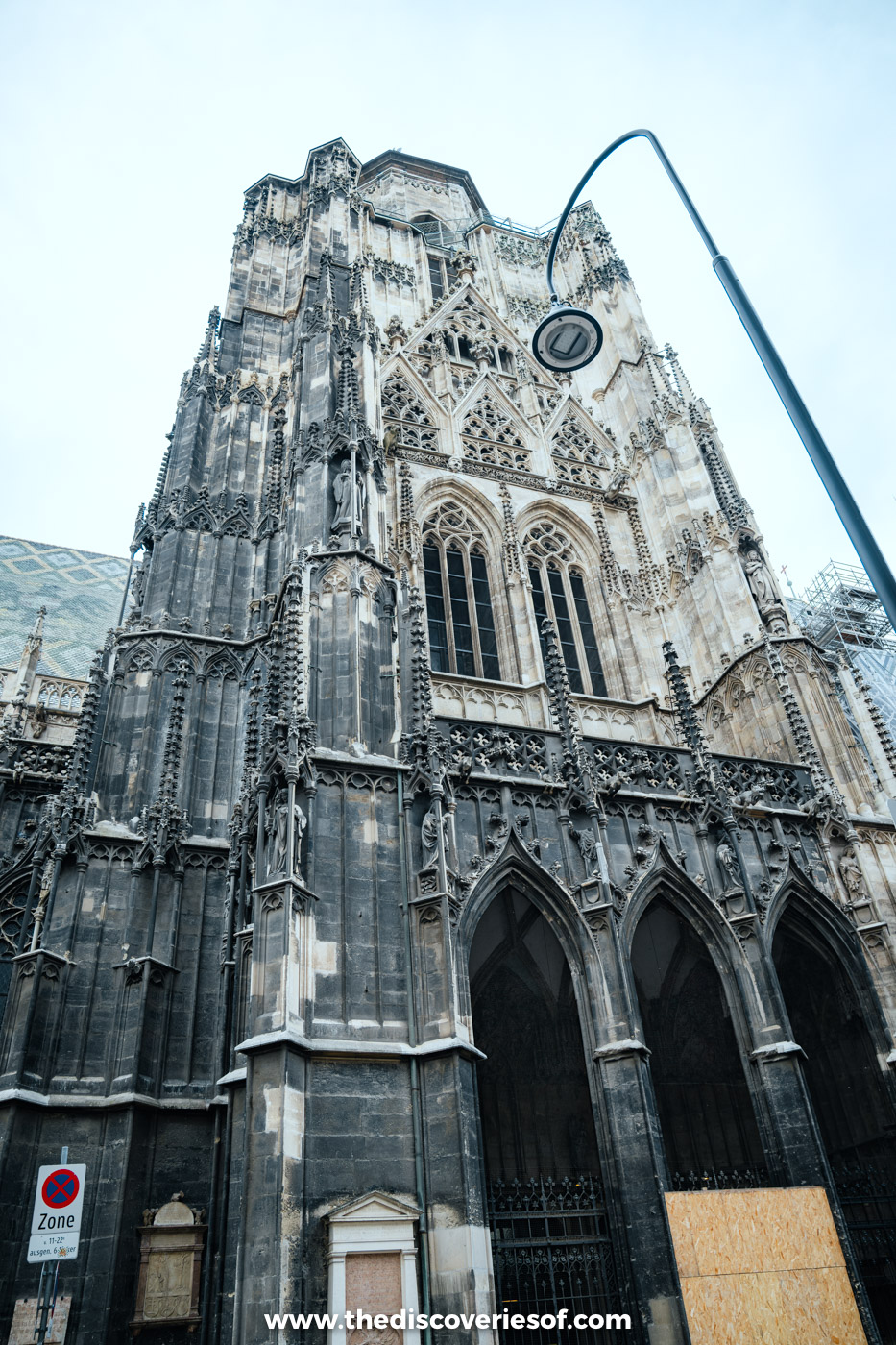
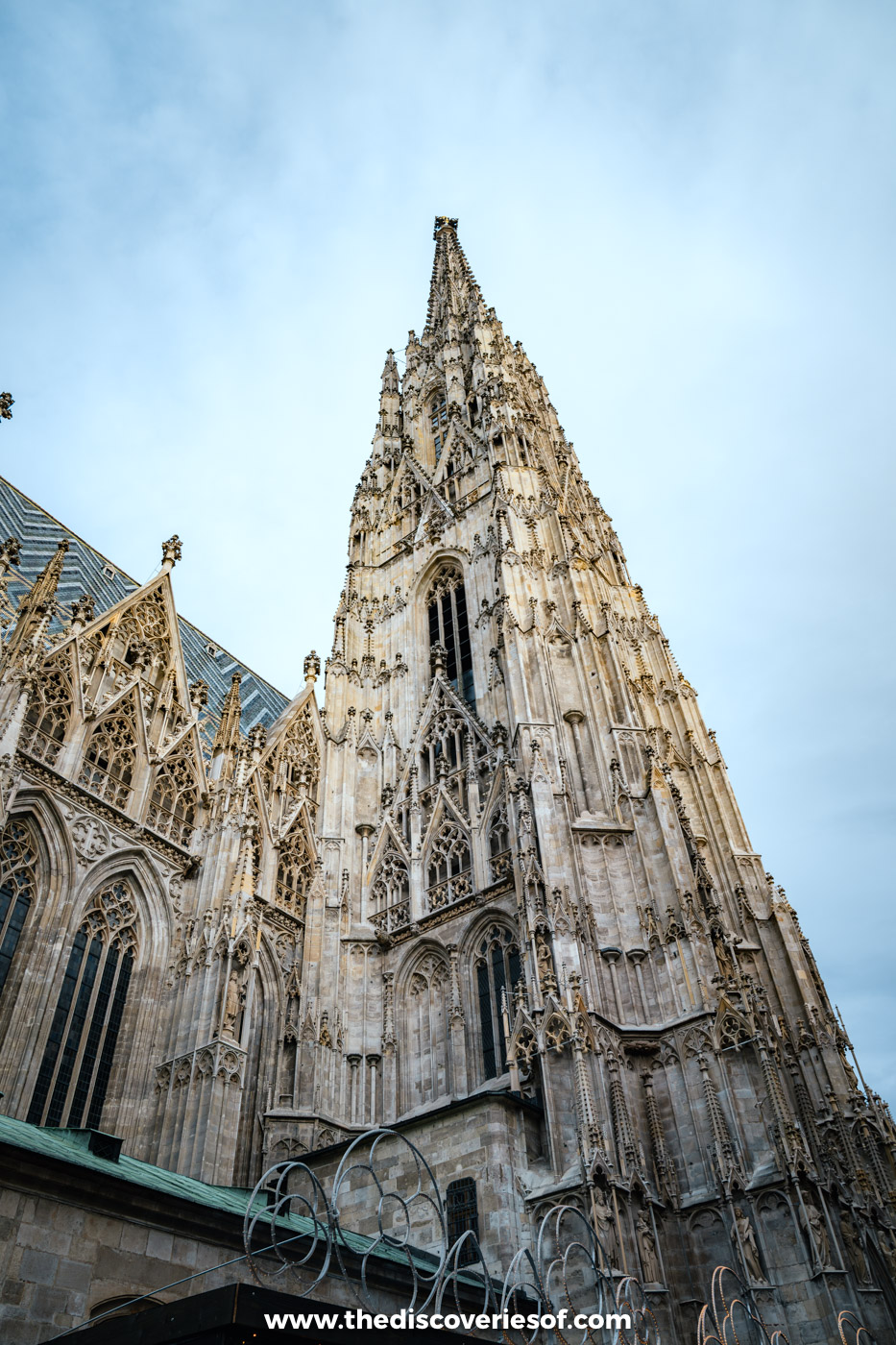
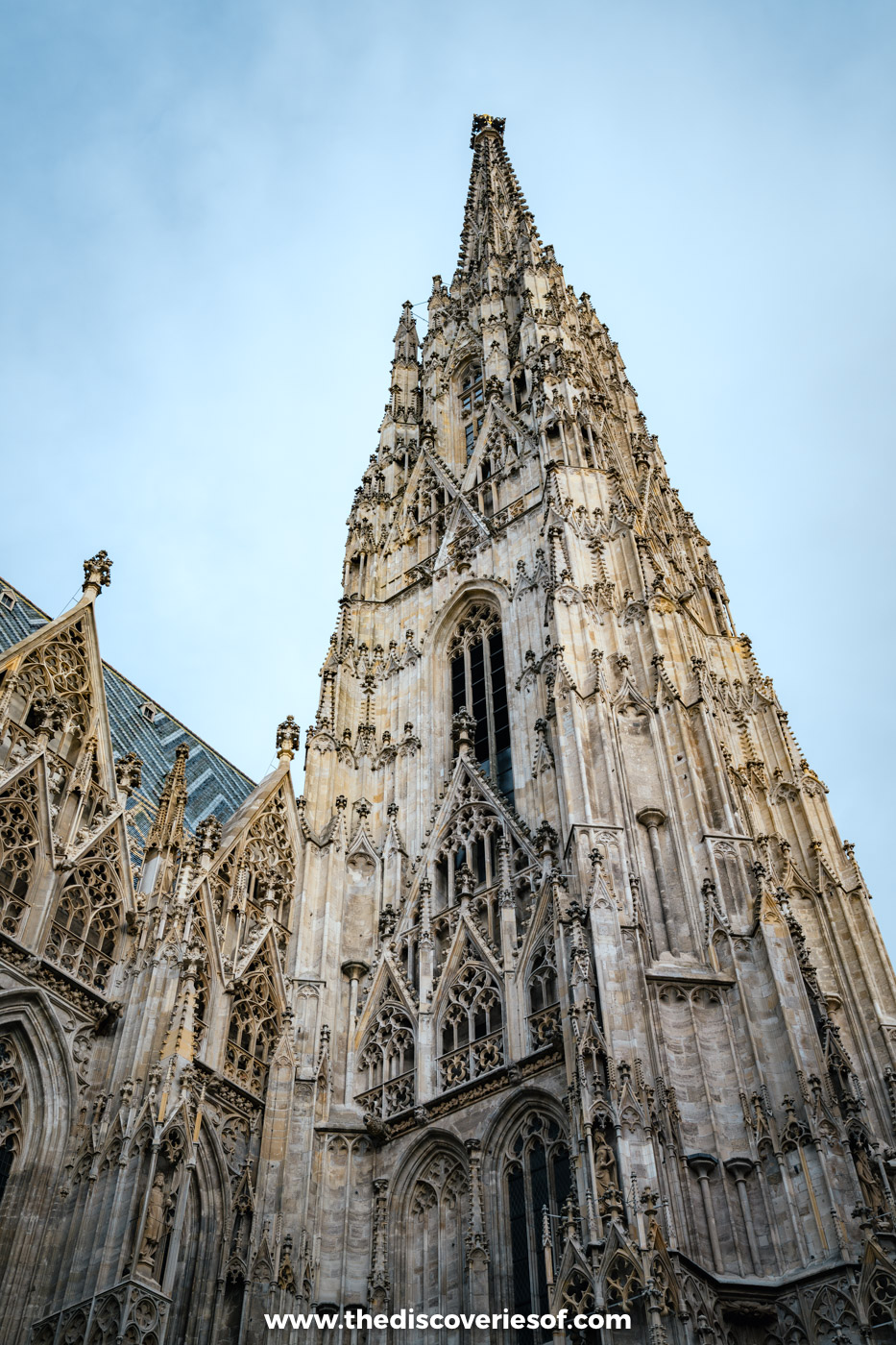
The south tower, nicknamed the Steffl, rises to 136.44 metres. Work on a matching north tower began in 1450 but stopped in 1511, when money ran short and the Ottoman wars took priority.
In 1578 the half-built tower was finished off with a Renaissance cap, and it has stayed that way ever since. That’s why the cathedral has its lopsided silhouette, with one soaring Gothic spire and one stubby tower about half its height.
Inside St Stephen’s Cathedral
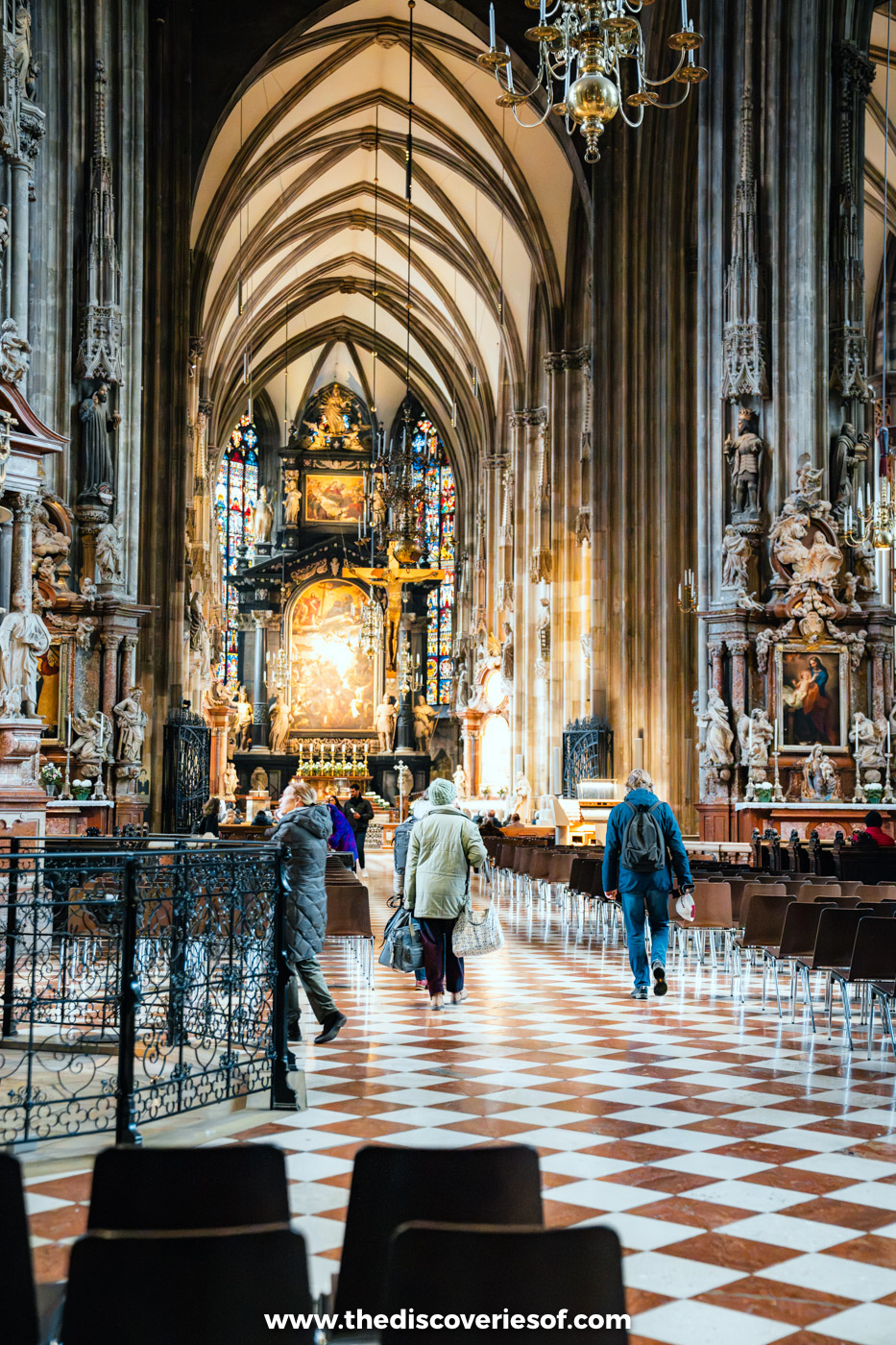
The tower gets the attention, but go inside as well. The scale of the nave is quite incredible, and the interior is beautiful, with soaring Gothic vaults, a run of side altars and a red and white chequered floor.
The area just inside the main doors is free whenever the cathedral is open. To walk further in, past the pulpit to the high altar, you need a ticket during sightseeing hours, and the €8 ticket is well worth it.
Do
Step inside even if you’re short of time. The free area at the back gives you the full sweep of the nave and the Maria Pötsch icon
The high altar
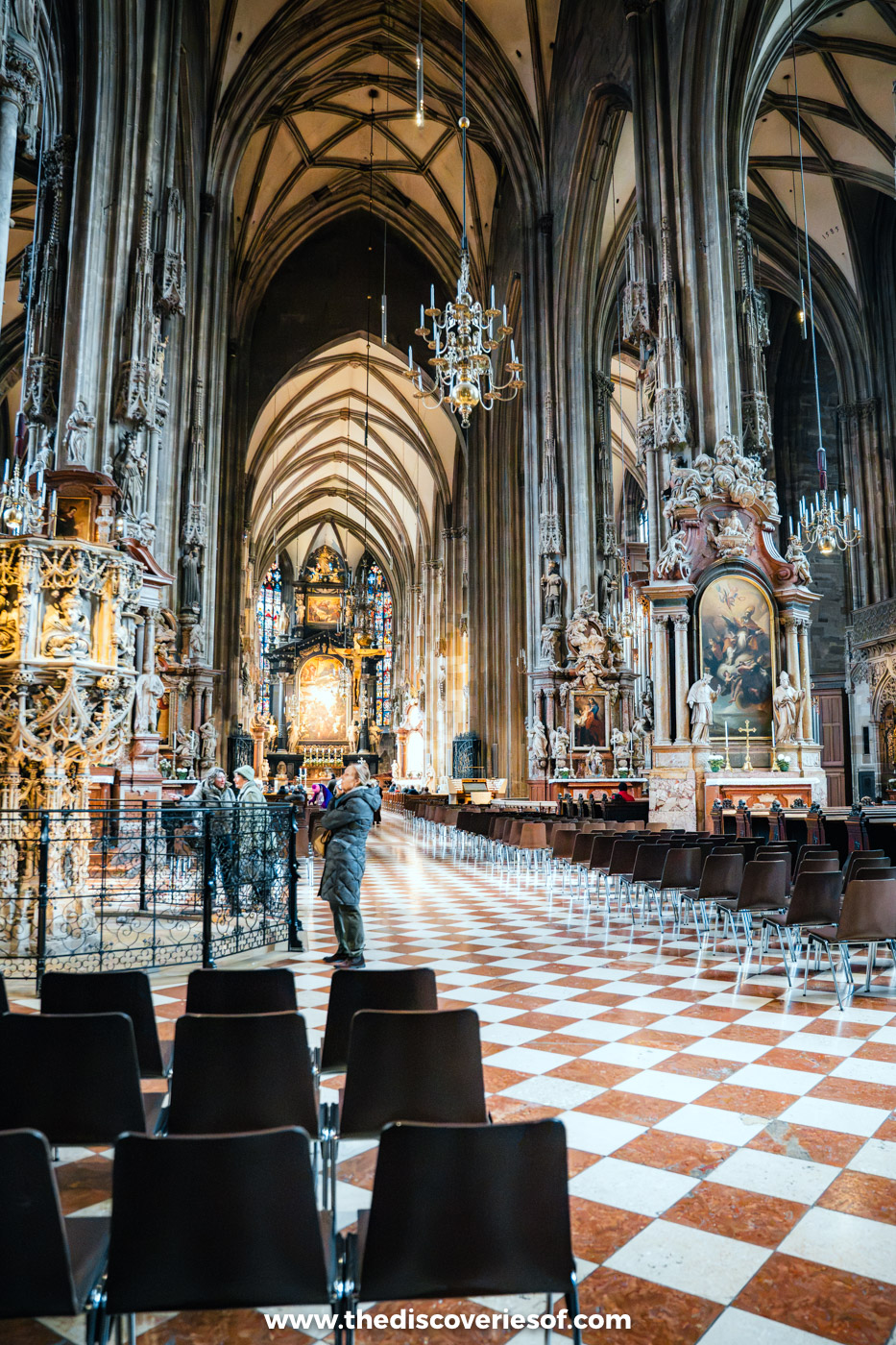
At the far end of the nave stands the baroque high altar, finished in 1647 by the brothers Johann Jacob and Tobias Pock. Its altarpiece shows the stoning of St Stephen, the cathedral’s patron saint.
The pulpit and the window gazer
Halfway down the nave is the stone pulpit, carved from limestone between about 1480 and 1510 and one of the finest late Gothic works in Austria. The four Church Fathers, Ambrose, Augustine, Gregory and Jerome, sit around its body.
Toads and lizards, symbols of evil and good, crawl up the stair rail, and a little stone dog guards the top. Below, a man leans out of a carved window: the Fenstergucker, or window gazer.
The pulpit was long credited to Anton Pilgram and the window gazer called his self-portrait, but current research points to the circle of Niclas Gerhaert van Leyden, with Pilgram helping to carve it.
Top Tip
Look out for the stone organ base, which the cathedral does credit to Pilgram. Another carved man peers out from beneath it, often said to be the sculptor himself
The Wiener Neustädter Altar
In the left-hand choir is the Wiener Neustädter Altar, a Gothic winged altar from 1447. It carries the motto A.E.I.O.U. of Emperor Frederick III and was brought here from the Neukloster in Wiener Neustadt in 1884.
Its carved, gilded shrine and painted wings are full of scenes from the life of Mary.
Emperor Frederick III’s tomb
In the right-hand choir lies Emperor Frederick III, who died in 1493. His tomb of red marble was begun by the sculptor Niclas Gerhaert van Leyden and not completed until 1513, two decades after the funeral.
It’s a heavyweight in every sense: the lid alone weighs about eight tonnes. It’s one of around 140 tombs in the cathedral, and easily the grandest.
Don’t
Expect to see the tomb from the free area. It sits in the right-hand choir, so you’ll need an interior ticket
The Maria Pötsch icon
Just inside the main entrance, on an altar under a canopy, hangs the Maria Pötsch icon, named after Pócs in Hungary, where it came from. In November 1696 it was said to have wept for two weeks without stopping.
Emperor Leopold I had it brought to Vienna, and it has been in the cathedral since 1697. Visitors still light candles in front of it.
The catacombs and the Habsburg urns
For centuries, the ground where Stephansplatz lies today was the cathedral’s cemetery. When it closed in 1732, burials moved underground into the catacombs, until 1783, and the remains of about 12,000 people still lie there.
The oldest part is the ducal crypt, directly below the high altar, built by Rudolf IV, who is buried there with his wife Katharina. From the 17th century it also took the entrails of the Habsburgs, who split their burials between three churches, and 76 copper urns still line its walls.
The tour also passes the bishops’ crypt, where Vienna’s archbishops lie in copper coffins, and chambers stacked with bones from the old burial ground.
You can only visit on a guided tour, in German and English, from the stairs halfway up the left aisle. There are 22 steps down and 43 back up, and photos aren’t allowed.
Top Tip
You don’t need to book a public catacombs tour. Buy a ticket at the counter and wait at the top of the stairs in the left aisle a few minutes before the tour starts
Climbing the south tower or taking the north tower lift
Climb the south tower’s 343 steps
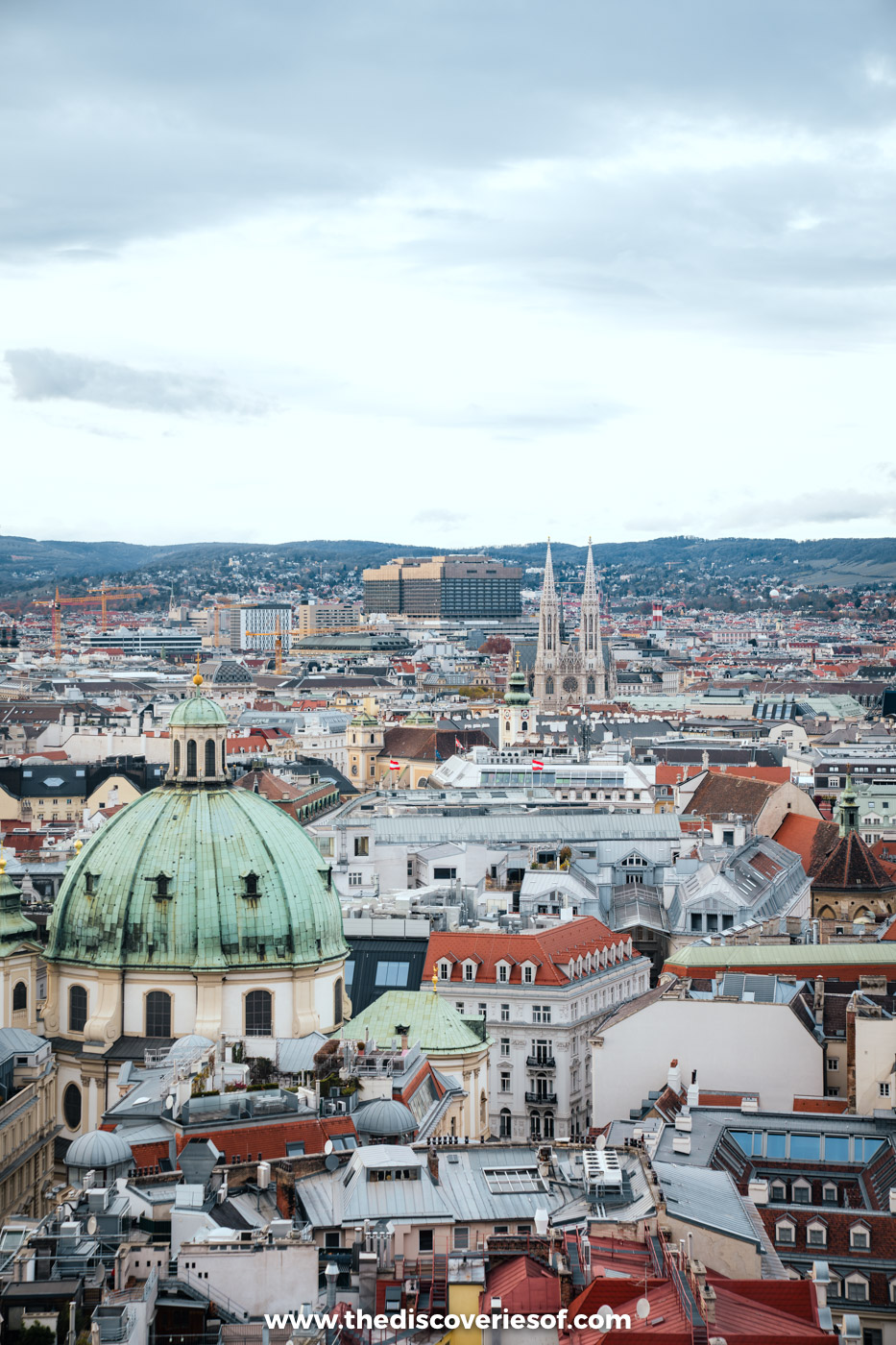
The south tower is the classic climb: 343 steps up a historic staircase to the Türmerstube, the old watchman’s room about 72 metres above the square. On the way up you pass the former bell chamber where the old Pummerin hung until 1945.
It’s a decent amount of climbing and a bit of a slog. I was relieved, though, that it isn’t one of those horrible cathedral towers where the stairway is so tight you can barely pass anyone, and by the top I was only a little out of puff.
What makes it manageable is that there are a few spots along the way where you can stop for a breather. There’s no lift, you come down the same steps, and the whole thing takes about half an hour.
Don’t
Feel you have to do it in one go. There are a couple of places to pause on the way up, and you can turn back at any point
The view from the watchman’s room
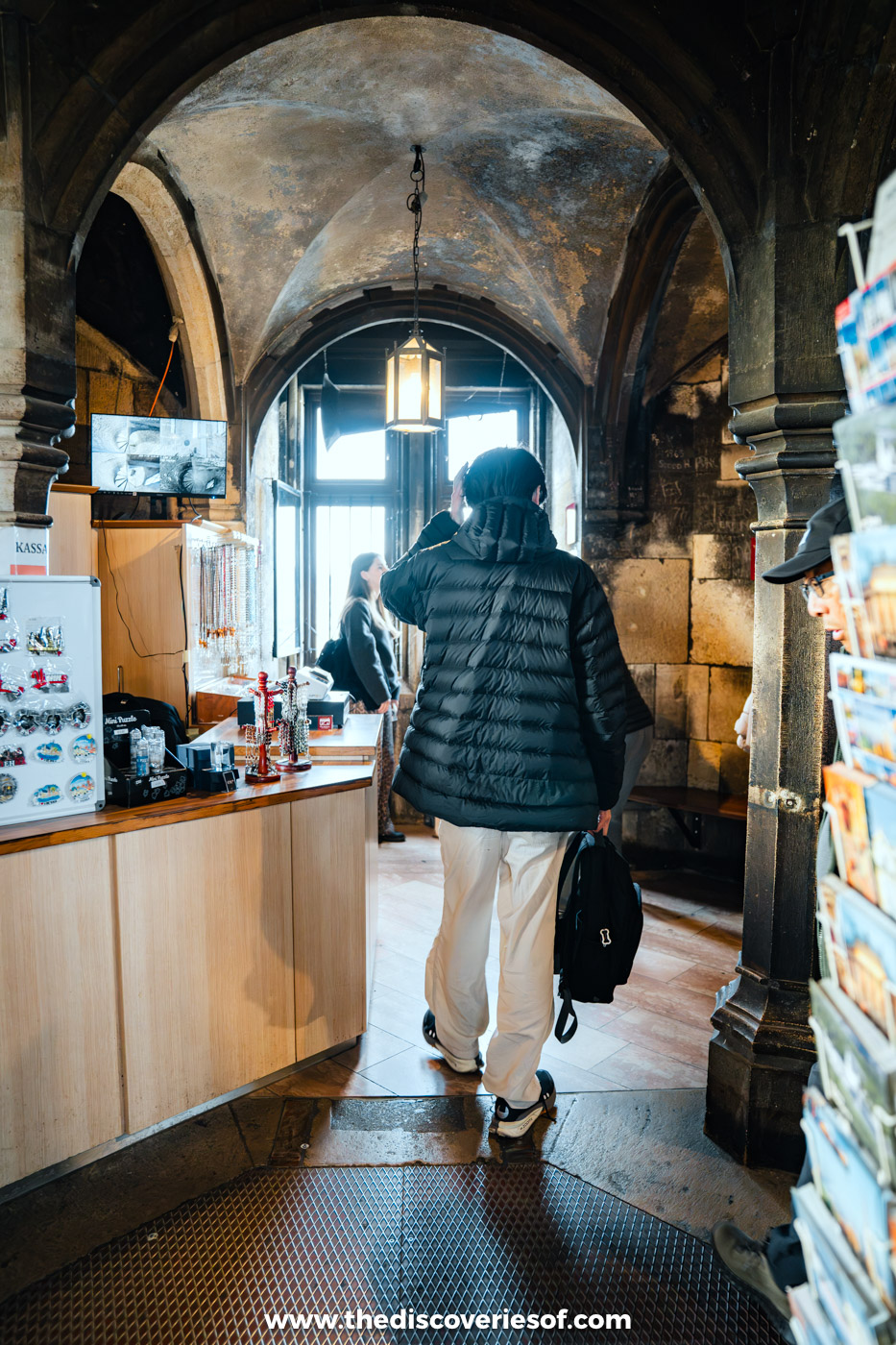
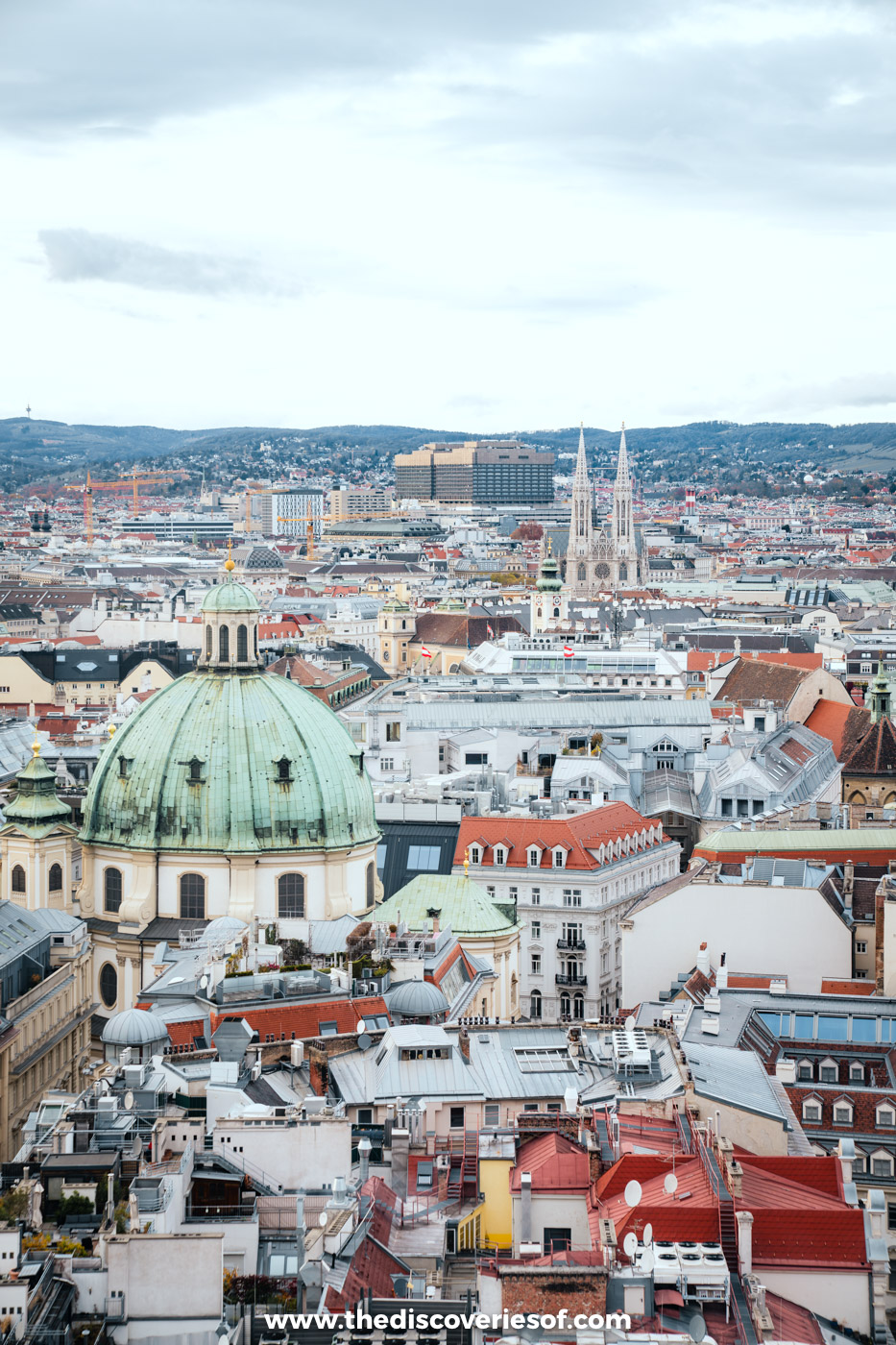
Is it worth it? The views are absolutely worth it. Look straight down and the patterned roof is right below you, eagle and all; look out and the old town’s red roofs run all the way to the wooded hills on the edge of the city.
The room itself is small and stone-walled, with windows on each side and a counter selling postcards and souvenirs. Close by you’ll spot the green dome of the Peterskirche, and further off the twin spires of the Votivkirche.
Take the lift up the north tower to the Pummerin
If 343 steps isn’t for you, the north tower has a lift. It’s inside the cathedral, on the left just past the main entrance, and takes you up to an open viewing platform at 68 metres, with a dozen steps to a small raised section.
Up here hangs the Pummerin, Austria’s largest bell at 20,130 kilograms. The original was cast in 1711 from captured Ottoman cannons and smashed when it fell in the 1945 fire; this one was recast from its remains in 1951.
It rings only on great occasions, among them Christmas, New Year, Easter and the death or election of a pope.
Do
Save the north tower for the evening if you’re visiting between April and December. From Monday to Thursday it stays open until 9.30pm
Which tower should you choose?
- Height: the south tower’s room is at about 72 metres, the north tower’s platform at 68.
- Getting up: 343 steps on the south tower; a lift plus 12 steps on the north.
- The view: from the south, you look down on the roof and out over the whole city through windows; from the north, you’re outside on an open platform, level with the tiles.
- The extra: the north tower has the Pummerin; the south tower has the watchman’s room and the bragging rights.
- Price: €8 each, or both on the All-Inclusive ticket.
Top Tip
Pick the south tower for the higher view and the north tower if stairs are a problem. On the All-Inclusive ticket you can do both
Guided tours and audio guides
The cathedral runs public tours of the interior, Monday to Friday, in English at 10.30am and German at 3.30pm. They cost €8 and meet in front of the Domshop, with no need to book.
The All-Inclusive ticket includes an audio guide for the interior, and from May to October there are German-language tours of the roof structure.
If you’d like a guide in English with more of the hidden corners, this one-hour guided tour of St Stephen’s takes in the catacombs and climbs into the attic under the tiled roof.
Concerts and services
This is a working cathedral, and mass is free and open to everyone. On Sundays the Hochamt, the main sung mass at 10.15am, is led by the Wiener Dommusik with organ, choir and orchestra.
There are masses through the day from 6.30am, and a mass in English every Saturday at 7pm. Full times are on the cathedral’s services page.
The cathedral also hosts paid concerts: organ recitals on the Riesenorgel, Advent concerts of Mozart, Bach and Handel, and gospel nights. In early December, the anniversary of Mozart’s death is marked with a late-night performance of his Requiem, timed for the hour he died.
Top Tip
For the music without a concert ticket, go to the 10.15am Sunday Hochamt. Arrive early, and stay seated until it ends
The Stephansplatz Christmas market
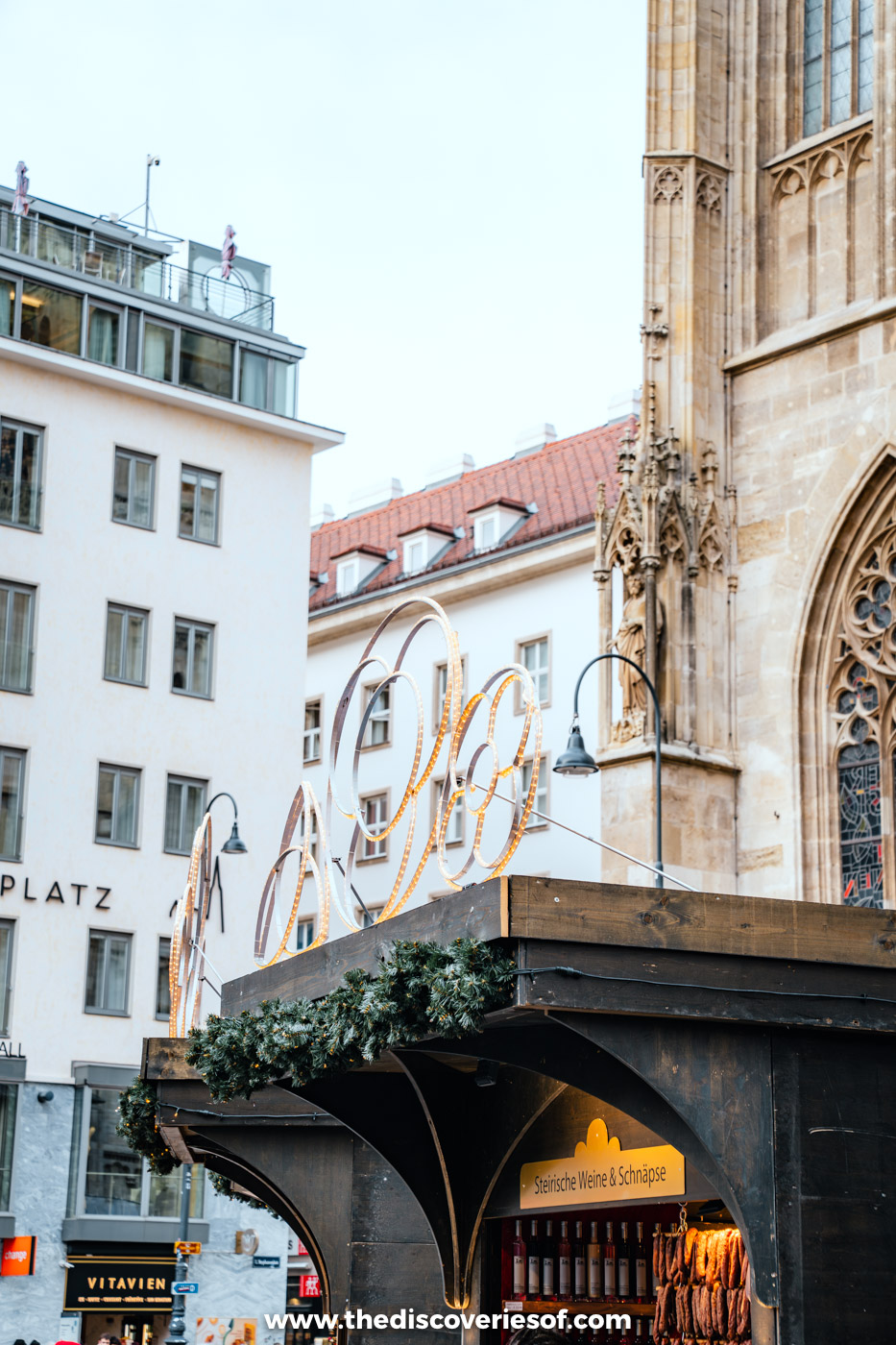
In Advent, a ring of wooden huts curls round the far side of the cathedral until 26 December, with Glühwein alongside knitted hats, mittens and wreaths. It’s small, and if you only see the west front from the Graben you can walk straight past it, so follow the cathedral wall round. I’ve covered it alongside the city’s other ten in my guide to the Vienna Christmas markets.
Planning your visit
Tickets and opening hours
- The cathedral: open for prayer Monday to Saturday 6am to 10pm, and Sundays and holidays 7am to 10pm. The area at the back is free.
- Sightseeing inside: Monday to Saturday 9am to 11.30am and 1pm to 4.30pm, Sundays and holidays 1pm to 4.30pm. €8 for adults and €3 for children aged 6 to 14.
- South tower: daily 9am to 7pm, last climb 6.15pm. €8, children €3.
- North tower lift: January to March daily 9am to 7pm; April to December Monday to Thursday 9am to 9.30pm and Friday to Sunday 9am to 7pm. €8, children €3.
- Catacombs: guided tours Monday to Saturday from 10am to 4.30pm, and Sundays and holidays from 1.30pm to 4.30pm. €8, children €3.
- All-Inclusive ticket: €29 (children €7), valid for a year. It covers the interior with an audio guide, both towers, a catacombs tour, the Dom Museum Wien and the treasury of the Teutonic Order.
Times can change around services and events, so check the cathedral’s visitor page before you go.
Top Tip
If you want both towers, the interior and the catacombs, the €29 All-Inclusive ticket costs less than four separate €8 tickets and adds the Dom Museum too
How long to allow
Allow about an hour for the interior, half an hour for the south tower and a little less for the north tower lift. Add the catacombs tour and the time spent waiting for the next one, and seeing everything takes around three hours.
Short of time? The free area and a walk round the outside take 20 minutes.
What to wear and how to behave
Dress modestly, with shoulders and knees covered where you can, especially during services. Keep your voice down, and don’t eat or drink inside.
Photos are fine as long as you turn the flash off, but not in the catacombs. During mass, stay in the area at the back unless you’re joining the service.
Don’t
Plan your look round the interior for a Sunday morning. Sightseeing doesn’t start until 1pm on Sundays and holidays
Getting there
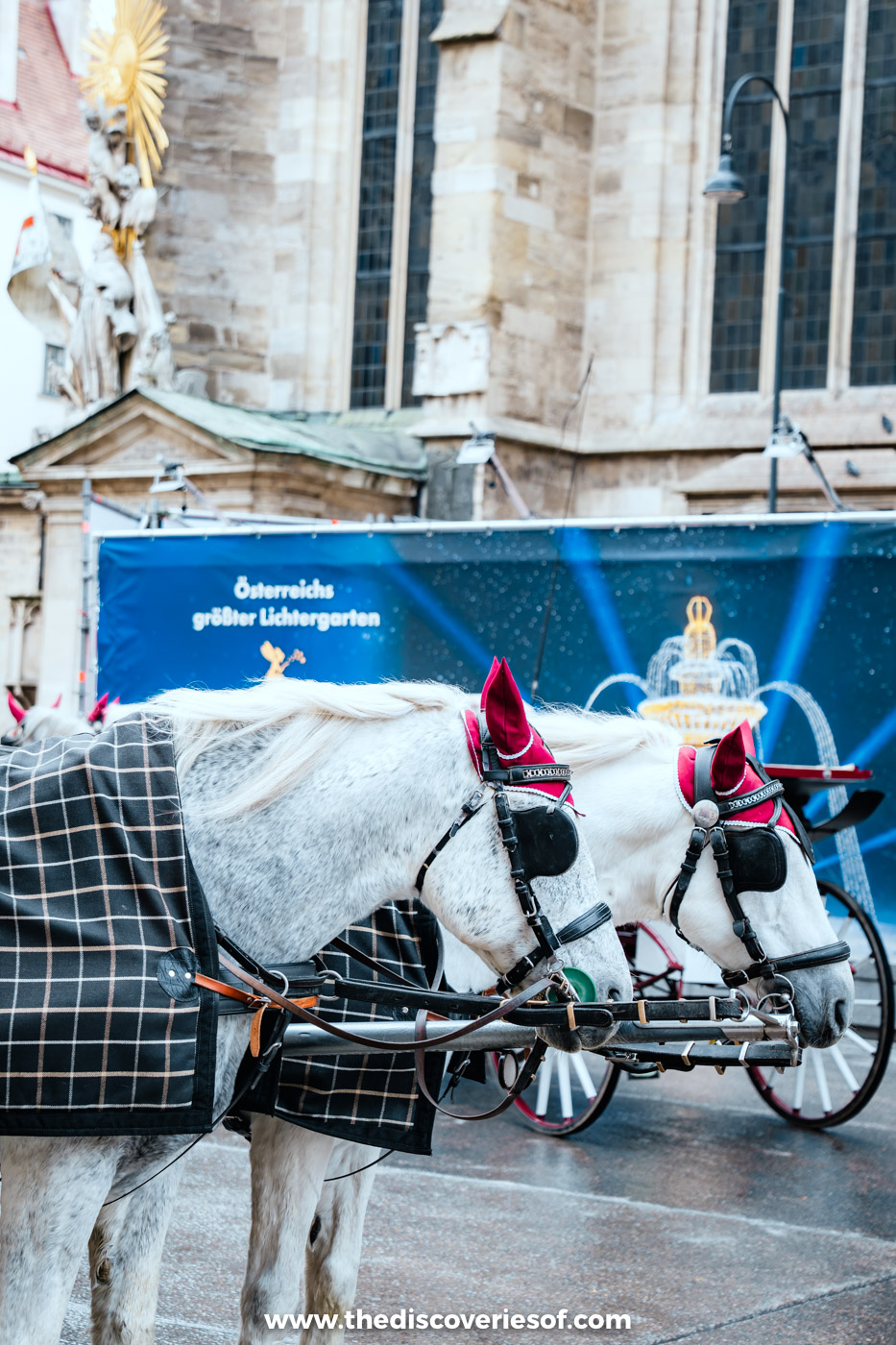
Stephansplatz station, on the U1 and U3, brings you up right beside the cathedral. Schwedenplatz (U1 and U4) is under ten minutes’ walk away along Rotenturmstraße.
The south tower entrance is outside, on the right-hand side as you face the main doors, opposite the Curhaus at Stephansplatz 3. The north tower lift, the catacomb tours and the public tours all start inside.
Best time to go
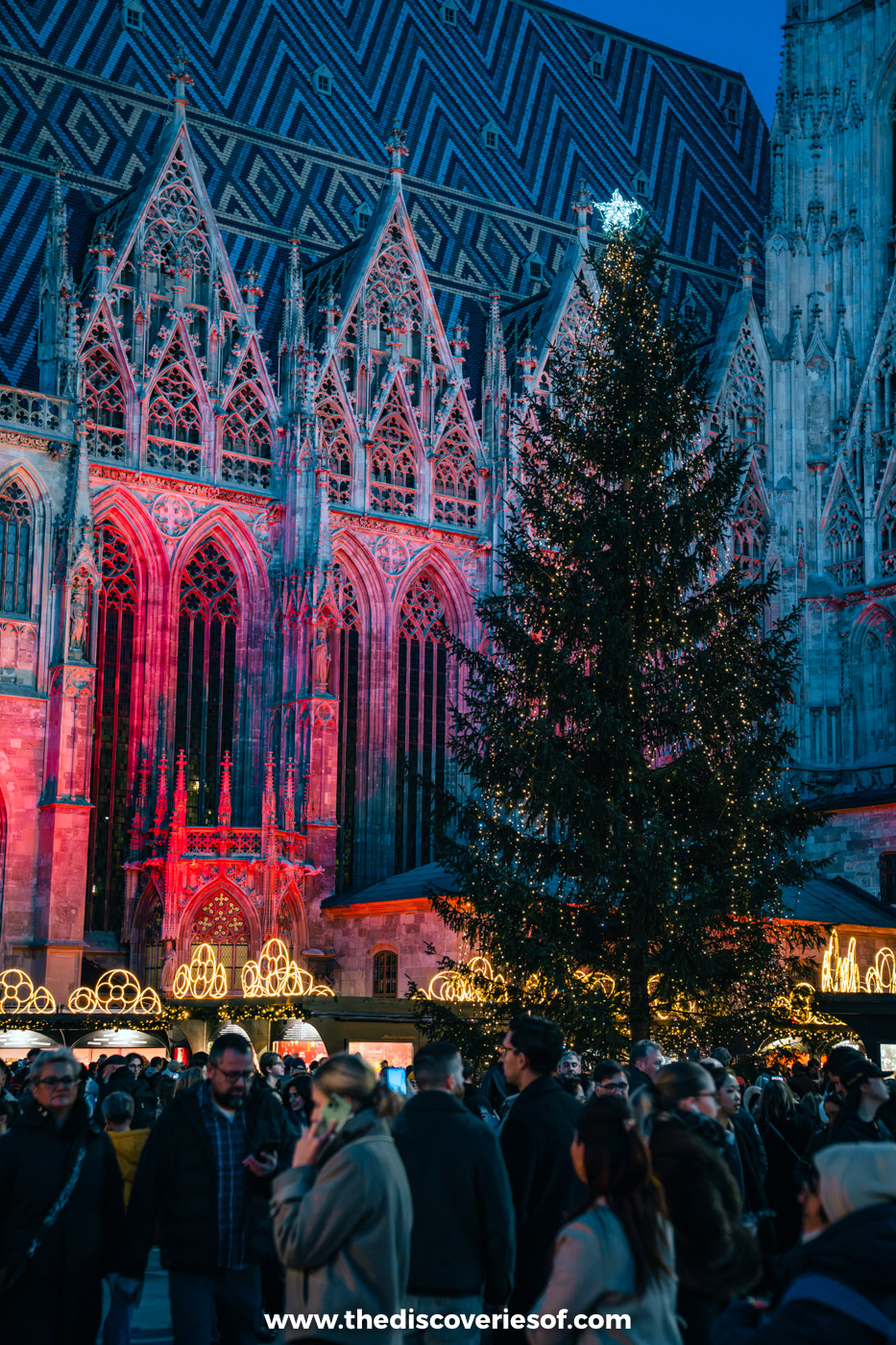
Climb in daylight for the clearest view. I went up around lunchtime and could see right out to the hills.
Then come back after dark. The facade is lit up, in Advent a huge Christmas tree stands outside, and the square fills with people heading for the market and the lights along the Graben.
Top Tip
Visits to the interior pause for lunch from 11.30am to 1pm, Monday to Saturday, but the towers stay open, so that’s a good time to climb
FAQs
Is it free to visit the cathedral?
The area just inside the main doors is free. The rest of the interior, the towers and the catacombs cost €8 each, or €29 together on the All-Inclusive ticket.
Can you visit during mass?
You can join any service for free, but sightseeing stops while it’s on. On Sundays and holidays, visits only begin at 1pm.
Is Mozart buried in the cathedral?
No. He married here in 1782 and his funeral blessing was held here in 1791, but he was buried in St Marx cemetery.
Map
Read next
- SO/ Vienna review: spacious rooms, views both ways and breakfast 18 floors up
- Inside the Sisi Museum at Vienna’s Hofburg, where an empress hung gym rings in her dressing room
- 3 days in Vienna, with time for Habsburg palaces, grand coffee houses and two rival Sachertortes
- Sacher or Demel? Where to eat Sachertorte in Vienna, and the cake war behind it
- What Vienna in winter is really like, with Christmas markets, coffee houses, balls and a chance of snow
- 11 Vienna Christmas markets, and the one to save your gift shopping for
- The Am Hof Christmas market, where Vienna’s makers sell their own work
- Visiting the Wiener Christkindlmarkt at Rathausplatz, where the ice rink winds through the park
- 70 UNESCO World Heritage Sites worth planning a whole trip around
- 28 of the best city breaks in Europe, and how long to give each one
- Best places to visit in December: 29 warm and wintry escapes
- Schnitzel, strudel and a sausage at midnight: what to eat in Vienna, and where to order it
- Trześniewski review: are Vienna’s century-old open sandwiches still the best quick lunch in town?
Love this? Save and share on Pinterest
Discover the top things to do, insider tips and hidden gems in our Austria Travel Guide.
Read the guides →