Planning a visit to Mission San Xavier del Bac? From the history of this 18th-century church on the Tohono O’odham Nation to its carved façade, painted interior, opening hours, Mass times and the short drive from Tucson, this guide covers everything you need to know.
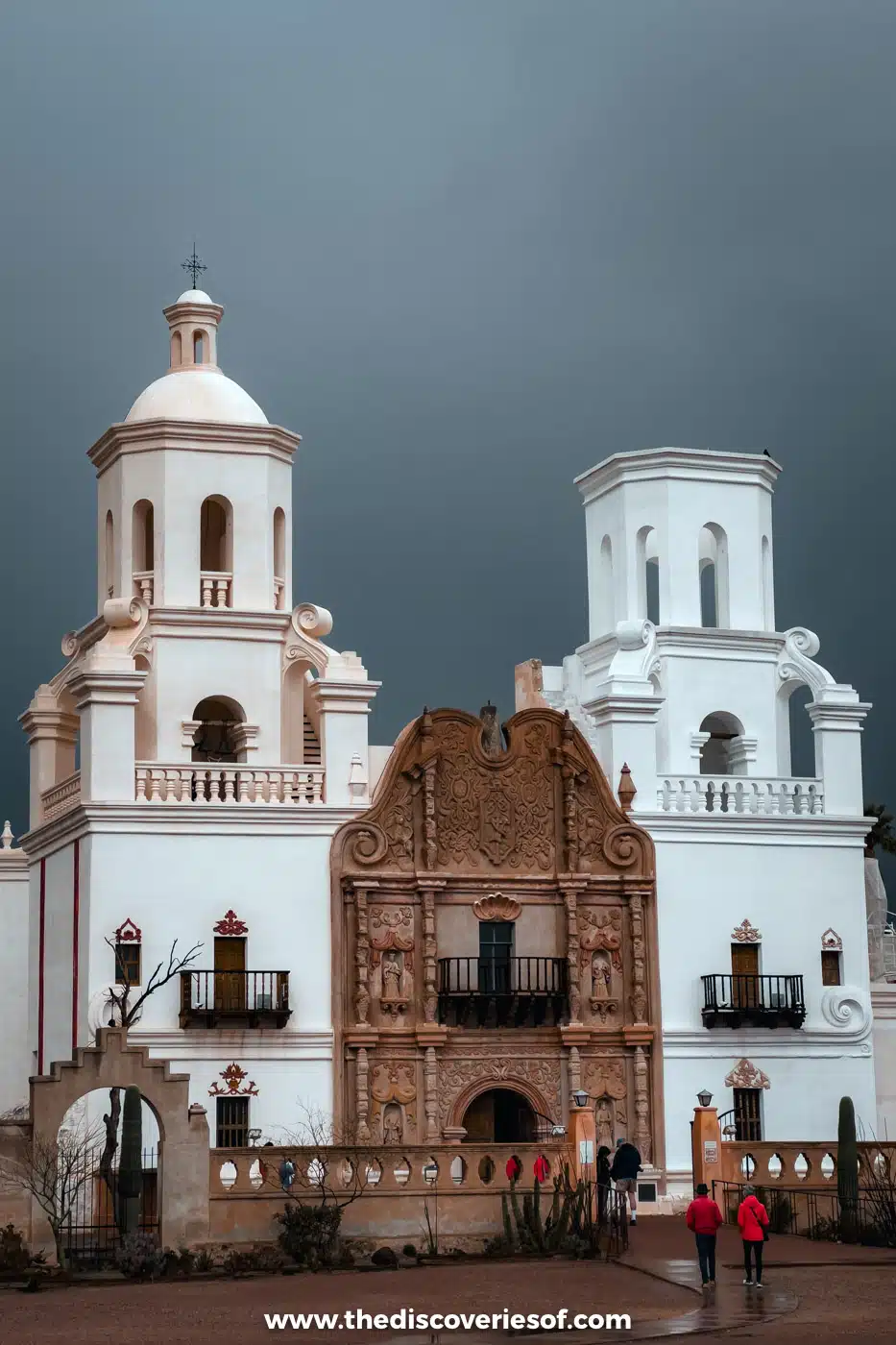
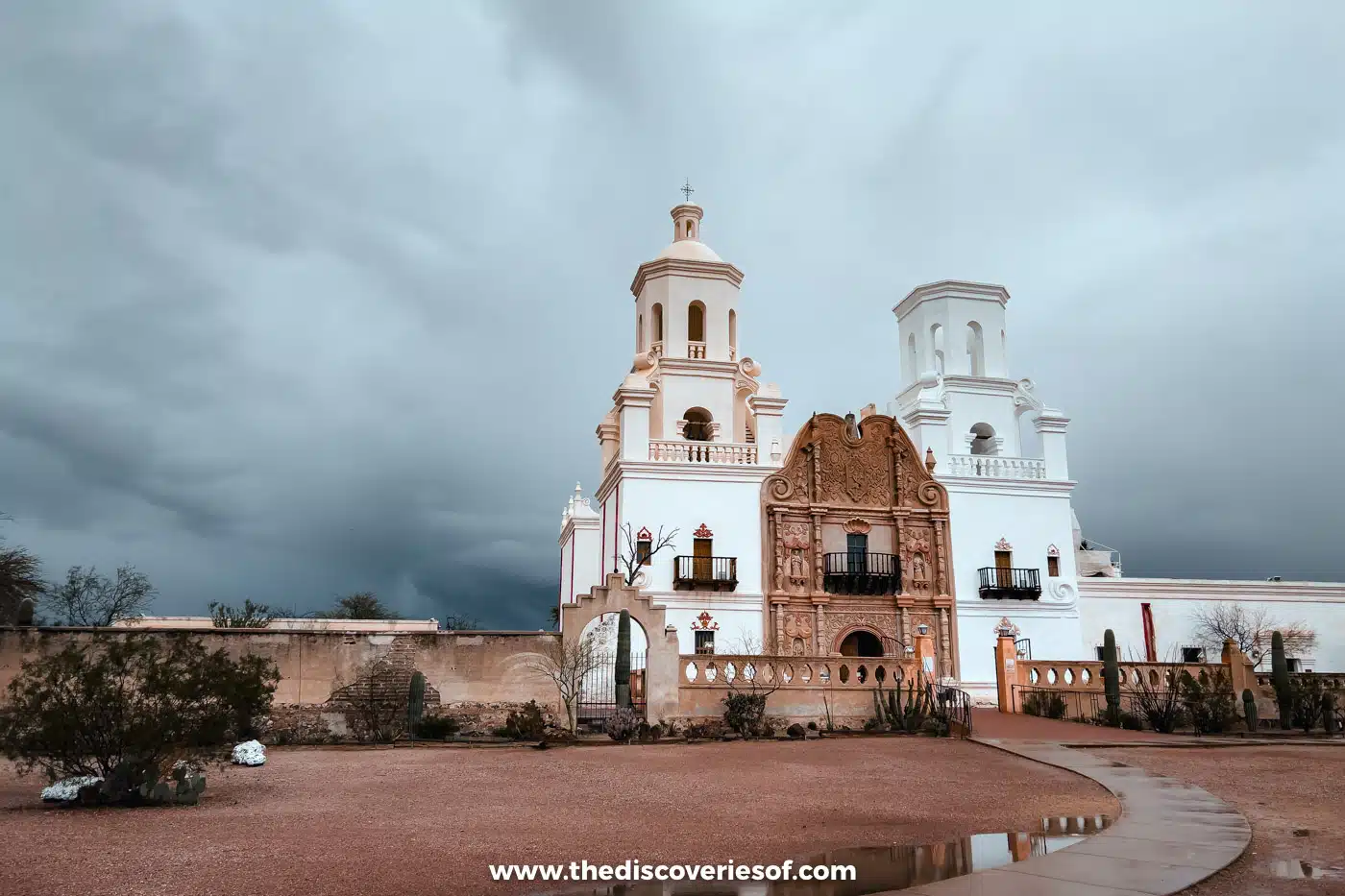
Rising brilliant white out of the desert just south of Tucson, Mission San Xavier del Bac is one of the most beautiful buildings in the American Southwest. Its twin towers, carved façade and gilded interior have earned it the nickname “the White Dove of the Desert”, and more than two centuries after it was finished, it’s still a working parish church at the heart of the local Tohono O’odham community.
I visited in February, and it’s a short drive out of Tucson and a must-visit. Spanish colonial architecture is relatively few and far between in southern Arizona, and this ornate example is stunning both outside and in.
You only need an hour or so to see the church and its grounds, so it’s easy to fit into a day of exploring Tucson. Here’s how to make the most of your visit.
Mission San Xavier del Bac at a glance
- Where: 1950 W San Xavier Rd, about 9 miles south of downtown Tucson, just off I-19 at exit 92
- What: a Spanish colonial mission church built between 1783 and 1797, and still an active Catholic parish
- Entry: free; donations are welcome and go towards the church and its preservation
- Hours: the church, museum and mortuary chapel are open from 9am to 4pm daily, including holidays; the gift shop is open from 8am to 5pm
- Tours: free, donation-based docent tours of the grounds run most days except Sunday
- Time needed: about an hour, or longer if you join a tour or walk up Grotto Hill
- Good to know: the church has no air conditioning or heating, and there’s little shade outside
A brief history of the White Dove of the Desert
The story of the mission begins in 1692, when the Jesuit missionary Father Eusebio Francisco Kino first visited the O’odham village of Wa:k, or Bac, and founded a mission there. Kino started building a church in 1700, but it never got beyond its foundations. A simpler, flat-roofed adobe church followed in the 1750s, and the Franciscans took over the mission in 1768.
The church you see today came later. It was built between 1783 and 1797 under two Franciscan friars, Juan Bautista Velderrain, who died in 1790 before it was finished, and Juan Bautista Llorens, who completed it. The work was financed with a loan of 7,000 pesos from a Sonoran rancher, and O’odham workers provided the labour. The date 1797 above the sacristy door is taken as the year it was completed.
The style is often described as Spanish colonial or Mexican baroque, with Moorish and Byzantine touches. Rather than adobe, the church is built of fired brick set in lime mortar, with a central dome about 52 feet high and towers that rise to about 80 feet. It’s often described as the oldest intact European-built structure in Arizona.
The mission was abandoned from 1837 to 1859 and was damaged by an earthquake in 1887, but it survived, and it was declared a National Historic Landmark in 1960. Today it’s run by the Franciscans and serves the Tohono O’odham people of the Wa:k community in the San Xavier District of the Tohono O’odham Nation, and the Franciscan Sisters of Christian Charity have staffed its school since 1872.
Admire the carved façade and towers
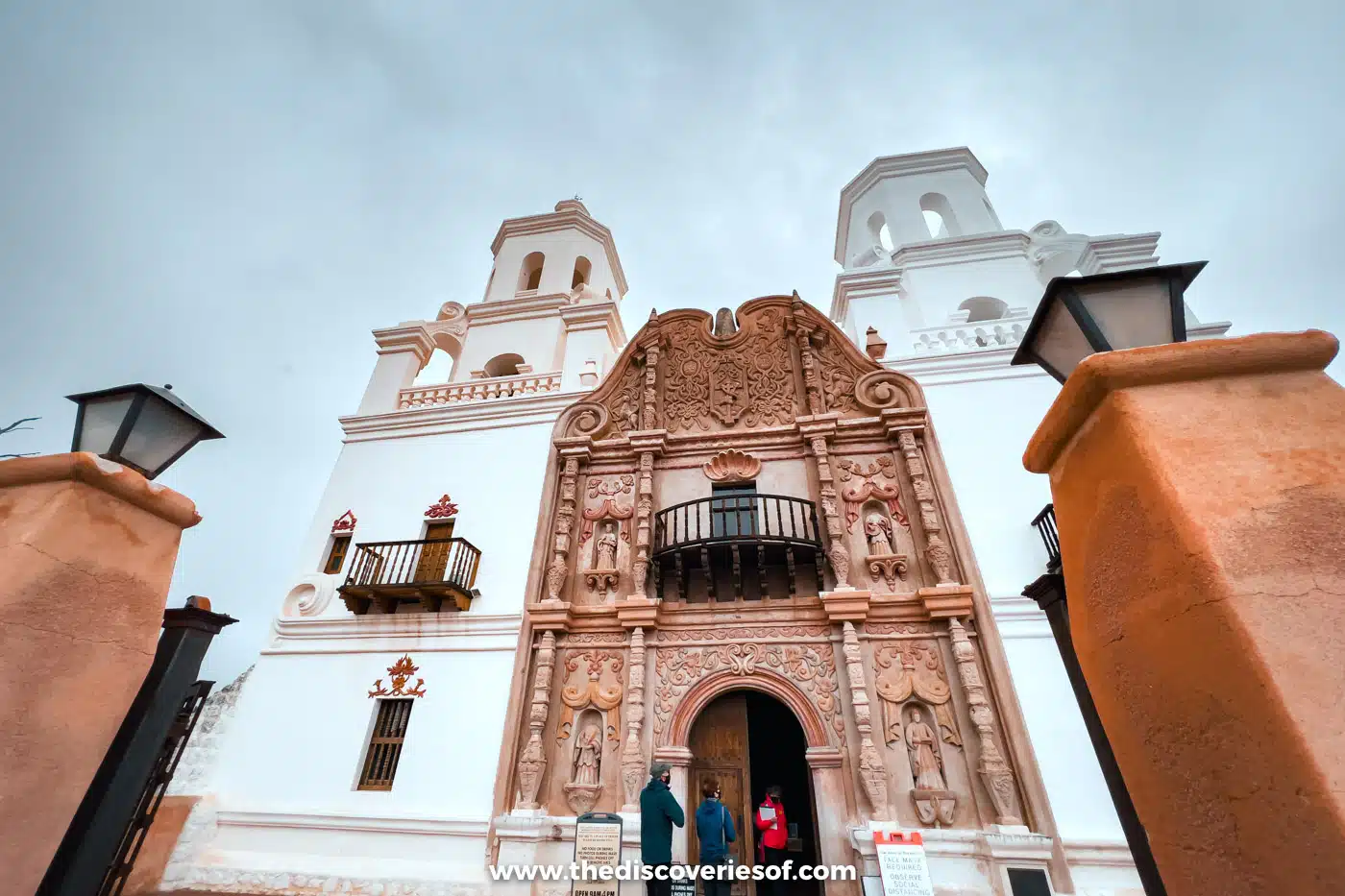
The first thing that strikes you is the contrast between the dazzling white walls and the ornate, terracotta-coloured façade in the middle. Carved in brick and plaster, it’s covered in scrolls, shell motifs and niches holding saints, and it’s the only part of the exterior that still has its original finishes and paint. Look closely and you’ll find a cat on one side and a mouse on the other. According to local folklore, the world will end when the cat catches the mouse; what the carvings were actually meant to show is unknown.
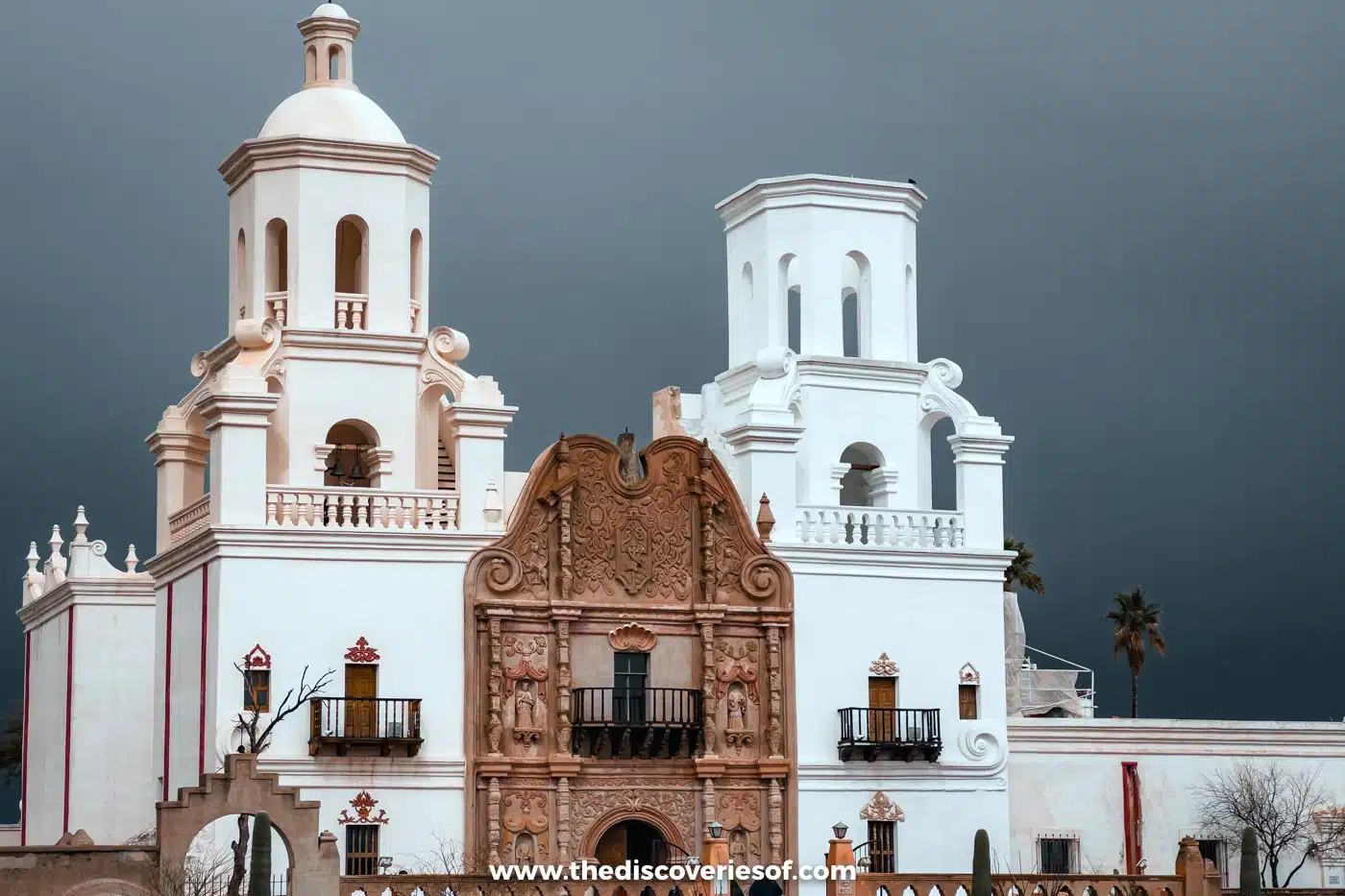
Then look up at the towers. The west tower is crowned with a domed lantern, but the east tower has none. There are plenty of legends to explain why, from a worker falling to his death to a tax loophole on unfinished buildings, but historians believe the builders simply ran out of money.
The non-profit Patronato San Xavier funds the preservation of the mission, and since the 1990s it has paid for conservation of the interior, a new lime plaster coat for the towers (the east tower was finished in 2022) and work inside the dome. Its current project is the carved façade, where crews are removing 1950s cement and conserving the original surface. The work happens in the cooler months, with scaffolding going up in autumn and coming down for Easter, and it’s expected to continue for another couple of years, so visitors may find scaffolding on the façade between October and Easter.
Walk up Grotto Hill
Just east of the mission rises a small hill with a grotto shrine. An easy trail of about a quarter of a mile loops around the hill, passing the shrine, with views out to the mountain ranges that surround the valley.
Step inside the church
The interior is even more impressive than the outside. Almost every surface is painted or decorated: there are frescoes, stencilled patterns, carved and painted statues, and a remarkable amount of trompe l’oeil, including painted tiles, a fake door and domes painted to look like folds of cloth. Many of the pigments were made from local plants and minerals. A count in the 1990s found more than 300 angels, 35 murals and 17 images of the Virgin Mary.
The focal point is the retablo, the great altarpiece behind the main altar, which is covered in gold and silver leaf and flanked by carved lions, with a standing statue of St Francis Xavier at its centre. In the west transept, look out for the reclining statue in a glass case. Long known as St Francis, it’s thought to have started life as a crucified Christ brought here from the mission at Tumacácori.
The church was never quite finished: on some walls you can still spot pencilled outlines for murals that were never painted. Its survival owes a lot to a major conservation project in the 1990s, led by Paul Schwartzbaum of the Guggenheim with an international team that trained four Tohono O’odham apprentices, which cleaned and conserved the paintings and statues.
After the church, visit the small museum, open from 9am to 4pm, and the mortuary chapel, which dates from 1796.
Opening hours, tours and etiquette
There’s no admission fee. Donations are welcome: envelopes handed out by the docents go to the Patronato for preservation, and cash given elsewhere goes to the parish. The church, museum and mortuary chapel are open from 9am to 4pm every day, and the gift shop from 8am to 5pm.
Free docent tours of about 30 minutes run Monday to Friday, and on Saturdays when possible, with no need to book; times are published monthly on the Patronato San Xavier website. The tours cover the grounds and the history of the mission, not the inside of the church, so go in on your own before or after. Tours are cancelled when it’s hotter than 95°F.
This is a working church and a place of worship for the local community. Mass is held at 6:30am Monday to Friday, at 5pm on Saturday and at 10am and noon on Sunday, so time your visit to avoid services if you want to look around. Dress respectfully, keep your voice down inside, and check the signs before taking photos, and don’t take any during Mass. The mission is on tribal land and follows Tohono O’odham Nation protocols, so check the mission’s website for the latest visitor guidelines, including its drone policy.
Try fry bread by the mission
Fry bread vendors often set up under the ramadas by the mission car park, mainly at weekends and especially on Sunday mornings, though who will be there on any given day is hard to predict. Just before the mission, San Xavier Plaza is home to Coyote Kitchen, which serves sweet and savoury popovers, along with an Indigenous arts and crafts shop.
Festivals and feast days
The mission comes alive for its feast days. On the Feast of St Francis on 4 October, the reclining statue is honoured with an evening procession with bells, music and fireworks, and the Feast of St Francis Xavier on 3 December is traditionally marked with processions around the plaza. The Wa:k Pow Wow is held at the mission each March, and in December the Patronato hosts its Christmas at San Xavier concerts to raise money for the mission’s preservation. Check the mission’s and the Patronato’s websites for dates.
The best time to visit
The best time to visit is from October to April, when the weather is mild. Summers in Tucson regularly top 100°F, the church isn’t air-conditioned, and docent tours are cancelled in the heat. In winter, on the other hand, the church isn’t heated either, so bring a layer.
Come at 9am, when the church opens, for the quietest visit and the coolest temperatures. If you want to try fry bread, Sunday morning is your best bet, but plan your time inside the church around the 10am and noon Masses. Bear in mind that the façade may be under scaffolding between October and Easter while the restoration continues.
How to get to Mission San Xavier del Bac
The mission is about 9 miles south of downtown Tucson, around a 15-minute drive. Take I-19 south to exit 92 (San Xavier Rd) and follow the signs west to the mission, where there’s a car park in front of the church.
From Phoenix: about two hours. Take I-10 east to Tucson, then I-19 south to exit 92.
From Tubac and Tumacácori: about 35 to 40 minutes north on I-19.
If you’d rather not drive, the Tucson city tour with lunch at El Charro Café includes a stop at the mission along with sights around the city.
Read Next
Places to visit nearby
Downtown Tucson and Barrio Viejo
A 15-minute drive north, downtown Tucson is home to Barrio Viejo, the city’s oldest neighbourhood, with its low-rise adobe houses and cacti-lined streets, plus the El Tiradito wishing shrine and St Augustine Cathedral. See my guide to the best things to do in Tucson.
Pima Air & Space Museum
About 20 minutes east of the mission, this is one of the largest aerospace museums in the world, with hundreds of aircraft in its hangars and across its outdoor grounds. It’s open from 9am to 5pm from October to May (last entry 3pm), with shorter hours in summer, and adult tickets are $22.50.
Arizona-Sonora Desert Museum and Saguaro National Park
West of the city, over the Tucson Mountains, you’ll find two of my top picks in Tucson. The Arizona-Sonora Desert Museum is part zoo, part botanical garden and part museum, and right next door, the western district of Saguaro National Park has some of the most stunning scenery in Arizona. Both are around 40 minutes’ drive from the mission.
Tumacácori and Tubac
For more mission history, head about 40 minutes south on I-19 to Tumacácori National Historical Park, where the ruins of a Spanish colonial mission church, begun in the early 1800s and never completed, stand among the mesquite. Entry is $10 per adult (16 and over), valid for seven days, and the park doesn’t accept cash. A few miles north, the small town of Tubac is home to Tubac Presidio State Historic Park and a cluster of art galleries.
Tips for visiting San Xavier del Bac
- Go early: arrive at 9am for fewer people and cooler temperatures, and avoid service times if you want to look around inside.
- Dress for the weather: there’s no air conditioning or heating inside and little shade outside, so bring water and sun protection in summer and a warm layer in winter.
- Bring cash: for donations and for fry bread from the vendors by the car park.
- Be respectful: it’s an active church on tribal land, so dress respectfully, keep noise down and check the signs before taking photos.
- Where to stay: I stayed at the Graduate by Hilton Tucson, a cool hotel in a great location near the University of Arizona, about 20 minutes from the mission. See my guide to where to stay in Tucson for more options, and plan the rest of your route with my Arizona road trip itinerary.
Map
Read next
- The best things to do in Tucson
- Where to stay in Tucson
- Visiting the Arizona-Sonora Desert Museum: a complete guide
- The best things to do in Saguaro National Park
- The best things to do in Arizona
- Visiting Montezuma Castle National Monument: a complete guide
Love this? Save and share on Pinterest

Discover the top things to do, insider tips and hidden gems in our USA Travel Guides.
Read the guides →