

Palm Springs has one of the finest collections of mid-century modern buildings anywhere, yet most of its famous houses are private homes you can only admire from the kerb. This self-guided drive strings the best of them together, with the story behind each one and the handful of places that let you through the door.
The mid-century look was a big part of what drew me to Palm Springs on my November road trip through California, so I set aside a morning to go house-spotting by car. Under a cloudless sky I drove from the Kaufmann House into the hillside streets of Little Tuscany and Vista Las Palmas, pulled in at the Art Museum, then crossed town to Frank Sinatra’s first desert home, all in well under an hour.
The big names sit a few minutes apart, so you set the pace. The route below runs north to south and builds on the addresses I’d saved before the trip, which follow the city’s own self-guided tour, adding the few places that open their doors.
The route at a glance
- Distance and time: about 15 miles from the north end of town to the south, and two to three hours with stops. Add half a day for Sunnylands.
- Start: the Visitor Center in the old Tramway Gas Station, 2901 North Palm Canyon Drive (open daily, 10am to 5pm).
- Going inside: the Art Museum and its Architecture and Design Center (Thursday to Sunday), Sunnylands (Wednesday to Sunday, outside its summer break) and Frey House II on scheduled tours only. Everything else is a private home, seen from the street.
- When to go: October to May, ideally in the morning, when the streets are quiet and the sun is on the mountains.
Why the city is full of mid-century modern buildings
Palm Springs grew up as Hollywood’s weekend escape just as modernism reached California, and the money, the space and the climate gave architects room to experiment. From the 1940s to the 1970s, Albert Frey, E. Stewart Williams, William Cody, Donald Wexler, William Krisel and Hugh Kaptur adapted the style to the desert: deep overhangs for shade, walls of glass turned towards the mountains, steel and concrete block that could stand the heat, and houses built around boulders rather than blasted clear of them. Locally, it’s called desert modernism.
It wasn’t only for the stars. Between 1955 and 1965 the Alexander Construction Company built more than 2,200 homes across the Coachella Valley, most designed by Palmer & Krisel, which is why whole streets of butterfly roofs and breeze-block walls survive today.
A self-guided drive past the city’s modernist landmarks
Begin at Albert Frey’s Tramway Gas Station
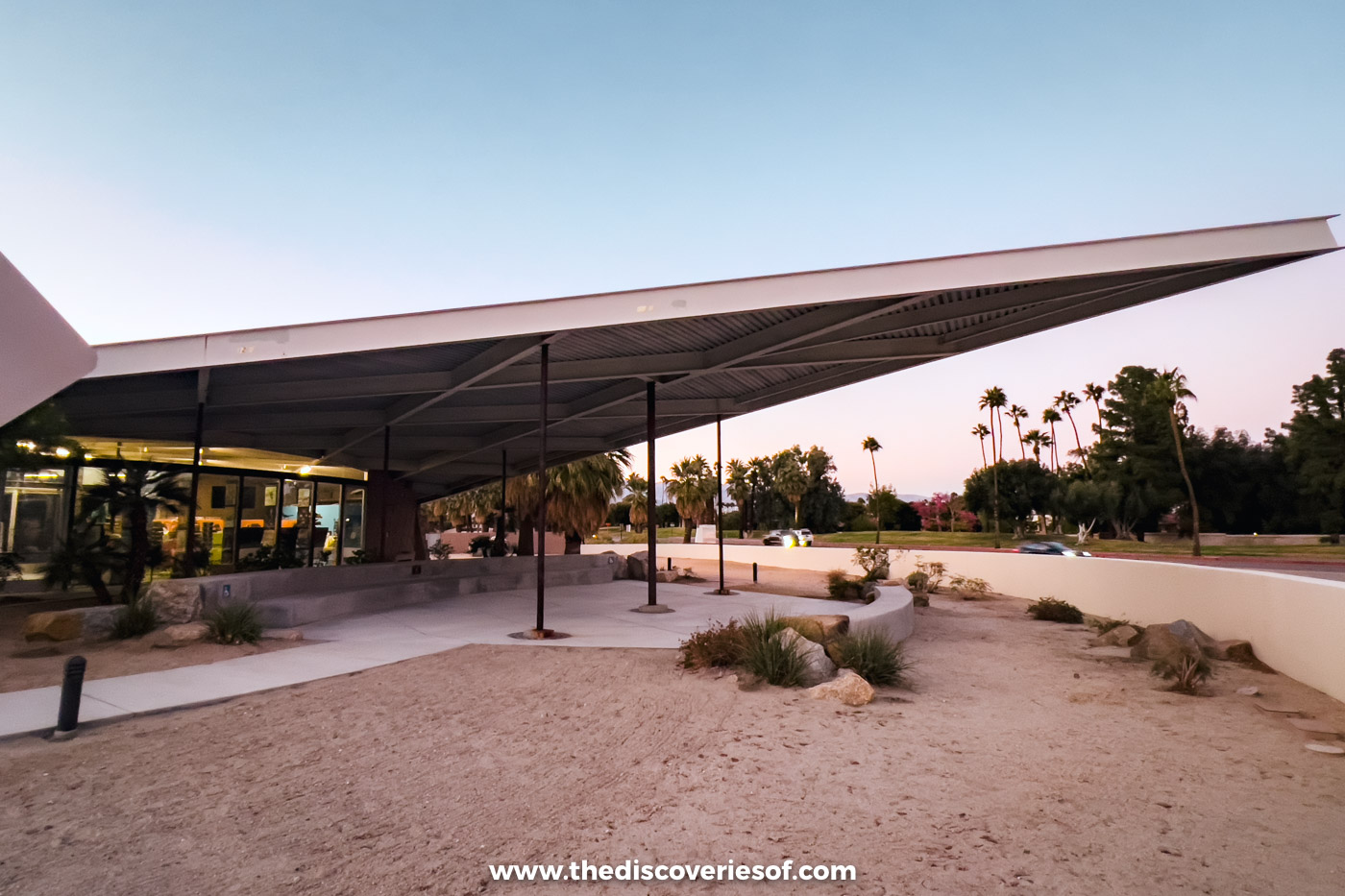
Start where visitors arriving from the north were meant to get their first look at the city. Albert Frey and Robson C. Chambers designed this Enco petrol station at the foot of Tramway Road in 1965, under a wedge-shaped canopy that cantilevers out towards Highway 111. It closed by the mid-1990s, spent a few years as an art gallery and reopened as the Visitor Center in 2003.
My photos of it are from just after sunset, when the underside of that canopy picks up the pink of the sky. Inside, the shop sells maps, including the Palm Springs Modern Committee’s guide to the city’s mid-century buildings. Just down the road at 2796 North Palm Canyon Drive, William Cody’s Tramway Shell station (1964) is the next stop on the city’s tour.
See where steel nearly took over at the Steel Houses
A few minutes east, in Racquet Club Estates, are the Steel Development Houses that Donald Wexler and Richard Harrison built in the early 1960s. The plan was 35 prefabricated homes with steel frames and folded steel roofs, but the price of steel shot up and only seven were finished.
You’ll find them on North Sunnyview Drive, East Molino Road and East Simms Road. All seven are Class 1 Historic Sites, and number 2, at 3125 North Sunnyview, is on the National Register of Historic Places.
Peer through the gate at the Kaufmann House
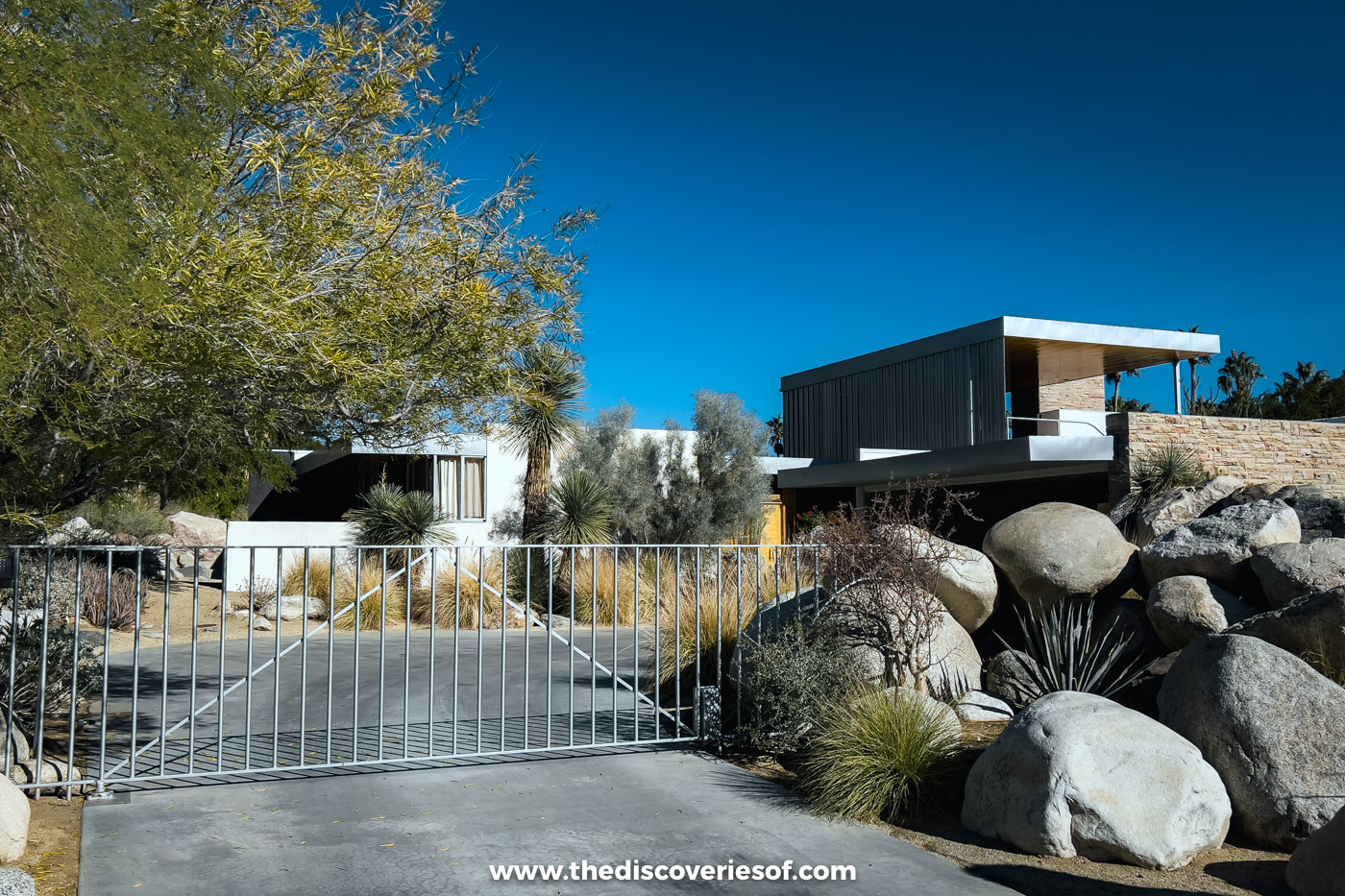
Richard Neutra’s 1946 house at 470 West Vista Chino is the one architecture fans come for. It was built as a winter retreat for Edgar J. Kaufmann, the Pittsburgh department store owner who had already commissioned Fallingwater from Frank Lloyd Wright. Julius Shulman’s 1947 photographs made it famous, and Slim Aarons’ 1970 shot “Poolside Gossip” made it the picture of desert glamour.
Later owners, Barry Manilow among them, made changes that hid Neutra’s design, until a five-year restoration by Marmol Radziner in the 1990s, which even reopened a Utah quarry to match the original stone. It sold for $13 million in 2022, a record for Palm Springs.
From the street, you get what I got: the white pavilion and its louvred rooftop gloriette through a steel gate, framed by boulders and yuccas.
Find the Edris House growing out of the rocks
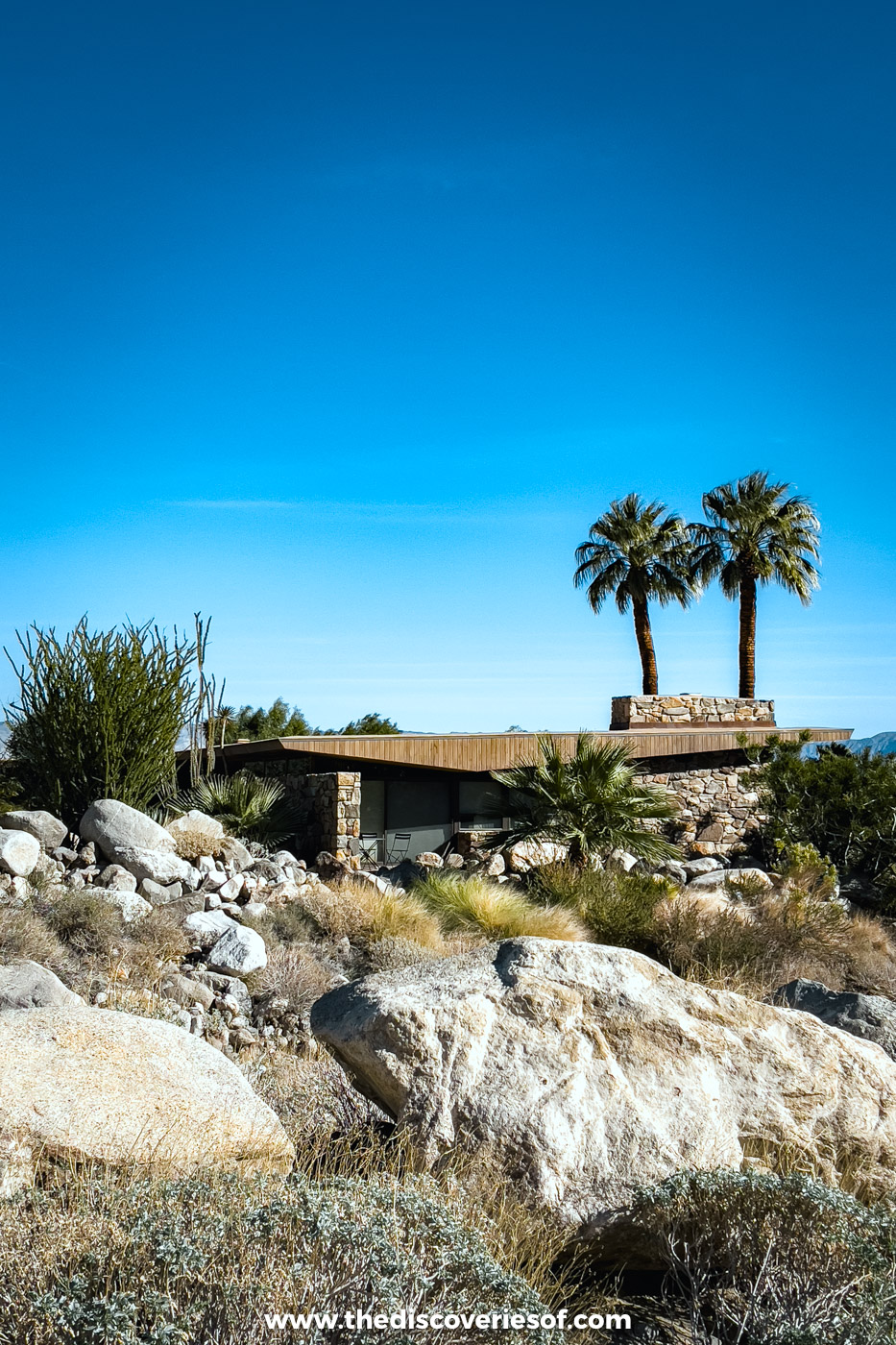
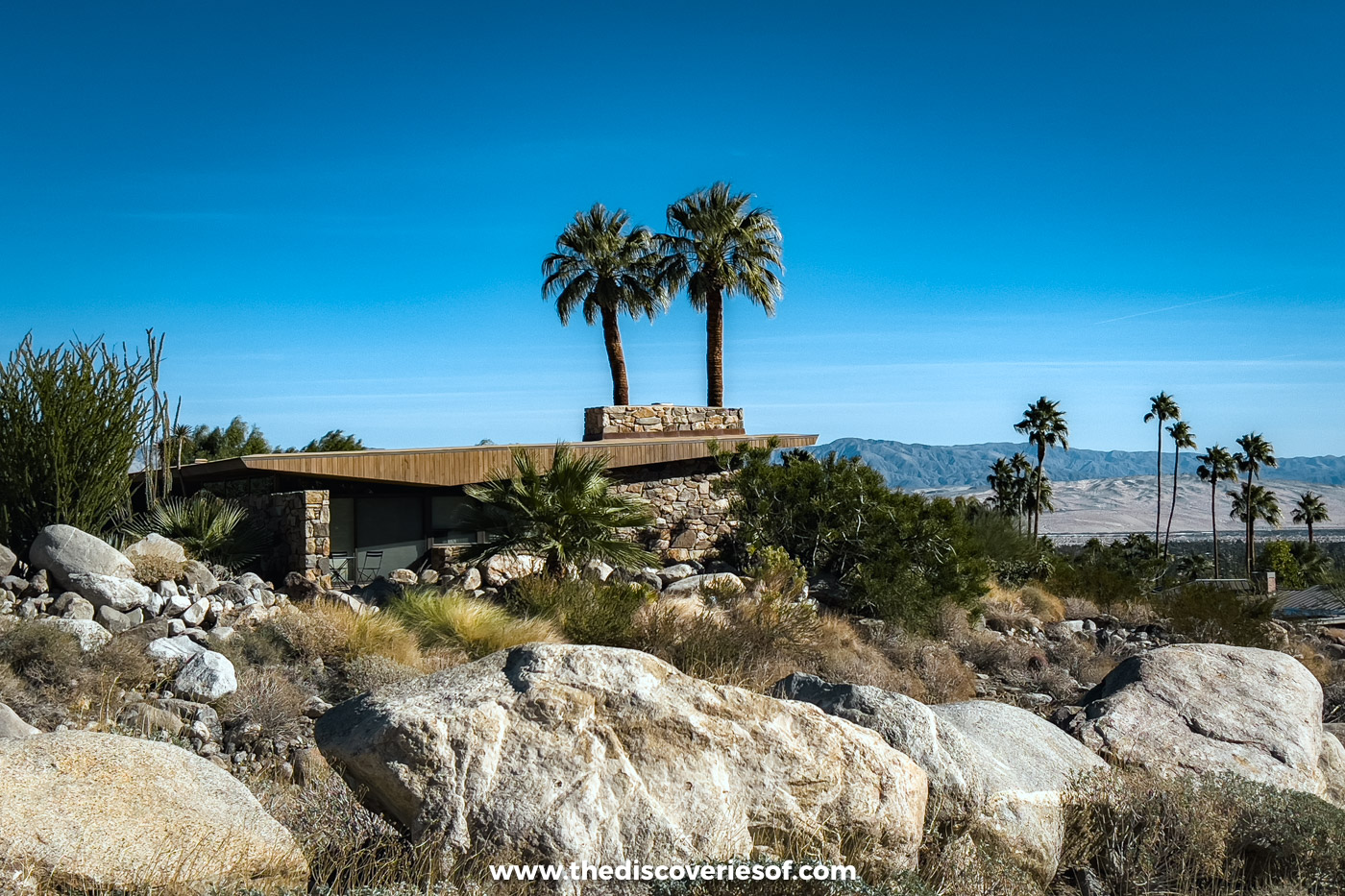
Head west into Little Tuscany, where the streets climb into the boulders at the foot of the San Jacinto Mountains. At 1030 West Cielo Drive, E. Stewart Williams built a low, wood-clad house for William and Marjorie Edris in 1954 on top of a rocky outcrop, so that it seems to grow out of the stone.
I stopped here mid-morning, and from the road the house barely rises above the rocks: look for the pair of tall palms beside it. Next door, at 1011 West Cielo Drive, is the Dr Franz Alexander House (1956) by Walter S. White. Both are on the National Register.
Slow down for the House of Tomorrow
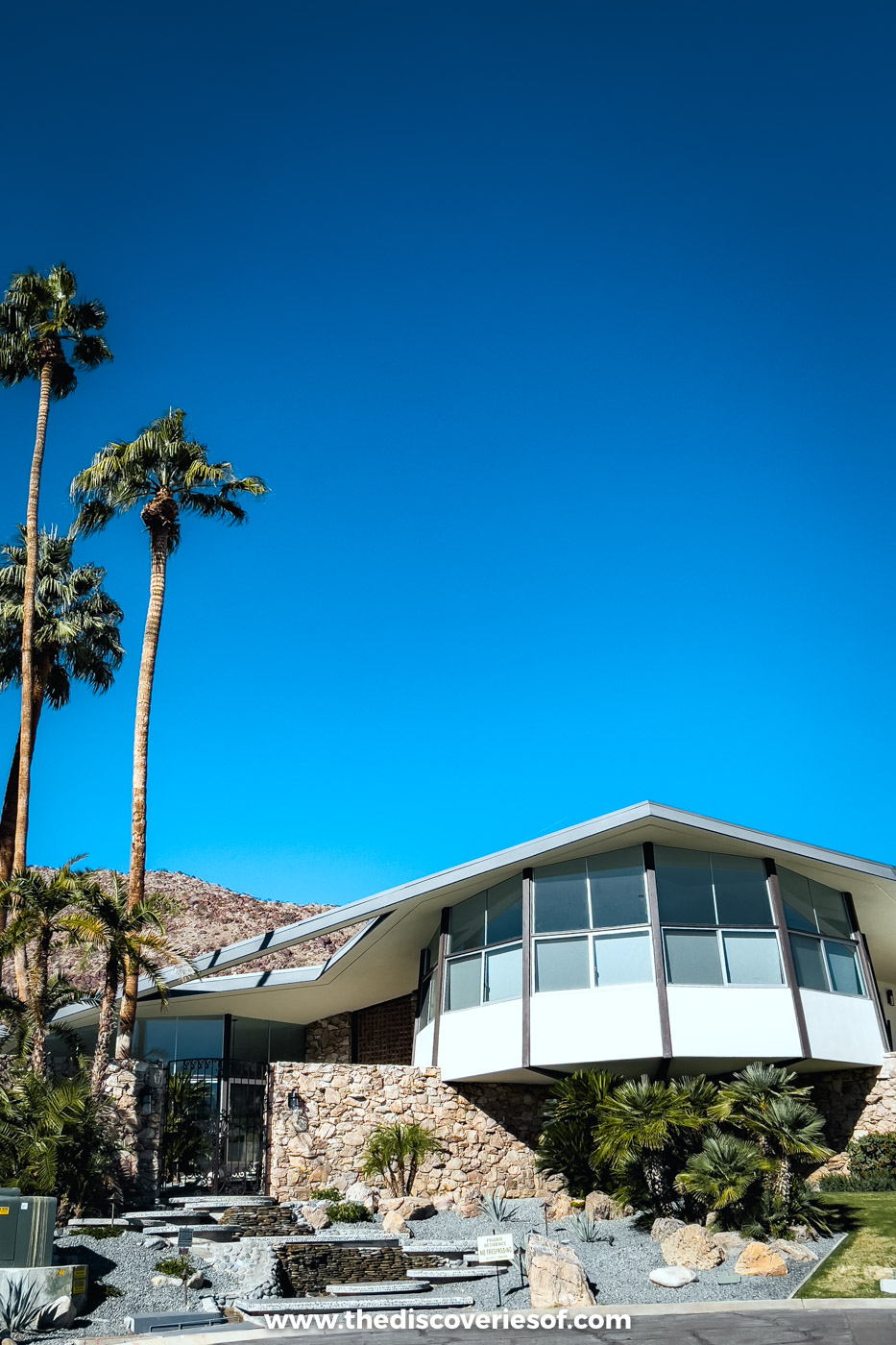
Down the hill in Vista Las Palmas, 1350 Ladera Circle is the house everyone slows down for. William Krisel of Palmer & Krisel designed it in 1960 for Robert and Helene Alexander, the developers behind those 2,200 homes, with four circular pods under a winged roof. Look magazine visited in 1962 and called it the House of Tomorrow.
The Alexanders didn’t get long to enjoy it: both died in a plane crash in 1965. Two years later, Elvis and Priscilla Presley spent their honeymoon here, which is why it’s also known as the Elvis Honeymoon Hideaway. A new owner restored it after buying it in 2020, and it has opened for tours during Modernism Week.
Nearby, look out for Charles DuBois’s Swiss Miss houses (1958 to 1961), whose steep A-frame gables stand out on Via Las Palmas and West Crescent Drive.
Look for the Dinah Shore house in Old Las Palmas
Cross Palm Canyon Drive into Old Las Palmas, a neighbourhood of walled estates where many Hollywood names kept winter homes. At 432 Hermosa Place, Donald Wexler designed a house for the singer and TV host Dinah Shore in 1964. Later owners included the Broadway composer Jerry Herman, it has more recently been linked to Leonardo DiCaprio, and these days it’s let out as a holiday rental.
It was one of the houses I made a point of finding on my drive, and it’s worth the short detour across town.
Pass Frank Sinatra’s Twin Palms
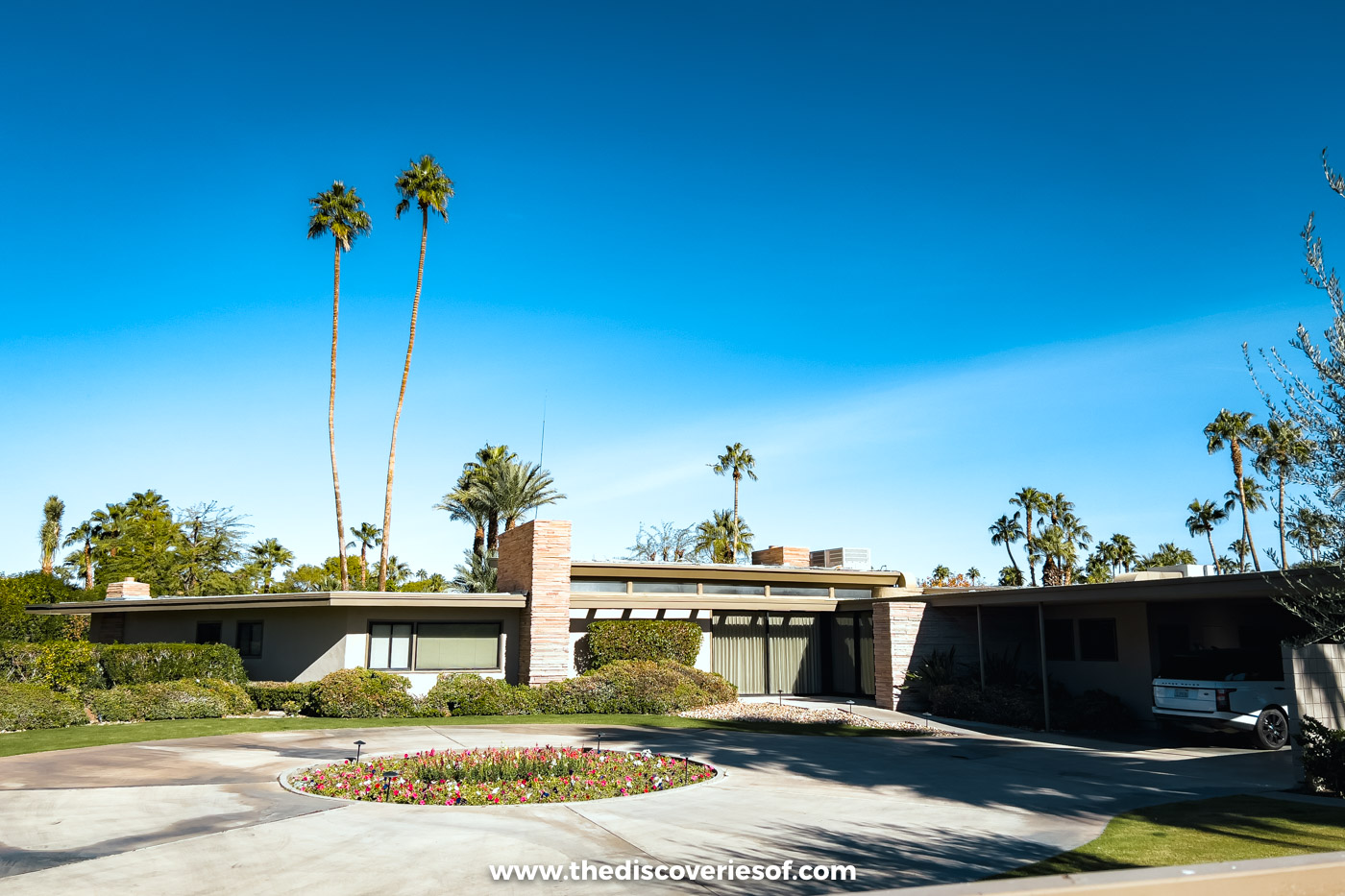
On the other side of downtown, at 1148 East Alejo Road in Movie Colony East, Twin Palms (1947) was E. Stewart Williams’ first house. He built it for Frank Sinatra, who lived here until 1954 and sold it in 1957. Its pool is famously shaped like a grand piano, and Sinatra rented the house to Moss Hart while he worked on A Star Is Born.
This was my last stop of the morning, looking across the circular drive to the long, low house and its palms. It’s on the National Register too, and it’s now rented out as a holiday home.
Go inside at the Art Museum and the Architecture and Design Center
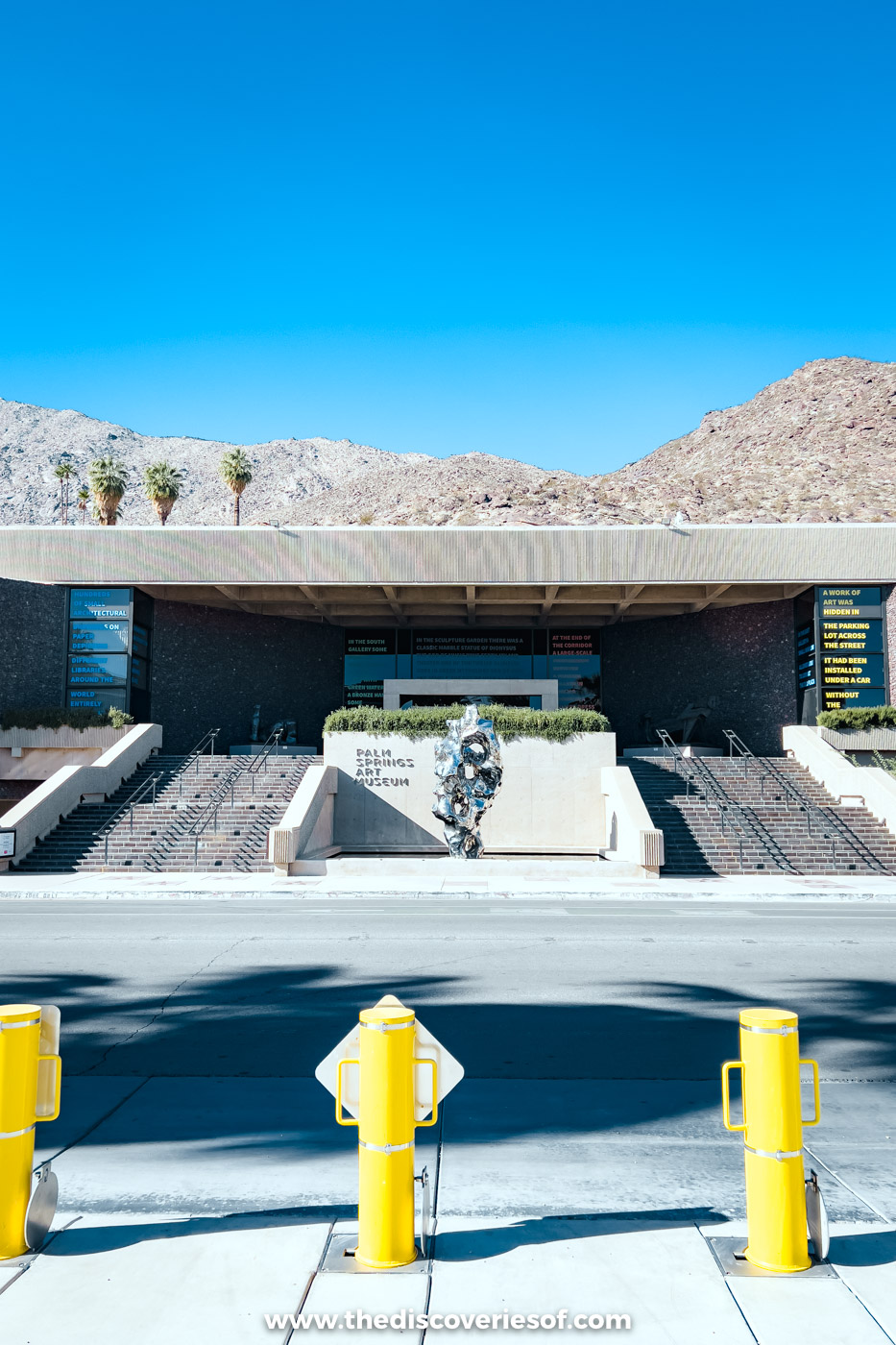
Downtown, you can finally get through a door. Williams also designed the Palm Springs Art Museum (1976), its dark stone walls set against the mountain behind, where I pulled in between houses.
A few blocks south, at 300 South Palm Canyon Drive, the museum’s Architecture and Design Center fills Williams’ 1961 Santa Fe Federal Savings and Loan, a glass and steel box raised above the street.
Tickets
one $25 ticket covers both the museum and the Architecture and Design Center, under-18s go free, and Thursday evenings from 5pm to 8pm are free for all. Opening hours are noon to 8pm on Thursdays and 10am to 5pm from Friday to Sunday.
Book ahead for Frey House II
On the mountainside above the museum, at 686 Palisades Drive, Albert Frey built his own home in 1964: just 800 square feet of glass and steel, with a huge boulder pushing into the house to divide the bedroom from the living room. It is now in the care of the Art Museum, and it was high on my list: I made my way up to see it while I was in town.
It’s closed to regular visits, so you’ll need a tour. The museum opens it during Modernism Week in February and October, and on selected Saturdays with Palm Springs Life; tickets were $75 in October, including museum entry, with a shuttle from the museum’s south car park (ages 10 and up). The Modern Tour also offers it as an add-on to its private tours.
Finish on South Palm Canyon Drive
Heading south, Hugh Kaptur’s Musicland Hotel (1967) at 1342 South Palm Canyon Drive shows the more organic side of desert modernism. Further on, at number 1774, the Royal Hawaiian Estates are 40 condominiums in 12 buildings designed by Wexler & Harrison in the early 1960s, with tiki-style apexes and 7-shaped outrigger beams known as “flying sevens”. In 2010 they became the city’s first residential historic district.
Step inside Sunnylands in Rancho Mirage
For one more interior, drive about 20 minutes down the valley to Sunnylands, at 37977 Bob Hope Drive. A. Quincy Jones designed the 25,000-square-foot house for Walter and Leonore Annenberg, completed in 1966, and seven US presidents have visited the estate.
The 90-minute Historic House Tour (ages 10 and up) costs about $58, with tickets released online at 9am Pacific time on the 15th of each month for the month after. The Center and Gardens keep hours of 8.30am to 4pm, Wednesday to Sunday, and the estate closes for the summer, reopening in early September.
Know which famous houses you can’t see
John Lautner’s Elrod House (1968), with its vast circular concrete canopy and boulders running through the living room, played Willard Whyte’s home in the Bond film Diamonds Are Forever, and his Hope Residence (1979), built for Bob Hope, is close by. Both sit inside the gated Southridge estate, so they aren’t on any drive-by route.
Guided tours and Modernism Week
If you’d rather someone else drove, or you want to see inside private homes, these are running now.
- Modernism Week: the main festival is 11 to 21 February 2027, and the October edition is 14 to 17 October 2027. Both open private homes for tours, alongside talks, parties and bus tours.
- Architecture Tours by Modernism Week: small-group tours in a 22-seat mini-coach, running from mid-October to the end of May.
- Palm Springs Mod Squad: Kurt Cyr’s 90-minute van tours for up to five people, from $80 for the Essential Palm Springs Tour, or $150 for an interior tour of two houses.
- Modern Tours Palm Springs: self-drive audio tours that play in your phone’s browser alongside Google Maps, from $59.99.
- The Modern Tour: the Art Museum’s official tour operator, with private tours from $200 per person that can include interiors.
The Palm Springs Preservation Foundation, behind many of the listings on this route, also runs free talks and home tours during Modernism Week.
Tips for touring the houses
- These are people’s homes. Look from the pavement or your car, never walk up a drive or knock, don’t fly drones and park without blocking gates.
- Go in the morning. The light is softer, the streets are quieter and it’s cooler. In high summer the thermometer often tops 100°F (38°C) by the afternoon, and Sunnylands shuts for the season.
- Book interiors early. Modernism Week, Frey House II and Sunnylands tickets go quickly, so check release dates before you travel.
- Make a day of it. The route slots neatly into my 2-day Palm Springs itinerary, and my guide to the things to do in Palm Springs has plenty more to fill the afternoon.
Map
Read next
- 27 things to do in Palm Springs, Old Hollywood’s favourite desert hideaway
- How to spend 2 days in Palm Springs (and still catch sunrise in Joshua Tree)
- The best day trips from Palm Springs
- The ultimate California road trip itinerary
Love this? Save and share on Pinterest

Discover the top things to do, insider tips and hidden gems in our USA Travel Guides.
Read the guides →




