

Behind the cobalt-blue walls of a corner house in Coyoacán, Frida Kahlo was born, painted, recovered, entertained and died. Today it’s the Frida Kahlo Museum, better known as the Casa Azul, and it’s one of the most visited museums in Mexico City: her easel still stands by the studio window, her ashes rest in her bedroom and her dresses hang a few metres away.

Picking which museums to see in Mexico City is both easy and nearly impossible. The first time I visited, my head was spinning trying to decide which to prioritise, and the Casa Azul was one of my favourites. Sometimes I think that house-museums can border on the kitsch, but this one offers a genuinely fascinating look at Kahlo’s life and the influences on her art. This guide covers how to get tickets (they sell out), when to go, what to look out for in each room, how long to allow, how to get there and what else to do in Coyoacán.
Why the Frida Kahlo Museum is worth the effort
Kahlo’s father, the photographer Guillermo Kahlo, built the house in 1904, around a central courtyard. Frida was born here in 1907, spent her long convalescence here after the bus accident that shattered her spine at 18, and began painting seriously in this house. After she married Diego Rivera in 1929, the couple lived here on and off, filling it with folk art and pre-Hispanic sculpture, and in 1937 they took in the exiled Leon Trotsky and his wife Natalia Sedova. In 1946 Rivera had the architect Juan O’Gorman add the volcanic-stone studio wing.
Kahlo died here in 1954, and the house opened as a museum in 1958. At Rivera’s request, a bathroom, cupboards and trunks stayed sealed for decades, until 2004. When they were finally opened, they turned up thousands of documents and photographs, along with her dresses, corsets and medicines, which is why the museum can now show so much of her everyday life.
What makes it special is how present she still feels. Her studio, her bedroom and the kitchen she shared with Rivera have been kept much as they were: this is not a sanitised museum experience, but a house that still feels lived in.
How to get Frida Kahlo Museum tickets
Entry is by timed ticket, booked for a specific date and slot (slots run every 15 minutes), and the most popular times sell out days ahead, especially at weekends and in school holidays. Book on the museum’s official ticket site as soon as you know your dates.
Tickets
In 2026 a general ticket costs 320 pesos. Mexican residents pay 160 pesos with ID, students, teachers and guides 60 pesos, and over-60s and children aged 6 to 12 pay 30 pesos. Under-6s and visitors with disabilities go free. Phone photos without flash are included for personal use. When you book on the official site, you can add free entry to the Museo Diego Rivera Anahuacalli to your ticket.
If the official slots are gone, resellers often still have space. This Frida Kahlo Museum ticket with a digital guide books you a timed entry with a self-guided audio guide in English or Spanish, and the Casa Azul option includes the Anahuacalli. It costs more than buying direct, so check the official site first.
Opening hours and the best time to go
The museum is open Tuesday and Thursday to Sunday from 10am to 6pm, and Wednesday from 11am to 6pm. It’s closed on Mondays and on a handful of holidays, including 25 December and 1 January. On Thursdays there are evening Noche Azul visits from 5.15pm to 9pm (check the museum’s listings), and on the last Wednesday of the month it stays open until 9pm for Noche de Museos.
The first slots of the morning are the calmest, before tour groups build up inside the rooms. Weekday visits are quieter than weekends.
Top Tip
Most of Mexico City’s museums close on Mondays, the Casa Azul included. If your trip includes a Monday, make it your day for Teotihuacán or Xochimilco instead.
What to see inside the Casa Azul
The route takes you through the rooms around the courtyard, up to the studio and bedrooms, then out to the garden and a separate gallery of her clothes.
The paintings
The Casa Azul isn’t where you’ll find her most famous canvases (The Two Fridas is at the Museo de Arte Moderno, for example), but it does hold some important works. Look for Frida and the Caesarean, the unfinished family portrait, and Viva la vida, the watermelon still life she painted in the last months of her life, alongside her drawings and works by the 18th- and 19th-century Mexican painters she collected.
The kitchen and dining room
The kitchen is a classic old Mexican one, with clay pots and cazuelas over a stove lined with Talavera tiles. Look up at the wall, where small clay jugs spell out Frida and Diego’s names. Next door, the dining room has yellow cupboards stacked with folk art and 19th-century still lifes on the walls. André Breton, Leon Trotsky and Sergei Eisenstein all gathered here.
The studio
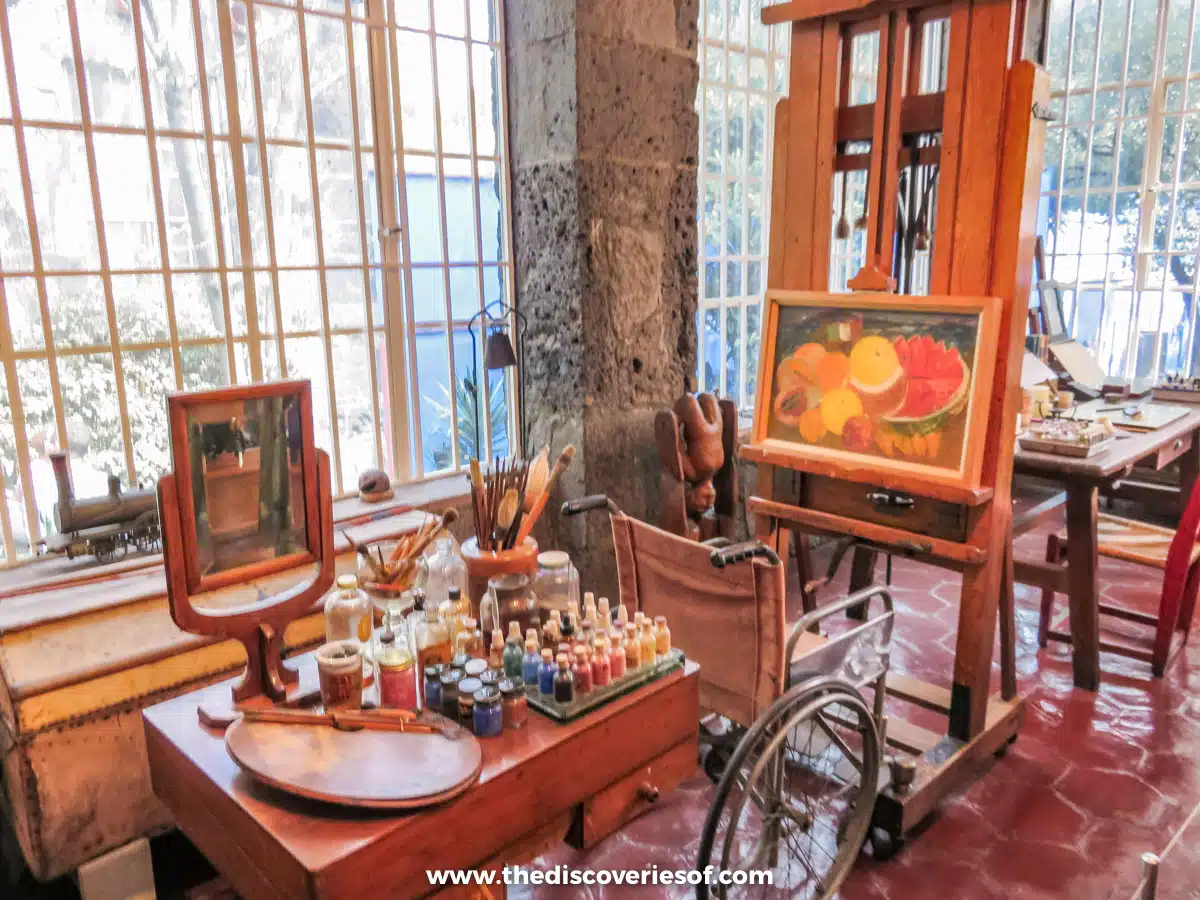
This is the room that stays with you. O’Gorman’s stone studio is flooded with light from tall windows over the garden, and her easel, a gift from Nelson Rockefeller, stands beside her wheelchair, with her brushes, paints and books laid out as if she’d just stepped away.
The bedrooms
Kahlo had two. In the day bedroom, the four-poster bed has the mirror her mother had fixed above it after the accident, so she could see herself and paint while lying in bed. Her ashes are kept here in a toad-shaped urn, with her death mask. The night bedroom holds the framed butterflies the sculptor Isamu Noguchi gave her and Nickolas Muray’s portrait photograph of her. Rivera’s bedroom, which she arranged for him in 1940, still has his clothes, hats and walking sticks.
The garden and the pyramid

The courtyard garden is a little oasis: cobalt and red walls, palms and succulents, and a small stepped pyramid that displays Rivera’s collection of pre-Hispanic sculpture. Stone figures and clay pots peer out from the planting all around it, so take your time.

Her dresses and corsets
In a separate gallery off the garden, the clothes that were locked away for decades are on show: her Tehuana dresses and jewellery, the corsets she wore after her many operations and her prosthetic leg. It’s a powerful way to end the visit, and a reminder of how much pain she lived and worked through.
How long to spend at the Frida Kahlo Museum
Allow about an hour for the house and garden, and up to an hour and a half if you want to read every label and linger in the dress gallery. Add time for the museum shop and for the queue at the door, even with a timed ticket.
How to get to the Casa Azul
The museum is at Londres 247 in Colonia Del Carmen, in Coyoacán, south of the centre.
- By Metro: the nearest station is Coyoacán on Line 3. From there it’s about a 15 to 20 minute walk through the neighbourhood.
- By taxi or Uber: the easiest option from Roma, Condesa or the Centro Histórico. Allow 30 to 45 minutes depending on traffic.
- On a tour: many Coyoacán and Xochimilco day tours stop at the Casa Azul, which is handy if you want to pair it with the canals.
There’s no parking at the museum.
What else to do in Coyoacán
Coyoacán is one of the prettiest neighbourhoods in Mexico City, with cobbled streets, colourful houses and a relaxed, village feel, so make a day of it.
- Museo Casa Kahlo: the Kahlo family’s red house, about 1km away near Plaza Hidalgo, opened as a museum in September 2025, with the only known mural by Frida in its kitchen. It’s open on Mondays and closed on Tuesdays, so it fills a gap.
- Museo Anahuacalli: Rivera’s volcanic-stone temple to pre-Hispanic art, about 4km south. Open Tuesday to Sunday from 11am to 5.30pm, and free if you add it to your Casa Azul ticket.
- Museo Casa de León Trotsky: the house a few blocks away where Trotsky lived after leaving the Casa Azul, and where he was murdered in 1940.
- Jardín Centenario and Plaza Hidalgo: the twin squares at the heart of the neighbourhood, with the coyote fountain and the church of San Juan Bautista.
- Mercado de Coyoacán: a lively market for a lunch of tostadas, with stalls of piñatas and sweets.
Tips to make the most of your visit
- Book ahead: timed tickets sell out, especially at weekends. Have your QR code ready on your phone.
- Avoid Mondays: the museum is closed. Wednesday opens an hour later, at 11am.
- Bring ID for discounts: resident, student, teacher and senior rates all need valid ID at the door.
- Go early: the first slot of the day is the best for photos of the courtyard without the crowds.
- Make a day of Coyoacán: pair it with Casa Kahlo, Anahuacalli or lunch in the market.
Map
Read next
- 23 things to do in Mexico City, from murals to tacos
- 3 days in Mexico City: the perfect Mexico City itinerary
- Pujol review: ants, a years-old mole and Mexico City’s hardest table
- 2 weeks in Mexico: the perfect road trip itinerary
- 34 famous landmarks in Mexico that are worth crossing the country for
- Swim, eat and dance your way through the 38 best things to do in Mexico
Love this? Save and share on Pinterest


Discover the top things to do, insider tips and hidden gems in our Mexico Travel Guide.
Read the guides →




