How to get around the Philippines: which domestic flights to book, which ferries and fast boats to take, what island-hopping boats and vans are really like, and how to plan around the weather.
Getting around the Philippines is the part of the trip that decides whether it feels like a holiday or a logistics exercise. The country is spread across more than 7,600 islands, and the places most people want to see (Siargao, Cebu, Palawan, Bohol, Boracay) are scattered across hundreds of miles of sea. A journey that looks like a short hop on the map can easily be a flight, a van and a boat.
I spent about three weeks travelling from Siargao to Cebu and across Palawan to Coron, and I used almost every kind of transport the Philippines has to offer: three domestic flights, a terminal change in Manila, a four-hour taxi, shared vans, tricycles, island-hopping boats at almost every stop and a three-day boat expedition that slept on remote beaches. This guide covers how each one works, what it costs and what I’d do differently, so you spend more of your time on the islands and less of it getting between them.
Some links in this article may be affiliate links, which means we may receive a small commission, at no additional cost to you, if you decide to purchase through one of my recommended partners.

The short version
- Fly for the long distances. Domestic flights are cheap if you book ahead, and they’re the only sensible way to cover the big jumps, such as Manila to Palawan or Cebu to Siargao.
- Use Cebu or Clark as your hub, not just Manila. Since March 2026 the small turboprop planes that serve many island airports no longer fly from Manila, so routes to Siargao, El Nido and Coron now leave from Clark or Cebu instead.
- Take boats for the short hops. Fast craft and ferries link neighbouring islands, and on Palawan the boat from El Nido to Coron is half the fun.
- Expect vans and long roads on the big islands. Cebu and Palawan are much bigger than they look, and road journeys of four to six hours are normal.
- Use tricycles, scooters and Grab once you arrive. Every island has its own way of covering the last few miles.
- Leave slack for the weather. Boats and small planes are the first thing to stop when the sea gets rough, so never plan a tight connection.
Flying around the Philippines
For most trips, flying is the backbone of getting around the Philippines. Distances between island groups are large, the sea crossings are long, and a 50-minute flight can replace a day and a night on a ferry. I flew three times in three weeks (into Siargao, from Siargao to Cebu and from Cebu to Puerto Princesa) and would happily do the same again.
The airlines
Cebu Pacific is the biggest domestic airline, with jets on the main routes and its subsidiary Cebgo flying smaller ATR turboprops to island airports. In July 2026 Cebgo also took over the AirSWIFT flights to El Nido, so those now carry Cebgo’s DG code. Philippine Airlines, through PAL Express, covers many of the same routes with a full-service fare, and AirAsia Philippines flies the busiest trunk routes. Fares on all of them are low if you book a few weeks ahead and climb fast around Christmas, Easter (Holy Week) and the summer school holidays from March to May.
Choose your hub: Manila, Clark or Cebu
This is the biggest change for anyone planning a trip right now. To free up space at Manila’s congested airport, the turboprop flights that serve smaller island airports moved out of Manila on 29 March 2026. Siargao, El Nido and Busuanga (for Coron) are no longer served by turboprops from Manila, and the main gateways for them are now Clark, about two hours north of Manila, and Cebu.
In practice, that makes Cebu the most useful hub in the country. From Mactan-Cebu airport you can fly to Siargao in under an hour, to Puerto Princesa, El Nido and Busuanga, and to Bohol, Boracay and most of the other islands, and it has its own international flights, so you may not need to touch Manila at all.
If you do arrive in Manila and your next flight leaves from Clark, there’s a free hourly shuttle bus from Bay 13 at NAIA Terminal 3, run by Genesis, for passengers flying out of Clark within 24 hours. Bring your booking reference and ID. Otherwise, Genesis buses run to Clark from Cubao and PITX, or a Grab costs roughly ₱1,500 to ₱3,500.
Top tip
Manila’s airport terminals have been reshuffled since a private operator took over in 2024, and more changes are planned, so always check which terminal your airline uses for your specific flight rather than relying on an old blog post or last trip’s memory.
Changing terminals in Manila
If your route does take you through Manila, allow plenty of time for any change of terminal. I connected through Manila on my way to Siargao, and my onward flight left from a different terminal. My checked bag went through to my onward flight, while I took the shuttle bus between terminals and had breakfast on the other side. With three hours between flights it was fine, and not nearly as stressful as I’d feared, but I arrived in Siargao on about three hours’ sleep and I could have made it easier on myself with a little more research into the transfer beforehand.
Baggage on domestic flights
Budget fares on domestic flights include a cabin bag only, and the limits are enforced. Cebgo’s turboprops in particular weigh bags at check-in, with a 7kg cabin allowance, and buying checked baggage at the airport costs far more than adding it online when you book. My Philippines packing list has the current allowances and how to pack around them.
Ferries and fast craft
Ferries are the other half of getting around the Philippines, and for neighbouring islands they’re often quicker than flying once you add the airport time. There are three main types:
- Fast craft: Enclosed, air-conditioned passenger boats for crossings of one to four hours. OceanJet and SuperCat run them around the Visayas, and on Palawan, Montenegro, Atienza and Phimal run fast ferries between El Nido and Coron.
- RoRo ferries: Slower roll-on, roll-off ferries that carry vehicles as well as passengers. FastCat is the best-known, and they’re cheaper but take longer.
- Overnight ferries: Big ships with bunks and cabins on long routes, run by 2GO, Starlite, Cokaliong and others. Useful if you’re short of money but long on time.
Buy fast-craft tickets online or at the port a day or two ahead in peak season, carry your passport (names are checked against the passenger manifest), and expect to pay a small port terminal fee in cash on top of the fare. Arrive at least an hour before departure. And remember that every boat is at the mercy of the weather: when the coastguard suspends sailings, nothing goes.
Some of the most useful routes:
| Route | Type | Time | Rough fare |
|---|---|---|---|
| Cebu City to Tagbilaran (Bohol) | Fast craft | About 2 hours | From ₱800 |
| Surigao City to Dapa (Siargao) | Fast craft or RoRo | 1.5 to 4 hours | ₱350 to ₱680 |
| Cebu City to Surigao (for Siargao) | Fast craft or overnight ferry | 5.5 hours or overnight | Around ₱1,350 |
| El Nido to Coron | Fast ferry | About 3.5 hours | ₱2,750 to ₱3,250 |
Fares and timetables change often, so treat these as a guide and confirm with the operator before you travel.
Island-hopping boats
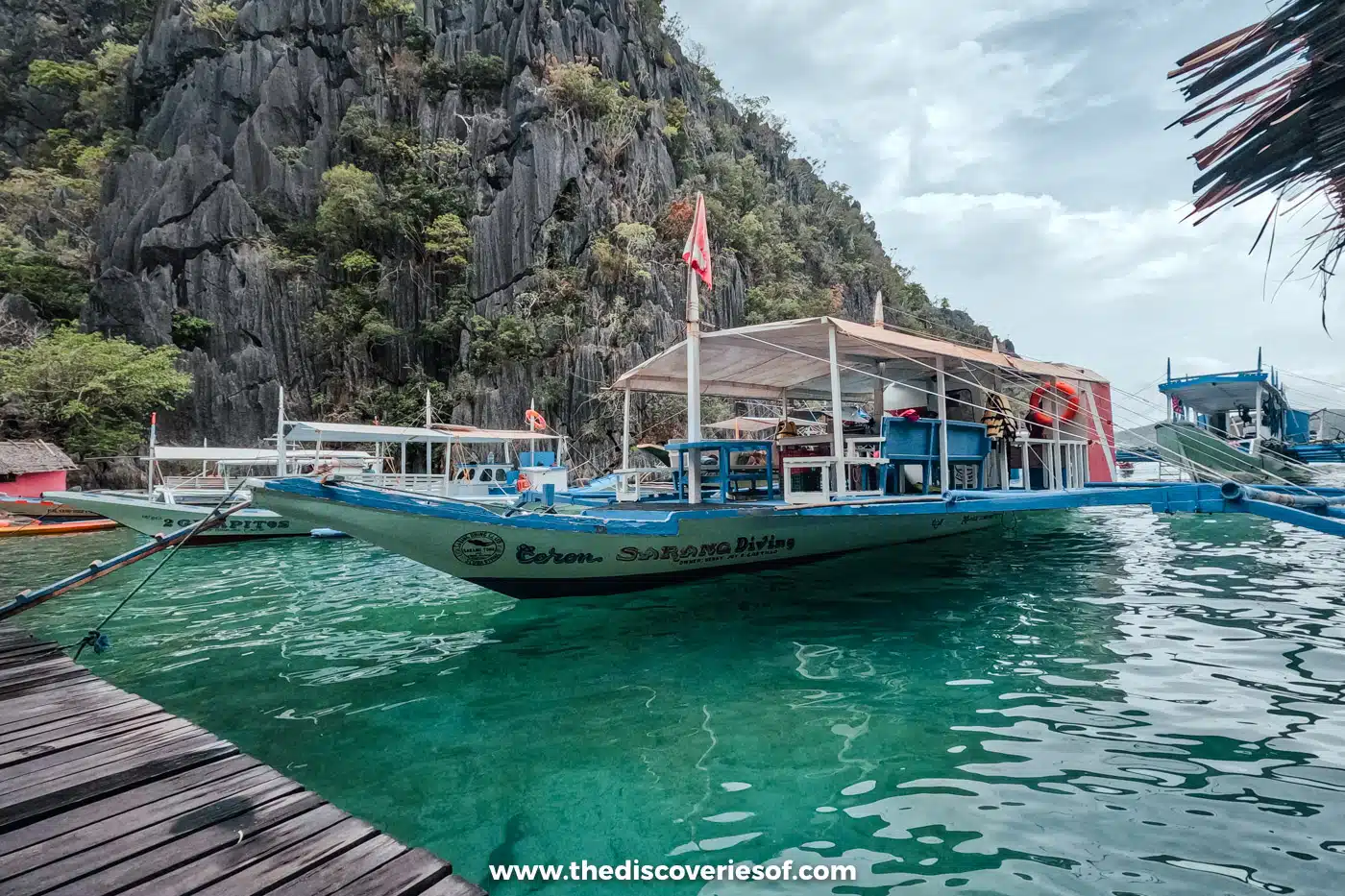
Once you’re on the islands, you’ll spend a lot of time on bangkas, the wooden outrigger boats with bamboo arms that carry island-hopping tours, dive trips and short transfers all over the country. On my trip I took them to Sohoton Cove, Sugba Lagoon, the Underground River, around El Nido’s Bacuit Bay and through the lagoons of Coron, and they’re as much a part of the experience as the places they take you to.

A few things are worth knowing before you step aboard:
- There’s always paperwork. Tour boats need permits and coastguard clearance before they leave, and in places like Puerto Princesa’s Underground River every passenger’s ID is checked against the permit. Expect to wait on the beach or at the port while your guide sorts it out. On my El Nido tours, the operator asked everyone to meet between 8 and 9am to leave time for it.
- Fees are in cash. Environmental fees, lagoon fees, kayak hire and terminal fees are almost always paid in cash on the day, on top of the tour price. In El Nido alone, that was a ₱400 environmental fee, a ₱200 to ₱300 user fee for the main stops and ₱300 to ₱500 for a kayak.
- Landings are wet. Most beaches have no jetty, so you jump off the side or wade ashore. If there’s one thing I’d tell you to pack for the Philippines, it’s a pair of water shoes: I wore mine on boats, at the rock pools, in the Underground River and canyoneering.
- Plans change with the sea. Crews swap stops when the water is too rough to land. On El Nido’s Tour C, choppy water ruled out Secret Beach, so we went to Cadlao Lagoon instead, and it turned out to be one of my favourite stops of the trip.
- Life jackets are compulsory. You’ll wear one in transit, and in places like the Big Lagoon and Secret Lagoon in El Nido you’ll swim in one too.
Top tip
Bring a dry bag for your phone, cash and ID. Even on a calm day, spray comes over the side of a bangka, and wet landings mean wading in up to your thighs.
Multi-day boat expeditions
The most memorable journey I made in the Philippines was also the slowest. Instead of taking the fast ferry from El Nido to Coron, I spent three days and two nights on a boat expedition with Keelooma, stopping at remote islands to snorkel, sleeping in simple cabins at beach camps, and arriving in Coron at 5.30pm on the third day. It’s far more expensive than the ferry (I paid about ₱17,100 per person), but it was one of the highlights of the whole trip, and it turned a travel day into an adventure.
Other operators, including Buhay Isla, We Are Juan and TAO Philippines, run similar trips on the same stretch of sea. Book months ahead for peak season. And because these trips run on small boats, check the cancellation policy: Keelooma cancels and refunds the deposit if the coastguard suspends sea travel for bad weather.
Vans, buses and taxis
On the bigger islands, roads do the heavy lifting, and they take longer than you’d think. The road network is improving, but traffic, winding routes and roadworks add up.
Cebu airport to Moalboal
My taxi from Mactan-Cebu airport to Moalboal took almost four hours, against the two I’d been told to expect, mostly because of the traffic getting out of Cebu City. A private van or taxi costs around ₱3,000 to ₱4,000. The budget option is a Ceres bus from Cebu South Bus Terminal, which takes about 2.5 to 3.5 hours from the city. Either way, don’t plan anything else for that day.
Puerto Princesa to El Nido
The road north through Palawan is the classic long haul. Shared vans take about five to five and a half hours and cost around ₱720 to ₱790, with pick-ups from hotels or the airport and departures from very early morning. Cherry Bus is cheaper but slower, at five and a half to seven and a half hours from the city’s main bus terminal. Private vans cost several thousand pesos and make sense for a group. Everything arrives at the transport terminal in Corong-Corong, a tricycle ride from El Nido town.
I did the transfer by road the day after the Underground River, in pouring rain, worrying about whether my island-hopping tour the next morning would run. It did, in glorious sunshine, which is a good reminder that the weather here changes fast.
Tour vans
Many day tours include transport in a shared minivan, which is easy but not always comfortable. On the way to Sohoton Cove from Siargao, the van was so packed that I genuinely wondered if my knees would ever recover. If you’re tall, ask for a front seat when you book.
Getting there
If a long road transfer is unavoidable, start early. Roads are quieter, the heat is lower, and you’ll arrive with time to find your feet before dark.
Getting around once you arrive
- Tricycles: A motorbike with a covered sidecar, and the default short-hop taxi everywhere from El Nido to Coron. Agree the fare before you get in. In Coron, a tricycle picked me up from my hotel for my island-hopping tour and dropped me at the port.
- Habal-habal: A motorbike taxi where you ride pillion. Cheap and quick, but bring your own sense of adventure.
- Scooters: The best way to explore Siargao, where rentals in General Luna cost around ₱350 to ₱450 a day. Only ride if you’re experienced, and check your travel insurance covers it.
- Grab: The ride-hailing app works in Manila, Cebu and other big cities, and it’s the easiest way to avoid haggling with taxis.
- Jeepneys: The colourful shared buses that run fixed routes in cities and towns. They’re incredibly cheap but take some working out.
My Philippines travel tips go into more detail on Grab, jeepneys and how to agree fares without a fuss.
How to get between the main destinations
| From | To | Best option | Time |
|---|---|---|---|
| Manila | Cebu | Flight | About 1 hour 20 minutes |
| Cebu | Siargao | Flight | Under an hour |
| Clark | Siargao | Flight | About 2.5 hours |
| Cebu | Moalboal | Private van or Ceres bus | 3 to 4 hours |
| Cebu | Bohol | Fast craft | About 2 hours |
| Cebu | Puerto Princesa | Flight | A little over an hour |
| Puerto Princesa | El Nido | Shared van | 5 to 5.5 hours |
| Clark | El Nido | Flight | About 1.5 hours |
| El Nido | Coron | Fast ferry, flight or boat expedition | 40 minutes by air, 3.5 hours by ferry, 3 days by expedition |
| Coron | Clark or Cebu | Flight from Busuanga | 1 to 1.5 hours |
These are the hops I’d use for a classic first trip. My three-week Philippines itinerary strings them together into one route, and the best places to visit in the Philippines will help you choose where to go.
Weather, delays and the rainy season
The weather has more say over getting around the Philippines than any timetable. The dry season runs from roughly December to May, and it’s the most reliable time to travel. From June, the south-west monsoon brings rain and rougher seas, and from around July to October typhoons can shut down boats and flights across whole regions for days at a time. When a storm warning goes up, the coastguard suspends sailings for small boats, and island-hopping tours, fast ferries and expeditions simply don’t run.
I travelled from mid-May to early June, and I was lucky. The weather was mostly glorious, with a few rainy patches and tours that had to swap a stop or two, but the rainy season arrived right on cue in my last few days in Coron, with the loudest thunderclap I’ve ever heard and a power cut to match. I’d finished the boat expedition just in time.
Top tip
Leave at least one buffer day before any international flight home, ideally in the city you’re flying out of. A cancelled ferry or a delayed turboprop is an annoyance mid-trip, but a disaster on the last day.
Read next
- Puerto Princesa Underground River: how to visit
- Cebu travel guide: the best things to do in Cebu
- The perfect 3-week Philippines itinerary
- Philippines travel tips: 41 things to know before you go
- The ultimate Philippines packing list
- Siargao travel guide
Love this? Save and share on Pinterest


Discover the top things to do, insider tips and hidden gems in our Philippines Travel Guides.
Read the guides →