
Korea’s great Buddhist temples usually hide deep in the mountains. This one clings to a ledge of dark rock with the East Sea breaking just below its halls, and its story begins with a monk who dreamed that a sea god asked him to build it here. Painted dragons coil under the eaves, golden pigs wait to be rubbed for luck, and the gates open well before dawn for anyone hoping to see the sunrise from the shore.
Haedong Yonggungsa sits on the coast at the north-eastern edge of Busan, less than an hour by bus from Haeundae, and I made the trip out to it in October. It feels like a retreat from the city: a peaceful, seaside landmark with centuries of history behind it, and it’s well worth the journey.
What makes it is the setting. The buildings themselves are magnificent examples of Korean Buddhist architecture, but it’s the way the halls perch on the clifftop, with nothing beyond them but rock and open sea, that stays with you.
This guide walks you through the temple from the entrance to the shore, with the history behind what you’re seeing, the best times to visit, and the buses there and back.

Haedong Yonggungsa Temple at a glance
- Where: 86 Yonggung-gil, Gijang-eup, Gijang-gun, on the coast north-east of Haeundae. Type 해동용궁사 into KakaoMap or Naver Map to find it.
- Opening hours: every day from 4.30am. Closing times differ between listings (7.20pm or 8.30pm), so aim to be through the gate by 6.30pm.
- Entry: free.
- How long: allow an hour to an hour and a half.
- Getting there: bus 181, 1001 or 100 from Haeundae station (line 2, exit 7) to the Yonggungsa stop, about 25 to 30 minutes, then a walk of about 12 minutes. Or take the Donghae line to Osiria station.
- Parking: a paid car park near the entrance (card only), 2,000 won for the first 30 minutes and 500 won for every 10 minutes after that.
- Accessibility: expect a lot of steps, down to the temple and back up again. No step-free route to the main courtyard is advertised.
The sea god, the monk and a dragon: the temple’s story
The temple dates its founding to 1376, under the Goryeo dynasty. The best-known version of its origin is that Naong Hyegeun, a monk who served as royal preceptor to King Gongmin, dreamed that the sea god of the East Sea came to him and asked for a temple to be built at the end of Bongnaesan, the hill that runs down to this stretch of coast. If he did, the country would be peaceful and secure. He built it, and it was first known as Bomunsa.
Like so much of Korea’s heritage, it didn’t survive the Japanese invasions of the 1590s, when it was burned to the ground. A monk from Tongdosa, the great temple near Yangsan, rebuilt it in the early 1930s, and the temple’s present look owes most to the decades after 1974, when the monk Jeongam became abbot and set about restoring it.
Jeongam also gave it its name. During a hundred days of prayer, he dreamed of Gwaneum, the bodhisattva of compassion, dressed in white and rising into the sky on the back of a dragon. Haedong, “east of the sea”, is an old name for Korea, and Yonggung is the palace of the dragon king who rules the sea, so the name ties the temple to its dream. Gwaneum is the figure it’s devoted to today.
So most of what you see is far younger than the 14th century. It honestly doesn’t matter. The halls are built and painted in the traditional way, and the setting is every bit as old as the legend.
Walk in past the zodiac generals
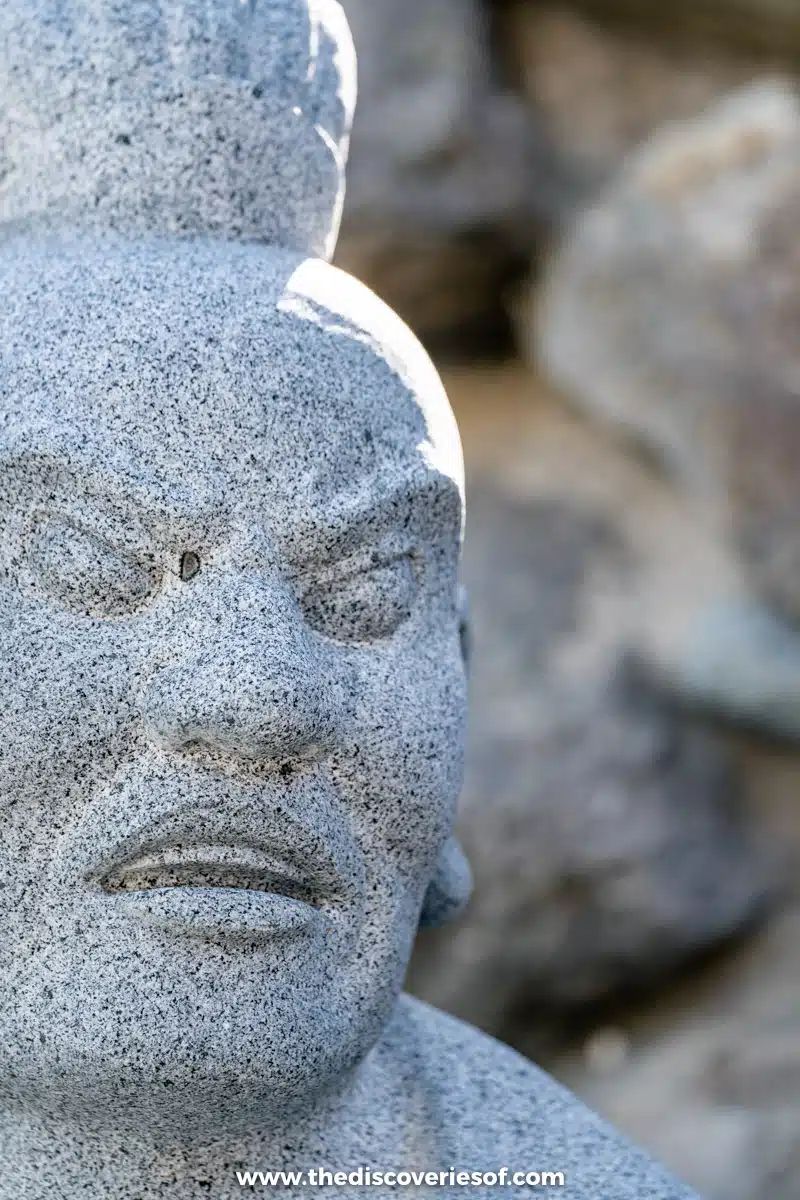
The approach starts at the car park and the bus drop-off, along a short lane of stalls selling snacks and souvenirs. Where the temple grounds begin, a line of twelve stone figures stands guard: the zodiac generals, each with a human body and the head of one of the animals of the Chinese zodiac. Visitors hunt out the animal of their birth year and pose with it for luck.

Close by, look out for the traffic safety pagoda, a tall, carved pagoda with an enormous tyre at its base, where drivers come to pray that they’ll stay out of accidents. It’s an unexpectedly modern touch at a place this steeped in ritual, and one of the quirkiest corners of the temple.
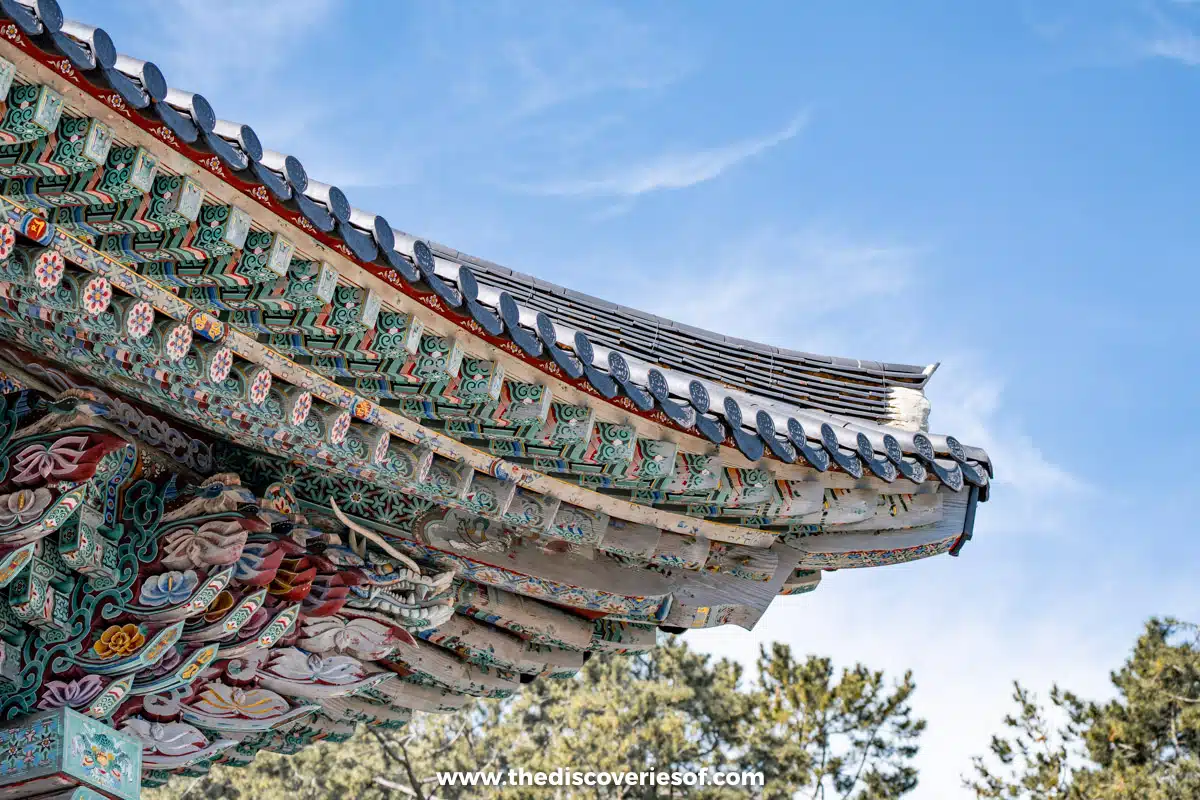
The gate itself is a riot of colour. Bright red, green and blue patterns cover every bracket under its tiled roof, a carved dragon winds around one of its pillars, and its signboard spells out the temple’s name in Chinese characters.
Count the 108 steps down to the sea
From the gate, a flight of 108 stone steps takes you down through the pine trees towards the water. The number isn’t random: in Buddhism, 108 stands for the earthly desires and worldly troubles that keep you from enlightenment, so each step is one more left behind.

All around the grounds, stone figures of monks and sages are clustered among the trees and rocks, each with its own expression, from serene to downright furious. They’re easy to walk past, and worth slowing down for.
At the bottom, the steps open out onto your first proper view of the temple: its halls and towers of piled stone stacked up on the rocks, with the sea beyond.

Top Tip
Every step you go down, you’ll climb again on the way out, plus a second staircase if you go up to the Gwaneum statue. Wear shoes with grip, carry water in summer, and save your energy for the return.
Cross the bridge and make a wish
Just before the bridge, a path to the left leads out onto the rocks, past a golden statue of Jijang, the bodhisattva who guides the dead. This is the classic view, looking back at the whole temple from the water’s edge. Stay on the marked path and off the lower rocks, which get slippery when the sea is up.
Before the main courtyard, a small stone arched bridge, Yongmungyo, spans a pond, and it’s tradition to toss a coin into the water below and make a wish as you cross. The temple’s own promise is that if you pray sincerely, at least one of your wishes will come true here, which explains why so many people come.
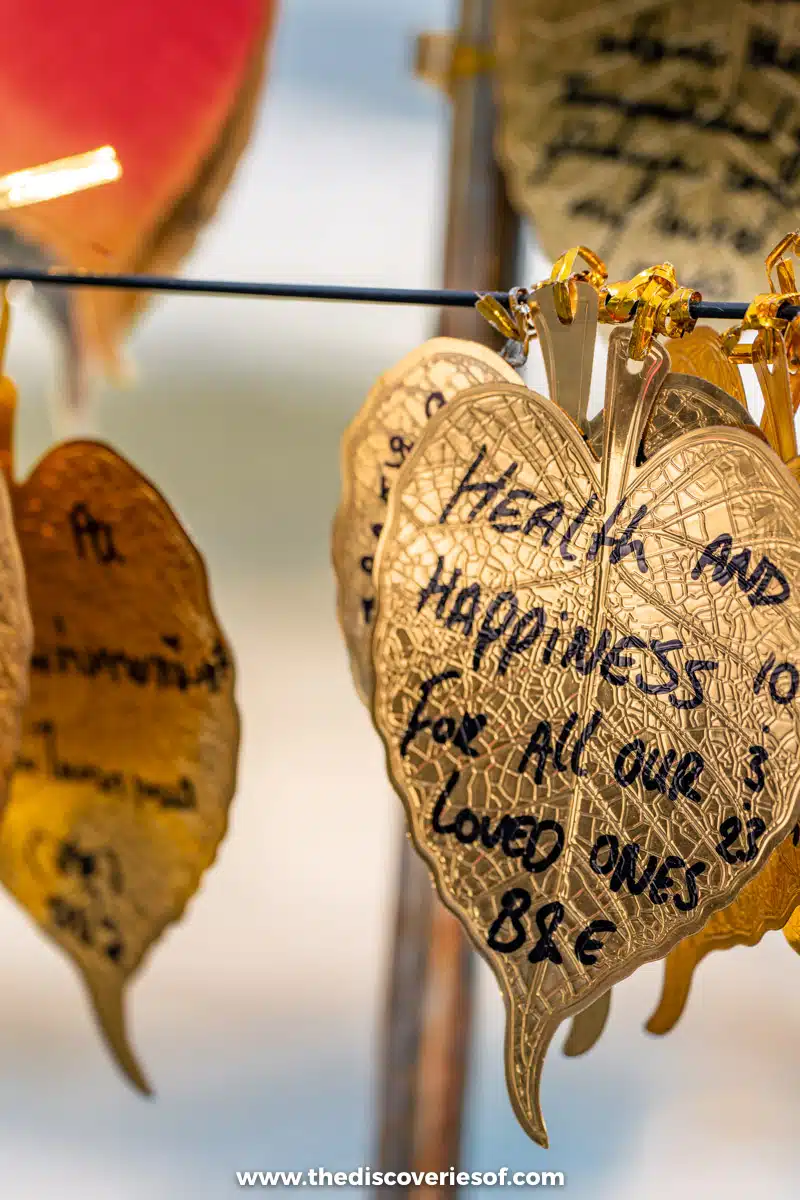
Wishes are everywhere once you start looking. Strings of golden, leaf-shaped plaques hang around the grounds, each one written with a hope for health, love or exams, alongside rows of paper lanterns that carry the names of the families who sponsor them.
Step inside Daeungjeon, the main hall
Daeungjeon, the main hall, is the heart of the complex. It stands on a terrace above the waves and holds a seated Shakyamuni Buddha, and in front of it is a three-storey stone pagoda supported by four stone lions.
Look up as you approach. The eaves are painted in dancheong, the dense, brightly coloured patterns that protect and decorate the wood of Korean temples and palaces, and carved dragons push their heads out from among the beams, horns, whiskers and all. It’s a fitting emblem for a temple named after a dragon’s palace.

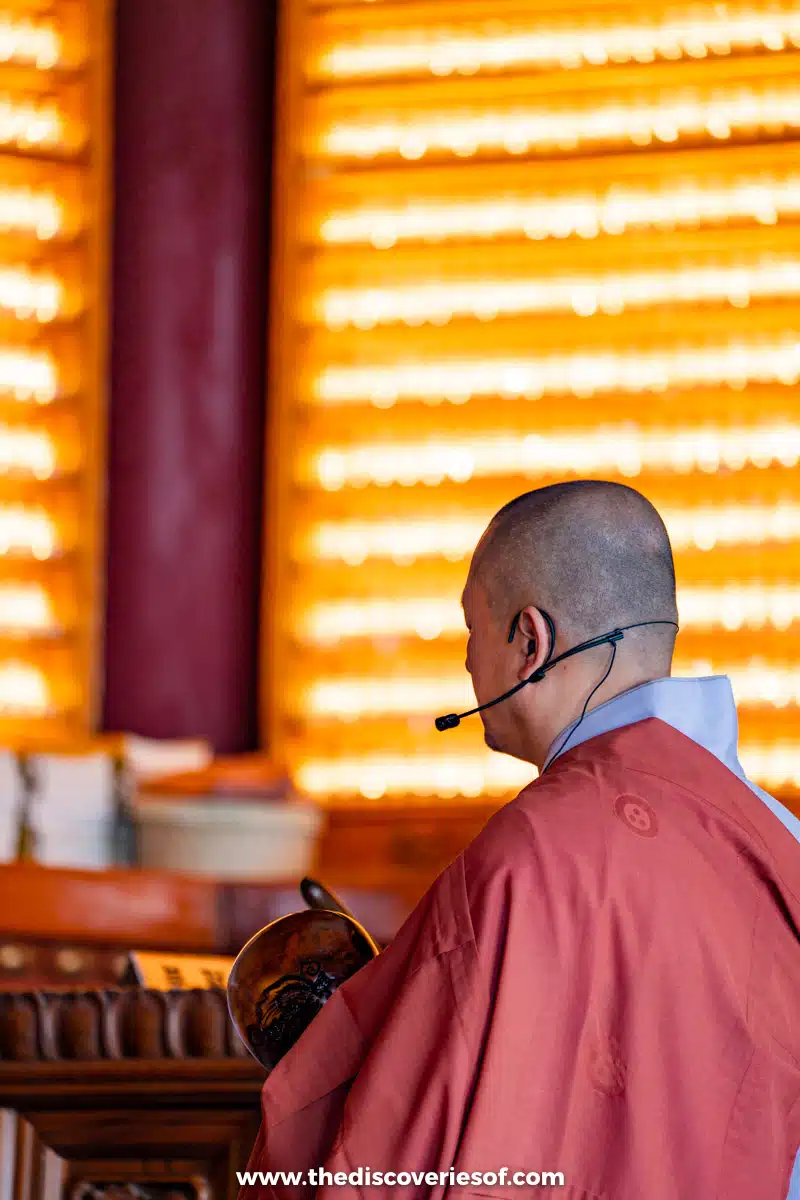
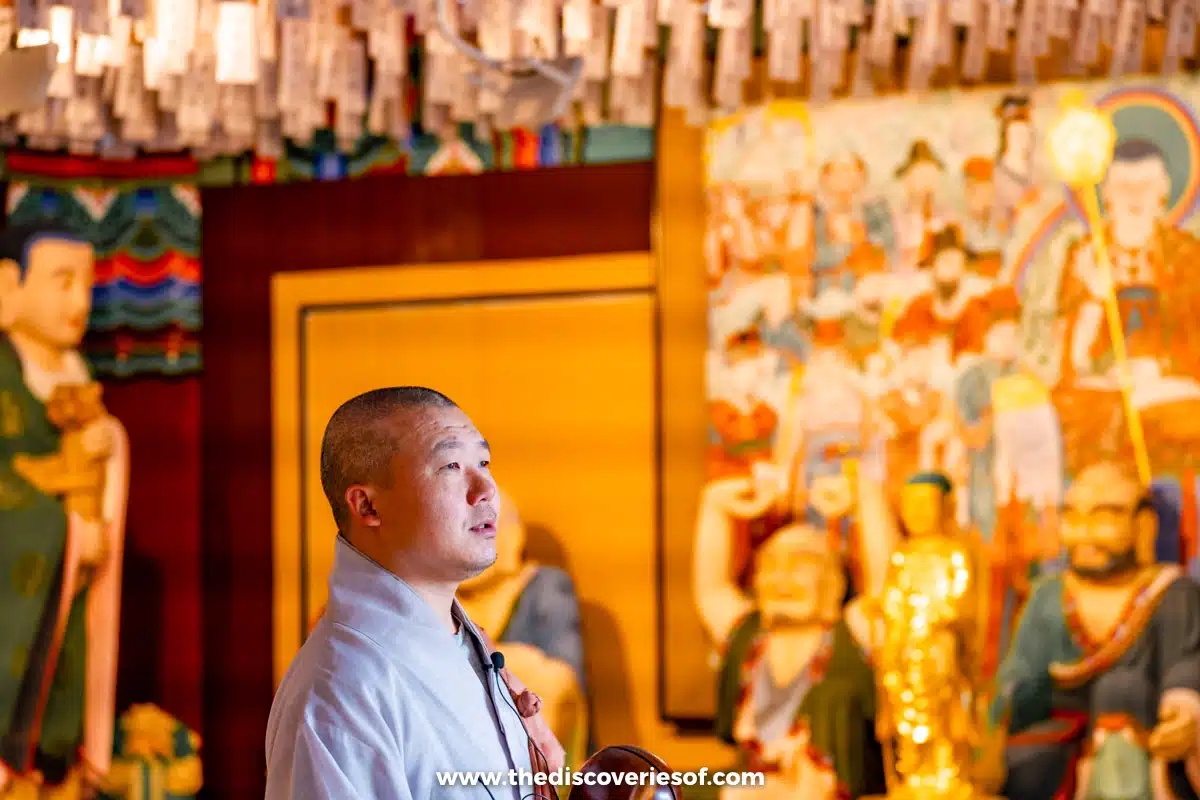
When I visited, prayers were under way inside the halls. One monk chanted while he struck a moktak, the hollow wooden fish used to keep the rhythm, and another bowed low before the altar, against a wall of tiny glowing lights. If a service is on, stay at the back, keep your voice down and don’t photograph the people praying up close.
To the left of the main hall, a shrine to the Dragon King of the sea, Yongwangdang, nods to the temple’s origin story. There’s also a cave shrine, where a stone Maitreya Buddha known as Deungnambul sits in candlelight. It’s especially popular with couples praying for a child, and visitors rub its nose and belly for luck.
Rub the golden pigs for luck
Behind the main hall, a round-bellied statue of Podae Hwasang, the laughing monk better known in the West as the laughing Buddha, keeps company with a pair of shiny golden pigs. In Korea, pigs are a symbol of wealth and good fortune, and the gold on these has been polished bright by the hands of everyone who stops to give them a rub.
Climb up to the Gwaneum statue for the view
The temple’s highest point belongs to Haesu Gwaneum Daebul, a large stone statue of Gwaneum looking out over the sea. A second staircase beside the main hall takes you up, and the reward is the best view of the whole complex, its roofs layered against the rocks, with the coastline curving away on either side.
Time your visit for sunrise or the lanterns
For sunrise, come at opening time. The temple faces east across the open sea, so few spots on this coast catch the sunrise as well, and the early start also gets you there long before the tour buses. Go before breakfast and you’ll have the steps almost to yourself. The first sunrise of the year, on 1 January, draws a big crowd, so expect company then.
Otherwise, weekday mornings are calmest; weekends and the middle of the day are busiest. The temple is at its most colourful in the weeks before Buddha’s Birthday, when thousands of paper lanterns are strung across the grounds. In 2027 it falls on 13 May.
Autumn, when I went, is a lovely time too, with clear blue skies that make the painted roofs glow.
Getting to Haedong Yonggungsa Temple
- By bus from Haeundae: from Haeundae station (line 2), go up exit 7 and take bus 181, 1001 or 100 to the Yonggungsa stop. The ride takes about 25 to 30 minutes, and buses come every 10 to 20 minutes depending on the route. From the stop, it’s about a 12-minute walk, following the crowds.
- By train and bus: take the Donghae line to Osiria station, then bus 139 or 1001 from exit 1 for a few minutes to the Yonggungsa stop and walk from there. A taxi from outside Osiria station takes about six minutes.
- By taxi: from Haeundae it’s about 20 minutes and roughly 15,000 won, depending on traffic. Taxis usually wait at the temple entrance for the trip back, or call one with the Kakao T app.
Getting There
For a more scenic way back, hop in a taxi or on a bus to Songjeong, about ten minutes away, and pick up the Haeundae Blue Line Park beach train and sky capsules along the coast to Mipo. My 3 days in Busan itinerary pairs the two on the same day.
Map
Read next
- 20 things to do in Busan, from a glass-floored cable car to blowfish cooked two ways
- How to spend 3 days in Busan, from cliffside temples to blowfish for brunch
- The UN Memorial Cemetery in Busan, from the daily flag ceremony to 40,896 names in stone
- How to spend 10 days in South Korea, from Seoul’s palaces to live octopus in Busan
Love this? Save and share on Pinterest

Discover the top things to do, insider tips and hidden gems in our South Korea Travel Guide.
Read the guides →