
Valencia Cathedral has three doors in three styles, a bell tower the whole city steers by and a chapel holding a cup that tradition says Christ drank from at the Last Supper. Here’s what to see inside, what the tickets cover and how to fit in the Micalet and the Thursday water court.
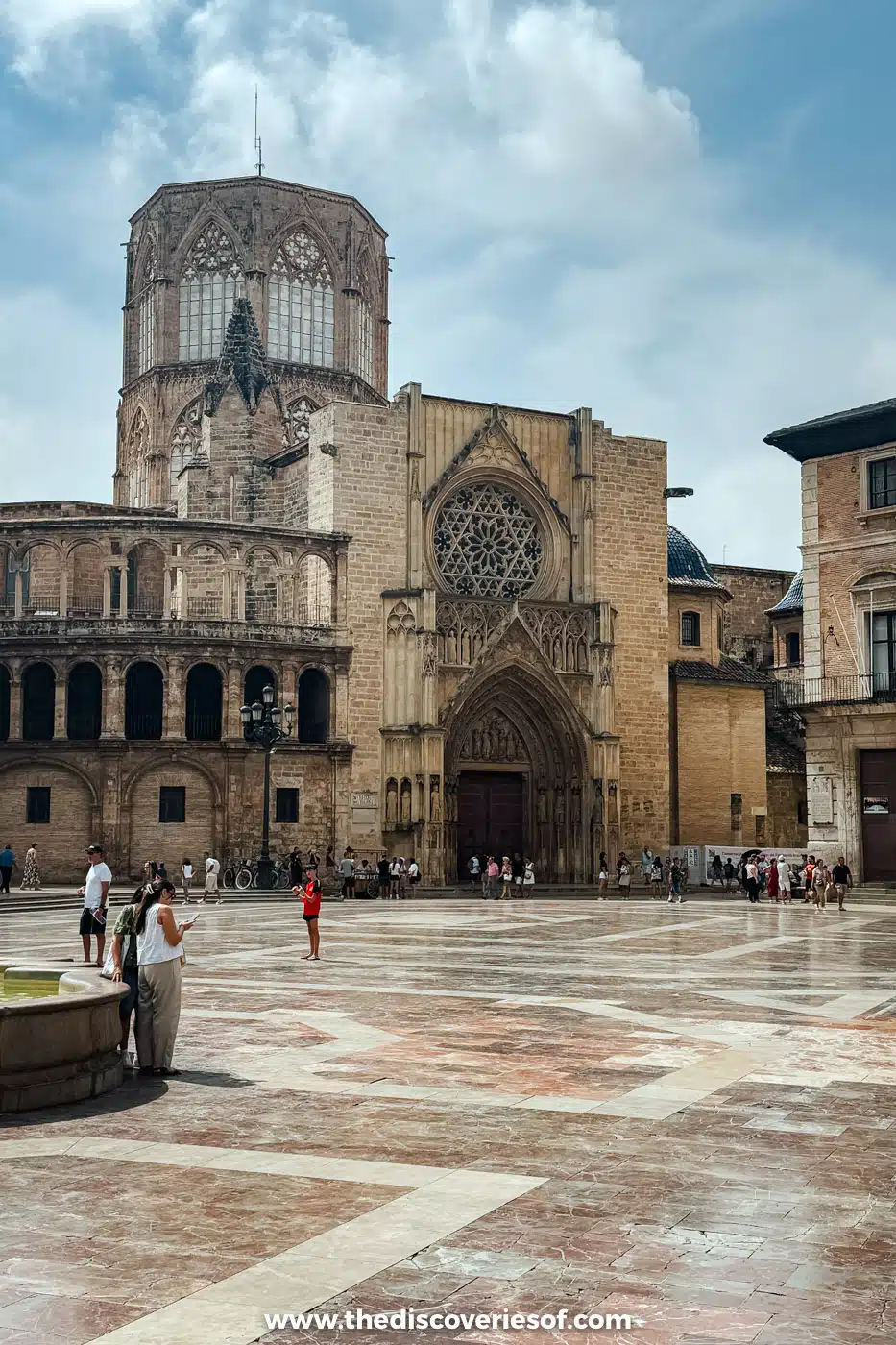
Valencia Cathedral sits right at the heart of the old town, between the city’s two grandest squares. It’s not the biggest cathedral in Spain, or the most famous, but it’s one of the most layered: a Gothic church built over a mosque, which itself stood on a Roman temple, with Romanesque, Gothic and Baroque doorways, an Italian Renaissance ceiling hidden for centuries and, in a side chapel, a cup that has been venerated as the Holy Grail since the Middle Ages.
I came on my third morning in Valencia, walking up through the old town from Plaza del Patriarca. I crossed Plaza de la Reina under the Micalet, stepped inside to see the long Gothic nave and its golden high altar, then came back out round the Apostles’ Door to Plaza de la Virgen, which is the prettiest corner of the whole city.
This guide covers the cathedral’s history, what to see inside, the Holy Chalice, the Micalet bell tower, the squares and the water court outside, and the tickets and opening hours you need to plan your visit.
Valencia Cathedral at a glance
- Where: Plaza de la Reina, in the old town, about 10 minutes’ walk from Plaza del Ayuntamiento.
- Cost: €12, or €6 reduced, including an audio guide, the Chapel of the Holy Chalice and the cathedral museum. The Micalet tower is €3 extra.
- Opening hours: Monday to Friday 10.30am to 6.30pm, Saturday 10.30am to 5.30pm and Sunday 2pm to 5.30pm, a little later at weekends in summer.
- Time needed: about an hour and a half for the cathedral and museum, plus half an hour for the Micalet.
- Don’t miss: the Holy Chalice, the angel frescoes above the high altar and the view from the top of the Micalet.
A mosque, a Roman temple and three doors in three styles
Work began on the cathedral in 1262, a couple of decades after James I of Aragon took Valencia from the Moors, on the site of the city’s main mosque. Before that, the same spot held a Visigothic church and, before that, a Roman temple, so this has been Valencia’s sacred centre for around 2,000 years.
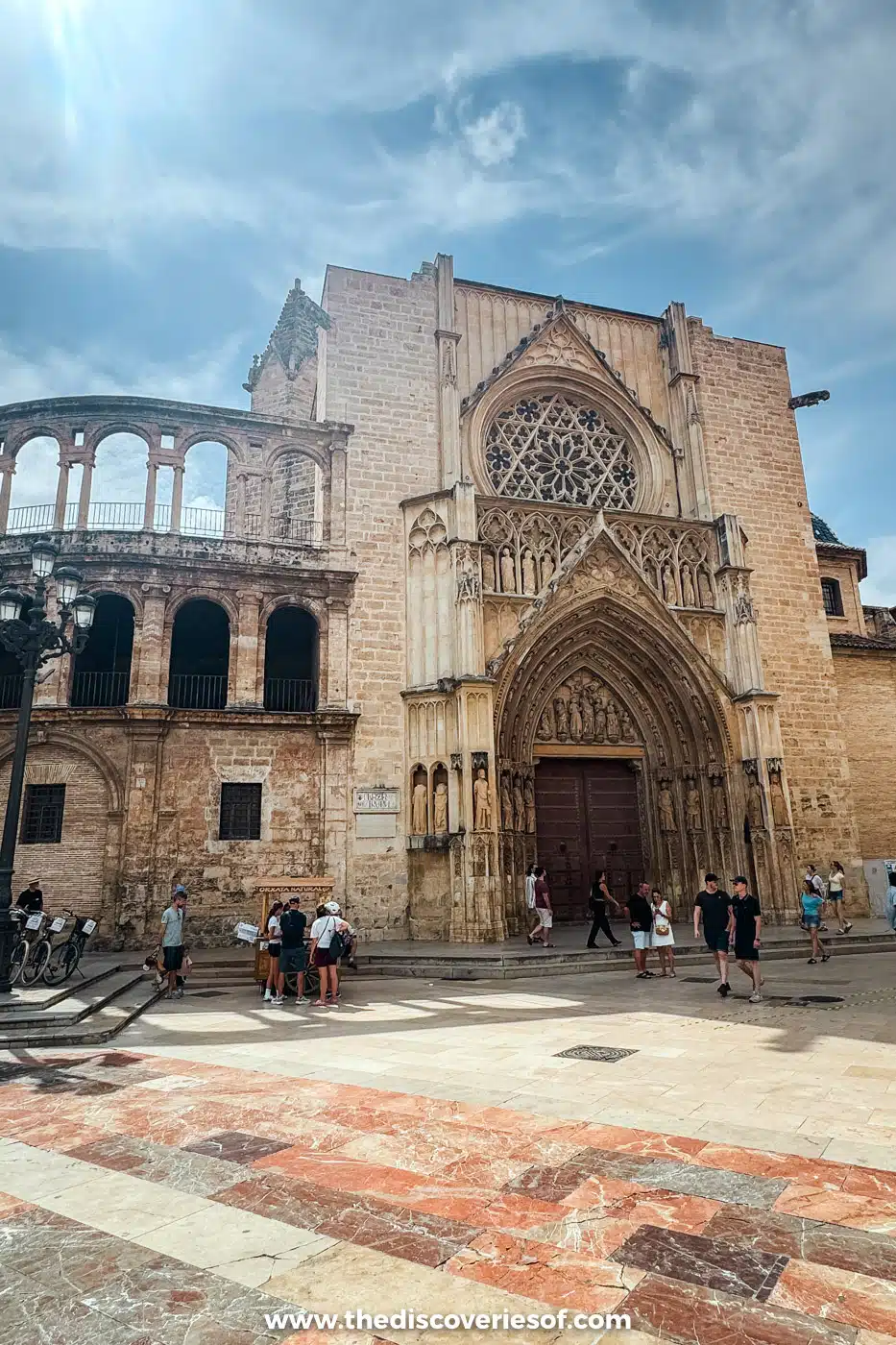
Building carried on for centuries, which is why the outside looks so different depending on where you stand. Walk round it and you’ll pass three doors in three styles:
- The Puerta del Palau (Almoina door): the oldest, Romanesque, on the eastern side facing the archbishop’s palace.
- The Puerta de los Apóstoles: Gothic, with a rose window and rows of carved apostles, facing Plaza de la Virgen.
- The Puerta de los Hierros: the grand Baroque main entrance on Plaza de la Reina, beside the Micalet, where you go in for a visit.
What to see inside Valencia Cathedral
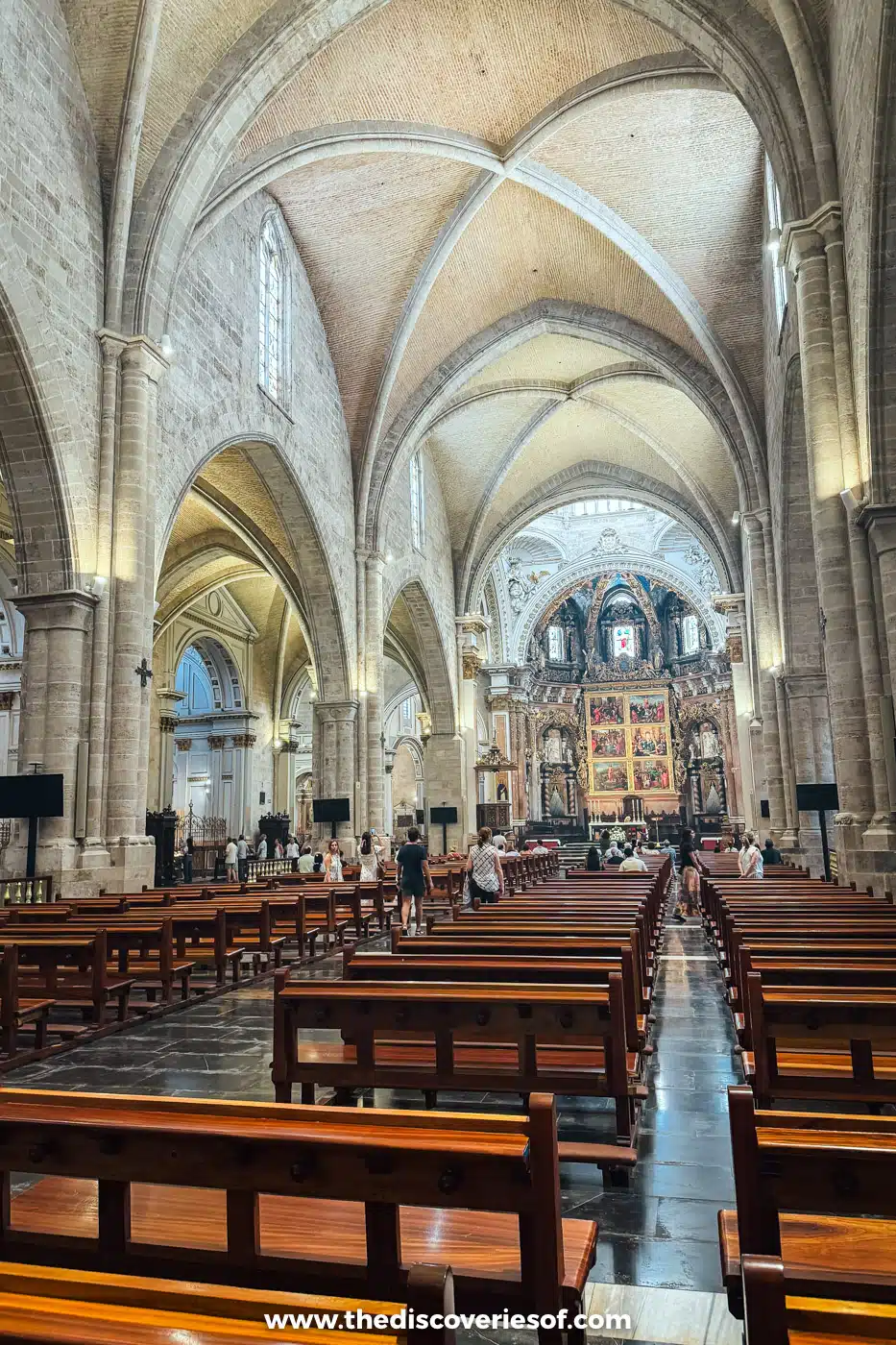
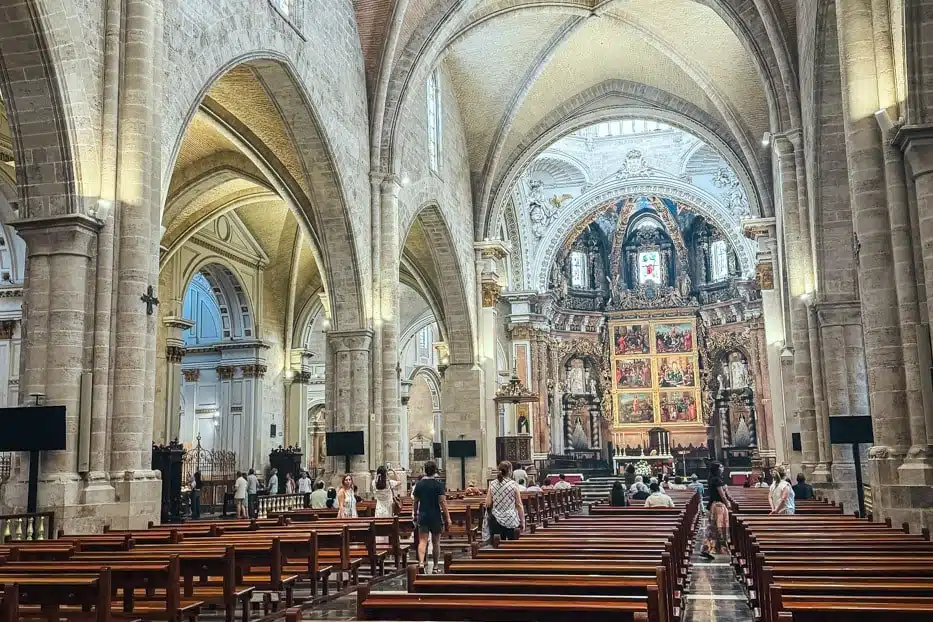
Inside, the long Gothic nave draws you straight down to the high altar, and it’s worth taking your time. The audio guide included in the ticket takes you round the chapels in order, and these are the highlights.
The Chapel of the Holy Chalice
The cathedral’s most famous treasure is in the old chapter house, a square Gothic room with a starred vault just to the right of the main entrance. Behind the altar, framed by a carved alabaster screen, is the Santo Cáliz: a small cup of dark red agate on a gold base set with pearls and gems.
Tradition holds that this is the cup Christ used at the Last Supper, carried to Rome by Saint Peter, sent to Spain in the third century and kept in monasteries in Aragon before King Martin the Humane took it in 1399. It came to Valencia Cathedral in 1437 and has been in this chapel since 1916. An archaeologist who studied it in 1960 dated the agate bowl to between 100 and 50 BC, and both John Paul II and Benedict XVI used it when they said Mass in Valencia. Whether or not you believe it’s the Grail, it’s an extraordinary object to stand in front of.
The high altar and its hidden angels
Look up above the high altar at the painted vault. In 2004, restorers working behind the Baroque ceiling found a set of Renaissance frescoes that had been hidden for centuries: angels playing musical instruments against a starry blue sky, painted in the 1470s by the Italian artists Paolo da San Leocadio and Francesco Pagano. They’re among the earliest Italian Renaissance paintings in Spain.
Goya and the cathedral museum
In the chapel of Saint Francis Borgia, look for two paintings by Goya showing scenes from the saint’s life. The cathedral museum, included in your ticket, holds more art and silverware from the cathedral’s treasury, along with paintings by Maella.
Tickets
Entry is €12, or €6 for pensioners, students, the unemployed, people with a disability and children aged 8 to 17. The price includes the audio guide, the Chapel of the Holy Chalice and the museum. The Valencia Tourist Card takes 20% off with the 24, 48 or 72-hour card and covers entry completely with the 7-day card.
Climb the Micalet for the best view in Valencia
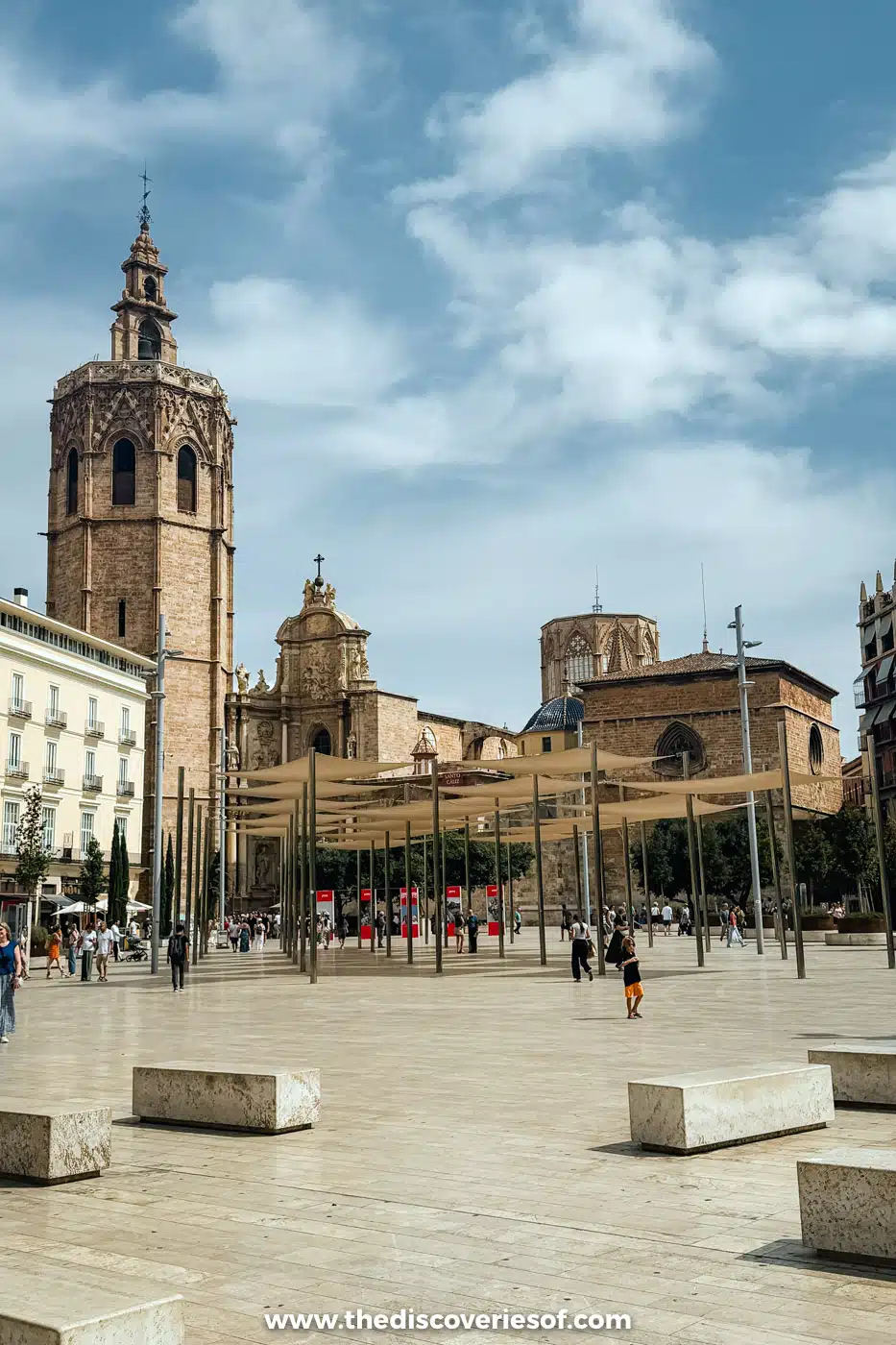
The cathedral’s octagonal bell tower, the Micalet (Miguelete in Spanish), was built between 1381 and 1424 and stands 50.85 metres tall. It’s named after its biggest bell, the Micalet, which was cast in 1539 and still rings the hours.
Getting to the top means 207 steps up a narrow, tightly winding spiral staircase, with no lift. It’s worth it: from the terrace you can see the whole of the old town, the domes and blue tiles of its churches, the Turia gardens and, on a clear day, the sea.
Tickets
The Micalet costs €3, or €2 reduced, and is free for children under 8. Buy tickets at the foot of the tower. It’s open from 10am to 6.45pm every day from March to November, and on weekdays only from December to February, with last entry half an hour before closing.
Plaza de la Virgen and the Water Tribunal
The cathedral’s north side opens onto Plaza de la Virgen, a long, marble-paved square that’s been the city’s main meeting place since Roman times, when the forum stood here. In the middle is the Turia fountain, with a reclining figure of Neptune representing the river surrounded by eight women who stand for its irrigation channels.
Opposite the cathedral is the Basilica of the Virgen de los Desamparados, the city’s patron saint, built in the 17th century and linked to the cathedral by an arched walkway. It’s free to go in, and it’s often busy with locals stopping by to pray.
Come on a Thursday just before noon and you’ll see one of Europe’s oldest courts in session. Outside the Apostles’ Door, eight farmers in black smocks sit in a semicircle as the Tribunal de las Aguas, the Water Tribunal, and settle disputes over irrigation water from the canals of the huerta, the farmland around Valencia. Proceedings are spoken in Valencian, rulings are given on the spot and nothing is written down. UNESCO added it to its list of Intangible Cultural Heritage in 2009.
Top Tip
Just behind the cathedral, L’Almoina archaeological centre shows the layers under this part of the city: Roman baths and streets, the Visigothic church and the Islamic buildings that came after, seen from above through a shallow glass-roofed pool in the square.
Opening hours
- Monday to Friday: 10.30am to 6.30pm (last entry 5.30pm)
- Saturday: 10.30am to 5.30pm (last entry 4.30pm)
- Sunday and public holidays: 2pm to 5.30pm (last entry 4.30pm)
- July to September: Saturday and Sunday visits run until 6.30pm.
- Closed to visitors: 1 and 6 January, 19 March, Palm Sunday, Good Friday, 9 October, 8 December and 25 December.
Outside these hours the cathedral is open for services, when you can go in to pray but not to look around.
Tips for your visit
- Go at opening time: the cathedral is quietest at 10.30am, before the tour groups arrive, and you can climb the Micalet before the heat builds in summer.
- Cover up: this is a working church, so cover your shoulders and avoid very short shorts.
- Do the Micalet separately: the tower has its own entrance and ticket, so from March to November you can climb it even when the cathedral is closed to visitors, including on Sunday mornings.
- Plan around Thursday noon: if you’re in town on a Thursday, time your visit to finish at Plaza de la Virgen for the Water Tribunal.
- Combine it with the old town: the Lonja de la Seda, the Mercado Central and the Torres de Serranos are all within a 10-minute walk, so it slots easily into a morning of sightseeing.
For more of the old town, and the rest of the city, see my guide to the best things to do in Valencia, or follow my 3 days in Valencia itinerary.
Map
Read next
- 23 things to do in Valencia
- 3 days in Valencia: the perfect Valencia itinerary
- A guide to the City of Arts and Sciences
- 50 famous landmarks in Spain
- 27 brilliant things to do in Spain
- My Spain travel guide
Love this? Save and share on Pinterest
Discover the top things to do, insider tips and hidden gems in our Spain Travel Guide.
Read the guides →