


Wild ponies on the heath, giant redwoods, a Tudor castle at the end of a shingle spit and a whole village built for Nelson’s navy: these are the best things to do in the New Forest, with prices, opening times and the tips that make a visit easier.
The New Forest is one of my favourite destinations in the UK, and one of the most surprising corners of southern England. Despite the name, much of it isn’t forest at all: it’s a patchwork of open heathland, ancient woodland, bogs, streams and salt marsh that runs right down to the Solent coast, with the Isle of Wight on the horizon.
William the Conqueror claimed it as a royal hunting ground in 1079, and nearly a thousand years later it still runs on medieval rules. Local commoners have the right to turn their ponies, donkeys, cattle and, in autumn, pigs out to graze, which is why you’ll share the lanes with animals that wander wherever they please. Since 2005 it has been a National Park, covering about 566 square kilometres (219 square miles) of Hampshire and a sliver of Wiltshire.
It’s also easy to reach. Trains from London Waterloo take about an hour and a half to Brockenhurst, in the middle of the forest, and stations at Ashurst, Beaulieu Road, Sway and Lymington put most of the sights below within a short bus ride, cycle or walk. By car, the M27 and A31 run along its northern edge.
But there’s so much more to explore in the New Forest than just its animals. This is an area that’s ripe for exploration, and here are my top picks: the classics (the ponies, Beaulieu, Exbury, Buckler’s Hard) alongside castles on the coast, quiet villages and the walks and rides that show off the landscape, with everything checked for this season.
The best things to do in the New Forest
Meet the ponies, donkeys and cattle that roam the open forest

I know, England has a lot of woodland. But this is a very, very special woodland, and the biggest attraction in the New Forest is the landscape itself. Drive or cycle across the open heath around Beaulieu Road, Fritham or Bratley View and you’ll see why it has been protected for so long: rolling heather and gorse, lone Scots pines, ancient oak and beech woods, and wide skies that feel a long way from the M27.

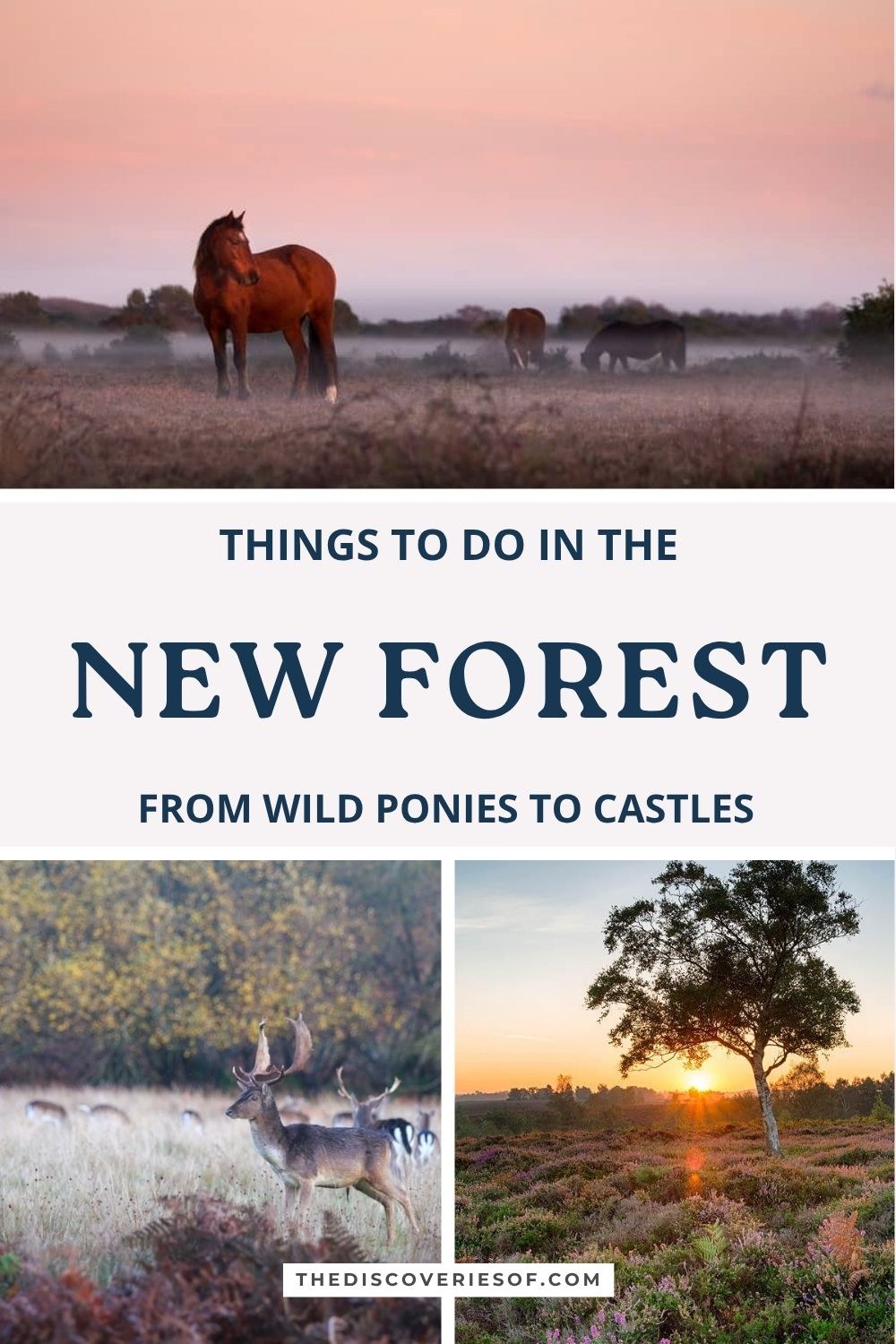
Then there are the animals. The famous New Forest ponies aren’t wild: each one belongs to a commoner, carries its owner’s brand and is checked by the Agisters, the forest’s livestock officers. You’ll also meet donkeys outside village shops, cattle lying in the road and, during the autumn pannage season, pigs hoovering up acorns that would otherwise poison the ponies.
Deer, hedgehogs, owls: oh my. The New Forest definitely has the best of our British native species. The same woods hide five species of deer, along with owls, badgers and rare birds such as the Dartford warbler and, in summer, the nightjar.
Top Tip
Look but don’t touch. Feeding or petting the ponies makes them loiter by roads and car parks, where they get hit by cars and can bite or kick. Most unfenced roads have a 40mph limit for the same reason: slow right down, especially at dusk.
Walk among giant redwoods on the Tall Trees Trail
Some of the tallest trees in the forest stand along the Rhinefield Ornamental Drive, a road lined with firs planted in the 1850s. From Blackwater car park, the Tall Trees Trail is a level 1.4-mile (2.3 km) loop on a smooth gravel path through the conifers, passing two enormous redwoods that dwarf everything around them. It’s suitable for wheelchairs and pushchairs, with frequent places to rest.
Across the A35, a short path from Knightwood Oak car park leads to the Knightwood Oak, a vast pollarded tree known as the Queen of the Forest and thought to be several centuries old. Combine the two with a drive along the Ornamental Drive itself, which is at its best in late spring when the rhododendrons are out and in autumn when the leaves turn.
Look for fallow deer at Bolderwood

While we’re on the topic of British wildlife, Bolderwood, west of Lyndhurst, is one of the best places in the forest to see fallow deer, which graze in the clearings around the car park and the Bolderwood Arboretum Ornamental Drive. Older guides mention a deer sanctuary where a keeper fed the herd every summer afternoon: that has gone, and Forestry England now says there is no sanctuary or feeding station at the site.
The deer are still here, though. Arrive early in the morning or towards dusk, walk quietly along the waymarked trails through the arboretum and its giant Douglas firs (some dating back to 1860), and scan the edges of the clearings. The car park has toilets and a picnic area; parking costs £1.50 for an hour up to £8 for more than four hours, paid by card or the RingGo app (no cash).
Cycle the gravel tracks around Brockenhurst
The New Forest is one of the best places in southern England for an easy bike ride. Forestry England looks after more than 100 miles of waymarked, family-friendly cycle routes, much of it on gravel tracks away from traffic, through inclosures of oak, beech and pine.
The Rhinefield Ornamental Woodland ride is a good place to start. It begins in Brockenhurst, a few minutes from the railway station, and follows quiet gravel tracks into the woods around the Rhinefield Ornamental Drive, so you can arrive by train, hire a bike in the village and be among the trees within minutes. It’s an easy ride, and you can do it in an hour or turn it into a few hours with picnic stops.
Top Tip
Stick to the waymarked cycle routes. Cycling off them, on footpaths or across the open heath, isn’t allowed, and you’ll need to give way to ponies and walkers.
Explore the National Motor Museum and Palace House at Beaulieu
If you prefer horsepower to horses, head to Beaulieu (pronounced “bew-lee”), home of the National Motor Museum. It began in 1952, when Edward, 3rd Baron Montagu of Beaulieu, opened his family home to the public and displayed five veteran cars in the entrance hall as a tribute to his father, John, a motoring pioneer who campaigned for drivers in Parliament.
Today the collection runs to more than 280 vehicles, from pioneering veteran cars to land speed record breakers, rally cars and film and television cars. One ticket also covers Palace House, the Montagu family home; the ruins of Beaulieu Abbey, founded for Cistercian monks in 1204; the Secret Army exhibition on the Special Operations Executive agents who trained on the estate during the Second World War; the gardens; and unlimited rides on the monorail that loops above the site.
Temporary exhibitions have included a pretty awesome display of James Bond cars (‘cos we all know the cars were the best bit of the movies).
It’s one of the best rainy-day options in the forest, and you’ll need most of a day to see everything.
Tickets
Beaulieu is open daily from 10am (except Christmas Day). Adults pay £31.50 on the day or £28.35 online, children aged 4 to 16 £18.50 or £16.65 online. Book ahead to save, and ask about returning free within six days.
Follow the Beaulieu River to Buckler’s Hard

The riverside walk from Beaulieu village to Buckler’s Hard is one of the prettiest easy walks in the forest. It’s about 2 miles (3 km) each way on flat, waymarked paths (good enough for a bike too), following the Beaulieu River through woodland and past salt marsh.
Starting from the car park in Beaulieu village, you pass views over the reed beds and the river before reaching the Georgian cottages of Buckler’s Hard. Keep an eye out for herons, egrets and, if you’re lucky, a kingfisher, and look out for the boardwalks and bird hides along the way.
Walk back the same way, or make a day of it with the longer 9.5-mile circular route via the Solent Way and East Boldre.
Step back into Nelson’s navy at Buckler’s Hard
An 18th-century shipbuilding village might sound niche, but Buckler’s Hard is one of the most atmospheric places in the forest. It began as Montagu Town, a planned port built by the 2nd Duke of Montagu, and became a shipyard instead. Master shipwright Henry Adams, sent from Deptford by the Admiralty in 1744, supervised the building of 43 Royal Navy ships here over about sixty years, including HMS Agamemnon, Euryalus and Swiftsure, all of which fought at Trafalgar in 1805.
Two rows of brick cottages slope down to the river, and the village is free to wander. Look inside the Shipwright’s Cottage, St Mary’s Chapel and the Agamemnon exhibition in the Shipwright’s Workshop, then pay for the museum, whose reconstructed cottages show how the shipbuilders and their families lived. During the Second World War, the river filled with landing craft preparing for D-Day.
There’s a café, and The Master Builder’s House hotel has a terrace on the river, perfect for afternoon tea in the New Forest.
Tickets
The village is free to enter (parking is charged). Museum: adults £6.25, children aged 4 to 16 £4.45. A 30-minute river cruise runs from late March to late September (adults £8.50, children £6.50), paid on board by card.
See the spring colours at Exbury Gardens

Across the Beaulieu River from Buckler’s Hard, Exbury Gardens is a 200-acre woodland garden created by Lionel de Rothschild, who bought the estate in 1919. It’s still owned by the ultra-wealthy Rothschild family. Luckily for us commoners, they keep it open for the public to enjoy, and in spring its world-famous collection of rhododendrons, azaleas and camellias is an explosion of colour. Autumn brings fiery maples and, in October, the annual nerine exhibition.
Several marked paths lead through the woods, around the ponds and down to the river, and the narrow-gauge steam railway that loops through the garden is a hit with children. During the Second World War, Exbury House was requisitioned by the Royal Navy as a base for training landing-craft crews ahead of D-Day.
Tickets
Open daily from spring until 31 October, 10am to 5.30pm (last entry 4.30pm). Autumn prices, booked online: adults £14.50, children aged 3 to 15 £6.50, family £39.90; the steam train costs extra.
Wander around Lymington’s quay and Saturday market
The forest’s main coastal town is a handsome place of Georgian houses, cobbled Quay Hill and a harbour full of yachts. Its Saturday charter market, which has filled the High Street since the 13th century, sells local produce, crafts and clothes, and the St Barbe Museum and Art Gallery covers the town’s maritime past and the history of the forest.
From the Town Quay, Puffin Cruises run short trips: a 30-minute guided river tour with commentary on the Lymington River (daily from 1 April to 30 September) and a pirate-themed boat trip for children. For a longer walk, follow the Solent Way west along the sea wall through the Lymington and Keyhaven marshes nature reserve, one of the best birdwatching spots on the south coast. Ferries also leave Lymington for Yarmouth on the Isle of Wight, a crossing of about 40 minutes.
Walk the shingle spit to Hurst Castle

While Highcliffe might be the prettier castle, nothing beats the setting of Hurst Castle. Henry VIII built it in 1544 as one of his chain of artillery forts, at the end of Hurst Spit, a shingle bank that reaches out towards the Isle of Wight and guards the western entrance to the Solent.
Inside, you can climb to the first floor of the Tudor keep, where Charles I was probably held prisoner in 1648 during the Civil War, and explore the huge Victorian wings and gun batteries added later. Part of the 19th-century east wing collapsed in February 2021 after the sea undercut its foundations, and English Heritage is working on a major project to stabilise the castle.
Getting There
Walk the 2 miles along the shingle of Hurst Spit from Milford on Sea (hard going, but the views are superb), or take the ferry from Keyhaven, which runs in the main season. The castle is run by English Heritage and opens seasonally, so check dates before you go.
Try stand-up paddleboarding at Milford on Sea

The forest isn’t just about woodland trails. Its coastline, from the sheltered Keyhaven River to Lepe and the mouth of the Beaulieu River, is a lovely place to get out on the water, and stand-up paddleboarding is the easiest way to try it.
The New Forest Paddle Sport Company runs paddleboard and kayak sessions around Milford on Sea, a pretty village on the coast just west of Keyhaven. Beginners usually start on calm water in the Keyhaven area, where you can paddle past the salt marshes with views of Hurst Castle, and group boards make a good family outing (or a perfect way to have a family argument while far out from the coast).
I kid, I kid. After all, the scenery is gorgeous and the whole thing is very relaxing: arguments will be the last thing on your mind. It’s a good core workout, but with that scenery you won’t notice.
Tour the romantic halls of Highcliffe Castle

Pretty much all English castles are pretty fancy, but I’ve got to admit Highcliffe Castle is kind of what fairytale castle dreams are made of. Just over the border in Dorset, on the clifftop near Christchurch, it was built between 1831 and 1835 for Lord Stuart de Rothesay, a diplomat who had been ambassador to France. His architect, William Donthorne, worked in carved medieval stonework brought over from the Abbey of Jumièges and the Grande Maison des Andelys in Normandy, and stained glass from across Europe, some of it centuries old, can still be seen today.
The house was privately owned until 1950, then had spells as a children’s convalescent home and a Catholic seminary before fires left it a gutted shell. Christchurch Council bought it in 1977 and restored the exterior. I have to say I’m pretty glad they did: it really is a spectacular sight, and one of the best things to see in the New Forest. It’s now a Grade I listed visitor attraction with heritage rooms, exhibitions and a tearoom, with paths down to the beach.
Tickets
Open Sunday to Thursday, 10am to 4pm. Adults £10, children aged 5 to 15 £3.50, family £25; card payments only.
Explore the beaches and history of Hengistbury Head

Technically it’s just outside the forest, on the edge of Bournemouth, but Hengistbury Head is an easy and rewarding addition to your trip. The headland is a nature reserve and Site of Special Scientific Interest, with more than 500 plant species and 300 bird species recorded, and the views from the top stretch from the Isle of Wight to the Purbeck Hills.
It’s also an important archaeological site. Stone Age hunters camped here more than 12,000 years ago, and in the Iron Age it was a busy trading port; you can see a reconstructed roundhouse near the visitor centre.
It’s not just me who thinks so: the beach huts on Mudeford Sandbank below the head are some of the most sought-after in the country, and one went on the market for £575,000 in 2021. Now that’s London pricey. From Easter to October, a land train runs from the visitor centre to the sandbank, or you can walk it in about half an hour.
Learn the forest’s story at the New Forest Heritage Centre, Lyndhurst
The forest is so much more than a simple woodland. Between the commoners’ animals, the royal hunting laws and centuries of smuggling and shipbuilding, there’s an amazing backstory to this place, and to learn about it, I recommend a visit to the New Forest Heritage Centre in Lyndhurst.
This is no usual little village museum: it’s really well done, with a wealth of information. I especially loved learning about the New Forest pony sales (sadly, I decided my London flat was not the ideal home for a pony). The museum covers commoning, the forest’s ancient laws and the people who still keep them, and the history of the pony sales, alongside a gallery, a library and archive, a café and a gift shop. It’s a good stop on a wet day, and it opens daily (10am to 5pm from April to October, 10am to 4pm in winter).
While you’re in Lyndhurst, the forest’s unofficial capital, look for the grave of Alice Liddell (the inspiration for Alice’s Adventures in Wonderland), who lived nearby, in the churchyard of St Michael and All Angels.
Browse the shops of Burley, the forest’s witch village
Burley is one of the most charming villages in the forest, with ponies and cattle wandering the main street, tea rooms, gift shops and art galleries. In past centuries its closeness to the coast made it a well-known haunt of smugglers, and in the 1950s it was home to Sybil Leek, a self-proclaimed white witch whose reputation still draws visitors to its shops selling witchcraft gifts.
It makes a good base for walks and rides over the surrounding heath, and in summer you can join tractor-and-trailer deer safaris. A cider festival takes over the village each October.
Go horse riding through the forest

The New Forest is paradise for horse lovers. While spotting the ponies is a thrill, it’s even better to explore the forest on horseback, and for those of us who aren’t lucky enough to have a trusty pony in the garden, there’s a great riding school that specialises in rides through the forest.
Burley Villa School of Riding, on Bashley Common Road near New Milton, runs beginner and novice lessons, forest trail rides and private lessons, with western riding available too. Younger children can try 30-minute pony trails on a lead rein, or a one-hour “brush and ride” session that includes grooming and tacking up (both for ages 4 to 14; the ten-year-old in me is loving that idea).
Top Tip
The minimum age for lessons is 4 and the maximum rider weight is 14 stone (90 kg). Book online, or call ahead for same-day rides.
Meet otters and wolves at the New Forest Wildlife Park
I might be a city kind of girl, but I’m certainly not immune to the charms of British wildlife. I mean, come on, how cute are otters? Most British wildlife is shy, so for a guaranteed close look, head to the New Forest Wildlife Park near Ashurst. It’s best known for its otters: it has the UK’s only breeding pair of smooth-coated otters and the largest collection of critically endangered giant otters anywhere.
Beyond the otters, look out for lynx, a wolverine, deer, wallabies and harvest mice, and wolves are returning to the park for the first time since its old pack died in 2024. I love the park not just for its adorable animals but also for its commitment to conservation, with the Hampshire and Isle of Wight Wildlife Trust among its partners. While I can’t guarantee you’ll see every animal, you’re pretty certain to come face to face with plenty of gorgeous British critters.
The park opens daily from 10am to 5.30pm; buy tickets online before you go.
Stand where a king was killed at the Rufus Stone
Near Minstead, just off the A31, a small iron-clad stone in a clearing marks one of the most famous mysteries in English history. On 2 August 1100, King William II, known as William Rufus and the son of William the Conqueror, was killed by an arrow while hunting here. The story goes that Sir Walter Tyrrell aimed at a stag, the arrow glanced off an oak and struck the king; whether it was an accident has been argued over ever since.
The first stone was put up in 1745 and replaced in 1841 by the one you see today. It sits next to a car park, so it’s an easy stop, and it pairs well with a walk through the woods around Minstead.
Take the kids to Paultons Park and Peppa Pig World
If you’re travelling with young children, Paultons Park at Ower, near Romsey, on the northern edge of the National Park, is the forest’s biggest family day out. It has more than 70 rides and attractions across 140 acres, from gentle rides for toddlers to roller coasters for older children, and it’s home to Peppa Pig World, the only Peppa Pig theme park in the UK, with nine themed rides and an indoor play zone.
Day tickets start at £46.75 per person (children under 1 metre go free), with seasonal events such as the Halloween Spooktacular (9 October to 2 November 2026). It’s just off junction 2 of the M27.
Join a ranger on a guided walk
There are plenty of do-it-yourself walks around the forest, but you’ll get even more from a guided one. The New Forest National Park Authority’s rangers and volunteers lead walks throughout the year, from dusk walks with bat detectors to tree identification, wildfire recovery and history walks, and the annual New Forest Walking Festival fills the autumn with dozens more.
Most walks need booking and some sell out, but prices are low (a ranger-led dusk walk has cost £5, with under-16s free). You’ll find the calendar on the National Park’s events page.
Tips for visiting
- Pay to park: Forestry England has charged for parking in its forest car parks since 20 April 2026, by card or the RingGo app (no cash); at Bolderwood, for example, it’s £1.50 for an hour and £8 for the day. Arriving by train to Brockenhurst and cycling avoids the charges altogether.
- Respect the animals and the forest: don’t feed or touch the ponies, drive slowly (most unfenced roads are 40mph), keep dogs under control near livestock, and leave the barbecue at home: barbecues and outdoor cooking equipment are banned across the forest.
- When to go: spring for Exbury’s rhododendrons and new foals, August for the heather, and autumn for pannage pigs, fungi and the walking festival. Summer weekends are busy, so visit popular spots early.
- If it rains: Beaulieu, the Heritage Centre, Buckler’s Hard museum and the New Forest Wildlife Park are the best wet-weather options.
- Camping: Camping New Forest runs ten campsites on Forestry England land; wild camping isn’t allowed.
Where to stay
Brockenhurst is the best base: it has the main railway station, a village full of pubs and cafés, and the forest on its doorstep, while Beaulieu, Lyndhurst, Burley and Lymington suit a quieter stay.
- Careys Manor Hotel (Brockenhurst): a country house hotel with a spa, a short walk from the station.
- The Montagu Arms (Beaulieu): a classic country inn in the heart of the village, within walking distance of the motor museum and the riverside path to Buckler’s Hard.
- Burley Manor (Burley): a Victorian manor house hotel in the middle of one of the prettiest villages in the forest.
Prefer your own space? The forest also suits a self-catering cottage: see Plum Guide’s New Forest homes, or browse all New Forest hotels.
Map
Read next
- Things to do in Dorset
- Stunning castles in England you have to visit
- Brilliant day trips from London
- The best things to do in England
- UK road trip ideas
- Unmissable things to do in Cornwall
- Epic UK bucket list destinations
Love this? Save and share on Pinterest

Discover the top things to do, insider tips and hidden gems in our United Kingdom (U.K.) Travel Guide.
Read the guides →






Great tips for the New Forest! Heading there tomorrow for a little horseback riding and wanted a few more things to do!l as a first time visitor. Thank you.
Hi Lori – total pleasure! Hope you had a brilliant time? How was the riding?